
Vox clamantis in deserto







Small colleges' existential crisis

From Robert Whitcomb’s “Digital Diary,’’ in GoLocal24.com
The number of small nonelite New England private colleges that are closing because of dwindling finances and enrollments continue to grow. The latest is Green Mountain College, in tiny Poultney, Vt., and the College of St. Joseph, in the small Vermont city of Rutland.
This is sad because some of these colleges have very usefully served to help educate those whose academic backgrounds and family issues may have blocked them from getting into richer and/or more prestigious institutions. But these closings can also be a heavy economic blow to the small towns and cities so many are situated.
Can online courses take the place of most of these little colleges? How important is in-person teaching? To me, very.
Eating from the same tree

Two taps in a maple tree, using plastic tubing for collecting sap to be boiled to make maple syrup.
“We’re taping trees my grandparents’ parents” tapped. We look at it like this: a corn farmer can eat corn from the same field his great-grandfather planted, but he can’t eat from the same stalk. But an old syrupin’ family eats from the same tree.’’
-- New England farmer Tom Hunter quoted in Blue Highways, by William Least Heat Moon
Jordan Rau: Trump cuts way back on fines for nursing homes
From Kaiser Health News
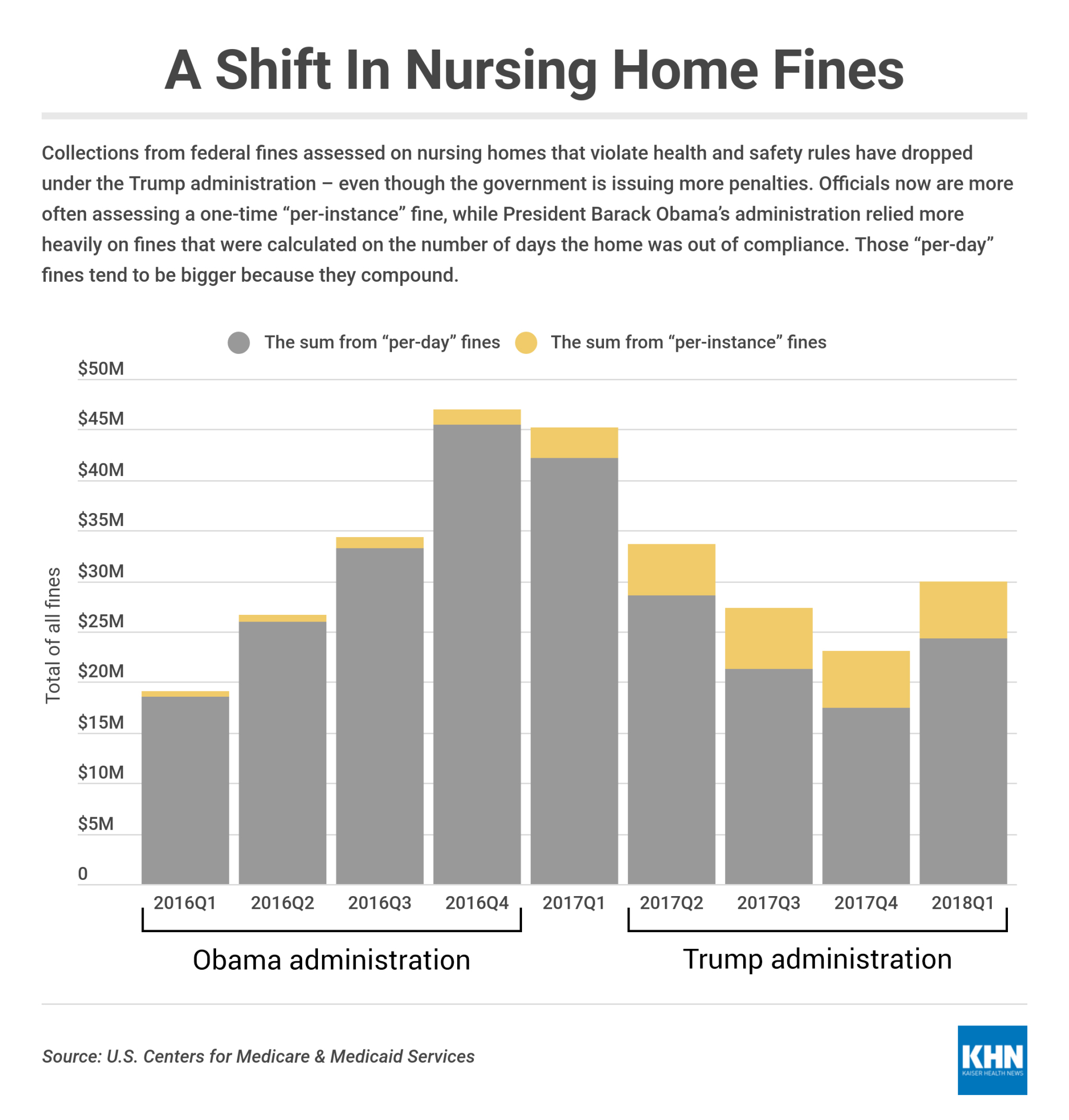
The Trump administration’s decision to alter the way it punishes nursing homes has resulted in lower fines against many facilities found to have endangered or injured residents.
The average fine dropped to $28,405 under the current administration, down from $41,260 in 2016, President Barack Obama’s final year in office, federal records show.
The decrease in fines is one of the starkest examples of how the Trump administration is rolling back Obama’s aggressive regulation of health care services in response to industry prodding.
Encouraged by the nursing home industry, the Trump administration switchedfrom fining nursing homes for each day they were out of compliance — as the Obama administration typically did — to issuing a single fine for two-thirds of infractions, the records show.
That reduces the penalties, giving nursing homes less incentive to fix faulty and dangerous practices before someone gets hurt.
“It’s not changing behavior [at nursing homes] in the way that we want,” said Dr. Ashish Jha, a professor at the Harvard T.H. Chan School of Public Health. “For a small nursing home it could be real money, but for bigger ones it’s more likely a rounding error.”
Since Trump took office, the administration has heeded multiple nursing home complaints about zealous oversight. It granted facilities an 18-month moratorium from being penalized for violating eight new health and safety rules. It also revoked an Obama-era rule barring homes from pre-emptively requiring residents to submit to arbitration to settle disputes rather than go to court.
The slide in fines occurred even as the Centers for Medicare & Medicaid Services issued financial penalties 28 percent more frequently than it did under Obama. That’s due to a policy begun near the end of Obama’s term that required regulators to punish a facility every time a resident was harmed, instead of leaving it to their discretion.
While that policy increased the number of smaller fines, larger fines became less common. The total amount collected under Trump fell by 10 percent compared with the total in Obama’s final year, from $127 million under Obama to $114 million under Trump. (KHN compared penalties during 2016, Obama’s last year in office, with penalties under Trump from April 2017 through March 2018, the most recent month for which federal officials say data is reliably complete.)
CMS said it has revised multiple rules governing fines under both administrations to make its punishments fairer, more consistent and better tailored to prod homes to improve care. “We are continuing to analyze the impact of these combined events to determine if other actions are necessary,” CMS said in a statement.
The move is broadly consistent with the Trump administration’s other industry-friendly policies in the health care sector. For instance, the administration has expanded the role of short-term insurance policies that don’t cover all types of services, given states more leeway to change their Medicaid programs and urged Congress to allow physicians to open their own hospitals.
Beth Martino, a spokeswoman for the American Health Care Association, a nursing home trade group, said the federal government has “returned to a method of applying fines in a way that incentivizes solving problems” rather than penalizing “facilities that are trying to do the right thing.”
Penalty guidelines were toughened in 2014, when the Obama administration instructed officials to favor daily fines. By 2016, those were used in two-thirds of cases. Those fines averaged $61,000.
When Trump took over, the nursing home industry complained that fines had spun “out of control” and become disproportionate to the deficiencies. “We have seen a dramatic increase in [fines] being retroactively issued and used as a punishment,” Mark Parkinson, president of the nursing home group, wrote in March 2017.
CMS agreed that daily fines sometimes resulted in punishments that were determined by the random timing of an inspection rather than the severity of the infraction. If inspectors visited a home in April, for instance, and discovered an improper practice had started in February, the accumulated daily fines would be twice as much as if the inspectors had come in March.
But switching to a preference for per-instance fines means much lower penalties, since fines are capped at $21,393 whether they are levied per instance or per day. Homes that pay without contesting the fine receive a 35 percent discount, meaning they currently pay at most $13,905.
Those maximums apply even to homes found to have committed the most serious level of violations, which are known as immediate jeopardy because the home’s practices place residents at imminent risk of harm. For instance, a Mississippi nursing home was fined $13,627 after it ran out of medications because it had been relying on a pharmacy 373 miles away, in Atlanta. CMS also reduced $54,600 in daily fines to a single fine of $20,965 for a New Mexico home where workers hadn’t been properly disinfecting equipment to prevent infectious diseases from spreading.
On average, per-instance fines under Trump were below $9,000, records show.
“These are multimillion businesses — $9,000 is nothing,” said Toby Edelman, a senior policy attorney at the Center for Medicare Advocacy, a nonprofit in Washington.
Big daily fines, averaging $68,080, are still issued when a home hasn’t corrected a violation after being cited. But even in those cases, CMS officials are allowed to make exceptions and issue a single fine if the home has no history of substantial violations.
The agency cautioned that comparisons of average fines is misleading because the overall number of inspections resulting in fines increased under Trump, from 3.5 percent in 2016 to 4.7 percent. The circumstances now warranting fines that weren’t issued before tend to draw penalties on the lower side.
However, KHN found that financial penalties for immediate jeopardies were issued in fewer cases under Trump. And when they were issued, the fines averaged 18 percent less than they did in 2016.
The frequency of immediate-jeopardy fines may further decrease. CMS told inspectors in June that they were no longer required to fine facilities unless immediate-jeopardy violations resulted in “serious injury, harm, impairment or death.” Regulators still must take some action, but that could be ordering the home to arrange training from an outside group or mandating specific changes to the way the home operates.
Barbara Gay, vice president of public policy communications at LeadingAge — an association of nonprofit organizations that provide elder services, including nursing homes — said that, under Trump, nursing homes “don’t feel they’ve been given a reprieve.”
But consumer advocates say penalties have reverted to levels too low to be effective. “Fines need to be large enough to change facility behavior,” said Robyn Grant, director of public policy and advocacy at the National Consumer Voice for Quality Long-Term Care, a nonprofit based in Washington. “When that’s not the case and the fine is inconsequential, care generally doesn’t improve.”
Jordan Rau: jrau@kff.org, @JordanRau
Destination bridge

What the new bridge will look like.
From Robert Whitcomb’s “Digital Diary,’’ in GoLocal24.com
The new pedestrian bridge to go over the Providence River, with its opening scheduled for later this year, is indeed expensive. GoLocal reports, for example, that the project is now estimated to cost $1,470 a square foot – 145 percent more, for example, than the estimated per-square-foot cost to replace the Henderson Bridge (aka “Red Bridge’’), linking Providence’s East Side and East Providence!
But the pedestrian bridge, in downtown Providence (“The Creative Capital’’?), will have aesthetic features (including custom-fabricated steel and a wooden (love it!) decking system) befitting its location (essentially on the campus of the Rhode Island School of Design, perhaps America’s most famous art school). It will not only be a pleasant way to travel between downtown and the East Side/College Hill/Fox Point; it will also be a destination point, where many people will linger on nice days. Sort of a mini-park. It should even lure some tourists (and their restaurant, etc., dollars) to the city. So special attention and added costs seem reasonable.
To read the GoLocal piece, please hit this link.
Reflect on this

‘‘Meditation #9’’ (oil on canvas), by Betsyann Duval, in her show “Time Out: Meditations and Relections,’’ at Bromfield Gallery, Boston, through March 31. Her photographs and paintings examine reflections in water as a place of refuge.

Todd McLeish: Threats remain to National Monument off the Northeast coast

From ecoRI News (ecori.org)
The Northeast Canyons and Seamounts Marine National Monument, the only national monument in the Atlantic Ocean, remains controversial more than two years after it was designated by President Obama in September 2016.
Fishermen brought suit to overturn the designation — the suit was dismissed last October, but it’s being appealed — President Trump has threatened to use his executive authority to revoke the designation, despite uncertainties as to whether he can legally do so, and the Interior Department has recommended that the Trump administration reopen the monument to commercial fishing.
Peter Auster, however, argued in a lecture at Providence’s Roger Williams Park Zoo on Feb. 28 that the 4,900-square-mile area about 150 miles off Cape Cod is deserving of protection because of its high species diversity, wide variety of habitats, and its numerous creatures that are sensitive to disturbance.
A senior research scientist at Connecticut’s Mystic Aquarium, Auster was a key player in building the scientific case for why the area should be designated a national monument. He has led multiple research projects to explore the area using submersible vessels, remotely operated vehicles, and autonomous vehicles, all of which have revealed an unusual array of marine life, from “Dr. Seussian species” of fish to dozens of kinds of deep-sea corals.
“A dive into the canyons and seamounts demonstrates the magic of the ocean,” he said. “There’s a whole garden of organisms that live there.”
About the size of Connecticut, the monument includes two distinct areas, one that covers three canyons and one that covers four seamounts. (NOAA)
The monument includes a portion of the edge of the continental shelf, where the seafloor drops sharply from a depth of about 600 feet down to 3,000, and where four extinct underwater volcanoes jut upward from the seafloor. The monument got its name from those underwater volcanoes — called seamounts — and a number of canyons carved into the shelf edge by ancient rivers.
“Those canyons and seamounts create varied ecotones in the deep ocean with wide depth ranges, a range of sediment types, steep gradients, complex topography, and currents that produce upwelling, which creates unique feeding opportunities for animals feeding in the water column,” Auster said.
Using colorful photographs of rarely seen creatures to illustrate his presentation, Auster called the area a “biodiversity hot spot,” noting that at least 73 species of deep-sea corals live in the area, including 24 that were found there for the first time during a research expedition in 2013. Many of those corals serve as hosts to other creatures — crabs, shrimp, and starfish, for instance — that are only found on those particular corals.
New England Aquarium researchers have found that the monument’s surface waters serve as feeding grounds for an abundance of whales, sea turtles, sharks, and seabirds, as well as fish that migrate from the deep water to the surface every day to feed.
In addition, Maine Audubon recently discovered that the monument area is where many of the region’s Atlantic puffins spend the winter. And researchers from the Northeast Fisheries Science Center, in Woods Hole, Mass., found that significant numbers of the extremely rare True’s beaked whale, one of the deepest diving marine mammals in the world, spends the summer in monument waters.
Despite these recent discoveries, scientists say there is still a great deal to be learned about the area.
“We don’t yet know everything we need to know to manage the monument,” Auster said.
At least 73 species of deep-sea corals live in the area, including bamboo coral. (NOAA)
On his scientific to-do list is an assessment of the biological diversity of the area and how it’s distributed in the monument; an assessment of ecological change over time; a better understanding of species interactions; and an assessment of how the region has recovered from natural and human-caused disturbances.
While the status of the monument remains in limbo, a number of additional threats may be lurking. So far, commercial fishing has only impacted the shallow areas of the monument on the continental shelf, but Auster said there are increasing efforts to fish in the deeper waters. In addition, the Trump administration is advocating for expanded oil and gas exploration in the waters off the East Coast, and the growing seabed mining industry may see the seamounts as potentially valuable sites for methane hydrate mining or manganese crust mining.
While Auster seems somewhat confident that the monument designation will hold, and he’s already working on making the case for a second marine national monument in the Atlantic — this one at Cashes Ledge in the middle of the Gulf of Maine — he acknowledged that there are influential political forces at work that could derail the monument designation.
“Like every monument, there are people who suggest that it isn’t a good thing to conserve examples of our natural heritage for future generations,” Auster said. “The end of this story remains to be written.”
Rhode Island resident and author Todd McLeish runs a wildlife blog.
'Immensely disappointing' at USC
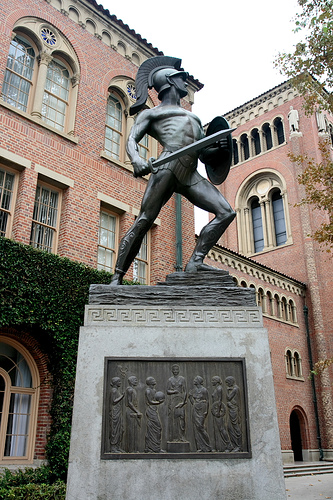
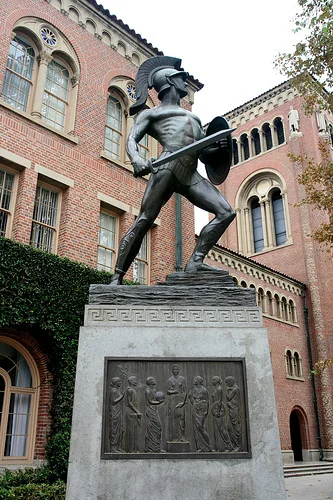
The unfortunately nicknamed “Tommy Trojan’’ statue on the campus of the University of Southern California.
On the college-admissions scandal, a letter from the president of the University of Southern California, in Los Angeles.
March 12, 2019
Dear USC Community,
I want to inform you of an ongoing wide-ranging criminal investigation involving universities nationwide, including USC. The government has made a public announcement and disseminated the charging documents. The federal government has alleged that USC is a victim in a scheme perpetrated against the university by a long-time Athletics Department employee, one current coach and three former coaching staff, who were allegedly involved in a college admissions scheme and have been charged by the government on multiple charges.
At this time, we have no reason to believe that Admissions employees or senior administrators were aware of the scheme or took part in any wrongdoing—and we believe the government concurs in that assessment. The government has repeatedly informed us that it views USC as a victim and that these employees purposefully deceived USC.
We have planned significant remedial efforts. We will take all appropriate employment actions. We will review admissions decisions. We are identifying all funds received that may be connected to the government’s allegations. And we will be implementing significant process and training enhancements to prevent anything like this from ever happening again.
It is immensely disappointing that individuals would abuse their position at the university in this way.
As our work on culture and values continues, we must take the appropriate action when we become aware of behavior that is contrary to our values. I appreciate the efforts of the staff who diligently responded to the government’s investigation, and for the broad commitment of our community to address problems as we learn of them.
We will continue to cooperate fully with all law enforcement and regulatory investigations.
Any media calls can be referred to the USC Media Line 213-740-2215.
Dr. Wanda M. Austin
President

Roping up identity politics

The Herd Quitter, by C.M. Russell
See Wall Street Journal editorial “Wyoming Cowboys Corral Identity Politics’’ (subscription needed) and Providence poet and philosophy professor Felicia Nimue Ackerman’s response:
Identity politics may attract some,
But what a relief that not all will succumb.
Bobwhites went with the farms

Northern Bobwhite.
From Robert Whitcomb’s “Digital Diary,’’ in GoLocal24.com
I remember as a kid often hearing the distinctive call of the Northern Bobwhite – “Bob White! Bob White!’’ But I haven’t it much in recent decades, and have wondered why.
Robert Tougias has explained the disappearance in a charming essay in The (New London) Day, headlined “Recalling when bobwhites flourished here’’ {in Connecticut and by implication across southern New England}: Bobwhites like pastureland and brushland and, Mr. Tougias wrote, “nested within overgrown weedy fencerows and sapling-covered waysides {a lovely word}’’. That explains why I often heard these birds when I was a kid in the ‘50s: There was a working farm across the road from our house and three or four others not far away in what was then a small, semi-rural town. No more. McMansions now loom in some of those former fields, surrounded by second-growth woods.
The exit of the Northern Bobwhites is yet another example of how endlessly humans change nature around them.
As farms have disappeared in New England and their pastures and other fields with them, to be replaced by woods and housing, the numbers of this species in the region have sharply declined, though, Mr. Tougias wrote, you can still find them on Cape Cod “within the pitch pine woodland edges.’’
To read his essay, please hit this link.

James P. Freeman: The Cape Cod Coliseum was a mecca of music, haze and glaze in the '70s

Lost Sailor
“Hear the sea birds cryin’ and there’s a ghost wind blowing
And it’s calling you, to that misty swirling sea
Till the chains of your dreams are broken
No place in this world you can be”
Grateful Dead, 1979
This article first ran in Cape Cod Life (capecodlife.com)
if you close your eyes, you can almost imagine the scene; through the dancing and the sweat-saturated, kaleidoscopic molecules. If you breathe in, you can almost smell the wafts of sweet leaf marijuana languorously competing with clean, salty Atlantic streams. And if you touch the weathered concrete slabs, you can almost feel the rumbling, if not serene, bass vibrations… when the jam band Grateful Dead rolled onto the peninsula for two scintillating shows in late October 1979 at the Cape Cod Coliseum.
Some aging Dead aficionados consider those concerts among the best in the band’s prolific touring career (over 2,300 performances from 1965-1995). The band allowed—if not encouraged—fans to record or bootleg their shows, a virtually unheard of practice in a pre-digital industry that closely guarded copyrighted material. Indeed, those Cape Cod shows are preserved for posterity. Helpful, no doubt, to those concert goers whose collective memories were clouded by jugs of Carlo Rossi red wine, and Panama Red weed.
Listening to those surprisingly pristine recordings now reveals something about Cape Cod then. For a brief period, anyway, the Coliseum was a regional cultural sanctuary in South Yarmouth for the young Me Generation: A refuge from the 1970s itself. Vietnam. Nixon. Watergate. Stagflation. Gas lines. Leisure suits. Three Mile Island. The Iranian Hostage Crisis. Bell-bottoms and belly-tops. Disco and discontent.
Can you dig it?
In retrospect, the Coliseum was a shabby cinder-block edifice nestled between an oasis of scrub pines, bays and sounds—fittingly, an impenetrable safe space from the surrounding adult meritocracy. Forty years ago, the “Old Sweatbox,” as it was known, was a mecca of glaze and haze. It had reached the peak of its popularity in the late seventies when it seemed possible that winter hockey combined with summer concerts could sustain a year-round, multi-purpose arena. And for a while it eclipsed the world-famous Melody Tent in attracting top national talent. But by 1984 its popularity proved perishable.
The wine turned to vinegar. The ice melted. And the smoke faded.
The 46,000-square-foot concrete structure opened in September 1972 (three months after the “third-rate burglary” at Watergate). Owned and operated by local real estate agent William Harrison, the arena cost $1.5 million to build and could seat over 5,000 people for sports and closer to 7,000 for concerts. It was conceived during a time when youth hockey exploded in the greater Boston area due to the success of the Bruins and its young star, Bobby Orr. Everywhere, it seemed, new rinks and amateur leagues sprouted up, Cape Cod among them. The new arena on White’s Path was indeed built for hockey. Ironically, though, hockey was also the Coliseum’s fatal attraction and its original sin.
The Cape Cod Cubs of the Eastern Hockey League became the first—and, some argue, most famous—tenant, debuting during the 1972-73 season. The team’s first official game at the arena occurred—seriously—on Friday the 13th of October 1972 and was broadcast on WCOD radio. Despite early success, trouble was already looming by the second season.
Writing for capecod.com, Chris Setterlund noted that the Cubs were routinely drawing 2,000 people or fewer during its 38 home-game season. “An average crowd of 2,500 or better,” he concluded, “was needed to assure the team of breaking even money-wise.” By the fourth season, the financially challenged Cubs were renamed “Cape Codders” and were playing in the North American Hockey League.
That league was the inspiration behind “Slap Shot.” The 1977 cult-like movie, starring Paul Newman, captured perfectly the violent, grungy, ramshackle aesthetic of the low-level minor leagues. In fact, the Codders became a minor-league affiliate of the New England Whalers and Cleveland Crusaders of the World Hockey Association (WHA). Nevertheless, with insufficient fans and insufferable fate, the team effectively folded on February 13, 1976. A Friday.

In all, 36 out of 121 players who wore the Cubs/Codders uniform would go on to play professionally in the WHA or National Hockey League. Pro hockey returned—like snowbirds in reverse—in late 1978 with the Cape Cod Freedoms of the Northeastern Hockey League. They were gone by spring 1979.
Billboard reported in the summer of 1974 that the Coliseum was the fifth largest facility of its kind in all of New England (after the Boston Garden, Providence Civic Center, New Haven Coliseum and Springfield Civic Center). But even by 1970s standards, it was expensive to maintain. Perennially on the brink of bankruptcy, management needed additional forms of entertainment to finance its operations beyond hockey. What resulted was a remarkably eclectic mash up.
Arthur Fiedler & the Boston Pops, Helen Reddy, Benny Goodman, Earth Wind & Fire, and a 1960s British Rock Invasion revival were the first musical acts to perform in 1973. Count Basie, Chuck Berry and The Beach Boys also paid visits. But it became apparent, rather quickly, that a spartan ice rink in summertime heat was not a suitable venue for soothing musical acoustics or comfortable climate control. (Such inconveniences were conveniently trivial when the playbill attracted more contemporary rock acts.)
Nonetheless, further experimental excursions included boxing, Roller Derby, Sesame Street Live On-Ice, the Harlem Globetrotters, the Boston Lobsters (professional tennis; owned by a young Robert Kraft) and, of course, wrestling.
Enter the impresario. . .
Vince McMahon in the mid-seventies was a young promoter and marketer. Brash and bombastic, he fused 1920s vaudeville kitsch with 1970s sports programming. The tempered alloy forged the World Wrestling Federation. McMahon was an old-school showman but foresaw the coming cable television revolution and its money-making potential. It was at the Coliseum offices that he built the fledgling professional wrestling franchise that became a multi-billion dollar enterprise (World Wrestling Entertainment). He and his wife Linda (one-time U.S. Senate candidate and now Administrator of the Small Business Administration under President Donald Trump) lived on the Cape, and he became the Coliseum’s last owner by decade’s end.
But like his predecessors, McMahon was tempted by the allure of professional hockey, notwithstanding painful evidence of the sport’s failure at the arena. He welcomed the proposition of owning the Cape Cod Buccaneers of the newly formed Atlantic Coast Hockey League in 1981. Professional hockey’s rebirth on the Cape was short lived; the team was shut down during the winter of 1982.
The concrete dungeon and its hodge-podge roster proved too small for a man with big ambitions. So with little fanfare the last event at the arena took place on June 4, 1984, a wrestling card featuring (with skillful irony) Sgt. Slaughter. Shortly thereafter, the McMahons sold the property to Christmas Tree Shops and his empire relocated to Stamford, CT. The structure was tripled in size to accommodate retail merchandise. Today, it still stands as a local warehouse for off-Cape distribution. Defeated yet defiant.
According to the blogspot “Heartpunchwrestling,” McMahon once predicted that an exhibition hockey game featuring the Boston Bruins and Buffalo Sabres in late 1979 would be the “greatest event in the building’s history.” What McMahon got wrong The Boston Globe got right. The paper wrote in May 1984 that “it was the rock stars who were the main event” throughout the Coliseum’s history. And that is true. Rock concerts left the most enduring impressions on youth of that era.

In spite of the bad sound and dreadful steam-bath heat, a who’s-who of 1970s classic rock played at the Coliseum. A sampling includes: Tom Petty, Peter Frampton, KISS, Van Halen, Marshall Tucker, Jackson Browne, Foreigner, Alice Cooper, Doobie Brothers, Aerosmith, and J. Geils Band (which held a record 10 performances).
Matt Reid remembers the sights, sounds, and scents…
Reid, proprietor of Booksmith Musicsmith in Orleans, moved to the Cape permanently in 1974 after spending vacations in South Dennis. For two summers he actually parked cars in the old dirt lot adjacent to the building and saw a number of shows, notably Emerson, Lake and Palmer. He says the atmosphere was “laid back” and “no one got in trouble.” Each concert was reminiscent, he says, of a mini Woodstock, the ’70s version of tailgating with plenty of booze and marijuana emerging from station wagons and vans, and where the attire was decidedly casual—denim, bare feet, and the occasional bikini top. Reid also recalls that local businesses and homeowners despised those events and evenings due to traffic and noise.
Looking back in 2019, it is easier to understand why the Coliseum closed. Professional hockey’s center of gravitational pull moved west (where the New York Islanders and Edmonton Oilers dominated the league in the 1980s). Music changed, too. It went mobile (Sony Walkman) and was embraced by television (MTV). Furthermore, contemporary music acts, like the generation it entertained, went off Cape to new places like Great Woods and Harborlights Pavilion.
By the mid-1980s, live entertainment and sporting events evolved into a model of state-of-the-art production values, where bigger was better. Modern facilities were built in metropolitan hubs to accommodate such needs. Meanwhile, local demographic changes were unfavorable to the Coliseum.
While the Cape’s population was growing, it was also growing older. From 1970 to 1990 the population grew from 96,656 people to 186,605 people; it aged by 5.2 years in the same period. Simultaneously, there were concerns that rapid development on Cape Cod was unsustainable. Quite probably, then, the Coliseum would have not been permitted to expand or refurbish. Besides, it was always more grit and grime than glitz and glamour. The 1984 Sweatbox was frozen in time, a relic from a by-gone era. A remnant of short-lived revelry.
Perhaps most importantly, pop culture also radically changed. The 1970s Me Generation of self-realization and narcissism later gave way to the 1980s Generation X of self-indulgence and materialism. Ever so briefly, though, the old Coliseum bridged those stark generational and cultural divides on Cape Cod. Like the Dead’s lost sailor bridging broken dreams.
A special thank you to JoAnne Cummings Beatty, of Hyannis, James Dow, of Centerville, Todd Kennelly, of Yarmouth Port, and Bob Viamari, of Yarmouth, for their old ticket stubs, posters, photos and memories.
James P. Freeman is a financial consultant and journalist, as well as a former banker. He has frequently contributed essays to New England Diary over the years.
Carolyn Morwick: N.E. governors' budget proposals
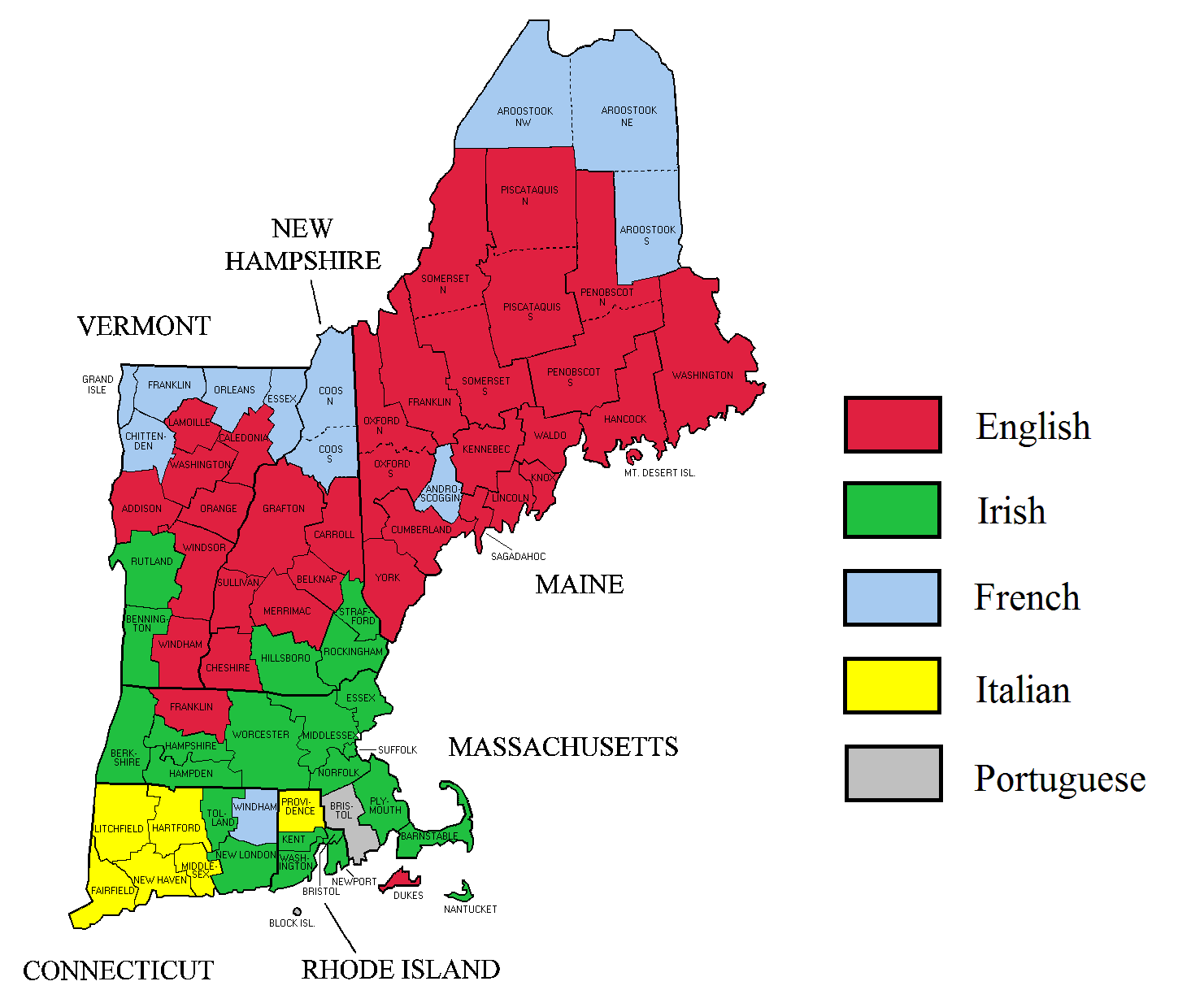
Self-reported ethnicity in New England
— Map by the southernhistorian45
From The England Journal of Higher Education, a service of The New England Board of Higher Education (nebhe.org)
Connecticut
Democratic Gov. Ned Lamont delivered a two-year budget plan of $43.1 billion to lawmakers, emphasizing that the state’s crushing fixed costs relative to its pension funds must be addressed. To accomplish this, he proposed restructuring, refinancing the systems’ payments and slowing the rate of increase in the teachers’ pension fund and the state employee pension fund, both of which are underfunded. Lamont also stated he will eliminate the multibillion dollar shortfall he inherited, without raising the state’s income tax.
Lamont announced that for the first time, cities and towns will be asked to contribute $73 million toward municipal teachers’ pension funds. At the same time the governor will provide cities and towns with an extra $65 million in Education Cost Sharing grants.
The governor’s budget calls for new taxes and fees by eliminating previously exempt goods and services including:
professional services including legal, accounting, interior design and real estate
personal services, including dry-cleaning, barber shops, beauty shops, veterinary services, parking, sport and recreation instruction
other services and goods, including property repairs and renovations, winter boat storage, non-prescription drugs, vehicle trade-ins, newspapers and certain magazines.
Lamont indicated he is open to legalizing and taxing marijuana and putting fees on sports betting. The governor’s budget also includes plans for instituting tolls that would apply to all vehicles.
The budget includes a minimum wage increase to $15 over four years, going from $10.10 to $11.25 in 2020, to $12.50 in 2021, to $13.75 in 2022 and finally to $15 in 2023.
The governor has also included $5.2 million in startup funds for a family medical leave program, which would be funded with a 0.5% payroll contribution. The plan would provide 12 weeks of coverage.
Maine
The two-year $8.03 billion spending package proposed by Democratic Maine Gov. Janet Mills represents an 11% increase over the prior two-year budget. The largest increase, $177 million, would fund Medicaid expansion, providing an additional 70,000 Mainers with health insurance. Mills made a campaign promise to Maine voters to fund the expansion, which former Gov. Paul LePage refused to do despite approval of the expansion by Maine voters.
The next largest increase in the Mills budget is for K-12 education, which is slated to receive an additional $126 million over the previous two-year budget cycle. The budget also provides that no Maine public school teacher will earn less than $40,000. Maine currently pays teachers an average of $33,000.
Mills also increased spending for the University of Maine System, which will expand the university’s capacity to address critical state workforce needs. Base funding for the system will increase from $189 million to $204 million in fiscal 2021. The budget also provides for $3.1 million to expand Early College enrollment, enabling high school students to explore careers that lead directly to job opportunities in areas such as healthcare, public safety and computer science. An additional $4.1 million will support Adult Degree Completion.
Maine’s public universities are partners of MaineSpark, a coalition of schools, universities, nonprofits, foundations, government agencies and businesses with a common goal of providing 60% of Mainers with education and workforce credentials by 2025.
Massachusetts
Gov. Charlie Baker presented to lawmakers a $42.7 billion budget for fiscal 2020, which represents a 1.5% increase over the prior year’s budget. Baker’s spending plan is built in part on $133 million in tax revenue from recreational marijuana sales. Adding to the revenue stream is an additional $42 million, which would come from a sales tax on online marketplaces like eBay, Etsy and others. A tax on e-cigarettes and vaping products is estimated to bring in another $6 million. The governor also anticipates $35 million in revenue from proposed legalization of sports betting, which would be deposited in the Gaming Local Aid fund. The budget builds in one-time revenue from a new sales tax collection modernization program for the Commonwealth’s largest vendors (those vendors that have remitted at least $100,000 in sales taxes in the prior year) that would shorten the time between collection and remittance. The revenue would be used to support one-time needs related to education, including investments in college scholarships, school safety and to assist school districts in eliminating lead from school drinking water.
Baker’s budget addresses the Foundation Budget Review Commission’s recommendations by overhauling the current state education formula with the biggest single change to the K-12 budget providing an additional $262 million in Chapter 70 state aid. The governor’s plan features full funding of foundation and base aid requirements; for health care including benefits for retirees; for educating English language learners; for districts with the highest number of economically disadvantaged students; minimum aid level of $20 per pupil for all school districts; helping school districts to meet out-of-district costs associated with special education costs; for students in Early College and Career Pathways.
For higher education, the governor’s budget includes a 5.5% average increase for campus operating budgets with a 7.5% increase for UMass, a 4.4% increase for the state universities and a 3% increase for community colleges.
A new initiative, the College Affordability and Student Success Trust Fund ($100 million), would give financial help to students enrolled at Massachusetts public colleges and universities to reduce college costs, provide greater opportunities to earn college credits and participate in paid student internships, beginning in fall 2020. Revenue for the trust fund would come from the Baker administration’s sales tax modernization proposal. It would also fully fund Commonwealth Commitment, and tuition payments for Early College while establishing a matching grant program for paid internships at 2-year and 4-year public institutions.
New Hampshire
Republican Gov. Chris Sununu budget message for fiscal 2020 and 2021 was highlighted by investments in social services and education. The two-year spending package of $13 billion contains no new taxes. It includes funding of $40 million for a new 60-bed forensic unit at New Hampshire State Hospital, $60 million to be invested in services for the developmentally disabled, which would address a huge backlog of people waiting for services and enabling legislation for a two-state initiative with Vermont for paid family medical leave. The spending plan fails to increase Medicaid rates, which are among the lowest in the nation.
The budget provides $64 million for targeted school building aid for the state’s poorest school districts. The per-pupil cost stays at $3,636 per student. Schools get an additional $1,818 for every low-income student, and $1,956 for special education students. English language learners get $711. Also funding for special education will be increased by 20%. An additional $8.6 million is targeted for tuition and transportation to help high school students travel to community colleges as part of the New Hampshire Career Academy.
For higher education, the governor’s budget includes $32 million over two years for a new loan-forgiveness program to encourage college graduates to work in the state.
The University System of New Hampshire is level-funded at $81 million for each year. Community colleges would receive a $1 million increase for each year. The governor’s budget targets investments in the UNH system, including $24 million to expand the capacity of healthcare and nursing programs and $10 million for the first phase of a Biological Sciences initiative.
Rhode Island
Democratic Gov. Gina Raimondo presented her budget plan of $9.9 billion, which represents a 3.7%, or $357 million increase over fiscal 2019. There are no changes to the rates for broad-based taxes, including the sales tax, the income tax and the corporate tax. That being said, the governor expands the sales tax to digital downloads of video, music and e-books (including Netflix) as well as Amazon Marketplace orders. The tax and fee changes are part of a plan to address a $200 million shortfall. Sin taxes will see a hike with the cigarette tax being raised to $4.50 along with a new tax on e-cigarettes. Fees will increase, including a Department of Motor Vehicle technology fee and Department of Environmental Management fees for beach parking and camping. Also, the governor proposes a surcharge on guns and ammunition.
With the U.S. Supreme Court’s decision to legalize sports betting, Rhode Island launched sports betting at Twin River Casino in November 2018. The budget expands sports betting by incorporating legislation proposed by Senate President Dominick Ruggerio to permit sports betting online, provided the player registers in person at Twin River and has a physical presence in Rhode Island when placing a bet. The online feature is anticipated to generate approximately $3 million out of a total $30 million from sports betting.
The budget proposes legalizing marijuana for adult use, which would be regulated by creating an Office of Cannabis Regulation. Six additional compassion centers would be added the existing three centers while restricting homegrown medical marijuana. Changes in pot policy are expected to generate $6.5 million beginning in January 2020.
The governor’s budget for education increases funding for K-12 by $30 million. It also increases the phasing in of PreK classrooms with $10 million to maintain current PreK classrooms and expand classrooms, and $2.25 to $5 million in dedicated funding for English Language Learners.
For higher education, the governor proposes an expansion of the Rhode Island Promise Scholarship/free tuition program. Adults age 25 or older who are attending the Community College of Rhode Island either full- or part-time, would be eligible. In addition, a new scholarship would be established to cover the third and fourth year of tuition at Rhode Island College. Those who would be eligible include students who are currently sophomores or juniors. The scholarship expansion is estimated to cost $13 million in 2019-20.
The budget also includes a plan to provide minimum standards for health insurance for Rhode Islanders and would mandate Rhode Islanders to have health insurance by Jan. 1, 2020 or pay a penalty or tax of $695 or 2.5% of household income.
Vermont
Republican Gov. Phil Scott presented a $6.1 billion spending plan for fiscal 2020. The budget represents a 4% increase over the previous year. After refusing to raise taxes in his first two years as governor, Scott proposed some new taxes and fees. He would increase fees by $8.5 million, most of which would come from increases on stockbrokers, mortgage lenders and other financial services professionals. Additional revenue would come from taxes on online purchases. He wants to raise $10 million by expanding the sales tax to online purchases and would increase the tax on electronic cigarettes, online hotel room taxes and online booking services such as Airbnb and Booking.com.
Scott noted Vermont’s biggest challenge to economic growth is its aging population. He proposed approximately $4 million to attract new workers to the state and would provide relocation grants for workers considering a move to Vermont. Starting in 2019, those who move to Vermont and work remotely for an out-of-state employer will be eligible to receive $10,000 over two years from the Vermont government to cover expenses such as relocation fees, a co-working space, a computer or Internet connectivity
The governor is asking for a $7 million increase for the Child Care Financial Assistance Program, which would raise subsidy levels for low- and moderate-income families. Scott is also asking for $2 million for the Department of Children and Families to add more family service workers and resource coordinators to serve at-risk families.
With regard to new spending, Scott is asking for $1.5 million to provide grants for “last mile” broadband connections and to increase broadband access to “underserved” communities.
The budget also calls for $1 million for the Vermont Student Assistance Corporation to fund a “non-degree” grant program that adults can pursue as an alternative to college. Also, the budget for Vermont state colleges would be increased by $3 million, an amount Scott says he would allow eliminating a 3% tuition increase slated to begin in the fall.
Other budget items include using $1.5 million from the Volkswagen settlement to subsidize the state’s fleet of electric vehicles and provide more charging stations.
Carolyn Morwick handles government and community relations for The New England Board of Higher Education.
Boston reveals social-investing program
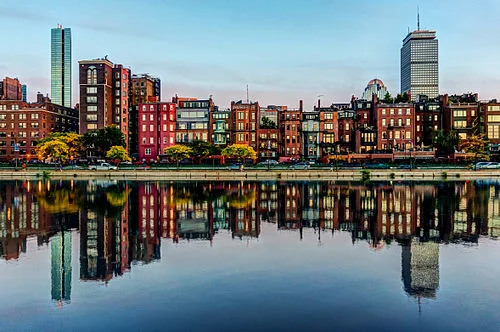
Boston’s Back Bay section as seen from across the Charles River.
From The New England Council (newenglandcouncil.com)
“The City of Boston has revealed a plan to invest in companies with strong environmental, social, governance (ESG) practices. Under the new policy, the city will invest up to $150 million of its operating funds in fixed-income securities of socially responsible companies.
Boston will make these investments by partnering with the Ceres Investor network, a sustainability nonprofit headquartered in Boston. Ceres uses its advocates using its investor network to address challenges such as climate change, water scarcity, pollution, and human rights abuses. Beyond investing in socially responsible companies, the city will pursue a “Community Bank Investment Initiative,” where the city will commit at least $100 million to Boston’s community banks and local financial institutions.
Boston’s Chief Financial Officer Emme Handy said, ‘This policy allows us to – while we are providing those critical core municipal services – build on that to support other valuable ESG businesses in our community banks. . . And we think it’s a great way to leverage our taxpayer dollars in a new way that supports the values of the city of Boston.”’
Always true to you in my fashion

“New Day’’ (mixed media on panel), by Robert Mars, at Lanoue Gallery, Boston.
Chuck Collins: Bring back Eisenhower socialism
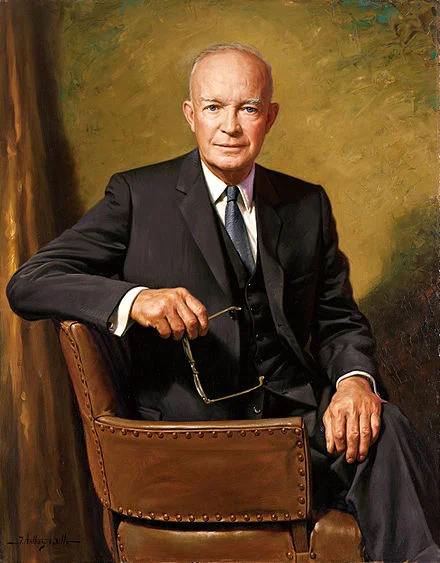
Official portrait of President Dwight D. Eisenhower in the White House.
From OtherWords.org
Beware of the specter of socialism!
Anytime that a politician proposes a wildly popular idea that helps ordinary people, a few grumpy conservatives will call them “socialists.” Propose to reduce college debt, help sick families, or ensure the super-rich pay their fair share of taxes — suddenly you’re a walking red nightmare.
Utah Republican Rep. Chris Stewart is so alarmed he’s convened an “Anti-Socialism Caucus” to ward off “the primitive appeal of socialism” that will “infect our institutions.” Democrats’ talk of restoring higher income tax rates on the wealthiest or helping families with childcare was enough to trigger Treasury Secretary Steve Munchin to quip, “We’re not going back to socialism.”
These same politicians consistently vote for tax cuts for the rich and to gut taxes and regulations on corporations so they can exercise their full freedom and liberty — to mistreat workers, pollute the environment, and rip off their customers.
The “shrink government” fear-mongers want you to believe there are only two flavors of economic ice cream. Choose strawberry and you get liberty-choking gulag communism. From this vantage, any proposal to rein in the unchecked power of global corporations and the rule-rigging rich is creeping socialism.
Choice number two, blueberry, is plutocracy, a society where the super-rich lord over the rest of us. It’s an economically polarized dystopia with stagnant wages and a declining standard of living for the majority.
Conservative demagogues aim to scare you into embracing their pro-plutocrat agenda as the only tolerable choice.
The good news is there many flavors to choose from. A number of presidential candidates have proposed or endorsed policies such as low cost or free college, a higher minimum wage, taxing the super-rich, and investing in infrastructure to reduce carbon emissions.
These ideas are tremendously popular with voters, winning majority support among Republicans, independents, and Democrats. As Fox News sheepishly reported from their own polling, over 70 percent of voters support tax hikes on households with over $10 million in income — including 54 percent of Republicans.
What would today’s hysterical Republicans say about the “socialist” presidency of Dwight Eisenhower? Most likely they would call him “Red Ike.” After all, during Eisenhower’s two terms between 1953 and 1960, the wealthy paid a top tax rate of 91 percent on incomes over the equivalent of $1.7 million for an individual and $3.4 million for a couple.
That crafty pinko Eisenhower also presided over government-subsidized mortgages that helped millions of Americans purchase their first home and attend college for free. He presided over the construction of public housing and state-owned infrastructure (like highways). Indeed, he was the prime creator of the Interstate Highway System.
(In 1954 Eisenhower proposed to have the government re-insure private insurance companies against usually heavy losses on health insurance as part of a comprehensive health and welfare program that Congress ultimately rejected. Ike’s idea was to encourage a big expansion of the percentage of the public covered by health insurance.)
In the early 1960s, the specter of socialism stalked the land again, this time in the form of a proposal to create a national health insurance program to cover senior citizens. Conservatives mounted a full-throated resistance movement to what George H.W. Bush at the time called “socialized medicine.”
The rest of us know it as Medicare.
Prior to the passage of Medicare in 1965, half of the country’s seniors didn’t have hospital insurance, and one in four went without medical care due to cost concerns. One in three seniors were in poverty. Half a century later, nearly all seniors have access to affordable health care, and the elderly poverty rate has fallen to 14 percent.
Now a majority of Americans support some form of “Medicare for All,” expanding universal coverage beyond seniors and disabled people to include children and adults.
Stay tuned for more fear mongering. Universal health care, the red baiters will say, will zap our national initiative and hurl us toward Soviet-style tyranny. Instead, maybe it will mean not having to choose between paying rent or for medicine.
Chuck Collins directs the Program on Inequality at the Institute for Policy Studies.


Llewellyn King: Embellishing Irishness far from Ireland

The Irish are an accommodating people. Well, not in everything but in some things. They share their culture with the world. Then they incorporate into Irish life modifications that other nations, especially the United States, have made.
Take St. Patrick’s Day. It was traditionally a dour day of religious observance in Ireland. Then Irish Americans turned it into the festival that we celebrate here. And now St. Patrick’s Day is celebrated in Ireland much the way it is here: joyously.
Likewise, corned beef and cabbage. That was a cheap dish that got its Irish identification among the poor immigrants in New York. It wasn’t a tradition in Ireland, where thick bacon, lamb and salmon, served with an astonishing array of potato options, is standard fare along with battered cod -- fish and chips the rest of the world. But in an accommodation to visitors, corned beef and cabbage can now be had in the big hotels.
A word about those potatoes: If you can think of preparation for potatoes, you might find them offered. Never, in my experience, are less than three varieties available in a restaurant. At a banquet once, I was offered a choice of chips (French fries) duchess, sautéed, boiled, croquette, mashed, and scalloped.
What isn’t seen in Irish restaurants are baked potatoes –although, to please visitors, they may be sneaking into the hotels. In my nearly four decades of annual travels in Ireland, I learned that baked potatoes, known as jacket potatoes, are street food -- to bought with all sorts of great fillings from stalls, food trucks and the like, not in restaurants and pubs.
Irish stew is also less common than you would expect.
The Irish do drink, but in their own way. As Ireland has become a modern, competitive country, people are drinking less. But drinking is part of the fabric of daily life, just as drinking coffee, tea (hot or iced) and soft drinks might be elsewhere. You do business in Ireland over a drink, celebrate with a drink, mourn with a drink and, well, just have a drink because that’s what you do between what you just did and what you’re going to do. A breather, you might say.
For 20 years, I was the American organizer for an Irish summer school. Summer schools -- there are more than two dozen -- are more like themed think tanks which meet only in the summer, often just for a long weekend. They cover literature, music, politics and are named accordingly, like the Yeats International Summer School and the Parnell Summer School.
The one my wife and I were affiliated with was the Humbert International Summer School, named for the French general sent to Ireland in 1798 to help with the uprising against the British, which was put down brutally by Gen. Cornwallis, fresh from his American defeat. Humbert was sent back to France -- the English not having a beef with the French at that moment. He had an affair with Napoleon’s sister and was ordered to New Orleans, where he passed his days drinking with Jean Lafitte, the French pirate and privateer, teaching French and living his exiled life in style. He did fight bravely in the Battle of New Orleans and helped the American forces with his military skill. He died in New Orleans and is buried there.
Back to the welcoming of American embellishments to Irish traditions. These are not resented in Ireland because of the great affinity of the Irish have with their 35 million or so kinsmen in the United States. The Irish enjoy the American stage and screen songs of Ireland, like “When Irish Eyes Are Smiling.” The Little People of Ireland’s folklore are beginning to look like Disney’s Seven Dwarfs.
That doesn’t mean that the Little People are not alive and well, it’s just that their presence has been enhanced by legends that came from Hollywood as much as from the Auld Sod. A friend of mine built a wall around his mother’s retirement house in Cork. But her neighbors insisted that it have a gap for the Little People to go through -- so it has a gap.
As for the fairies, my wife and I were riding in northwest Ireland and our guide told us it was all right to ride through a copse, but we shouldn’t the horses disturb the fairy circle there. He rode around the copse to be sure he didn’t upset the fairies.
Despite the drink, the Little People and the fairies, Ireland is the computing capital of Europe and hopes to take over as a financial center after Britain loses many banking houses due to Brexit.
Sláinte! That’s the equivalent of cheers as you raise a glass. Do that Sunday or the Little People, or the fairies, or your Irish friends may be upset. You’ve been warned.
Llewellyn King is executive producer and host of White House Chronicle, on PBS. His email is llewellynking1@gmail.com. He’s based in Rhode Island and Washington, D.C.
I like the heavy stuff at Fenway
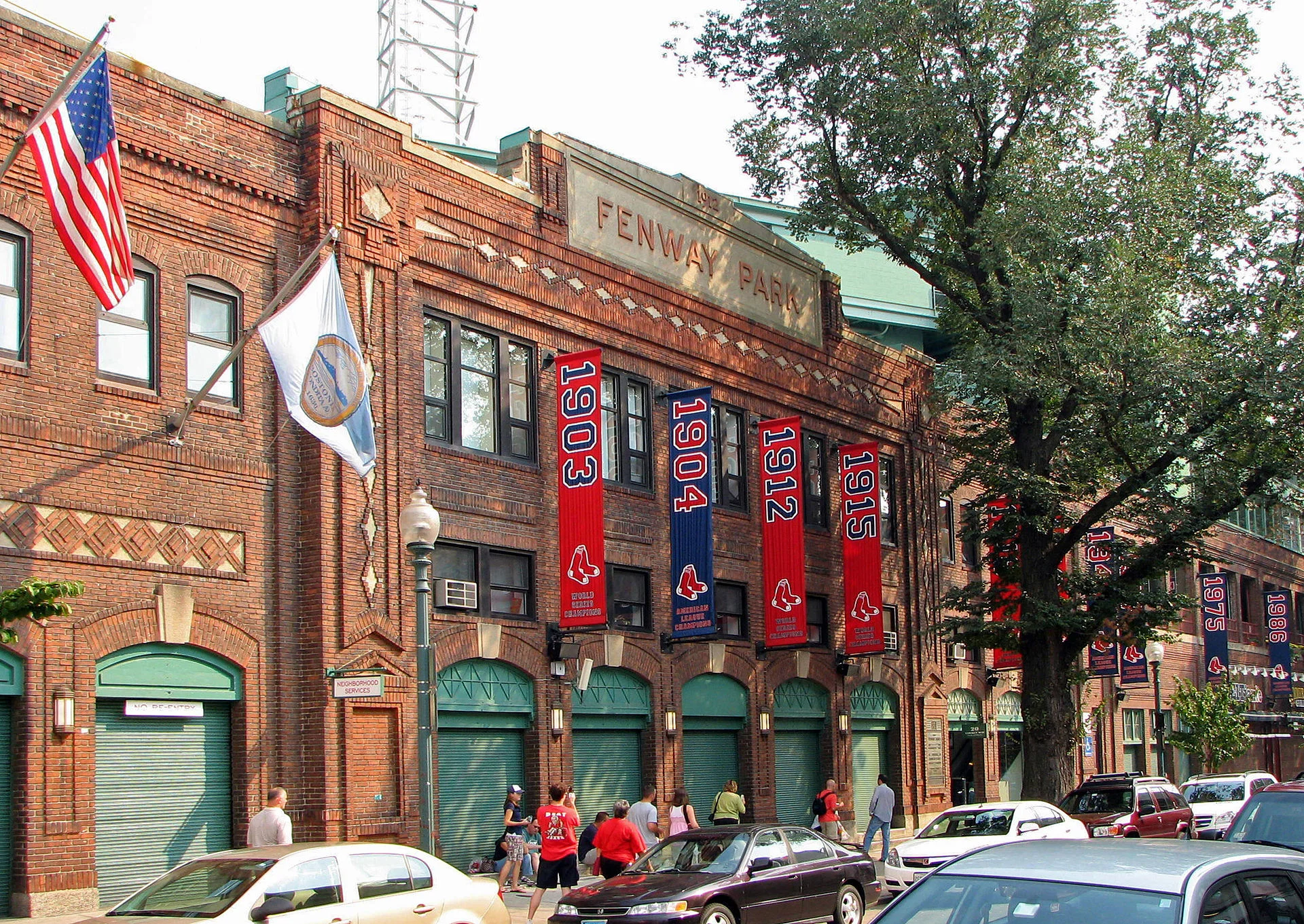
— (Dated!) photo by Bernard Gagnon
Forget the frank, the hot dog –
Give me the Fenway sausage.
Lansdowne or Yawkey,
Just give me the street, the crowds, the carts….
So much memory
Of family and fun
Of ballgames, tailgates, and the carnie….
— From “Sausage,’’ by Raymond Foss, in The Poets of New England: The Underground Writers Association’s Anthology of New England Poets.
Furniture and other fine art

Above, “Club Chair’’ (claro walnut with Italian calfskin), by Timothy Philbrick. Below, “Sonation’’ (oil on wood panel), by Tayo Heuser.
Both are in the show “Art & Design: A Conversation,’’ at Contemporary Fine Art Gallery, East Greenwich, R.I., March 14-April 23.

Tapley takes a new approach to silver jewelry


Look at Tapley Jewelry take a new approach to silver. To see, hit this link.
Rhode Island's own Cookie Countess
The Cookie Countess is a fun Rhode Island-based company. To read about it, please hit this link.