
Vox clamantis in deserto





Mass. lawsuit unveils aspects of how the Sackler family reaped a vast fortune off OxyContin
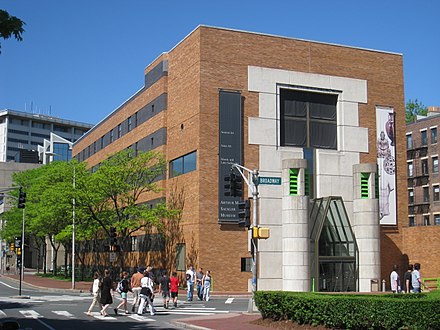
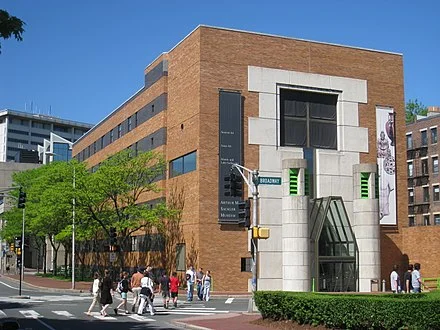
The Sackler family, famously obsessed with raising their social status, have given most of their charitable gifts to already rich elite institutions. Here, for example, is the Sackler Building at Harvard.
By Christine Willmsen, WBUR and Martha Bebinger, WBUR
BOSTON
The first nine months of 2013 started off as a banner year for the Sackler family, owners of the pharmaceutical company that produces OxyContin, the addictive opioid pain medication. Stamford, Conn.-based Purdue Pharma paid the family $400 million from its profits during that time, claims a lawsuit filed by the Massachusetts attorney general.
However, when profits dropped in the fourth quarter, the family allegedly supported the company’s intense push to increase sales representatives’ visits to doctors and other prescribers.
Purdue had hired a consulting firm to help reps target “high-prescribing” doctors, including several in Massachusetts. One physician in a town south of Boston wrote an additional 167 prescriptions for OxyContin after sales representatives increased their visits, according to the latest version of the lawsuit filed Thursday in Suffolk County Superior Court in Boston.
The lawsuit claims Purdue paid members of the Sackler family more than $4 billion between 2008 and 2016. Eight members of the family who served on the board or as executives as well as several directors and officers with Purdue are named in the lawsuit. This is the first lawsuit among hundreds of others that were previously filed across the country to charge the Sacklers with personally profiting from the harm and death of people taking the company’s opioids.
WBUR along with several other media sued Purdue Pharma to force the release of previously redacted information that was filed in the Massachusetts Superior Court case. When a judge ordered the records to be released with few, if any, redactions this week, Purdue filed two appeals and lost.
The complaint filed by Massachusetts Atty. Gen. Maura Healey says that former Purdue Pharma CEO Richard Sackler allegedly suggested the family sell the company or, if they weren’t able to find a buyer, to milk the drugmaker’s profits and “distribute more free cash flow” to themselves.
That was in 2008, one year after Purdue pleaded guilty to a felony and agreed to stop misrepresenting the addictive potential of its highly profitable painkiller, OxyContin.
At a board meeting in June 2008, the complaint says, the Sacklers voted to pay themselves $250 million. Another payment in September totaled $199 million.
The company continued to receive complaints about OxyContin similar to those that led to the 2007 guilty plea, according to unredacted documents filed in the case.
While the company settled lawsuits in 2009 totaling $2.7 million brought by family members of those who had been harmed by OxyContin throughout the country, the company amped up its marketing of the drug to physicians by spending $121.6 million on sales reps for the coming year. The Sacklers paid themselves $335 million that year.
The lawsuit claims that Sackler family members directed efforts to boost sales. An attorney for the family and other board directors is challenging the authority to make that claim in Massachusetts. A motion on jurisdiction in the case hasn’t been heard. That attorney hasn’t responded to a request for comment on the most recent allegations.
Purdue Pharma, in a statement, said the complaint filed by Healey is “part of a continuing effort to single out Purdue, blame it for the entire opioid crisis, and try the case in the court of public opinion rather than the justice system.”
Purdue went on to charge Healey with attempting to “vilify” Purdue in a complaint “riddled with demonstrably inaccurate allegations.” Purdue said it has more than 65 initiatives aimed at reducing the misuse of prescription opioids. The company says Healey fails to acknowledge that most opioid overdose deaths are currently the result of fentanyl.
Purdue fought the release of many sections of the 274-page complaint. Attorneys for the company said at a hearing on Jan. 25 that they had agreed to release much more information in Massachusetts than has been cleared by a judge overseeing hundreds of cases consolidated in Ohio. Purdue filed both state and federal appeals this week to block release of the compensation figures and other information about Purdue’s plan to expand into drugs to treat opioid addiction.
The attorney general’s complaint says that in a ploy to distance themselves from the emerging statistics and studies that showed OxyContin’s addictive characteristics, the Sacklers approved public marketing plans that labeled people hurt by opioids as “junkies” and “criminals.”
Richard Sackler allegedly wrote that Purdue should “hammer” them in every way possible.
While Purdue Pharma publicly denied its opioids were addictive, internally company officials were acknowledging it and devising a plan to profit off them even more, the complaint states.
Kathe Sackler, a board member, pitched “Project Tango,” a secret plan to grow Purdue beyond providing painkillers by also providing a drug, Suboxone, to treat those addicted.
“Addictive opioids and opioid addiction are ‘naturally linked,'” she allegedly wrote in September 2014.
According to the lawsuit, Purdue staff wrote: “It is an attractive market. Large unmet need for vulnerable, underserved and stigmatized patient population suffering from substance abuse, dependence and addiction.”
They predicted that 40-60 percent of the patients buying Suboxone for the first time would relapse and have to take it again, which meant more revenue.
Purdue never went through with it, but Attorney General Healey contends that this and other internal documents show the family’s greed and disregard for the welfare of patients.
This story is part of a reporting partnership between WBUR, NPR and Kaiser Health News.
A version of this story first ran on WBUR’s CommonHealth. You can follow @mbebinger on Twitter.

Llewellyn King: Confusing empathy with policy
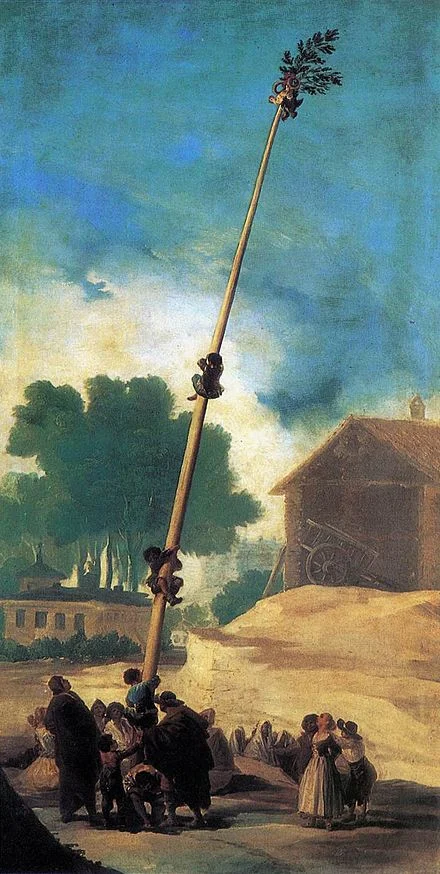
“La Cucana’’ (greasy pole), by Francisco Goya.
WEST WARWICK, R.I.
Mark Twain once observed that no one would try to play a fiddle in public without some prior instruction in the instrument, but no one had such hesitation when it came to writing.
Clearly, many candidates these days think you can run for president without any political experience or with precious little. The unqualified and the marginally equipped seem to believe they are uniquely gifted to be president of the United States.
At the moment a large school of Democrats feel that because they empathize with the working poor, the struggling middle class and are appalled by the excesses of the plutocrats, they can, when elected, put it all right. They confuse empathy with policy and achievability.
Then there are those who subscribe to the belief in business as the incubator of all skills. These are the people who believe — and they could well line up for former Starbucks CEO Howard Shultz — that if you can run a business, you can get a handle on Washington. It is a myth that just won’t die. If one can make a lot of money, it proves just one thing: One has made a lot of money. Running based on commercial success and Washington failure doesn’t work. The two worlds are not subject to the same laws of nature, as it were.
In business, you can walk away from failure; in politics, it follows you. If a franchise deal fails in business, you abandon it. You can’t abandon Russia or China because you can’t get a deal. And you can’t abandon the poor because you think you can’t afford them.
Politics is, above all, learned, and it is learned in political places — school boards, community associations, unions and state legislatures. Anywhere where offices are elective.
If you want to succeed in reshaping Washington, the first thing to do is to understand it and respect it. Yes, respect it.
We are so inured to people running against Washington that we forget that it is the product of all the others who ran against it. Washington, like all complex systems, is the sum of its parts, from the lobbyists to the agencies, and the laws which Congress has passed.
Washington is a seething, dynamic system, not too complex to be reformed but way too complex to be a candidate for simple solutions. Look at the supreme political amateur Donald Trump and see how his plan to upend Washington and “drain the swamp” has fared. In engineering and science, if you want to change something, first understand it — know its parts and their functions before you start.
Rex Tillerson, the former CEO of ExxonMobil, failed to reform the State Department because he didn’t feel he needed to understand it. He failed in his own right, even without the difficulties that Trump piled on him.
If politics is war by another means, then don’t show your hand. You don’t tell the enemy where you’ll dig in or what secret weapon you’ll bring to bear. To declare the rate of tax you favor (70 percent for the rich), how you are going to implement a national healthcare system (extend Medicare) and who you’ll not listen to (lobbyists are a great source of information), and what limits you are going to put on yourself (to draw attention to your rectitude) is neither the way to get elected nor to do the peoples’ business. Caring isn’t a plan.
Many successful presidents, from Washington to Clinton, have been bad businessmen. The best qualification for the office isn’t how well you’ve done at something else, but to have run something big and political like a charity, an advocacy group, a school, a city or a state. That way you learn the art of give a little, take a lot. Those who haven’t had this administrative experience need to study it over and over.
As Lloyd George, the British prime minister during the last part of World War I, wrote, “There is no greater mistake than to try to leap an abyss in two jumps.” Every day, I read someone is setting out to prove him wrong and run for president without regard to the geography of the politics.
On Twitter: @llewellynking2
Llewellyn King is executive producer and host of White House Chronicle, on PBS. He is based in Rhode Island and Washington, D.C.
'What's Groton into you?'
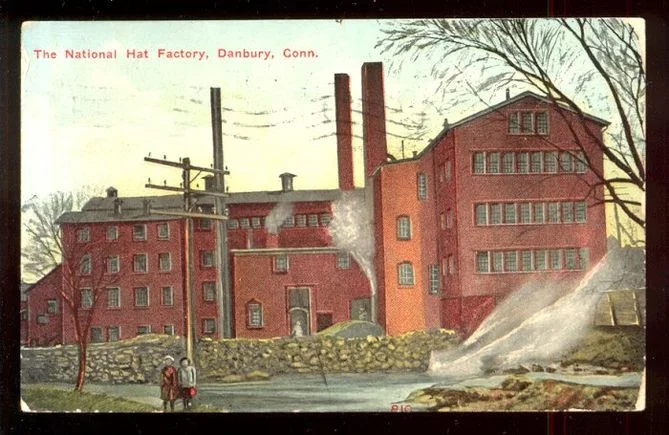
At the time this postcard was printed, in 1912, Danbury was the hat-making capital of America.
“When they can hear each other over the wind and the music, they speak Connecticut: I will not Stamford this type of behavior. What’s Groton into you? What did Danbury his Hartford? New Haven can wait. Darien’t no place I’d rather I’d rather be.”
― David Levithan, in “Are We There Yet?’’
'A child passed through me'
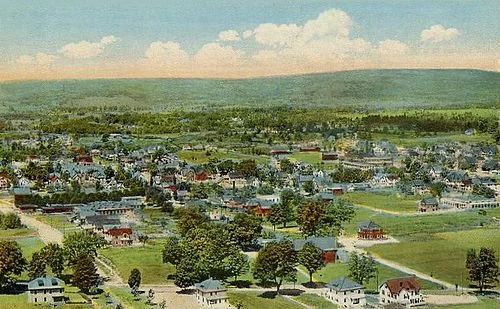
Greenfield, Mass., from Poet's Seat Tower, 1917.
“Somewhere between Greenfield and Holyoke
snow became rain
and a child passed through me
as a person moves through mist
as the moon moves through
a dense cloud at night…’’
— From “In the Bus,’’ by Grace Paley (1922-2007). She lived in New York and Vermont

The rich folks next door

Townhouses on Louisburg Square, on Beacon Hill, Boston. Some call the square the epicenter of Boston wealth.
From Robert Whitcomb’s “Digital Diary,’’ in GoLocal24.com
‘Rhode Island Gov. Gina Raimondo commendably wants the state to be a lot more like Massachusetts – a desire reflected in her State of the State address and her (too?) ambitious budget proposals. That’s especially true when it comes to her ideas on how to advance public education -- K-college/voke school -- the heart of her program, around which hovers the question of how tough her administration will be willing and able to be on standards, as measured by tests.
The legislature is casting a gimlet eye on how she would fund her proposals, which would hike some fees, broaden the currently rather narrow sales tax and “scoop’’ some money from some quasi-public agencies. And who knows what might happen if we get a recession in the next year or so? We’d like to see contingency plans.
By the way, Massachusetts Gov. Charlie Baker also wants to raise taxes, in part to boost education aid to the localities. Among his proposals: putting a levy on opioid sales, broadening the excise tax to include vaping products, and boosting the tax that homeowners pay when they sell their house. The $150 million a year projected to come from this levy is supposed to go “resiliency-building’’ projects to address such effects of global warming as increased coastal flooding, flooding that’s already cutting property values in some places.
The biggest problem that all Rhode Island governors have in trying to implement programs like Massachusetts’s is simply that the Ocean State, while richer (in median household income, etc.) than the majority of states is much poorer than the Bay State, with its huge wealth-creating (and thus tax revenue) machine in Greater Boston based on technology, world-famed higher education, financial services and health care. (Consider that Massachusetts General Hospital alone has just announced a $1 billion building project).
Rhode Island, which has been much slower than Massachusetts to move away from its old mill culture, has nothing like this. But it does have proximity to Boston, which it must leverage with its own strengths, especially in such sectors as design and marine-related industries. The best thing that Rhode Island could do economically is make itself part of Greater Boston.
Stylish snowshoes
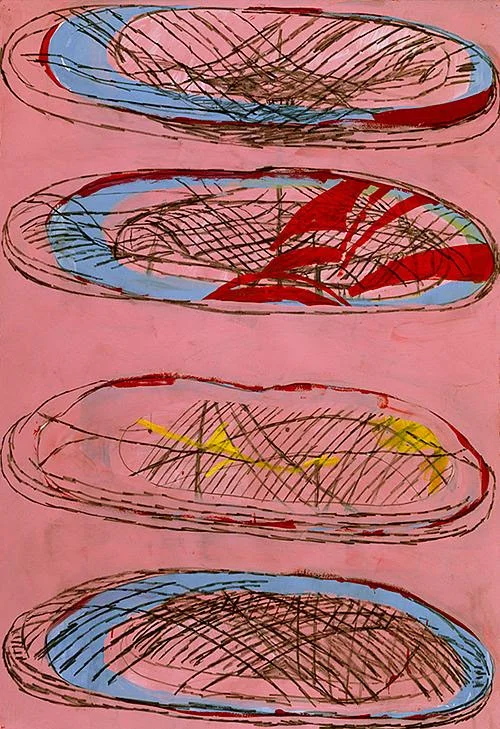
Untitled gouache on paper by Terry Winters (image courtesy of The Drawing Center, New York) in his show “Facts and Fictions,’’ at the University Museum of Contemporary Art at the University of Massachusetts at Amherst through April 28.

Philip K. Howard: Red tape has replaced responsibility

For decades now, Americans have slogged through a rising tide of idiocies. Getting a permit to do something useful, say, open a restaurant or fix a bridge, can take years. Small businesses get nicked for noncompliance of rules they didn’t know. Teachers are told not to put an arm around a crying child. Doctors and nurses spend up to half the day filling out forms that no one reads. Employers no longer give job references. And, in the land of the First Amendment, political incorrectness can get you fired.
We’d all be better off without these daily frustrations. So why can’t we use our common sense and start fixing things?
But common sense is illegal in Washington. Red tape has replaced responsibility. No official has authority even to do what’s obvious. In 2009, Congress allocated $800 billion, in part to rebuild America’s infrastructure. But it didn’t happen because, as President Obama put it, there’s “no such thing as a shovel-ready project.” Even President Trump, a builder, can’t get infrastructure going. The entire government was shut down in a spat over one project, the Mexican border wall, that the parties don’t agree on. How about fixing the broke rail tunnel coming into New York?
Washington’s ineptitude is only the tip of the iceberg. A bureaucratic mindset has infected American culture. Instead of feeling free to do what we think is right, Americans go through the day looking over our shoulders: “Can I prove that what I’m about to do is legally correct?”
Every Republican administration since Reagan has promised to cut red tape with deregulation. “Washington is not the solution,” as Reagan put it: “It’s the problem.” But Washington has only gotten bigger during their terms in office. That’s because deregulation is too blunt: Americans want Medicare, clean water, and toys without lead paint.
Americans are not stupid. Government drives people nuts because it prevents anyone from being practical. Nothing’s wrong with requiring a permit for a new restaurant, but should you have to go to 11 different agencies? Who has the job of moving things along in Washington and making sure officials focus on real issues? That would be, uh, no one.
No one designed Washington’s giant bureaucracy either. It just grew, like kudzu, since the 1960s. Its organizing idea is to tell everyone exactly how to do everything correctly. Mindless compliance replaced human judgment. A new problem? Write another rule. The steady accretion of rules is why government has become progressively paralytic over the past few decades.
Back in the old days, of say, JFK or the late Sen. Majority Leader Howard Baker, government fixed problems by giving some official that job and then holding them accountable. Congress authorized the Interstate Highway System with a 29-page statute, and nine years later over 21,000 miles had been built. Today, the red tape would probably prevent it from being built at all.
It’s time to bite the bullet: Washington can’t be repaired; it must be replaced. Creating a coherent governing framework is not so daunting. Most bureaucratic detail is irrelevant when people are allowed to take responsibility again.
Instead of bickering over a laundry list of reforms, Americans should demand a few core principles:
* Radically simplify regulation. Law should set goals, not require mindless compliance with thousand-page rulebooks. Let Americans take responsibility and meet public goals in their own ways. More local control will not only work better but restore pride and self-respect.
* Accountability is key. Democracy is toothless without accountability. Accountability today is lost in legal quicksand and then strangled by public unions. Fairness should be protected with oversight, not exhausting lawsuits.
* Shake up Washington. Obsolete laws, bureaucratic stupor, partisan politics and lobbyists’ money all preserve the status quo. Reboot everything. Disrupt the electoral process by changing campaign rules. Move most agencies out of Washington — the bureaucratic culture there is toxic. Let the FDA go to Boston or San Diego. Send the worker safety agency to Ohio.
Experts say that change is impossible, pointing to the gridlock in Washington. Incremental change may be impossible, but big change is inevitable. Americans are fed up. That’s why they elected Donald Trump president and why Democrats are steering to the far left.
What’s missing is not public demand for change but a coherent vision of how Washington can work again. My proposal is basic: Replace the dense bureaucracy and put humans in charge again. Empower Americans, at all levels of responsibility, to make practical and moral daily choices. Then hold them accountable for how they do. Let Americans be American again.
Philip K. Howard, a New York-based lawyer, civic leader and writer, is chairman of Common Good and author of Try Common Sense: Replacing the Failed Ideologies of Right and Left.

Chris Powell: Smoke screen for other sales-tax increases; another police-pay scam

Sometimes trial balloons are meant to be shot down, which seems to be the case with the report that Connecticut Gov. Ned Lamont is considering repeal of the state sales-tax exemptions for groceries and medicine, necessities of life.
No tax policy could be more retrograde. But when this balloon is popped, as it surely will be, people may be less resentful about what follows from the governor on the sales tax -- a call to consider repealing some of its many other exemptions, which may cost nearly $3 billion every year.
Good arguments can be made for some exemptions, particularly when repealing an exemption may drive so much business out of state that tax receipts will fall instead of rise. But the decisive argument for some exemptions has been only that an influential special interest wanted it.
A comprehensive study of sales tax exemptions, often urged by former state Sen. Tony Guglielmo, R-Stafford, who just retired, should have been undertaken by the General Assembly long ago. It shouldn't have to wait another three weeks for the governor's budget. Legislators should get started on it now, while they're wasting their time on trivial legislative proposals.
xxx
While it is impoverished and heavily dependent on state financial aid, Bridgeport managed the other day to pay its police chief, Armando Perez, $172,000 in vacation, personal, sick, holiday, and compensatory time accrued in his 28 years with the city's police department, money for which he no longer would qualify upon leaving the police union to become chief.
This accrual of time-off benefits is common in police departments and other government agencies in Connecticut and can amount to a second pension for people who already have pretty good first pensions from the government. It's a racket, and since municipal finance and state government finance are now so intertwined and so desperate, the practice should be ended by state law prohibiting accrual of more than a few months' worth of time-off benefits.
Police work is said to be stressful, but when an officer can go 28 years without fully using his ordinary time off and without becoming a physical and mental wreck, thereby amassing more savings just with accrued time off than ordinary taxpayers can amass from their full incomes in a lifetime, police work itself is a racket.
Where is the governor or state legislator with the courage to confront the police unions about this, thereby establishing that government in Connecticut isn't always a racket too?
xxx
Two Republican state legislators, Reps. Fred Camillo of Greenwich and Brenda Kupchick of Fairfield, have joined Secretary of the State Denise Merrill, a Democrat, in proposing legislation to deny public access to voter registration information. The idea is to protect personal privacy.
But privacy can be achieved here only at the expense of making it impossible for people outside the government itself to detect election fraud, even as state government invites such fraud by issuing driver's licenses to illegal immigrants and New Haven city government invites it by issuing city identification cards to illegals. If the voter rolls weren't public, Connecticut last year might not have discovered that the Republican nominee for governor, political neophyte Bob Stefanowski, had never voted in the state he suddenly had presumed to run.
Voting requires assumption of a public office established by the state Constitution -- the office of elector. This much public identification is simply civic duty and should be sustained.
Chris Powell is a columnist for the Journal Inquirer, in Manchester, Conn.
'Women of Jazz'

From the show “Women of Jazz: Portraits by Kate Shaffer,’’ at the Carney Gallery, Regis College, Weston, Mass., opening Feb. 7.
The gallery says:
“Reflecting the diverse spectrum of talent from the 1920s to the present, from composers and bandleaders, to singers and producers, this exhibit honors the remarkable contribution women have made to this truly American form of musical expression.’’
Explosive dependence

Gas-valve cover in Boston.
From Robert Whitcomb’s “Digital Diary, in GoLocal24.com
The recent natural-gas emergency on Aquidneck Island calls to mind the need for New England to accelerate its slow move away from polluting and flammable (and, in the case of gas, explosive) fossil fuel brought from far away and toward local renewable sources, which means mostly wind and solar power. Of course, this will require steady improvement in battery technology and much new construction, onshore and offshore. Ultimately, electricity from these sources will provide all of the electricity needed to run our homes, including heat, and do it cleanly.
Making New England less dependent on fossil fuel is not only good for the environment but it strengthens its economy by making it more energy-independent. And consider that the companie
Meanwhile there’s the good news that commercial fishermen are talking with Orsted U.S. Offshore Wind (which took over Deepwater Wind) on how to ease the interactions between offshore wind companies and the fishermen. The fishermen’s group is called the Responsible Offshore Development Alliance and represents fishermen from Maine to North Carolina.
While recreational fishermen tend to like the sort of offshore wind operation that’s up off Block Island because the wind-turbine supports act as reefs that lure fish, commercial fishermen are leery that wind farms will limit their ability to move around. Their fears are exaggerated but must be addressed. Of course, they, too, would benefit from the fact that wind farms tend to attract fish.
What the fishermen should really worry about is the Trump administration’s push for drilling for oil and gas off the East Coast. While a big offshore wind farm might inconvenience some commercial fishermen, think about what a big oil spill would do….
'Why is the world so old?'

On a beach in the Cape Cod National Seashore.
“The low sandy beach and the thin scrub pine,
The wide reach of bay and the long sky line,—
O, I am sick for home!
The salt, salt smell of the thick sea air,
And the smooth round stones that the ebbtides wear,—
When will the good ship come?
The wretched stumps all charred and burned,
And the deep soft rut where the cartwheel turned,—
Why is the world so old?
The lapping wave, and the broad gray sky
Where the cawing crows and the slow gulls fly,
Where are the dead untold?
The thin, slant willows by the flooded bog,
The huge stranded hulk and the floating log,
Sorrow with life began!
And among the dark pines, and along the flat shore,
O the wind, and the wind, for evermore!
What will become of man?’’
— “Cape Cod,’’ by George Santayana

Photo taken around the turn of the 20th Century.
Jill Richardson: Billionaire candidates don't get it
Via OtherWords.org.
Former Starbucks CEO Howard Schultz just announced he may run for president as an independent centrist candidate in 2020.
I have some concerns about billionaires, however well-intentioned, running the country.
For one thing, people generally pay a lot of attention to those who have more than them, but they are less aware of those who have less. A billionaire with “just” a private jet will compare himself to an even richer billionaire with their own private island. They don’t have any idea what life is really like for a single parent raising two kids while working and attending night classes.
Social psychologists find that people usually believe they are responsible for their successes, but blame their failures on external factors like bad luck or a sluggish economy. They also extend the same benefit of the doubt to people within their own group.
When looking at people in other groups, they are less generous. Then they tend to blame people for their own failures.
As a result, the rich generally believe that worked hard for everything they had — but many think the poor are probably poor because they’re lazy. In reality, all people’s fates are due to both their own talents and efforts and their circumstances.
Think about Donald Trump. He was born to a wealthy and well-connected real estate mogul in New York. His father gave him millions, sent him to elite schools, trained him in the business, and introduced him to the powerful people whose help he needed to succeed.
Would Donald Trump gone anywhere in business if he were born to your parents? Very unlikely. But could you have done even better than Trump in business if you were born to his parents? It’s definitely possible.
Trump, no doubt, believes his success is solely due to his own work and “genius,” but it’s undeniable that the circumstances he was born into played a role.
The same of true for those with less extraordinary privilege.
Imagine a college classroom filled with 30 equally talented and hardworking students. Some come from well off families, live with their parents, and don’t need to work while attending school. Others come from poverty and hold full time jobs to pay their living expenses and tuition.
Perhaps some are homeless, or food insecure. Maybe they have to care for children or elderly relatives in addition to attending school. They might not have reliable transportation or own a computer at home.
Who will get better grades? Who will graduate sooner? Who might not graduate at all?
Good bet the students from wealthy families will feel they’ve earned their good grades and will have no idea what the students with lower grades were facing at home. They might even think students who got poor grades did so because they were stupid, lazy, or both.
In such a class, the best way to get grades up might be to help the students have stable living situations, enough to eat, fewer money woes, and less need to work full time while attending school. Just telling the low income students to work harder can only help so much when they’re in such a tough situation — it may even demoralize them further.
We need a government that understands the lives and struggles of ordinary Americans and can craft policies to help them. Billionaires generally won’t, regardless of their intentions, because it’s human nature to be generally clueless about those with less privilege than you.
Jill Richardson, a sociologist, is an OtherWords.org columnist.
Absorbing the forest

“Rhododendron Forest 1” (incised photograph) by Hilary Tolan, in her show “Emerge,’’ at the Kingston Gallery, Boston, through Feb. 14.
The gallery says that her “images, both delicate and fierce, encourage the viewer to slow down and absorb the stillness and intricacy they offer. Emerge is a collection of photographs and drawings initiated 10 years ago during a three-week residency and daily walks into an overgrown rhododendron forest. ‘‘
Kudos for UNH research

Thompson Hall, finished in 1892, is the oldest academic building built for the flagship campus of UNH, which moved to Durham from Hanover in 1893.
This is from The New England Council (newenglandcouncil.com):
“The University of New Hampshire (UNH), a New England Council member, has been ranked by the Carnegie Classifications of Institutions of Higher Education as one of the top research universities in the country. This new rating places UNH among the 130 doctoral-granting universities with a ‘very high research activity’ label. UNH is one of only three public universities in New England, along with UMass at Amherst and the University of Connecticut, to achieve the ‘R1’ rating.
“With research programs in a range of fields, from space physics to vulnerable populations, the school attracts more than $110 million in research funding each year. UNH officials believe that this new ranking will attract talented students, researchers, faculty, and staff, as well as signal to government agencies, philanthropists, and businesses that the school can be expected to conduct high-quality research and education.
“Jan Nisbet, UNH senior vice provost for research, commented, ‘This is a powerful recognition of UNH as one of the nation’s highest-performing research universities. It underscores our ongoing commitment to research and scholarship that improves the lives of people here in the Granite State and across the globe.’’’
David Warsh: A climate dividend plan gains wide support

SOMERVILLE, Mass.
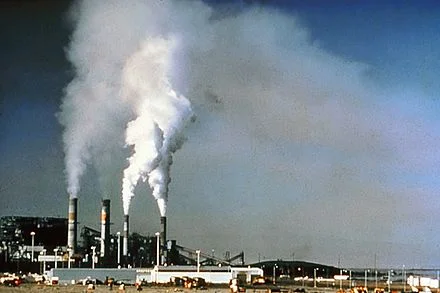
The existence of a concrete and credible plan to steadily reduce carbon emissions in the United States makes it possible that the 2020 presidential election could be about climate change instead of the vandal presidency of Donald J. Trump. How likely IS that? Today, it’s anybody’s guess. But a couple of things have become apparent this month.
One is that the preponderance of expert opinion, at least among the most distinguished economists, now supports a climate dividend plan. (Resource economists, a subset of the whole, hard to sample, and less attuned to politics, may be a different matter.) The other is that a logical candidate to campaign on the issue is on the verge of declaring his candidacy.
The revenue-neutral tax and dividend plan has been publicly espoused since 2013 by two grandees of the Republican Party, James Baker and George Shultz, secretary of s
tate, respectively, to George H. W. Bush and Ronald Reagan. They first proposed it, with former California Gov. Arnold Schwarzenegger, as Western forest fires began to ramp up.
Since then, the Climate Leadership Council, a two-year-old Washington think-tank founded by serial policy-entrepreneur Ted Halstead has built support for the plan among multinational corporations, business leaders, and non-profit organizations. Founders include BP, ConocoPhillips, Shell, and ExxonMobil, among major energy companies; General Motors, Proctor & Gamble, Unilever, AT&T, Johnson & Johnson, the Conservation International, the Nature Conservancy and the World Wildlife Fund.
In 1997, Halstead organized an Economists Statement on Climate Change, drafted by Kenneth Arrow, Dale W. Jorgenson, Paul Krugman, William Nordhaus, and Robert Solow, on the eve of Kyoto Protocol negotiations. The framers then were ambivalent as to the best means of emissions control: either carbon taxes or cap-and-trade permit auctions designed to meet emission targets. Since then, support has waned for cap-and trade, on grounds that those auctions concentrate power in the hands of administrators and politicians.
This month, the CLC published a second expression, Economists Statement on Carbon Dividends, signed initially by 27 Nobel laureates, all 4 living former Fed chairs, and 15 former chairs of the Council of Economic Advisers.
This time the signatories came down firmly on the side of carbon taxation. Among laureates, only Paul Krugman, Joseph Stiglitz, James Heckman and Edward Prescott declined to sign. Organizers included politically involved economists Martin Feldstein, Lawrence Summers, N. Gregory Mankiw, and Austan Goolsbee.
The Economists Statement omitted key details of the Baker-Shultz plan, presumably in the interest of attracting the widest possible array of support. Not all signers, for instance, are eager to buttress the American government’s income security programs grouped together as the Social Security system. The second of four tenets of the plan promoted by CLS reads,
“All the proceeds from this carbon fee would be returned to the American people on an equal and quarterly basis via dividend checks, direct deposits or contributions to their individual retirement accounts. In the example above of a $40/ton carbon fee, a family of four would receive approximately $2,000 in carbon dividend payments in the first year. This amount would grow over time as the carbon fee rate increases, creating a positive feedback loop: the more the climate is protected, the greater the individual dividend payments to all Americans. The Social Security Administration should administer this program, with eligibility for dividends based on a valid social security number.’’
What about the promise that elimination of regulations that would be rendered superfluous by a rising carbon fee, so long as it was buttressed by the popularity of quarterly dividends? Many, though not all, of the Obama-era carbon dioxide regulations could be safely phased out, proponents promise, including an outright repeal of the Clean Power Plan. They continue:
“To build and sustain a bipartisan consensus for a regulatory simplification of this magnitude, however, the initial carbon fee rate should be set to significantly exceed the emissions reductions of all Obama-era climate regulations, and the carbon fee should increase from year to year.’’
So how much would it cost the ordinary consumer of gasoline, electricity, and gas or oil heat? Alas, that is a matter for experts, well beyond EP’s capability to determine, except by reference, in this or any other column. That first-year estimate of $40 a ton for the cost of carbon emissions is deliberately low – an increase in the price of a gallon of gas measured in dimes rather than dollars. It would certainly steadily rise.
But no plan of experts goes beyond the op-ed pages without the backing of a candidate. The putative candidate who holds the strongest views on the threat posed by global warming is Michael Bloomberg, financial data entrepreneur and former mayor of New York.
It’s no accident that Bloomberg chose last week to blast Trump in the most scathing terms. Bloomberg’s candidacy as a Democrat is still undeclared. Conventional wisdom is that he is too old, too centrist, and too short (he is 5’8’’ tall.) On the other hand, he is very rich and thoroughly tested by his three successful terms as mayor. An announcement is expected next month.
Meanwhile, the field of Democratic presidential candidates is fragmented, the Republican Party is fractured, and it seems (to me, at least) more likely than ever that Trump won’t run again, because, seeing he cannot hope to win, he will prefer to cut his losses.
The logic of punishment in very powerful. The newspapers can be expected to devote major resources to the Trump presidency until its bitter end. There is, however, a question of balance. The carbon dividend story has yet to break into the pages of the major newspapers, much less onto their front pages.
The stakes are high. Were it adopted, even after a quadrennial loss or two, the carbon dividend plan would at least vault America back into a position of global leadership in the battle against global warming, even if it weren’t enough to stave off the worst of the peril. (There is geo-engineering for that.) Granted, journalism is what journalists do. But what’s the bigger story here, Trump or the fate of the Earth?
XXX
I asserted last week that Sir James Mirrlees had failed to join his fellow laureates in their statement on carbon dividends. He had a good excuse. Mirrlees died last August, at 82. John Kay gave him this first-rate send-off in the Financial Times. Richard Blundell and Ian Preston provided a lucid account in Vox EU of Mirrlees’ penetrating ideas. Presumably Jean Tirole and Christopher Pissarides were not consulted because they are not US citizens.
Had I been sharper, I might have mentioned New York Times columnist Paul Krugman’s New Year’s Eve explanation of his doubts about his fellow-laureates’ sentiments.. A revenue-neutral carbon tax high enough to make a difference is, he writes, “a fantasy at best, a fossil-fuel-industry ploy to avoid major action at worst.”
David Warsh, a veteran columnist and an economic historian, is proprietor of economicprincipals.com, where this column first appeared.
Plus money

“All You Need Is …Joy’’ (Calder & Miro Dancing at La Coupole) (mixed media on canvas), by Barbara Burgess Maier, in the group show “All You Need Is…’’, at the Bromfield Gallery, Boston, Jan. 30-Feb. 24.
'Code Green from sun-up'
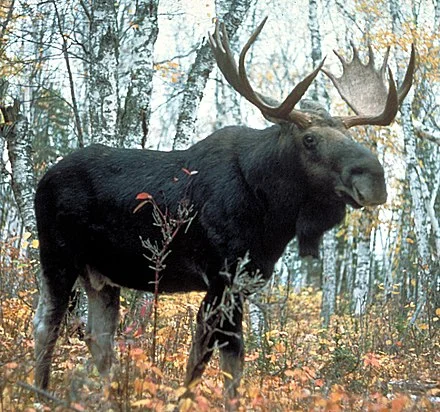
Home by Now
“New Hampshire air curls my hair like a child’s
hand curls around a finger. ‘Children?’ No,
we tell the realtor, but maybe a dog or two.
They’ll bark at the mail car (Margaret’s
Chevy Supreme) and chase the occasional
moose here in this place where doors are left
unlocked and it’s Code Green from sun-up…’’
— From “Home by Now,’’ by Meg Kearney

Don Pesci: On transactional journalism

An anti-Adams screed by James Callendar in the vicious presidential campaign of 1800.
VERNON, Conn.
Journalism, we are told, is suffering from two ailments: Fake news – some of the boys and girls are just pestiferous ideologues – and transactional journalism. Of the two, the more fatal is transactional journalism, because it perverts the very purpose of honest reporting, which is to tell the truth and shame the Devil.
Reporters who engage in transactional journalism are the Donald Trumps of the reportorial world. Journalism is, among other things, a business, and business orbits around access to a product. When he was attorney general of Connecticut for more than 20 years, Dick Blumenthal was a master at putting his product before the television cameras, so much so that it was said of him -- by journalists weary of having to make his frequent media releases into reportorial foie gras -- that there was no more dangerous place in Connecticut than the space between Blumenthal and a television camera.
Transactional journalism, as the name implies, involves a mutually beneficial arrangement – or a Faustian bargain, depending on your point of view -- between a politician and a journalist: The journalist will give the politician the kind of coverage he wants, and the politician will return the favor by giving the journalist the kind of access he needs; both are frauds parading as saints.
Investigative reporter Sharyl Attkisson discussed transactional journalism at the Hillsdale College (in Iliinois) National Leadership Seminar in 2018. She was presenting to the faculty and students of the college a modern iteration of an arrangement that is as old as the country.
The Adams-Jefferson campaign of 1800, truly vicious, was prosecuted by proxies; gentlemen of the time did not engage publicy in three ring campaign circuses. Jefferson, according to one surrogate defamer, president of Yale College at the time, presented a danger to virtuous wives and daughters. Should Jefferson become president, “we would see our wives and daughters the victims of legal prostitution.” A Connecticut newspaper warned that electing Jefferson would create a nation where “murder, robbery, rape, adultery and incest will openly be taught and practiced.”
Jefferson, for his part, found James Callender, an influential journalist of the day, a useful tool. Callender specialized in incendiary pamphleteering. Pulling out all the stops on his media organ, Callender, a satirist born in Scotland, wrote that Adams was a “rageful, lying, warmongering fellow,” a “repulsive pedant” and “gross hypocrite” who “behaved neither like a man nor like a woman but instead possessed a hideous hermaphroditical character.”
Callender had a private beef with Adams. He had been prosecuted and imprisoned by the Adams administration for violating the execrable Alien and Sedition Acts and was receiving payments for his seemingly objective journalism from Jefferson. To his credit, Callender later turned on Jefferson, authoring a series of newspaper articles alleging that Jefferson had sired children with Sally Hemings, one of his slaves.
Stumbling out of a bar in 1803, Callender drowned in the James River; so it was reported. However, there were doubters. Federalists suspected skullduggery since Callender was due to testify in a much publicized trial, The People vs. Croswell, involving charges against publisher Harry Croswell for having reprinted claims that Jefferson paid Callender to defame George Washington.
Two morals may be drawn from all this reportorial perfidy: 1) If you are a seasoned politician and want a good press, you should buy a sympathetic reporter; 2) If you are a bought reporter, stay bought, and avoid bars and rivers.
American campaigning and American political journalism were born in the same crib. In the good old days, newspapers were little more than party organs. Honest Abe Lincoln wrote editorials for a sympathetic paper under a pseudonym. The notion that the press is and ought to be non-partisan and objective is a modern aspiration, sometimes attained, sometimes not.
Attkisson sees transactional journalism as a noxious practice, fatal to honest journalism. The coin of the realm in transactional journalism is not money, but favorable news in return for access, which is corrupting on both ends; the reporter becomes a conveyance of partisan news, and the politician’s messaging is dishonestly sold as objective reporting. In biblical terms, the bought reporter sells his birthright of honest journalism for a mess of political pottage.
Attkisson’s book The Smear offers some timely advice followed by a warning: “One smear artist I interviewed said nearly every image you run across in daily life, whether it’s on the news, a comedian’s joke, a meme on social media or a comment on the Internet, was put there for a reason. It’s like scenes in a movie, he said. Nothing happens by accident. Sometimes people have paid a great deal of money to put those images before you. What you need to ask yourself isn’t so much ‘is it true,’ but ‘who wants me to believe it and why?’”
She warns that the firewall between political reporting and propaganda may easily be breached: “We are not keeping an adequate firewall, giving the very people access to the newsroom who are trying to sway our opinion and shape news coverage. I am often not sure what these pundits on both sides add, besides propaganda talking points. This is part of what I call the soft ‘infiltration’ of the news media. We haven’t done a good job at staying at arm’s length from the interests that seek to use us as tools.”
Don Pesci is a Vernon-based essayist.
Labels: Adams, Attkisson, Callender, Croswell, Hillsdale, Jefferson, Lincoln, The Smear, Trump
More troubled small colleges
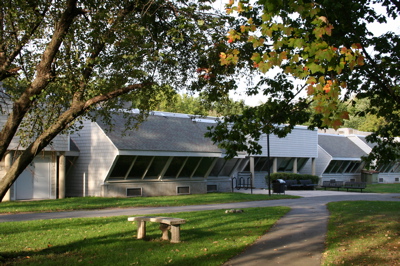
Emily Dickinson Hall at Hampshire College. The building was designed by the architecture firm of former faculty member Norton Juster, and and houses much of the space devoted to humanities at the college, including creative writing and theater. It’s named after the famed 19th Century poet, who lived in Amherst.
Adapted from Robert Whitcomb’s “Digital Diary,’’ in GoLocal24.com
A couple of minor private Massachusetts colleges have announced in the past year that they’re folding -- Mount Ida and Newbury colleges. And Green Mountain College, in Vermont, announced last week that’s closing. Small colleges have been closing around America at an accelerating rate but few of them have been particularly distinguished.
However, as the demographic and financial crisis of higher education mounts, some prestigious colleges must close, too, or merge with larger, nearby institutions. Still, it was a bit of a bombshell last Tuesday to learn that Hampshire College, in Amherst, Mass., is in serious enough trouble that it’s seeking a partner, and, I assume, might have to close if it doesn’t get one.
Will a nearby institution rescue Hampshire? If so, it will probably be one of the four that helped found Hampshire in 1965 (it opened for students in 1970} for experimentation in the liberal arts when the Baby Boomer population meant surging applications. Those are the University of Massachusetts at Amherst and Smith, Amherst and Mount Holyoke colleges. Hampshire and the four comprise the Five College Consortium, whose students can take course at any of the schools.
Hampshire is known for its alternative curriculum, emphasis on portfolios rather than course-distribution requirements and reliance on professors’ narrative assessments instead of grade point averages. Despite this seemingly touchy-feely approach, the college sends a big percentage of its graduates off to highly selective graduate schools.
Since 1970, Hampshire (sometimes affectionally called “Hamster’’) has become a sort of semi-elite institution. But its $52 million endowment is far too small for its ambitions and its applications have generally been slipping in recent years as they have at many other private colleges.
Hampshire, unlike some other economically challenged colleges, has not tried to turn itself into a glorified vocational school. Rather it has stuck with an emphasis on the liberal arts – an education that produces the most engaged and effective citizens. So I hope that some way may be found for Hampshire to survive with maximum independence and not just as a sort of experimental-education campus of one or more of the other four institutions in the Five College Consortium.
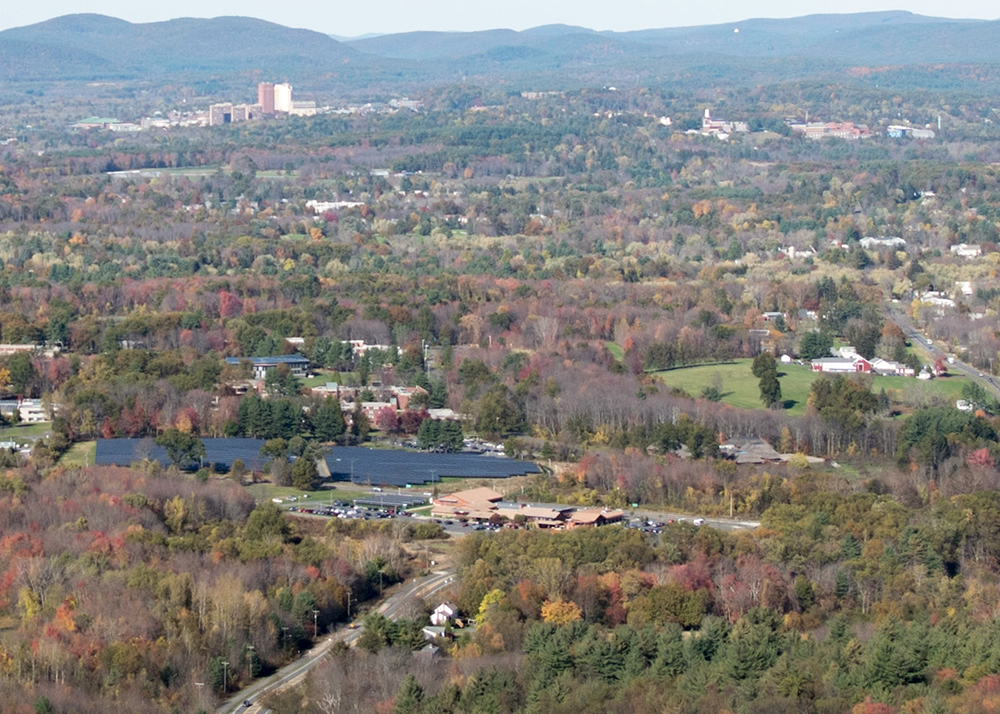
Hampshire College is in foreground, the University of Massachusetts at Amherst is in the upper left while Amherst College is in upper right. They comprise, with Smith and Mount Holyoke colleges, the Five College Consortium.
— Photo by MonsieurNapoleon