
Vox clamantis in deserto







Suffolk Construction to help employees pay off student loans
This is from The New England Council (newenglandcouncil.com)
“Suffolk Construction, of Boston, introduced a new benefits program this month that allows eligible employees to receive monthly contributions toward outstanding student loans. This effort is aimed at not only reducing the financial stress felt by employees, but also at helping them focus on long-term career growth.
In 2017, college seniors in the U.S. owed on average $28,650 in student loans, with 65 percent of them having received loans. Under Suffolk Construction’s new program, employees who are paying federal or private loans from a U.S. lender, borrowed for the financing of higher-education at an accredited institution, will receive a $100 per month contribution toward their loan payments. Suffolk Construction will make this possible by working with a Boston-based student loan repayment company,
Suffolk President and CEO John Fish stated “I’m a big believer in education – it means everything to me. But the truth is, more and more people are finding education to be a financial burden rather than a ticket to a successful life. My hope is that people see this student loan repayment benefit as an opportunity to focus less on the cost of education and more on the exciting future that education, and our industry, can offer.”
The New England Council commends Suffolk Construction, a NEC member, for its innovative approach in addressing the student debt crisis and its commitment to enhancing employee welfare.’’
Roots in the brine

In the Barn Island Wildlife Management Area, in eastern Connecticut.
“The winds linger here
In the wooded coves
Before crossing the Atlantic
Sauntering for a time
Among the oaks
Whose roots soak in the brine.’’
From “Roots in the Sea,’’ by L.M. Browning. Written on Barn Island, Stonington, Conn.
Crackling Maine

“Maine out of season is unmistakably a great destination: hospitable, good-humored, plenty of elbow room, short days, dark nights of crackling ice crystals.’’
— Paul Theroux, novelist and travel writer
School days in the Rhode Island State House

The Southernmost Schoolhouse, in Portsmouth, R.I., built in 1725 and the oldest surviving structure built for that purpose in the state. It’s now a museum owned by the New England Historical Society.
From Robert Whitcomb’s “Digital Diary,’’ in GoLocal24.com
‘Rhode Island Gov. Gina Raimondo’s second inaugural speech, starting off her second term, continued her emphasis on improving public education, which is essential to promote the state’s economic and civic health. Equally hopeful is that House Speaker Nicholas Mattiello and Senate President Dominick Ruggerio agreed last week that improving schools is central, with the latter calling for “a meaningful comparison of our education system with the system in Massachusetts,’’ considered by many people the nation’s best. Reversing the state’s mediocre record on public schools will take years but that prospect must not be allowed to dilute the sense of urgency about the task.
There are also some other things that the governor should she should take on, such as:
Addressing “affordable housing’’ and environmental challenges by leading an effort to reform zoning laws, including allowing more density in some places to encourage more housing construction (and thus curb housing-cost increases) and discourage sprawl. And while building light-rail lines in the more densely settled parts of the state could take up to a decade, state government should get the process started. That Greater Boston has lots of rail service is one big reason for its prosperity.
For that matter, the governor and the legislature should strive to make Rhode Island’s public policy, including taxes and regulation, as similar as possible to that of Massachusetts, the successful giant next door. Of course, Rhode Island is a much poorer state and so it will be tough….
The Ocean State’s political leaders should trim layers of government that citizens and companies must deal with so that it’s easier to get things done. This would mean in some cases reducing local control. Take Providence’s Route 195 relocation space, which is state land whose development has been slowed by municipal politics as well as by the city’s legal and regulatory red tape. Rhode Island is tiny and yet there are 39 cities and towns in it, all of course with their own rules. But the localities are legal children of the state, which has broad rights to change local powers.
The efforts that the governor cited to promote the rather murky concept of “inclusion,’’ while well-meaning, will have far less impact on the state than the factors above. In any case, political leaders should avoid identity politics and focus their efforts on doing as much as they can to improve life for everyone.
Separate but equal

“Friendship’’ ( gouache and graphite on paper), by Steven Cabral in the group show “Pushing Forward,’’ at Kingston Gallery, Boston, through Jan. 27.
David Warsh: The work revolution and the changing mix of cities
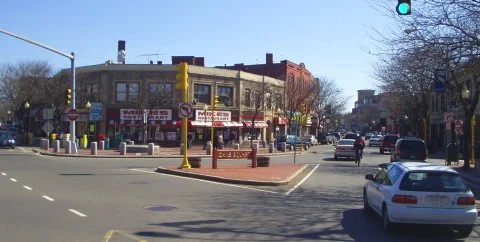
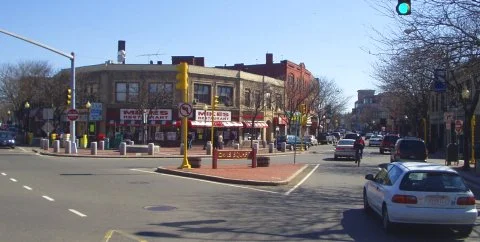
David Square, Somerville, which has become a boom town casting off its blue-collar history.
ATLANTA
I hadn’t driven far beyond this city before I came across what seemed to me to be the future, in the form of a Waffle House beside the Interstate highway. These restaurants are ubiquitous across the South; in method, if not in menu, they are equal and opposite to McDonald’s.
At McDonald’s, nearly all the workers are in the back, tending the machines. At Waffle House, everybody is out front: 10 or 12 staffers standing around behind a counter, everybody from the manager to a pair of griddle cooks whose backs were turned to me. The little restaurant contained a dozen counter seats and perhaps a dozen booths.
I was thinking about the lecture that I had heard 36 hours before at the annual meeting of the Allied Social Science Associations, “Work of the Past, Work of the Future,’’ by David Autor, of the Massachusetts Institute of Technology. Autor is best-known for his description, with David Dorn and Gordon Hanson, of the geography of the rapid decline of U.S. manufacturing work, especially after China entered the World Trade Organization in 2000 (“The China Shock”).
Ben Bernanke, former Federal Reserve Board chairman and incoming American Economic Association president, had invited him to speak. The Ely lecture is one occasion at the meetings, apart from the AEA presidential address, when nearly everything else comes to a halt.
Autor began by reminding listeners of the shrinking middle of the wage structure since 1980. Employment in high-skill categories has been steadily rising since then (management, professional, technician), and in low-skill jobs (health and personal services, cleaning and protection, operator/laborer); but more steadily declining in middle-skill employment (production, office administration, and sales). Middle-skill work had has been disappearing mainly in the cities, as workers have been replaced by software of one sort or another.
Next he described his surprise at the geography of the trend. Historically, rural areas were younger than the cities. He knew that the average population of rural areas had grown older. He had not known, until 72 hours before, that cities had become relatively younger than the countryside.
“I was so amazed by the figure that Juliette [Fournier, his co-author] and I did a complete clean room operation and reconstructed all the data from the get-go, just to be sure that there was not an error.”
There wasn’t. In the 1950s, rural counties were an average five years younger than cities. By the 1990s, city and country were about the same. But by 2010, cities were six years younger than rural areas. Rural counties had aged twelve years in the second half of the twentieth century, thanks to the emptying-out of the young; cities had aged an average of only two.
Why? Because the kids who used to move to cities for school, only to leave for the suburbs or for home, were now staying there – perhaps because cities are safer than they used to be, perhaps because wages are higher there, perhaps because opportunity is greater. That’s great, said Autor, but it is not clear there is a similar set of opportunities anywhere for less-educated workers of any age.
Autor asked whether new jobs coming into existence might fill in the middle, or contribute further to the bifurcation. It is not as easy to categorize new jobs as it sounds. Using a new measure based on periodic revisions to occupational classifications collected by the Census Bureau, Autor sorted emergent work into three broad categories: “frontier jobs”; “wealth work”; and “last-mile” jobs.
The terms were his; the method was developed a decade ago by economist Jeffrey Lin, of the Federal Reserve Bank of Philadelphia. The Census tracks 500 or so broad occupational groups, but underlying are some 36,000 job titles within them.
Frontier work, or Jetson jobs, after the early ‘60s sitcom of a family living in the distant future, are what you would expect: high-wage jobs requiring much education, usually predominantly performed by men. The frontier keeps moving: in the 1980s, the category included word-processing supervisors and drone pilots; today, molecular physicists, wind-turbine technician and echo cardiographers.
Wealth work involves catering to the comfort and well-being of the affluent, A large or larger set of jobs than frontier, requiring low to moderate education, a majority of them performed by women. New jobs in the 1980s included gift wrappers and hypnotherapists. By the 1990s, family marriage counselors, fingernail formers, and baristas had appeared. In the Oughts, oyster openers and sommeliers appeared in sufficient numbers to rate a mention.
Last mile jobs take their name, not from the distance to someone’s front door, but rather from the length of time before artificial intelligence software takes over the task completely. These are the husks of jobs that for the most part already have been automated, said Autor; Ghost Work: How to Stop Silicon Valley from Building a Global Underclass, is the title of Microsoft anthropologist Mary Gray’s forthcoming book. From tamale-machine feeders in the 1980s to vending-machine attendants in the 1990s to Amazon packagers and underground cable locators today, these jobs are grueling, low paid and most probably won’t be around for long. Often they can be done almost anywhere in the world.
Wages? The new work doesn’t pay much differently than old work in the present day: $18.78 an hour for the average of all workers; $26.89 for workers in frontier jobs; $18.49 for wealth Work, and $15.28 for the last mile trades. In short, said Autor, it is a great time to be young and educated, but it isn’t clear where a land of opportunity is to be found for adults with no college.
Some of this will be familiar to readers of The New Geography of Jobs (Houghton Mifflin Harcourt, 2012), by Enrico Moretti, of the University of California at Berkeley. That book had same galvanizing effect on impressions of the changing landscape of opportunity, as did Edge City: Life on the New Frontier (Anchor, 1991), by Joel Garreau. Moretti vaulted to the editorship of the Journal of Economic Perspectives.
Where Autor went an important step beyond, it seems to me, is in his assessment of rural opportunity. Work in nonmetropolitan areas is changing much more slowly than elsewhere, he said: Job structure, skill structure, wage structure, are all more stable. “People often say… I’ve said it myself, Why aren’t people moving out of Tennessee to some big city where they could get higher wages? Well, it’s much less obvious to me than before that the opportunity really exists….”
He concluded with a conjecture: “I suspect the fall in geographic mobility means something different from what I used to think – barriers of some sort, costs in the way. Increasingly I see it as a slowing of the moving out of places because they were thought to be unattractive, [because] increasingly, they are [attractive].
And that’s what I saw in the Georgia Waffle House, and the rural and semirural counties around it. Wealth is a relative phenomenon, and as long as you can afford cable television and $5 for a waffle, some sausage, and a cup of coffee, life in the countryside may be preferable in many respects to work in the office towers of downtown Atlanta. If you can afford to, you might as well stay home.
Returning to Somerville, Mass., a rapidly gentrifying city of 100,000 next to Cambridge and just across the Charles River from Boston, I heard one phrase in particular of Autor’s lecture ringing in my ears – to the effect that heightened pursuit of opportunity in cities had implications for politics and social structure there. He said:
"In a Democratic primary in Massachusetts’s Seventh Congressional District last September, Ayanna Pressley defeated Michael Capuano. Capuano was a 10-term progressive congressman well positioned in the Democratic Party’s’s leadership. Pressley was a Boston city councilor who had successfully led a campaign for more city liquor licenses. Here is what one veteran political analyst had to say about the race.
"Before Election Day, experts had pegged the probable turnout at between 50,000 and 80,000 – the kind of turnout that in this district is historically older and white, an advantage for Capuano. In fact, he won 42,000 votes, a total that in any other year would have meant a win. This time it meant an 18,000-vote drubbing
"Why? 106,000 people showed up to vote in this primary, in effect at least 25,000 new voters. And given where turnout surged, it’s clear the bulk of these voters came from Millennial and Gen X outposts, where voters were primed to vote for a candidate like Pressley – young, female and African American and, in their minds, the true progressive in the race.
"Somerville, Capuano’s hometown, is one such outpost. Formerly a blue-collar city known derisively as Slummerville, today it is home to soaring real estate prices, trendy restaurants and a largely white hipster and tech worker population. Eighteen thousand people voted in a city that generally sees 10,000 or 12,000 for a primary or municipal election. {Thus} Capuano, who played an instrumental role in transforming the city as mayor in the 90’s’’ was defeated in “in the thriving city he helped create.''
Trump’s misogyny and racism did the rest. The changing composition of superstar cities is a big story on every beat.
David Warsh, a veteran columnist and economic historian, is proprietor of Somerville-based economicprincipals.com, where this piece first ran.
Chris Powell: Conn. inauguration day needed more than giddy gush
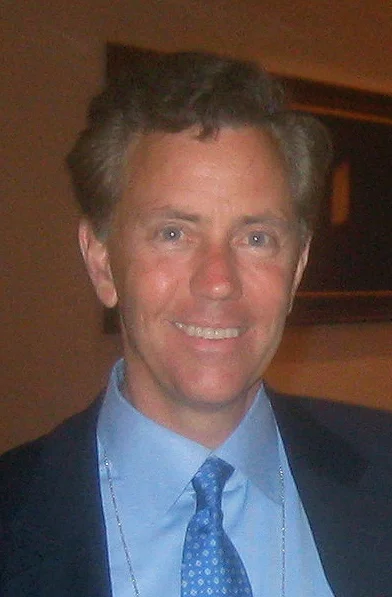
Connecticut’s new governor, Ned Lamont.
Democrats were entitled to celebrate on Inauguration Day in Hartford. Going into the recent election their record of eight years in control of state government was so much against them that no one of any standing in the party thought its nomination for governor was worth the trouble. So the nomination was left to two-time loser Ned Lamont on the understanding that he would finance his campaign with his own money, at least sparing the party the expense.
Whereupon, thanks to President Trump and an excess of political neophytes dividing their primary vote, Connecticut's Republicans self-destructed. So the Democrats simply repudiated their record and were rewarded with another term.
The forthcoming patronage and plunder would have intoxicated the Republicans too. But the giddy gush of Inauguration Day was a bit too much, from the invocation exalting political correctness, to the appeals to optimism and believing in the state despite its chronic insolvency and decline, to the new governor's emptily proclaiming to the General Assembly, "Let's fix this damn budget once and for all!"
Three of Lamont's four immediate predecessors as governor, who sat in the front row at the inauguration, might have wondered, "How's that again?" For fixing the budget [ITALICS] even once [END ITALICS] had been nearly impossible for them, and fixing it forever will be impossible as long as Connecticut has more special interests than civic virtue.
Saying he'll welcome "any good idea," Lamont advertises openmindedness and bipartisanship. But there is no shortage of ideas, and the basic ones are contradictory. From the start of the campaign last year right through the inaugural address there has been instead a shortage of people in authority able to distinguish the good ideas from the bad ones in any way that comes close to balancing revenue and expenditures.
People already know the choices and how politically inconvenient they are; that's why candidates avoided them. The optimism and good fellowship touted on Inauguration Day are nice but without a couple of dollars they won't buy anyone a cup of coffee at the Legislative Office Building cafeteria next week unless he has something to offer in return. Politics will devour optimism and good fellowship.
Lamont's gee-whiz manner -- Heaven help him if it is really his nature as well -- seems to have prevented him from saying what Connecticut needed to hear on Inauguration Day.
Becoming chief executive when the very survival of his country was in question, Winston Churchill offered only "blood, toil, tears, and sweat." Even so, he would add: "Do not let us speak of darker days. Let us speak rather of sterner days" -- days in which the country might be saved.
Though his times were not that stern, President Kennedy also famously demanded something of the people: "Ask not what your country can do for you. Ask what you can do for your country."
But on Inauguration Day the new governor barely managed a scolding: "Please don't tell me you've done your share and it's somebody else's turn. It's all of our turns."
It sounded like the policy of the discredited governor who had just gone out the door, Dannel P. Malloy -- "shared sacrifice" -- that is, raising taxes again to keep government employees happy. But why not? The Democrats are back in charge.
Chris Powell is a columnist for the Journal Inquirer, in Manchester, Conn.
Welcoming the 'crisp brass shout' of winter

In Franconia, N.H. Cannon Mountain ski area is in distance.
“After the long
Melancholy of the fall,
One longs for the crisp
Brass shout of winter—
The blaze of firewood,
The window’s spill
Of parlor lamplight
Across the snow.’’
— From “New Hampshire,’’ by Howard Moss
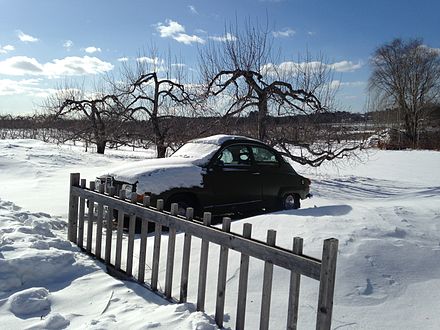
Bright but frigid day in Hollis, N.H.
Cold builds character?
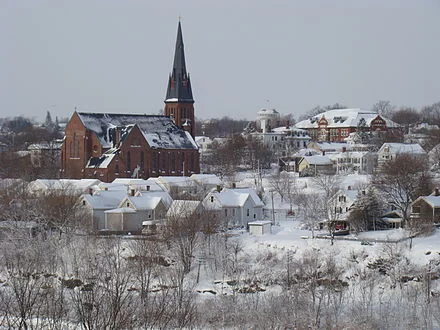
Bangor, Maine.
“Maine's long and cold winters may help keep our state's population low, but our harsh climate also accounts for what is unique and valuable about our land and our people.’’
— Former Maine Congressman Tom Allen
Cape boat on inland water

“Beetlecat on Weirs Beach’’ (in Laconia, N.H., on Lake Winnipesaukee} (watercolor), by Jon Fish, at the Art Complex Museum, Duxbury, Mass. These centerboard boats are most associated with Cape Cod.
Always looking for work
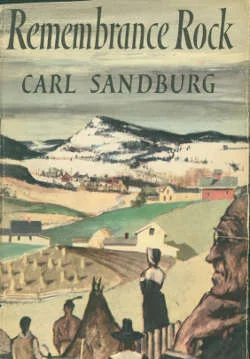
The cover of poet Sandburg’s only novel , published in 1948, was by Paul Sample, a Norwich, Vt.-based painter. The scene here is based on countryside near Sample’s home.
“Hard work was not only necessary, but it was also noble; and to avoid it would lead to disgrace, dishonor, and probably, to Hell itself. If a true Yankee ran out of work, he was expected to look for more.’’
— Lewis Hill, in Fetched-Up Yankee (2001), a memoir of the author’s Depression era boyhood in rural Vermont.
Troy Jackson/Mike Carpenter: Let Maine’s ‘The County’ help other New England states reach renewable-energy goals
Aroostook County, the largest and northernmost county in New England, is most famous for its potatoes. In Maine, Aroostook is often just called “The County.’’
From ecoRI News (ecori.org)
As state senators for Aroostook County in Maine, we plan to usher in a new era of renewable-energy investment in our state. And that means talking with our neighbors in other New England states about the benefits of siting projects in Maine to help them reach their renewable-energy goals, while at the same time inviting investment that helps us with property tax relief, jobs, and energy security.
One potential partner is due south, in Rhode Island. In 2017, Gov. Gina Raimondo set an ambitious goal to increase the amount of renewable energy serving Rhode Island to 1,000 megawatts by 2020. Rhode Island recently took a major step toward reaching that goal by issuing a request for proposals for 400 megawatts of renewable energy from a broad portfolio of resources, including solar and onshore and offshore wind, generated either in state or imported from another state.
We want Maine to be a partner in reaching that goal. The commitment that Rhode Island is making to renewable energy is laudable, and Maine’s new legislature and state government are ready to support it. Rhode Island has already established itself as an innovation leader in renewable energy, with the nation’s first offshore wind facility.
To ensure safe, reliable, affordable renewable energy for Rhode Islanders, the state needs to aim for a diversified energy mix, and that mix should include the cheapest form of renewable-energy generation: onshore wind.
Rhode Island has an opportunity to get affordable, sustainable renewable energy from Maine’s Number Nine Wind Farm. Located in Aroostook County, our home county, the largest and northernmost in New England, the Number Nine Wind Farm would generate 250 megawatts of renewable power — enough energy to power some 109,000 average Rhode Island homes annually. That amount of power would save more than 383,000,000 gallons of water each year, and be the equivalent of taking more than 122,000 cars off the road.
Wind energy also enhances air quality by helping to mitigate the health effects of harmful air pollutants.
Closer to home, this project will mean significant property tax revenue, helping to alleviate property tax burden of Aroostook County residents. EDP Renewables has also committed funds to help Aroostook County residents offset burdensome home-heating costs.
Additionally, development of the Number Nine Wind Farm, and the electrical transmission supporting it, will be an important step toward a long-deferred dream of connecting northern Aroostook County to the New England electrical grid — in much the same way that Block Island was connected to the larger regional grid in conjunction with the development of the nation’s first offshore wind farm.
The advantages of the Number Nine Wind Farm go beyond its cost-effectiveness for ratepayers. The project will provide profound economic benefits to New England in the form of hundreds of full-time jobs during its construction, dozens of permanent jobs during the life of the project, as well as increased regional economic activity that will continue throughout the project’s lifetime.
Number Nine is good for Rhode Island and for Aroostook County, and that’s why we support it.
Rhode Island has already begun reaping the benefits of the Number Nine project, in the form of a partnership between EDP Renewables and the New England Institute of Technology to develop and train workers with the knowledge and technical skills required for wind-energy generation. By creating renewable-energy jobs and supporting high-quality training for local people who aspire to work in them, EDP Renewables has demonstrated its commitment to the state, and to the future of renewable energy in New England and beyond.
The Number Nine Wind Farm represents the culmination of more than 15 years of development activity seeking to harness the powerful wind resource of Aroostook County. Number Nine’s owner and eventual operator is one of the leading developers of onshore wind in the country, so Rhode Islanders and Mainers alike can rest assured that this project will be operated at the highest standards throughout its life. Equally important, this well-engineered and comprehensively reviewed project enjoys the support of Maine citizens, elected officials and community leaders, who recognize the economic and environmental value it brings.
The question before Rhode Island now is what renewable-energy projects are best positioned to meet the state’s ambitious energy goals. The answer, my friends, is blowing in the wind …. from Maine.
Troy Jackson is a Democratic state senator from Maine’s 1st Senate District and is the president of the Maine Senate. Mike Carpenter, also a Democrat, is a six-term state senator from Maine’s 2nd Senate District.
Rise and freeze

In the cold I will rise, I will bathe
In waters of ice; myself
Will shiver, and shrive myself,
Alone in the dawn, and anoint
Forehead and feet and hands;
I will shutter the windows from light,
I will place in their sockets the four
Tall candles and set them a-flame
In the gray of the dawn; and myself
Will lay myself straight in my bed,
And draw the sheet under my chin.
— “The Lonely Death,’’ by Adelaide Crapsey (1878-1914)
Senator Warren's campaign

Elizabeth Warren.
From Robert Whitcomb’s “Digital Diary,’’ in GoLocal24.com
‘Stranger things have happened, but it seems highly unlikely that Massachusetts Sen. Elizabeth Warren can win the 2020 Democratic presidential nomination; she has staked out some admirable (if maybe unrealistic) positions on addressing yawning income inequality, on breaking up increasingly monopolistic companies in the tech and some other sectors; on the need for close oversight of the financial-services sector, parts of which engage in massive fraud and out-of-control speculation from time to time, and where some institutions have become “too big to fail,’’ and she backs some kind of “Medicare for all.’’ She has positioned herself as a latter-generation New Dealer.
But she can come across as strident, and coming from Massachusetts is not particularly beneficial for a national candidate. Senator Warren also is often seen as “anti-business,’’ although she calls herself “a capitalist to my bones.’’ She, at 69, is also old, as are some other possible Democratic candidates (and Trump). I’m leery of people over 70 assuming the presidency; at that stage of life you could be seemingly very healthy one minute, and fall apart in the next, mentally and/or physically. (Yes, I know that Ronald Reagan was in his 70s when he served. Thank God that he had a superb staff in his second term….)
The Democrats would do best to nominate someone like Ohio Sen. Sherrod Brown or Minnesota Sen. Amy Klobuchar. They’re both very smart, have engaging personalities, and, importantly, can’t be accused of being “East Coast elitists,’’ which is how Senator Warren is labeled despite the fact that she comes from a poor family in Oklahoma and has long fought for the socio-economically disadvantaged.
Whether or not Trump runs for re-election, the Democrats should have a good chance of winning back the White House. While congressional gerrymandering and the power of business lobbyists in Washington have usually suppressed reforms sought by liberals, the majority of Americans think that the rich have too much power in Washington and are very concerned about income inequality; support Medicare-for-all; favor raising taxes if necessary to preserve Social Security, and like labor unions. There’s not as much polarization on policies as you might think. And it bears noting that Democratic presidential candidates got more popular votes than Republican nominees in four of the past five elections.
Then there’s the strong likelihood that we’ll have a recession, perhaps a deep one, between now and the 2020 election. The GOP will be blamed for it, as it was in the 2008 financial crisis.
More like survival of the fittest

“Courtship,’’ by John Owen, in the “39th Annual Juried Photography Show’’ at the Carriage Barn Arts Center, New Canaan, Conn., through Feb. 15.
Llewellyn King: Perhaps Trump should consider a beautiful ha-ha wall.

President Trump has sought to conflate walls with wheels. In a call-in to Fox and in several tweets, he declared both as having been around for a long a time and that they’ve proven themselves.
In a tweet last month, he said, “Democrats are trying to belittle the concept of a WALL, calling it old fashioned. The fact is there is nothing else’s that will work, and that has been true for thousands of years. It’s like the wheel, there is nothing better. I know tech better than anyone. ….”
I’m with Trump on wheels. I’m a fan of wheels. They work, walls less so; walls are heavily invested in failure, as a psychiatrist might say.
You can get by without wheels, but you’d be ill-advised. The Incas built a great civilization without the round things. Amazing. Don’t try it. Likewise Great Zimbabwe, the center of a Southern African civilization in medieval times, was also wheel-free and has some beautiful walls, all built without grout. The stones just sit there, collaborating if you will. This construction isn’t recommended where stone-throwing is prevalent. You’ll get your wall thrown in your face.
When it comes to wheels, we are so deep into the wheel culture that one’s head goes round and round. The greatest invention of the last few years was, without doubt, adding wheels to luggage. What took so long? Well, the wheels do have super nylon bearings and are better than the old wheels, but even so …
There’s a downside: Bellhops, porters and others have been, well, wheeled away. Sort of like grain-grinders before the mill wheel sent them back to wherever old mortar and pestle people go -- probably into building walls.
There are forever new uses for wheels, like giant flywheels that can store untold amounts of energy. Nifty eh? These are the solution to the “alternatives,” like wind and solar, making too much electricity when everyone is at work or asleep. Downside: this wheel, with as much energy as hundreds of locomotives, is also an inadvertent weapon of mass destruction. If it gets loose and goes wandering through your town, wheelie mayhem.
Walls are really without equal for houses and buildings. After that, their history has been troubled. Emperor Hadrian, something of an architect, built a wall in order to keep undesirables out of Rome’s Britannica province. It stretched from sea to sea across northern England, only 174 miles. Yes, he had the army build it along with a ditch. They put it up -- using stone, earth and wood -- in six years. Its greatest use has been as a tourist attraction.
Ditto the Great Wall protecting northern China. A lot of China’s enemies, like the Mongols, Japanese and British, found it easy to get over or to come by sea. It, too, is a big tourist attraction nowadays. The story of walls is they pay for themselves, if you can wait a couple of thousand years.
As for the purpose of keeping people in or out, the Berlin Wall must get a prize. It was a great concrete-and-barbed-wire job, but the thing that made it work were the shoot-to-kill guards. No rushing it a second or third time.
In Cyprus, Northern Ireland and Israel walls have been erected to keep people apart. Trump wants keep people out and apart, but he has no idea how this will stimulate people to get around, over, under or just to find new access.
Most walls that have stood the test of time have been built of masonry because it lasts. Steel has a short life: It rusts and requires constant expensive painting or maintenance.
All references to the Trump wall suggest that it sticks up, maybe 30 feet. He might investigate a ha-ha wall. They are the wall equivalent of infinity pools. The ground looks level and verdant, but a deep ditch or trench faces an impregnable vertical wall below the surface level. These were favored around Australian lunatic asylums in the 19th Century. When the poor inmates tried to make a break they were, in fact, walled in – hence, the ha-ha. Maybe it’s what we need on the southern border, inconspicuous and effective.
Llewellyn King is executive producer and host of White House Chronicle, on PBS. He’s based in Rhode Island and Washington, D.C., and his email address is llewellynking1@gmail.com

Ha-ha protecting the lawn at Hopetoun House, West Lothian, Scotland. Note how the wall disappears from view as it curves away to the left of the picture.
By the book

This library, like many across America, was partly funded by money from steel mogul Andrew Carnegie. It was built in 2008.
Adapted from Robert Whitcomb’s “Digital Diary,’’ in GoLocal24.com
The Library Book, by Susan Orlean, is a riveting mystery story, a history of Los Angeles and most of all a love story about public libraries everywhere and the key civic role they play around America, through an exploration of the Los Angeles Public Library, with its Art Deco central building and the passionate people who carry out its mission in starring roles.
You come away from reading Ms. Orlean’s book with a keener appreciation of how important –in some ways more important than ever – public libraries are as learning and community centers in a time of privatization and online personal insularity.
New England, for its part, is fortunate to have such great urban institutions as the Boston and Providence public libraries as well as many beautiful small-town libraries, many dating back to the 19th Century.