Don Morrison: Learning how to father
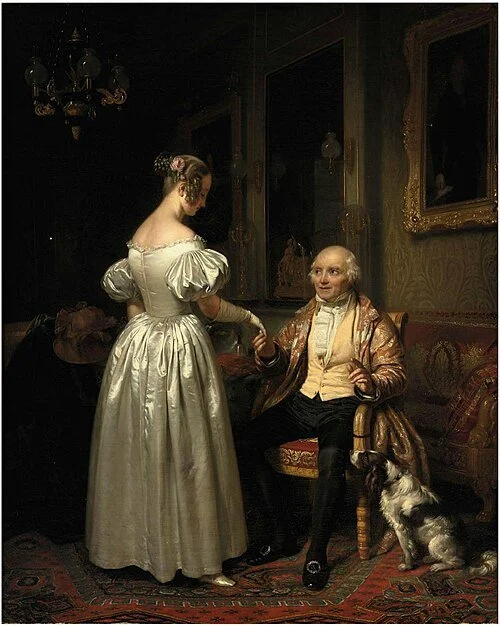
“Paternal Advice,’’ by Josephus Laurentius Dyckmans
PITTSFIELD, Mass.
Sonora Smart Dodd was 16 years old when, in 1898, her mother died in childbirth. The baby survived, and Sonora helped her beleaguered father raise the boy and his four older brothers on a farm outside Spokane, Wash.
One Sunday morning, after sitting through a church sermon praising the new Mother’s Day celebrations popping up around the country, she decided that fathers deserved equal recognition.
Sonora began lobbying local church leaders, and on June 19, 1910 — her father’s 68th birthday — Spokane marked America’s first Father’s Day. The idea caught on, and in 1972 President Richard Nixon established the third Sunday in June as a national holiday in honor of dads.
This Sunday, once again, Americans will come together to salute their family patriarch with gifts of neckties and power tools as he grills various meat products to cinders. The day also gives us an opportunity to reflect on what fatherhood has become in this age of fractured families, shifting gender roles and proliferating views of masculinity.
Everybody has a father — present, absent or long gone — so nearly all of us can claim some familiarity with the job, regardless of how it was handled. My own dad was a man of his time. To him, a father’s main role was as family breadwinner. He focused on running his retail store while our mom raised the little ones. Eventually, the business faltered, and she began working alongside him, entrusting us kids to a shifting pageant of paid help.
That wasn’t rare in our dying little town. So I almost didn’t notice when, a few decades later, mothers began joining the U.S. workforce in record numbers as their spouses took on more child-rearing and housekeeping responsibilities.
My own wife went back to work shortly after our first son was born. She found a terrific babysitter, who remained with us for years, and I got to learn a few domestic skills.
In truth, I was never good at diaper-changing, skinned-knee disinfecting, bedtime storytelling and other elements of effective parenting, but I did find such chores surprisingly satisfying. Only later did I realize why.
Neuroscientists have found that the brains of new fathers are altered by the birth of their first child. Neuronal patterns change and dormant hormones stir. Testosterone-fueled assertiveness is crowded out by oxytocin-infused feelings of tenderness and generosity. Touching or merely being near their kids brings unaccustomed pleasure. Not for nothing did God and evolution make the little nippers so adorable.
Thus, I was not surprised when the role of paterfamilias began shifting a few decades ago from my dad’s mostly hands-off approach to a deeper male involvement in the details of child-raising.
Not every father is OK with that change. Traditionalists see the blending of parental roles as troublingly “woke,” or inefficient, or bad for children. Some husbands are uncomfortable with the idea of wives working outside the home, and some moms simply aren’t interested in doing so.
That’s fine. The world of kid-raising has room for multiple approaches, and children can thrive under a variety of family arrangements — provided these offer love, safety and stability. For a father, psychologists say, being a presence in his kids’ lives is crucial, even if he and their mom eventually split.
One of the nice things about Father’s Day is that it honors all who have taken up that responsibility. The celebration doesn’t favor some theories over others, new fathers over veterans, live-in dads over separated ones. What counts is that the guy stays in the picture.
That’s why the third Sunday of June is one of my favorite holidays. It’s an equal-opportunity, non-judgmental celebration. If you’ve fathered, you qualify.
When my first son was born, I consulted books and articles about how to raise him. Yet the recommendations seemed simplistic, sometimes confusing. So I winged it, made stuff up as I went along, even borrowed some moves from my dad — like trying to make each kid feel special. I no doubt committed a few mistakes, such as assuming their world was similar to the one in which I grew up. Still, both of my sons turned out better than fine.
I recently recalled the moment when, in the maternity ward, I gazed into the eyes of my firstborn. He seemed remarkably self-asssured. I realized that much of who he would become was already present, and that my ask was less to shape him than to support him. The best I could ever do was keep him safe and make him feel valued.
That’s not such an easy task for a stressed-out dad in a high-pressure job, and my joys were tempered with doubt and anxiety. But the years flew by, and the kids have retained their self-assurance. They are now raising their own cubs.
I resist giving advice. Though staying engaged is important, fatherhood is ultimately a journey each man must navigate for himself. He may falter, but he plods on.
As Sonora Smart Dodd understood more than a century ago, being a dad is one of the most demanding, most rewarding jobs in the world. Sure was for me and, I hope, fellow dads everywhere. Happy Father’s Day to us all.
Don Morrison is a veteran international editor, writer and lecturer. He’s also co-chairman of The Berkshire Eagle editorial advisory board.