
Vox clamantis in deserto






Always looking for work

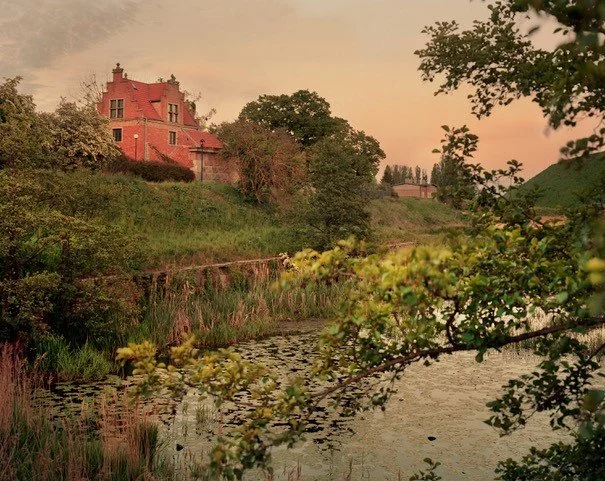
The cover of poet Sandburg’s only novel , published in 1948, was by Paul Sample, a Norwich, Vt.-based painter. The scene here is based on countryside near Sample’s home.
“Hard work was not only necessary, but it was also noble; and to avoid it would lead to disgrace, dishonor, and probably, to Hell itself. If a true Yankee ran out of work, he was expected to look for more.’’
— Lewis Hill, in Fetched-Up Yankee (2001), a memoir of the author’s Depression era boyhood in rural Vermont.
Troy Jackson/Mike Carpenter: Let Maine’s ‘The County’ help other New England states reach renewable-energy goals
Aroostook County, the largest and northernmost county in New England, is most famous for its potatoes. In Maine, Aroostook is often just called “The County.’’
From ecoRI News (ecori.org)
As state senators for Aroostook County in Maine, we plan to usher in a new era of renewable-energy investment in our state. And that means talking with our neighbors in other New England states about the benefits of siting projects in Maine to help them reach their renewable-energy goals, while at the same time inviting investment that helps us with property tax relief, jobs, and energy security.
One potential partner is due south, in Rhode Island. In 2017, Gov. Gina Raimondo set an ambitious goal to increase the amount of renewable energy serving Rhode Island to 1,000 megawatts by 2020. Rhode Island recently took a major step toward reaching that goal by issuing a request for proposals for 400 megawatts of renewable energy from a broad portfolio of resources, including solar and onshore and offshore wind, generated either in state or imported from another state.
We want Maine to be a partner in reaching that goal. The commitment that Rhode Island is making to renewable energy is laudable, and Maine’s new legislature and state government are ready to support it. Rhode Island has already established itself as an innovation leader in renewable energy, with the nation’s first offshore wind facility.
To ensure safe, reliable, affordable renewable energy for Rhode Islanders, the state needs to aim for a diversified energy mix, and that mix should include the cheapest form of renewable-energy generation: onshore wind.
Rhode Island has an opportunity to get affordable, sustainable renewable energy from Maine’s Number Nine Wind Farm. Located in Aroostook County, our home county, the largest and northernmost in New England, the Number Nine Wind Farm would generate 250 megawatts of renewable power — enough energy to power some 109,000 average Rhode Island homes annually. That amount of power would save more than 383,000,000 gallons of water each year, and be the equivalent of taking more than 122,000 cars off the road.
Wind energy also enhances air quality by helping to mitigate the health effects of harmful air pollutants.
Closer to home, this project will mean significant property tax revenue, helping to alleviate property tax burden of Aroostook County residents. EDP Renewables has also committed funds to help Aroostook County residents offset burdensome home-heating costs.
Additionally, development of the Number Nine Wind Farm, and the electrical transmission supporting it, will be an important step toward a long-deferred dream of connecting northern Aroostook County to the New England electrical grid — in much the same way that Block Island was connected to the larger regional grid in conjunction with the development of the nation’s first offshore wind farm.
The advantages of the Number Nine Wind Farm go beyond its cost-effectiveness for ratepayers. The project will provide profound economic benefits to New England in the form of hundreds of full-time jobs during its construction, dozens of permanent jobs during the life of the project, as well as increased regional economic activity that will continue throughout the project’s lifetime.
Number Nine is good for Rhode Island and for Aroostook County, and that’s why we support it.
Rhode Island has already begun reaping the benefits of the Number Nine project, in the form of a partnership between EDP Renewables and the New England Institute of Technology to develop and train workers with the knowledge and technical skills required for wind-energy generation. By creating renewable-energy jobs and supporting high-quality training for local people who aspire to work in them, EDP Renewables has demonstrated its commitment to the state, and to the future of renewable energy in New England and beyond.
The Number Nine Wind Farm represents the culmination of more than 15 years of development activity seeking to harness the powerful wind resource of Aroostook County. Number Nine’s owner and eventual operator is one of the leading developers of onshore wind in the country, so Rhode Islanders and Mainers alike can rest assured that this project will be operated at the highest standards throughout its life. Equally important, this well-engineered and comprehensively reviewed project enjoys the support of Maine citizens, elected officials and community leaders, who recognize the economic and environmental value it brings.
The question before Rhode Island now is what renewable-energy projects are best positioned to meet the state’s ambitious energy goals. The answer, my friends, is blowing in the wind …. from Maine.
Troy Jackson is a Democratic state senator from Maine’s 1st Senate District and is the president of the Maine Senate. Mike Carpenter, also a Democrat, is a six-term state senator from Maine’s 2nd Senate District.
Rise and freeze

In the cold I will rise, I will bathe
In waters of ice; myself
Will shiver, and shrive myself,
Alone in the dawn, and anoint
Forehead and feet and hands;
I will shutter the windows from light,
I will place in their sockets the four
Tall candles and set them a-flame
In the gray of the dawn; and myself
Will lay myself straight in my bed,
And draw the sheet under my chin.
— “The Lonely Death,’’ by Adelaide Crapsey (1878-1914)
Senator Warren's campaign

Elizabeth Warren.
From Robert Whitcomb’s “Digital Diary,’’ in GoLocal24.com
‘Stranger things have happened, but it seems highly unlikely that Massachusetts Sen. Elizabeth Warren can win the 2020 Democratic presidential nomination; she has staked out some admirable (if maybe unrealistic) positions on addressing yawning income inequality, on breaking up increasingly monopolistic companies in the tech and some other sectors; on the need for close oversight of the financial-services sector, parts of which engage in massive fraud and out-of-control speculation from time to time, and where some institutions have become “too big to fail,’’ and she backs some kind of “Medicare for all.’’ She has positioned herself as a latter-generation New Dealer.
But she can come across as strident, and coming from Massachusetts is not particularly beneficial for a national candidate. Senator Warren also is often seen as “anti-business,’’ although she calls herself “a capitalist to my bones.’’ She, at 69, is also old, as are some other possible Democratic candidates (and Trump). I’m leery of people over 70 assuming the presidency; at that stage of life you could be seemingly very healthy one minute, and fall apart in the next, mentally and/or physically. (Yes, I know that Ronald Reagan was in his 70s when he served. Thank God that he had a superb staff in his second term….)
The Democrats would do best to nominate someone like Ohio Sen. Sherrod Brown or Minnesota Sen. Amy Klobuchar. They’re both very smart, have engaging personalities, and, importantly, can’t be accused of being “East Coast elitists,’’ which is how Senator Warren is labeled despite the fact that she comes from a poor family in Oklahoma and has long fought for the socio-economically disadvantaged.
Whether or not Trump runs for re-election, the Democrats should have a good chance of winning back the White House. While congressional gerrymandering and the power of business lobbyists in Washington have usually suppressed reforms sought by liberals, the majority of Americans think that the rich have too much power in Washington and are very concerned about income inequality; support Medicare-for-all; favor raising taxes if necessary to preserve Social Security, and like labor unions. There’s not as much polarization on policies as you might think. And it bears noting that Democratic presidential candidates got more popular votes than Republican nominees in four of the past five elections.
Then there’s the strong likelihood that we’ll have a recession, perhaps a deep one, between now and the 2020 election. The GOP will be blamed for it, as it was in the 2008 financial crisis.
More like survival of the fittest
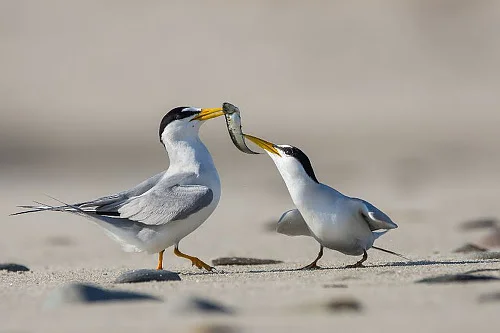
“Courtship,’’ by John Owen, in the “39th Annual Juried Photography Show’’ at the Carriage Barn Arts Center, New Canaan, Conn., through Feb. 15.
Llewellyn King: Perhaps Trump should consider a beautiful ha-ha wall.

President Trump has sought to conflate walls with wheels. In a call-in to Fox and in several tweets, he declared both as having been around for a long a time and that they’ve proven themselves.
In a tweet last month, he said, “Democrats are trying to belittle the concept of a WALL, calling it old fashioned. The fact is there is nothing else’s that will work, and that has been true for thousands of years. It’s like the wheel, there is nothing better. I know tech better than anyone. ….”
I’m with Trump on wheels. I’m a fan of wheels. They work, walls less so; walls are heavily invested in failure, as a psychiatrist might say.
You can get by without wheels, but you’d be ill-advised. The Incas built a great civilization without the round things. Amazing. Don’t try it. Likewise Great Zimbabwe, the center of a Southern African civilization in medieval times, was also wheel-free and has some beautiful walls, all built without grout. The stones just sit there, collaborating if you will. This construction isn’t recommended where stone-throwing is prevalent. You’ll get your wall thrown in your face.
When it comes to wheels, we are so deep into the wheel culture that one’s head goes round and round. The greatest invention of the last few years was, without doubt, adding wheels to luggage. What took so long? Well, the wheels do have super nylon bearings and are better than the old wheels, but even so …
There’s a downside: Bellhops, porters and others have been, well, wheeled away. Sort of like grain-grinders before the mill wheel sent them back to wherever old mortar and pestle people go -- probably into building walls.
There are forever new uses for wheels, like giant flywheels that can store untold amounts of energy. Nifty eh? These are the solution to the “alternatives,” like wind and solar, making too much electricity when everyone is at work or asleep. Downside: this wheel, with as much energy as hundreds of locomotives, is also an inadvertent weapon of mass destruction. If it gets loose and goes wandering through your town, wheelie mayhem.
Walls are really without equal for houses and buildings. After that, their history has been troubled. Emperor Hadrian, something of an architect, built a wall in order to keep undesirables out of Rome’s Britannica province. It stretched from sea to sea across northern England, only 174 miles. Yes, he had the army build it along with a ditch. They put it up -- using stone, earth and wood -- in six years. Its greatest use has been as a tourist attraction.
Ditto the Great Wall protecting northern China. A lot of China’s enemies, like the Mongols, Japanese and British, found it easy to get over or to come by sea. It, too, is a big tourist attraction nowadays. The story of walls is they pay for themselves, if you can wait a couple of thousand years.
As for the purpose of keeping people in or out, the Berlin Wall must get a prize. It was a great concrete-and-barbed-wire job, but the thing that made it work were the shoot-to-kill guards. No rushing it a second or third time.
In Cyprus, Northern Ireland and Israel walls have been erected to keep people apart. Trump wants keep people out and apart, but he has no idea how this will stimulate people to get around, over, under or just to find new access.
Most walls that have stood the test of time have been built of masonry because it lasts. Steel has a short life: It rusts and requires constant expensive painting or maintenance.
All references to the Trump wall suggest that it sticks up, maybe 30 feet. He might investigate a ha-ha wall. They are the wall equivalent of infinity pools. The ground looks level and verdant, but a deep ditch or trench faces an impregnable vertical wall below the surface level. These were favored around Australian lunatic asylums in the 19th Century. When the poor inmates tried to make a break they were, in fact, walled in – hence, the ha-ha. Maybe it’s what we need on the southern border, inconspicuous and effective.
Llewellyn King is executive producer and host of White House Chronicle, on PBS. He’s based in Rhode Island and Washington, D.C., and his email address is llewellynking1@gmail.com

Ha-ha protecting the lawn at Hopetoun House, West Lothian, Scotland. Note how the wall disappears from view as it curves away to the left of the picture.
By the book
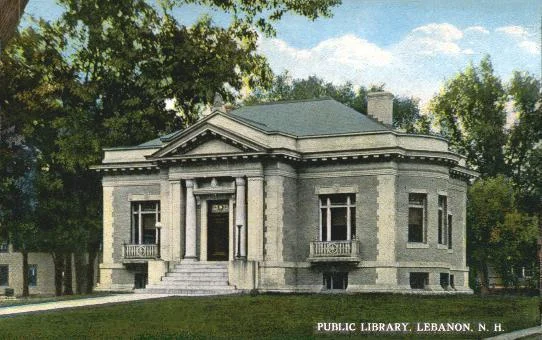
This library, like many across America, was partly funded by money from steel mogul Andrew Carnegie. It was built in 2008.
Adapted from Robert Whitcomb’s “Digital Diary,’’ in GoLocal24.com
The Library Book, by Susan Orlean, is a riveting mystery story, a history of Los Angeles and most of all a love story about public libraries everywhere and the key civic role they play around America, through an exploration of the Los Angeles Public Library, with its Art Deco central building and the passionate people who carry out its mission in starring roles.
You come away from reading Ms. Orlean’s book with a keener appreciation of how important –in some ways more important than ever – public libraries are as learning and community centers in a time of privatization and online personal insularity.
New England, for its part, is fortunate to have such great urban institutions as the Boston and Providence public libraries as well as many beautiful small-town libraries, many dating back to the 19th Century.
Pushing back against gentrification of Boston's Chinatown

“Two Sisters’’ (oil on reprographics on wood), by Wen-Ti Tsen, in his show “Mister,’’ at Milton Academy’s Nesto Gallery, in Milton, Mass., through Feb. 22.
The show focuses on his series “Home Town: Re-presenting {Boston’s} Chinatown as a Place of People’'. The artist is known for addressing such topics as migration, identity and politics, and “Home Town’’ is no exception. The series is a visual pushback against the gentrification of Chinatown, drawing attention to the part of Chinatown that matters most to him: its people.

Todd McLeish: Efforts to save New England cottontails pick up steam

New England cottontail.
— Photo by M. Poole, U.S. Fish and Wildlife Service.
From ecoRI News (ecori.org)
More rare New England cottontails were raised at Roger Williams Park Zoo, in Providence, and the Queens Zoo, in New York City, and released into the wild than ever before, according to conservation officials. The success is a positive sign , populations of the region’s only native rabbit, which had declined precipitously in recent decades because of habitat loss, hunting, and competition with the introduced eastern cottontail.
Seventy-seven New England cottontails were raised and weaned at the two zoos in 2018, almost double the number weaned in each of the past few years. Including animals taken from a breeding colony on Patience Island in Narragansett Bay, about 100 cottontails were released into the wild in Rhode Island, New Hampshire, and Maine last year.
“Our goal is to breed as many rabbits as we can throughout the breeding season, but it’s challenging,” said Lou Perrotti, the director of conservation at the Roger Williams Park Zoo and the coordinator of the zoo’s cottontail breeding program. “They don’t always breed like rabbits.”
The reason for the tremendous breeding success in 2018 is still a mystery, however.
“I wish I knew why it was so successful,” Perrotti said. “We didn’t do anything different.”
“We’re somewhat baffled ourselves,” added Heidi Holman, a wildlife biologist for the New Hampshire Fish and Game Department and chair of the New England Cottontail Population Management Working Group. “We’ll continue to review our data in more detail to see if we can tease out a variable, but there doesn’t seem to be any particular thing we can put our thumbs on just yet to explain it.”
The breeding program began in 2010 with six cottontails collected from a wild population in Connecticut. Since then, 163 litters have resulted in 301 weaned cottontails, mostly raised at Roger Williams Park Zoo. The Queens Zoo joined the effort in 2015.
Once the rabbits are about 35 days old, they are removed from the zoos and brought to what the biologists call “hardening pens” at Ninigret National Wildlife Refuge, in Charlestown, R.I., or the Great Bay National Wildlife Refuge, in New Hampshire, to become acclimated to natural conditions. After they spend several weeks or months adjusting to the environment, gaining weight, and learning to hide and forage, they are released into the wild.
Decisions about which animals are released in which location are based largely on their genetics.
“We’re trying to diversity the gene pool and track who’s successfully mating so we’re not over-representing particular genes in any one population,” Holman said.
Representatives from each state in the region submit what Perrotti called “a wish list” of how many cottontails they would like to release in their state annually, and based on the number of animals available and their genetic makeup, the rabbits are divvied up and delivered.
New Hampshire and Maine have experienced the largest decline in their New England cottontail populations, so they receive animals each year for release. Cottontail populations in Massachusetts and Connecticut are more robust, and wildlife officials there believe they may be able to increase the populations by manipulating habitat rather than augmenting the population with captive-bred rabbits.
In Rhode Island, New England cottontails were initially released on Patience Island, which at last count had between 56 and 90 animals, according to T.J. McGreevey, a researcher at the University of Rhode Island who serves as the wildlife geneticist on the cottontail project. A total of 51 rabbits from Patience have been released elsewhere in the past three years, including in the Great Swamp Wildlife Management Area in West Kingston.
“The Patience Island population is being managed to prevent it from reaching carrying capacity,” Holman said. “It could crash from disease or starvation if it grew too high, so we’re managing it to keep the population healthy. That’s why we remove some animals from there.”
Another sign of the success of the breeding program is documentation that some of the released animals are reproducing in the wild. New England cottontails released at the Bellamy River Wildlife Management Area in New Hampshire have been reproducing since 2013. Reproduction was documented among the cottontails released at the Great Swamp in 2017.
As successful as the program has been during the past eight years, it’s still well below its target of releasing 500 cottontails annually. To increase breeding capacity, the researchers plan to establish a new breeding colony this year on Nomans Land, a 612-acre uninhabited island off the coast of Martha’s Vineyard. Other islands are being considered for similar colonies in the future.
In addition, the Bristol County Agricultural High School, in Dighton, Mass., has offered to provide assistance in rearing cottontails for the project. The school has successfully raised several varieties of rare turtles for release in the wild since 2012. Other partner organizations will likely be added in the future.
“We’ve set the bar at 500 per year, and we’ll see if we can get there,” Holman said. “But we’re just getting started. The conservation strategy we’re following will continue through 2030. We’re still out there actively trying to create more habitat, and some of that habitat is just getting ready to have rabbits. We should have more places to release them very soon. And we’re continuing to collect information on how they survive and make sure we adapt our protocols to improve that success as much as we can.”
Rhode Island resident and author Todd McLeish runs a wildlife blog.
So 'fake it that you love me'

Proposal to Professor Superstar
Come marry me! Come be my love
(Or fake it that you love me).
The job I crave is at your school,
But others rank above me.
The old boy system didn’t die.
It took a new direction.
Today the favored form of pull
Is marital connection.
To hold you fast when we’re a pair,
They’ll surely want to hire me.
When I get tenure, we can split —
There’s no way they can fire me.
— Felicia Nimue Ackerman

Liz Szabo: Dartmouth study shows ever-swelling flood of money into medical marketing

From Kaiser Health News
Hoping to earn its share of the $3.5 trillion health-care market, the medical industry is pouring more money than ever into advertising its products — from high-priced prescriptions to do-it-yourself genetic tests and unapproved stem cell treatments.
Spending on health care marketing nearly doubled from 1997 to 2016, soaring to at least $30 billion a year, according to a study published Tuesday in the Journal of the American Medical Association.
“Marketing drives more testing. It drives more treatments. It’s a big part of why health care is so expensive, because it’s the fancy, high-tech stuff things that get marketed,” said Steven Woloshin, co-director of the Center for Medicine and Media at The Dartmouth {College} Institute for Health Policy and Clinical Practice, based in in Hanover, N.H., and co-author of the study, which captured only a portion of the many ways that drug companies, hospitals and labs promote themselves.
Advertising doesn’t just persuade people to pick one brand over another, said Woloshin. Sophisticated campaigns make people worry about diseases they don’t have and ask for drugs or exams they don’t need.
Consumer advocates say that taxpayers pay the real price, as seductive ads persuade doctors and patients alike to order pricey tests and brand-name pills.
“Whenever pharma or a hospital spends money on advertising, we the patients pay for it — through higher prices for drugs and hospital services,” said Shannon Brownlee, senior vice president of the Lown Institute, a Brookline, Mass., nonprofit that advocates for affordable care. “Marketing is built into the cost of care.”
High costs ultimately affect everyone, because they prompt insurance plans to raise premiums, said Diana Zuckerman, president of the National Center for Health Research, a nonprofit that provides medical information to consumers. And taxpayers foot the bill for publicly funded insurance programs, such as Medicare.
“These ads can be amazingly persuasive, and they can exploit desperate patients and family members,” said Zuckerman, who was not involved in the new study.
Drug companies spend the bulk of their money trying to influence doctors, showering them with free food, drinks and speaking fees, as well as paying for them to travel to conferences, according to the study.
Yet marketers also increasingly target consumers, said Woloshin, who wrote the study with his wife and longtime research partner, Dartmouth’s Dr. Lisa Schwartz, M.D., who died of cancer in November.
The biggest increase in medical marketing over the past 20 years was in “direct-to-consumer” advertising, including the TV commercials that exhort viewers to “ask your doctor” about a particular drug. Spending on such ads jumped from $2.1 billion in 1997 to nearly $10 billion in 2016, according to the study.
A spokeswoman for the pharmaceutical industry group, PhRMA, said that its ads provide “scientifically accurate information to patients.” These ads “increase awareness of the benefits and risks of new medicines and encourage appropriate use of medicines,” said Holly Campbell, of PhRMA.
The makers of genetic tests — including those that allow people to learn their ancestry or disease risk —also bombard the public with advertising. The number of ads for genetic testing grew from 14,100 in 1997 to 255,300 in 2016, at a cost that year of $82.6 million, according to the study. AncestryDNA spends more than any other company of its kind, devoting $38 million to marketing in 2016 alone.
Some companies are touting stem cell treatments that haven’t been approved by federal regulators. The Food and Drug Administration has approved stem cell therapy for only a few specific uses — such as bone marrow transplants for people with leukemia. But hundreds of clinics claim to use these cells taken from umbilical cord blood to treat disease. Many patients have no idea that these stem cell therapies are unapproved, said Angie Botto-van Bemden, director of osteoarthritis programs at the Arthritis Foundation.
Stem cell clinics have boosted their marketing from $900,000 in 2012 to $11.3 million in 2016, according to the study.
In recent months, the FDA has issued warnings to clinics marketing unapproved stem cell therapies. Twelve patients have been hospitalized for serious infections after receiving stem cell injections, according to the Centers for Disease Control and Prevention.
Medical advertising today goes beyond TV and radio commercials. Some online campaigns encourage patients to diagnose themselves, Woloshin said.
The Web site for Restasis, which treats dry eyes, prompts patients to take a quiz to learn if they need the prescription eye drops, said Woloshin, who co-wrote a February 2018 study with Schwartz on the drug’s marketing strategy. The Restasis Web site also allows patients to “find an eye doctor near you.”
Many of the doctors included in the Restasis directory have taken gifts from its manufacturer, Allergan, Woloshin said. The doctor directory includes seven of the top 10 physicians paid by the company, his study says.
In a statement, Allergan spokeswoman Amy Rose said the company uses direct-to-consumer advertising “to support responsible disease awareness efforts.” The ads “do not displace the patient-physician relationship, but enhance them, helping to create well-informed and empowered consumer and patient communities.”
Drug sites don’t just lead patients to doctors. They also provide scripts for suggested conversations. For example, the website for Viagra, which treats erectile dysfunction, provides specific questions for patients to ask.
The Web site for Addyi, often called the “female Viagra,” goes even further. Patients who answer a number of medical questions online are offered a 10- to 15-minute phone consultation about the drug for $49. Patients who don’t immediately book an appointment receive an email reminder a few minutes later.
“This is more evidence,” Brownlee said, “that drug companies are not run by dummies.”

But sell the reservoir?
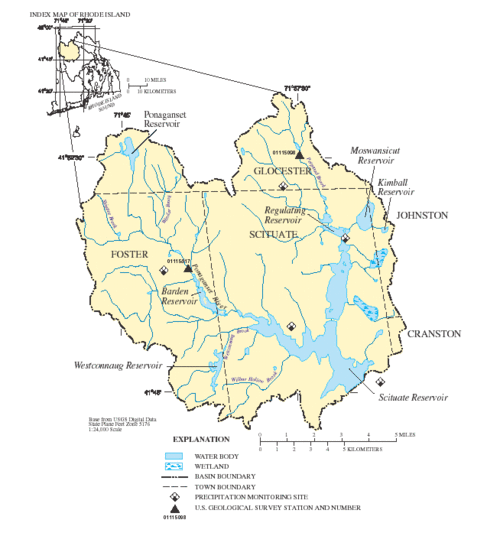
From Robert Whitcomb’s “Digital Diary,’’ in GoLocal24.com.
‘Congratulations to Providence Mayor Jorge Elorza’s administration for ending fiscal 2018 with a $9.2 million surplus, for the third surplus in as many years. This leaves a modest rainy day fund of $11.3 million.
Mayor Elorza’s chief of staff, Nicole Pollock, said “This surplus was achieved primarily through realistic budgeting practices, a steady increase in tax collections, a hiring freeze on nonessential employees, better departmental revenue and reduced operational expenses.’’
But the last few years have been relatively prosperous. What happens in the next recession? And what about the city’s unfunded pension liability of $1 billion?
So the city should continue to investigate whether it can sell the Scituate Reservoir for several hundred million dollars.

Olivia Alperstein: Trump's EPA seeks to weaken mercury rules

Via OtherWords.org
While Americans were quietly preparing to ring in the New Year, Trump’s Environmental Protection Agency gave families a deadly present to start the year off wrong.
On Dec. 28, the Environmental Protection Agency announced a proposal that would effectively weaken the Mercury and Air Toxics Standards (MATS), which protect American families from mercury and other harmful air pollutants emitted by power plants.
The EPA “proposes to determine that it is not ‘appropriate and necessary’ to regulate” these emissions, the EPA wrote in a statement. This means that the regulations will lose the necessary legal mechanism that actually enables them to actually be enforced.
These regulations save a lot of lives — 11,000 every year, according to the EPA’s own data — and they prevent 130,000 asthma attacks annually. Stripping this regulatory power virtually guarantees more asthma attacks and more preventable deaths.
For families, those aren’t just numbers.
At any age, exposure to even small amounts of mercury can lead to serious health problems. The worst health impacts include irreparable brain development defects in babies and young children, and cancer, heart disease, lung disease, and premature death among people of all ages.
Infants, young children, and pregnant mothers are particularly vulnerable to mercury — as well as to arsenic, lead, dioxin, and acid gases, which are also regulated by MATS.
Before MATS, coal-fired power plants were the largest source of these pollutants. American families paid the price for lack of federal regulations.
I’m a fairly young person — I grew up with dire warnings about exposure to these chemicals. Yet despite overwhelming evidence of their health effects — and the longstanding availability of proven control technologies — it took over 20 years after the 1990 Clean Air Act Amendments to establish federal regulations on power-plant emissions of these harmful substances.
Through the MATS program, Congress identified approximately 180 hazardous air pollutants, including mercury, and directed the EPA to draft regulations governing their emissions from power plants.
The impact has been enormous. A significant majority of top power companies have already complied with MATS, for a fraction of the originally estimated cost. It’s estimated that over 5,000 emergency and hospital visits and 4,700 heart attacks have been prevented each year as a direct result of these vital regulations.
In fact, one of the EPA’s own resources on the program highlights its widespread benefits: “The benefits of MATS are widely distributed and are especially important to minority and low income populations who are disproportionately impacted by asthma and other debilitating health conditions,” it notes.
Undoing critical health and safety standards and putting more Americans in danger goes against the very purpose of the EPA. Even utility companies, who invested in complying with the standards, are calling for the EPA to keep MATS fully intact.
Younger generations deserve to grow up protected from these harmful and deadly substances. The EPA wants to make mercury and air toxics deadlier again. We can’t let that happen.s
Olivia Alperstein is the media relations manager at Physicians for Social Responsibility, which is a party to current litigation to protect and strengthen MATS.
Tim Faulkner: Fishermen may take buyouts to settle dispute with Vineyard Wind

— Vineyard Wind image
From ecoRI News (ecori.org)
NARRAGANSETT, R.I. — Fishermen are not happy with the latest offer from Vineyard Wind and appear headed to buyouts and other compensation rather than a redesign of the proposed 84-turbine offshore wind project.
At the project’s most recent meeting, Jan. 3 at the University of Rhode Island Coastal Institute, Vineyard Wind had no new map or compensation plan to share with the Coastal Resources Management Council’s Fisheries Advisory Board (FAB) and the 30 or so fishermen in the room.
Instead, Vineyard Wind CEO Lars Thaaning Pedersen got an earful from what sounded like a mutinous crew.
Commercial fisherman Chris Brown, a FAB member, chastised Pedersen for failing to meet with the board after a promise to do so in November. He accused Pedersen of garnering support for the wind project from Gov. Gina Raimondo.
“Don’t waste my time anymore dragging me to these things that is a forgone conclusion,” Brown said. “I don’t need to go to some governor-produced fake meeting. That’s bullshit. It’s a waste of my time.”
Todd Sutton, a lobster and gill-net fisherman out of Newport, said the review process was another example of big business quashing smaller business.
“I’m insulted by what the wind farm and the governor and some of these people are trying to do to us,” he said.
Pedersen reiterated his plan to minimize the loss of fishing access to the federal wind zone by offering financial compensation and building fewer turbines, which is possible by increasing the size to taller models with 9.5-megawatt generators. But one big issue, so far, is agreeing on the data provided by the Rhode Island Department of Environmental Management (DEM) to determine the compensation.
Jason McNamee, DEM’s chief of marine resource management, said data is lacking on lobster and crab catches and therefore he must rely on trends and assumptions to determine a dollar figure for landings and related expenses.
FAB member and commercial fisherman Mike Marchetti questioned the usefulness of trends and assumptions and said there isn’t enough time to review the science and math behind the forthcoming compensation plan.
“It’s mind-boggling where this all can go,” he said. “The problem is this is too new and we don’t have anything we can firmly put our finger on. The science hasn’t been done and there are too many questions.“
Lanny Dellinger, a lobsterman out of Newport and chair of the FAB, noted that time is running out.
“It’s 12 days from now and we need to vote. We are up against it,” he said.
On Nov. 27, the Rhode Island Coastal Resources Management Council (CRMC) granted Vineyard Wind a 60-day extension for submitting its plan for review. Although the project is in federal water due south of Cape Cod, CRMC has jurisdiction in the application process because Rhode Island-based activities such as fishing take place in the designated wind zone.
CRMC executive director Grover Fugate said in November that buyouts of fishing boats and/or permits was a last resort and instead encouraged a collaborative modification of the 160,000-acre area 14 miles south of Martha’s Vineyard. Fishermen expressed concern about crashing into turbines, especially in foul weather, and wanted wider lanes for passage and fishing and more space between each turbine to ensure safety and room for rescues, if needed.
There has been little communication between Vineyard Wind and the FAB since that late-November CRMC meeting. Rather than a discussion about a modified layout of the offshore project, the recent meeting, Fugate said, was indented to “work on a compensation package that might be suitable to overcome some of the issues that have been identified that are obviously detrimental to the fishery.”
One reason for Vineyard Wind’s unwillingness to modify the project is the lack of time. Vineyard Wind must have all permits by September to qualify for a federal tax credit. The tax credit is necessary for the expected financing on the 9-cent-per-kilowatt-hour price the developers will receive in its 20-year power-purchase agreement. Approval by the Bureau of Ocean Energy Management (BOEM) is expected by mid-July. Any significant changes to the current design would add more than a year to the application process, according to Vineyard Wind.
Meetings canceled
On Jan. 7, Vineyard Wind postponed public hearings scheduled for Jan. 8 and 9 because of the federal government shutdown. The public can comment of the environmental impact statement on the BOEM website until Jan. 22.
Provided there are no other delays caused by the federal shutdown, the FAB is expected to vote on Vineyard Wind’s offer at its Jan. 15 meeting. The full CRMC board will consider the FAB’s recommendation when it votes on the project Jan. 22.
Vineyard Wind, based in New Bedford, Mass., is 50 percent owned by Copenhagen Infrastructure Partners and 50 percent by Avangrid Renewables.
Tim Faulkner is a journalist with ecoRI News.
Getting lost in time

The New England Cement Company Kiln and Quarry historic site in Woodbridge, Conn., a busy place in the 19 Century.
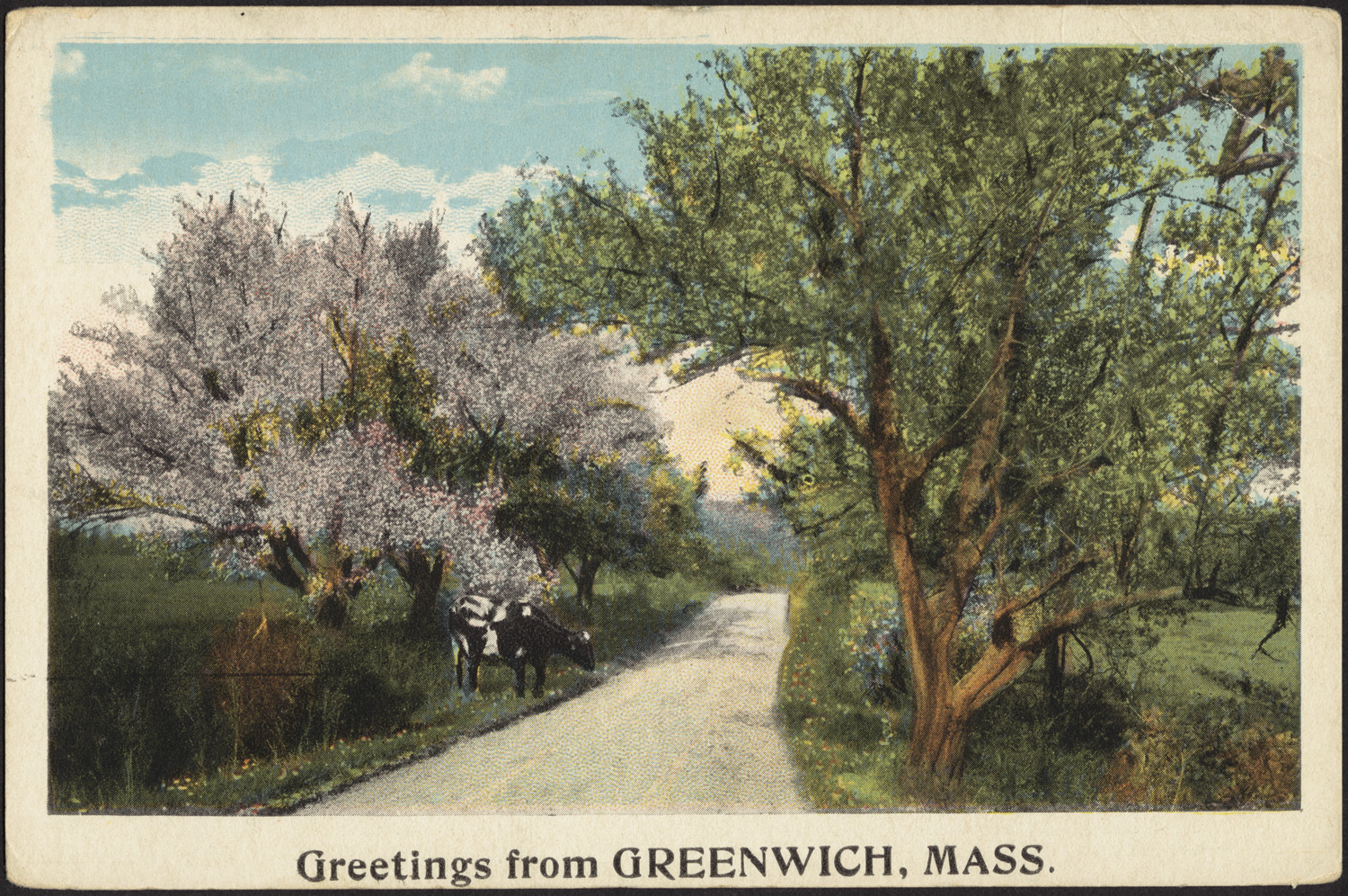
This postcard from the early 1900s depicts the bucolic community of Greenwich, Mass. – one of the four towns lost in the 1930s with the creation of the Quabbin Reservoir.
“There is a house that is no more a house
Upon a farm that is no more a farm
And in a town that is no more a town.
The road there, if you'll let a guide direct you
Who only has at heart your getting lost,
May seem as if it should have been a quarry -
Great monolithic knees the former town
Long since gave up pretense of keeping covered.’’
— From “Directive,’’ by Robert Frost
Salinger's work a time capsule

From Robert Whitcomb’s “Digital Diary,’’ in GoLocal24.com:
A few publications have noted that Jan. 1 was J.D. Salinger’s birthday. While I thought that his most famous work, The Catcher in the Rye, with its cynical and bitter adolescent prep-school protagonist, Holden Caulfield, was and is overrated, there’s no doubt that Mr. Salinger had an engaging voice. (Still, as Holden kept calling people “phonies,’’ he started to sound pretty phony himself.) What I still find most charming about Salinger’s work is his evocation of the mostly young and mostly upper-middle class people of imperial New York of the ‘40s and ‘50s – a time capsule.
Salinger became one of America’s most famous recluses after his move to the small town of Cornish, N.H., in 1953. His neighbors helped protect him by misleading reporters and fans about the location of his house. The students at nearby Dartmouth College did, too. People in the college library told me that he’d go into the college library to check something – seeking a reference to something that happened in the ‘40s? Nobody bothered him.
Jay Parini, a young English professor in the mid ’70s, wrote:
“He came often to read books or magazines in the Baker Library at Dartmouth, and several times I saw him reading by himself at a table, often late at night, in the basement of that library. Once he brushed passed me in the hallway outside my office, a lean and lonely figure. Everyone knew he did not want to be disturbed, and I would never have dared to say a word. I can still see him, a man of late middle age, hunched over a magazine at night, looking strangely out of place.’’
To read an essay by Parini about Salinger, please hit this link.
https://www.theguardian.com/books/booksblog/2010/jan/29/jd-salinger-catcher-in-rye
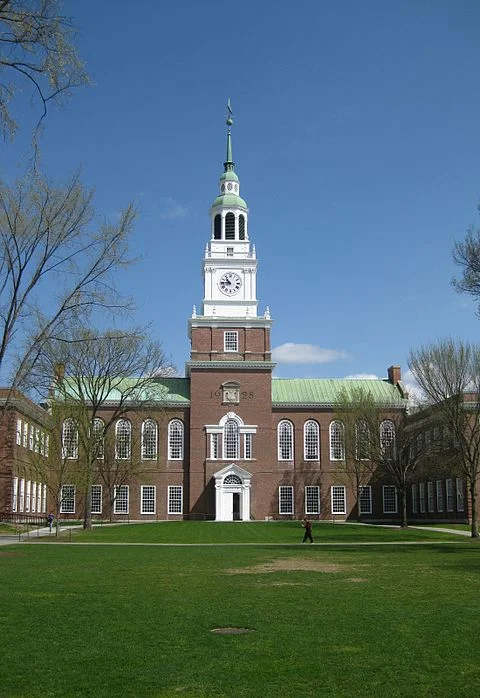
Baker Library, at Dartmouth College.
When I was in a small Dartmouth seminar on East Asian history with his then wife, Claire Douglas, no one ever mentioned her husband.
So for a recluse per se, the Upper Connecticut Valley seemed a good place to be. Whether it was good for his writing is another matter. He published nothing after 1965.
Salinger had a terrific sensitivity to how young people felt and spoke decades ago; he connected with, and wrote about best, children and teens. But of course just about all of them are dead, and their language in his writing sounds ever more dated, even to people like me who used to hear it all the time.
Stubborn pronounciation
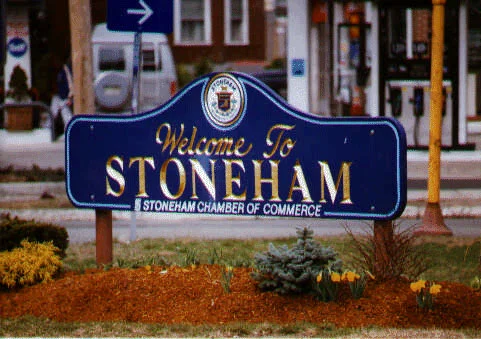
“I grew up in Stoneham, a little suburb of Boston. It's pronounced 'Stone 'em' because Massachusetts doesn't bend to the will of 'how letters are supposed to be said.'‘
— Josh Gondelman, comedy writer and stand-up comedian
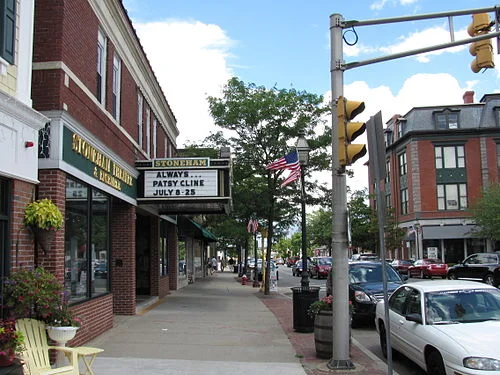
Main Street in Stoneham.
Sculptural signs of the zodiac

“Rooster,’’ by wood sculptor Donna Dodson, in her show “Zodiac,’’ at the Fuller Craft Museum, Brockton, Mass., Feb. 2-May 19. (Photo by Joan Boivin). The show references the animals associated with the Chinese and Western zodiacs.

Jay A. Halfond: The future of U.S. college internationalization

Boston University's East Campus along Commonwealth Avenue.
Via The New England Journal of Higher Education, a service of The New England Board of Higher Education (nebhe.org)
America’s university population peaked in 2010 at about 21 million students. We would be mired in a nationwide enrollment crisis if not for two major decade-long trends that cushioned a fall: students enrolling exclusively online and those relocating here from abroad to study. These, combined, now comprise almost a quarter of the nation’s students. Because these two mitigating factors do not benefit all institutions equally, a major redistribution of enrollments is underway. Those institutions with sizeable distance-learning programs and foreign populations are thriving, as others decline and some risk demise. Even Greater Boston—the world’s mecca of higher learning—has not been immune to this zero-sum enrollment shift.
America has long had abundant capacity in its colleges and universities, which have increasingly welcomed those from countries where quality higher education is a scarce resource. This coincided nicely with America’s pivotal role in the growing globalization of the world’s economy. An American degree has become a valuable rite of passage for an aspiring elite in business, government and science and technology. Part of the appeal is the opportunity to stay and work for a year or two beyond the degree (Optional Practical Training)—as about half do—and then to pursue their version of the American Dream long-term.
This dramatic increase in international students—by favoring some institutions, some fields of study and some institutions and regions—has yet to spread across the American academic landscape. Its impact is both sporadic and tenuous. It is tempting to target the Trump administration for imperiling our growing dependence on international students. The responsibility for sustaining our global presence, however, rests just as much on America’s universities.
Debunking claims of internationalization
Whenever I query my students on what percentage of students nationally they think come from other countries, they are often amazed that barely 5% are foreign. This may be their Boston bias showing. About one million international students enroll in U.S. colleges and universities—roughly triple the number over the past two decades. Half do so in only five states: California, New York, Texas, Massachusetts and Illinois. The top academic destinations are three cities (New York, Los Angeles and Boston) that reap tremendous economic rewards from these affluent visitors and their families. One-fifth of all international students attend just 20 large research universities. By expanding and professionalizing their international infrastructure, these and other universities have raised the barriers to entry for schools that have been late—or too small—to expand their international reach.
Since international students often enroll in business and STEM programs—and as often at the graduate as undergraduate level—liberal arts colleges without business majors, universities without engineering schools, and colleges without post-baccalaureate programs rarely see students from abroad.
Even though the U.S. is the desired destination for three-quarters of the world’s migrating students, their impact has been barely felt across the spectrum of schools and programs. The vast majority of America’s professors rarely, if ever, teach any of these students. Likewise, most of America’s domestic students hardly ever encounter someone from another country and, when they do, have only superficial opportunities to benefit from that interaction. We still have a long way to go before international students pervasively and profoundly impact the nation’s campuses.
For the past 30 years, “international” has largely meant Asian. Japan dominated foreign demand in the 1990s, followed by India, and now China. Two-thirds of all current international students are Asian, one-third from China—and growing. The fragility of this dependency on one country and one continent is frightening. Imagine the devastating consequences were the president to declare that Chinese students are a serious national security risk, or if China were to retaliate in a tariff war by taxing (or restricting) those who want to study in the U.S. Nor can this dependency on one region justify claims of a truly international student body.
The purposes for their presence
Nationwide tallies show that new international students began to decline in number even before the Trump Inauguration. Foreign students have shifted toward other institutions in other countries less because of an unwelcoming national administration than because an increasing number of European programs are now taught in English. Canada has become more inviting and affordable, and other nations’ universities are supplanting American schools in global rankings. Trump might exacerbate our declining competitive advantage, but we should not be overconfident that the innate appeal of America’s universities would otherwise persist. Enrollments from China, India and Vietnam are still growing, while other countries cultivate alternative places for their citizens to study. If international numbers remain flat while reliance on several countries intensifies, America’s schools will be even more vulnerable to the vicissitudes of a few nations.
This raises serious questions about whether representation from just these few countries constitutes genuine internationalization. Why have some major research universities been so welcoming? Public institutions, whose mission dictates a local focus, have been especially aggressive in growing their international numbers. If the main reasons are financial, then more full-tuition-paying students becomes an end in itself. If the reasons are academic, then this is a meritocratic means of elevating institutional reputation. In either case, the source of students matters less than their academic pedigree and willingness to pay the full sticker price of a higher education.
But if the motives are more idealistic and humanistic—if the goals are to diversify the student body and enrich the on-campus global experience—then current results of international student recruiting are far more suspect. And where they come from and what they bring to campus life becomes paramount. Simply attracting offspring of affluence from a few countries, doing little to educate them about American life, showing minimal concern for their well-being as strangers in a strange land, and failing to leverage their campus presence to benefit the global savvy of domestic students are not only missed opportunities, but irresponsible and exploitive.
With power comes responsibility
International students are not solely means to greater ends. International students have emerged as the largest, perhaps most overlooked, minority on many college campuses. Those institutions that tout their diversity need to appreciate that this is as much a moral mandate as a statistical achievement. Otherwise, through neglect, student self-segregation persists.
The internationalization of American higher education still has a long way to go, even with likely flatlining of foreign numbers in the near term. Opportunism is only a first step toward achieving a global campus. More institutions need to attract more students from abroad, from a broader range of countries and social classes, across a wider array of disciplines, with greater sensitivity to the challenges of adjusting to the American classroom and culture, and toward greater inclusivity on campus. This will require investing in student recruiting, financial aid, and academic and social programs. Doing so will strengthen the ongoing appeal for those from other countries and cultivate global awareness for the benefit of all.
Jay A. Halfond is a Professor of the Practice at Boston University, where he teaches a course on Global Higher Education, among others. He is the former dean of BU’s Metropolitan College.