
Vox clamantis in deserto




Two kinds of Maine winters

Mattanawcook Lake, in Lincoln, Maine.
“Ellsworth (Maine) winters are a maddening ‘tease and freeze,’ thanks to the warm Atlantic currents. I never got used to them. It may snow in October or it may rain into December, or there may be a two-week cold snap of forty below, teeth-numbing weather. In January there is a thaw when it may be forty above for several days. It can snow in Ellsworth, sleet in Trenton, and rain in Bar Harbor at the same time. Half-hearted winters drop snowfall from crisp to slush through the beginning of April, when mud season begins. …
“Lincoln, however, is serious about winter, and the feeling is mutual. Once it snows in November, the whining of snowmobile engines fills the air. Snowmobilers ride across Mattanawcook Lake as soon as it freezes. … Those who ride onto the vast ice warm themselves in ice fishing shacks that remain into April, and the snow sticks until May. The winters are the good, old-fashioned Maine kind with plenty of snow and a good deal of disappointment if there isn't.’’
— Scott Warner, writing in www.theheartofnewengland.com
'Underexposed'

“My parents are both from Vermont, very old-fashioned New England. We heated our house with wood my father chopped. My mom grew all of our food. We were very underexposed to everything.’’
— Geena Davis, actress
'You've need to say a prayer'
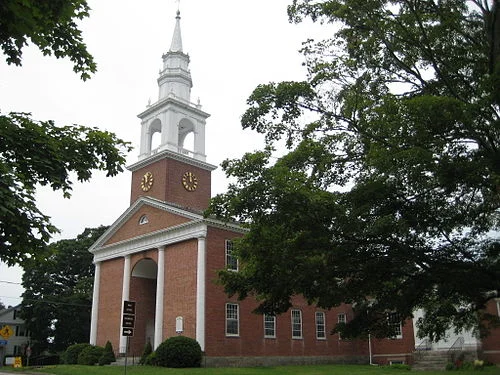
First Congregation Church, in Lebanon, Conn.
“IN the wide and rocky pasture where the cedar trees are gray,
The briar rose was growing with the blueberry and bay.
The girls went forth to pick them and the lads went out to play,
But I had to get to Stonington before the break of day.
And when I came to Stonington, she was a town of pride.
'Come in,' they said, 'and labor, and be at home and bide.
For gold shall be thy wage,' but 't was past the hour of morn—
And I had to get to Jordan while the dew was on the thorn.
There is a girl at Jordan, she sweetly smiled at me,
As pale as are the berries on the gray cedar tree.
And 'Oh,' she cried, 'thou traveler, come bide awhile with me,'
But I had to get to Lebanon while light was in the tree.
The pale church spires of Lebanon shone sweet upon the sky.
The Sabbath bells were ringing, the parson passed me by.
'Oh wait, traveler, wait, for you've need to say a prayer,'
But I had to be in Wallingford while noon was in the air.
The road that leads to Wallingford, it runs through mire and stone.
I was parched with the dust, I was bleeding and alone.
'My lad, you will die, if you do not tarry here.'
But I had to get to Killingworth while day was on the mere.
And when I got to Killingworth I heard the people say
'He has come to bring the news from a hundred miles away.'
But I had not any news and not any time to stay,
For I had to be at Jericho before the end of day.
And when I came to Jericho I heard the people call,
'Do you run to save a city that you will not wait at all?'
'I run to save no city, yet must I leave you soon,
For I have to be in Windsor with the rising of the moon.'
And when I got to Windsor, then was I spent for bread.
'Come in,' they cried, 'poor traveler! and be thou comforted.
What strange great need is on thee that makes thee journey so?'
But I had to be in Coventry ere yet the moon was low.
For a strange great need was on me that I should hunt the rain,
And take into my body a breakage and a pain;
That I should tame the sunset and goad the hurry-ing plain,
And that the leagues behind me should lie a thousand slain.
Wherefore, ye men of Coventry, if ye desire to stay,
Lay not your curb upon me, that love the open way.
For I want to smell the dew, the blueberry and the bay,
And I have to get to Colchester before the break of day.
From commerce to Christ
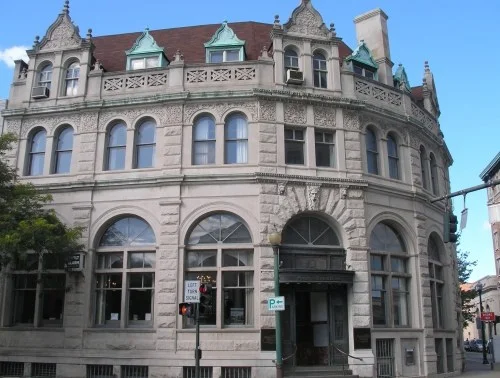
Norwich (Conn.) Savings Society Building.
From Robert Whitcomb’s “Digital Diary,’’ in GoLocal24.com.
We’ve seen plenty of stories about closed churches being turned into offices, condos, rental apartments and stores. But here’s a nice switch: The grand former Norwich (Conn.) Savings Society Building in that old mill town is being turned into a new Protestant church, the Castle Church, to open sometime in 2019.
The church describes itself thus:
“We love Norwich. Our passion is to work for the peace and prosperity of the city, aligning ourselves with God’s strategy for urban areas around the world. We regularly serve our neighbors in the Rose City. Jesus served among people – not above them. We look forward to doing the same!’’
Amazon and other parts of the Internet epidemic are killing many businesses in old (and even fairly new) buildings. Some of the old ones, especially former banks, even look a bit like churches and could be elegantly transformed to that use. But I don’t imagine that skeptical New England will be a very fertile region for this. Many of these projects will more likely than not involve the evangelical and/or fundamentalist wing of Protestantism.
'Come home to Gloucester town'
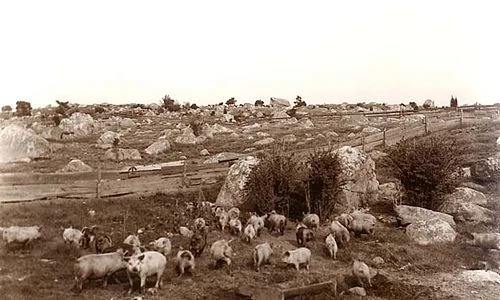
The “Dogtown’’ part of the Gloucester Moors, about 2008.
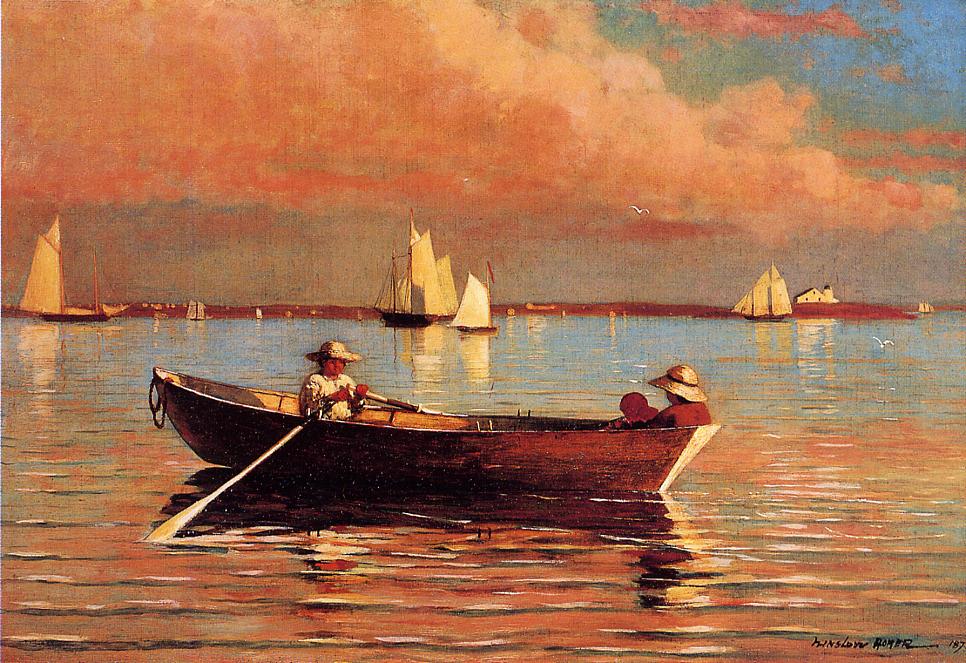
“Gloucester Harbor’ (1873) (oil on canvas), by Winslow Homer.
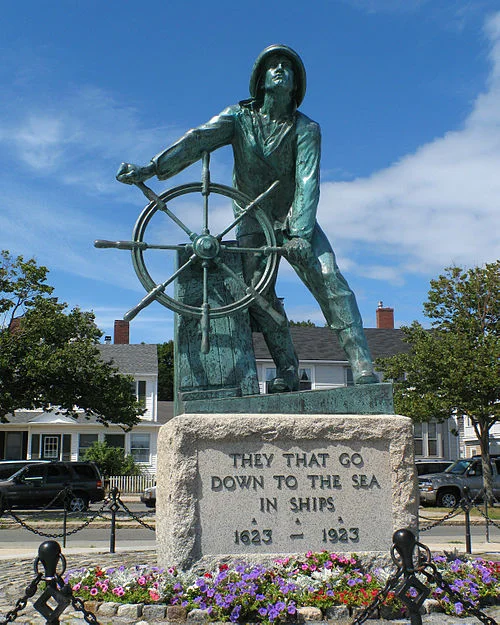
“Man at the Wheel,’’ Fisherman's Memorial Cenotaph, in Gloucester.
“A mile behind is Gloucester town
Where the fishing fleets put in,
A mile ahead the land dips down
And the woods and farms begin.
Here, where the moors stretch free
In the high blue afternoon,
Are the marching sun and talking sea,
And the racing winds that wheel and flee
On the flying heels of June.
Jill-o'er-the-ground is purple blue,
Blue is the quaker-maid,
The wild geranium holds its dew
Long in the boulder's shade.
Wax-red hangs the cup
From the huckleberry boughs,
In barberry bells the grey moths sup,
Or where the choke-cherry lifts high up
Sweet bowls for their carouse.
Over the shelf of the sandy cove
Beach-peas blossom late.
By copse and cliff the swallows rove
Each calling to his mate.
Seaward the sea-gulls go,
And the land-birds all are here;
That green-gold flash was a vireo,
And yonder flame where the marsh-flags grow
Was a scarlet tanager.
This earth is not the steadfast place
We landsmen build upon;
From deep to deep she varies pace,
And while she comes is gone.
Beneath my feet I feel
Her smooth bulk heave and dip;
With velvet plunge and soft upreel
She swings and steadies to her keel
Like a gallant, gallant ship.
These summer clouds she sets for sail,
The sun is her masthead light,
She tows the moon like a pinnace frail
Where her phosphor wake churns bright.
Now hid, now looming clear,
On the face of the dangerous blue
The star fleets tack and wheel and veer,
But on, but on does the old earth steer
As if her port she knew.
God, dear God! Does she know her port,
Though she goes so far about?
Or blind astray, does she make her sport
To brazen and chance it out?
I watched when her captains passed:
She were better captainless.
Men in the cabin, before the mast,
But some were reckless and some aghast,
And some sat gorged at mess.
By her battened hatch I leaned and caught
Sounds from the noisome hold,--
Cursing and sighing of souls distraught
And cries too sad to be told.
Then I strove to go down and see;
But they said, "Thou art not of us!"
I turned to those on the deck with me
And cried, "Give help!" But they said, "Let be:
Our ship sails faster thus."
Jill-o'er-the-ground is purple blue,
Blue is the quaker-maid,
The alder-clump where the brook comes through
Breeds cresses in its shade.
To be out of the moiling street
With its swelter and its sin!
Who has given to me this sweet,
And given my brother dust to eat?
And when will his wage come in?
Scattering wide or blown in ranks,
Yellow and white and brown,
Boats and boats from the fishing banks
Come home to Gloucester town.
There is cash to purse and spend,
There are wives to be embraced,
Hearts to borrow and hearts to lend,
And hearts to take and keep to the end,--
O little sails, make haste!
But thou, vast outbound ship of souls,
What harbor town for thee?
What shapes, when thy arriving tolls,
Shall crowd the banks to see?
Shall all the happy shipmates then
Stand singing brotherly?
Or shall a haggard ruthless few
Warp her over and bring her to,
While the many broken souls of men
Fester down in the slaver's pen,
And nothing to say or do?’’
— “Gloucester Moors,’’ by William Vaughn Moody (1869-1910)
Chris Powell: Behind the brawls at the malls

You can observe a lot just by watching, Yogi Berra said. Maybe that's possible even with local television news in Connecticut, though it's usually trivial.
For the other day WFSB-TV3 broadcast two touching stories whose details hinted at much bigger issues.
The first was about a Christmas dinner for the down-and-out in Hartford sponsored by a charitable organization, Hands On Hartford. In addition to dinner, guests received gifts -- hats, mittens, and socks -- that seemed to anticipate cold days on the street. The guests were grateful, though those interviewed, as is typical with the very poor, were missing many teeth, so feeding themselves may not be easy even when it's free.
The second story was about three sisters in Meriden who are caring for their mother because she has been diagnosed with terminal cancer. The sisters are preparing the family home for sale in the hope of raising money to get their mom admitted to a leading cancer hospital in New York, since her insurance won't cover it.
Lacking teeth no longer has to be a permanent handicap. Nor is the worst cancer case necessarily a death sentence anymore. Dental implants and cancer treatments just cost more money or more insurance than many people have. Meanwhile, the federal government still spends billions of dollars every month on stupid and futile imperial wars, and last week state government began spending another $5 million in the name of preserving open space, though Connecticut's population long has been stagnant and open space is preserving itself.
That is, these days government has money for everything except what people need most. So maybe elected officials should pay more attention to local TV news when they're not the ones being covered.
But elected officials aren't likely to notice missing teeth and lousy medical insurance when they don't notice the social disintegration exploding all around them.
Last week, while outgoing Gov. Dannel Malloy and his aides congratulated themselves on what they claim is a reduction of crime in the state, hundreds of young people brawled at shopping malls in Manchester and Milford; a 12-year-old boy was shot to death in Bridgeport by an 18-year-old illegal immigrant during a gang war in which several other youths were shot but survived; two men were shot, one fatally, in Hartford, where shootings have risen this year; and the decline in the state's prison population being touted by the governor continued to correspond ironically with a growing number of arrests of offenders with long records whose avoidance of prison despite their incorrigibility is nothing to cheer.
Bridgeport City Councilor Ernie Newton, a chronic offender himself, responded to the 12-year-old's murder by proposing that police be authorized to stop and frisk anyone who looks suspicious. Newton withdrew the idea when he was reminded that this would violate constitutional rights and inflame racial tensions, especially when most officers are white and most city residents are not.
But one of the activists who scolded Newton was just as oblivious. She told the Connecticut Post that instead of "stop and frisk" Bridgeport needs "youth programs" and "a huge increase in therapists and counselors in schools."
No, Bridgeport and Connecticut need elected officials who dare to address the causes of problems rather their symptoms and ask where all the messed-up kids are coming from, why so many kids don't have parents anymore, and how public policy may be causing this.
Chris Powell is a columnist for the Journal Inquirer, in Manchester, Conn.
Old New England skiing
Adapted from Robert Whitcomb's "Digital Diary, in GoLocal24.com
'On Jan. 1, 1961, when my parents and a couple of my siblings were staying in an old inn, or glorified bed and breakfast, in Jackson, N.H., then, as now, a ski town. As we sat in the dining room having a breakfast of blueberry pancakes and enough bacon to instigate acute myocardial infarction, the co-owner (with his wife) of the establishment, a retired Episcopal priest, came bounding in, wishing everyone a “Joyous Feast of the Circumcision!’’ Later that day, I saw him speeding down the slopes of Black Mountain with great skill, despite his having called himself a “lousy intermediate’’ and his having consumed several martinis with his guests the night before.
Skiing then was a lot cheaper – fancy equipment such as snow-making machines and high-speed chairlifts, and huge personal-injury lawsuit settlements and soaring insurance premiums, not yet having made the sport so expensive. And there were still lots of tiny commercial ski hills (many owned by local dairy farmers) with rope tows powered by truck engines spewing out very dirty exhaust. Indeed, whenever I smell heavy exhaust, I think of those ski hills, especially in “spring skiing’’ on corn snow in March. Richly evocative.
The two New Englands

The Boston skyline from Belmont.
“Reduced to simplest terms, New England consists of two regions: Boston and Not-Boston.’’
—Wayne Curtis, writing in Frommer’s 2001 New England
'Experimental woodland'
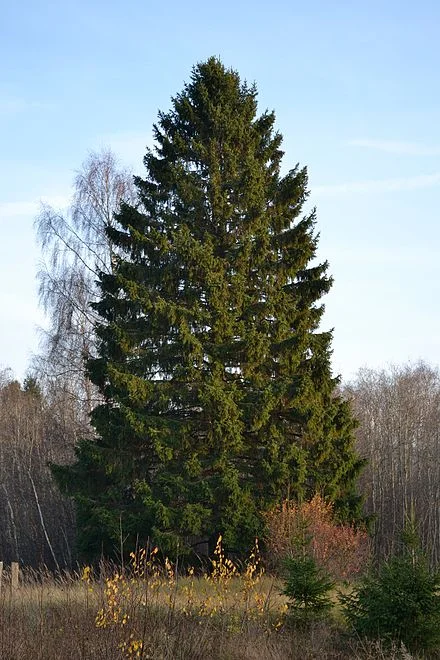
A Norway spruce tree — a species widely planted in New England.
“In the false New England forest
where the misplanted Norwegian trees
refused to root, their thick synthetic
roots barging out of the dirt to work on the air,
we held hands and walked on our knees.
Actually, there was no one there.
For forty years this experimental
woodland grew, shaft by shaft in perfect rows
where its stub branches held and its spokes fell.
It was a place of parallel trees, their lives
filed out in exile where we walked too alien to know
our sameness and how our sameness survives….
— From “The Expatriates,’’ by Anne Sexton
Llewellyn King: Prepare for the convulsion of the Fourth Industrial Revolution
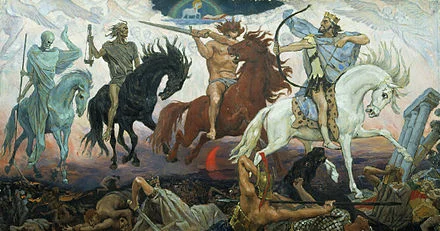
“The Four Horsemen of the Apocalypse, by Viktor Vasnetsov.
WEST WARWICK, R.I.
It isn’t starting with a bang, but don’t be deceived: The Fourth Industrial Revolution (4IR) is underway, and companies and institutions that ignore it will be overwhelmed by it. Individuals will adapt to it as best we can, as we always have.
In short 4IR is the fusing of the digital, physical and biological spheres. It’s the interconnection of everything, bringing change in companies, jobs, schools and eventually government. Government won’t to be able to stand idly by when it sees traditional businesses upended and huge changes in how we work and study, and where.
As 4IR moves ahead one can reasonably contemplate a time when body parts will be printed, robots will prepare restaurant food and drone taxis will take us to the airport, where departures will be handled without human intervention -- because you were verified through facial recognition when you bought your ticket on your smartphone, you won’t need to do anything but walk through security and onto a plane, which has a cabin crew to look after you but no pilots.
Behind and driving the revolution is artificial intelligence, commanding everything from farms, where tractors will start themselves and plow or reap without a human in sight, to street lights that turn off when nothing is moving and back on as needed, to manufacturing that will be dominated by 3D printing, better referred to as additive manufacturing.
The troubadour of 4IR is Klaus Schwab who created the World Economic Forum back in 1971, the world’s most important ideas mart known as Davos, after Davos-Klosters the Swiss resort where the forum meets every year. This year Davos kicks off on Jan. 22 and will be devoted to what Schwab, 80, a German economist and engineer, has called “Globalization 4.0”.
The first forum to look at 4IR was in 2016. Schwab has written two books on the subject -- The Fourth Industrial Revolution and Shaping the Future of the Fourth Industrial Revolution -- and has been ceaseless in promoting the future while warning of it. He told Gerard Baker, the former executive editor of The Wall Street Journal, in a TV interview that enumerating the challenges wasn’t enough, there need to be solutions as well.
A note: Don’t think you can join the 3,000 participants this year. It’s by invitation only. And if you get one, Davos hotel rooms -- plain vanilla rooms – can cost $900 a night and suites can go for $5,000 a night. When I checked, there were few vacancies. The movers and shakers start early.
The three past industrial revolutions are listed by Schwab as the replacement of animal power by water and then steam power, the latter at the beginning of the 18th Century; the deployment of electricity, starting in the late 19th century; and the digital revolution of the last part of the 20th Century.
The Davos meeting will examine the upheaval besetting the world with 4IR and how it’ll be managed. It’s what Schwab calls Globalization 4.0. “We must develop a comprehensive and globally shared view of how technology is affecting our lives and reshaping our economic, social, cultural, and human environments. There has never been a time of greater promise, or greater peril,” he says.
Andre Kudelski, a Silicon Valley veteran, now head of the eponymous Swiss high-tech company that bears his name, says, “A skilled engineer can take control remotely of any connected ‘thing.’ Society has not yet realized the incredible scenarios this capability creates.”
Says Robert Shiller, a Yale University economics professor and 2013 Nobel Prize winner, “We cannot wait until there are massive dislocations in our society to prepare for the Fourth Industrial Revolution.”
Others dream of a cleaner, safer and healthier world. Dileep George, an artificial intelligence and neuroscience researcher, quoted by the forum, says, “Imagine a robot capable of treating Ebola patients or cleaning up nuclear waste.”
Leon Trotsky, a veteran of the Russian Revolution, said, “You may not be interested in war, but war is interested in you.” He might well be paraphrased to say, “We may not be interested in the Fourth Industrial Revolution, but it is interested in us.”
Llewellyn King is executive producer and host of White House Chronicle, on PBS. His email is llewellynking1@gmail.com. He’s based in Rhode Island and Washington, D.C.
'Accidentally profound'
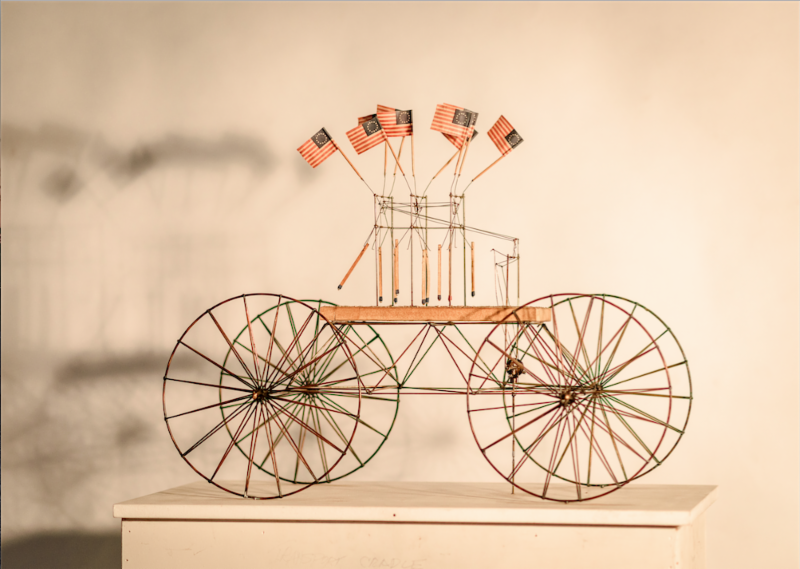
From “Flights of Fancy,’’ by the late David A. Lang, at the Boston Sculptors Gallery.
The gallery says:
“The show, curated by Katherine French, includes Lang's signature kinetic pieces, which, when set off by motion detectors, come to life when closely inspected by viewers. ‘Flights of Fancy’’ explores the whimsical - yet serious - nature of an artist who preferred to describe his efforts as ‘accidentally profound.’
“Join us at Boston Sculptors Gallery (486 Harrison Ave.) at 3 p.m. Saturday, Jan. 12 for a curator talk by Katherine French, director of Catamount Arts, in St. Johnsbury, Vt. French will offer thoughts on her relationship with Lang, an extraordinary sculptor she remembers as teacher, artist and friend. This event is offered in cooperation with the Boston Art Dealers Association, and is free and open to the public.’’
Brian Wakamo: Get a lot of federal offices out of Washington
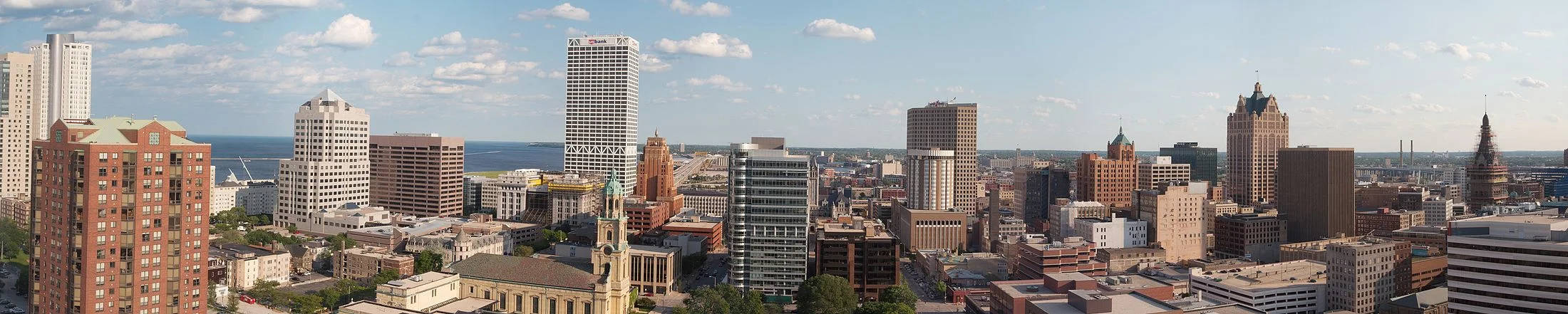
Downtown Milwaukee, a good place to add federal offices to serve the Midwest.
Via OtherWords.org
Americans of all political stripes distrust the federal government.
For years, the name of the nation’s capital has been used as shorthand for federal overreach and bloat. For most Americans, Washington, D.C. is hundreds of miles away — and a million ways disconnected — from them.
The Washington area is home to hundreds of thousands of federal jobs, and many unpopular agencies. But agencies that are more spread out, like the Postal Service, are significantly more popular.
So here’s a simple idea: Move more of the federal government to the rest of the country.
Studies show that once you get to know people different from you, your prejudice towards them drops. Could that same approach also bridge the deep disconnect between Americans and their national government?
One way to sweeten the pot would be the promise of tens of thousands of jobs to areas that need them.
A geographically diverse federal government would be bolstered by the Green New Deal program championed by progressives such as Alexandria Ocasio-Cortez.
Bringing back past agencies, like the Depression-era Works Progress Administration, to help build green infrastructure would help transition this country off fossil fuels and into a sustainable future. It would guarantee jobs, maybe good union jobs, for countless workers.
A new Works Progress Agency could establish offices in places like Milwaukee, where it could build a long-discussed high-speed rail line connecting the cities of the Midwest. Or in Phoenix, where it could construct more solar-power plants in the desert. It could set up in places like Jackson, Miss., helping to build sustainable co-op farms, or on the Gulf Coast, to fight climate change.
Similarly, a single-payer, Medicare for All health service would also need to have offices in communities. It would create health care jobs in places often abandoned by providers, boosting economies and bringing affordable care to millions.
Meanwhile, reintroducing postal banking would bolster Post Office finances and bring banking to millions of underbanked Americans.
There’s another benefit to all this: the revitalization of our heartland cities. Midwestern cities like Detroit, Cleveland and Milwaukee are full of classical architecture and cultural amenities, but have lost hundreds of thousands of jobs from the erosion of manufacturing. New federal jobs could reverse decades of decline in these grand cities.
Why stop there?
The National Weather Service could move to New Orleans or another area impacted by the climate change they study. The U.S. Geological Survey could move out to Sacramento, which knows something about earthquakes. Agencies that deal with farming and rural development could set up in Farm Belt areas like Kansas City, where they’d be more attuned to the people they serve.
Spreading out the federal government would help rebuild the trust that’s eroded in recent years and provide jobs that are unionized, well-paying, and accessible to people often excluded from the broader economy.
Decentralizing government is popular across the political spectrum, and the federal government is bogged down by its centralization in D.C. Why not put it more in line with its original mission — to be of the people, by the people — and bring it to the people that need it most?
Brian Wakamo is a research assistant at the Institute for Policy Studies.
Ocean pollution in black and white

“Closing the Sea 1’’ (black and white silver print), by Boston-basedO Patricia Kelliher, in her show “Closing the Sea,’’ at Bromfield Gallery, Boston, through Jan. 27. She highlights ocean pollution through semi-abstract black-and-white photos.
Mysterious NEPOOL; memories of the great blackout

From Robert Whitcomb’s “Digital Diary,’’ in GoLocal24.com
Rhode Island, reports GoLocalProv, has the third-highest overall utility costs in America. That’s not very surprising since it still depends on expensive, end-of-the-pipeline natural gas to generate much of its electricity and provide fuel for heat and cooking in many buildings. It also has very expensive, if fast and generally reliable, Internet service.
But there’s hope: Technology is gradually bringing down the cost of locally produced energy such as solar and wind, and there will probably be more competition entering the Internet sector because of technological advances and corporate shuffles.
To read the GoLocal piece, please hit this link.
One reason that electricity prices are so high in New England may be the New England Power Pool (“NEPOOL”). This trade group is dominated by big utilities and power-plant owners, reports New Hampshire Public Radio (NHPR), and its meetings aren’t open to the public.
Independent Service Operator of New England (ISO), created by the Feds to keep the region’s power on, is charged with overseeing the region’s grid. NEPOOL makes recommendations to ISO on rates and on whether and where new transmission lines should be strung, NHNPR reports. But NEPOOL can submit its own regulatory ideas to the government, which may contradict those of ISO.
Don Reis, New Hampshire’s utility ratepayer advocate, told NHPR: NEPOOL is “more powerful than the other stakeholder advisory boards at other regional transmission organizations around the country.’’

Red marks the area hit by the Great Northeast Blackout of 1965.
We need to know how much of New England’s high electric rates can be explained by the structure and power of NEPOOL.
To read the NHPR story, please hit this link.
The creation of ISO and NEPOOL can be traced back to federal regulators’ efforts to prevent a repeat of the huge blackout that darkened most of the Northeast on Nov. 9 and 10, 1965.
I remember it fondly, but then I wasn’t stuck in an elevator. I was in a classroom in a girls’ school in Waterbury, Conn., for a rather vague course called “Philosophy of Religion.’’ The class was one of the very few co-ed classes open for students at my boys boarding school, which was in another town about eight miles away.
At about 5:20 that dark day, the room went pitch dark and someone muttered: “The wrath of God!’’ Weirdly, a now-long-dead classmate (and terrific musician) called Al d’Ossche, from New Orleans, found a candle in the room and lit it using a cigarette lighter.
Chuckling nervously, the spinsterish teacher soon dismissed us, and we headed out the door to find the grumpy driver and his van that would take us back to our school. With most everything dark except for car headlights, we had an eerie, exciting trip up and down the hills. When we got to the school we carefully walked up to second-floor apartment of Mr. Dunlop (an English teacher) and his eventual ex-wife, off the dorm corridor where most of the seniors lived. Thank God there were no electric door locks at the school then.
There were a couple of flashlights and hurricane lamps lit, along with the glow of cigarettes; seniors were allowed to smoke in teachers’ apartments if the teachers (aka “masters’’ – sounds a little S&M) permitted. And in the background you’d hear on a transistor radio: “77 WABC – home of the All Americans!’’ from New York. The WABC DJs and news folks reveled in describing the drama of Manhattan gone dark.
It was a delightful evening, in part because it was impossible to do any “homework.’’ It was one of those gleeful, lovely inconveniences, like, for some, southern New England’s Great Blizzard of ’78 – that is gleeful, for a day or two….
Tim Faulkner: Fossil-fuel groups try to drown out global-warming science
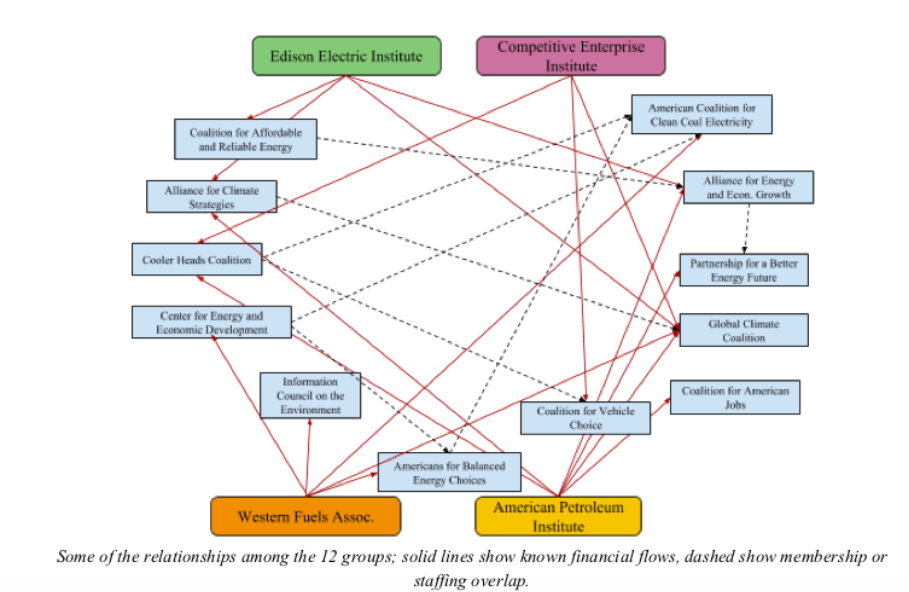
This chart shows the web of groups that share money and staff to spread misinformation about climate change. (Brown University Climate and Development Lab)
From ecoRI News (ecori.org)
TV ads spinning a positive message about fossil-fuel companies are running more frequently as climate change is poised to move into the legislative spotlight now that Democrats have taken control of the U.S. House.
Recent commercials by the ExxonMobil Corp. show millennials in lab coats, waiting tables, and welding pipeline tubes: jobs that are ostensibly created by the fossil fuel-extraction industry. Missing are the health and environmental impacts of oil spills and natural-gas leaks, acidifying oceans and displacement and destruction caused by powerful storms — all of which are the result of drilling, shipping, processing, and the burning of fossil fuels. This new PR blitz is the latest action in a decades-long offensive to counter the science proving that fossil fuels are destroying the planet.
A project led by the Climate and Development Lab at Brown University intends to expose and delegitimize this feel-good narrative by revealing the people and money behind climate-opposition efforts. It also aims to remind the public of what ExxonMobil and other energy companies have known for decades: that fossil-fuel emissions are destructive.
“This really is a failure to warn us that (fossil-fuel companies) know their products are going to cause all of these problems but they are not warning the public about it,” said Robert Brulle, a visiting professor at Brown University and one the leading national researchers on climate-change denialism.
One of the goals of the investigation is to bring to the fore the campaign of denialism and the accompanying disinformation funded by fossil-fuel corporations, utility companies, and right-wing policy groups.
“They are selling us the idea of oil, prosperity, and fossil fuels are all the same thing,” Brulle said. It’s “a very, very subtle manipulation that runs into the billions of dollars over decades.”
Sen. Sheldon Whitehouse, D- R.I., has been broadcasting the issue from the Senate floor since 2012 with his Time To Wake Up speeches. But without hearings or other public debate led by Congress, clime-change legislation has been suppressed by intimidation, political contributions, and a mass media-marketing campaign to discredit the science.
“The biggest gap that we have on a pathway to success on climate is our failure to have shown the public who’s behind the curtain on so much of the nonsense that gets propagated as climate denial,” Whitehouse said.
Whitehouse is part of the multifaceted effort to out the climate-denial network and its funders. This includes a forthcoming book, new research, and legislation.
In Washington, D.C., Whitehouse and Rep. David Ciciliine, D-R.I., have introduced an updated version of the proposed Disclose Act, which prevents corporate donors from hiding their campaign donations in shell corporations. Whitehouse said making public such donations will cause the collapse of “the special interest hiding systems” and “laundering systems.”
“The dark money disappears when it’s required to become transparent,” he said. “It’s like when you flip on the light and the cockroaches scuttle for the shadows.”
At Brown University, Caroline Jones, a third-year student, wrote a 37-page report on the fossil-fuel spin apparatus with a team of classmates, Brulle, and professor J. Timmons Roberts. Jones delivered her findings to the Climate Action Task Force in the U.S. Senate.
“A lot of these groups engage in pretty blatant pubic misinformation campaigns,” Jones said. “They run targeted strategies to specific demographics, to people who they think are vulnerable to misinformation.”
During a recent meeting with members of the media, Jones, Roberts, and Brulle presented slides showing the complex network of companies, public-relations firms, lobbyists, and bogus environmental groups that spread climate disinformation. Brulle’s research dates back until 1967 and his current work focuses on the years 2010 to 2015.
The spider web of money comes from oil and gas companies such as Shell, Chevron, ExxonMobil, and Texaco; from automakers such as Ford and General Motors; and from utilities and chambers of commerce. They fund groups such as the National Coal Association and the American Petroleum Institute (API), and “astroturf” denialist groups with ambiguous names such as Global Climate Coalition and the Cooler Heads Coalition.
The report Countermovement Coalitions profiles these groups and explains how they create the appearance of public support for deregulation, while also reminding politicians that they may lose election/re-election by opposing corporate priorities.
In Rhode Island, the report looks at the institutions that have resisted climate and renewable-energy legislation. National Grid has been one of the top opponents to legislation endorsed by the Environmental Council of Rhode Island, a coalition of 60-plus environmental groups. National Grid opposed seven bills that supported renewable energy and action on climate change in the General Assembly between 2012 and 2017, according to the Climate and Development Lab.
The state’s primary electric and natural-gas utility also donates to the national anti-climate group Edison Electric Institute (EEI). The organization has opposed — or funded groups that oppose — net metering, one of the core renewable-energy policies that allow homes and businesses to sell excess solar energy to the power grid. EEI officials also question whether climate change is manmade.
The trade association of U.S. electric utilities works closely with the American Legislative Exchange Council (ALEC), the conservative policy group with massive influence in state legislatures. ALEC is funded by climate deniers like the Koch brothers and Koch Industries. Among its initiatives, ALEC has pushed President Trump to rollback climate regulations and open public land to fossil-fuel and mineral extraction.
The Energy Council of Rhode Island (TEC-RI) also opposed seven climate and renewable-energy bills proposed at the Statehouse between 2012 and 2017. TEC-RI lobbies on behalf of the state’s largest electricity users and manufacturers. Other opponents of climate and energy legislation include the Greater Providence Chamber of Commerce, the Rhode Island Pubic Expenditures Council (RIPEC), and the Rhode Island Building and Construction Trades Council.
National Grid confirmed that it continues to be a member of EEI. In response to the groups connection to ALEC and its front groups and opposition to climate legislation, National Grid said, “We as a company support the science of climate change.”
Spokesman Kevin O’Shea noted National Grid’s backs the nine-state Regional Greenhouse Gas Initiative, the nation’s first cap-and-trade program. He said National Grid also endorses the Paris Climate Accord’s Clean Power Plan. O’Shea also cited National Grid’s involvement with the Block Island Wind Farm and touted a corporation plan to cut greenhouse-gas emissions 80 percent by 2050.
EEI also has financial ties to groups fighting climate-change regulations, such as the Coalition for Affordable and Reliable Energy, the Global Climate Coalition, Alliance for Climate Strategies, and the Alliance for Energy and Economic Growth.
According to research by Brulle and Jones, most of these denial group share staff. They lobby Congress to oppose climate legislation, spread false information about climate science, and run public-relations and advertising campaigns that boost the image of fossil fuels.
Jones studied 12 front groups that spread climate denialism, four of which received money from EEI.
“The leaders in many of these denial coalitions have held highly influential positions in the Republican party and some are now in positions in the Trump administration with direct control over the future of U.S. climate and environmental policy,” according to their research.
EEI has contributed to the Global Climate Coalition (GCC) and the Competitive Enterprise Institute (CEI). In 2016, a CEI official managed Trump’s transition at the Environmental Protection Agency. The GCC was a key player in rejecting the Kyoto Protocol and spread false narratives about the effects of carbon dioxide.
Jones’ research paints an unflattering history of the astroturf groups, showing how they disbanded after bad publicity only to reform under new names.
“They are all funded by the same people, a lot of them have the same leadership and membership,” Jones said. “They’re run out of the same offices, often times. And they engage in really slimy tactics to get their message across and to manipulate pubic opinion.”
Groups such as the Information Council on the Environment (ICE) received funding from EEI to support one of the first multi-media efforts to cast doubt on climate change. The effort relied on dubious climate experts to sow doubt about global warming through TV appearances and opinion pieces in newspapers in select cities and towns. Although ICE had a brief existence, it created a model that is used by many anti-climate networks today.
The denial groups use these tactics to turn their economic capital into cultural and political capital. Anti-climate corporations outspend environmental groups 20 to 1.
“When you have multiple voices and multiple media outlets, if you can come in there with a big swath of money and push it across all of these outlets all the time that gives you an enormous advantage,” Brulle said. “If you’ve got a megaphone that can just drown people out, what does that say about democracy?”
Tim Faulkner is a journalist with ecoRI news.
When near our journey's end
When all the fiercer passions cease
(The glory and disgrace of youth):
When the deluded soul in peace,
Can listen to the voice of truth:
When we are taught in whom to trust,
And how to spare, to spend, to give,
(Our prudence kind, our pity just),
'Tis then we rightly learn to live.
Its weakness when the body feels,
Nor danger in contempt defies:
To reason when desire appeals,
When, on experience, hope relies:
When every passing hour we prize,
Nor rashly on our follies spend:
But use it, as it quickly flies,
With sober aim to serious end:
When prudence bounds our utmost views,
And bids us wrath and wrong forgive:
When we can calmly gain or lose, -
'Tis then we rightly learn to live.
Yet thus, when we our way discern,
And can upon our care depend,
To travel safely, when we learn,
Behold? we're near our journey's end.
We've trod the maze of error round,
Long wand'ring in the winding glade:
And, now the torch of truth is found,
It only shows us where we stray'd:
Light for ourselves, what is it worth,
When we no more our way can choose?
For others, when we hold it forth,
They, in their pride, the boon refuse.
By long experience taught, we now
Can rightly judge of friends and foes,
Can all the worth of these allow,
And all their faults discern in those;
Relentless hatred, erring love,
We can for sacred truth forego;
We can the warmest friend reprove,
And bear to praise the fiercest foe:
To what effect? Our friends are gone
Beyond reproof, regard, or care;
And of our foes remains there one,
The mild relenting thought to share?
Now 'tis our boast that we can quell
The wildest passions in their rage;
Can their destructive force repel,
And their impetuous wrath assuage:
Ah! Virtue, dost thou arm, when now
This bold rebellious race are fled;
When all these tyrants rest and thou
Art warring with the mighty dead?
Revenge, ambition, scorn, and pride,
And strong desire, and fierce disdain,
The giant-brood by thee defied,
Lo! Time's resistless strokes have slain.
Yet Time, who could that race subdue,
(O'erpowering strength, appeasing rage,)
Leaves yet a persevering crew,
To try the failing powers of age.
Vex'd by the constant call of these,
Virtue a while for conquest tries:
But weary grown and fond of ease,
She makes with them a compromise:
Av'rice himself she gives to rest,
But rules him with her strict commands;
Bids Pity touch his torpid breast,
And Justice hold his eager hands.
Yet is their nothing men can do,
When chilling age comes creeping on?
Cannot we yet some good pursue?
Are talents buried? genius gone?
If passions slumber in the breast,
If follies from the heart be fled;
Of laurels let us go in quest,
And place them on the poet's head.
Yes, we'll redeem the wasted time,
And to neglected studies flee;
We'll build again the lofty rhyme,
Or live, Philosophy, with thee:
For reasoning clear, for flight sublime,
Eternal fame reward shall be;
And to what glorious heights we'll climb,
The admiring crowd shall envying see.
Begin the song! begin the theme! -
Alas! and is Invention dead?
Dream we no more the golden dream?
Is Mem'ry with her treasures fled?
Yes, 'tis too late,--now Reason guides
The mind, sole judge in all debate;
And thus the important point decides,
For laurels, 'tis, alas! too late.
What is possess'd we may retain,
But for new conquests strive in vain.
Beware then, Age, that what was won,
If life's past labours, studies, views,
Be lost not, now the labour's done,
When all thy part is,--not to lose:
When thou canst toil or gain no more,
Destroy not what was gain'd before.
For, all that's gain'd of all that's good,
When time shall his weak frame destroy
(Their use then rightly understood),
Shall man, in happier state, enjoy.
Oh! argument for truth divine,
For study's cares, for virtue's strife;
To know the enjoyment will be thine,
In that renew'd, that endless life!
— “Reflections,’’ by George Crabbe (1754-1832)
Always leaving the Northeast

An unofficial flag of New England.
From Robert Whitcomb’s “Digital Diary,’’ in GoLocal24.com
Every once and while a story comes out about people leaving the Northeast, especially to move south, for jobs, lower taxes, cheaper housing, less winter and so on. These stories have been a staple of journalism since the invention of air-conditioning, which made manufacturing and its jobs more attractive in the South. And yet the Northeast remains the richest part of the country. That’s because it has the academic institutions, dense centers of skilled workers and several “world cities’ that are so closely associated with wealth creation and preservation. And it’s on the coast.
The large number of affluent people in the Northeast helps explain why property prices and taxes are so high here: They can bid up prices.
As for Northeast’s weather: Yes winter in the region can be tedious, but most of the year is fairly mild and the region rarely suffers the floods and droughts so frequent in much of the rest of the country. And we have plenty of fresh water. It’s interesting, by the way, that the happiest place in the world appears to be cold, dark Scandinavia, at least in part because of its public services. (Still, I think I’ll nip down to Florida for a week soon to break up the winter.…)
And there’s what should be an obvious reason why population growth in the Northeast is so slow – the region has long been densely populated and urbanized; it’s much further along in development than most of the Sunbelt. Consider that the seven most densely populated states are, in order of density: New Jersey, Rhode Island, Massachusetts, Connecticut, Maryland, Delaware and New York (even with the vast Adirondack wilderness). They aren’t going to empty out as people move to Florida and Texas subdivisions.
The most serious demographic challenge facing the Northeast is its aging population. This is an especially serious problem for Rhode Island, exacerbated by its deeply entrenched cynicism and parochialism; someone once called it an “urban backwater.’’ It needs a higher percentage of younger adults to start and grow businesses and to help pay the soaring social costs of the elderly. More on that to come in future columns.
I’m sure that cheaper land and lower taxes (except for regressive sales taxes, which tend to be highest in the Sunbelt) will continue to draw many from the Northeast for some years to come. But I’m just as sure that the Northeast will remain the richest part of the country. And many of those who stay will appreciate its slow population growth, which means less sprawling development, and a healthier natural environment, than in much of the country. And eventually, growing populations and other demographic change will lead to political pressures for more and better public services, more controls on land development and higher taxes in the Sunbelt – even as the effects of global warming make them more problematic.
David Warsh: Americans should expect to have to talk it out
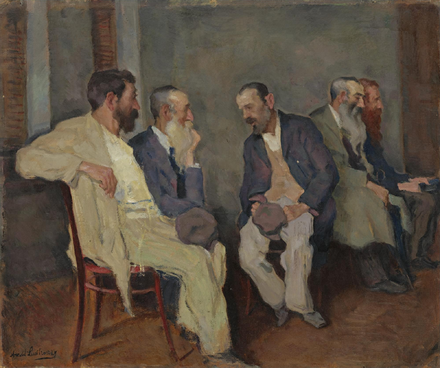
“The Conversation” (1935), by Arnold Lakhovsky.
SOMERVILLE, Mass.
It’s a commonplace that economics in the industrial democracies in the years after World War II took on many outward aspects of an engineering discipline. A “new welfare economics,” pioneered in Britain by A.C. Pigou, Nicholas Kaldor, John Hicks and others, led in the next generation in the U.S. by Paul Samuelson, supported the privilege of economists to give advice as experts on a wide variety of topics. Free trade might help some people and hurt others, for instance, but overall gains would be more than sufficient for the winners to compensate the losers. Thus government engineering could increase welfare across the board.
Two subfields of economics emerged in the 1950s which at first seemed to be at cross purposes, except that both had trouble with the newly dominant welfare economics. Social choice, from Kenneth Arrow, concerned itself with voting systems. Public choice, from James Buchanan and Gordon Tullock described itself as “the economics of politics”: legislative log-rolling, lobbying, pandering to the electorate and all that. Buchanan’s “politics without romance” seemed to exhibit a strong bias in his further explication of its underlying principle: “government is something to seek protection from, not to exploit.” But in fact his concern was simply that the motivations of policy-makers be examined as carefully as those of everyone else.
In her prize-winning article on the evolution of the system economists use to classify the literature of their profession, historian Beatrice Cherrier told how by the 1980s the two subfields had grown closer to one another and somehow seemed to be on the brink of becoming a major new field. Indeed, 5 percent of the profession was then described as working on problems of public choice. So editors of the Journal of Economic Literature came up with a new name to encapsulate both fields, as well as some related studies: “collective decision-making.” It turns out that the collision of collective decision-making with welfare economics conceals a pretty interesting story.
It had been Kaldor who first formulated the principle of compensation. Following the argument that John Stuart Mill had made a century before against Britain’s Corn Law program of price supports, Kaldor asked why not simply compensate those who suffered from a given policy adoption if everyone would gain something over all? There would be no need for the economist to prove that no one would suffer as a result of the adoption of the plan. A few years later, in The Foundations of Welfare Economics, John Hicks introduced production possibility frontier diagrams as “a perfectly objective test” of the efficiency of improvement plans – or their lack thereof. This would become the basis of the “scientific analysis” of welfare.
A few years after that, the young American economist Arrow asked if the same thing could be said of majority voting, where many voters of different views were involved. To make his model work, he made a key assumption: that individual preferences were given and couldn’t be changed by the decision process. Arrow concluded, to general surprise, that no system of voting would produce an ordering that was consistent with individuals’ underlying preferences. Bad enough that this seemed to undercut the new welfare analysis. What if the preferences were to change as a result of the process? Then new welfare economics would make no sense at all.
Three years later, in “Individual Choice in Voting and the Market,” Buchanan, then a professor at the University of Virginia, made precisely the counter-argument; that individual preferences can and do change in the process of decision-making; that this was the whole point of adducing evidence and learning from debate. Over time, Buchanan’s argument has carried the day. Forty years later, Amartya Sen, of Harvard University, wrote “[I]t is only through Buchanan’s expansion of Arrow’s departures that we can do justice to the Enlightenment enterprise of advancing rational decision-making in societies, which lies at the foundation of democratic modernity.”
I know all this (and have paraphrased much) from having read Escape from Democracy: The Role of Experts and the Public in Economic Policy (Cambridge, 2017), by David Levy, of George Mason University, and Sandra Peart, of the University of Richmond. Levy and Peart were interested in calling attention to the views of Buchanan’s teacher, Frank Knight, of the University of Chicago, who sank into relative obscurity after retiring from Chicago in 1955 – except for the half-year he spent lecturing at the University of Virginia, enough to become a founding member of the Virginia school of political economics. The two are at work now on a larger book about just what that Virginia school represented – as distinct from the Chicago school. You can expect to hear much more about it in a year or three.
Knight liked to quote James Bryce, Britain’s ambassador to the Unites States from 1907 until 1913, and author of The American Commonwealth: “Democracy is government by discussion.” Knight himself put it this way:
In contrast to natural objects – even with the higher animals – man is unique in that he is dissatisfied with himself; he is the discontented animal, the romantic, argumentative, aspiring animal. Consequently, his behavior can only in part be described by scientific principles or laws.
The new welfare economics is by now pretty well discredited, and not only by the widespread failure to compensate the losers. But the instinct of deference to experts is still pretty well embedded in our political culture. Perhaps it needs to be checked a little in favor of the virtues of democratic debate. George Stigler, who also had been Knight’s student, objected to the supposed expertise of the new welfare economics with respect to policies by invoking goals: “The primary requisite for a working social system is a consensus on ends. The individual members of the society must agree upon the major ends that society is to seek.”
One of the perils of being a solo practitioner is the news business is that once you start thinking about something, there’s no one there to make you stop. This topic is indeed the topic I cut short last week. The moral this week is pretty much the same. The rest of us, not the experts, are the jury.
Whether you are worried about the future of a divided country, impatient about the debate about the policies of President Trump, or eager to decide the appropriate policy against global warming, it helps to think of the question as akin to the process of jury deliberation, twelve persons making decisions together around a table in a room. Granted, 330 million souls, inhabiting 4.5 million square miles, is some As-if. But the basic principles are the same. Accept that opinions will be drawn from all walks of life, without regard to income or education. Expect to have to talk it out. Listen to the experts and the commentators. Consider the evidence that they (and nature) present. Cross-examine them as best you can. Talk some more. Strive for consensus, and be patient. Expect a verdict to be reached only when consensus is in sight.
David Warsh, an economic historian and veteran columnist, is proprietor of Somerville-based economicprincipals.com, where this column first ran.
Norah Lawter: Time for a Green New Deal
Via OtherWords.org
Lately there’s been a lot of bad news about climate change and the future of humanity.
In October, the United Nations issued a major report warning of a climate crisis as soon as 2040. The day after Thanksgiving, the Trump administration tried to bury the release of its own report on the dire effects of climate change already occurring in the United States, which included dark predictions for the future.
In December alone, we learned that 2018’s global carbon emissions set a record high. NASA detected new glacier melts in Antarctica. There were wildfires. Coral reef bleaching. Ecosystem upheaval in Alaska as the arctic ice melts.
Meanwhile the Trump administration sent an adviser to the U.N. climate summit to promote coal and warn against climate “alarmism.”
So this all sucks. But here’s the thing about climate change: You can either ignore it, get depressed about doomsday scenarios, or believe that no matter how badly we’ve screwed up as a species, we’re also smart and creative enough to fix this.
If the alternatives are ignorance and despair, I’ll choose hope. Every single time.
So where can we focus our hope? What can we actually do about climate change?
I’m excited about the Green New Deal, an idea that’s been kicking around since 2007 but was popularized this fall by Representative-elect Alexandria Ocasio-Cortez (D.-N.Y.) and the youth-led Sunrise Movement. At least 37 members of Congress have signed on, along with dozens of activist organizations.
Not only a plan to shake up environmental policies, it’s also a massive jobs program, named after the Depression-era New Deal. The basic idea is to get us to 100 percent renewable energy by 2035, by putting Americans to work building a new energy infrastructure.
It merges the immediate concerns of working Americans — jobs and the economy — with the long-term concerns of climate change. We don’t have to choose between economic sustainability and environmental sustainability.
“This is going to be the Great Society, the moonshot, the civil rights movement of our generation. That is the scale of the ambition that this movement is going to require,” said Ocasio-Cortez during a town hall meeting with Bernie Sanders.
The ambitious plan touches on a “smart” grid; energy-efficient buildings; sustainable agriculture, manufacturing, transportation, and infrastructure; and exporting green technology to make the U.S. “the undisputed international leader in helping other countries transition to completely carbon neutral economies.” Think of the scale of this program, and then think of all the jobs that would be created. This could be huge for rural America in particular.
Will the Green New Deal be expensive? Probably. But that doesn’t mean it will be a drag on our economy.
A recent study by the Global Commission on the Economy and Climate revealed that we could save $26 trillion, worldwide, if we shifted to sustainable development. Another new study shows wind and solar power to be the cheapest sources for electricity around the world. Last year, the Republican mayor of Georgetown, Texas switched his city to 100 percent renewable energybecause of the low costs in the long-term.
On the other hand, at the UN climate summit in Poland, some of the world’s most powerful investors warned of a major financial crash if we don’t solve the climate crisis.
Is the Green New Deal too ambitious? No. We need ambition. The impending climate crisis is the biggest problem the human race has ever faced, and we can’t think small.
So let’s get visionary. Let’s dream big. Let’s fight for our children, and let’s invest in their future.
Norah Vawter is a freelance writer living in Northern Virginia.
Pay attention!

“Self Portrait as a Beautiful Lady’’ (detail), by Arhia Kohlmoos, in the show “Depth of Perception,’’ at Fountain Street Fine Art, Jan. 2-27.
The gallery says the show:
“{E}xplores the concept of taking notice. For many people this action represents a single moment in time that encourages reflection and to focus one’s attention on the present. It can be viewed as the link between human and spirit; darkness and light; scarcity and abundance. ‘‘