
Vox clamantis in deserto







Only constant is change
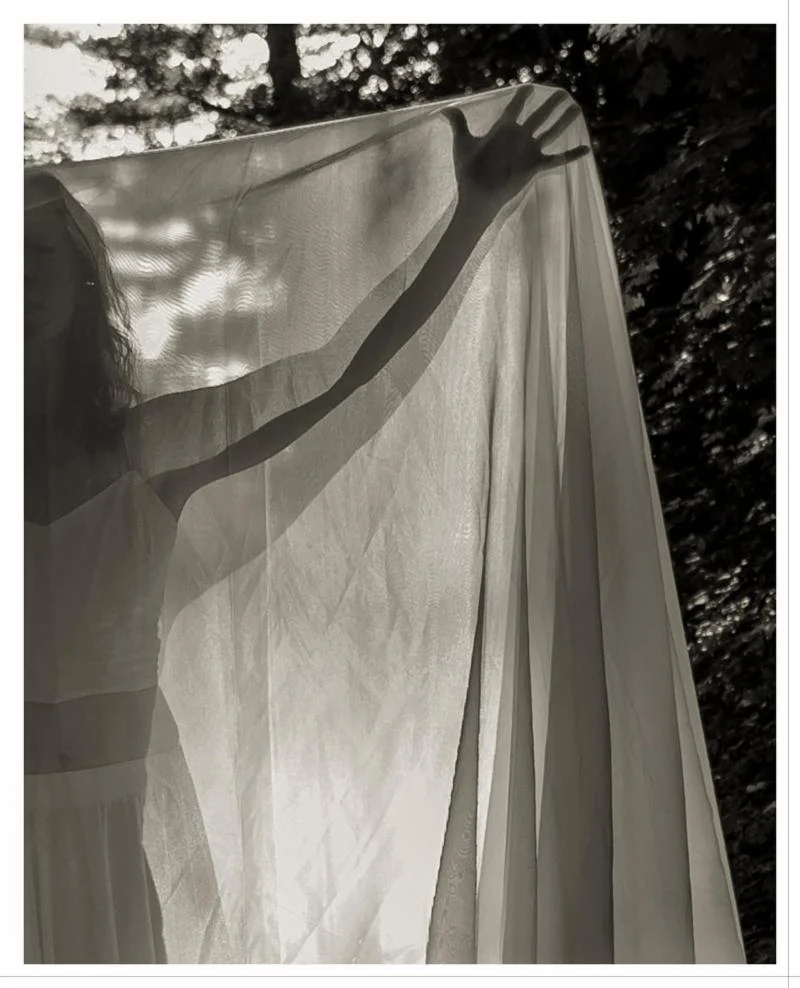
From David Lee Black’s show “Passage,’’ at Galatea Fine Art, Boston Jan. 2-26.
Chris Powell: Native Americans could be pretty nasty, too

A man displaying himself as a Pequot warrior at the Pequot Museum at the Foxwoods casino in Connecticut
MANCHESTER, Conn.
Replacing Columbus Day with "Indigenous Peoples Day" on its school calendar, Manchester's Board of Education has concluded that the Italian navigator sailing for Spain should not be considered such a hero after all, since, in discovering the New World, he began the colonial subjugation of its natives.
This is fair criticism, and people are always free to change their minds about who should be honored with holidays, statues, and such. But the school board does not seem to have explained why "indigenous peoples" are any more deserving of special honor than Columbus himself. After all, these days nearly everyone in the United States is "indigenous," and back in Columbus' time and throughout the colonial era in the Western Hemisphere "indigenous" people weren't the noble savages of romantic myth but carried the same character and cultural flaws as the rest of humanity.
The "indigenous peoples" of old warred against each other as much as the European settlers warred against them. They even made alliances with the Europeans against other aborginals. Though it does not seem to be taught in many schools in Connecticut, this is precisely the state's own story. Indian tribes living here invited the Europeans in Massachusetts to settle among them as allies against the Pequots, an aggressive tribe that had moved into the area and was preying on the other tribes and whose very name is said to have meant "destroyers."
Before long the Pequots were destroyed themselves, nearly all of them exterminated, including noncombatant women and children, in what was essentially genocide committed by the warriors of an alliance of the Europeans and the Mohegan and Narragansett tribes.
Of course tribal wars go back through the Bible to the beginning of human history. There have always been aggressors and victims, and being "indigenous" never automatically conveyed virtue any more than it does today. So while there is a case for demoting Columbus and leaving his day unmarked, the only purpose of putting "indigenous peoples" in his place on the calendar is to advance the politically correct proposition that all of American history has been dishonorable and thereby to induce guilt to intimidate the public in the face of the PC agenda generally.
This political correctness contaminates public education throughout the county and now, with Indigenous Peoples Day, reigns in Manchester's schools as well as Bridgeport's, New London's, and West Hartford's.
But despite its many ugly aspects, American history on the whole exemplifies what used to be called the Ascent of Man, the gradual but steady extension of liberty and democracy and the improvement of living standards. The sacrifices made in pursuit of these objectives are profound though not always well-taught.
There is another reason Manchester's school board has not just erased Columbus Day from its calendar but declared it a different holiday to honor a whole class of people good and bad. That is, Columbus Day remains by law a state holiday for which government employees must be paid without working.
The board can call this paid day off whatever it wants, but until the General Assembly and the governor erase him, Connecticut is still honoring Columbus, and politically incorrect as he may have become, crossing the government employee unions is considered worse than politically incorrect -- politically fatal.
Chris Powell is a columnist for the Journal Inquirer, in Manchester, Conn,
David Warsh: How the press didn't cover the Panic of 2008

The headquarters, in New York, of Lehman Brothers, whose collapse ignited the Panic of 2008.
— Photo by David Shankbone
SOMERVILLE, Mass,.
When John Authers departed the Financial Times for Bloomberg News earlier this autumn, he left behind a couple of bombshell articles that my friends still haven’t stopped talking about. After 29 years as one of the FT’s most admired commentators, the former editor of the paper’s vaunted Lex page, proprietor of the “Short View” column, was leaving Britain for the United States.
In the first article, under a headline “In a crisis, sometimes you don’t tell the whole story,” he wrote:
It is time to admit that I once deliberately withheld important information from readers. It was ten years ago, the financial crisis was at its worst, and I think I did the right thing. But a decade on from the 2008 crisis (our front pages during the period are at ft.com/financialcrisis), I need to discuss it.
It had occurred on Wednesday, Sept. 17, two days after Lehman Brother declared bankruptcy, the scariest day of the crisis, both for Authers, and, to judge from his memoir, for Federal Reserve chairman Ben Bernanke as well. The insurance giant AIG had received an $85 billion government loan the day before. The Reserve Fund, the nation’s largest money market fund, had seen its redemption value dip below $1, thanks to its losses on Lehman bonds. A high rate of withdrawals had begun.
Authers, as it happened, had sold his flat in London not long before. The proceeds were deposited in Citibank, far more than would be covered by government insurance if Citi failed. He went to the bank, intending to withdraw half his money and carry the cash to a rival bank. He found himself standing in a long line. The bank officer he finally reached told him he didn’t need to withdraw his funds in order to protect them. She quickly opened trust accounts for each of his children and a joint account with his wife.
Presto, Authers was insured by the government for the full amount of his deposit. The maneuver had been going on all morning, the officer explained, and the same at Chase bank next door. Neither she nor her competitor had ever performed a single such transaction previously. That day they had undertaken many. Authers wrote,
I was finding it a little hard to breathe. There was a bank run happening, in New York’s financial district. The people panicking were the Wall Streeters who best understood what was going on. All I needed was to get a photographer to take a few shots of the well-dressed bankers queuing to get their money, and write a caption explaining it.
Instead, he went back to his desk and wrote a column about the breakdown of trust among banks, describing the atmosphere as one of panic, but omitting the queue in the bank branch. Authers concluded,
We didn’t do it. Such a story on the FT’s front page might have been enough to push the system over the edge. Our readers went unwarned, and the system went without that final prod into panic…. The right to free speech does not give us the right to shout fire in a crowded cinema; there was the risk of fire and we might have lit the spark by shouting about it.
A month later, in a long contemplative essay headlined “In nothing we trust” ($1 trial subscription may be required), Authers explored the erosion of confidence in the media he had experienced in the thirty years since he had begun. He described the old days of newspapers’ semi-monopoly on advertising and information, the faith invested in the FT’s every word, and the ethic of responsibility that went with it.
He described the stinging backlash to his earlier admission that he and the paper had held back from adding fuel to the fire. There had been hundreds of responses in which opinion was overwhelmingly against him. One reader wrote,
Your decision to save yourself while neglecting your readership is unforgivable and in the very nature of the elitist Cal Hockley of the Titanic scrambling for a lifeboat at the expense of others in need.
He found the feedback “astonishing and wrongheaded.” But gradually he came to view it as a crisis of belief – belief in the news media as an institution that clarifies and sets the agenda. The rise of social media had diluted the privileges of print, including the mystique that relative anonymity conferred. These days his photo accompanied nearly everything he wrote. His mornings turned into a digital talk show with readers. Sometimes they were specialists, thrillingly well-informed. Increasingly they were ignorant and rancorous. Limits on deposit insurance had been raised a few weeks later and the crisis abated, he wrote; ten years later, banks were once again sound, and the threat had moved on to the pension system.
The irony, it seems to me, is that Authers had missed the fact, or at least the significance, of the very real panic already raging thirty floors above that retail branch, and in trading rooms around the world. To judge from the special section devoted to the tenth anniversary of the crisis in which his initial column appeared, so had the FT itself. What would eventually become the Panic of 2008 was not so different from the Panic of 1907, or 1893, as economic historian Gary Gorton wrote a year later, “except that most people had never heard of the financial markets involved.” In Slapped by The Invisible Hand: The Panic of 2007 (Oxford, 2010), Gorton continued,
In the earlier panics, individuals, fearing for their savings and not knowing if their banks would survive the coming recession, rushed to their banks to withdraw their money. Those runs would occur at all banks, usually starting in New York City, and spreading from there. Everyone knew that the panic had happened and then consequences would follow; firms would fail and there would be difficulties making transactions.
The visibility of the earlier panics did not make the event itself explicable, but it did provide clarity about what had happened in a direct sense. In the Panic of 2007 [sic], the “bank run” was invisible to almost everyone because it was a run by banks and firms on other banks. These interbank markets were invisible to the public, journalists, and politicians. Without observing the bank run, what became visible were only the effects of the run and, in many cases, the effects were mistaken for the cause.
Because what happened after Lehman Brothers failed in September 2008 wasn’t framed as a traditional systemic banking panic, the traditional policy response was then widely misunderstood. Instead of being seen as performing their traditional role as “lenders of last resort” (backed by national treasuries), central banks’ emergency loans designed to stem the fear were routinely described as “bailouts,” despite the fact that in most cases loans were fully repaid.
The willingness to engage in self-examination shows why the FT is widely loved, why Authers is respected, at least by most of his readers. By acknowledging the centrality of trust he goes straight to the heart of the matter. But it wasn’t the press that failed to adequately explain the Panic of 2008. It was the economics profession. That story still has a long way to go.
David Warsh, a longtime columnist and an economic historian, is proprietor of Somerville-based economicprincipals.com, where this column first ran.
Da
Frank Robinson: 'Senior Moments, 11'

(Written from a senior community)
By Frank Robinson
This is the place
where old people go,
to visit their parents.
xxx
Work or retirement –
a hard choice
between wasting time doing something
or wasting time doing nothing.
xxx
I wasn’t old
until I went to an old people’s home;
old age is catching.
xxx
Is this a hospital or a home?
A little bit of both.
xxx
Everybody is nobody here,
no matter what you were.
You make yourself
every day.
xxx
In line at our café –
“I’m in a hurry;
My husband is dying.’’
xxx
If this is what life is like when I’m lucky,
God help me when I’m not.
xxx
There are so many exotic diseases these days,
cancer and heart attack
seem kind of safe.
xxx
Christmas here:
a hundred flowers
waiting at the front desk.
xxx
What a perfect marriage!
We take turns being sick.
xxx
This is the world of second chances,
of last chances,
a new beginning at the end.
xxx
Those days when I don’t want to live
and don’t want to die,
it takes a lot
to get out of bed.
xxx
To be old is to worry,
especially when there’s nothing
to worry about.
xxx
From the first,
I knew we owed the gods a death,
but I didn’t know
we owed them two,
yours and mine.
xxx
If someone’s really old,
you hate to waste their time
saying hello.
xxx
We think about the past every day,
that abandoned building
we forgot to tear down.
xxx
These days,
I talk to myself even more,
now that people can’t hear me.
(Did they listen before?)
xxx
This is the test:
Can you be patient and kind
to people who are dying?
xxx
Old age –
when suddenly
everything around you
seems fragile.
xxx
When someone tells you
her husband is doing well,
you know he isn’t
xxx
We use ski poles in every season,
even in summer –
in preparation, I suppose, for winter.
xxx
This is a strange world,
so comfortable and safe,
and yet so close to pain and death.
xxx
This place is such a good subject for poetry,
let’s hope nobody comes up with a miracle cure.
xxx
I forget things I shouldn’t forget
and remember things I shouldn’t remember.
I think too much.
xxx
Watch out for those wheelchairs!
They’re just showing off,
or getting back at us
for walking.
Frank Robinson, an art historian and the former director of the art museums at Cornell University and the Rhode Island School of Design, is a poet and essayist living in Ithaca, N.Y.
'A present of our own'
“Only this evening I saw again low in the sky
The evening star, at the beginning of winter, the star
That in spring will crown every western horizon,
Again… as if it came back, as if life came back,
Not in a later son, a different daughter, another place,
But as if evening found us young, still young,
Still walking in a present of our own.’’
— From “Martial Cadenza,’’ by Wallace Stevens
Closer to spring
‘‘I heard a bird sing
In the dark of December
A magical thing
And sweet to remember.
'We are nearer to Spring
Than we were in September,'
I heard a bird sing
In the dark of December.’’
— Oliver Herford
For spring

“Yearn,’’ by Lissa Banks in the Members Exhibition at Attleboro Arts Museum, through Feb. 1.
Kathy Toler: Trump plan would slash mail service and raise rates in many places

Via OtherWords.org
I’ve been a postal clerk for 23 years, serving my customers in a public post office in Gresham, Ore.
As you might imagine, with the holidays fast approaching, it’s a busy time of year for us. Every day, I help my customers mail letters, cards, and packages across town and across the county. Even when we’re busy, it’s a joy to share a small part in spreading holiday cheer.
Because the U.S. Postal Service charges uniform rates across the country, I don’t need to ask you if a package is being sent to a home or a business, or whether the recipient lives in a big city or a distant rural area.
You can select a flat rate box that goes anywhere for one price, no matter what’s inside. Or if you pack your own gift, we price it based on weight and distance. The post office never charges you more to send your gift just because your grandma happens to live out in the country.
If you took your packages to a private delivery firm, on the other hand, you might be hit with extra charges because of where your grandma lives.
On top of their base rates, UPS and FedEx charge more for deliveries to over half of all U.S. ZIP codes — hitting not just Alaska, Hawaii, and other distant areas, but also many small towns. Even suburbs of major cities — like Laveen, just eight miles from Phoenix, and Whites Creek, eight miles from Nashville — can draw extra charges.
According to new research by the Institute for Policy Studies, these ZIP codes are home to around 70 million people.
These extra costs already range up to $4.45 for a package delivered to a home in a rural area. But my real worry is that these extra costs are just a taste of what would happen if the U.S. Postal Service is sold off to private, for-profit corporations.
Last summer, the White House Office of Management and Budget recommended postal privatization in a report on government restructuring. And just in time for the holidays, a presidential task force just made recommendations that would slow down the mail, privatize large portions of the Postal Service, and lead to other service cuts.
If these privatization efforts succeed, millions of people may well face a return to 19th century standards of expensive, private delivery services and limited USPS access.
For the first 121 years of U.S. history, postal services were limited to those in cities. Farmers and other pioneers had to either travel long distances to cities or pay handsomely for private carriers to deliver their mail periodically.
Without competition from the public Postal Service, for-profit firms would likely jack up delivery fees even higher for the 70 million people who already live in areas hit by delivery surcharges.
And of course, USPS doesn’t just ship gifts. Millions of people rely on us for delivery of prescription drugs, medical supplies, and other essential items.
I think of myself as a public servant. I’m glad that the United States Postal Service treats all Americans fairly, regardless of where they live or work. A privatized, for-profit company won’t do that.
If the armfuls of gifts customers bring into my post office are any indication, that means holiday shipping would be a lot more expensive for millions of people.
Let’s protect the world’s finest public postal network, and together insist that the U.S. Mail is Not for Sale.
Kathy Toler has been a postal clerk in Gresham, Ore. for 23 years. The views expressed here are her own, not necessarily those of her employer’s.
And the other on a neck
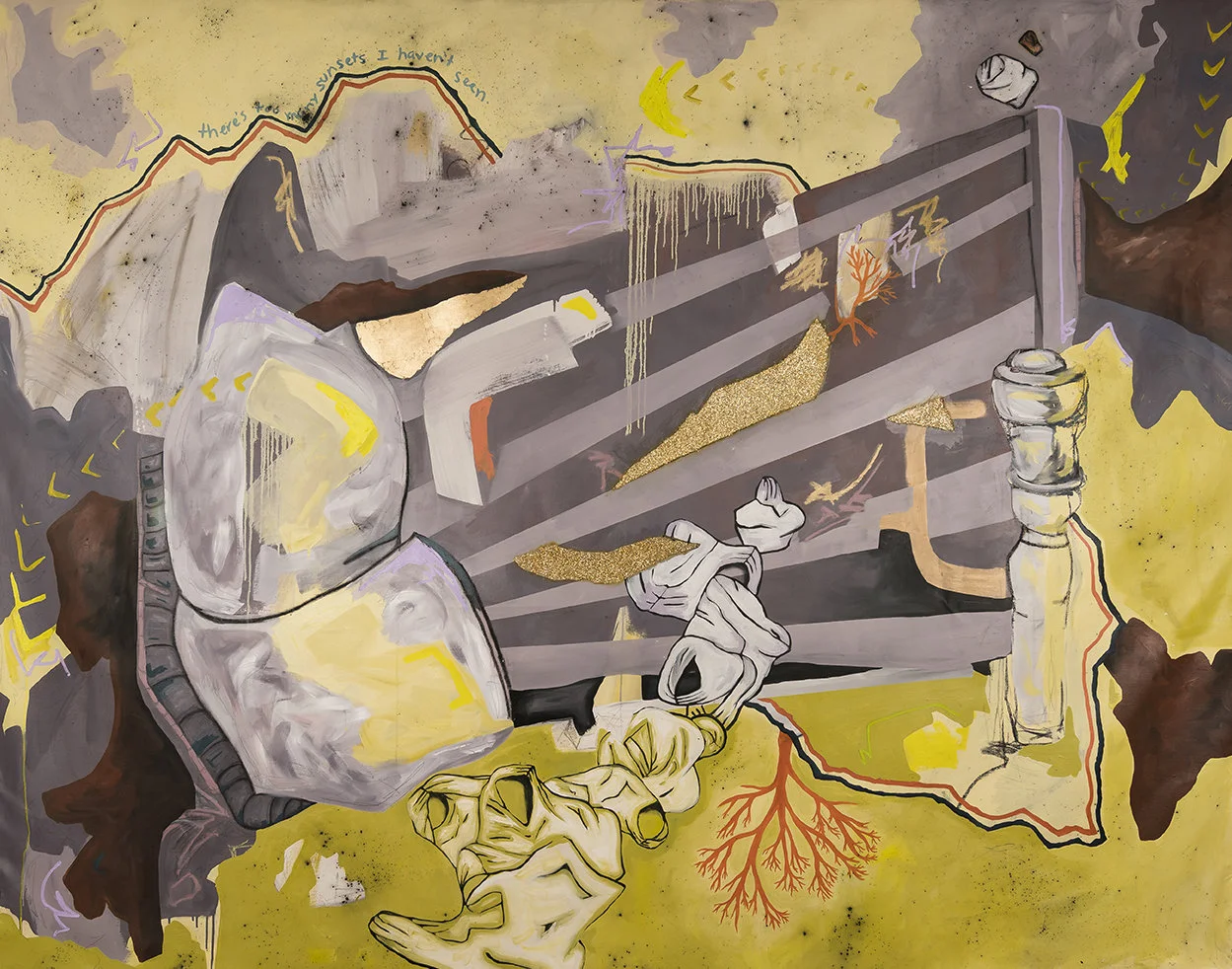
“One Foot On The Floor (oil, charcoal, graphite, gold leaf, glitter on linen), by Hilary Tait Norod, in her show at Workbar Central Square, Cambridge.
N.E. just got a lot more clout on Capitol Hill
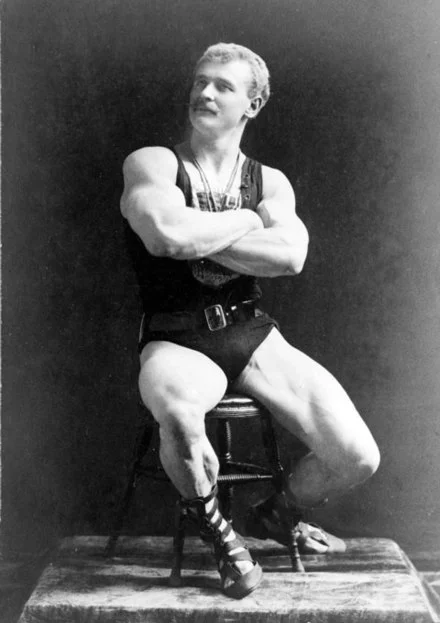
Jim Brett, president and CEO of the New England Council (newenglandcouncil.com), says that New England’s congressional clout just got a big boost because Democrats won the House in the mid-terms.
“I would say, today, that our region, our New England congressional delegation is a powerhouse in the new 116th Congress,” Mr. Brett recently told a group in Ipswich.
In New England, all 21 House seats will now be held by Democrats, with the defeat of a Republican in Maine’s Second Congressional District. To read more, including about individual New England congressional movers and shakers, please hit this link.
'But the mountains aren't quite high enough'
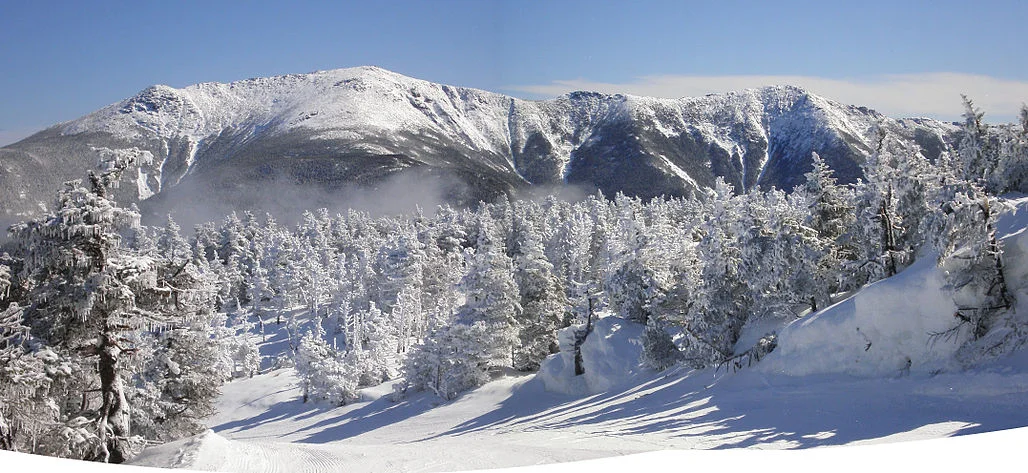
New Hampshire’s Franconia Range, which Robert Frost could have seen from his home.
“I met a lady from the South who said
(You won't believe she said it, but she said it):
"None of my family ever worked, or had
A thing to sell." I don't suppose the work
Much matters. You may work for all of me.
I've seen the time I've had to work myself.
The having anything to sell is what
Is the disgrace in man or state or nation.
I met a traveler from Arkansas
Who boasted of his state as beautiful
For diamonds and apples. "Diamonds
And apples in commercial quantities?"
I asked him, on my guard. "Oh, yes," he answered,
Off his. The time was evening in the Pullman.
I see the porter's made your bed," I told him.
I met a Californian who would
Talk California—a state so blessed,
He said, in climate, none bad ever died there
A natural death, and Vigilance Committees
Had had to organize to stock the graveyards
And vindicate the state's humanity.
"Just the way Stefansson runs on," I murmured,
"About the British Arctic. That's what comes
Of being in the market with a climate."
I met a poet from another state,
A zealot full of fluid inspiration,
Who in the name of fluid inspiration,
But in the best style of bad salesmanship,
Angrily tried to male me write a protest
(In verse I think) against the Volstead Act.
He didn't even offer me a drink
Until I asked for one to steady him.
This is called having an idea to sell.
It never could have happened in New Hampshire.
The only person really soiled with trade
I ever stumbled on in old New Hampshire
Was someone who had just come back ashamed
From selling things in California.
He'd built a noble mansard roof with balls
On turrets, like Constantinople, deep
In woods some ten miles from a railroad station,
As if to put forever out of mind
The hope of being, as we say, received.
I found him standing at the close of day
Inside the threshold of his open barn,
Like a lone actor on a gloomy stage—
And recognized him, through the iron gray
In which his face was muffled to the eyes,
As an old boyhood friend, and once indeed
A drover with me on the road to Brighton.
His farm was "grounds," and not a farm at all;
His house among the local sheds and shanties
Rose like a factor's at a trading station.
And be was rich, and I was still a rascal.
I couldn't keep from asking impolitely,
Where bad he been and what had he been doing?
How did he get so? (Rich was understood.)
In dealing in "old rags" in San Francisco.
Ob, it was terrible as well could be.
We both of us turned over in our graves.
Just specimens is all New Hampshire has,
One each of everything as in a showcase,
Which naturally she doesn't care to sell.
She had one President. (Pronounce him Purse,
And make the most of it for better or worse.
He's your one chance to score against the state.)
She had one Daniel Webster. He was all
The Daniel Webster ever was or shall be.
She had the Dartmouth needed to produce him.
I call her old. She has one family
Whose claim is good to being settled here
Before the era of colonization,
And before that of exploration even.
John Smith remarked them as be coasted by,
Dangling their legs and fishing off a wharf
At the Isles of Shoals, and satisfied himself
They weren't Red Indians but veritable
Pre-primitives of the white race, dawn people,
Like those who furnished Adam's sons with wives;
However uninnocent they may have been
In being there so early in our history.
They'd been there then a hundred years or more.
Pity he didn't ask what they were up to
At that date with a wharf already built,
And take their name. They've since told me their name—
Today an honored one in Nottingham.
As for what they were up to more than fishing—
Suppose they weren't behaving Puritanly,
The hour bad not yet struck for being good,
Mankind had not yet gone on the Sabbatical.
It became an explorer of the deep
Not to explore too deep in others' business.
Did you but know of him, New Hampshire has
One real reformer who would change the world
So it would be accepted by two classes,
Artists the minute they set up as artists,
Before, that is, they are themselves accepted,
And boys the minute they get out of college.
I can't help thinking those are tests to go by.
And she has one I don't know what to call him,
Who comes from Philadelphia every year
With a great flock of chickens of rare breeds
He wants to give the educational
Advantages of growing almost wild
Under the watchful eye of hawk and eagle
Dorkings because they're spoken of by Chaucer,
Sussex because they're spoken of by Herrick.
She has a touch of gold. New Hampshire gold—
You may have heard of it. I had a farm
Offered me not long since up Berlin way
With a mine on it that was worked for gold;
But not gold in commercial quantities,
Just enough gold to make the engagement rings
And marriage rings of those who owned the farm.
What gold more innocent could one have asked for?
One of my children ranging after rocks
Lately brought home from Andover or Canaan
A specimen of beryl with a trace
Of radium. I know with radium
The trace would have to be the merest trace
To be below the threshold of commercial;
But trust New Hampshire not to have enough
Of radium or anything to sell.
A specimen of everything, I said.
She has one witch—old style. She lives in Colebrook.
(The only other witch I ever met
Was lately at a cut-glass dinner in Boston.
There were four candles and four people present.
The witch was young, and beautiful (new style),
And open-minded. She was free to question
Her gift for reading letters locked in boxes.
Why was it so much greater when the boxes
Were metal than it was when they were wooden?
It made the world seem so mysterious.
The S'ciety for Psychical Research
Was cognizant. Her husband was worth millions.
I think he owned some shares in Harvard College.)
New Hampshire used to have at Salem
A company we called the White Corpuscles,
Whose duty was at any hour of night
To rush in sheets and fool's caps where they smelled
A thing the least bit doubtfully perscented
And give someone the Skipper Ireson's Ride.
One each of everything as in a showcase.
More than enough land for a specimen
You'll say she has, but there there enters in
Something else to protect her from herself.
There quality makes up for quantity.
Not even New Hampshire farms are much for sale.
The farm I made my home on in the mountains
1 had to take by force rather than buy.
I caught the owner outdoors by himself
Raking.up after winter, and I said,
“I’m going to put you off this farm: I want it."
“Where are you going to put me? In the road?”
“I’m going to put you on the farm next to it.”
“Why won't the farm next to it do for you?"
"I like this better." It was really better.
Apples? New Hampshire has them, but unsprayed,
With no suspicion in stern end or blossom end
Of vitriol or arsenate of lead,
And so not good for anything but cider.
Her unpruned grapes are flung like lariats
Far up the birches out of reach of man.
A state producing precious metals, stones,
And—writing; none of these except perhaps
The precious literature in quantity
Or quality to worry the producer
About disposing of it. Do you know,
Considering the market, there are more
Poems produced than any other thing?
No wonder poets sometimes have to seem
So much more businesslike than businessmen.
Their wares are so much harder to get rid of.
She's one of the two best states in the Union.
Vermont's the other. And the two have been
Yokefellows in the sap yoke from of old
In many Marches. And they lie like wedges,
Thick end to thin end and thin end to thick end,
And are a figure of the way the strong
Of mind and strong of arm should fit together,
One thick where one is thin and vice versa.
New Hampshire raises the Connecticut
In a trout hatchery near Canada,
But soon divides the river with Vermont.
Both are delightful states for their absurdly
Small towns—Lost Nation, Bungey, Muddy Boo,
Poplin, Still Corners (so called not because
The place is silent all day long, nor yet
Because it boasts a whisky still—because
It set out once to be a city and still
Is only corners, crossroads in a wood).
And I remember one whose name appeared
Between the pictures on a movie screen
Election night once in Franconia,
When everything had gone Republican
And Democrats were sore in need of comfort:
Easton goes Democratic, Wilson 4
Hughes 2. And everybody to the saddest
Laughed the loud laugh the big laugh at the little.
New York (five million) laughs at Manchester,
Manchester (sixty or seventy thousand) laughs
At Littleton (four thousand), Littleton
Laughs at Franconia (seven hundred), and
Franconia laughs, I fear—-did laugh that night--
At Easton. What has Easton left to laugh at,
And like the actress exclaim "Oh, my God" at?
There's Bungey; and for Bungey there are towns,
Whole townships named but without population.
Anything I can say about New Hampshire
Will serve almost as well about Vermont,
Excepting that they differ in their mountains.
The Vermont mountains stretch extended straight;
New Hampshire mountains Curl up in a coil.
I had been coming to New Hampshire mountains.
And here I am and what am I to say?
Here first my theme becomes embarrassing.
Emerson said, "The God who made New Hampshire
Taunted the lofty land with little men."
Another Massachusetts poet said,
"I go no more to summer in New Hampshire.
I've given up my summer place in Dublin."
But when I asked to know what ailed New Hampshire,
She said she couldn't stand the people in it,
The little men (it's Massachusetts speaking).
And when I asked to know what ailed the people,
She said, "Go read your own books and find out."
I may as well confess myself the author
Of several books against the world in general.
To take them as against a special state
Or even nation's to restrict my meaning.
I'm what is called a sensibilitist,
Or otherwise an environmentalist.
I refuse to adapt myself a mite
To any change from hot to cold, from wet
To dry, from poor to rich, or back again.
I make a virtue of my suffering
From nearly everything that goes on round me.
In other words, I know wherever I am,
Being the creature of literature I am,
I shall not lack for pain to keep me awake.
Kit Marlowe taught me how to say my prayers:
"Why, this is Hell, nor am I out of it."
Samoa, Russia, Ireland I complain of,
No less than England, France, and Italy.
Because I wrote my novels in New Hampshire
Is no proof that I aimed them at New Hampshire.
When I left Massachusetts years ago
Between two days, the reason why I sought
New Hampshire, not Connecticut,
Rhode Island, New York, or Vermont was this:
Where I was living then, New Hampshire offered
The nearest boundary to escape across.
I hadn't an illusion in my handbag
About the people being better there
Than those I left behind. I thought they weren't.
I thought they couldn't be. And yet they were.
I'd sure had no such friends in Massachusetts
As Hall of Windham, Gay of Atkinson,
Bartlett of Raymond (now of Colorado),
Harris of Derry, and Lynch of Bethlehem.
The glorious bards of Massachusetts seem
To want to make New Hampshire people over.
They taunt the lofty land with little men.
I don't know what to say about the people.
For art's sake one could almost wish them worse
Rather than better. How are we to write
The Russian novel in America
As long as life goes so unterribly?
There is the pinch from which our only outcry
In literature to date is heard to come.
We get what little misery we can
Out of not having cause for misery.
It makes the guild of novel writers sick
To be expected to be Dostoievskis
On nothing worse than too much luck and comfort.
This is not sorrow, though; it's just the vapors,
And recognized as such in Russia itself
Under the new regime, and so forbidden.
If well it is with Russia, then feel free
To say so or be stood against the wall
And shot. It's Pollyanna now or death.
This, then, is the new freedom we hear tell of;
And very sensible. No state can build
A literature that shall at once be sound
And sad on a foundation of well-being.
To show the level of intelligence
Among us: it was just a Warren farmer
Whose horse had pulled him short up in the road
By me, a stranger. This is what he said,
From nothing but embarrassment and want
Of anything more sociable to say:
"You hear those bound dogs sing on Moosilauke?’’
Well, they remind me of the hue and cry
We've heard against the Mid - Victorians
And never rightly understood till Bryan
Retired from politics and joined the chorus.
The matter with the Mid-Victorians
Seems to have been a man named Joh n L. Darwin."
"Go 'long,"‘ I said to him, he to his horse.
I knew a man who failing as a farmer
Burned down his farmhouse for the fire insurance,
And spent the proceeds on a telescope
To satisfy a lifelong curiosity
About our place among the infinities.
And how was that for otherworldliness?
If I must choose which I would elevate —
The people or the already lofty mountains
I'd elevate the already lofty mountains
The only fault I find with old New Hampshire
Is that her mountains aren't quite high enough.
I was not always so; I've come to be so.
How, to my sorrow, how have I attained
A height from which to look down critical
On mountains? What has given me assurance
To say what height becomes New Hampshire mountains,
Or any mountains? Can it be some strength
I feel, as of an earthquake in my back,
To heave them higher to the morning star?
Can it be foreign travel in the Alps?
Or having seen and credited a moment
The solid molding of vast peaks of cloud
Behind the pitiful reality
Of Lincoln, Lafayette, and Liberty?
Or some such sense as says bow high shall jet
The fountain in proportion to the basin?
No, none of these has raised me to my throne
Of intellectual dissatisfaction,
But the sad accident of having seen
Our actual mountains given in a map
Of early times as twice the height they are—
Ten thousand feet instead of only five—
Which shows how sad an accident may be.
Five thousand is no longer high enough.
Whereas I never had a good idea
About improving people in the world,
Here I am overfertile in suggestion,
And cannot rest from planning day or night
How high I'd thrust the peaks in summer snow
To tap the upper sky and draw a flow
Of frosty night air on the vale below
Down from the stars to freeze the dew as starry.
The more the sensibilitist I am
The more I seem to want my mountains wild;
The way the wiry gang-boss liked the logjam.
After he'd picked the lock and got it started,
He dodged a log that lifted like an arm
Against the sky to break his back for him,
Then came in dancing, skipping with his life
Across the roar and chaos, and the words
We saw him say along the zigzag journey
Were doubtless as the words we heard him say
On coming nearer: "Wasn't she an i-deal
Son-of-a-bitch? You bet she was an i-deal."
For all her mountains fall a little short,
Her people not quite short enough for Art,
She's still New Hampshire; a most restful state.
Lately in converse with a New York alec
About the new school of the pseudo-phallic,
I found myself in a close corner where
I bad to make an almost funny choice.
"Choose you which you will be—a prude, or puke,
Mewling and puking in the public arms."
"Me for the hills where I don’t have to choose.”
"But if you bad to choose, which would you be?"
1 wouldn't be a prude afraid of nature.
I know a man who took a double ax
And went alone against a grove of trees;
But his heart failing him, he dropped the ax
And ran for shelter quoting Matthew Arnold:
"'Nature is cruel, man is sick of blood':
There s been enough shed without shedding mine.
Remember Birnam Wood! The wood's in flux!"
He had a special terror of the flux
That showed itself in dendrophobia.
The only decent tree had been to mill
And educated into boards, be said.
He knew too well for any earthly use
The line where man leaves off and nature starts.
And never overstepped it save in dreams.
He stood on the safe side of the line talking—
Which is sheer Matthew Arnoldism,
The cult of one who owned himself "a foiled
Circuitous wanderer," and "took dejectedly
His seat upon the intellectual throne"—
Agreed in 'frowning on these improvised
Altars the woods are full of nowadays,
Again as in the days when Ahaz sinned
By worship under green trees in the open.
Scarcely a mile but that I come on one,
A black-checked stone and stick of rain-washed charcoal.
Even to say the groves were God's first temples
Comes too near to Ahaz' sin for safety.
Nothing not built with hands of course is sacred.
But here is not a question of what's sacred;
Rather of what to face or run away from.
I'd hate to be a runaway from nature.
And neither would I choose to be a puke
Who cares not what be does in company,
And when he can't do anything, falls back
On words, and tries his worst to make words speak
Louder than actions, and sometimes achieves it.
It seems a narrow choice the age insists on
8ow about being a good Greek, for instance)
That course, they tell me, isn't offered this year.
"Come, but this isn't choosing—puke or prude?"
Well, if I have to choose one or the other,
I choose to be a plain New Hampshire farmer
With an income in cash of, say, a thousand
(From, say, a publisher in New York City).
It's restful to arrive at a decision,
And restful just to think about New Hampshire.
At present I am living in Vermont.
— “New Hampshire,’’ by Robert Frost
Vermont town loses its cops
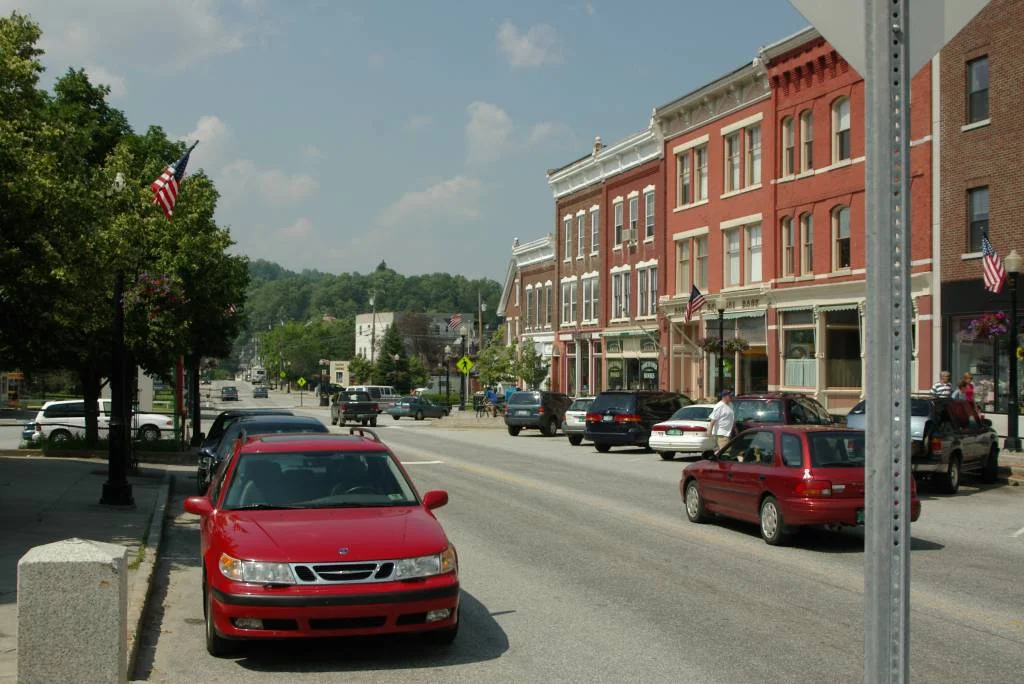
Downtown Randolph, Vt.
Photo by M.S.Maguire Copyright: ©2006 M.S.Maguire
From Robert Whitcomb’s “Digital Diary,’’ in GoLocal24.com
‘The Boston Globe had a rather poignant story Dec. 4 about the perhaps permanent loss of the town police force of Norman Rockwellian Randolph, Vt., in the White River Valley, because of fiscal and other issues. Law enforcement will, at least for the time being, be provided by Orange County. Townspeople are saddened that they’re losing an element of their local identity and some folks seem to feel less secure. It’s important to preserve such local agencies. Not every public service should be outsourced, or privatized.
To read more, please hit this link.
'Shadows and Light'
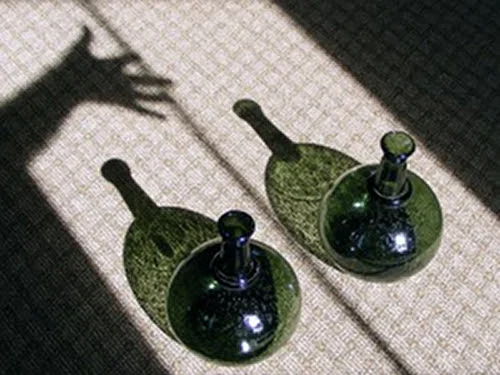
Image from the “Shadows and Light’’ show at The Franklin Gallery at Riverstones Custom Framing, in the very lively and interesting city of Rochester, N.H., through January. The show, coordinated by Peter Abate and featuring 34 artists, is a traveling exhibition. “Shadows and Light’’ is about the interplay and interpretation of shadow and light in art. The pieces in “Shadows and Light’’ explore the technical aspects of light and shadow as well as the symbolic and metaphorical ways these elements are expressed.
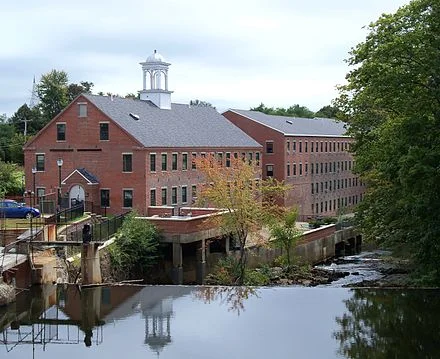
The Cocheco River provided power for Rochester’s early factories and mills, which made it a very prosperous place for many decades, starting in the early 19th Century. Shoes and blankets were among the major products. Prosperity spawned a remarkable degree of cultural energy, which continues to this day and has included the construction of an opera house and the residence of numerous visual artists, albeit some only in the summer.

Martha Bebinger: Boston nurse denied life insurance because she has naloxone prescription

Isela was denied life insurance because her medication list showed a prescription for the opioid-reversal drug naloxone.
— Photo by Jesse Costa for WBUR
BOSTON
Bloodwork was supposed to be the last step in Isela’s application for life insurance. But when she arrived at the lab, her appointment had been canceled.
“That was my first warning,” Isela said. She contacted her insurance agent and was told her application was denied because something on her medication list indicated that Isela uses drugs. Isela, a registered nurse who works in an addiction treatment program at Boston Medical Center, scanned her med list. It showed a prescription for the opioid-reversal drug naloxone — brand name Narcan.
“But I’m a nurse, I use it to help people,” Isela told her agent. “If there is an overdose, I could save their life.”
That’s a message public health leaders aim to spread far and wide. “Be prepared. Get Naloxone. Save a life,” was the message at the top of a summary advisory from the U.S. surgeon general in April.
But some life insurers consider the use of prescription drugs when reviewing policy applicants. And it can be difficult, some say, to tell the difference between someone who carries naloxone to save others and someone who carries naloxone because they are at risk for an overdose.
Primerica is the insurer Isela said turned her down. (We agreed to use just Isela’s first name because she is worried about how this story might affect her ongoing effort to get life insurance.) The company said it can’t discuss individual cases. But in a prepared statement, Primerica noted that naloxone has become increasingly available over the counter.
“Now, if a life insurance applicant has a prescription for naloxone, we request more information about its intended use as part of our underwriting process,” said Keith Hancock, the vice president for corporate communications. “Primerica is supportive of efforts to help turn the tide on the national opioid epidemic.”
After Primerica turned her down, Isela applied to a second life insurer and was again denied coverage. But the second company told her it might reconsider if she obtained a letter from her doctor explaining why she needs naloxone. So, Isela did contact her primary care physician — and then realized that her doctor had not prescribed the drug.
Isela bought naloxone at a pharmacy. To help reduce overdose deaths, Massachusetts and many other states have established a standing order for naloxone — one prescription that works for everybody. Isela couldn’t just give her insurer that statewide prescription; she had to find the doctor who signed it. As it happens, that physician — Dr. Alex Walley — also works at Boston Medical Center.
Walley is an associate professor of medicine at Boston University; he also works in addiction medicine at Boston Medical Center and is the medical director for the Opioid Overdose Prevention Pilot Program at the Massachusetts Department of Public Health.
“We want naloxone to be available to a wide group of people — people who have an opioid use disorder themselves, but also [those in] their social networks and other people in a position to rescue them,” Walley said.
He said he has written a half-dozen letters for other BMC employees denied life or disability insurance because of naloxone, and that troubles him.
“My biggest concern is that people will be discouraged by this from going to get a naloxone rescue kit at the pharmacy,” Walley said. “So this has been frustrating.”
The life insurance hassle — and threat of being turned down — has discouraged Isela and some of her fellow nurses. She is not carrying a naloxone kit outside the hospital right now because she doesn’t want it to show up on her active medication list until the life insurance problem is sorted out.
“So if something were to happen on the street, I don’t have one — just because I didn’t want another conflict,” Isela said.
BMC has alerted the state’s Division of Insurance, which has said in a written response that it is reviewing the cases and drafting guidelines for “the reasonable use of drug history information in determining whether to issue a life insurance policy.”
But Isela isn’t a drug user. And yet, she is being penalized as if she were.
Michael Botticelli, who runs the Grayken Center for Addiction Medicine at BMC, said friends and family members of patients with an addiction must be able to carry naloxone without fear that doing so will send them to the insurance reject pile.Jewr
“It’s incumbent on all of us to make sure that we try to kind of nip this in the bud,” he said, “before it is any more wide-scale.”
Botticelli said increased access to naloxone across Massachusetts is one of the main reasons overdose deaths are down in the state. The most recent state report showed 20 fewer fatalities through the first nine months of 2018 compared with the same period in 2017.
Botticelli relayed his concerns in a letter to Dr. Jerome Adams, the U.S. surgeon general, who says he contacted the National Association of Insurance Commissioners. That group says it has not heard of any cases of life insurance applicants being denied because they purchased naloxone.
Adams said it’s good to — as Botticelli suggests — nip the problem in the bud.
“Naloxone saves lives,” Adams said, “and it is important that all Americans know about the vital role bystanders can play in preventing opioid overdose deaths when equipped with this lifesaving medication.”
Isela said the second company that rejected her has agreed to let her reapply, in light of Walley’s letter stating that she carries the drug so that she can reverse an overdose. Isela is in the process of reapplying.
This story is part of a partnership that includes WBUR, NPR and Kaiser Health News.
The only cure: Get plenty of sleep
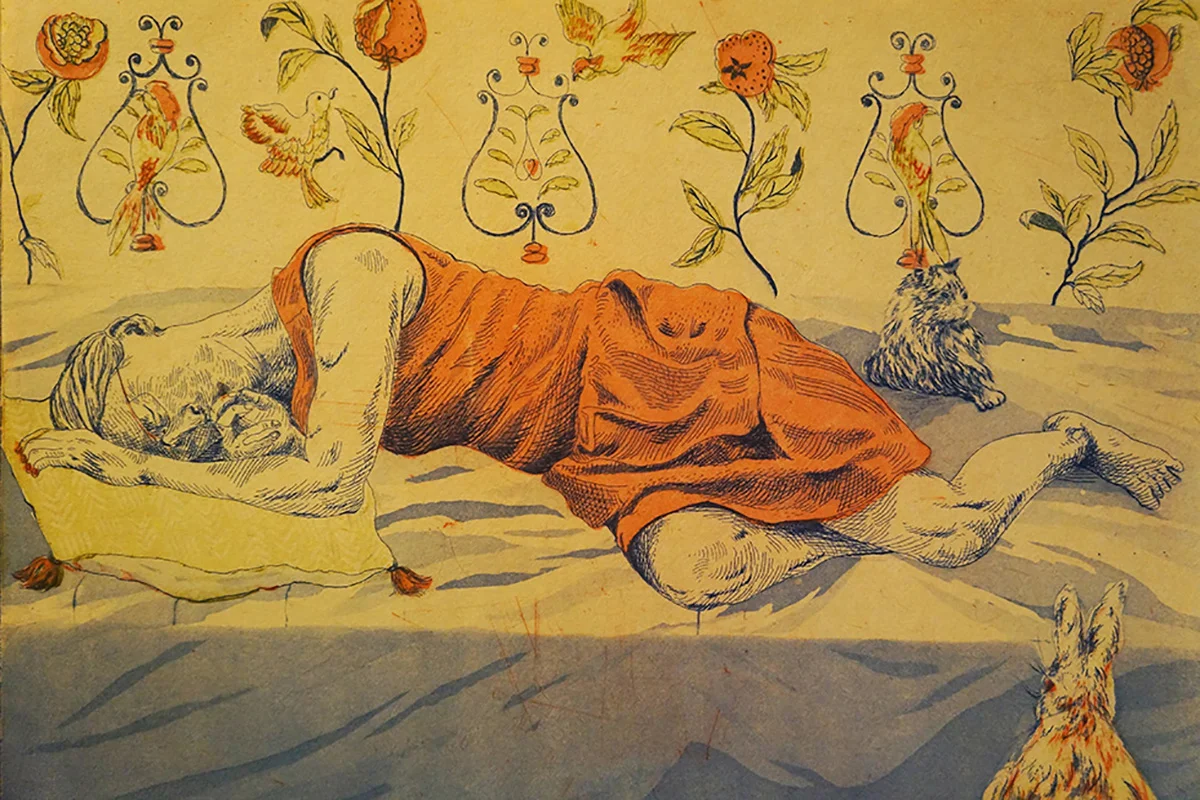
”Insomnia’’ (print), by Mei Fung Elizabeth Chan in the Duxbury Art Association’s Winter Juried Show at the Art Complex Museum, Duxbury, Mass., Feb. 3-April 13.

Llewellyn King: A Christmas cake for the Bakers' Year

WEST WARWICK, R.I.
Christmas is coming. I know this because of indelible evidence in my own home. My wife, Linda Gasparello, has just baked a Christmas cake. If I doubt that this is the month of Christmas, I just have to look at it, cooling on the kitchen counter, declaring itself, in its way, the harbinger of the holidays.
The cake can’t be eaten yet. No, no. Linda, who’s a phenomenon at the range, explains when she sees me circling with a knife, the cake needs to “cure” for at least a week. Rum must infuse the cornucopia of fruit which has bonded with flour and eggs and whatever else makes a cake a cake. I don’t know all the fruits and nuts that go into The Great Christmas Cake, but I do know there are dried apricots. Linda gave me some as a bribe to get out of the kitchen while she was baking the cake.
All year we eat very little cake in our home. Desserts are avoided for the usual reason: keeping down the calorie count. But recently, for a party, Linda made a carrot cake. Not because she’s my wife, but because I adore carrot cake, I can say that hers is the best-ever.
How come I indulge in carrot cake when I eschew sponge, hide from German chocolate and, with a heavy heart, have even shaken my head at Sachertorte (chocolate cake covered with apricot jam and chocolate icing) in Vienna -- a crime against Austria, practically an act of war? (I must confess, though, that I once ate the cake in the Hotel Sacher in Vienna where it was invented.) The answer is carrots sound so healthy. “Good for you,” my mother used to say. She was a frightful cook and so raw carrots were better than anything she tried to do to them, which was mostly boil the life out of them until they were soft and spongy, most of the nutrients gone.
This year I read Hotel Sacher, a novel by Rodica Doehnert which traces the role of the great hotel at the end of the 19th Century -- how it was a kind of headquarters for the events that led to the end of Austro-Hungarian Empire and to World War I. If you want to research this in chilling detail, read Max Hastings’s book Catastrophe 1914: Europe Goes to War.
Back to cakes and Christmas. Linda’s cake has so many things in it I wonder it doesn’t cause a criticality incident or spontaneously ignite.
There seems to be boom in cooking and baking in particular. It all goes back to Julia Child, “The French Chef” starting on television in the 1960s, who whet the nation’s palate for cooking. Julia showed that cooking could be fun (especially if you cook with wine and imbibe as you go) and challenging -- so much so that today we have an abundance of cooking shows.
The ones I hate are those which weaponize cooking — with contestant chefs who are sent home in tears because their sauce separated or, horror of horrors, their soufflé collapsed.
Anyway, it seems 2018 is the Bakers’ Year. Linda is an exception because she bakes and tames meat. She can make a delectable osso buco as easily the tiramisu which follows. Mostly, there’s a divide between the flour people and meat people. Pretty much in the same the way, when I worked at The Washington Post, there was a divide between the pot smokers and the drinkers. Me, the latter.
I can tell baking is in by the number of recipes I find people exchanging, and I put it all down to The Great British Baking Show, on PBS, which entertains and makes baking exciting. Here contestant chefs also are sent home, but with such teary reluctance that if you want a hug from the whole cast and the other amazing chefs, you deliberately add a cup of salt instead of sugar to the cake. Tears and hugs all round.
We’re planning a Great British Christmas Tea at our house with Devonshire clotted cream and jam on scones, little sandwiches and – play the drums and trumpets fortissimo -- the fruited cake, which is curing very nicely, thank you.
And for Christmas itself? We’re going out to a restaurant. Happy holidays!
Llewellyn King is executive producer and host of White House Chronicle, on PBS. His email is llewellynking1@gmail.com. He is based in Rhode Island and Washington, D.C.
Patrick would have been stronger candidate than Warren
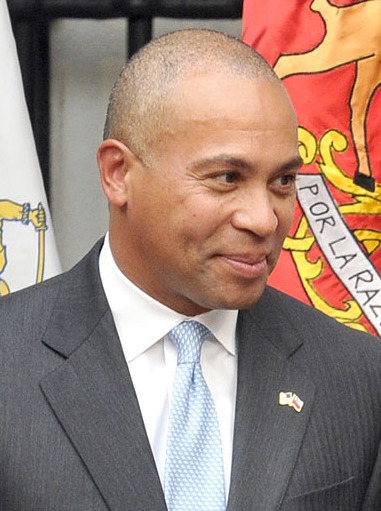
Deval Patrick
From Robert Whitcomb’s “Digital Diary,’’ in GoLocal24.com
So former Massachusetts Gov. Deval Patrick has decided not to run for the 2020 Democratic presidential nomination. As a fine speaker (to me better than Obama) and retail politician with two successful terms as the state’s CEO, he could have been a formidable candidate for the nomination, if not in the general election.
His decision opens the door wider for fellow Bay State Sen. Elizabeth Warren, who, if she decides to run, could draw on some of the financial and other campaign resources that Patrick would have gotten and certainly has an enthusiastic following of progressives. But it’s hard to see how the senator could get elected president.
Tim Faulkner: Opposition mounts to seismic blasting off East Coast to find oil and gas
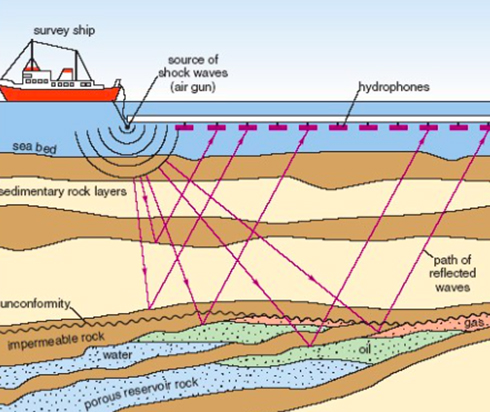
From ecoRI News (ecori.org)
Sen. Sheldon Whitehouse, D-R.I., and environmental groups intend to resist the recent announcement of plans to commence seismic blasting for offshore oil and gas drilling. But time may be running out to prevent it.
Seismic blasting uses underwater airguns to search for fossil fuels deep beneath the seafloor, a process that endangers marine mammals such as whales and dolphins.
On Nov. 30, the National Marine Fisheries Service issued what is known as incidental harassment authorizations (IHA) to five companies for conducting seismic testing in an area from Delaware to Florida, a region twice the size of California.
The companies are ION GeoVentures, based in Houston; Spectrum Geo Inc. of England; TGS-NOPEC Geophysical Company of Norway; WesternGeco of England, and CGG, based in Paris.
Whitehouse called their approval “a statement” and “just an idea” that could be stalled by Congress. But according to the Bureau of Ocean Energy Management (BOEM), the five authorizations are under final review and seismic surveys could begin as early as January.
The IHA allows the the companies to perform deep-penetration seismic surveys that search thousands of meters below the seafloor for oil, natural gas, and minerals. The federal “incidental take authorization” provision allows the activity to kill, harass, hunt, or capture marine mammals. Harassment is defined as “any act of pursuit, torment, or annoyance which has the potential to injure a marine mammal or marine mammal stock in the wild; or has the potential to disturb a marine mammal or marine mammal stock in the wild by causing disruption of behavioral patterns, including, but not limited to, migration, breathing, nursing, breeding, feeding, or sheltering.”
The federal National Marine Fisheries Service, a division of the National Oceanic and Atmospheric Administration, says the potential to displace or harm marine life is minimal because of brief and limited exposure to survey noise.
According to the environmental advocacy group Oceana, the surveys deliver seismic blasts every 10 seconds, 24 hours a day over days or even weeks. Survey boats use dozens of airguns simultaneously to produce a constant blast that can travel thousand of miles.
The impact on sea life is significant. Airgun blasts cause temporary and permanent hearing loss, abandonment of habitat, disruption of mating and feeding, beach strandings and even death, according to Oceana. Airgun blasts also kill fish eggs and larvae.
“For whales and dolphins, which rely on their hearing to find food, communicate, and reproduce, being able to hear is a life or death matter,” according to Oceana.
According to a 2013 report, catch rates of Atlantic cod, haddock, rockfish, herring, sand eel and blue whiting declined by 40 percent to 80 percent because of seismic testing.
Seismic airgun testing in the Atlantic Ocean could injure 138,000 whales, according to BOEM. The noise is particularly threatening to the endangered North Atlantic right whale.
BOEM offers a list of protective measures to reduce harm to sea life, such as halting airgun use when animals get too close to vessels.
When a similar proposal was advanced under President Obama, more than 90 percent of the coastal communities in the Mid- and South Atlantic passed resolutions opposing the practice. The dissent was known as the Resolution Revolution, organized by Oceana. Shortly before Turmp took office in 2017, the Obama administration denied the applications for seismic testing in the Mid and South Atlantic, citing impacts on marine life. President Trump and Interior Secretary Ryan Zinke reversed that decision in May 2017, with the America-First Offshore Energy Strategy.
In January, Zinke announced plans to open the entire East and West coasts to offshore fossil-fuel exploration, prompting broad public opposition and efforts by coastal governors to meet with Zinke to convince him to halt the initiative.
In February, Gov. Gina Raimondo and Rhode Island’s congressional delegation held a press conference to announce their opposition to offshore drilling. Block Island, Charlestown, Jamestown and Tiverton all passed resolutions opposing offshore drilling and seismic blasting.
During a 45-day comment period on the proposed seismic airgun testing, the National Marine Fisheries Service received 15 petitions with a total of 99,423 signatures. Only one petition, with 595 signatures, supported the seismic surveys. The 14 other petitions with nearly 99,000 signatures opposed seismic blasting, as well as oil and gas drilling in the Atlantic Ocean.
After the recent news of forthcoming seismic testing, Whitehouse said South Atlantic Republicans “would do well to remember the job Oceana did with the Obama administration trying for offside drilling.”
Whitehouse intends to work with the Commerce Committee and Appropriations Committee “to align our folks” to halt the seismic surveys and offshore oil and gas extraction.
On Dec. 11, Whitehouse, Sen. Edward J. Markey, D-MA, and six other senators asked the Department of Commerce to rescind IHA’s and the Department of Interior to deny the seismic survey permits. In a letter, the senators cite environmental threats and economic harm to tourism and fishing. They also noted that the results of the surveys would be kept private by the survey companies and not available for government or public use.
BOEM, however, is already reviewing the survey applications and could approve them by January.
“If they try to move up to the Northeast, they’ll find that the opposition is bipartisan,“ Whitehouse said. “So, I think we have a real prospect of stopping it, but it’s hard to stop something that’s at this point is just an idea, a statement. Once it hits the administrative steps, we’ll figure out what the best way to counterattack is.”
The counterattack is also going through the courts, primarily in the South. On Dec. 11, Oceana and eight other environmental groups filed in U.S. District Court in South Carolina a lawsuit that claims that by issuing the IHA, the National Marine Fisheries Service ignored science and violated the Marine Mammal Protection Act, the Endangered Species Act, and the National Environmental Policy Act. The lawsuit wants the authorizations suspended until environmental assessments are performed.
If and when the seismic blasting get underway, Oceana will track the activity with a real-time map.
Tim Faulkner is a reporter and writer for ecoRI News.

Vertigo in wood
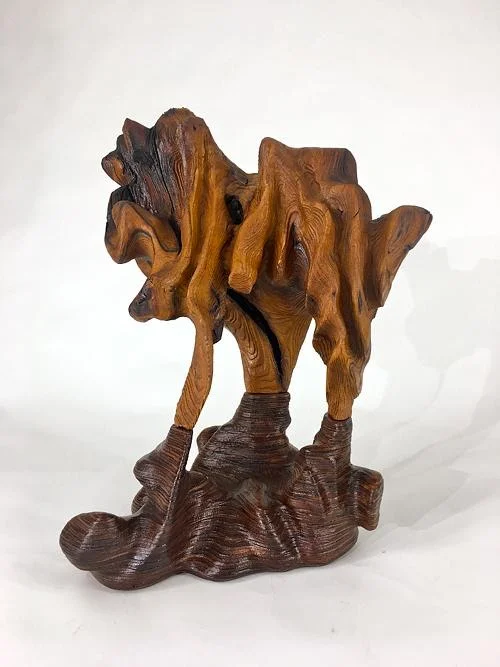
Roller Coaster, (mulbury and plywood), by Andy Moerlein, at Boston Sculptors Gallery.