
Vox clamantis in deserto




Exploring black identity in B.U. show

“Giverny I (Negresse Imperiale)’’ (film still), in the show “A Litany for Survival’’ through Jan. 27 at Boston University’s Faye G., Jo and James Stone Gallery. The show is meant to reveal and explore an aspect of black identity.
Jack Clarke: Fossil-fuel burning, not wind turbines, is the huge threat to birds

Via ecoRI News (ecori.org)
President Trump recently criticized “windmills” as a source of energy, claiming: “They kill so many birds. You look underneath some of those windmills, it’s like a killing field.”
All this while he attempts to prop up a fading coal industry that is responsible for killing 24 times as many birds as wind energy.
But do wind turbines really “kill so many birds?” It’s one of the most commonly repeated criticisms of wind power: that they are giant Cuisinarts for birds.
Last winter, Trump’s secretary of the interior, Ryan Zinke, told an oil and gas industry audience that wind facilities kill 750,000 birds a year. Yet his own Fish & Wildlife Service put the estimate at less than half that number. Meanwhile, Zinke is doing away with century-old protections under the Migratory Bird Treaty Act.
Estimated bird deaths from wind turbines are small when compared to other human-caused sources of avian mortality. In contrast to the 5 billion birds killed annually as a result of encounters with a variety of hazards ranging from domestic cats to building glass, turbines are a much smaller risk.
The greatest threat to birds today is climate change. Of Massachusetts’s 143 breeding bird species evaluated by Mass Audubon, 43 percent are “highly vulnerable” to its impacts.
Climate change produces warmer temperatures that alter the length of seasons, interrupting traditional migration patterns. It also causes accelerated sea-level rise and stronger ocean storms, which wreak havoc on coastal bird habitats, drowning out the nesting and foraging areas for species such as the federally protected roseate tern and piping plover.
The impacts of climate change on birds will become even more severe unless we reduce our over-dependence on fossil fuels, which are clogging the atmosphere and heating up the planet.
We can do this by increasing conservation and efficiency, and producing more renewable energy. Wind energy is now among the most cost-effective, competitive, and reliable technologies available.
Today, the U.S. wind energy industry is primarily comprised of land-based turbines. As the third-most densely populated state, Massachusetts isn’t a very hospitable place for big, terrestrial wind-energy development — we’re just too crowded. So, we look offshore where there’s more space, fewer people, and stronger winds.
Europe can boast a 24-year history of successful offshore wind-energy development, with more than 4,000 turbines in the water. In comparison, the United States has just five operating structures, planted in the seabed off Block Island, R.I.
Bay State voters support offshore wind, as a WBUR/MassINC September poll showed, with an overwhelming 80 percent of those tallied saying we should rely more on wind for our electricity.
Consistent with this opinion, Beacon Hill lawmakers recently passed legislation that will hopefully result in at least 3,200 megawatts of offshore wind energy, as we work to reduce our reliance on dirty fossil fuels and reduce greenhouse-gas emissions.
In response, the Vineyard Wind company aims to build the first U.S. industrial-scale wind farm 35 miles south of Cape Cod. Its 80-100 turbines would remove 2 million tons annually of heat-trapping carbon dioxide, in addition to thousands of tons of poisonous nitrogen and sulfur oxides. That’s good for people, birds, and wildlife.
For this wind facility to be viable, however, it must first demonstrate that it will pose no significant threat to the marine life and environment in and around the project area.
That doesn’t mean the wind facility can have absolutely no affect on the region’s wildlife and habitat, as any development of energy will entail some level of impact. However, the project must be designed to avoid any significant environmental damage, and anticipated impacts need to be minimized and mitigated. That’s the sequence to success and the review standard for this project and those in the future.
If Vineyard Wind gets it right, others will follow as leases in two more deep-water areas off Massachusetts and Rhode Island have been granted, with a fourth sale scheduled next month.
And while Mass Audubon supports the deployment of renewable wind-energy projects off our shores, that commitment can’t and will not be at any cost. With appropriate design, siting, and mitigation, the industry can grow and prosper as Massachusetts does its part to combat the devastating impacts of global climate change.
Birds, other wildlife, and people will all reap the benefits.
Jack Clarke is the director of public policy and government relations at the Massachusetts Audubon Society.
Don Pesci: A measles epidemic of tolling gantries coming in Conn.?
Hey, working suburban women who voted for the toll guy for governor -- get out your wallets. Multiple reports in Connecticut’s media advise us that Lamont eked out a win over Republican gubernatorial nominee Bob Stefanowski with some encouragement from suburban women, many of whom hold down jobs to which they travel – by car, not by largely empty FastTrack-powered buses.
During his gubernatorial campaign, Gov. Elect Ned Lamont was warm on tolls – but the tolls, working suburban women and others were told, would be levied only on out-of-state trucks, a dubious constitutional gambit. Rhode Island, the state from which Lamont lifted the idea, is now embroiled in law suits on the issue.
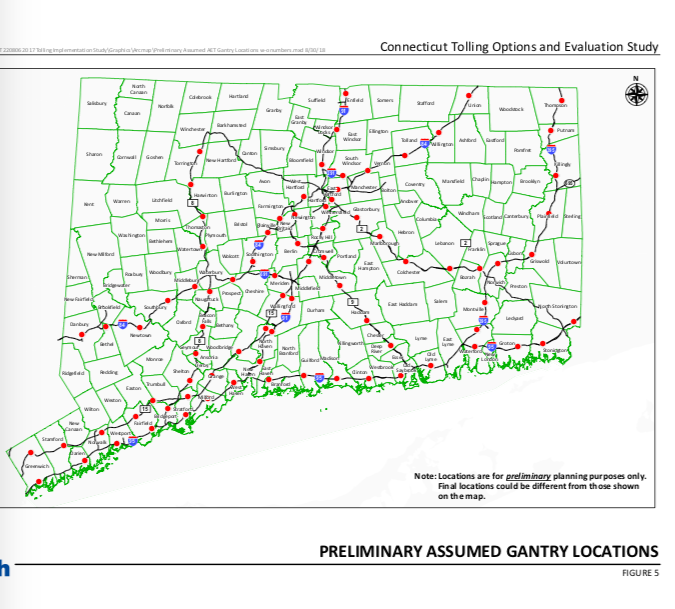
A little more than a week after the election, it was reported by the indispensable Yankee Institute that a new study commissioned by the Connecticut Department of Transportation calls for 82 tolling gantries on Connecticut highways. A note provided on a map furnished by the study authors reads, comfortingly, “Locations are for preliminary planning purposes only.”
The mapped major transportation arteries are pock-marked with red dots (see map above)— gantry locations that make the state look as if it had come down with an advanced case of measles. In a somewhat sour note, the study remarks that “fairness” in toll collections should be paramount: “Fairness – tolls should be set to ensure collection of revenues from CT as well as out-of-state auto and truck trips.” But fairness, Connecticut’s taxpayers will understand lies, like beauty and truth, in the eye of the beholder.
Speaking of fairness, Yankee notes wryly, “The study was previously kept under wraps by DOT Commissioner James Redeker and was the subject of a complaint to the Freedom of Information Commission by Sen. Len Suzio, R-Meriden. In July, Redeker cited the results of the study in testimony before the state Bond Commission but refused to release the study until today.” Len Suzio is no longer in the Senate, having been purged by politicians he has in the past unmercifully annoyed.
The Connecticut DOT has not yet produced a study showing the number of times tolling limited to a targeted subset has not, sooner or later, trickled down to a much broader base. And in fact, that is the case with nearly all taxes. The federal income tax began as a temporary tax on millionaires levied to pay for Civil War debt during the Lincoln administration. But in the course of time, the reinstituted income tax trickled down to non-millionaire working suburban women whose votes now have hoisted Lamont into a gubernatorial seat to be vacated in January by the most unpopular governor in the United States, Dannel Malloy, the author, along with a now revivified majority in the General Assembly, of two hefty tax increases.
If Connecticut’s onerous progressive tax system – which is the primary cause of budget instability – is ever to be reformed, the state might consider moving to a fair or flat tax in which every citizen in Connecticut pays the same rate and is therefore equally invested in state politics. The very rich, many of whom pay fewer taxes than their secretaries (see Warren Buffett on this), would pay the flat tax rate rather than shelter their assets through legalized chicanery, and the poor could be recompensed after having paid the tax. Collections would be simple, and large legal firms hired by the very rich to avoid paying crippling taxes would move on to more profitable pursuits.
Progressivism is little more than a political lure dangled before a credulous public to persuade them to vote for limitless spending that benefits politicians who shortly devise other means – tolling? – to further empty the pockets of working suburban women and all their other targets. Toll gantries placed approximately every 6.6 miles on interstates 95, 84, 91, 395, 691 and 291 and routes 2, 9, 8 and 15 would allow the state to take a major bite from working suburban women, among others. According to the study, Connecticut could collect more than $1 billion per year from electronic tolls.
If there is anyone in the state who believes that tolling – count the gantries – will be long limited to out-of-state trucks, perhaps his or her voting rights should be taken from them and given to the guy behind the tree. Mocking those who believe the claims of politicians that they will be exempted from paying taxes, the late Louisiana Sen. Russell Long offered the following short pearl of wisdom in verse: “Don’t tax you, don’t tax me, tax the fellow behind the tree.”
Don Pesci is a Vernon, Conn.-based columnist.
Silver night
"How cold it is! Even the lights are cold;
They have put shawls of fog around them, see!
What if the air should grow so dimly white
That we would lose our way along the paths
Made new by walls of moving mist receding
The more we follow. . . . What a silver night!
That was our bench the time you said to me
The long new poem -- but how different now,
How eerie with the curtain of the fog
Making it strange to all the friendly trees!"
-- Sara Teasdale, “A November Night’’
Better than Thanksgiving snow

“Christmas Snow’’ (oil on panel), by Marieluise Hutchinson, in the “Holiday Small Works 2018” show at the Copley Society of Art, Boston.
Moonlit mystery
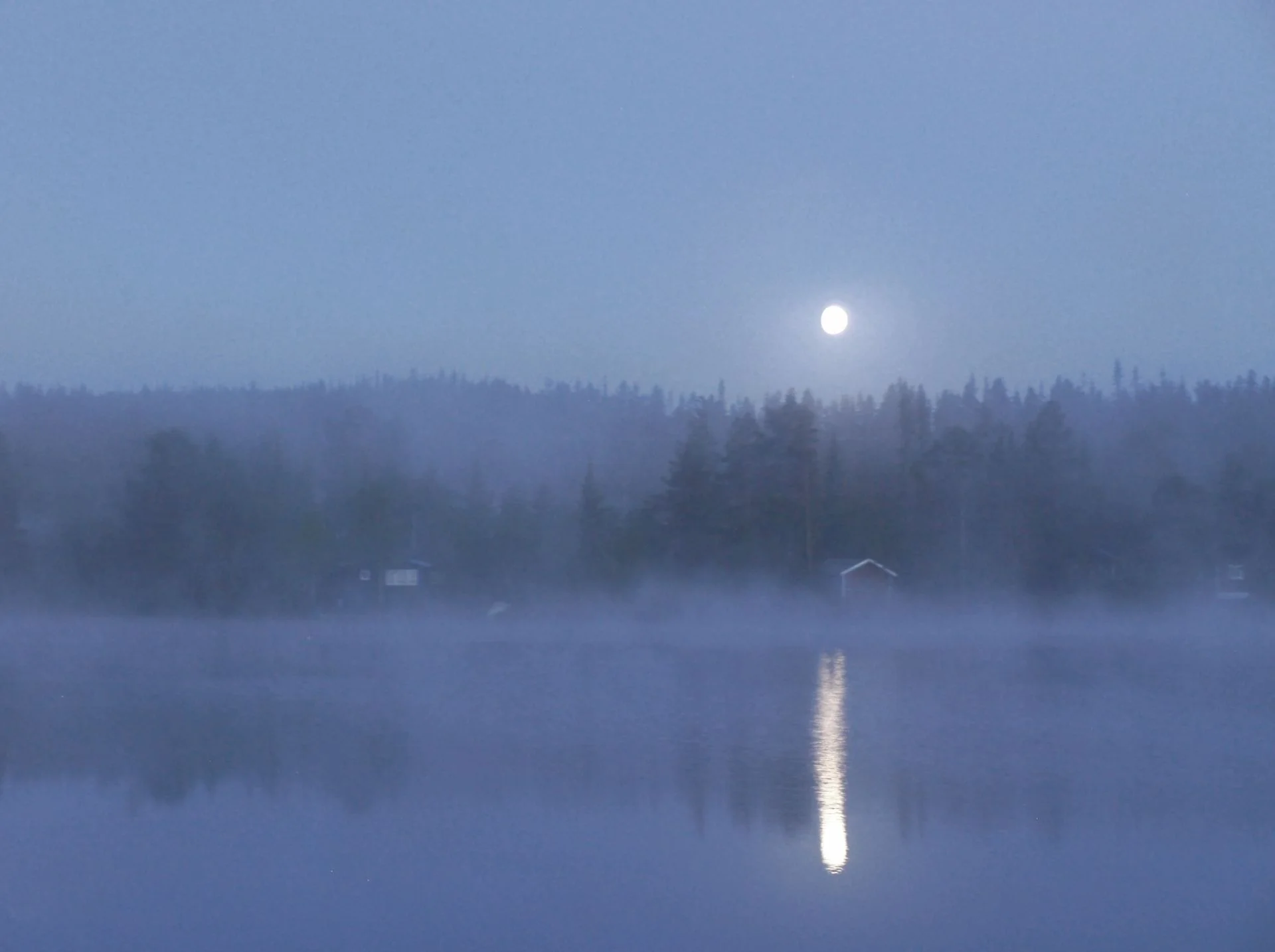
— Photo by Jeblad
“Late November and I am
in a country house.
The moon glares across
an open field and there’s
a lump of deer guts
like shapeless sculpture.
The air keeps cutting
at the stubble I can’t see
…..
The wind in the eaves
breaks some shingles loose,
and I want a deer to rise
from the pile of himself.’’
— From “A Country House,’’ by Robert Lowell (1917-1977)
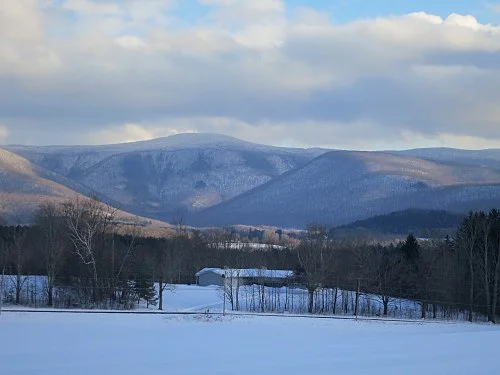
Mt. Greylock and 'Moby Dick'
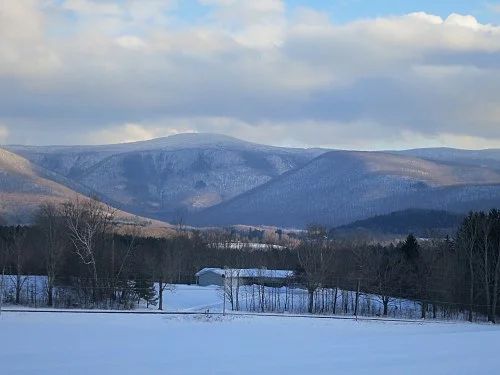
Mt. Greylock.
‘‘From the desk at which he wrote Moby-Dick {in the 1850s}… Herman Melville could gaze upon … western Massachusetts' Berkshire Mountains. In the summer of 1850, at age 31, the writer had moved from New York City, … to the outskirts of Pittsfield, then still a village, where he settled into a modest, mustard-yellow farmhouse called Arrowhead—for the Native American artifacts once unearthed on the property. After years of sailing the world aboard New England whaling vessels, Melville was trying his hand at farming. … But in winter, the landscape turned his thoughts back toward the mariner's life.’’
”From Melville's cramped, book-lined study, visitors today take in a clear view of Mt. Greylock. For Melville, the brooding mass of wintry Greylock called to mind, or so biographer Andrew Delbanco has speculated, a great leviathan, emerging from a roiling, white-capped ocean. Although Melville's few surviving letters make no mention of this, his neighbor and fellow novelist, Nathaniel Hawthorne, once wrote that Melville spent his days ‘shaping out the gigantic conception of his white whale’ while staring at the snow-covered mountain. In his novel, Melville would describe Moby-Dick as a ‘grand hooded phantom, like a snow hill in the air."‘
— From Jonathan Kandell’s article “The Berkshires,’’ in the May 2007 Smithsonian Magazine.
Even the strongest of us are

“NET WORKS, Fragmented 1 (detail) (net imprint on paper affixed to canvas), by Barbara Eskin, at Galatea Fine Art, Boston, Dec. 5-30.
Carbon tax is coming

Mystic Generating Station, in Everett, Mass. It burns oil and natural gas.
From Robert Whitcomb’s “Digital Diary,’’ in GoLocal24.com
‘Voters in Washington State have rejected a badly drafted “carbon tax’’ proposal for power plants and other polluters. The money from the levy would have gone to help pay for various air-quality and other environmental needs. Carbon taxes proposed for other jurisdictions would go to those sorts of initiatives as well as to other public projects or even be rebated to the public.
The idea, obviously, is to reduce the burning of fossil fuels by making them more expensive. A carbon tax is the most efficient --- and market-based way -- to reduce our lethal fossil-fuel dependence. I think that we’ll eventually see it in all developed nations, though that might require more weather disasters first. We’ll do the right thing after we’ve exhausted all other options.
Masters of masochism

“Vermont farmers, back each side of the turn of the {20th} century, loved a good blizzard.’’
— Murray Hoyt, in Vermont: A Special World
Llewellyn King: Will Bezos's kiss be lethal?
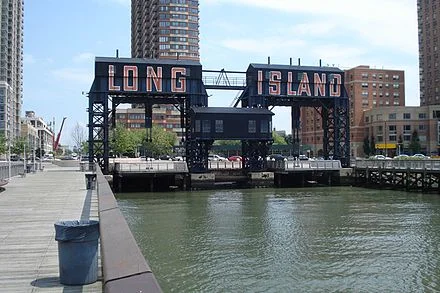
On the waterfront of the Long Island City part of New York City. It’s the flood-prone area where Amazon will put one of its “Second Headquarters.’’
Having run around the country as a modern Prince Charming in search of Cinderella, Jeff Bezos, Amazon's boss, has decided that two hopefuls fit the slipper: Crystal City, Va., part of Arlington, and the Long Island City part of the New York city borough of Queens.
But these Cinderellas aren’t to be carried off to live happily ever after in Amazon Castle. No, there are dowries to be paid -- about $2 billion each in tax abatement and other goodies. These beauties are no bargain.
In fact, New York City and Washington, D.C. -- Queens is a borough of New York and Crystal City is a Virginia suburb, south of Washington -- may be prostrating themselves to gain possibly 25,000 jobs in an unhappy, taxpayer-funded alliance.
The theories as to why Bezos chose these locations abound. The dominant one is that high-tech companies must follow high-tech workers. That explains why Boston and San Francisco are overheated along with, yes, New York and Washington.
This overheating might be described as more people trying to get into a city than its housing base and infrastructure can absorb. Result: skyscraper-high living costs, hideous commutes and wretched lives for those on the economic bottom rung. High rents and homelessness go together.
I'm more persuaded that the decision has been made more to suit Bezos and his executives than to snare talent. Washington is the site of one of the Bezos's mansions and he owns The Washington Post. New York has always had special appeal to the ultra-rich: Wall Street and the gilded social set.
Palo Alto, in California’s Silicon Valley, is white-hot in terms of desirability for high-tech jobs. But it was underdeveloped 45 years ago when a visionary scientist, Chauncey Starr, established the Electric Power Research Institute (EPRI) there. Starr told me he chose the location not because of the talent pool, but because he wanted the independence he feared he wouldn’t get in a big city, close to the electric companies which funded EPRI. The high-tech talent was yet to move in.
The point here is that it’s not necessary to go to the labor, the labor will come to you. Had Amazon chosen, say Upstate New York or somewhere in Kansas, and hung out a shingle for help, it would’ve poured in: Build and they’ll come.
The great Washington hostess and diplomat Perle Mesta said, “All you have to do to draw a crowd to a Washington party is to hang a lamb chop in the window.” The same goes for labor.
The downside to Washington these days is that its roads and bridges, to say nothing of its troubled subway, are inadequate for the stunning growth it has seen since the late 1960s. It has some of the worst traffic jams anywhere and is said to have overtaken Los Angeles for traffic congestion. As the greater Washington area is split between the District of Columbia, Maryland and Virginia, regional problems are hard to solve and often go unsolved as a result.
New York needs infrastructure spending in the worst way, from the tunnels into Penn Station to the estimated $48 billion the subway needs to modernize. But an increasing amount of the city's capital budget is going to have to be devoted to building barriers against sea rise, particularly in lower Manhattan and to a lesser extent in Brooklyn and Staten Island. Is it a good investment to sink money into any location which is going to have to throw its treasure at Neptune, not improving the rest of the infrastructure?
As someone who lived most of his adult life in Washington, I don’t celebrate its helter-skelter growth, gridlocked roads, potential water shortages or the just-upgraded sewage treatment plant, Blue Plains, which has been known to flood, sending the raw stuff into the Potomac River in big rainstorms.
Virginia and New York, have you bought into a cyber-dream from Amazon which denies reality? You’re paying for a tenant who should pay you for the stress of his buildout.
Prince Bezos, there were so many other pretty feet.
Llewellyn King is executive producer and host of White House Chronicle, on PBS. His email is llewellynking1@gmail.com and he’s based in Rhode Island and Washington, D.C.

Sam Pizzigati: It's past time for Democrats to be bold progressives

From OtherWords.org
Tony Maxwell, a retired African-American naval officer, was trying to get his Jacksonville, Fla., neighbor to go vote with him. The young neighbor, a high-school-dropout, had no interest.
“Voting,” the young man declared, “doesn’t change anything.”
Can Democrats use their newly won House majority to reach that dispirited young man in Jacksonville? That all depends on their eagerness to think big and bold — and to challenge the concentrated wealth and power that keeps things from changing.
Of course, big and bold new legislation will be next to impossible to enact with a Republican Senate and White House. But just pushing for this legislation — holding hearings, encouraging rallies, taking floor votes — could move us in a positive direction and send the message that meaningful change can happen.
This sort of aggressive and progressive pushing would, to be sure, represent a major break with the Democratic Party’s recent past. The reforms Democrats in Congress have championed have often been overly complicated and cautious — and deeply compromised by a fear of annoying deep-pocketed donors.
That fear may be easing. A number of leading Democrats with eyes on 2020 — and the party’s growing progressive base — have advanced proposals that could spark real change in who owns and runs America.
Senator Bernie Sanders started the big-and-bold ball rolling in 2016. He’s still adding fresh new ideas to the political mix. This past September, he introduced legislation that would discourage corporate execs from underpaying workers.
Under this new Sanders proposal, corporations with 500 or more employees would have to pay a tax that equals the cost of federal safety-net benefits — from programs like food stamps and Medicaid — their underpaid workers have to rely on.
Massachusetts Sen. Elizabeth Warren’s
, unveiled this August, would refocus large corporations on serving “not just shareholders but their employees and communities as well.” Warren’s bill would set 40 percent of corporate board seats aside for directors elected by employees.
Warren is also thinking big and bold on housing. Her American Housing and Economic Mobility Act would invest $450 billion over the next decade in affordable housing for working families. To offset the price-tag, Warren’s initiative would increase the estate tax on the nation’s 10,000 wealthiest families.
New Jersey Sen. Cory Booker is looking at establishing a new “baby bond” program to “make sure all children,” not just kids from wealthy homes, “have significant assets when they enter adulthood” — as much as $50,000 for kids from poorer families. A big chunk of the dollars for Booker’s baby bonds would come from raising the tax rate on capital gains, an income stream that flows overwhelmingly to America’s rich.
California Sen. Kamala Harris is advocating a tax credit that would increase the income of couples making less than six figures up to $500 a month. “Instead of more tax breaks for the top 1 percent and corporations,” says Harris, “we should be lifting up millions of American families.”
Other ambitious ideas are coming from progressive activists and scholars.
Matt Bruenig, of the People’s Policy Project,. has proposed an “American Social Wealth Fund,” an independent public investment enterprise that would take in “regular injections of cash from the government” and “make regular dividend payouts to its shareholders — all American adults.” Funds for this solidarity fund would come from a variety of corporate taxes.
Meanwhile, my colleague Sarah Anderson notes, five states have introduced legislation that limits or denies tax dollars to corporations that reward top execs at worker expense.
The new Democratic House could give ideas like these an airing and debate. And new leaders like Alexandria Ocasio-Cortez, of New York, have the charisma to attract wide swatches of America into that discourse.
If all this action materialized, would large numbers of our politically dispirited sit up and take notice? We’ll never know unless we try.
Sam Pizzigati is an associate fellow at the Institute for Policy Studies. He co-edits Inequality.org, where a longer version of this piece first appeared.
And get married
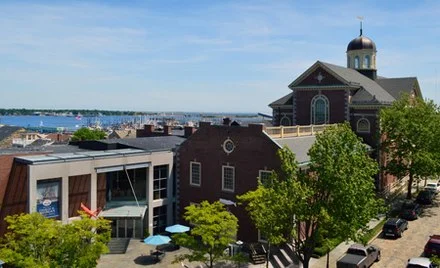
New Bedford Whaling Museum.
From Robert Whitcomb’s “Digital Diary,’’ in GoLocal24.com
Takeru Nagayoshi, a New Bedford public-school teacher writing in Commonwealth magazine about school accountability, makes the good point that however much local and state mandates focus on the internal operations of school, the problems of the broader community around the school must be addressed if there is to be substantial long-term improvement within the schools:
He writes:
“While these interventions {in individual schools} may have moved the academic needle, it felt as though at times we were chasing short-term successes, rather than addressing the fundamental causes of our challenges: racial and socioeconomic disparity, linguistic hurdles for immigrant populations, and socioemotional trauma. By attending to the symptoms of our problems, we unintentionally set aside the systemic and structural causes that exist outside the school.
“Our schools are both academic institution and a community resource; a reform effort that prioritizes one over the other can achieve only so much success. As many high-needs districts like mine struggle to close their opportunity gaps, we must radically reimagine an accountability model that heals schools in conjunction with their communities. This can be done through greater access to health care, social wraparound services, or more family-centered supports.’’
To read his essay, please hit this link.
What would help a lot would be a revival of the old-fashioned married two-parent family. Families led by unwed mothers are closely correlated with socio-economic decay, crime and low educational outcomes, and such families now dominate many cities such as New Bedford. 56 percent of children in the Whaling City live in single-parent families.
Chris Powell: So why not just leave already?
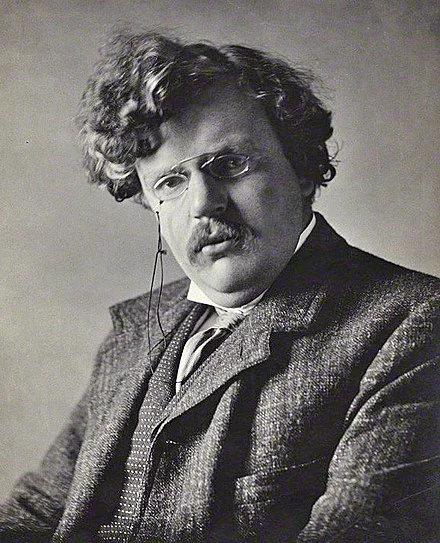
G.K. Chesterton, in 1911. “Men did not love Rome because she was great. She was great because they had loved her.”
Anyone who got a penny for each time he heard someone threaten to leave Connecticut because of its corrupt and ineffectual state government would be rich.
Anyone who got a dollar for every such person he heard who fulfilled his threat and actually left the state might be able to buy a cup of coffee.
Even so, such threats are cascading like student test scores because of the triumph of the Democratic Party in the recent state election, since it followed eight years of Democratic administration that even the party’s own candidate for governor called a disaster. Talk radio and newspaper letters columns are featuring more such threats than ever.
Yes, there’s more to gripe about, since, even before addressing the estimated $4 billion state budget deficit ahead of them, Democratic state legislators are exulting in how much more they plan to increase government spending as well as the cost of doing business in the state by raising the minimum wage and requiring paid family leave.
But people so noisily threatening to leave the state are only advertising that they’re still here. They would have far more political impact if they’d just shut up and go.
And yes, Connecticut’s trend of politics and policy will lead inevitably to a state inhabited only by government employees and welfare recipients staring blankly at each other wondering where the private sector went and who is left to be preyed upon. But this is only the age-old corruption of prosperity that has befallen many other important states, such New York, New Jersey, Illinois, Michigan and California.
Florida may be most popular with exiles from Connecticut, especially because of its warm winters and lack of a state income tax. But summers there can be brutal, hurricanes there can interrupt electricity for weeks at a time, the geography is flat and swampy, and the predatory wildlife -- alligators and Burmese pythons -- can put in perspective Connecticut’s government employee unions and the politicians who serve them.
So those inclined to continue contending for Connecticut may take heart from the great G.K. Chesterton, who wrote a century ago:
"The world is not a lodging-house at Brighton, which we are to leave because it is miserable. It is the fortress of our family, with the flag flying on the turret, and the more miserable it is the less we should leave it.
"The point is not that this world is too sad to love or too glad not to love; the point is that when you do love a thing, its gladness is a reason for loving it, and its sadness a reason for loving it more. ...
"Let us suppose we are confronted with a desperate thing -- say, Pimlico." (Pimlico was then a slum area of London.) "If we think what is really best for Pimlico we shall find the thread of thought leads to the throne or the mystic and the arbitrary. It is not enough for a man to disapprove of Pimlico; in that case he will merely cut his throat or move to Chelsea. Nor, certainly, is it enough for a man to approve of Pimlico, for then it will remain Pimlico, which would be awful.
"The only way out of it seems to be for somebody to love Pimlico -- to love it with a transcendental tie and without any earthly reason. If there arose a man who loved Pimlico, then Pimlico would rise into ivory towers and golden pinnacles; Pimlico would attire herself as a woman does when she is loved.
"For decoration is not given to hide horrible things but to decorate things already adorable. A mother does not give her child a blue bow because he is so ugly without it. A lover does not give a girl a necklace to hide her neck. If men loved Pimlico as mothers love children, arbitrarily, because it is theirs Pimlico in a year or two might be fairer than Florence.
"Some readers will say that this is a mere fantasy. I answer that this is the actual history of mankind. This, as a fact, is how cities did grow great.
"Go back to the darkest roots of civilization and you will find them knotted round some sacred stone or encircling some sacred well. People first paid honor to a spot and afterwards gained glory for it.
“Men did not love Rome because she was great. She was great because they had loved her.”
By February everyone in Connecticut will have been entitled to a week or two down south. But if they are still of fighting age the best ones will return and join the resistance. At least spring will vindicate them.
Chris Powell is a columnist for the Journal Inquirer, in Manchester, Conn.
'Tiny ecosystems'

From painter James Sundquist’s show “Living Nature’’ at Paper Nautilus, Wayland Square, Providence, through Dec. 1. He says: “The motifs for the work came out of small places, the little patches of grass and vegetation that become a world and ecosystem unto themselves through persistent observation. These tiny ecosystems reveal their layers through persistent looking, and a poetics of space comes to life.
“The larger pieces in this show are made in the studio using some of the spatial motifs and gestures generated in the smaller works. The result is, like a poem, the amplification of the order and beauty of the natural world.’’
Revolutionary privatization
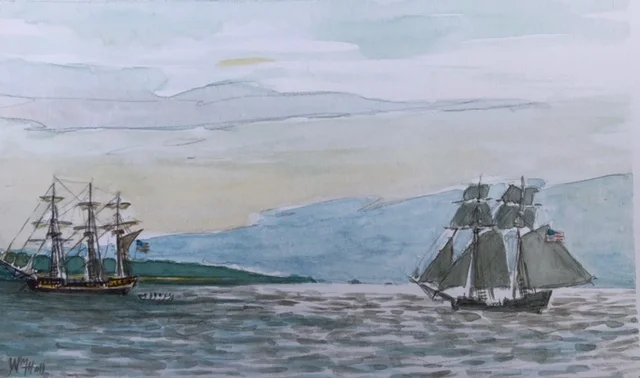
Two American privateers meeting off Newport (Brenton Point off the left) during the Revolution. They, of course, preyed on British ships.
— Watercolor by William T. Hall
Wheel within a wheel
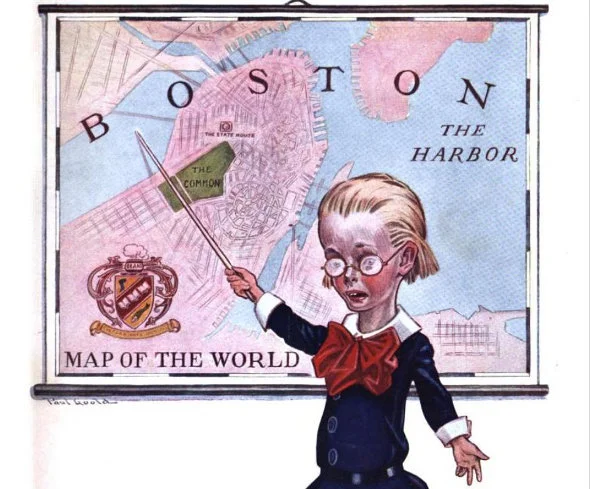
From the “Boston Number’’ of the Oct. 19, 1911 issue of the old Life magazine.
"Massachusetts has been the wheel within New England, and Boston the wheel within Massachusetts. Boston therefore is often called the `hub of the world' since it has been the source and fountain of ideas that have been reared and made America."
The Rev. F.B. Zinckle, in Last Winter in the United States (1868).
Calligraphy in the Hub
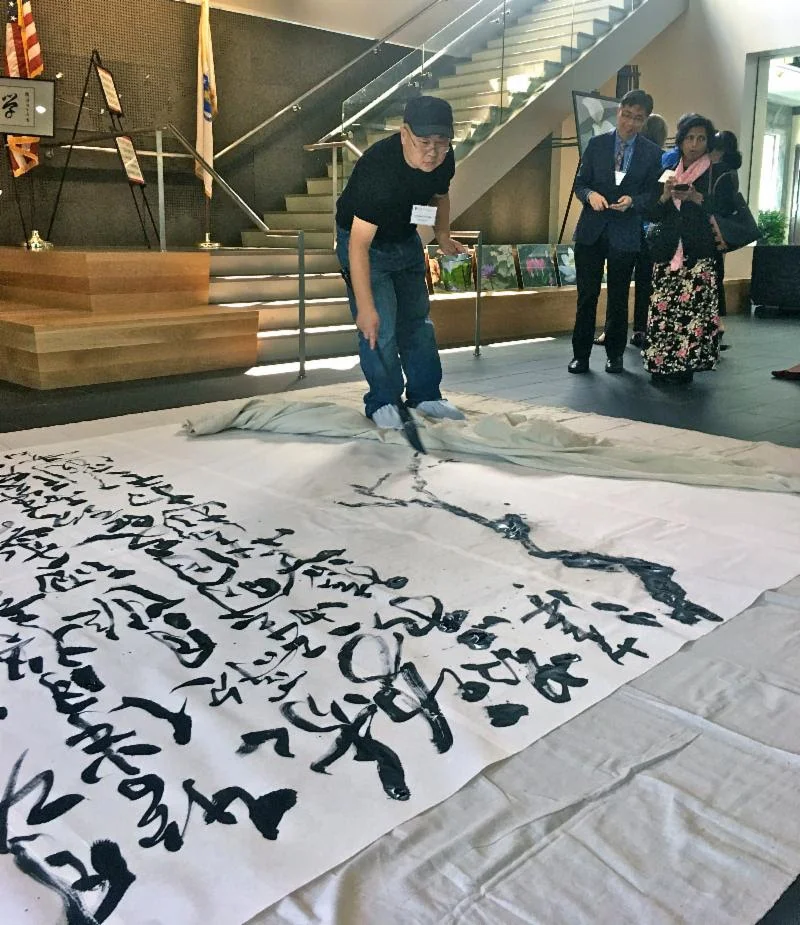
On Sunday Nov. 18 at noon, Quanzhou (aka Jack) Zhao will give a calligraphy demonstration at Boston Sculptors Gallery.
Calligraphy Demonstration
with Quanzhou (Jack) Zhao
Pawtucket's nonstop crisis
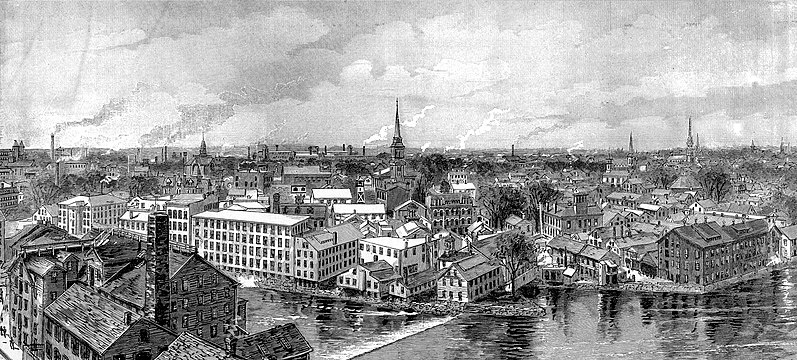
Very prosperous but very polluted Pawtucket in 1886, viewed from the steeple of the Pawtucket Congregational Church. Just don’t think about the child labor.
From Robert Whitcomb’s “Digital Diary,’’ in GoLocal24.com
‘Having lost the PawSox and Memorial Hospital, Pawtucket officials are desperate to keep Hasbro’s headquarters. But the toy and game company, while expressing empathy, will solely make its decision based on bottom-line considerations and its projection of company needs and wants over the next decade. That might mean moving to downtown Providence, close to the designers at the Rhode Island School of Design, other colleges and many other activities and services lacking in Pawtucket -- and far less car-dependent.
Or perhaps it might make the most sense for Hasbro to move to Los Angeles or New York, two capitals of the entertainment industry, of which Hasbro is very much a part.
Organic innocence

“Esmeralda” (oil), by Stephanie Bush, at the Mill Brook Gallery and Sculpture Garden, Concord, N.H.