
Vox clamantis in deserto





Tim Faulkner: Sport and commercial fishermen at odds over offshore wind

Via ecoRI News (ecori.org)
NARRAGANSETT, R.I. — Commercial fishermen and sport fishermen are split over the benefits of offshore wind facilities.
Commercial fishermen, primarily from eastern Long Island, N.Y., say the wind-energy projects planned for southern New England, such as the South Fork Wind Farm, are the latest threats to their income after decades of quotas and regulations.
“I don't like the idea of the ocean being taken away from me after I’ve thrown so many big-dollar fish back in the water for the last 30 years, praying I’d get it back in the end,” said Dave Aripotch, owner of a 75-foot trawl-fishing boat based in Montauk, N.Y.
In the summer, Aripotch patrols for squid and weakfish in the area where the 15 South Fork wind turbines and others wind projects are planned. He expects the wind facilities and undersea cables will shrink fishing grounds along the Eastern Seaboard.
“If you put 2,000 wind turbines from the Nantucket Shoals to New York City, I’m losing 50 to 60 percent of my fishing grounds,” Aripotch said during a Nov. 8 public hearing at the Narragansett Community Center.
Dave Monti of the Rhode Island Saltwater Anglers Association said the submerged turbine foundations at the Block Island Wind Farm created artificial reefs, boosting fish populations and attracting charter boats like his.
“It’s a very positive thing for recreational fishing,” Monti said. “The Block Island Wind Farm has acted like a fish magnet.”
Offshore wind development also has the support of environmental groups such as the National Wildlife Federation and the Conservation Law Foundation, which view renewable energy as an answer to climate change.
“Offshore wind power really is the kind of game-changing large-scale solution that we need to see move forward, particularly along along the East Coast,” said Amber Hewett, manager of the Atlantic offshore wind energy campaign for the National Wildlife Federation.
Aripotch and fellow commercial fisherman Donald Fox urged the Bureau of Ocean Energy Management (BOEM) to study the cumulative effects of the four other wind projects planned for the Rhode Island/Massachusetts wind-energy area. They want to know how catches and quotas will be calculated if fishing nets run through multiple wind facilities.
“God bless you if you figure that one out,” Fox said.
Commercial fisherman David Aripotch said offshore wind turbines and the accompanying infrastructure will shrink fishing grounds along the Eastern Seaboard. (Tim Faulkner/ecoRI News photos)
The comments were made at the last of three public hearing held by BOEM for the South Fork Wind Farm’s environmental impact statement (EIS). A 30-day public comment period on the environmental impacts ends Nov. 19. BOEM has held a total of eight public meetings for the South Fork project.
After the current comment period, a second 45-day comment period will follow BOEM’s release of a draft IES. BOEM then has three months to issue a decision, which is expected in early 2020. If approved, construction on the South Fork Wind Farm would begin in 2021. Pending other permits, the wind facility would then be expected to be operating by the end of 2022.
BOEM is reviewing the engineering plans for the wind turbines, an offshore substation, and the 30-mile power cable that will run to East Hampton, N.Y. The federal agency also is reviewing the effects of the transmission line, such as the impacts of electromagnetic fields on sea life.
The substation would be above the water on its own platform or share a platform with a wind turbine. It will have a height of up to 200 feet to support a high-voltage power transformer, reactor, and ventilation and air-conditioning systems. The substation may also include a 400-horse-power diesel generator and a 500-gallon diesel fuel tank.
Sportfisherman Dave Monti said the submerged turbine foundations at the Block Island Wind Farm created artificial reefs, boosting fish populations and attracting charter boats like his.
The designated wind area between Block Island and Martha’s Vineyard has already restricted wind-energy development in portions of prime fishing grounds such as Cox Ledge.
Bonnie Brady of the Long Island Commercial Fishing Association called Deepwater Wind “the not ready for primetime players” because of technical problems with the Block Island Wind Farm, such as exposed undersea cables.
Brady noted that Deepwater Wind, now called Ørsted U.S. Offshore Wind, increased the capacity of the proposed South Fork Wind Farm from 90 to 130 megawatts. Each turbine can have an electricity output of 12 megawatts, or twice the power output of the Block Island turbines. The maximum height of the new turbines is 840 feet. The Block Island turbines are about 580 feet tall.
Brady wants BOEM to study of the effects of the larger turbines and increase the space between each turbine to 2 miles. Deepwater Wind has offered to separate the turbines by a mile. She said studies are needed of the noise and particle pressure from the larger turbines and the impacts of jet plowing and pile driving on fish and shellfish.
Brady is advocating for BOEM and New York regulators to afford fishermen the same protections that Rhode Island fishermen receive, such payment for lost revenue, as defined by the Ocean Special Area Management Plan.
“There needs to be long-term mitigation, long-term compensation at fair values, without signing a nondisclosure agreement,” she said.
Tim Faulkner, nature writer, is a reporter and writer for ecoRI News
Lines on a beach
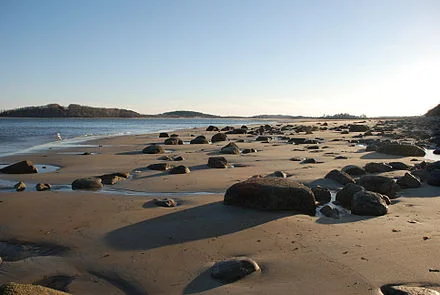
South Beach on Plum Island.
“What if the earth knows longing and regret,
And no one’s heard a whisper of it yet?
Why is the earth without an intimate?
These cursive lines, in which the ebbing tide
Would hint at little secrets to confide,
Denote a frilled coquette and not a bride.’’
From “On the Strand at Plum Island’’ {Mass.}, by Alfred Nicol

Don Pesci: 'So sorry to have left you a mess'

Autumn in Connecticut?
“Connecticut Gov.-elect Ned Lamont says outgoing Gov. Dannel Malloy has ‘done a lot of thinking about transition…’– WTNH News 8After lunch, Governor Malloy and Gov. -Elect ] Lamont have a ‘frank and honest’ conversation with each other. Throughout, Malloy – approval rating 15 -- appears to be carefree, strangely excited. The burden of governing has been lifted from his shoulders. When his term ends, he will kick the dust of Connecticut from his feet, move to Massachusetts and teach courses at his old alma mater, Boston College. Lamont is restrained, his characteristic ebullience gone, now that he faces the reality of governing a state in the dumps.
Malloy: … reason to be depressed. According to one analysis, your margin of victory in the race was larger even than mine during my first campaign. Imagine that. You have in your corner the large cities, most of the state’s media and – big surprise – portions of the state that have always gone Republican. Right now, you are very well positioned. You have the General Assembly laying like a cat in your lap, purring. Why, President Pro Tem of the Senate Martin Looney can hardly contain himself. He no longer will have to deal with Themis Klarides or Len Fasano; tough customers, those two. You can do whatever you want. It’s 2011 all over again. Be happy.
Lamont: I think you know there are problems.
Malloy: Yes, there are always problems.
Lamont: I hope we can speak frankly. Most of it has to do with the legacy you left me. I have fewer weapons in the struggle with SEBAC (union leaders with whom the governor of Connecticut sets the path of future governance) than you did coming into office in 2011. I can’t change your contracts until 2027, and the contracts provide a no-layoff provision and salary increases after a brief freeze. Then there are the recurring deficits and your expressed intention not to raise taxes. People take these silly pledges seriously you know. Perhaps most importantly, I can't shuck my problems off on my predecessor. That would be you.
Malloy: Right. Speaking frankly Ned, those are your problems, or they will become yours in January. I’m sure you’ll think of something. Tolls for trucks in Connecticut is a good baby step. The tolling, and the revenue pouring in from tolling gantries, can always be extended far beyond trucks to all vehicles, and that will provide you with a new revenue resource. Just tell everyone the bridges will collapse without repair, and that you’ll place the new revenue in a lockbox to which, heh, heh (he moves his fingers as if opening a safe) you have the combination. Given the Democratic Party’s mutually beneficial connection with unions, there is no way to discharge deficits without some new and expandable revenue source – hence tolls. You could make a grab for municipal dollars by restructuring property taxes. We’ve talked about this, remember?
Ned: The unions will have to come around.
Malloy: Yes, I’ve I tried that. It’s easier politically to stick to tax increases. Not for me of course. I’m rather hoping that the people at Boston College Law School will be willing, after a time, to forget that they hired as a professor someone whose approval rating among overtaxed Connecticut citizens is 15 percent, according to one dubious poll. I’m relying on history to rectify my standing. But you’ve made no promises during your campaign. Asked whether you intended to raise taxes, you first said ‘Yes’ and later wisely amended your ‘Yes’ to ‘No comment.’ {Republican gubernatorial candidate Bob} Stefanowski had some fun with that in his ads. But, of course, we both know that people generally discount both political ads and promises made in the heat of campaigns. Remember your Bismarck: ‘People never lie so much as after a hunt, during a war or before an election.’ To tell you the truth, I’m glad to be out of it.
Lamont: And so your final advice to me would be what?
Malloy: Do the progressive thing, shut out rump Republicans as I’ve done, and slog through. Remember, there will be a life after politics. As Weicker did and I will do, you may have to move out of state for a bit to reinvent yourself. He went to Washington DC to teach a class in Lowell Weicker, and I’m off to Boston to teach a class in Dannel Malloy. I feel liberated. So sorry to leave you with a mess. One more budget and I’m off the hot seat. Did I tell you I’m working on a book? Personal memoirs have become a form of character restitution, have you noticed? Shall we join the ladies?
Don Pesci is a columnist based in Vernon, Conn.
E-mail: donpesci@att.net
Too late

”Landscape With Trees,’’ by Vincent van Gogh
“Yet one smile more, departing, distant sun!
One mellow smile through the soft vapory air,
Ere, o’er the frozen earth, the loud winds run,
Or snows are sifted o’er the meadows bare.
One smile on the brown hills and naked trees,
And the dark rocks whose summer wreaths are cast,
And the blue gentian flower, that, in the breeze,
Nods lonely, of her beauteous race the last.
Yet a few sunny days, in which the bee
Shall murmur by the hedge that skirts the way,
The cricket chirp upon the russet lea,
And man delight to linger in thy ray.
Yet one rich smile, and we will try to bear
The piercing winter frost, and winds, and darkened air.’’
-- “November,’’ by William Cullen Bryant (1794-1878), a native of Cummington, Mass.
David Warsh: Romer's huge contribution to growth economics

Ruins of the church at São Miguel das Missões, Rio Grande do Sul, Brazil, one of the missions that ministered to the Guarani tribe.
It was a newspaper feature story of a sort that has become fairly familiar, if rarely so well executed, and my physicist friend was enthusiastic about it. “I love studies like this. Data on almost anything can be squeezed out of the most unlikely places. Clever data acquisition, analysis, and normalization to an ingeniously inferred control group. And in this case, the look-back period is 400 years and the ripple effects have continued for 250 years after the stimulus was removed.”
As described by Washington Post reporter Andrew Van Dam, “The Mission: Human Capital Transmission, Economic Persistence, and Culture in South America,” a study published in the Quarterly Journal of Economics, tells the following story:
Jesuit missionaries arrived in South America in the mid-16th Century, proselytizing Catholicism and teaching useful new skills in roughly equal measure. In 1609, the order established the first of some 30 missions in the remote homeland of the Guarani tribe, what is today the “triple frontier” region where two great rivers meet to form the boundaries of Brazil, Paraguay and Argentina. Jesuits taught blacksmithing, arithmetic and embroidery to the Guarani people. The missions mostly thrived until 1767, when King Charles III of Spain expelled all Jesuits from the Spanish Empire. Formal instruction stopped.
Yet even today, people living near the ruins of those missions show the effect of that long ago training, going to school 10 to 15 percent longer and earning 10 percent more than residents of equivalent towns without missions. Felipe Valencia Caicedo, of the University of British Columbia, chose to piece together the story of the Guarani missions from archival sources because the relatively isolated region, with its jumble of governments, offered a natural experiment.
Bringing to bear much of the apparatus of a randomized controlled trial, the economic historian was able to show that it wasn’t colonialism that produced the result, it wasn’t geography, it wasn’t religion. It was investment in skills. “Valencia’s analysis is among the most striking of a surge of studies that show how returns from education and vocational training span generations and even centuries,” wrote Van Dam.
“The Mission” is also a prime example of the torrent of important work that was unleashed t by a single paper, “Endogenous Technical Change,” in 1990, for which Paul Romer, of New York University, shared this year’s Nobel Prize in economics with William Nordhaus, of Yale University. Nordhaus’s topic is the interplay of economic growth and climate. Romer’s topic was the role of inventors, researchers and entrepreneurs in economic growth. Even before he completed his thesis, in 1983, at the University of Chicago, his emphasis on differential and, often, accelerating national growth rates was causing excitement. As his adviser Robert Lucas famously put it in his Marshall lectures,
I do not see how you can look at figures like these without seeing them as possibilities. Is there some action a government of India could take that would lead the Indian economy to grow like Indonesia’s or Egypt’s? If so, what, exactly? If not, what is it about the “nature of India” that makes it so? … The consequences for human welfare involved in questions like these are simply staggering: Once one starts thinking about them, it is hard to think of anything else.
Romer concentrated narrowly on the economics of technological change. On Vox EU Web site, Charles I. Jones, Romer’s successor at Stanford University’ Graduate School of Business, describes the path by which his friend introduced an “economics of ideas,” with is powerful implication that governments inevitably influence growth through intellectual property regimes, education and training policies, and subsidies to long-run research and development..
Almost immediately researchers began looking for other policies that might influence growth, financial, legal and political institutions in particular. New journals appeared. So did a long shelf of books, including Why Nations Fail: The Origins of Power,, Prosperity, and Poverty, by Daron Acemoglu and James Robinson; The Great Escape: Health, Wealth, and the Origins of Inequality, by Angus Deaton; The Race Between Education and Technology, by Claudia Goldin and Lawrence Katz; and The Rise and Fall of American Growth, by Robert Gordon. Economic historians emphasized the role of culture: Joel Mokyr, of Northwestern University, in A Culture of Growth: The Origins of the Modern Economy; and Deidre McCloskey, of the University of Illinois at Chicago, in her epic trilogy, The Bourgeois Era, especially its third volume, Bourgeois Equality: How Ideas, Not Capital or Institutions, Enriched the World. Historian Youval Noah Harari contributed Sapiens: A Brief History of Humankind.
Romer tried for a while to keep ahead of the torrent, beginning to work on endogenous change of tastes and preferences, and then gave up. He started an online learning company, Aplia, sold it, resigned from Stanford University to become a policy entrepreneur, advocating for the creation of “charter cities” around the world. He joined the Stern School of Business at NYU, founded the Marron Institute of Urban Management on the university’s campus, then left to serve for a tumultuous time as chief economist of the World Bank.
Between times he skirmished publicly over a tendency to “mathiness” in economics and the state of macroeconomics, continuing to play a role behind the scenes in research economics. Today he is an Institute Professor at NYU. As Jones concludes, Romer’s contribution to growth economics has been monumental. With a single paper, he virtually invented the modern field. “Endogenous Technical Change” is an especially vivid reminder of Einstein’s dictum, that it is the theory which decides what we can observe.
David Warsh, an economic historian and long-time columnist, is proprietor of Somerville, Mass.-based economicprincipals.com, where this column first appeared.
Doesn't work well in a greenhouse

Gatekeeper (oil on canvas), by Joan Baldwin, in her show “Unkempt Gardens,’’ at Kingston Gallery, Boston, Dec. 5-30.
The gallery says: Her inspiration stems from “the stories and histories developed when gardens are left to be in their natural states. The imaginary spirits of ancient civilizations lingering in the gardens have become her subjects. Within the lush settings Baldwin creates a mood with mythical figures, statuary and gargoyles designed to delight and bring history alive. Interspersed with the large paintings are small portraits in frames that are part of the collection though seem simultaneously independent. Baldwin’s portraits, with names implying that they are family members, were influenced by the gargoyles she saw on churches and buildings while in southern Italy in 2017. Though the gargoyles were originally intended to be frightening and ward off evil spirits, the personified portraits seem comical in their new environment and interact with their lush counterparts in unexpected ways.’’
So drink more coffee
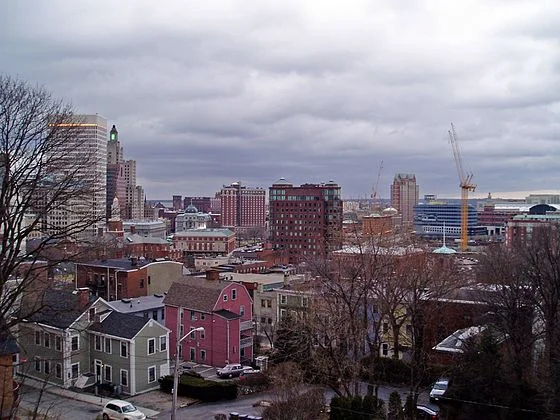
View of Providence from College Hill.
”If months were marked by colors, November in New England would be colored gray. ‘‘
— Madeleine M. Kunin, former diplomat and ex-Vermont governor, as well as writer.

Late October on Town Neck Beach, Sandwich, Cape Cod, by Bobby Baker (copyright Bobby Baker Fine Art).
We all would like 'em if not need 'em

“Prayers for the Innocent, Prayers for the Guilty’’ (mixed media on board) in the show “Donnamaria Bruton: Part II, The Later Years,’’ currently at Cade Tompkins Projects, Providence. (The gallery is on the ground floor of a beautiful old brick mansion adjacent to Brown University.)
Mysticism and color relationships
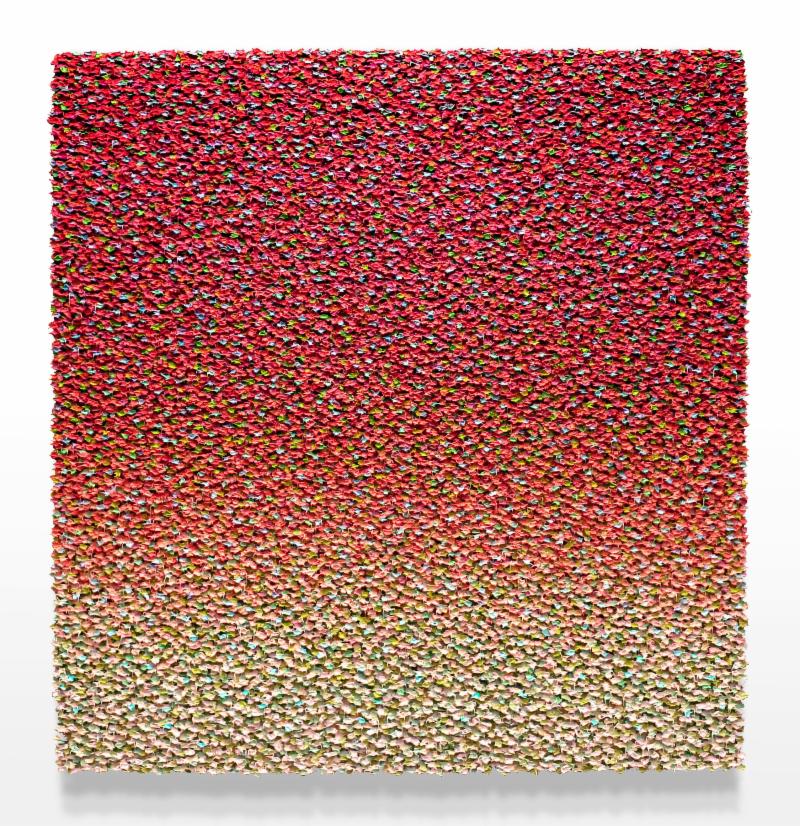
Silicone on canvas mounted on panel — a work by Robert Sagerman, in the current group show “Room for Play,’’ at Heather Gaudio Fine Art, New Canaan, Conn. The gallery says:
“Robert Sagerman combines mysticism and investigation of color relationships in his paintings. He builds up the texture by squeezing individual dollops of paint he has mixed himself, slowly amassing the surface with a deliberate fashion. Sagerman counts and records ever single pigment application and keeps track of the numbers that are typically in the thousands. The practice of counting is a meditation based in medieval Jewish mysticism, a method Kabbalists believed could bring forth divine clarity. Sagerman’s technique makes for richly textured, captivating and mesmerizing color field paintings.’’
A lost culture
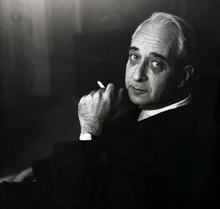
Lionel Trilling
From Robert Whitcomb’s “Digital Diary,’’ in GoLocal24.com
For a trip through literary, political and academic worlds from the 1920s to the 1970s, you’d do well to read Life in Culture: Selected Letters of Lionel Trilling, edited by Adam Kirsch and published by Farrar, Straus and Giroux. Mr. Trilling (1905-1975) was for decades of America’s one or two most respected and famous literary critics (e.g., his essay collection The Liberal Imagination) as well as a distinguished writer of fiction (e.g., his novel, The Middle of the Journey, as well as short fiction, e.g., his collection Of This Time, of That Place, and Other Stories).
His career spanned what was probably the golden age of American criticism. His formidable wife, Diana, was also a distinguished member of the famous collection of writers, most of whom lived in New York and whose heyday was the ‘30s through the ‘70s, and at the center of which was Lionel Trilling.
Professor Trilling was a very sharp and subtle social observer as well as a legendary teacher at Columbia University. (Among his famous students were Jack Kerouac and Allen Ginsberg.) He mined literature, politics, history and the wider society to find and explain cultural connections and causes and effects.
Some of these “public intellectuals’’ became famous enough, in less crass times, to be invited to appear on late night commercial television. This book walks you through what seems a lost world of great intellectual excitement.
Wise old killer
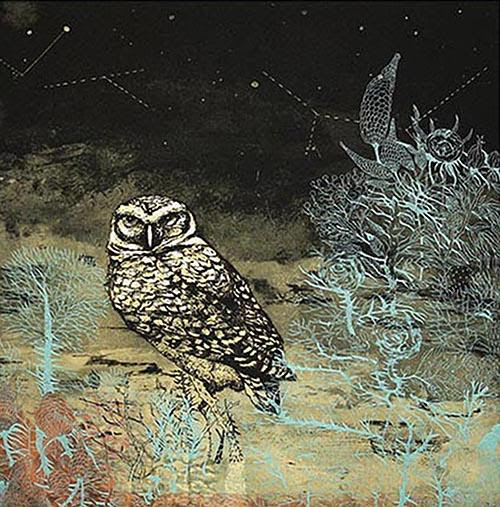
From Boriana Kantcheva’s “Garden’’ show — meditations on childhood memories, — at Bromfield Gallery, Boston, through Dec. 2.
Liz Szabo: N.E.-based study pours cold water on fish-oil and vitamin D hype

Fish-oil pills.
By LIZ SZABO
A widely anticipated study has concluded that neither vitamin D nor fish oil supplements prevent cancer or serious heart-related problems in healthy older people, according to research presented Saturday at the American Heart Association Scientific Sessions. Researchers defined serious heart problems as the combined rate of heart attacks, stroke and heart-related deaths.
Although hundreds of studies of these supplements have been published over the years, the new clinical trial — a federally funded project involving nearly 26,000 people — is the strongest and most definitive examination yet, said Dr. Clifford Rosen, a senior scientist at the Maine Medical Center Research Institute who was not involved in the research.
Doctors have been keenly interested in learning the supplements’ true value, given their tremendous popularity with patients. A 2017 study found that 26 percent of Americans age 60 and older take vitamin D supplements, while 22 percent take pills containing omega-3 fatty acids, a key ingredient in fish oil.
The new study also suggests there’s no reason for people to undergo routine blood tests for vitamin D, said Rosen, who co-wrote an accompanying editorial. (Both were published in the New England Journal of Medicine.). That’s because the study found that patients’ vitamin D levels made no difference in their risk of cancer or serious heart issues, Rosen said. Even people who began the study with clear vitamin D deficiency got no benefit from taking the supplements, which provided 2,000 international units a day. This amount is equal to one or two of the vitamin D pills typically sold in stores.
A recent Kaiser Health News story reported that vitamin D testing has become a huge business for commercial labs — and an enormous expense for taxpayers. Doctors ordered more than 10 million vitamin D tests for Medicare patients in 2016 — an increase of 547 percent since 2007 — at a cost of $365 million.
“It’s time to stop it,” said Rosen of vitamin D testing. “There’s no justification.”
Dr. JoAnn Manson, the study’s lead author, agrees that her results don’t support screening healthy people for vitamin D deficiency. She’s at Harvard’s T.H. Chan School of Public Health.
But she doesn’t see her study as entirely negative.
Manson notes that her team found no serious side effects from taking either fish oil or vitamin D supplements.
“If you’re already taking fish oil or vitamin D, our results would not provide a clear reason to stop,” Manson said.
Manson notes that a deeper look into the data suggested possible benefits.
When researchers singled out heart attacks — rather than the rate of all serious heart problems combined — they saw that fish oil appeared to reduce heart attacks by 28 percent, Manson said. As for vitamin D, it appeared to reduce cancer deaths — although not cancer diagnoses — by 25 percent.
But slicing the data into smaller segments — with fewer patients in each group — can produce unreliable results, said Dr. Barnett Kramer, director of the cancer prevention division at the National Cancer Institute. The links between fish oil and heart attacks — and vitamin D and cancer death — could be due to chance, Kramer said.
Experts agree that vitamin D is important for bone health. Researchers didn’t report on its effect on bones in these papers, however. Instead, they looked at areas where vitamin D’s benefits haven’t been definitely proven, such as cancer and heart disease. Although preliminary studies have suggested vitamin D can prevent heart disease and cancer, more rigorous studies have disputed those findings.
Manson and her colleagues plan to publish data on the supplements’ effects on other areas of health in coming months, including diabetes, memory and mental functioning, autoimmune disease, respiratory infections and depression.
Consumers who want to reduce their risk of cancer and heart disease can follow other proven strategies.
“People should continue to focus on known factors to reduce cancer and heart disease: Eat right, exercise, don’t smoke, control high blood pressure, take a statin if you are high risk,” said Dr. Alex Krist, a professor of family medicine and population health at Virginia Commonwealth University.
Liz Szabo: lszabo@kff.org, @LizSzabo
Now I understand the Cape

“Until I subscribed to The Cape Codder {a still existing newspaper} I thought that a cranberry was a cherry with an acid condition. I thought that a seagull was a thyroid pigeon. I thought the mayor of Cotuit was an oyster. Today, thanks to The Cape Codder, I know why the Pilgrim Fathers, who had the entire continent available for their purposes, chose to land on Cape Cod.’’
-- From Fred Allen’s (1894-1956) 1950 letter to The Cape Codder. He was mostly known as a radio comedian.
Ambiguous homecoming

“After Dad Came Home’’ (encaustic/mixed media), by Nancy Whitcomb, in the “Members Exhibition’’ at the New Bedford Art Museum, through March 17.
‘Norway of the year’
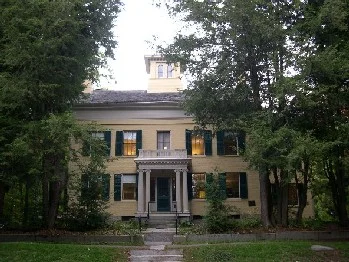
The house, now a museum, in Amherst, Mass., where Emily Dickinson (1830-1886), the celebrated poet, lived most of her life. The town is famous for her and for hosting the flagship campus of the University of Massachusetts and Amherst College, a member of the “Little Ivy League,’’ along with Williams and Bowdoin colleges and Wesleyan University.
“It is also November. The noons are more laconic and the sunsets sterner, and Gibraltar lights make the village foreign. November always seemed to me the Norway of the year. ---- is still with the sister who put her child in an ice nest last Monday forenoon. The redoubtable God! I notice where Death has been introduced, he frequently calls, making it desirable to forestall his advances.”
― Emily Dickinson, in a letter
Driving will get more exciting as pot use surges

“American Landscape,’’ by Jan A. Nelson (graphite on Strathmore rag, 1974).
— Jan.anders.nelson
From Robert Whitcomb’s “Digital Diary,’’ in GoLocal24.com
Some states, including in New England, are blithely rushing into legalizing marijuana use, in large part to get tax revenue from pot sales, setting aside the inconvenient fact that use of the drug undermines memory, concentration and reasoning and causes accidents. And it can be a gateway drug for stronger stuff.
Consider, for example, that the Insurance Institute for Highway Safety reports that Washington, Colorado and Oregon, which have legalized the drug, now have 5.2 percent more vehicle crashes than neighboring states.
"Despite the difficulty of isolating the specific effects of marijuana impairment on crash risk, the evidence is growing that legalizing its use increases crashes," said institute president David Harkey, as quoted in thedrive.com.
"The {institute’s}new research on marijuana and crashes indicates that legalizing marijuana for all uses is having a negative impact on the safety of our roads. States exploring legalizing marijuana should consider this effect on highway safety." Just what we need in our attention-deficit times!
To read more, please hit this link.
Peter Certo: GOP's mid-terms campaign depended on lies, fear-mongering and rule-rigging
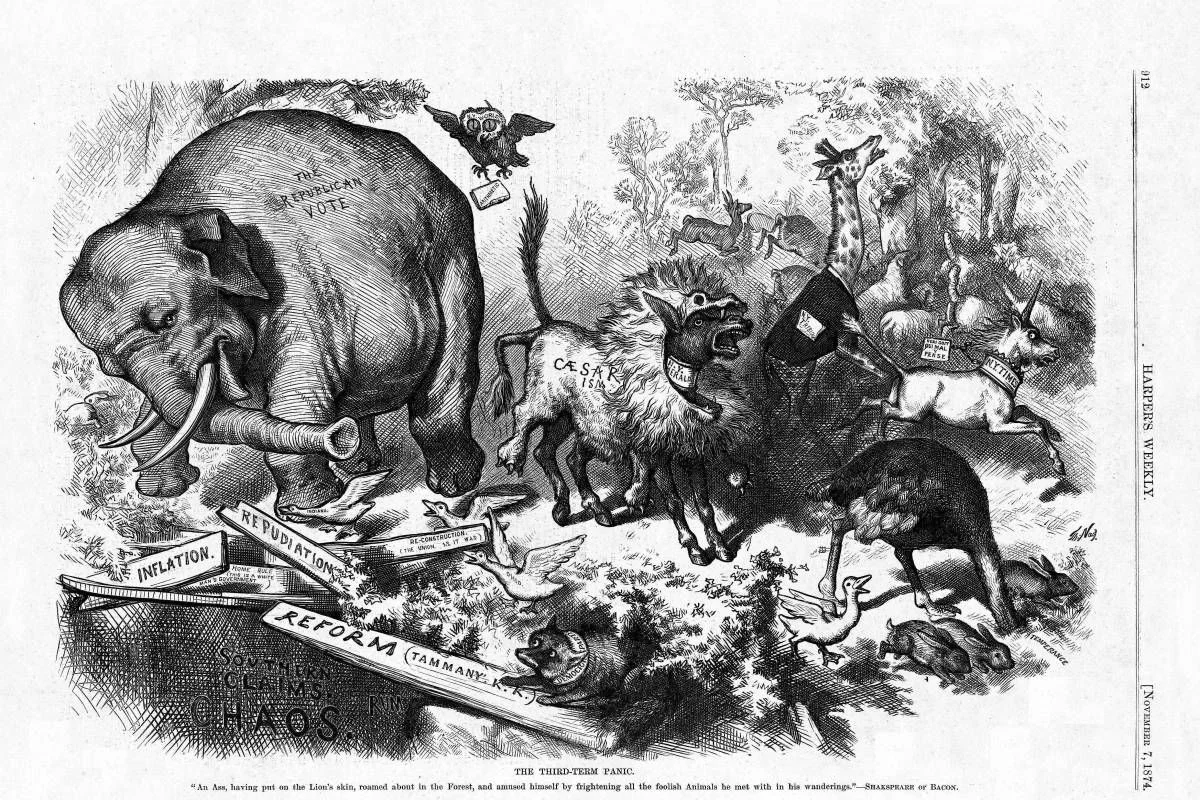
This 1874 cartoon by Thomas Nast is considered the first important portrayal of the Republican elephant.
Via OtherWords.org
I can’t be the only one who spent the night of the mid-terms tossing and turning. Though I managed to shut off the coverage and try to sleep, spasms of anxiety woke me repeatedly throughout the dreary hours.
Ultimately, Republicans picked off several Red State Senate seats while Democrats won back the House and at least seven governorships.
A Democratic House will serve as a badly needed check after two years of aggressive Republican monopoly, but I can’t help feeling uneasy. For one thing, I can’t shake the last days of the campaign.
For a while, Republicans “merely” lied about their policy agenda.
Rather than campaigning on the $2 trillion tax cut for rich people they actually passed, they promised a middle class tax cut they never even had a bill for. And after spending all last year trying to throw 20 million to 30 million Americans off their health care, they (unbelievably!) promised to defend Americans’ pre-existing condition coverage — even as they actively sought to undermine it.
But the lies took a much darker turn as the White House took hold of the narrative.
Led by the president, GOP propagandists turned a few thousand refugees — over a thousand miles away in southern Mexico — into an “invading army.” The White House put out an ad about it so shockingly racist and false that even Fox News stopped airing it.
Unashamed, President Trump kept repeating the obvious lie that the homeless refugees were funded by Jewish philanthropist George Soros — even after a refugee-hating extremist murdered 11 Jews at a Pittsburgh synagogue.
Such vile hatred may have been key to Red State Republican gains in the Senate. But where that wasn’t enough, it was backstopped by voter suppression and gerrymandering.
Suppression may have helped the GOP governor candidates fend off strong challenges in Florida and especially Georgia, where tens of thousands of voters were scrubbed from the rolls and lines in Democratic precincts ran up to five hours long.
And thanks to gerrymandering, it took an extraordinary effort for Democrats to win even a slim House majority. They’re up only a few seats despite decisively winning the popular vote by at least 9 points. Had it been “only” a 4 or 5 point win, Vox’s Matthew Yglesias estimates, the GOP might have retained its majority.
Also worth noting: Democratic Senate candidates actually racked up over 10 million more votes than Republicans, even as Republicans picked up Senate seats on a GOP-tilting map,
To me these results show that Republicans can’t win with their actual policy agenda — not even in many Red States, judging by some ballot initiative results.
For instance, Red State voters in Missouri and Arkansas raised their minimum wages against the wishes of state Republicans. Missouri also legalized medicinal marijuana, along with deeply conservative Utah, and Purple State Michigan voters brought legal recreational marijuana to the Midwest.
Along with Utah, ruby red Idaho and Nebraska expanded Medicaid under Obamacare, a big win for health care.
These progressive policies are far more popular than their right-wing alternatives. So Republicans rely on a potent combination of lies, fear-mongering, and rule-rigging to win.
If Democrats ever hope to really come in from the wilderness, they need to support a host of radical pro-democracy reforms.
In that they can take inspiration from a stunning movement in Florida, where voters re-enfranchised over 1 million of their neighbors with felony convictions. And from Michigan, Colorado, Utah and Missouri, which all passed initiatives to support citizen-led redistricting. And from Maryland, Michigan, and Nevada, which all made voter registration easier.
Uneasiness is part and parcel of drawing breath in 2018. But if I sleep a little better tonight, it’ll be thanks to movements like those.
Peter Certo is the editorial manager of the Institute for Policy Studies and the editor of OtherWords.org.
High-altitude art

“Samyek Festival, Nagbahal, Lalitpur, Nepal,’’ photo by James Giambrone, in his show “The Newar Craftsmen of Kathmandu Valley: Objects of Devotion from Nepal,’’ through Dec. 15 at the Iris & Gerald Cantor Art Gallery, College of the Holy Cross, Worcester. An independent scholar and resident of Kathmandu, Mr. Giambrone has studied the master works of the Newar craftsmen of that region for many years. This exhibition highlights objects of both Buddhist and Hindu devotion.’’
The gallery says: “As an independent scholar and resident of Kathmandu, James Giambrone has studied the master works created by the Newar craftsmen of that region for many years. This exhibition, curated by Giambrone, highlights objects of both Buddhist and Hindu devotion.’’
Michelle Andrews: New food stamp contractor upsets farmers markets' carts
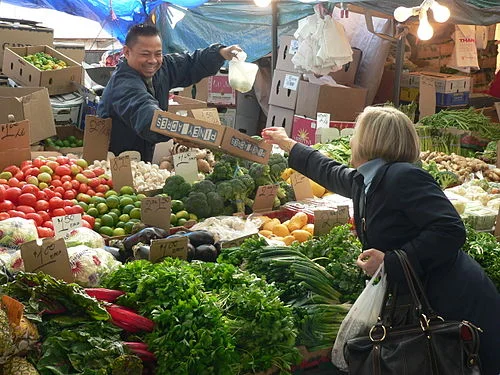
In the Haymarket farmers market in downtown Boston.
By MICHELLE ANDREWS
When the woman stopped by Phil Munson’s stall at a Rochester, N.Y., farmers market recently, he noticed a change. A regular customer, she browsed his Fisher Hill Farm vegetables as usual and selected a few to buy. But this time, instead of offering cash for her produce, the woman paid with the wooden tokens available for people using Supplemental Nutrition Assistance Program (SNAP) benefits, formerly known as food stamps.
Because the market accepts SNAP benefits, the woman could make her regular purchases with no difficulty. She also qualified for New York’s FreshConnect program, an incentive for SNAP beneficiaries to improve their access to fresh food. So, she got an extra $2 for every $5 she spent at the market, boosting her purchasing power by 40 percent.
Munson said the customer bought eggs that day in addition to her usual vegetables.
“She was really happy to get the benefit,” Munson recalled. “She said, ‘I can’t believe how much they gave me.’”
Federal and local officials have long said they are eager to get farmers’ produce to low-income families’ dinner tables, but for people like Munson’s customer, the ability to use SNAP benefits in the future is uncertain. While using food stamps to purchase vegetables at a farmer’s stall may seem like a simple exchange, it depends on complex government contracting requirements and increasingly sophisticated technology.
A change this year in federal contracts has left some market operators and advocates nervous. The company that provided the technology used by roughly 1,700 of the more than 7,000 farmers markets that accept SNAP benefits said it is pulling out of the business.
Earlier this year, federal officials announced they had picked a new contractor to provide equipment to help expand the number of markets that handle SNAP transactions. That contractor, when choosing the companies it would work with, did not include the Novo Dia Group, whose “Mobil Market+” app is used by those markets. Following that, Novo Dia announced it would, as of the end of July, no longer provide that service even to existing clients.
The announcement, coming at the height of the market season, took many operators and advocates by surprise and set off an urgent scramble to avoid a disruption in service. The National Association of Farmers’ Market Nutrition Programs stepped in to fund the processing platform’s operations for one month, and New York Gov. Andrew Cuomo later announced a short-term agreement with the company to provide service nationally through the end of February.
What happens after that remains unclear.
For some farmers, SNAP customers make up an important part of their market business.
“I think it would be noticed if it went away,” said Anita Amsler, whose family sells produce and eggs from their Oldhome Farm at the Rochester Public Market year-round.
Some advocates, however, see the current situation as an opportunity to improve the long-term prospects for the acceptance of SNAP and other nutrition benefits at farmers markets.
“A crisis is a terrible thing to waste,” said David Sandman, president and CEO of the New York State Health Foundation, who has written about the SNAP processing problems. He said his organization and others are interested in options for continuing to make the Nova Dia app available nationally through a public-private partnership.
The markets’ popularity among SNAP users is growing. SNAP benefit redemptions by farmers and markets grew by more than a third from 2012 to 2017, to $22.4 million, according to the U.S. Department of Agriculture.
“They are important touchstones and places for people to access their food the way other consumers do,” said Ellen Vollinger, legal director at the Food Research & Action Center, an advocacy group that works to reduce hunger among the poor.
When farmers market customers want to use SNAP benefits, their first stop is typically at a central market office — like a tent or a trailer — to swipe their SNAP electronic benefits card for whatever amount they want to spend. They are generally given wooden tokens or paper scrip in small denominations of $1 or $5 to spend at the market. They may also get incentive coupons — like those from New York’s FreshConnect program — to boost their purchasing power.
The USDA’s Food and Nutrition Service, which oversees SNAP at the federal level, has long championed farmers markets as an important way to provide people with nutritious food while also supporting farmers economically.
Every few years, that agency awards a contract to a firm to manage the wireless processing equipment program for farmers markets and farmers who want to begin accepting SNAP benefits. In March, it selected Financial Transaction Management of Reston, Va.
The Farmers Market Coalition, the previous contractor, had offered equipment to markets through three providers, including .
The new contractor opted not to work with Novo Dia. When choosing equipment options, Financial Transaction Management focused on cost effectiveness and compliance with standards that protect farmers markets from liability in the event of a data breach, said CEO Angela Sparrow by email.
“It did throw Novo Dia into a tailspin,” said Diane Eggert, executive director of the Farmers Market Federation of New York, who helped put the stopgap funding for the company in place and is seeking a long-term solution. “They needed to continue growing to maintain operations.”
Novo Dia didn’t respond to a request for comment.
The Mobile Market+ app works with a smartphone to enable processing of SNAP benefits. The smartphone technology enhances markets’ ability to track sales and transactions through the app and allows for frequent technology updates, Eggert said.
The current equipment provided by the new contractor is a standard wireless point-of-sale device that uses older, outdated technology, critics say.
Financial Transaction Management is processing applications from farmers markets for its equipment. As of Sept. 24, 140 applications were in the review-and-approval process, and 46 pieces of equipment had shipped, according to USDA officials.
The Food and Nutrition Service said it is interested in modernizing its approach. It wants to employ a “bring your own device” model for the market operators who want to begin processing SNAP in which “markets and farmers would use a smartphone and FNS would facilitate provision of [an] app,” officials said.
To that end, the USDA is testing a mobile application and encryption device that could be used with a smartphone to accept SNAP benefits. The new app, which will require a separate PIN-encryption device, is “not as streamlined” as the Novo Dia app, according to USDA officials. Still, “this is an option that could provide additional flexibility for farmers and markets while also reducing cost to the federal government.”
That option may be available by year’s end.
In addition to federal efforts to promote SNAP purchases at farmers markets, some states, such as California, have taken an active role in providing their markets with free wireless equipment to process transactions.
But the current upheaval has sown uncertainty among many farmers markets about their ability to handle SNAP transactions next year.
Last year, the Rochester Public Market processed more than $800,000 in SNAP benefits and $300,000 in incentives, said Margaret O’Neill, program director for Friends of the Rochester Public Market, a nonprofit that runs the market’s SNAP program. She said she has tried to reassure her vendors and customers that a solution will be found: “It’s a huge market for us.”
Michelle Andrews: andrews.khn@gmail.com, @mandrews110