
Vox clamantis in deserto








Settled and resettled

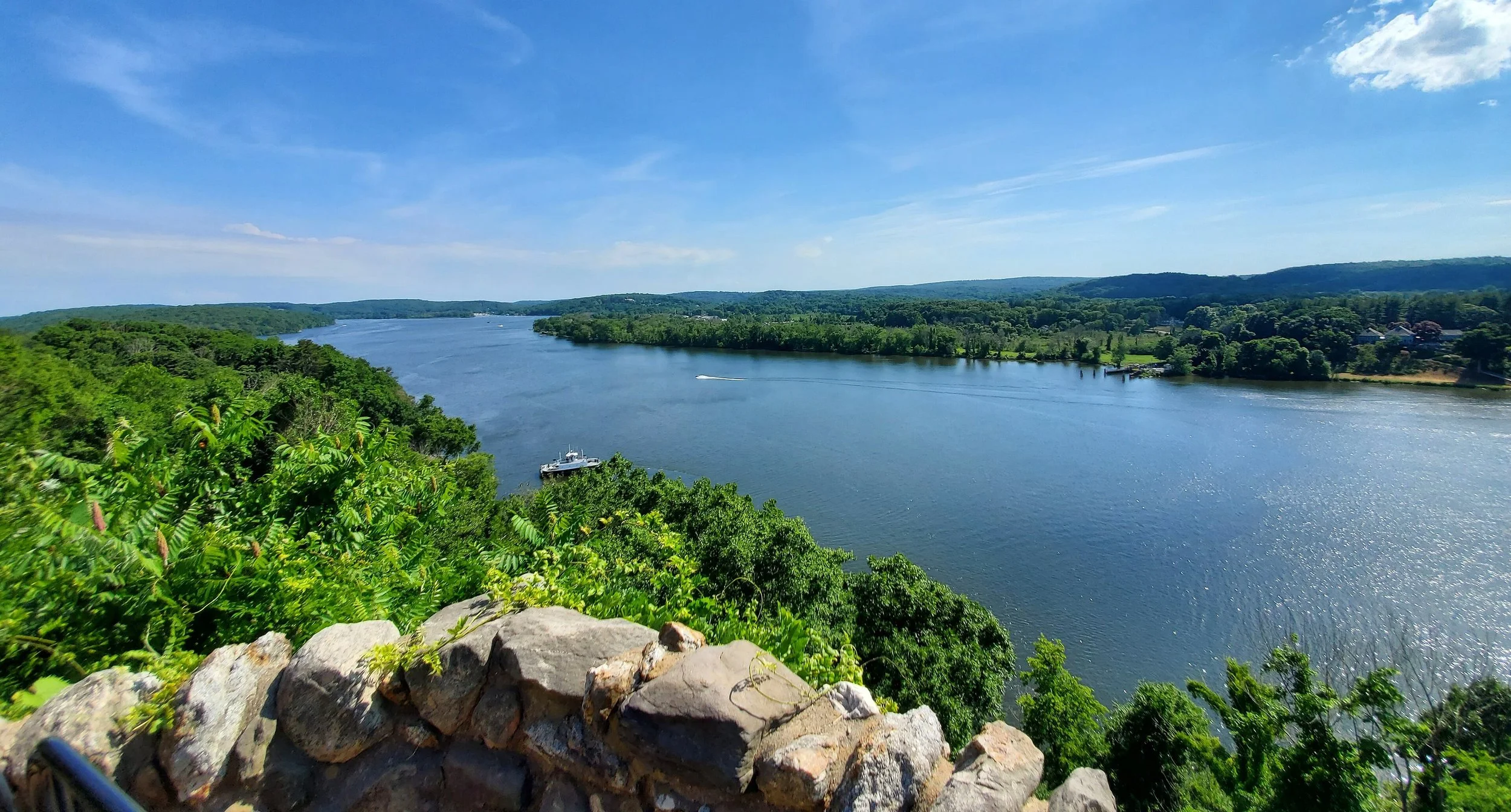
Greenfield from Poet's Seat Tower, 1917
"You go to towns in Massachusetts, Greenfield, first settled in 1686. Wouldn’t it be cool if it said, 'Greenfield. First settled c. 13,000 B.P. or approximately 13,000 Before the Present. Resettled.' Maybe we could say even, 'Resettled by whites,' Or, 'Resettled anyway, 1686.' It would have a different impact. And of course it would help explain why the town is called Greenfield, because it was a green field and the fields were left by Native people who had already been farming them.
-- James W. Loewen, historian and sociologist

Marker in downtown Greenfield.
David Warsh: The Times and the WSJ in the hot-air debate

SOMERVILLE, Mass.
A consensus seems to be emerging that climate change has begun exceeding its natural variability, and that accelerating global warming is something to be feared. What makes me think so? Accounts of widely shared experiences on the front pages of the newspapers that I read: forest fires; melting ice; famine, flood and drought; ecosystem collapse, and species loss. The Economist’s cover 10 days ago was, “Losing the War against Climate Change.”
What can we hope to do about it? It’s hard to tell, since, at least for the present, it seems only one problem among many: trade wars, international rivalries, urban-rural disparities, even arguments about the nature of truth. Yet many ways of narrowing differences exist, beginning with, as noted, the great but sometimes dangerous teacher of experience.
I’d like to suggest that we pay special attention to another mechanism. I think someone, not me, should carefully examine and compare the coverage that climate change receives from the three major American newspapers, The New York Times, The Wall Street Journal, and The Washington Post, with other nations and other languages soon to follow.
There is, obviously, a wide divergence in treatments of these issues. For example, the Aug. 5 Sunday Times magazine devoted an entire issue to a 30,000-word article accompanied by striking photographs of various disasters, titled “Thirty years ago, we could have saved the planet.” Meanwhile, the editorial page of The Wall Street Journal, arguing that Trump administration deregulation policies were “improving consumer choice and reducing cost from health care to appliances,” celebrated the decision to freeze corporate average fuel-economy (CAFE) standards as “Trump’s Car Freedom Act.” The two issues are not tightly connected, the editorial argued, offering a crash course in the microeconomics of auto-emissions regulation in a dozen paragraphs.
The Times magazine was especially striking. Nathaniel Rich, the author, writes, “That we came so close, as a civilization, to breaking our suicide pact with fossil fuels can be credited to the efforts of a handful of people, a hyperkinetic lobbyist and a guileless atmospheric physicist, who at great personal cost, tried to warn humanity of what was coming.”
Of the story’s heroes, the lobbyist, Rafe Pomerance, seemingly had been born to his role: “He was a Morgenthau – the great-grandson of Henry Sr., Woodrow Wilson’s ambassador to the Ottoman Empire; great-nephew of Henry Jr., Franklin D. Roosevelt’s Treasury Secretary; second cousin to Robert, district attorney for Manhattan,” The physicist, James Hansen, had been the first to raise the alarm, as lead author of a Science paper, in 1982, then, forcefully, before a Senate hearing in the heatwave summer of 1988. Rich’s story has its villains, too: then-White House Chief of Staff John Sununu and Office of Management and then-Budget Director Richard Darman, who together blunted a drive to cap carbon emissions during the George H.W. Bush administration. And, of course, there is the author himself; the son of former Times columnist Frank Rich and HarperCollins executive editor Gail Winston. I don’t know about the three novels that Rich has published, but a previous article in the Times Magazine, about the history of a Dupont Co. product called PFOA, for perfluorooctanoic acid, was awfully good. This new article is divided into two chapters, with all the years since 1989 compressed into a short epilogue. My hunch is that they are drawn from a book in progress.
Rich’s article elicited a response from WSJ columnist Holman Jenkins, Jr., “Fuel Mileage Rules Are No Help to the Climate.” Incorporating the arguments of the paper’s editorial on the topic more or less by reference (he probably wrote the editorial), Jenkins disparaged Rich’s attachment to international climate treaties that “by their nature would have been collusion in empty gestures.” He scolded him for failing to note that “the U.S. has gone through umpteen budget and tax debates without a carbon tax — which is unpopular with the public, but so are all taxes – ever being part of the discussion.”
That seemed to be jumping the gun, given that Rich’s magazine article so clearly seemed part of a longer account. Perhaps later Rich will get around to the issue of quotas vs. prices as a way of limiting carbon dioxide emissions. Still, I was glad to see Jenkins bring up what seems to me to be the central issue of what can be done to curb global warming. He blamed “the green movement” for “hysterical exaggeration and vilifying critics” for the failure to obtain widespread support “the one policy that is nearly universally endorsed by economists, that could be a model of cost-effective self-help to other countries, that could be enacted in a revenue-neutral way that would actually have been pro-growth” (as opposed to a presumed drag on it).
I’m not so sure that the Greens, or even the Democrats, are mostly to blame. It’s true that the WSJ has periodically published op-ed pieces propounding carbon taxation – for instance, here. But if the paper’s editorial board has taken the initiative in arguing that global warming is a serious threat and that urgent measures are required to combat it, I haven’t noticed. Jenkins wrote, “A carbon tax remains a red cape to many conservatives, but in fact, it would represent a relatively innocuous adjustment to the tax code. It could solve political problems for conservatives (who want a tax code friendlier to work, savings, and investment) an as well as for liberals (who want action on climate change.)”
I was among those who were disappointed when The Times a year ago discontinued the position of its public editor. To that point it had been the leader among newspapers employing news professionals to plump for high standards of public discussion.
Other papers rely on columnists (like Jenkins) to augment debate. and preserve a semblance of even-handedness. Newspaper discourse is a little like an ongoing series of judicial proceedings. Acting as advocates – reporters, for readers; editorialists, for publishers – obey different rules to summon experts to support their pleadings. A seminal event in the saga of global climate study occurred 60 years ago when the U.S. established a carbon-dioxide observatory atop a volcano in Hawaii in the middle of the Pacific Ocean. Who will establish an equally disinterested project to monitor major emissions of newspaper hot air — The Times’s magazine piece, the WSJ editorial page — on the topic of global warming?
David Warsh, a long-time economics and political columnist, is the proprietor of economicprincipals.com, based in Somerville, Mass.
Judith Graham: How to make life easier for those with dementia and their caregivers
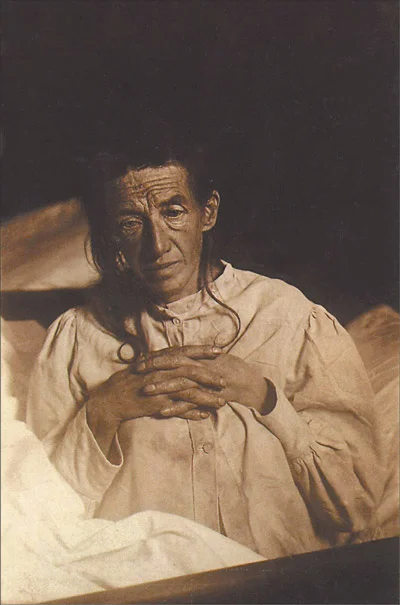
Alois Alzheimer's patient Auguste Deter in 1902. Hers was the first described case of what became known as Alzheimer's disease.
Imagine your doctor telling you have Alzheimer’s disease or some other type of dementia. Then, imagine being told, “I’m sorry, there’s nothing we can do. You might want to start getting your affairs in order.”
Time and again, people newly diagnosed with these conditions describe feeling subsequently overcome by hopelessness.
In their new book, Better Living With Dementia, Laura Gitlin and Nancy Hodgson — two of the nation’s leading experts on care for people with cognitive impairment — argue forcefully that it’s time for this “cycle of despair” to be broken.
“There is no cure for Alzheimer’s but there are many things that can be done to make life better for people with dementia and their caregivers,” said Gitlin, dean of the College of Nursing and Health Professions at Drexel University and chair of the Department of Health and Human Services advisory council on Alzheimer’s Research, Care and Human Services.
At a minimum, Gitlin and Hodgson suggest pointing people newly diagnosed with dementia to the Alzheimer’s Association, the Lewy Body Dementia Association, the Association for Frontotemporal Degeneration and the government’s website, alzheimers.gov — all valuable sources of information and potential assistance.
Also, individuals and families should obtain referrals to elder law attorneys, financial planners, adult day centers, respite services and caregiver support services, among other resources. But none of this happens routinely. Instead, “people are not given access to the resources they need to plan for the future,” said Hodgson, the Anthony Buividas endowed term chair in gerontology at the University of Pennsylvania. “They’re left on their own to find out even basic information.”
Most people with Alzheimer’s and other types of dementia live at home — an estimated 70 percent. But few professionals inquire about patients’ living conditions, even though these environments play a major role in shaping people’s safety and well-being. (The remainder live in nursing homes or assisted living residences.)
More often than not, professionals don’t help families anticipate what to expect as dementia progresses. Left to their own devices, individuals with dementia and their caregivers “tend to move inwards and away from their communities, which fosters isolation, which worsens their sense of despair,” Hodgson said.
Even small steps could help improve quality of life. In their book and subsequent phone conversations, Gitlin and Hodgson highlighted several strategies:
Attend to the home. As people with dementia become more impaired, attention to their home environment needs to become a priority.
In one study cited in Gitlin and Hodgson’s book, safety issues — cleaning agents under the sink, knives and other sharp objects, guns and ovens that can be turned on and left running, for instance — were discovered in 90 percent of homes where people with dementia lived. Another study found an average of eight hazards in these residences.
What can be done: Hire an occupational therapist, ideally with expertise in dementia, to do a home assessment and recommend modifications.
Common suggestions: Reduce clutter, which can contribute to disorientation. Install handrails along staircases and grab bars and shower seats in bathrooms to reduce the risk of falls. Put up visual cues that identify where common objects are stored — underwear and socks, for instance, or coffee mugs. Make sure lighting is adequate. Remove knobs from stoves and remove other potentially dangerous electronic devices.
“What you want to know is can a person with dementia find their way easily in the home? Are there sufficient cues? Is the environment too stimulating — is there too much noise from a television that’s left on during the day, for example — or not stimulating enough?” Gitlin said.
Create a routine. People with dementia need predictability and well-structured routines that minimize uncertainty and help them get through the day.
“A routine helps people with dementia know what to expect,” Hodgson said. “That lowers their anxiety and stress and makes it easier for them to negotiate their environments. If change is introduced regularly, they’re just not going to do as well.”
What can be done: Time activities through the day to match an individual’s physical and psychological rhythms.
Common suggestions: Most people are sharper, cognitively, in the morning, so that’s a good time to look through photo albums, do puzzles, reminisce about the past, play simple word games or go off to adult day care, Hodgson said.
After lunch, people may need to rest, but they shouldn’t nap too long. “You want to have some physical activity in the afternoon, as more and more research is showing the importance of exercise for people with dementia,” Hodgson noted.
Around sunset, it’s time for relaxation and helping people settle down. Playing music or lighting a scented candle can set the mood. Good sleep hygiene — no caffeine at the end of the day, darkness, quiet and comfortable temperatures in the bedroom — is recommended at night, as sleep problems are common in people with dementia.
An occupational therapist, who can evaluate the skills of people with dementia, can suggest appropriate activities. “You’ll need to learn how to understand if someone can initiate an activity on their own or follow a sequence needed for the activity,” Gitlin said. “If not, and this is common later on, you’ll have to learn how to set up the activity and cue the person.”
Know what to expect. Individuals with dementia and their caregivers will find their needs changing as their illness progresses.
What can be done: During every significant transition, reassess needs and how you’re going to get them met — with the help of an experienced social worker or care manager, if possible. “Who are the people who can help you? What resources are available? What alterations need to be made in the home and care arrangements? You’ll need a new plan of action,” Hodgson said.
At first, the most significant need may be obtaining a reliable diagnosis and learning more about the type of dementia your physician has identified. According to a new study by researchers at Johns Hopkins University, nearly 60 percent of people with dementia have not been diagnosed or are not aware of their diagnosis.
Gitlin and Hodgson recommend that people with dementia be involved in learning about treatment options and planning for their care, to the extent possible. “Talking over people or ignoring them or telling them what should happen, without soliciting their participation, is attack on personhood,” Gitlin said.
Depression and anxiety may need to be addressed, as people struggle with the reality of a diagnosis, withdraw from work or social activities and worry about the future. Finding ways to keep people engaged with meaningful activities starts to become a challenge.
When individuals progress to moderate dementia, they may need more supervision and assistance with dressing, bathing, grooming and taking medications. This is when families often hire caregivers, if they can afford it. Communication may become compromised and problematic behaviors such as wandering, agitation or aggression may emerge.
Often, someone with dementia is unable to express her needs and resorts to difficult behaviors. A person may be bored, afraid, in pain, constipated, overwhelmed or distressed, for example. To cope, caregivers are urged to try to understand the triggers for troublesome behaviors and take steps to address them.
Interactive Web-based systems that offer expert assistance to caregivers may become available going forward. Gitlin and colleagues at the University of Michigan and Johns Hopkins University have developed a comprehensive program, WeCareAdvisor, that is being tested. Another website featuring the DICE Approach is expected to debut in three months and include interactive training videos.
In the final stage, severe dementia, people need sensory stimulation — a foot massage, music they enjoy, a fragrant bouquet of flowers. Addressing distress, discomfort and pain are key care challenges. Even if the person with dementia can’t acknowledge it, the presence of family and friends remains important. Throughout every stage of this illness, “it’s important to let people with dementia know that they belong and surround them with a feeling of warmth and affection,” Hodgson said.
Judith Graham: @judith_graham
But none the worse for it

"Black and Blue, '' by isamu Noguchi, in the show "Isamu Noguchi and the Borders of Sculpture,'' at the Portland Museum of Art, Oct. 5-Jan. 6.
The museum says the show:
"{I}nvestigates Noguchi’s expansive artistic practice by exploring his efforts to enlarge and challenge conventional notions of sculptural boundaries. Born in 1904, the Japanese-American modernist experimented endlessly with the intersection of objects, people, and space over the course of his 60-year career. Melding ideas and approaches to art from across the globe, Noguchi created traditional sculpture, landscape architecture, play structures, monuments, stage sets, interior designs, furniture, and more. This exhibition brings aspects of his varied production together, complicating notions of form and function and using the juxtaposition of materials, shapes, and techniques to encourage audiences to reimagine their sense of what sculpture can be.''
Llewellyn King: Trying to slow carbon emissions, from the right

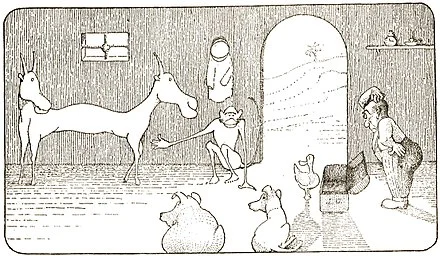
In Hugh Lofting’s children’s stories about “Doctor Doolittle” there appears an imaginary creature resembling a llama, but with a head at either end of the body, so that it always faces in two directions at once. Called the pushmi-pullyu, it’s become a metaphor for contradiction.
U.S. energy-environmental policy, I submit, is characterized by this kind of contradiction. And make no mistake, energy policy is profoundly affected by environmental policy. Mostly, it’s the bit left over after the environmental constituencies have been satisfied.
The country’s energy-environmental policies are subject to a plethora of contradicting stimuli and restrictions that, while sometimes achieving their goal, cost the economy 1 percent a year, according to an analysis by EY, the global accounting firm. This on top of bad decisions — based on what can be gotten through the regulatory thicket not on what is needed, or what will benefit the environment — and endless delay.
Now a group of Republican stalwarts, who believe that climate change is happening and is caused by human activity, wants to do something about this pushmi-pullyu situation in energy-environmental policy. Their remedy: Substitute all the contradictions, preferments, subsidies, tax anomalies and self-defeating rules with a simple, revenue-neutral carbon tax.
These climate change-minded conservatives have created a Washington-based organization, the Alliance for Market Solutions. Its executive director is Alex Flint, a former staff director of the Senate Committee on Energy and Natural Resources, and a former senior vice president of governmental affairs at the Nuclear Energy Institute.
The backers of the alliance — rock-ribbed Republican business executives, academics and think-tank fellows — are committed to turning the GOP toward taking a positive stance on climate change. They believe that science has spoken, and the environment is the great existential threat facing humanity.
Among those who are throwing their experiential weight and financial resources behind the alliance are Jeffrey Williams, founder and chairman of the eponymous investment banking company; William Strong, chairman and managing director of the private equity firm Longford Capital Management; Marvin Odum, former chairman of Shell Oil; John Rowe, former chairman of Exelon Corp., and Stephen Wolf, former chairman and CEO of United and three other airlines.
These titans are joined by academics and public intellectuals including John Graham, dean of the Indiana University School of Public and Environmental Affairs, and administrator of the Office of Information and Regulatory Affairs in the U.S. Office of Management and Budget during the George W. Bush administration, and Christopher DeMuth, a distinguished fellow at the Hudson Institute and a former president of the American Enterprise Institute.
The alliance and its backers are neither seeking to argue with the Trump administration, which has denied climate change, nor to take up arms with the forces that categorically reject any new tax. They say they’ll only support a carbon tax if it’s a genuine tax reform as well as a regulatory reform. They want to work quietly, and in small groups, inside the GOP body politic.
The difficulties of getting Republican lawmakers to consider a carbon tax were illustrated when Rep. Carlos Curbelo of Florida introduced a such a bill on July 23. It got immediate pushback from Grover Norquist of Americans for Tax Reform, and the House passed an anti-carbon tax resolution on July 25.
But Flint and members of the alliance are undaunted: “As long as we have to address carbon pollution and doing so with a carbon tax is much less burdensome than doing so with regulations, and we have to make our tax code more efficient, a carbon tax is going to be part of the conversation,” Flint said at his offices near the Capitol.
The battle to contain carbon emissions is joined — from the right.
On Twitter: @llewellynking2
Llewellyn King (llewellynking1@gmail.com) is executive producer and host of White House Chronicle, on PBS.
'Among the frantic menhaden'

Atlantic menhaden.

"Trolling for Bluefish,'' lithograph by Currier & Ives, 1866.
As if the banks were lined by spiders
Tossing long, shimmering filaments
The river crawls along like prey.
I’ve come, parked with rest,
All our radios on to the local station
For news of ourselves, in between the music
Hard people are soft on. Cut-bait, treble-hook plugs,
Wobbling spoons, plop among the frantic menhaden.
-- From "Bluefish Run, Machias, Maine,'' by Paul Nelson
Let's have less parking, more housing downtown
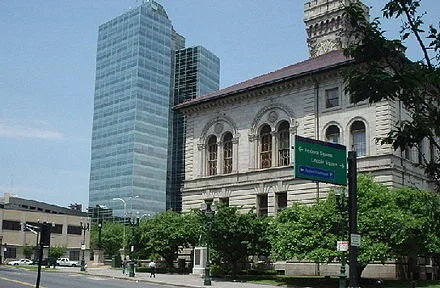
Downtown Worcester, with City Hall to right.

Downtown Providence, with the Arcade (1828) at the left.
From Robert Whitcomb's "Digital Diary,'' in GoLocal24.com
Instead of setting aside more parking places in old downtowns like Providence’s and Worcester's, cities would do better to reserve more space for housing there, boost public transportation 'sand encourage walking and bike-riding so that fewer people need cars (or require Uber and Lyft, which are jamming too many center-city streets). Setting aside so many spaces for parking in American cities (space taken from potential new housing, etc.) is bad for the cities’ economies and environment.
The scarcity of new housing, caused in part by antiquated zoning and in part by expensive “prevailing-wage’’ and other laws that can make it very difficult to build housing, obviously raises housing costs.
Donald Shoup, who’s an internationally known expert on the economics and sociology of urban parking, suggests that employers give workers the choice of taking the cash value of employer-provided parking rather than parking spaces themselves to encourage them to use public transportation or bikes.
To read an interview with Mr. Shoup, please hit this link
Medieval beauty in 'Suck City'

Boston's famed Trinity Church, on Copley Square.
“Trinity Park lies directly across from the {Boston Public} library, Trinity Church rising like a medieval thought amidst the glass and steel towers'' {around Copley Square in Boston's Back Bay}.''
-- From Another Bullshit Night in Suck City, by Nick Flynn
Trinity Church and its parish house were designed by Henry Hobson Richardson, and built from 1872 to 1877, when the complex was consecrated. Trinity Church established Richardson's reputation. It is the archetype of the Richardsonian Romanesque style, with its clay roof, polychromy, rough stone, heavy arches and a massive tower. This style was soon adopted for many public buildings, and some churches, across the United States.
The church is considered one of the greatest buildings in America.
The church was structurally damaged in the ‘70s by construction of the 60-story skyscraper at 200 Clarendon St., first called the John Hancock Tower, and still colloquially known as The Hancock. Among other problems with the tower were that a few panes of glass fell from it until engineering flaws were fixed. The flaws added the thrill of possible decapitation of visitors to Copley Square – one of the grandest public spaces in the Western Hemisphere.
The structural damage to the church was fully fixed, with the cost borne by the developers.
Just keep caffeinated

Three deckers in Boston's Jamaica Plain neighborhood.
“I guess no true Bostonian would trust a place that was sunny and pleasant all the time. But a gritty, perpetually cold and gloomy neighborhood? Throw in a couple of Dunkin’ Donuts locations, and I’m right at home.”
― Rick Riordan, in The Sword of Summer
The first college book?
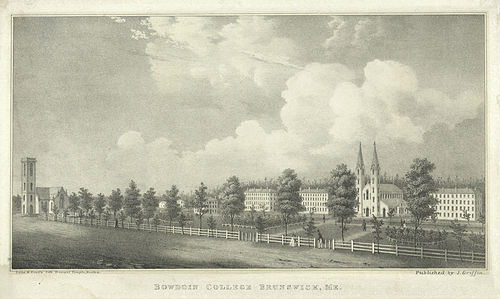
Bowdoin College about 1845.
"In an ancient though not very populous settlement, in a retired corner of one of the New England states, arise the walls of a seminary of learning, which, for the convenience of a name, shall be entitled 'Harley College'.''
--From the novel Fanshawe: A Tale, by Nathaniel Hawthorne. It is said to be the first novel about college life. Harley is based on Bowdoin College, in Brunswick, Maine, which Hawthorne attended in 1821-25.
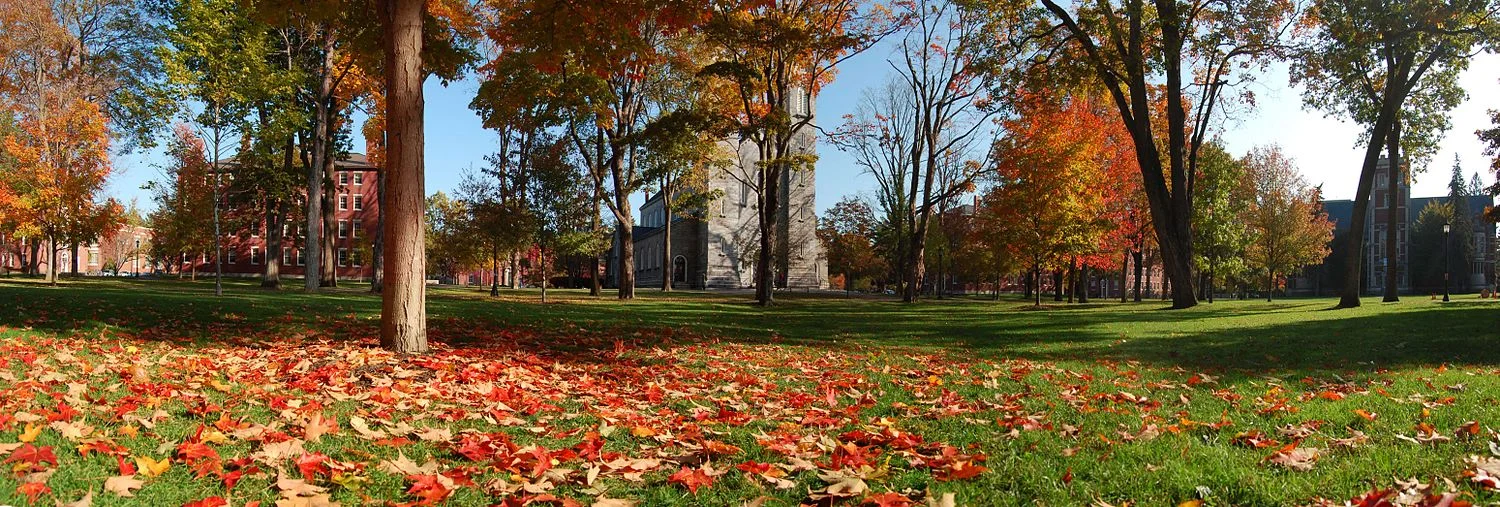
The Main Quad at Bowdoin.
We've got your back

"Then III" (mezzotint print), by Cleo Wilkinson, in the "Footprint International Exhibition 2018,'' at the Center for Contemporary Printmaking, Norwalk, Conn.,, through Aug. 26. The show showcases the current trends in printmaking within one square foot configuration.

A view of a couple of the more than two dozen islands off Norwalk, which is a mostly affluent New York City suburb on Long Island Sound. The quaint village of Rowayton may be the most interesting section. It's very pretty and has long attracted as residents many writers and painters. But it's now overdeveloped along the shore. That piled up the damage in Hurricane Sandy, in 2012, and the construction of waterfront McMansions has not ceased since then.
Don Pesci: In Connecticut, touching third rails
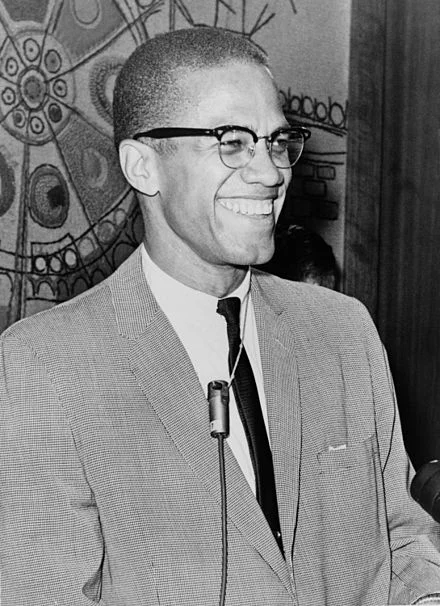
Malcolm X -- a firm believer in self-reliance.
Some people, not generally Friends of Tim Herbst (FOH), think that the Republican contender for Connecticut governor is aggressive. He is, as has been noticed during the Republican primaries, somewhat less aggressive in his advertising than David Stemerman, but then Herbst commands a more modest campaign war chest.
Herbst disputes the slur; he says he is competitive. However, the former first selectman of Trumbull does have a habit of fondling third rails that other Republicans running for governor fear touching.
Some of those rails – a hearty defense of the Second Amendment to the U.S. Constitution, every bit as inviolable as the First Amendment; peace and security in Connecticut; the socially disruptive effects of certain justice reforms under Gov. Dannel Malloy; the abolition of Connecticut's death penalty on social rather than legal grounds by Connecticut’s constitutionally confused, left-leaning Supreme Court; serious crime ripening in Connecticut cities; a plenitude of illegal guns in a state that boasts some of the most restrictive gun laws in the country; the baneful effects of fatherlessness among young urban African-American boys; and the constant chipping away of traditional morality by pretentious moral “reformists” – have gotten Herbst in Dutch with progressive social warriors. T
To be sure, Herbst not only stands squarely in a traditional Christian moral universe, his plans to lift Connecticut from its economic doldrums represent the larger part of his campaign message. Still, there are those rails pulsing with electricity, and also a sense on the part of many Democrats that Herbst is treading on sacred ground reserved to Democrats, a part of their progressive moral preserve.
The flight from social issues by Republicans has surrendered half the political battlefield to Democrats. That is how Democrats win elections. And now the left has to deal with this interloper. It’s best to make quick work of him, after which Democrats can set about winning elections by couching all issues in glossy moral terms.
Not so long ago, U.S. Sen. Dick Blumenthal, a progressive attached by a permanent umbilical cord to Planned Parenthood, advised everyone that any regulation of the abortion provider would reek of immorality. Herbst, not unreasonably or immorally, thinks that parents of children should be advised when their daughters procure abortions.
A ridged division between social and financial issues is not only false; it is silly. There is no Berlin Wall separating such issues. Welfare dependency among what English aristocrats used to call “the lower orders” is both a social and an economic issue. When welfare payments are unaccompanied by work requirements, you create a permanent dependent underclass that is certain to be preyed upon by rootless and fatherless males.
The notion that independence or self-reliance is morally superior to a cringing dependence on the mercy of strangers was the center pillar of the social philosophies of both Malcolm X, whom some of his critics during during his own day regarded as aggressive, and Martin Luther King Jr.
They weren't far removed from crusading journalist Ida B. Wells, who recommended arming black men who wanted to put the fear of the Lord in the KKK, King kept a pistol close by; so did Malcolm X, bushwhacked by the hoods that surrounded Elijah Mohammed after Malcolm X publicly accused the religious leader of having illicit sex with young girls. And it was President Bill Clinton, no hard-hearted conservative, who approvingly signed into law the “Personal Responsibility and Work Opportunity Reconciliation Act” of 1996 (PRWORA), having promised during his 1992 campaign to "end welfare as we have come to know it.”
That is the kind of third rail Herbst likes to fondle, even as his own Republican Party has been for decades in full retreat from welfare reform, silent on the matter of the Second Amendment, stonily silent as generation after generation in the state’s inner cities drift towards social and moral anarchism. Republican incumbents insincerely believe that ceding the moral high ground to moral reformists like Planned Parenthood will in the end assure them enough votes to remain a second rate minority party; better a live mouse in office than an out of office lion prowling on the political perimeter.
In the meantime, cowardly Republicans continue to win economic arguments and lose elections to gifted Democrat demagogues proficient in the art of fooling most of the people most of the time. A thoughtful media would blow many of them out of the water with raucous, cleansing laughter. For 50 years and more, hegemonic Democrat political organizations have been holding the lower orders in cities, many of them bankrupt, hostage to feel good programs, gilded cages that shrink the soul and open the heart to endless despair and misery. Herbst and a few fearless Republicans know this, and they are roaring – ENOUGH!
Don Pesci is a Vernon, Conn.-based writer. His email is donpesci@att.net
Still on guard

"Patrolling Fort Warren, Georges Island, Boston Harbor" (painting), by Karie O'Donnell, at the Art Complex Museum, Duxbury, Mass., through Aug. 12.
Fort Warren is a pentagonal bastion fort, made with granite, and built from 1833–1861. It was an important part of the defenses of Boston Harbor from 1861 through World War II, and during the Civil War was a prison for Confederate officers and government officials. It was decommissioned in 1947, and is now a tourist site. It was designated a National Historic Landmark in 1970 as a masterpiece of pre-Civil War coastal engineering, and for its role in the Civil War.
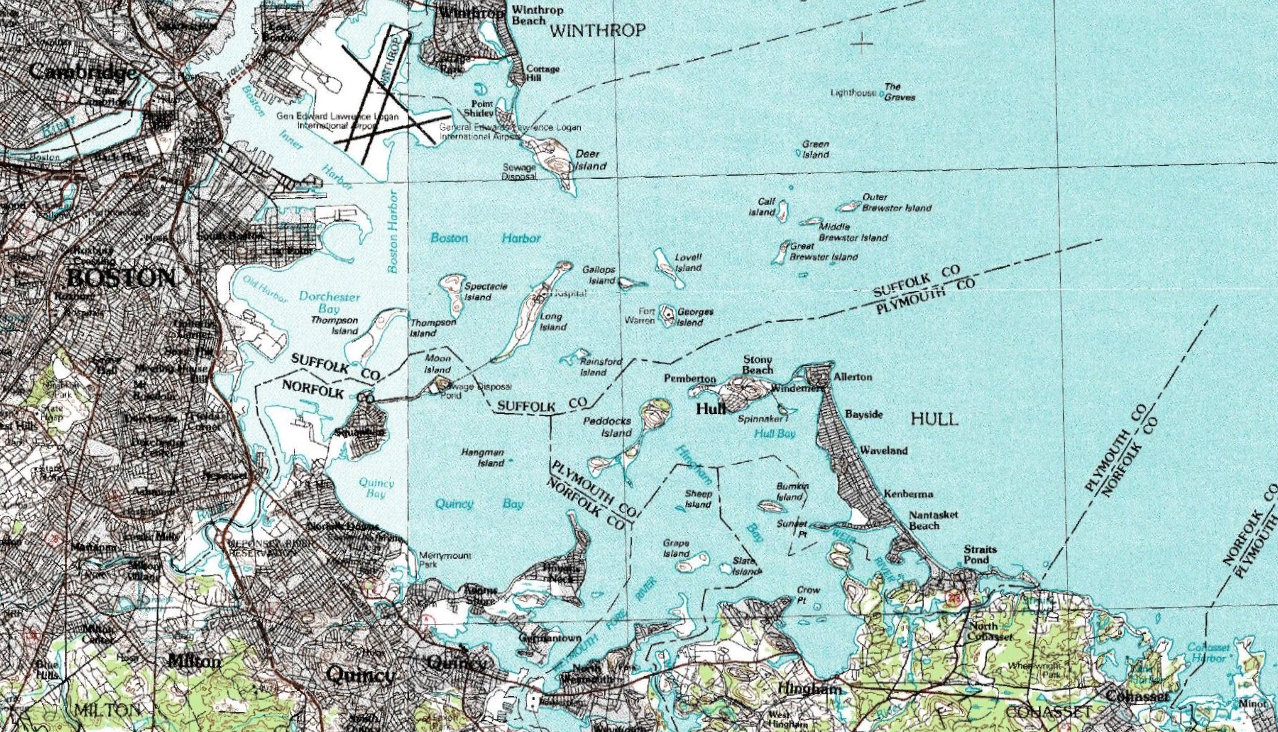
Georges Island is in the middle of the map.

Georges Island.
Using Ukrainian moths to control invasive vines

Swallow-wort, a highly invasive vine from Europe that reduces Monarch butterfly populations.

The Hypena opulenta moth. It eats swallow-wort.
Via ecoRI News (ecori.org)
KINGSTON, R.I.
After more than 10 years of research, scientists at the University of Rhode Island’s Biocontrol Laboratory have released a species of moth collected from Ukraine to help control invasive black and pale swallow-worts.
Swallow-worts are invasive vines native to Europe that were introduced into North America in the 19th Century, and quickly spread along the East Coast and into Canada. Not only do they outcompete native species and alter soil chemistry, but they harm Monarch butterfly populations. Because swallow-wort is so closely related to milkweed, Monarch butterflies lay their eggs on swallow-wort leaves, but when the eggs hatch the larvae are unable to survive on the plant.
“Swallow-wort was one of those weeds becoming increasingly problematic,” said Aaron Weed, of Tunbridge, Vt., a former Ph.D. student at URI who spearheaded the project. Back in 2005 when Weed started his research as a URI graduate student, there was increasing interest in controlling swallow-worts. Since then, he’s seen the vine spread aggressively. It thrives in several different environments, including pastures, forests, and urban spaces.
“Integrated management of weeds is a very challenging endeavor,” Weed said. “Biocontrol is potentially efficacious for swallow-wort because conventional methods just weren’t working or were incompatible in sensitive areas.”
Weed traveled to Europe to try and find natural enemies of swallow-worts and brought back several insect species to test at URI’s Biocontrol Lab. Among them was the Hypena opulenta, a small moth collected from southeastern Ukraine, that the lab found feeds exclusively on swallow-wort species. Weed worked with Lisa Tewksbury, URI’s Biocontrol Lab manager, and Richard Casagrande, professor emeritus of entomology at URI, to conduct years of research on the biology of Hypena opulenta and its impact on swallow-worts.
Hypena opulenta was a suitable candidate because it uses swallow-wort exclusively as its host plant, and reproduces several times a year. Its larvae have the potential to cause significant harm to the plants, according to Tewksbury.
URI received the permit to release the moths in 2017, and field tests in controlled cages were conducted in Charlestown, R.I., and in Massachusetts last year. Tewksbury has been monitoring the releases, and if they’re successful, she said the lab plans to work with other local agencies to share resources and release the moths in other areas.
Tewksbury’s lab found the first moth that emerged in June, but hasn’t seen any others yet emerge. Tewksbury hypothesized that Rhode Island’s unusually cool temperatures throughout June may have delayed the moths’ emergence. She also noted that this is the first time that we’re seeing the emergence of this species in New England.
“The goal of biological control is to reacquaint new pests with their historical natural enemies,” Tewksbury said. “This restores the evolutionary relationship of an insect with its host plant, which we hope will provide long-term management of the invasive plant species.”
Continued research is underway to assess how well this insect will control populations across New England.
“Since insects are impacted by the health of their plants, the local climate, and the health of plants is affected by site conditions, we still need to determine under which site conditions biocontrol impact is likely to lead to weed suppression,” Weed said.
1 Comment
It's alive!

“Here something stubborn comes,
Dislodging the earth crumbs
And making crusty rubble.
It comes up bending double,
And looks like a green staple.
It could be seedling maple,
Or artichoke, or bean.
That remains to be seen.’’
-- From "Seed Leaves,'' by Richard Wilbur (1921-2017), a two-time winner of the Pulitzer Prize for his poetry. He spent most his career teaching at New England colleges. He died in Belmont, Mass.
Kathleen A. D'Alessio/Dorothy A. Osterholt: Teaching self-advocacy to students with learning disabilities

From the New England Board of Higher Education (nebhe.org)
PUTNEY, VT.
Over the past year, an increasing number of students have come forward to speak out against school violence. And there has been increased attention placed on helping students seeking support if an incident occurs and exercising their right to speak out against those who may perpetuate such behaviors. With high-profile cases of sexual assault, such as Brock Turner from Stanford University in 2015 and Brandon Vandenburg of Vanderbilt University in 2016, students are awakening to the existing inequities. The student response to these cases was swift and loud. Advocating for changes in attitudes and policies, the students invigorated the public to take notice and colleges and universities to institute changes.
The skill of self-advocacy is not only useful for supporting changes that students want to see in their institutions and beyond: It may be the most important foundational skill behind success in college. In general, students who thrive in college do so as they mature and find their place on campus. It can seem like a natural process for an emerging adult as they grow intellectually. But this is not the experience of all college students. By looking at the experiences of students who are struggling in college, we can have a better understanding of the importance of self-advocacy and its impact on the college experience.
The struggling student
Landmark College is designed for students who learn differently, including students with learning disabilities (such as dyslexia), attention deficit hyperactivity disorder, and autism spectrum disorder. These students are no strangers to the term “self-advocacy.” From the time they are in high school until they reach college, they have heard the term in various settings. Defining self-advocacy includes getting what one needs in an educational setting, as well as, understanding one’s diagnosis, knowing the legislation surrounding individuals with learning disabilities, requesting appropriate accommodations, providing documentation and knowing how to take effective action if difficulties arise. In other words, it means being able to work within a system, knowing how and when it is necessary to challenge that system, while demonstrating independence. Students with learning disabilities still get derailed by obstacles as a manifestation of their own learning difference, or by commonly perceived opinions of others regarding disabilities.
We assert that students with learning differences need direct instruction individualized to their learning to educate them regarding their strengths, challenges and effective learning strategies. Even when practiced in a postsecondary environment of inclusivity, accessibility, approachability and collaboration, students who learn differently struggle with self-advocacy. Landmark College has designed support that addresses the unique needs of these students through the explicit teaching the skill of self-advocacy and the various settings in which self-advocacy is taught. What we have learned may help other colleges that are grappling with the inherent challenges of their diverse student population.
Success attributes linked to self-advocacy
As any professional would attest, the goal of self-advocacy for students who learn differently is to help them become successful adults and to transition to adulthood with the skills necessary to navigate their chosen career. A firm understanding of success attributes is a starting point for working with students.
In the 1990s, Paul J. Gerber, Henry B. Reiff and Rick Ginsberg conducted interviews with successful high-achieving adults with learning disabilities. Seven attributes for success were gleaned from this study. These seven attributes are interactive in nature; and they work best when they are supported by one another.
1) Desire: having a supportive system to help with motivation.
2) Goal orientation: being able to manage one’s time, to stay organized and to establish study routines.
3) Reframing: changing one’s perception of oneself and emphasizing positive traits.
4) Persistence: coping with failure and starting over in order to succeed.
5) Goodness of fit: maximizing strengths and minimizing weaknesses, and aligning these characteristics with choosing classes, a job or a career.
6) Learned creativity: finding creative ways to overcome challenges.
7) Positive social network: having a support system of family, friends, significant others or coworkers. This foundational work can help inform how colleges provide support for this group of students.
Landmark’s approach
Well before self-advocacy became a staple of freshmen orientation programs for students with learning disabilities who are entering into college, Charles Drake, founder of Landmark College in Putney, Vt., framed the concept in 1985 using the simple verbiage: “Don’t do for the student what the student can do for him/herself.”
At the core of Landmark’s philosophy is the belief that each student will be able to become their own strong self-advocate given the proper tools. Learning how to self-advocate permeates every aspect of the student’s program. It begins with explicit instruction in a student’s first year and is reinforced throughout the student’s time at the college.
Beginning with self-understanding, students are given ample time and frequent opportunities to practice self-reflection. The college’s student-centered approach to teaching enables students to access professors and advisors. Self-understanding begins with an individual being able to know what their diagnosis is, but more importantly what the implications are for education and career choices. This includes an understanding of one’s strengths, the knowledge of accommodations that may be needed, and the ability to self-appraise and adjust one’s behavior when necessary.
The college has defined self-advocacy skills as the student’s ability to not only understand general definitions of learning disabilities, but to understand the legislation in order to know one’s rights to request accommodations or services. In addition, self-advocacy includes the ability to provide appropriate documentation for the specific requested accommodations, and to be able to deliver and present this information with strong interpersonal communication skills.
Today’s student
This is a tall order for some students given their challenges, lack of experience and, in some cases, the effect of well-meaning parents doing for the student. Jean M. Twenge advances this position in her 2017 book, iGen: Why Today's Super-Connected Kids Are Growing Up Less Rebellious, More Tolerant, Less Happy—and Completely Unprepared for Adulthood—and What That Means for the Rest of Us. She says that the students of the igeneration are comfortable having a parent speak for them, rather than taking on this responsibility.
While taking the position of advocate may not be always necessary for all students, those parents of children with disabilities are often forced into this position in order to ensure their child receives an appropriate education. Advocating for their student can linger through high school and overlooks opportunities to foster the ability in their child before they enter college. Likewise, this makes the job of teaching and fostering self-advocacy sometimes an uphill battle for faculty as parents are reluctant to step aside. Through explicitly designed support embedded within first year seminar courses and advising, students gradually learn about themselves at a deeper educational and emotional level and become more comfortable in getting support. Other colleges may offer similar support through their institution’s existing programs for incoming students.
Self-advocacy skills are introduced within the curriculum of the advising program as one of 10 advising student-learning outcomes for first-year students. The value of this specific learning outcome to students is to recognize the benefits of self-advocacy in a college setting. Advisors facilitate knowledge acquisition by: working with the student to define self-advocacy and to differentiate between entitlement and self-advocacy; assessing the student’s knowledge of basic email systems, grading systems and intranet tools; informing students of college policies, such as course drop/add, withdrawal periods; discussing and sometimes role-playing how to communicate with faculty regarding coursework concerns; fostering student development of effective self-advocacy with parents; and helping students understand the benefits of accessing college resources.
Addressing the whole student
The work of the advising program is underscored in the student’s first semester particularly in the first year course entitled: Perspectives in Learning. It is within the curriculum of this course that self-advocacy is embedded. The curriculum is holistically presented through Four Domains of Learning: self-regulation, motivation, social/emotional influences and academic skills.
The four domains offer a simple framework to understand the complexity involved in learning. The fact that the learner must have adequate control over each area in order to perceive, process and express their understanding of new information more effectively is also underscored. The goal is to help students develop a more robust understanding of the interconnectedness of influences that affect learning. The World of Learners Wheel, as shown below, leads students toward self-discovery of their strengths as well as their challenges with specific strategies that encourage movement from areas of challenge toward positive success attributes in order to improve academic success.
The World of Learners Wheel
Landmark students will first understand the Four Domains as a whole. Having a common language within the classroom when talking about strengths and challenges proves to be useful as they build their self-advocacy skills.
Next, they learn how each domain is interdependent. Having deficits in one area can have a negative impact on another, and building skills in one domain can also have a positive impact on other domains.
Within the first year seminar, it is important to introduce the success attributes (Outer Circle) first to allow students to identify areas of strength that may not have been apparent to them. Then they can see how the positive attributes will appear if they become barriers (Inner Circle). In identifying their challenges, students are asked to focus primarily on those areas that pose a significant negative impact and impede academic success. Lastly, they will come to understand that there are individual strategies (Middle Circle) that will help them strengthen their areas of challenge.
Once students are familiar with the Four Domains framework, they will be asked to set relevant, sustainable and attainable personal goals that are reflected in the wheel. Deepening their understanding of how to develop new habits and break old habits will encourage greater success and a process for assessing their progress. Taking the time to self-reflect on their progress every few weeks is also important so they can make adjustments when necessary.
When students begin discovering and using their own strategies they learn about the distinction between strategies they implement themselves and accommodations provided for them by the teacher or institution. It is important for students to not only understand the distinction between strategies and accommodations, but they must also be able to express their needs to others in a clear and comprehensive way.
At the end of the semester a final advocacy portfolio is comprised of a compilation of documents that display their self-understanding gained through assessing and addressing their own learning processes. The portfolio includes a display of strengths and weaknesses identified, lifestyle habits that impact their academic performance, personal reflections and how their disabilities impact their academic progress. Students are also asked to compose a written statement disclosing their disability that may be use at their discretion for college or the work place. The Final Advocacy Fair at the end of the semester gives them an opportunity to present their portfolio orally to visitors.
The conceptual framework and direct instruction around self-advocacy are specifically presented in a holistic manner to reflect the link between the academic and the non-academic components of learning.
Challenges remain
Even within a small structured program with a student-to-faculty ratio of 6:1 and direct instruction in self-advocacy skills, some students will struggle to achieve the skill of self-advocacy. Reasons vary as do students, but a general hypothesis may be attributed to a developmental lag in students who learn differently. In addition, faculty and staff are observing some millennial and Igen students who are more underprepared for college than in previous generations and are more dependent on parents and others. We put forth the assertion that students with a learning disability need direct instruction in learning how to self-advocate. We outlined the holistic nature of this approach and the ways in which self-advocacy is integrated into the advising program and into the curriculum of the first year course. We discussed the communication between advisors and professors of first year students, who are the major stakeholders in this process of self-advocacy. The final product produced by the student in their first semester represents an entire semester’s worth of learning and self-discovery as it pertains to self-advocacy. Students then have the opportunity to practice self-advocacy, with room to make errors and to learn from those errors.
The population of students who learn differently attend all different kinds of colleges in all states, and while their voices might not be taking center stage with those, for example, addressing violence on campus, this current climate of speaking out can ignite greater support for a sometimes-overlooked group of students. It is through their self-advocacy efforts that they can create greater success for themselves and become the consistent whisper in the background for future students. Providing a supportive and instructive environment that fosters greater self-advocacy is an admirable first step.
Kathleen A. D’Alessio is an associate professor and academic adviser at Landmark College. Dorothy A. Osterholt is an associate professor of education at Landmark.
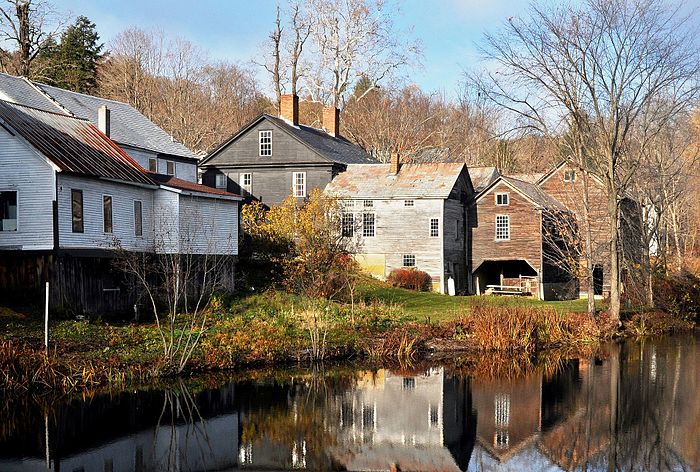
In downtown Putney. The town, in southern Vermont, is also well know for its "progressive'' prep school The Putney School and lots of well-heeled summer folks. In nearby Brattleboro is the Experiment in International Living, another well known educational institution. The area was a favorite for Hippies back in the '70s and late '60s./
When the ER is your primary-care doctor
From Robert Whitcomb's "Digital Diary,'' in GoLocal24.com
Memorial Hospital, in the old mill town of Pawtucket, R.I., may have been too uneconomic to remain open as a full community hospital but state officials and others could have done a better job anticipating that closing Memorial, with its disproportionately sick and low-income clientele, would overwhelm the emergency rooms of the Miriam Hospital and Rhode Island Hospital. One reason is that America has about the most fragmented (and expensive) health-care “system’’ in the Developed World, which leads all too many patients – especially low-income ones -- to use hospital emergency rooms as their main source of health care. That’s a notably inefficient and expensive way of getting care!
Presumably the proliferation of free-standing emergency departments and drugstore-chain clinics will eventually reduce the severe crowding in hospital emergency rooms in coming years. So would public-education campaigns to discourage people from using hospital ERs for such routine ailments as pink eye and bad colds

Textile show in textile town with a National Park and canals

"Evening Song'' (quilt), by Marianne Williamson, in the group show "Interplay: Fiber and Art Quilts 2018'', at the Whistler House Museum of Art, in Lowell, Mass., Aug. 11-Sept. 15. "Interplay," refers to the connection between fiber and art. The museum was the birthplace of the famous painter James McNeill Whistler (1834-1903); remember his painting nicknamed "Whistler's Mother''?
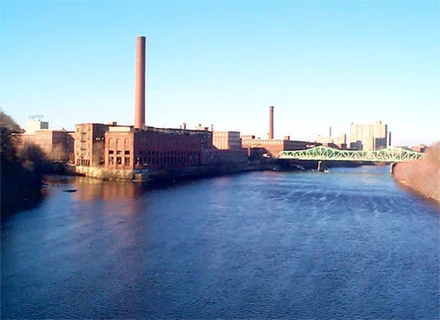
Lowell, at the confluence of the Merrimack and Concord rivers (which Thoreau wrote about so memorably), has a rich history in textiles. Founded in 1826 as a mill town using water power, it was named after Boston's Francis Cabot Lowell, a major figure in the Industrial Revolution who had prospered in the China Trade. Indeed, the city became one of the cradles of the American Industrial Revolution because of its many factories, most of which were textile mills. Also giving the city a certain romance is its canal network, on which you can travel by tourist boat.
In the late 20th Century some of Lowell's historic manufacturing sites became part of the Lowell National Historical Park. It's well worth a visit. During the Cambodian genocide by the Communist Khmer Rouge in the '70s, the city took in an influx of refugees from that country, leading to the development of a section called Cambodia Town.

The Pawtucket Canal, in Lowell's historic mills section.
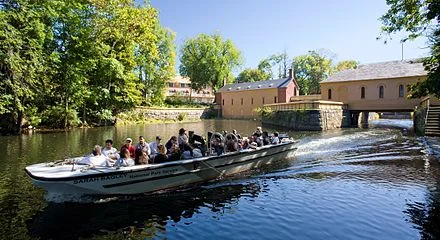
Tourists get a tour of the Lowell National Historic Park.
Chris Petersen: GOP wants to bring back 'pre-existing conditions' as a reason to deny health care
Via OtherWords.org
For my family, “pre-existing conditions” are more than a technicality. They’re a matter of life or death, of sickness or health.
My wife and I are Iowa family farmers. I have diabetes, and Kristi has a heart murmur. Without the Affordable Care Act (ACA) and its guarantees for people with pre-existing conditions, there’d be nothing standing between us and the insurance corporations.
We know firsthand what happens when insurance corporations can discriminate based on a pre-existing condition. Years ago, I had health coverage through an outside job and was diagnosed with a nickel-sized hernia that didn’t require immediate surgery.
When farming started looking up, I began to farm full-time and applied for my own insurance. My wife and I disclosed our health conditions and were approved. Each month we religiously paid the $700 premium.
After about a year, I decided to fix the hernia and was pre-approved for surgery. Then the bills started. After months of back-and-forth, my insurer denied the claim, citing a pre-existing condition. They dropped me.
Then my wife had pre-approved tests for her heart, and the insurer dropped her, too. They cited “discrepancies” between medical records and the insurance forms we’d filled out two years earlier.
The discrepancies? A one-inch difference in her height and the fact that she’d gained 12 pounds!
It took us 14 years to pay those medical bills with no help from the insurer. After years of us sending them monthly premium payments, they’d left us holding the bag.
Then came the ACA. Kristi and I finally got quality, affordable health care, like many other small-business owners. The law isn’t perfect, but it provided a measure of stability we needed to keep our business going strong.
Now the Trump administration and some Republicans in Congress are attacking the ACA again. They want to let insurance corporations discriminate against people with pre-existing conditions, like my wife and me.
This comes after Republicans in Congress voted to pass the new tax bill — a huge giveaway to giant corporations that did nothing for farmers like us.
This tax bill doesn’t just funnel billions in preferential tax treatment to mega-corporations. It also eliminates the ACA’s penalty for not having health insurance. Trump is using that as an excuse to ask a judge to throw out the ACA’s pre-existing condition protections, too. A new Trump-appointed Supreme Court justice like Brett Kavanaugh just might help him do it.
Meanwhile, Republicans in Congress are advancing a budget that cuts health care and raises prices for all of us enrolled in Medicare, Medicaid, and the ACA.
Let’s not go backwards.
Any politician who believes in thriving family farms and small businesses should protect people with pre-existing conditions and support universal health care.
Any politician who believes in us should reverse the Republican corporate tax giveaways and adopt fair taxes that fund public investments and help fuel small business development.
And any politician who supports us should reject the finger-pointing. No more blaming our hard times on immigrants, people of color, or on those who seem “different.” Our strength comes from working together — on health care and all the other things that matter in our lives.
Last year, the GOP Congress tried to repeal our health care. People of all walks of life stopped them. Believe me, like my friends and neighbors, this family farmer is persistent. We’re not done fighting for everyone to get the health care they need.
Chris Petersen is an independent family farmer near Clear Lake, Iowa. He’s a leader of the Main Street Alliance, a national small business network.
Looks rather cool to us

"Heat Wave" (watercolor on paper), by Brian Herrick, at the Patricia Ladd Carega Gallery, Center Sandwich, N.H.