
Vox clamantis in deserto







Basav Sen: 'Energy-efficiency' technology creates far more jobs than fossil fuel
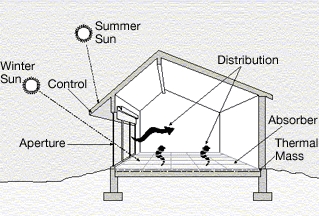
Elements of passive solar energy design.
Via OtherWords.org
We’ve all heard claims that such fossil fuels as coal, oil and gas are major job creators. President Trump says so all the time.
But it turns out that developing and installing the technology to reduce fossil-fuel use — known in the industry as “energy efficiency” — creates many more jobs than fossil fuels.
Energy efficiency jobs in the United States totaled 2.18 million in 2016, more than double the total of fossil fuel production and fossil-fuel based electricity generation combined.
They’re growing at a much faster rate, too. From 2015 to 2016, there was 53 percent employment growth in advanced and recycled building materials, and 59 percent employment growth in Energy Star appliances. Compare that to just 9 percent growth in fossil fuel-based electricity generation.
These energy-efficiency jobs are much cheaper to create. According to an academic study, every $1 million invested in energy efficiency creates 12 jobs, compared to just 4 or 5 for fossil fuel jobs.
These are good, well-paying jobs. For example, electricians have a median hourly pay of $26, and the corresponding numbers for heating, ventilation, and air-conditioning (HVAC) workers and carpenters are $22.64 and $21.71, respectively. (Compare that to the median hourly pay for all U.S. workers, $18.12.)
These jobs are more likely to be unionized, too. And they’re a great way to lift up people who’ve been left out of the fossil fuel economy.
So it’s no wonder that many states are working to grow their share of efficiency jobs, especially for traditionally excluded populations such as people of color and low-income people. I looked at a bunch of inspiring examples in a new report for the Institute for Policy Studies that will be out this week.
For example, Illinois has passed legislation requiring larger utilities to create renewable energy and energy efficiency job training programs, especially for people from economically disadvantaged communities — including youth of color, formerly incarcerated people, individuals who’ve been in the foster care system as children, and others.
Oregon is another success story. Forty-seven percent of new jobs created through Oregon’s statewide residential energy efficiency program — and 55 percent of the hours worked — went to women and people of color. Median hourly wages for these jobs were 7 percent higher than the median hourly wage of $17.24 for all Oregon workers, and 81 percent of workers had health benefits.
These successes didn’t happen by themselves — they were the product of setting goals and making serious efforts to meet them.
So energy efficiency creates more jobs than fossil fuels — and at a faster rate and a lower cost.
They’re good jobs, with good wages and above-average rates of unionization. And states have taken concrete measures to make these jobs accessible to everyone and raise standards for energy efficiency workers.
Why, then, does the federal government lag behind? And worse still, why does it pursue fantasies such as bringing back coal? Sadly, the answer is bribes, bribes, bribes.
Fossil-fuel interests pour money into congressional and presidential campaigns, and politicians return the favor by doing their bidding. The Trump administration’s push for coal is driven by two billionaire coal oligarchs, Robert Murray and Joseph Craft. Both have pumped money into Trump’s campaign and openly advocate deregulating fossil fuels and bailing out coal.
If the federal government really cared about “jobs, jobs, jobs,” they would follow the lead of Illinois and Oregon and make a big push to subsidize energy efficiency — instead of bailing out coal.
Basav Sen directs the Climate Policy Project at the Institute for Policy Studies.
PCFR to soon launch new season

To members and friends of the Providence Committee on Foreign Relations,
The PCFR returns for the 2018-2019 season, and we are excited to share our lineup of notable, expert presenters with you.
Thank you in particular to all members who shared feedback and speaker suggestions. Your input is valued as we aim to provide events that are edifying to our members.
We invite you to attend all these events, and encourage members to bring guests, especially as prospective new members.
Just a reminder, we are collecting 2018/19 member dues. Thank you to those who have already sent them in.
We have four membership categories:
Sustaining: Annual dues are $120. We much encourage your becoming a sustainingmember for the additional resources that it gives us to bring in good speakers and boost our related services.
Regular: Annual dues are $90.
Associate: For spouses of regular or sustaining members annual dues are $50. Thus, for example, the total dues for a sustaining member and his or her spouse would be $170. For a regular member and spouse, $140.
Student: Current full-time students may join for $50.
To pay your dues and dinner charges via credit card, please visit our website at thepcfr.org. Otherwise, please mail your checks, made out to “PCFR,’’ for dues to:
Hannah Hazelton
PO Box 146
Fiskeville, RI 02823
Dinners and dues can also be paid for at the welcome table on the night of a dinner by check, credit card or cash.
The cost of dues and dinners may be deductible for business reasons in some cases. Consult your tax adviser.
Please get your dues in for the 2018-19 season. The earlier we get them, the easier it is to plan for the new season. Thanks to everyone who has already sent them in.
Regards,
Hannah Hazelton
Chairperson
Providence Committee on Foreign Relations
pcfremail@gmail.com
Thursday, September 13
Paulo Sotero, Director, Wilson Center’s Brazil Institute
6:00, The Hope Club, 6 Benevolent Street, Providence
Paulo Sotero, the Director of the Wilson Center’s Brazil Institute, has covered the evolution of his native Brazil and U.S.-Brazilian relations for nearly forty years as a journalist and analyst. An award-winning reporter, he worked for publications across his country before serving as the longtime Washington correspondent for O Estado de S. Paulo, one of Brazil’s top dailies. A frequent guest commentator for the BBC, CNN, NPR and major newspapers in Latin America and beyond, Sotero has taught at Georgetown University and The George Washington University.
If you're paying at the door, please RSVP by replying to this email.
Wednesday, September 26
The Good Citizen and American Civilization
Fred Zilian
6:00, The Hope Club, 6 Benevolent Street, Providence
American Civilization is under stress and therefore also its exceptional leadership of the free world. Since the divisive 1960s, its basic building block—the good citizen—has been buffeted by at least seven factors: the legacy of the Sixties, the breakdown of the family and community, changes in our public education system, the rise of the Wild-West digital world, the degradation of cultural ethical standards, under-regulated capitalism, and a decline in leaders of character. This talk will explore the roles and responsibilities of the good citizen in historical perspective, those of the good citizen today, and the seven stresses on the good citizen today. It will then propose a partial solution: a universal national service program. Finally it will relate these challenges to the “Real Thucydides Trap,”—an alternate to Graham Allison’s—which threatens America’s leadership of the free world.
After graduating West Point in 1970, Fred Zilian completed a 21-year career as an infantry officer in the Army, a career that included four years teaching international relations at the U.S. Military Academy and four years teaching “Strategy & Policy” at the Naval War College. His second career was as an educator at Portsmouth Abbey School, 1992-2015, where he taught history, ethics, and German. Currently he is an adjunct professor at Salve Regina University, Newport, RI, where he teaches history and politics, and also a monthly columnist for the Newport Daily News.
Zilian holds a Ph.D. in international relations/strategic studies from the Paul H. Nitze School of Advanced International Studies, Johns Hopkins University.
Wednesday, October 3
Social Entrepreneurship with Dr. Teresa Chahine, Harvard
6:00, The Hope Club, 6 Benevolent Street, Providence
Dr. Teresa Chahine is the author of “Introduction to Social Entrepreneurship,” based on her course at Harvard. She is the Innovation Advisor at Alfanar Venture Philanthropy, which she helped launch in her home country of Lebanon. Alfanar provides tailored financing and technical support to social enterprises serving marginalized populations in the Arab world.
Dr. Chahine divides her time between Beirut and Boston, where she leads the social entrepreneurship program at the Center for Health and the Global Environment, Harvard T.H. Chan School of Public Health.
Wednesday, October 17
Two Paths to Brexit: Michael Goldfarb
6:00, The Hope Club, 6 Benevolent Street, Providence
On the eve of an EU summit where the bloc's chief Brexit negotiator, Michel Barnier, hopes to present a draft treaty for Britain's withdrawal from the EU former NPR correspondent, Michael Goldfarb, who covered the creation of the euro and the border free Europe, looks at the details of the deal: the rights of millions of British and European citizens now living in what have become "foreign" countries, how to keep the Irish border fully open, maintaining supply chains, and the time frame for transition.
It is also possible talks will have collapsed. In that case, Goldfarb will explain the likely impact on UK, Europe and global economy of a no-deal Brexit.
Michael Goldfarb is an author, journalist and broadcaster. He has written for The Guardian, The New York Times and The Washington Post but is best known for his work in public radio. Throughout the 1990’s, as NPR’s London Correspondent and then Bureau Chief, he covered conflicts and conflict resolution from Northern Ireland to Bosnia to Iraq for NPR.
Thursday, November 8
Geopolitics Underlying US Foreign Policy
Sarah C. M. Paine
6:00, The Hope Club, 6 Benevolent Street, Providence
Sarah C. Paine is a professor of strategy and policy at the U.S. Naval War College located in Newport, Rhode Island. She has written or co-edited several books on naval policy and related affairs, and subjects of particular interest to the United States Navy or Defense. Other works she has authored concern the political and military history of East Asia, particularly China, during the modern era. She is the author of the 2012 award-winning book, Wars for Asia 1911–1949.
Suggestions for speakers and topics are always much appreciated.
We’re all in this together.
We want your feedback.
Do you have ideas for PCFR? Thoughts? Opinions? Please share your feedback with us by sending an email to pcfremail@gmail.com
Hannah Hazelton
Chairman
Providence Committee on Foreign Relations
Young physicians embracing single payer
By SHEFALI LUTHRA
When the American Medical Association — one of the nation’s most powerful healthcare groups — met in Chicago this June, its medical student caucus seized an opportunity for change.
Though they had tried for years to advance a resolution calling on the organization to drop its decades-long opposition to single-payer health care, this was the first time it got a full hearing. The debate grew heated — older physicians warned their pay would decrease, calling younger advocates naïve to single-payer’s consequences. But this time, by the meeting’s end, the AMA’s older members had agreed to at least study the possibility of changing its stance.
“We believe healthcare is a human right, maybe more so than past generations,” said Dr. Brad Zehr, a 29-year-old pathology resident at Ohio State University, who was part of the debate. “There’s a generational shift happening, where we see universal health care as a requirement.”
The ins and outs of the AMA’s policymaking may sound like inside baseball. But this year’s youth uprising at the nexus of the medical establishment speaks to a cultural shift in the medical profession, and one with big political implications.
Amid Republican attacks on the Affordable Care Act, an increasing number of Democrats — ranging from candidates to established Congress members — are putting forth proposals that would vastly increase the government’s role in running the health system. These include single-payer, Medicare-for-all or an option for anyone to buy in to the Medicare program. At least 70 House Democrats have signed on to the new “Medicare-for-all” caucus.
Organized medicine, and previous generations of doctors, had for the most part staunchly opposed to any such plan. The AMA has thwarted public health-insurance proposals since the 1930s and long been considered one of the policy’s most powerful opponents.
But the battle lines are shifting as younger doctors flip their views, a change that will likely assume greater significance as the next generation of physicians takes on leadership roles. The AMA did not make anyone available for comment.
Many younger physicians are “accepting of single-payer,” said Dr. Christian Pean, 30, a third-year orthopedic-surgery resident at New York University.
In prior generations, “intelligent, motivated, quantitative” students pursued medicine, both for the income and because of the workplace independence — running practices with minimal government interference, said Dr. Steven Schroeder, 79, a longtime medical professor at the University of California-San Francisco.
In his 50 years of teaching, students’ attitudes have changed: “The ‘Oh, keep government out of my work’ feeling is not as strong as it was with maybe older cohorts,” said Schroeder. “Students come in saying, ‘We want to make a difference through social justice. That’s why we’re here.’”
Though “single-payer” healthcare was long dismissed as a left-wing pipe dream, polling suggests a slim majority of Americans now support the idea — though it is not clear people know what the term means.
A full single-payer system means everyone gets coverage from the same insurance plan, usually sponsored by the government. Medicare-for-all, a phrase that gained currency with the presidential campaign of Sen. Bernie Sanders (I-Vt.), means everyone gets Medicare, but, depending on the proposal, it may or may not allow private insurers to offer Medicare as well. (Sanders’ plan, which eliminates deductibles and expands benefits, would get rid of private insurers.)
Meanwhile, lots of countries achieve universal healthcare — everyone is covered somehow — but the method can vary. For example, France requires all citizens purchase coverage, which is sold through nonprofits. In Germany, most people get insurance from a government-run “public option,” while others purchase private plans. In England, health care is provided through the tax-funded National Health System.
American skeptics often use the phrase “socialized medicine” pejoratively to describe all of these models.
“Few really understand what you mean when you say single-payer,” said Dr. Frank Opelka, the medical director of quality and health policy for the American College of Surgeons, which opposes such a policy. “What they mean is, ‘I don’t think the current system is working.’”
But the willingness to explore previously unthinkable ideas is evident in young doctors’ ranks.
Recent surveys through LinkedIn, recruiting firm Merritt Hawkins and trade publication NEJM Catalyst indicate growing support. In the March NEJM survey, 61 percent of 607 respondents said single-payer would make it easier to deliver cost-effective, quality healthcare.
Delving further, that survey data shows support is stronger among younger physicians, said Dr. Namita Mohta, a hospitalist at Brigham and Women’s Hospital and clinical editor at NEJM Catalyst.
But it’s unclear whether these findings reflect young doctors’ feelings about the policy or whether they are tapping in to broader frustrations with the American health system.
Much like the general public, doctors often use terms like single-payer, Medicare-for-all and universal healthcare interchangeably.
“Our younger generation is less afraid to come out and say we want universal healthcare,” said Dr. Anna Yap, 26, an emergency medicine resident at UCLA, who served as a medical student delegate to the AMA until this past June. “But how? It’s different in what forms we see.”
Younger doctors also pointed to growing concern about how best to keep patients healthy. They cited research that broadly suggests having health insurance tracks with better health outcomes.
“Medical students, I would say, are very interested in public health and improving social determinants of health — one of them being access to health insurance,” said Dr. Jerome Jeevarajan, 26, a neurology resident at the University of Texas-Houston, referring to non-medical factors that improve health, such as food or housing.
Some of the shift in opinion has to do with the changing realities of medical practice. Doctors now are more likely to end up working for large health systems or hospitals, rather than starting individual practices. Combined with the increasing complexity of billing private insurance, many said, that means contracting with the government may feel like less of an intrusion.
The debate is, at this point, still theoretical. Republicans — who control all branches of the federal government — sharply oppose single-payer. Meanwhile, single-state efforts in California, Colorado and New York have fallen flat.
Also, doctors represent only one part of the sprawling healthcare industrial complex. Other health care interests — including private insurance, the drug industry and hospital trade groups — have been slower to warm to catchphrases like single-payer or universal health care, all of which would likely mean a drop in income.
But increasingly physicians seem to be switching sides in the debate, and young physicians want to be part of the discussion.
“There’s tremendous potential … to be at the table if single-payer becomes a significant part of the political discourse, and create a system that is more equitable,” Pean said.
Mysterious island

"Mohegan (Manana Nocturne III)'' (mixed media on canvas), by Tom Hall, at the Corey Daniels Gallery, Wells, Maine. Mohegan Island, off the Maine Coast, is famous as an artists colony.
Photography and the genius of Winslow Homer

"Winslow Homer at Marshfield {Mass.}, " ca. 1869 (albumen silver print), by an unknown photographer. Bowdoin College Museum of Art, Brunswick, Maine. This is in the show "Winslow Homer and the Camera: Photography and the Art of Painting,'' through Oct. 28. The museum building is famous, having be designed by Charles McKim, who also designed the Rhode Island State House and much of Columbia University.

Winslow Homer with 'The Gulf Stream' in his {Prouts Neck, Maine} studio," ca. 1900, (gelatin silver print), by an unidentified photographer.
The museum says:
"This exhibition explores the question of Homer’s relationship with the medium of photography and its impact on his artistic practice. As one attuned to appearances and how to represent them, Homer understood that photography, as a new technology of sight, had much to reveal. This exhibition thus adds an important new dimension to our appreciation of this pioneering American painter, demonstrating his recognition that photography did not undermine, but instead complemented his larger artistic interests.''
Overlapping seasonal music

Male katydid.

Groundscraper thrush.
“One evening early this month of August, we were privileged to hear a joint presentation of the summer song of the thrush and the fall fiddling of the katydid. We are told that it is not unusual for these two musical halves of the season to overlap; it often happens that a thrush will sing late or some katydid rehearse early.
“But this year there was that single evening on which we heard the very last of the song that denotes the fullness of summer and the very first stirrings of the insect that it is supposedly the prophet of the frost to come within six weeks. And this, according to friends of ours who make something of such notations and who also observed that the thrush remained silent on succeeding evenings, was an unusually precise timing for the changing of the musical guard.’’
-- From In Praise of Seasons, by the late Connecticut editor Alan H. Olmstead, who lived in a rural area east of Hartford.
Chris Powell: Using trivia to rile up voters
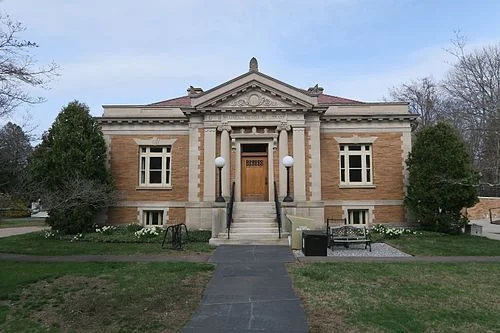
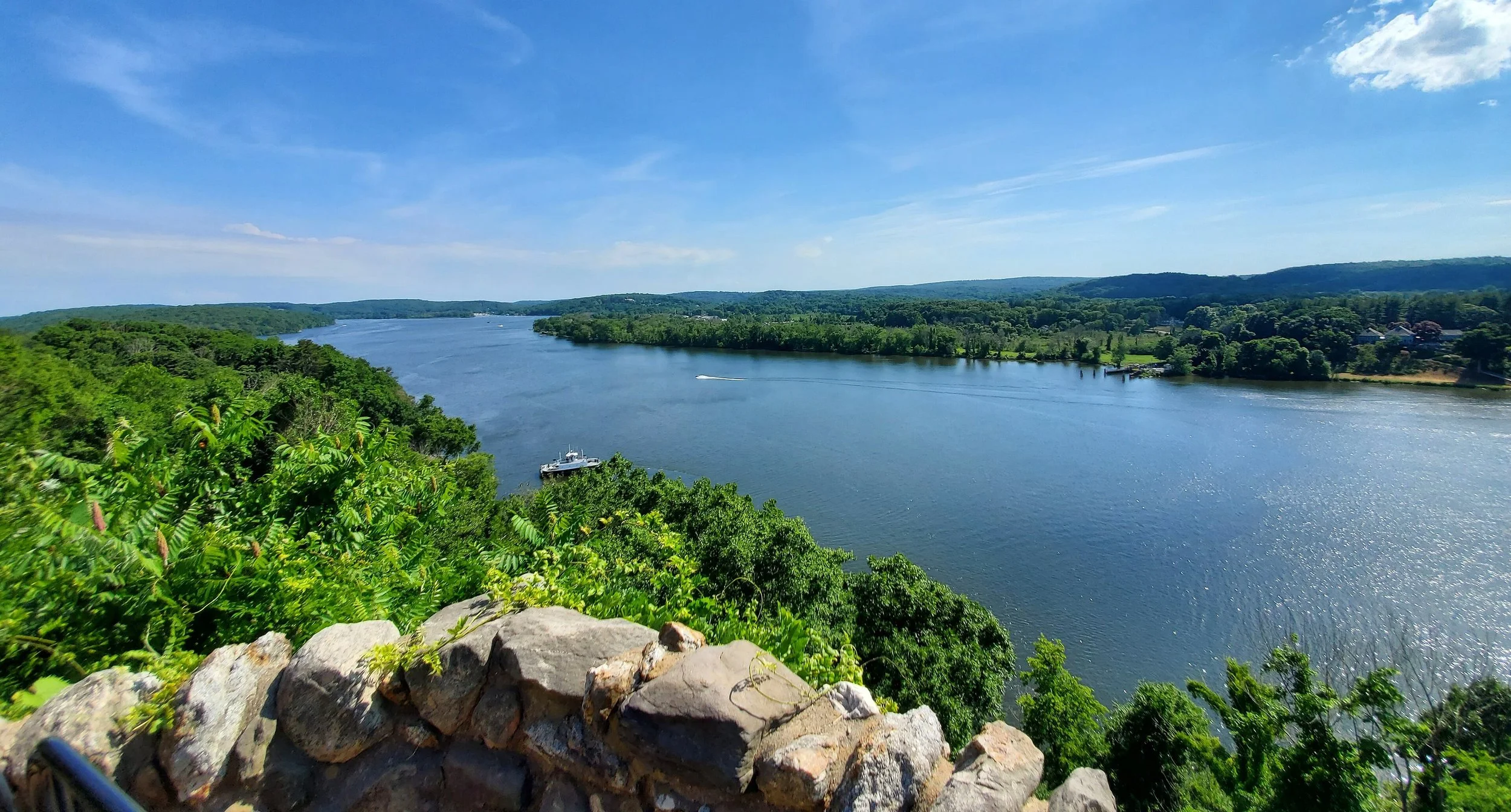
Brainerd Memorial Library, in Haddam, Conn. Haddam is in south-central Connecticut, in the lower Connecticut River Valley and home of Cockaponset State Forest. Incorporated in October 1668 as Hadham, It was later renamed Haddam because of people saying Hadham too fast.
Haddam is the only town in Connecticut divided by the Connecticut River, by far New England's biggest river. It contains five villages – Hidden Lake, Higganum, Shailerville and Tylerville on the west side of the river, and Haddam Neck on the east. For its first 200 years, the river was a major source of the town's livelihood and, of course, transportation. Today, Haddam is almost entirely a residential community.
Connecticut's politicians seem determined to vindicate H.L. Mencken, who observed a hundred years ago: "The whole aim of practical politics is to keep the populace alarmed (and hence clamorous to be led to safety) by an endless series of hobgoblins, most of them imaginary."
A round of hobgoblining was triggered two weeks ago at a meeting of Haddam's Board of Selectmen, when Selectwoman Melissa Schlag, a Democrat, knelt during the Pledge of Allegiance to protest President Trump. Schlag had been protesting this way for some time without wrecking the country or the flag. Indeed, she had been doing it without being noticed outside Haddam at all.
But the episode two weeks ago was noticed on local cable television and was quickly turned into a national sensation by two Connecticut Republican primary candidates -- Tim Herbst, running for governor, and Art Linares, state senator from the Haddam district, running for treasurer.
Herbst and Linares called a rally in Haddam, supposedly to defend the flag but actually to boost their campaigns by riling people up over an issue having no connection to the offices they seek. Thus they gave Schlag's protest far more publicity than she had gotten on her own.
The rally coincided with another Haddam selectmen's meeting, which was attended by hundreds of people who sought to criticize if not intimidate Schlag and who recited the pledge as loudly as they could. Schlag knelt again but this time placed her hand over her heart, perhaps now perceiving that the pledge is not to the president but to the country and that using it politically may give offense.
While many in the audience rebuked Schlag, some still acknowledged her right to protest as she did and some supported her outright. The confrontation managed to stay above the brawling of the aspiring Nazis and Communists elsewhere in Weimar America.
But Schlag still had to trample on the remnant of civility. As the meeting ended cell phone video caught her remarking that her town is "fascist and racist" even though she had been allowed to continue her protest and race never figured in the controversy. She ended up revealing herself as another looney leftist, her self-promoting and self-righteous stunt having been trumped by a bigger stunt by far more accomplished and self-righteous self-promoters.
Then some Connecticut Democrats took their turn at hobgoblining, jumping on the federal lawsuit seeking to suppress publication of blueprints for plastic guns made by three-dimensional printers, called "ghost" guns because they carry no identification marks and don't activate metal detectors.
Not just Connecticut's two U.S. senators but the two contenders for the Democratic nomination for governor, Ned Lamont and Joe Ganim, and even a candidate for the party's nomination for treasurer, Shawn Wooden, called for outlawing such guns.
But only federal law can have much effect on items potentially in commerce like these, and so state law and state officials are virtually irrelevant here.
Of course Connecticut and the country have a serious gun-violence problem, but it is not guns themselves as much as the worsening of poverty on top of drug prohibition. Democrats seem to think that if they can scare voters with "ghost" guns, they might not have to address their failure with poverty policy.
Chris Powell is a columnist for the Journal Inquirer, in Manchester, Conn.
James P. Freeman: Applying data analysis to Supreme Court nominees
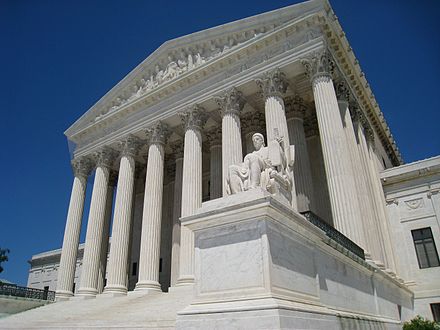
U.S. Supreme Court Building.
Last autumn, techrepublic.com concluded, with its feature “How big data won the 2017 World Series,” that America’s pastime was more the cold science of analytics than the graceful art of, say, a George Springer swing. This fall, progressives hope that big data will win the day to thwart Judge Brett Kavanaugh’s ascension to the Supreme Court.
When the book Moneyball: The Art of Winning an Unfair Game was published in 2003, it acted as a catalyst for Major League baseball teams to “start taking data-based decision making more seriously.” The employment of metrics was also rooted in cost-effective ways to win. The prize was the Fall Classic.
Baseball, already known for its rich sediment of data, hired experts to “make data-driven decisions based on predictive analytics.” Perhaps the biggest manifestation of data predicting outcomes is the use of “the shift” — a technique where a coach will move his defensive players to one side of the field knowing, in advance, that a hitter will put a ball into play there a statistically significant number of times. (Shifts increased from 2,350 in 2011 to 28,130 in 2016). TechRepublic notes that teams with a “prowess with data” — the once moribund Boston Red Sox, Chicago Cubs and Houston Astros — are recent World Series champions.
Some now believe that these methodologies can be applied to Supreme Court nominees.
Data for Progress is, in its own words, “the think tank for the future of progressivism.” Claiming that “a new generation of progressives is rising,” it wants to be the Elias Baseball Analyst for left-leaning causes. Using scientific techniques to support progressive activists and issues, it also aims to “challenge conventional wisdoms about the American public that lack empirical support.”
Areas of its research include: “Multilevel Regression and Poststratification analysis,” to provide “reliable sub-national opinion estimates on progressive issues;” “deep learning textual analysis of media;” and “data mining and analyzing social media data for politicians and pundits to find interesting trends and patterns.”
Pitchers and catchers beware!
In another sign of the miniaturization and mobilization of complex matters on social media, Data for Progress prefers to distribute its research over the internet because “data can only help interpret the world.” (Many credit its co-founder, Sean McElwee, with inspiring the “Abolish ICE” movement based upon a tweet he posted in early 2017.)
Today, however, McElwee is focusing on the Supreme Court. And his opposition to Judge Kavanaugh.
Data for Progress believes that a Kavanaugh seat on the high court would set back progressive causes in areas such as voting rights, Medicaid, corporate pollution, unions, gerrymandering, and, most urgently, abortion rights.
A key component of its approach is that ideological implications can be measured. Data for Progress uses a political science methodology called Judicial Common Space, which seeks to answer, among other things, why courts make the decisions they do. Judicial politics, like a Chris Sale slider, can be measurable and explainable. Or can it?
Justices are “scored” or measured in similar ways that members of Congress are measured for their roll call votes. So, Justice Sonia Sotomayor appears on the left of the spectrum and Justice Clarence Thomas appears on the right. But, like all computer modeling, how Kavanaugh fits into the equation — hence, how he would affect the ideological balance of the court — is entirely hypothetical.
Data for Progress suggests that judicial reasoning is necessarily a linear process; past judicial decisions are a measurable and definitive predictor of future decisions. This in turn determines where judges stand on an ideological plane.
For Data for Progress — even if its quantitative analysis stands close scrutiny — prospective liberal justices are acceptable and conservative justices are not. Big data is now political fodder for modern progressives.
But history may prove McElwee and Data for Progress wrong.
In a recent piece for The Nation, McElwee argues that “Democrats Must Stop Pretending the Supreme Court is Apolitical.” He worries about the looming “threat” of a Supreme Court that could “reverse progressive legislative accomplishments.” When did Democrats stop believing the court was apolitical?
In 1937, President Franklin D. Roosevelt, a Democrat, attempted a ''court-packing” plan. His motivations were entirely political. He intended to shape the ideological balance of the court so that it would cease striking down his New Deal legislation. And in 1987, Democrats launched a full partisan attack on the nomination of Robert Bork to the high court. The conservative jurist was soundly defeated over what conservatives believe were purely political motivations. There is a long history of partisan battles in picking Supreme Court justices.
And Data for Progress’ fears of the court — and, by extension, the nation — being held hostage by conservative justices for years to come may be mistaken. In fact, big data may prove Data for Progress to be just another political lever of the progressive organ. And render their rantings moot.
Fivethirtyeight.com concluded three years ago that “Supreme Court Justices Get More Liberal As They Get Older.” The “ideological drift” of justices is cited in a 2007 academic paper. The authors of the study, using scores based on data from the Supreme Court Database, write that: “Drift to the right or, more often, the left is the rule, not the exception.”
A 2005 New York Times expose, “Presidents, Picking Justices, Can Have Backfires,” should be a reminder to Data for Progress that, despite a wealth of data, Supreme Court justices’ ideology is malleable and subject to change. As President Eisenhower learned of Chief Justice Earl Warren and President George H.W. Bush learned of Justice David Souter.
Whatever their political persuasions, Americans are now keeping score in two spectator sports because of big data.
James P. Freeman is a former banker and now a New England-based essayist. This piece first appeared in Inside Sources.

David Warsh: 'Radical Markets' in Somerville?

David Square in Somerville, Mass.
I live in Somerville, a city near Boston that is rapidly gentrifying. It seems like a pretty good place to think about the implications of Common Ownership Self-Assessed Tax, or COST system, that Eric Posner and Glen Weyl sketch out in Radical Markets: Uprooting Capitalism and Democracy for a Just Society (Princeton, 2018) The example they give is Rio de Janeiro, but their notion of “perpetual auctioning” easier to imagine think in a place close to home.
Here’s the “thought experiment” the authors propose.
“Suppose the entire city of Rio is perpetually up for auction. Imagine that every building, business, factory and patch of hillside has a going price, and anyone who bids a price higher than a going price for an entity would take possession of it… [Assume] that the auctions are conducted via smartphone apps that automatically bid based on default settings, eliminating most of the need for people to constantly calculate how much to offer. Laws ensure that obvious sorts of disruptions don’t occur (for example coming home to find your apartment is no longer yours). Incentives are in place to care for and develop assets, and ensure that privacy and other values are also preserved.
“All the revenue generated by this auction would be returned to citizens equally, as a ‘social dividend,’ or used to fund public projects, which is how revenues from oil sales in Alaska and Norway are used.’’
What would happen? The slums on Rio’s picturesque hillsides would soon disappear. Whoever bought them wouldn’t be planning to build rickety slums (though what the acquirers might have in mind isn’t described). Where would the slum-dwellers go? Transformed by those “social dividends” into a vast middle class,” they would rent apartments in the skyscrapers that would replace the ritzy shops and condos that now dominate in the center of the city. The rich, meaning “people who own a lot of businesses and land,” would disappear, because “if everything was up for auction, no person would own such assets.” Instead “their benefits would flow equally to all.” And with the radical diminution of inequality that would ensue from steeply progressive taxation, crime would drop, gated communities would disappear, street life would be restored, and trust in public life would flourish.
Not, I think, in Somerville.
In the pure, thought-experiment form of the COST scheme, everything would be owned in common and the right to rent it would be forever on the auction block – a little like the old Soviet Union, but with individuals rather than planners making and timing decisions. In practice, the authors say, some combination would probably be required, as in the United States, where government owns vast tracts that it rents out as parcels for drilling, timbering, grazing, and so on, while private property law governs all of the rest.
This isn’t the world of John Lanchester’s biting 2012 novel of contemporary London, Capital, with its increasingly sinister declarations slipped under neighborhood homeowners’ doors: “We want what you’ve got.” It’s much worse than that. In a city like Somerville, individuals and businesses would be required to list their homes and factories on a city Web site and, for each, enter a price for which they would be willing to leave – or accept a default based on the history of the house. This is a reservation price in the lingo of auctions; it is the “self-assessed” value of the property, in Posner’s and Weyl’s scheme. It also sets the owner’s annual tax bill – the portion that the city would keep from the sale, at whatever the tax rate happened to be. Residents could adjust their reservation price up or down at any time during the year.
Meanwhile, would-be buyers would search online for houses they might like to acquire, much as they do now with Web sites like Zillow, with one critical difference: Every house would be for sale at the listed price. You could buy it out from under the owner with a few clicks and move in after a “reasonable period of time.” A footnote explains that the authors have in mind mainly a system of business taxation. They describe their example of Rio as “fanciful,” and say that they conjure markets for personal possessions like homes and automobiles mainly to make their account “vivid.”
Weyl works for Microsoft and teaches at Yale University. Posner, son of former U.S. Appeals Court Judge Richard Posner, is a professor at the University of Chicago Law School. Their book contains several other novel proposals, each of which probably merits a column. If I understand it correctly, the essence of their property scheme, is a highly generalized second-price auction, coupled with the steep progressive taxation.
They dedicate their book to economist William Vickrey (1914-1996), who identified the mechanism and described its virtues in a celebrated paper, “Counter-speculation, Auctions, and Competitive Sealed Tenders,” published in 1961. In a second-price auction, the winner pays only the second-highest price bid. The idea is to elicit honest offers, to prevent participants from shading their bids. He suggested using the method to auction off government bonds. But houses out from under their owners? “Most novel concepts initially seem far-fetched,” the authors write. “[B]ear in mind [Vickrey’s] idea is already used to assign the advertising slots of Web and Facebook pages all of us visit every day. Every few seconds these slots are reallocated to the highest bidder…”
In 1996, three days after he was recognized, with James Mirrlees, with a Nobel prize in economics for his work on moral hazard in public finance, Vickrey died, preventing him, the authors say, from articulating a grand vision such as their own. (See the splendid biographical memoir by Jacques Drèze.) Instead, they cite a similar scheme propounded by University of Chicago economist Arnold Harberger in a speech in Chile in 1962. He had in mind a way of circumventing widespread bribery of tax assessors by homeowners eager to understate the value of their property:
“If taxes are to be levied… on the value of… properties… it is important that assessment procedures be adopted which estimate the true economic value. The economist’s answer … is simple and essentially fool-proof: allow each… owner… to declare the value of his own property, make the declared values… public, and require that the owner sell his property to any bidder … willing to pay… the declared value. This system is simple, self-enforcing, allows no scope for corruption, and creates incentives, in addition to those already present in the market, for each property to be put to that use in which it has the highest economic productivity.’’
As Tim Harford slyly observed in the Financial Times, “This system [of Radical Markets] has enormous potential — simple, fair, progressive taxes and a more dynamic economy. It would be much easier to develop new infrastructure, build new homes, buy your neighbor’s garden, and pour concrete all over twee villages to build monorails or airport runways.”
Posner and Weyl locate resistance to their idea of using perpetual auctions to erode private property “barriers to trade” in, among other impediments, the “endowment affect.”
Richard Thaler, of the Booth Business School of the University of Chicago, won a Nobel Prize for describing the emotional attachment to what you already possess. The authors say the endowment effect seems characteristic of those who lack time and ability to make swift trading decisions. That sent me to the library, where I spent part of a pleasant afternoon leafing through Measuring America: How an Untamed Wilderness Shaped the United States and Fulfilled the Promise of Democracy (Walker, 2002), by Andro Linklater. Nearby was Utopian Ideas and Movements of the Great Depression: Dreamers, Believers and Madmen (Lexington, 2013), by Donald Whisenhunt.
The way it works now is that Somerville gentrifies at its own rate. People wait to sell their homes until, for one reason or another, they are willing to let go. Rents are rising rapidly, driven by home sales. A record 871 new units are under construction. Property rights in the city are not absolute, of course. There are zoning and building-code restrictions. A 1 percent sales tax has been submitted to the state legislature for approval, given that homeowners reap windfall gains thanks to local improvements (better schools, new rail lines) and changes in tastes (more people moving in from the suburbs). That’s about as far as it goes. Meanwhile, Posner and Weyl want most of the rest of our property rights. Shoot the moon!
David Warsh, a long-time columnist on economics and politics and an economic historian, is proprietor of ecnomicprincipals.com, where this essay first appeared.

The Somerville Theatre is an independent movie theater and concert venue in the Davis Square neighborhood. It was started off as a vaudeville house and movie theater. The theater now operates as a live-music venue and first-run movie theater.
Tapley Jewelry has a new way of looking at silver

Tapley Jewelry has a new way of looking at silver.
https://www.t-a-p-l-e-y.com/
Info@t-a-p-l-e-y.com


Negin Owliaei: How a Pa. county kept out a for-profit prison giant

A Geo Group vehicle used for transporting prisoners.
Via OtherWords.org
What’s the best way to push profit-seeking corporations out of the public sphere? Don’t let them take over in the first place.
Residents of Lancaster County, Pa., were thrilled to learn this lesson with their recent victory against Geo Group, a giant of the private prison industry.
Geo turned into a household name for profiting off the youth and family detention centers that have become hallmarks of President Trump’s inhumane immigration policies. But the company’s shady practices go way back. Geo Group has misspent millions in federal funds, only to manage facilities that one federal judge called “a cesspool of unconstitutional and inhuman acts and conditions.” (In New England, Vermont and Connecticut have privately run prisons.)
Despite its abhorrent track record, Geo has raked in hundreds of millions of dollars in federal government contracts in the last year, with a staggering $9.7 million lining the pockets of CEO George Zoley in 2017.
In Lancaster County, Geo was bidding to take over the reentry services the county provided to formerly incarcerated people as they left the prison system.
But Lancaster County already had an established reentry program. A coalition of nonprofits known as the Reentry Management Organization had been providing community-led reintegration services with proven success.
Those nonprofits were left in the dust when the county decided to change the funding process to a bidding-style competition. A whirlwind of changing standards and opaque processes left the nonprofits confused. Meanwhile, Geo Group capitalized, putting forward the only bid to provide parolee services.
Lancaster residents were surprised and angry to learn that local nonprofits might be replaced by prison profiteers. They leapt into action, planning town halls and packing prison board meetings. Religious leaders, nonprofit leaders, and formerly incarcerated citizens turned the normally empty gatherings into standing-room-only events.
“I don’t think [county officials] expected such a community response — or, as they called it, a distraction,” Michelle Hines, an organizer with Lancaster Stands Up, told me.
“It’s a bad company,” Hines added of Geo Group, citing her concerns over for-profit prisons in general, and Geo’s contract to build controversial immigrant family detention centers in particular. “I know I’ve lived in Lancaster my whole life and I don’t want them in my county.”
Neither did many people in Lancaster. Ultimately, the county was swayed, rejecting the company’s bid. Hines and other members of the community are now pushing the county to let the local nonprofits maintain control over the reentry program.
“These big corporations over and over again come into our communities, buy people off, and then are able to perpetrate harm against everybody here,” Hines said. “For a really long time I’d been watching this happen and it just felt like an impossible thing to fight back against, and I feel so empowered to be in a position to have enough people power in our community to be able to fight back.”
Lancaster Stands Up has been organizing in southern Pennsylvania for two years now. The collective came together in the wake of Donald Trump’s election, and has since put pressure on elected officials across the political spectrum in an effort to recast established politics into something that works for people in their community.
“To do work to try to make sure that the people — the regular, everyday working people — have a voice, and to see that actually come to fruition in such a concrete way,” Hines said, “is really incredible.”
Hines hopes that the victory against Geo will help other communities railing against what often feel like insurmountable odds. “I hope we can provide some inspiration to other groups that are fighting and feel like they’re up against an impossible system and incredible power, to know to keep at it.”
Negin Owliaei co-edits Inequality.org, where a longer version of this piece appeared, for the Institute for Policy Studies.
Beautiful dogs in action in Boston

"Under the Surface,'' by Seth Casteel, in the exhibition "Best in Show II,'' at the Lanoue Gallery, Boston, through Sept. 2. The show is a fundraiser for the Massachusetts Society for the Prevention of Cruelty to Animals-Angell Animal Medical Center.

The marijuana-marketing mania is too persuasive

Legal status of recreational marijuana retail shops in Massachusetts by town as of June 21, 2018. Towns in red have implemented permanent bans, towns in yellow have implemented temporary moratoriums, and towns in green have not implemented a permanent ban or a temporary moratorium.
From Robert Whitcomb's "Digital Diary,'' in GoLocal24.com
As business people, states and localities rush to get into the marijuana bonanza, everyone would do well to look at a nationally representative online survey of 16,280 U.S. adults that found that “many ascribe health benefits to marijuana that haven’t been proven, report researchers in Annals of Internal Medicine.’’
“The American public has a much more favorable point of view than is warranted by the evidence,” the study’s lead author, Dr. Salomeh Keyhani, of the University of California at San Francisco, told the news service. “Perhaps most concerning is that they think that it prevents health problems.”
Reuters reported: “While studies have shown that cannabis can help quiet seizures in children with hard to treat epilepsy, quell the nausea and vomiting that can accompany chemotherapy and soothe nerve pain, there’s no evidence that it can help with the vast majority of other medical conditions, Keyhani said. And yet, people think of it as a cure all, she added.’’
Recalling Big Tobacco in the ‘50s and ’60s, the marijuana industry is relentlessly marketing its products, with what I think will end up being very nasty public-health results. But meanwhile, we may see pot stores pop up in most strip malls.
To read the Annals of Medicine report, please hit this link.
'Nothing is cost-effective here'

"The week in August you come home,
adult, professional, aloof,
we roast and carve the fatted calf
-- in our case home-grown pig, the chine
garlicked and crisped, the applesauce
hand-pressed. Hand-pressed the greengage wind.
Nothing is cost-effective here.
The peas, the beets, the lettuces
hand-sown are raised to stand apart.''
-- From "Family Reunion,'' by Maxine Kumin (1925-2014)
From 1976 until her death she and her husband lived on a farm in Warner, N.H., where they bred Arabian and quarter horses. She was the U.S. poet laureate in 1981-82.
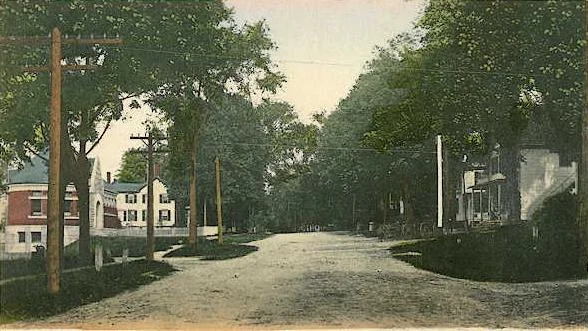
Main Street in Warner, N.H. about 1908.
What we got
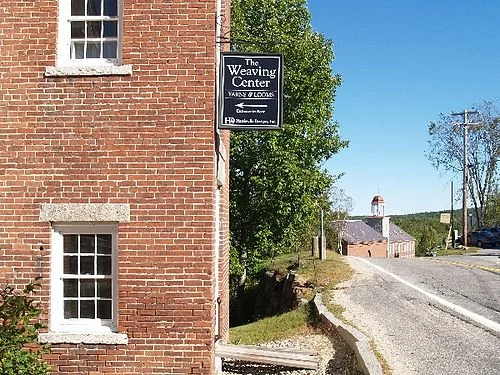
In the New Hampshire mill village of Harrisville.
"New Englanders gave us codfish and quahogs and atomic submarines. They gave us the America's Cup races and Waltham watches, town meetings and mill towns, village greens and fall colors.''
-- From New England, by Ted Smart and David Gibson
And with Indian pudding, too?
From Robert Whitcomb's "Digital Diary,'' in GoLocal24.com
Sabin Lomac and Jim Tselikis are two cousins from Maine who have created a national company with restaurants and food trucks under the name Cousins Maine Lobster whose main fare is, of course, Maine lobster. I wonder if someone from Rhode Island and/or southeastern Massachusetts could do the same thing with quahogs and oysters?
To read about the cousins’ success, please hit this link:
James T. Brett/Michael K. Thomas: A strategy for building a New England pipeline for talent

From the New England Council (newenglandcouncil.com)
BOSTON
The New England Board of Higher Education Commission on Higher Education & Employability recently released an 18-point strategy to increase the career readiness of graduates of New England colleges and universities and improve their transitions to work.
Chaired by Rhode Island Gov. Gina M. Raimondo, the 50-member commission invested 11 months in public meetings and working-group sessions exploring New England employers’ concerns about a lack of qualified, skilled workers, particularly in rapidly changing, technology-intensive and growth-oriented industries.
In its report, “Learning for Life and Work,” the commission offers a strategic action agenda with key recommendations to align institutions, policymakers and employers.
The commission believes that all postsecondary students must have access to and demonstrate completion of critical employability-related experiences during their postsecondary education, including:
• Foundational skills in literacy, numeracy and communication.
• An individual career plan prepared early in their postsecondary experience.
• At least one paid and/or credit-bearing, work-integrated learning experience.
• Achievement of digital competencies related to their course of study, career goals and the fast-changing economy.
• Attainment of an affordable credential that is employer-informed and aligned to a career pathway.
The commission also recommends that the New England states should collaborate to launch multistate, industry-specific, talent-pipeline partnerships focused on top growth-oriented sectors in the states and region (including health care, life and biosciences, information technology, advanced manufacturing and financial services), and driven by key stakeholders from higher education, industry and government.
As a regional business association, The New England Council brings together employers across a range of industries with colleges and universities to foster partnership that will help develop a talent pipeline in our region. The council has promoted internships, apprenticeships and other partnerships where employers ensure that students are being educated in up-to-date industry practices that will prepare them to contribute to the regional workforce. The council has also advocated for public policy that will support and enhance experiential-learning opportunities for students at various levels of education.
Talent is already one of the biggest reasons that companies choose New England. Building upon the world-class strength of our institutions and human capital will confirm that this reputation is long-lasting and indisputable.
Working together, we can ensure that New England will have a future as a hub for cutting-edge technology, innovative entrepreneurship and career-ready graduates prepared to tackle the economic and civic challenges that lay ahead for us all.
James T. Brett is president and CEO of The New England Council and a member of the NEBHE Commission on Higher Education & Employability. Michael K. Thomas is the president and CEO of NEBHE and executive director of the commission.
Todd McLeish: Invasive crab is stressing New England lobster populations

Asian shore crab.
Via ecoRI News (ecori.org)
Speculation about the cause of the decline of lobster populations in Narragansett Bay has focused on an increasing number of predatory fish eating young lobsters, warming waters stressing juveniles, and a disease on their shells that is exacerbated by increasing temperatures.
A new study by a scientist at the University of North Carolina points to another contributing factor: Asian shore crabs, which originated on the shores of the Pacific.
The crabs were first observed on the coast of New Jersey in 1988, where they probably arrived in the ballast of cargo ships. They quickly expanded up and down the East Coast — arriving in Rhode Island in 1996 — and they are now found at densities of up to 200 per square meter in the intertidal zones of southern New England.
“If you flip over a rock, it’s like going into an old basement and turning on a light and watching the cockroaches scatter,” said Christopher Baillie, who conducted the study as a doctoral student at Northeastern University. “They’re really abundant.”
The dramatic increase in the density of Asian shore crabs in the region was followed by a massive decline in the density of green crabs. Green crabs are also not native to the region, having been introduced more than 100 years ago, “but it’s an indication of what the Asian shore crab could be doing to native species,” Baillie said.
Adult lobsters live in much deeper water than the shallow intertidal zone inhabited by Asian shore crabs, so the two species seldom interact. But some larval lobsters settle in the intertidal and subtidal zones, which they use as nursery habitat. Prior to the arrival of Asian shore crabs, it was an area that had fewer predators and an abundance of food. But now the young lobsters are finding themselves in competition with the crabs for food and shelter.
When Baillie surveyed the shoreline in Nahant and Swampscott, Mass., over a five-year period, he found a dramatic increase in the density of Asian shore crabs concurrent with a decrease in the density of juvenile lobsters. He then conducted several laboratory experiments that found that smaller juvenile lobsters lost out to the crabs when competing for food and shelter, especially as the crab numbers increased.
“We saw that the presence of Asian shore crabs significantly reduced the amount of time the lobsters were able to spend in the shelter,” Baillie said. “The more crabs we introduced, the more times the lobster was displaced. When the crabs were at higher densities, the lobsters spent the entire time fleeing from predation attempts by the crabs.”
In similar tests, lobsters that were slightly larger than the crabs were able to obtain food and shelter, but the lobsters fed more frequently and ate faster in the presence of the crabs.
“It appeared that they perceived the crabs as a competitor, and sometimes the lobsters even attacked the crab,” Baillie said. “So while that sized lobster was the dominant competitor, there is a potential energetic cost to battling the crab as well as a potential for injury in those battles.”
According to Niels-Viggo Hobbs, a lecturer and researcher at the University of Rhode Island who studies Asian shore crabs, Baillie’s research confirms what many scientists have suspected: the crab has a substantial negative impact on young lobsters.
“There are still a lot of unanswered questions,” he said. “There may also be a positive impact for lobsters. The crabs may provide a food source for adult lobsters. Lobsters love to eat smaller crustaceans. The take-home message for me is that even when we talk about invasive species, we can’t always say they’re 100 percent bad.”
Although the crabs arrived in Rhode Island waters at about the same time that lobster numbers began declining in Narragansett Bay, Hobbs said it’s unclear if the crabs were a major factor in lobster decline.
“The problem is that on top of Asian shore crabs showing up, we also had lobster shell disease, increasing water temperatures, and other factors working to make life for lobsters more difficult,” Hobbs said. “The Asian shore crab certainly didn’t help. It’s difficult to say how bad an impact it had, but it was certainly poor timing if not worse.”
The long-term implications of Baillie’s study are unclear, since most lobster nursery grounds are in deeper waters than where Asian shore crabs are found.
“But as the crabs continue to expand their range into the northern Gulf of Maine, there is potential for further interactions with juvenile lobsters,” Baillie said. “And while there’s a number of things going on with lobster populations, we’ve shown that the Asian shore crabs may be reducing the value of this nursery habitat for lobsters.”
Unfortunately, there is little that can be done about the invasive crabs. They are occasionally used as bait by tautog fishermen, but not enough to affect population numbers. They are too small to be a valuable commercial fishery. A parasite in the crab’s native range in East Asia is believed to castrate the crabs, rendering them unable to reproduce, but releasing the parasite in local waters would likely cause more harm than good.
“It would be incredibly dangerous to go down that rabbit hole,” Baillie said.
“The crabs are established and here to stay,” Hobbs noted. “So the best we can do is keep an eye on how they impact our native species, and then hope that maybe there’s some good that comes out of it.”
Baillie hopes his study will at least draw attention to the effects the crabs have and prompt government leaders to prioritize what he calls “fairly simple changes in policies” — like requiring the discharge of ballast water in the open ocean — that could be implemented to prevent future introductions of invasive species to the local marine environment.
Rhode Island resident and author Todd McLeish runs a wildlife blog.
'Obstruction is in vain'
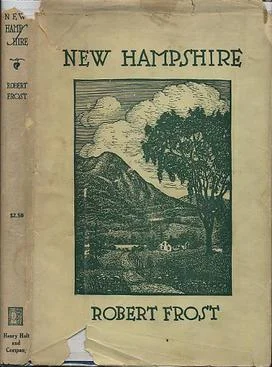
The poetry collection published in 1923 where this poem first appeared.
The tree the tempest with a crash of wood
Throws down in front of us is not bar
Our passage to our journey's end for good,
But just to ask us who we think we are
Insisting always on our own way so.
She likes to halt us in our runner tracks,
And make us get down in a foot of snow
Debating what to do without an ax.
And yet she knows obstruction is in vain:
We will not be put off the final goal
We have it hidden in us to attain,
Not though we have to seize earth by the pole
And, tired of aimless circling in one place,
Steer straight off after something into space.
"On a Tree Fallen Across the Road (To hear us talk),'' by Robert Frost

Jennifer Ware: When bad stuff comes from technology

Via The New England Board of Higher Education (nebhe.org)
It’s an unpleasant reality, but also an inevitable one: Technology will cause harm.
And when it does, whom should we hold responsible? The person operating it at the time? The person who wrote the program or assembled the machine? The manager, board or CEO that decided to manufacture the machine? The marketer who presented the technology as safe and reliable? The politician who helped pass legislation making the technology available to consumers?
These questions reveal something important about what we do when bad things happen; we look for an individual—a particular person—to blame. It’s easier to make sense of how one person’s recklessness or conniving could result in disaster, than to ascribe blame to an array of unseen forces and individuals. At the same time, identifying a “bad guy” preserves the idea that bad things happen because of rogue or reckless agents.
Sometimes—as when hackers create programs to steal data or drone operators send their unmanned aircraft into disaster zones and make conditions unsafe for emergency aircraft—it is clear who is responsible for the adverse outcome.
But other times, bad things are the result of decisions made by groups of people or circumstances that come about incrementally over time. Political scientist Dennis Thompson has called this "the problem of many hands." When systems or groups are at fault for causing harm, looking for a single person to blame may obfuscate serious issues and unfairly scapegoat the individual who is singled out.
Advanced technology is complex and collaborative in nature. That is why, in many cases, the right way to think about the harms caused by technology may be to appeal to collective responsibility. Collective responsibility is the idea that groups, as distinct from their individual members, are responsible for collective actions. For example, legislation is a collective action; only Congress as a whole can pass laws, while no individual member of Congress can exercise that power.
When we assign collective responsibility and recognize that a group or system is morally flawed, we can either try to alter it to make it better, or to disband it if we believe it is beyond redemption.
But critics of collective responsibility worry that directing our blame at groups will cause individuals to feel that their personal choices do not matter all that much. Individuals involved in the development and proliferation of technology, for instance, might feel disconnected from the negative consequences of those contributions, seeing themselves as mere cogs in a much larger machine. Or they may adopt a fatalistic perspective, and come to see the trajectory of technological development as inevitable, regardless of the harm it may cause, and think to themselves, “Why not? If I don’t, someone else will."
Philosopher Bernard Williams argued against this sort of thinking in his “Critique of Utilitarianism” (1973). Williams presents a thought experiment in which “Jim” is told that if he doesn't kill someone, then 20 people will be killed—but if he chooses to take one life, the other 19 will be saved. Williams argues that, morally speaking, it is beside the point whether someone else will kill or not kill people because of Jim's choice. To maintain personal integrity, Jim must not do something that is wrong—killing one person—despite the threat.
In the case of an individual who might help develop “bad” technology, Williams’ argument would suggest that it does not matter whether someone else would do the job in her place; to maintain her personal integrity, she must not contribute to something that is wrong.
Furthermore, at least some of the time our sense of what is inevitable may be overly pessimistic. Far from being excused for our participation in the production of harmful technologies that seem unavoidable, we may have a further obligation to fight their coming to be.
For many involved in the creation and proliferation of new technologies, there is a strong sense of personal and shared responsibility. For example, employees at powerful companies such as Microsoft and Google have made efforts to prevent their employers from developing technology for militarized agencies, such as the Department of Defense and Immigration and Customs Enforcement. Innovators who have expressed some remorse for the harmful applications of their inventions include Albert Einstein (who encouraged research that led to the atomic bomb), Kamran Loghman (the inventor of weapons-grade pepper spray), and Ethan Zuckerman (inventor of the pop-up ad), all of whom later engaged in activities intended to offset the damage caused by their innovations.
Others try to make a clear distinction between how they intended their innovations to be used, and how those technologies have actually come to be used down the line—asserting that they are not be responsible for those unintended downstream applications. Marc Raibert, the CEO of Boston Dynamics, tried to make that distinction after a video of the company’s agile robots went viral and inspired dystopian fears in many viewers. He stated in an interview: "Every technology you can imagine has multiple ways of using it. If there's a scary part, it's just that people are scary. I don't think the robots by themselves are scary."
Raibert’s purist approach suggests that the creation of technology, in and of itself, is morally neutral and only applications can be deemed good or bad. But when dangerous or unethical applications are so easy to foresee, this position seems naive or willfully ignorant.
Ultimately, our evaluations of responsibility must take into consideration a wide range of factors, including: collective action; the relative power and knowledge of individuals; and whether any efforts were made to alter or stop the wrongs that were caused.
The core ethical puzzles here are not new; these questions emerge in virtually all arenas of human action and interaction. But the expanding frontiers of innovation can make it harder to see how we should apply our existing moral frameworks in a new and complicated world.
Jennifer Ware is an editor at Waltham, Mass.-based MindEdge Learning who teaches philosophy at the City University of New York.