
Vox clamantis in deserto





Impatience time

Apple orchard in Hollis, N.H.
“Pruning the apple tree I scatter
Its suckers and twigs across wet snow.
March wind honeycombs the drifts,
and when my work is done I stand
in an attic window close
to spume of driven clouds.’’
-- From “A Season’s Edge,’’ by T. Alan Broughton (1936-2013), a Vermont poet and pianist.
Are N.H. state liquor stores facilitating money laundering?

From Robert Whitcomb's "Digital Diary,'' in GoLocal 24.com
The logo of the New Hampshire Liquor Commission. The global shape represents the worldwide products the commission sells, the triangular shape the shape of the state, and the "L" shape for "liquor".
Most adult New Englanders know about New Hampshire’s highly lucrative state liquor stores, the revenue from which helps the Granite State avoid having state income or sales taxes. The New Hampshire Liquor Commission had a staggering (for a small state) $698.2 million in sales last year.
Consumers drive from all over the Northeast to buy cheap booze in New Hampshire.
But now, it turns out, there may be funny business, with Andru Volinsky, a member of the state’s Executive Council, calling for an investigation of the commission for, he says, enabling out-of-state bulk purchases and perhaps breaking federal tax laws. Mr. Volinsky tells New Hampshire Public Radio that the commission’s practices could “unquestionably facilitate money laundering related to criminal activities.’’
Whenever government sets itself up as a business, whether in liquor or gambling (as with state lotteries and state-government overseen casinos) the potential for associated crime should be obvious.
To read the New Hampshire Public Radio article, please hit this link:
Chuck Collins: Some business leaders agree that reducing inequality is good for the bottom line
For decades, big business leaders have warned that redistributing wealth is bad for business. Taxing the rich to pay for infrastructure and education, they say, will kill the goose that lays the golden egg.
But what if it’s the opposite? What if decades of stagnant wages and growing inequality are scrambling the golden egg and stifling the economy?
A growing body of research suggests that’s exactly what’s happening. And a growing number of business leaders now agree.
Jim Sinegal, the retired CEO of Costco, famously fended off Wall Street pressure to cut wages and made an eloquent case for a higher federal minimum wage. “The more people make, the better lives they’re going to have and the better consumers they’re going to be,” Sinegal told The Washington Post years ago.
“Our country needs less inequality and more opportunity,” agreed former Stride Rite CEO Arnold Hiatt in 2015. “Instead, we’re moving toward a society that will be economically and politically dominated by the sons and daughters of the Forbes 400.”
One of the clearest voices on the business risks of growing inequality is Peter Georgescu, a retired ad man from one of the world’s largest marketing firms. His new book, Capitalists Arise: End Economic Inequality, Grow the Middle Class, Heal the Nation, is a stinging indictment of the way business has been done in our country.
“For the past four decades, capitalism has been slowly committing suicide,” he writes — especially shareholder capitalism, where businesses operate for the benefit of shareholders and no one else.
“Shareholder primacy has become a kind of cancer that needs to be eradicated before it destroys our way of life,” Georgescu warns.
Those views were recently echoed in a letter written to CEOs by Larry Fink, chairman of the investing giant Blackrock.
In January, Fink called on the companies Blackrock invests in to “understand the societal impact of your business as well as the ways that broad, structural trends — from slow wage growth to rising automation to climate change — affect your potential for growth.”
Businesses, Fink exhorted, need a social purpose other than making money.
Reversing inequality will require robust government action at all levels. This includes boosting the minimum wage, fairly taxing big businesses and the rich, and making robust public investments in education, infrastructure, and individual opportunity.
We also need government to crack down on wage theft and discrimination, and to protect the right to organize. Unions and activists have demanded these changes for years.
So what can supportive businesses do? Everything.
They can encourage more employees to be owners. Employees already have an ownership stake at companies such as Publix supermarkets and Southwest Airlines.
They can raise their wage floor to close the monstrous pay gap between top management and average workers — a policy long supported by business guru Peter Drucker. And they can publicly speak out in favor of policies that reduce inequality.
If nothing else, they can stop paying dues to business associations that lobby against sensible taxes and labor protections — like the U.S. Chamber of Commerce and the National Federation of Independent Businesses, which tend to be much more conservative than their members.
Can more business leaders “wake up and take action,” Georgescu challenges? Or will they “continue doing business the ways it’s been done… until the whole system risks falling apart?”
Corporate leaders should stand with ordinary Americans to push for serious public policy to halt the nation’s slide towards greater inequality.
Chuck Collins directs the Program of Inequality and the Common Good at the Institute for Policy Studies.
Once the sardine capital

Union Dock in Eastport, Maine, in 1910.
"On a boat cruising down east, sardines are scooped out of the holding seine at Eastport {Maine} at dawn. 'Sardines' may be any of several species of fish; in Maine they are usually small herring. Fish are penned in nets until the boats are ready to load. The fish are taken a short distance to canneries which work round the clock, according to the time of the catch.''
Luis Marden (1913-2003), American writer, explorer and photographer.
Eastport used to be America's sardine capital but its last sardine fishery closed in 2010.
Blue Cross Blue Shield in plan to expand Metro Boston bike-sharing
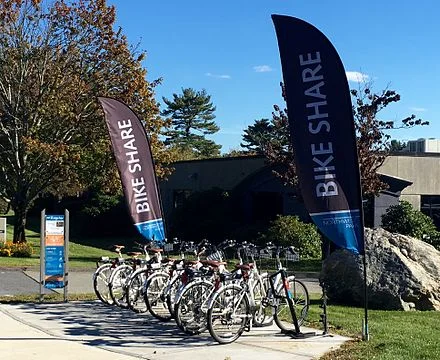
Zagster bike-sharing station on a corporate campus in Burlington, Mass.
This is from the New England Council (newenglandcouncil.com)
"Blue Cross Blue Shield of Massachusetts (Blue Cross) recently entered a six-year partnership agreement with the Metropolitan Area Planning Council and bike share operator Motivate International, Inc. to expand access to bike share in the metro Boston region.
"The existing Hubway system will be rebranded as Blue Bikes to reflect Blue Cross’ support for expanding the bike share system. Currently there are 1,800 bikes, but with Blue Cross’ sponsorship there 3,000 Blue Bikes by the end of 2019, and more than 100 new stations. Blue Cross’ support will bring brand new bikes, new mobile app features, and more valet service at busy stations. The expansion and transition to Blue Bikes will begin in spring 2018.
“We’re delighted to partner with Boston, Cambridge, Brookline, and Somerville on the Blue Bikes initiative. . . Not only are we helping to expand bike share access to communities that have long been asking for the program, we’re also living up to our company’s commitment to healthy living and to environmental sustainability,” said Andrew Dreyfus, president and CEO of Blue Cross Blue Shield of Massachusetts. The bike sharing system will remain operated by Motivate and owned by the municipalities of Boston, Cambridge, Brookline, and Somerville.''
Chris Powell: Free college is just a ploy; go local, not regional
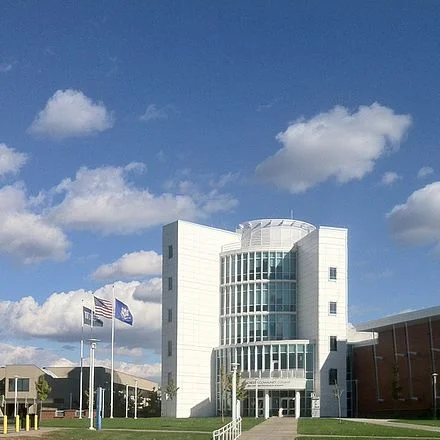
The arts, technologies and science center at Manchester Community College.
MANCHESTER, Conn.
Connecticut state government's great new "bipartisan budget" is already $250 million in deficit and budget deficits in the billions are forecast for years to come, but Democratic leaders in the state Senate are proposing to make community college free for students. Mere taxpayers would pay an extra $30 million or so per year.
Many Democratic legislators also favor making state financial aid available to illegal immigrant students in college.
Meanwhile state government's financial support for the innocent needy is in danger of being cut, and a commission appointed to study state government's financial trouble has just urged saving money.
So why are the Democrats so calculatingly oblivious, so intent on reminding people that they remain the Party of Free Stuff, as if anything really is free and as if state government's financial trouble and the contraction of the state's economy haven't been caused in large part by too much free stuff?
The Democrats are doubly oblivious about free community college because Connecticut's education problem is not higher education but primary education. Standardized tests show that most of the state's high school students never master high school math and English but are graduated anyway. Many then are admitted to public colleges only to take remedial courses. A Superior Court judge surveying the state's primary education system reported 18 months ago that high schools are graduating illiterates.
The Democrats say free community college will help the state's employers, who lack qualified applicants. But improving outcomes in primary education, through which everyone goes, would help employers more than free college when so many college students just repeat high school in pursuit of another false credential.
Indeed, in these circumstances free college is less a gift to students than to educators, whose unions dominate the Democratic Party. The proposal is another ploy to rile up the party's base.
xxx
TRY LOCALISM, NOT REGIONALISM: Pushing regionalism again in a series at the Connecticut Mirror this month, veteran journalist Tom Condon approvingly quotes a Massachusetts mayor who says a region that wants to prosper has to "act like a region." But Condon proposes little more than the politically correct groupthink of creating regional governments and giving them taxing authority on top of the taxing authority of state and municipal governments.
What advocates of regionalism don't notice is that Connecticut already has tried plenty of regionalism.
That's what state government is, with all its laws and policies outlawing or impairing democratic control of expenses, like binding arbitration of government employee union contracts, defined-benefit pensions for government employees, "prevailing wage" requirements for government construction projects, and the state Board of Mediation and Arbitration's forbidding dismissal of government employees even for the worst misconduct.
More regionalism would mainly let the corrupt and incompetent city governments, which dominate state government through their influence in the majority party, grab more taxes from suburbanites.
In these circumstances the chance of improvement in Connecticut would be greater with more localism, letting municipalities opt out of expensive state mandates that serve only special interests.
Even as Condon was writing his series, New Haven Mayor Toni Harp proposed raising her city's property tax rate by 11 percent rather than aggravate the city's government and welfare classes with too much economizing. Why should anyone outside New Haven want more of that?
Chris Powell is a columnist for the Journal Inquirer in Manchester, Conn., and a frequent contributor to New England Diary.

Artists' personal scenery

Images from the group show "Scapes'' at Galatea Fine Art, Boston, April 4-29. From left, work by Barbara Lindstrom, Carol Wontkowski and Christina Beecher.
Galatea says:
'''Scapes' is a members group show incorporating the works of photography, painting, sculpture, and mixed media. All artists use the idea of 'Scapes' in their works in a variety of ways: landscapes, mindscapes, places to escape to/from, and interpret what these scenarios mean to them.
"'Scapes,' a term extracted from landscape, denoting an extensive view, is represented in a variety of ways in this interdisciplinary exhibition featuring the works of six gallery artists. Representing many forms of scapes -- landscapes, seascapes, skyscapes, dreamscapes, mindscapes -- the mixed media exhibition conveys a sense of place and fresh imaginative views of the artist's personal scenery.''
Jill Richardson: Time for an honest talk about 'free trade'

Via OtherWords.org
America, can we talk? We need to talk about “free trade.” We’ve needed to have this conversation for a while, actually. Like, since the 1980s.
For the past several decades, the U.S. political establishment has advocated free trade as part of a broader economic ideology called neoliberalism.
Now, you may need to ignore the word “liberal” in there — its meaning here is different from how most people use it in our politics.
Neoliberalism is not a Democratic idea. Ronald Reagan was a huge champion of it. In more recent decades, all of our presidents from both major political parties were on board with it — until, to some extent, Trump.
The simple way to understand neoliberalism is that it’s the package of economic and trade policies the U.S. has lived under since the Reagan administration. Deregulation. Privatization. That sort of thing.
One pillar of neoliberal ideology is free trade.
In business school, I was taught not to question it. The idea was that if countries removed trade tariffs, then everyone would benefit.
Each country would produce what it’s most “efficient” at producing: Developing nations will manufacture goods with cheap labor. The U.S. will grow lots of corn and soybeans and export them. And everyone wins because there will be low prices.\
The counter arguments are often humanitarian and environmental. If we’re going to buy clothing and iPhones from nations with cheap labor, lax environmental laws, and few labor rights, then the people who make the goods we buy will work in unsafe and inhumane conditions.
That’s essentially what happened.
For example, in 2013, a building housing garment factories in Bangladesh collapsed, killing 1,134 people and injuring thousands more. Cracks had appeared in the building before it collapsed, and an engineer declared it unsafe. Factory owners ordered their workers back to work — and then the building collapsed.
The workers were producing clothes for export, including top U.S. brands. But, on the upside (say the neoliberals), clothing made in Bangladesh is nice and cheap in the United States.
Also, corporations get massive profits. You can make more money when you can pay workers only $3 a day.
Free trade may help our consumers and corporate CEOs — but it hurts workers. In the book Threads, Jane Collins details how the garment industry changed after some companies began sending jobs overseas.
Workers in the U.S. became limited in how much they could push for higher wages. They knew that if they pushed too hard, their employer would fire them all and move the factory to Mexico, Vietnam, or Bangladesh.
Furthermore, an American company that wanted to pay its workers well was limited in its ability to do so, because it was competing with other companies that paid less for labor overseas.
A similar trend has played out, rather more famously, with manufacturing jobs.
For some voters in hard-hit regions, part of Trump’s appeal is that he was one of the first major party candidates to oppose free trade.
Unfortunately, it doesn’t look like he’s got a great alternative for it.
Pugnaciously declaring he’s implementing a steel tariff has so far done little more than outrage our allies and provoke Europe to retaliate by putting tariffs on American goods like bourbon and blue jeans, which could also hurt American workers.
Trade wars won’t fix the deeper problem of neoliberalism. But maybe future leaders will see that it pays to question the costs of “free trade.”
OtherWords columnist Jill Richardson is the author of Recipe for America: Why Our Food System Is Broken and What We Can Do to Fix It.
Wood is actually a bad source of energy for New England

Firewood.
From Robert Whitcomb's "Digital Diary,'' in GoLocal24.com
'New England has lots of woodland and so we’re tempted to see biomass as a good source of “renewable energy.’’ The theory goes that, yes, burning wood, notably in the form of wood pellets, releases carbon dioxide but growing trees absorbs it and so the whole process can be seen as “carbon neutral’’.
But a report from an outfit called Not Carbon Neutral says that CO2 emissions far exceed the absorbing capacity of the living trees planted or maintained as future fuel sources. The report’s author, Mary Booth, told ecoRI News journalist Tim Faulkner:
“This analysis shows that power plants burning residues-derived chips and wood pellets are a net source of carbon pollution in the coming decades just when it is most urgent to reduce emissions.’’ She included in her calculations the fossil-fuel emissions from the shipping and manufacturing of wood fuels.
Southern New England gets some electricity from burning wood in northern New England.
The report reminds me of the wood-burning mania in New England during the energy crises of the ‘70s. It was handy to have all that wood available for heating in New England to offset a little the swelling price of heating oil, but the wood stoves caused serious air pollution in many parts of our region, including in rural areas once noted for their clean air.
So wind, solar and hydro are the way to go in New England’s energy future.
To read Mr. Faulkner’s article, please hit this link:
https://www.ecori.org/renewable-energy/2018/2/26/report-says-wood-based-energy-doesnt-add-up
For New England, think bar fight

"Most people, when they imagine New England, think about old colonial homes, white houses with black shutters, whales, and sexually morbid WASPs with sensible vehicles and polite political opinions. This is incorrect. If you want to get New England right, just imagine a giant mullet in paint-stained pants and a Red Sox hat being pushed into the back of a cruiser after a bar fight.''
-- Matt Taibbi, journalist
For Greenfield storeowners, Amazon much tougher foe than Walmart

Greenfield in 1917, around its commercial heyday.
From Robert Whitcomb's "Digital Diary,'' in GoLocal24.com
'The Atlantic had a good article (“A Small Town Kept Walmart Out. Now It Faces Amazon,’’ March 2) about Greenfield, a town in western Massachusetts.
Greenfield has managed to keep big-box retailers out of town in order to preserve locally owned stores. But now local store owners and consumers who want to keep them are fighting a bigger enemy – Amazon. The behemoth online retailer offers a convenience that’s very difficult to compete against. Alana Semuels writes:
“Greenfield and other towns across New England are learning that while they might have been able to keep out big-box stores through zoning changes and old-fashioned advocacy, there’s not much they can do about consumers’ shift to e-commerce. They can’t physically keep out e-commerce stores—which don’t have a physical presence in towns that residents could push back against—and they certainly can’t restrict residents’ Internet access. ‘It’s one thing for me to try and fight over land use in the town I live in, or in somebody else's town,’ {local leading} big-box foe {Al} Norman told me, ‘But e-shopping creates a real problem for activists, because on some level, shopping online is a choice people make, and it’s hard to intrude yourself in that.”’
Beyond the demise of local business that keep much of their revenues in their area, there’s a hollowing out of local civil society as people have fewer opportunities to meet in local stores; there are fewer of them as more and more folks order more and more products from home or office. As the Internet society heads toward its fourth decade, we’ll need to find different ways to encourage locals to meet and to participate in their community other than, say, joining AA.
To read The Atlantic’s article, please hit this link:

Llewellyn King: Thinking machines will replace innumerable skilled jobs

Consider it as the work dichotomy.
There is a shortage in the millions for skilled labor jobs in the United States. The country is desperate for men and women who drive trucks, operate machines, weld, wield hammers – or can fill skilled jobs in dozens of categories, from bulldozer operator to utility lineman.
Bill Hillman, chief executive officer of the National Utility Contractors Association, the organization that represents contractors (people who do everything, from replacing electricity poles to working down manholes to operating heavy equipment), says getting help is a major problem for his members. So they are setting up training programs and working with schools and community colleges.
But these also are some of the people who could be jobless due to artificial intelligence (AI) in the near future. Thomas Kochan, co-director of the MIT Sloan Institute for Work and Employment Research, told me this “middle of the labor market” is coming under attack by AI deployment.
John Savage, professor of computer science at Brown University, foresees a need for major retraining of workers with the spread of AI. But he told me he is “optimistic”: He sees major displacements but new opportunities.
Displacement is a worry for workers, but so is job quality deterioration in the so-named gig economy or freelance economy: a volatile labor pool where the employer holds most of the cards.
Gig workers are spread among diverse occupation groups: arts and design, computer and information technology, media and communication, transportation and material moving, construction and extraction. They are working here and there without permanence, medical insurance or pension provisions, like employer 401(k) contributions.
That is for starters and it is happening now. Then comes the apocalypse when millions of workers find themselves displaced by thinking machines. Think of what happened to elevator operators in cities when elevators were automated.
The first to go might be taxi drivers, some truck drivers, airline pilots and others in transportation. Already in Phoenix, you can ride in a robot taxi operated by Waymo, the Google self-driving car project. Truck makers, stirred on by potential competition from new entrants, like Tesla, are hard at perfecting autonomous intercity trucks.
To my mind, the issue is not whether but when. There are more than 3 million truck drivers on U.S. roads. Not all will be displaced by AI, but if 1 million go, there will be considerable downward pressure on wages.
Traditionally, and Savage points this out, automation has led to a surge in new, different jobs. Ned Ludd, who with his followers destroyed mechanical weaving machines in England in the early 1800s, was wrong. Mechanized weaving added far more related jobs than those lost.
But this time it could be different, warns John Raymont, chief strategy officer of Kurion, an advanced technology nuclear company. He says the difference is that automation heretofore has led to more products, and therefore more jobs. Artificial intelligence threatens to take away jobs without producing new products, which themselves produced new jobs.
Take the automobile production line: It led to more people being able to afford cars and more jobs maintaining and fueling those cars. It enhanced America’s growing prosperity.
So far, AI appears to be aimed directly at employment. In the way that cheap labor in Asia sucked manufacturing jobs out of the United States, so machines may take over skilled jobs from airline pilots to Uber drivers, Raymont says. Other jobs may still be safe, including plumbers, he says.
And it will not be just manual workers who will have their jobs taken over by wily computers. Accounting, tax preparing and auditing, money lending, loading and unloading ships and trucks will be done by machines guided by artificial intelligence. A ship, it is theorized, will be able to leave a U.S. port without the aid of seamen or dock workers and sail to Singapore, dock and unload autonomously.
Job displacement may have this opportunity: More leisure time in which people can play golf on greens maintained by thinking mowers, aerifiers and fertilizer spreaders. After they play, a machine may make them an extra dry martini at the club bar.
Llewellyn King is executive producer and host of White House Chronicle on PBS. His e-mail is llewellynking1@gmail.com.
Integrating drawings and music

"Compania Irene Rodriguez'' (watercolor and ink), by Carolyn Newberger, in her show "In Concert,'' at Galatea Fine Art, Boston, April 4-29.
She told the gallery:
"Sitting in a darkened concert hall, with a loose hand and receptive mind I try to capture the urgency, spark, and character of sublime music and dance. The sounds and movements animate my pen as their spirits penetrate my soul.
"For the past several years, my husband, Eli, and I, both musicians, have been reviewing music and dance performances at the Tanglewood, Jacob’s Pillow, and Aston Magna festivals. We work for The Berkshire Edge, a newspaper of ideas, news and culture serving Western Massachusetts.
"Integrating drawings with music and dance commentary fits naturally into my complex identity as an artist, writer and musician. In this show, the first of its kind, I offer illustrative reviews with their attendant drawings that express my respect for art’s capacity to exalt and inspire.''
A little humility, please

The Breakers, the most famous of the Newport man mansions.
“The house of stone turns its back on town
To govern an Atlantic even sky can’t stop.
Big as a museum, it keeps us off the lawn
With chain-link fences camouflaged by rose hips.
Presiding from this height, it says Look on
My works, ye Mighty and despair!’’
From Carole Simmons Oles’s “On the Cliff Walk at Newport, Rhode Island, Thinking of Percy Bysshe Shelley’’
Jim Hightower: The Dow doesn't reflect how most Americans are doing
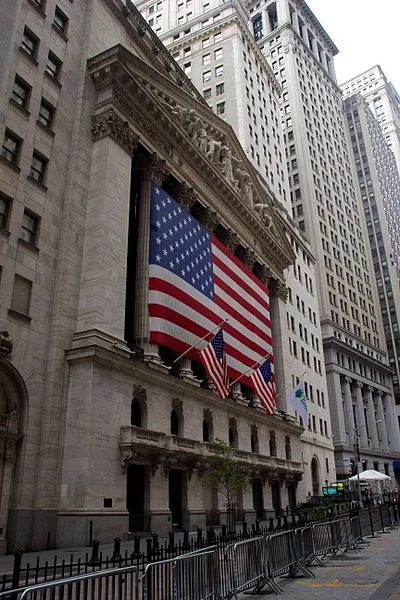
The New York Stock Exchange.
.
Via OtherWords.org
Language matters. For example, the words that corporate and government officials use to report on the health of America’s economy can either make clear to us commoners what’s going on — or hide and even lie about the reality we face.
Consider the most common measurement used by officials and the media to tell us whether our economy is zooming or sputtering: Wall Street’s index of stock prices. The media literally spews out the Dow Jones Average of stock prices every hour — as though everyone is waiting breathlessly for that update.
The thing is, nearly all stock is owned by the richest 10 percent of Americans. So the Dow Jones Average says nothing about economic conditions for 90 percent of us.
For the true economic health of America as a whole, we need to know what I call the Doug Jones Average. How are your average Doug and Dolores doing?)
As we’ve seen, stock prices keep rising to new highs. But wages and living standards for the middle class and poor majority have been held down by the same corporate and political “leaders” telling us to keep our eye on the Dow.
To disguise this decline, they play another dirty language trick on us when they issue the monthly unemployment report. Currently, with the unemployment rate down to 4 percent, they tell us America’s job market is booming.
But that only reflects the number of jobs, not the dollar value of those jobs in terms of wages and benefits. Having lots of people doing poorly paid work is hardly a healthy job market.
Notice that they don’t measure the stock market by the number of stocks out there, but by their value. They should measure our job market the same way.
Of course, they’d only do that if they gave a fig about all of us Dougs and Deloreses. And that speaks volumes about their bias for stock-owning elites.
OtherWords columnist Jim Hightower is a radio commentator, writer, public speaker, and editor of the populist newsletter, The Hightower Lowdown.
'Rumor in the air'

Eastern bluebird.
"In New York and New England the sap starts up in the sugar maple the very day the bluebird arrives, and sugar-making (see below) begins forthwith. The bird is generally a mere disembodied voice; a rumor in the air for two or three days before it takes visible shape before you.''
-- The late John Burroughs, naturalist and essayist.
"

Boiling off maple sap to make syrup in late winter and early spring.

The Green Mountain State is very proud of its maple-syrup sector.
Sleeping through the storm

Surface analysis of the Great Blizzard of 1888, which took place March 11-14. Areas with greater isobaric packing indicate higher winds. This remained New England's most famous snowstorm until the Blizzard of Feb. 6-7, 1978.
"A wintry storm's blown over us while we slept.
The world's no worse for it,
Though a storm-window cracked a bit
When it fell down hard in the middle of the night.
All we value most we've kept.
The tree of life is still upright.''
-- From "March Winds,'' by Alfred Nicol, who lives in Amesbury, Mass.
'Memory and matter'

"See You in Dreams,'' by S. Tudyk, in her show "An Improving View,'' at ArtProv Gallery, Providence, April 4 through May 26. The gallery says that she "draws inspiration from her surroundings as well as her thoughts and memories. In these works, she explores the process of fragmentation, applied to both memory and matter. ''
Memories of the New Haven
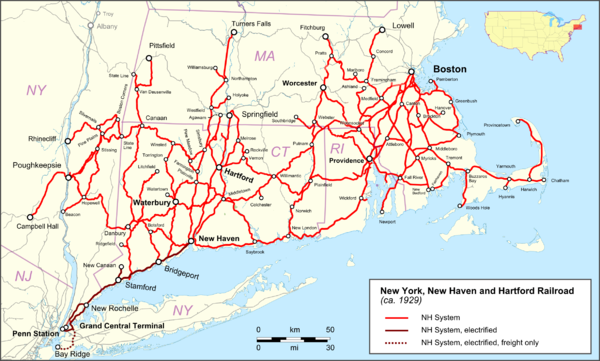
The apogee of the New Haven, right before the Depression.
Adapted from Robert Whitcomb's "Digital Diary,'' in GoLocal24.com
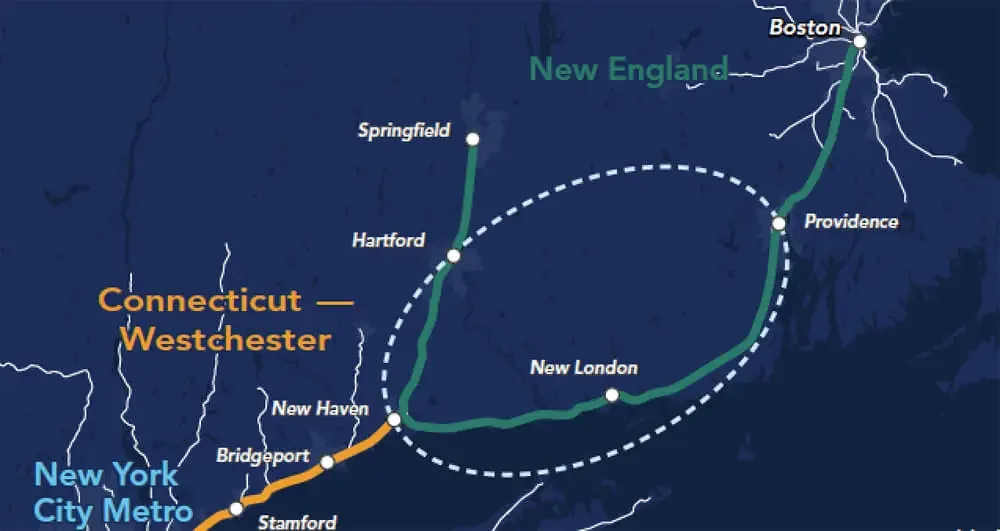
'The other week I took the Shore Line East commuter rail line, which runs between New London and New Haven. I noticed that the cars were from the old New Haven Railroad, which went out of business in 1968! That the cars are so old testifies both to how sturdy (if now rattling) they are, reminding me of those tough old DC 3 prop passenger planes that were flown for decades by numerous airlines, and to how old so much of America’s infrastructure is. (The official name of the the railroad was, as you can see above, a mouthful. But everyone just called it "The New Haven''.)
The old NH cars also reminded me of the old New Haven Railroad itself, with its stuffy smoking cars, itchy upholstery and, on its longer runs, especially Boston to New York, dining cars where you could even get lobster but because of silly labor rules, you had to put your order in writing.
And then I think of the weary and melancholy commuters, such as the Dan Draper character in Mad Men, sitting and smoking in a New Haven Railroad car and looking sadly out at a platform at a suburban station in Westchester or Fairfield County where a sole man, wearing a fedora and a London Fog raincoat, is pacing back and forth in the dusk.
Tim Faulkner: Northern Pass decision delayed again
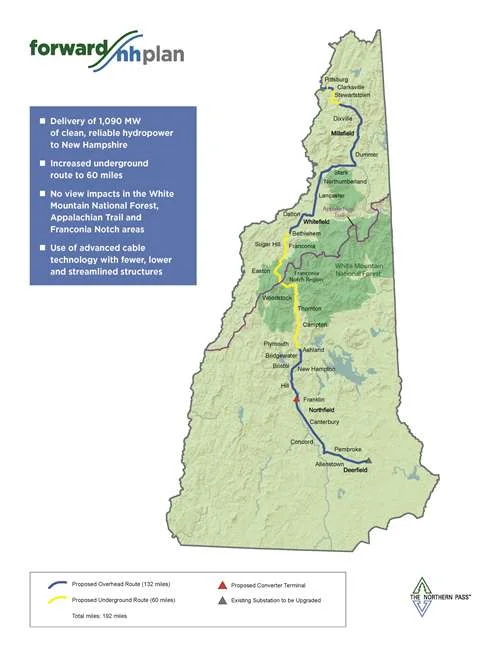
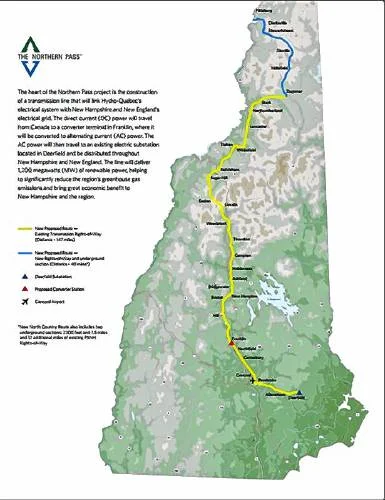
-- Pro-Northern Pass map
Via ecoRI News (ecori.org)
The Northern Pass hydropower transmission-line project isn't dead yet, but time is running short for the $1.6 billion project.
On March 12, the New Hampshire Site Evaluation Committee (SEC) voted, 5-0, to defer a request to reopen the deliberation process. The committee did agree to suspend its Feb. 1 oral vote to deny the project but only until the written decision is released later this month. A decision on whether to restart hearings won’t be made until May.
The March 12 meeting was held at the request of Northern Pass in an effort to somehow convince the SEC to rehear and reverse its Feb. 1 decision to reject the project. Soon after that vote, Massachusetts, the primary buyer of the electricity, gave the developer, Eversource Energy, until March 27 to salvage the proposal.
“This is just really a Hail Mary effort on Northern Pass’s part,” said Melissa Birchard, staff attorney for the Conservation Law Foundation. “It was a long shot and they knew it. But they just wanted to make an effort to satisfy the Massachusetts’ ultimatum.”
Opponents say the project threatens 95,000 acres of forestland and could harm scenic tourist areas. Small towns fear the project would hurt business and disrupt their communities.
New Hampshire Gov. Chris Sununu endorsed the 192-mille high-voltage system for the jobs and the promise of lower electric bills for ratepayers. He was disappointed that the siting board rejectedthe project on Feb. 1.
Massachusetts agreed to buy a portion of the 1.09 gigawatts of so-called "low-carbon energy" to meet its Clean Energy and Climate Plan for 2020.
In the meantime, the Bay State selected a backup plan, the New England Clean Energy Connect, developed by the Central Maine Power Co., to bring Canadian hydropower to Massachusetts.
There has been no response from the Massachusetts Department of Energy Resources regarding the recent SEC decision to postpone any action on the Northern Pass until May.
On Feb. 28, Eversource Energy filed a request to vacate the SEC's decision saying it wanted to elaborate on efforts to address the objections to the project. According to Eversource, the impacts on tourism and property values would be offset through payments from a $200 million state fund. Also, Eversource says alternative construction methods would be used lessen impacts on businesses.
Eversource claims the project will create 2,600 jobs during constriction, save New Hampshire ratepayers $62 million annually, add $30 million to state and local tax revenue annually, and reduce regional carbon emissions by more than 3 million tons a year.
The project received good news March 6 when the Canadian National Energy Board approved the proposal, thereby completing the last of the permits for the construction between Eversource Energy and Hydo-Quebec, a Canadian government-run utility.
Eversource issued the following statement after the March 12 decision by the SEC:
“We hope it is an indication that the SEC will evaluate the required statutory criteria, as well as thoroughly consider all of the conditions that could provide the basis for granting approval. At a time when the region needs new and diverse sources of clean energy, it is vitally important that projects like Northern Pass are considered fully and efficiently and without unnecessary delay.”
Tim Faulkner is a reporter and writer for ecoRI News.