
Vox clamantis in deserto



Don Pesci: Of Anita Hill and Ben Shapiro at UConn
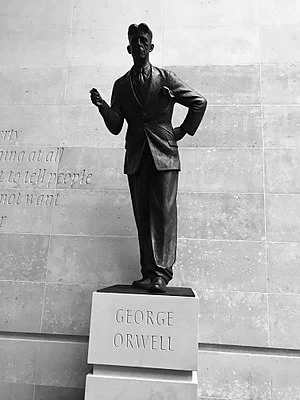
At the headquarters of the BBC, in London. The wall behind the statue is inscribed with the words "If liberty means anything at all, it means the right to tell people what they do not want to hear”, words from Orwell's proposed preface to Animal Farm.
“The law, in its majestic equality, forbids the rich as well as the poor to sleep under bridges ...”
-- Anatole France.
Of course, we all know that the rich do not sleep under bridges, and so the law, which in this case enforces the same rules of behavior for rich and poor, is not at all majestic, or merciful, or just. Justice, Aristotle says, treats equal things equally and unequal things unequally.
Let’s begin with an obvious observation: a university talk by Ben Shapiro and Anita Hill are in no sense equal. And we know from bitter experience that opposition to such talks are radically (pun intended) unequal. Susan Herbst, the president of the University of Connecticut, would be hard pressed to cite a case in which a political sermonette by a noted liberal was cut short by audience thugs. But in the case of conservatives invited to speak at colleges, address-interruptus, sometimes violent, always ill mannered, is as common as applause. It would appear then that conservative speakers are in no sense equal to liberal/progressive/socialist/communist speakers; their messages are different, and reception to their messages is different.
Anita Hill was permitted to speak at UConn without enduring the kind of interruptions that have become common when conservatives exercise their First Amendment rights at public universities such as Berkley, where protesters set fires, broke windows, taunted cops and speakers, and engaged in mob behavior reminiscent of Hitler’s Sturmabteilung. In California, a progressive poverty catch-basin that has more homeless people on its streets than Alabama,
Antifa, aligned with other groups that would not protest a college address given by Hill, was successful in closing down an address given by Milo Yiannopoulos, a former senior editor of Breitbart News, a “cultural libertarian,” a gay provocateur in full scale rebellion against the baneful excesses of third wave feminism, radical Islam, political correctness, academic intolerance and weepy students searching for safe places in edenic universities.
Some weeks ago, audience thugs at UConn successfully shut down an address given by Lucian Wintrich , the White House correspondent for the Gateway Pundit, provocatively titled “It’s OK To Be White.” Arrested by UConn police, perhaps in order to protect him from the lynch mob in the audience determined to shut him down, charges against Wintrich were quickly dropped. A prosecutor soon brought charges against one of his tormentors, student adviser at Quinebaug Valley Community College Catherine Gregory, who had created a ruckus by stealing notes from the speaker’s speech. Her charges were later reduced.
That incident produced an administrative policy at the university that, in its majestic equality, forbids both conservative and progressives to attend college addresses at UConn, unless the attendees are UConn students. The university’s precautions censor the audience rather than the text, which is just as objectionable as pre-censoring printed material. Both are forms of prior restraint.
Obvious observation number two: Ben Shapiro is not Yiannapolis – not that there’s anything wrong with being Milo. Neither is he Wintrich or Anita Hill, best remembered in connection with her opposition to the nomination to the Supreme Court of now Justice Clarence Thomas, an African-American associate justice married to a white woman who presumably is non-racist. Nor is Shapiro an alt-righter, as he has been labeled in recent news reports issuing from Connecticut’s inattentive media. In fact, Shapiro is an adamant non-alt-righter.
Listening to Shapiro is a bit like listening to a Gatling gun that speaks English in full sentences. And the dialogues he conducts at the end of his addresses with articulate students who think they disagree with his message, remarkably free of overt and intended provocations, is Socratic in structure and mildly subversive, because Shapiro is entertaining, rational and persuasive, not only to the conservative/libertarian choir that comes to hear him sing, but also to students making an honest and arduous journey between progressivism and conservatism in an age in which conservatives are treated in academia much the way witches were in Cotton Mather’s Boston.
In remarks preceding his address, “White Privilege Microaggressions and Other Leftist Myths,” Shapiro lamented that the beefed-up security was necessary, remarked “that the left is so afraid of open conversation that they scheduled an event at the exact same time,” and regretted that more left-leaning students were not in attendance. He “prefers speaking to people with whom I disagree,” Shapiro said, “ because discussions are useful.” A month prior to his appearance, college administrators circulated a notice to the insulted and injured at UConn that Shapiro would be making an appearance at the university; but not to worry, because empaths at UConn would provide counseling for aggrieved students – signs of the times that show just how far universities have come since Cardinal Newman published his “The Idea of a University,” which should be required reading for all administrators at UConn.
Don Pesci is a Vernon, Conn.-based essayist and a frequent contributor to New England Diary.
Basav Sen: Ruthless coal baron helps set Trump energy and environment policuy

Removing the top of a mountain to mine for coal in Appalachia.
Via OtherWords.org
It’s common knowledge that our political system is awash with money. And that money, despite some flimsy legal barriers, comes with strings attached.
One coal baron’s efforts to set an entire administration’s energy agenda are the perfect case study.
His name is Robert Murray, and he heads Murray Energy, one of the largest coal mining companies in the United States. Murray contributed $300,000 to President Trump’s inauguration — and clearly wants a return on his investment.
The details are laid out in some memos Murray wrote to Vice President Mike Pence and Energy Secretary Rick Perry, which were reported on by The New York Times and In These Times magazine.
The memos recommend a detailed (and horrifying) energy agenda. And the administration is following it almost to a T.
Murray recommended that the administration get rid of greenhouse gas regulation. Status? Check. The White House is trying to get rid of the Clean Power Plan, the prior administration’s most significant effort to regulate greenhouse gases.
Murray recommended that ozone regulation be gutted. While the administration hasn’t succeeded in doing that yet, it’s not for lack of trying. The Trump EPA tried to delay the rule by a year, and it took the threat of a lawsuit by 15 states to compel the administration to reverse its decision.
Murray recommended that the EPA’s staff be cut by more than half. They’re well on their way, thanks to a combination of buyouts, retirements, and resignations that have brought the agency down to 1989 staffing levels.
Meanwhile, to reinforce the message to EPA employees that they aren’t wanted, the agency has censored their work and spied on them.
There’s more. Murray also recommended a convoluted idea for more regulation of energy markets — and higher costs for utility ratepayers. To justify them, he cited made-up concerns about the reliability of an electric grid that relies increasingly on renewables.
Cutting though the jargon, Murray wants you and me to pay higher energy bills to bail out the coal industry.
Career experts at the Energy Department concluded that the alleged threat to the electric grid from solar and wind was “fake news.” But under Perry’s leadership, the department still tried to get the Federal Energy Regulatory Commission (FERC) to approve a scheme very much like the one Murray proposed.
Thankfully, FERC, which is an independent agency, overruled the idea unanimously.
So while Murray’s agenda has hit a roadblock, it’s not because the Trump administration hasn’t tried to implement it. (Indeed, one Energy Department staffer said he was fired after leaking a photo of Perry literally giving Murray a big hug.)
When a wealthy person gives a politician a large sum of money, and a detailed policy agenda that benefits his business interests, and the politician goes about implementing this policy agenda almost to the letter, the logical thing to call it is bribery.
Our politicized courts think that it’s “free speech.”
What’s a good way to describe a country where the formal structures of democracy don’t make the government accountable to the public interest? And instead, where a small wealthy oligarchy bribes politicians to do their bidding?
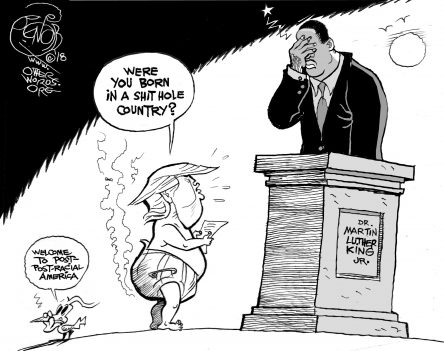
The old term for that was a banana republic. But perhaps a more “presidential” term would be a s—hole country.
Basav Sen directs the Climate Policy Project at the Institute for Policy Studies.
Where they really like quilters

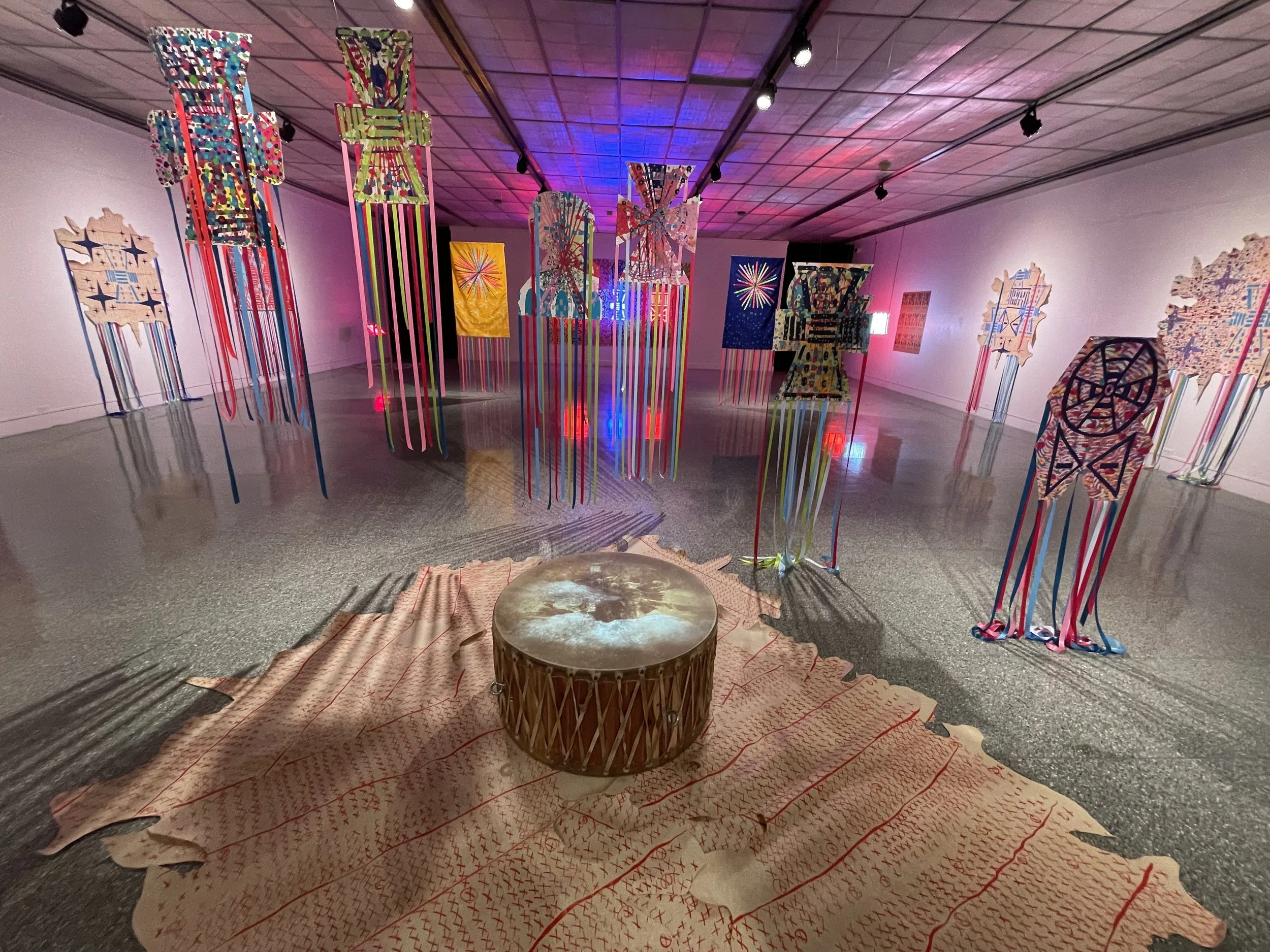
"Ghost Pockets," (mixed fabrics, including denim, cotton, polyester and synthetic wool), by Mary Lee Bendolph, in her show "Piece Together: The Quilts of Mary Lee Bendolph" through May 27, at the Mount Holyoke College Art Museum, South Hadley, Mass. The museum says that Bendolph has made more than 150 quilts in her lifetime, "adapting traditional African-American designs to create beautiful and functional works of art that have been featured in Hallmark cards and American postage stamps.''
There's long been a deep interest in folk crafts in Mount Holyoke's region of western Massachusetts.
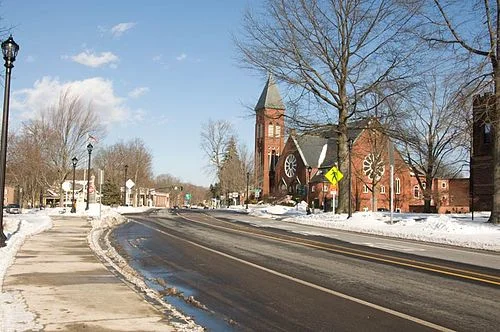
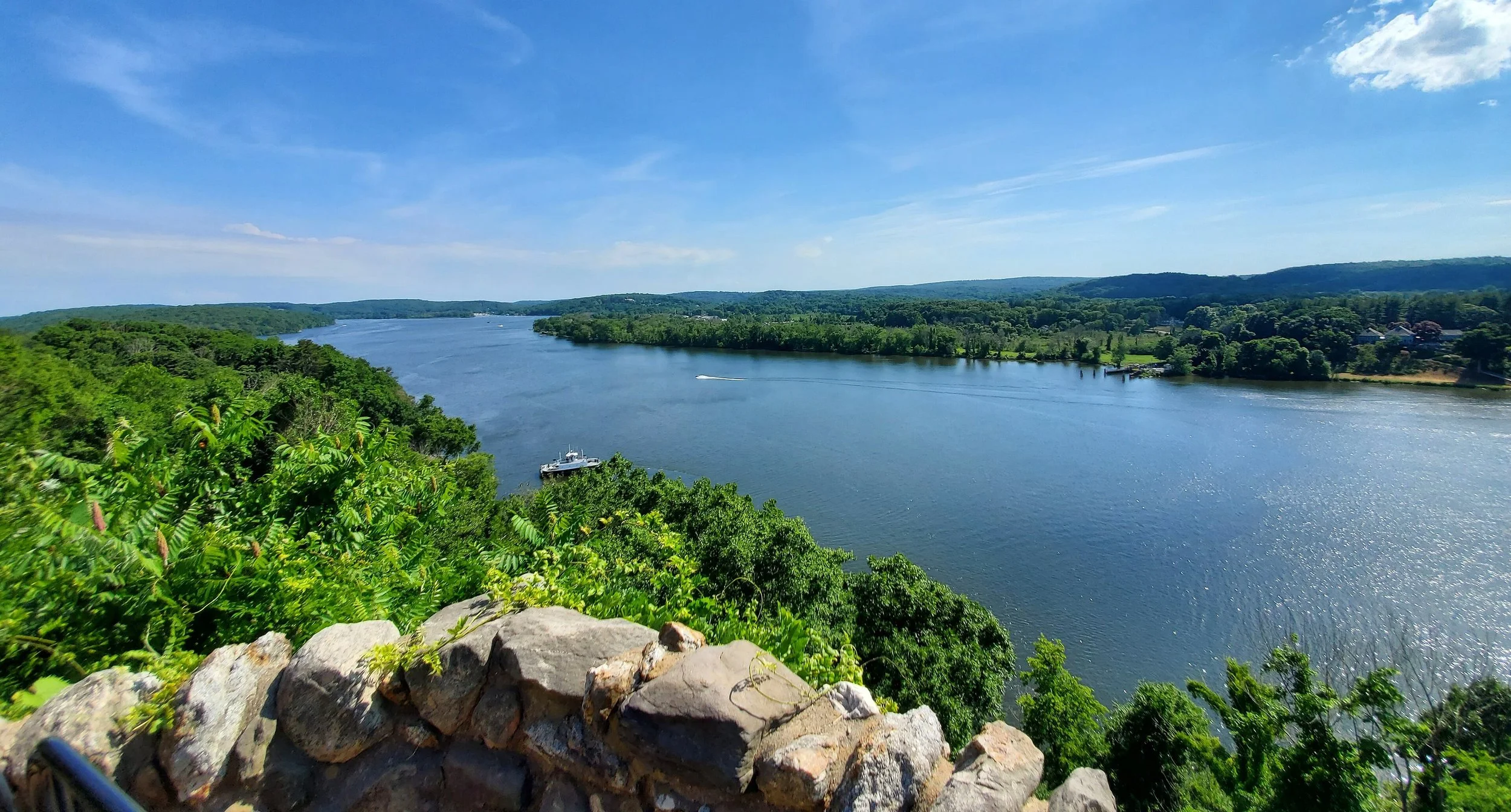
Wintry scene in South Hadley.
South Hadley, in the long stretch of the Connecticut River Valley nicknamed "the Pioneer Valley'' by marketing people, hosts Mount Holyoke College, South Hadley High School, Pioneer Valley Performing Arts Charter Public School and the Berkshire Hills Music Academy. Mount Holyoke College is a member of the famous Five College Consortium in the Pioneer Valley, along with Smith, Amherst and Hampshire colleges and the University of Massachusetts at Amherst.
More than mystical
There really is a Mystic Pizza, in the eponymous town in Connecticut. The eatery inspired the film of the same name, a coming-of-age tale focused on three women working there are waitresses. The movie helped to make Matt Damon and Julia Roberts stars.
https://www.youtube.com/watch?v=muLvjpHGHig
And handy for congressional insider trading
From Robert Whitcomb's "Digital Diary,'' in GoLocal24.com:
Congress, at least in recent sessions, has not particularly cared about poor people with limited access to medical care. As Robert Pear noted in The New York Times, “They cannot agree on subsidies for low-income people under the Affordable Care Act or even how to extend funding for the broadly popular Children’s Health Insurance Program.’’ Many Republicans have often expressed a barely disguised distaste for Medicaid and the low-income people on it, while they’re leery of offending the generally higher-income and high-voting folks on Medicare, a much more expansive program.
Most members of the House and Senate are affluent and have few interactions with poor people who are uninsured and who can’t afford doctor visits or prescription drugs.
But the solons do love expanding funding for medical research, with a plan, for example to boost the funding of the National Institutes of Health by $2 billion in the next fiscal year. Mr. Pear notes, accurately in my view, that a major reason could be that legislators think that the research could create cures for ailments that they, their families and friends might have. And of course, few legislators are young; ailments increase with age.
“{T}he cynic in me says it’s because of the prevalence of selfishness. We all want to know there’s something out there that will cure us if we need it, but many of us are quite reluctant to pay for somebody else to get cured when they need it,’’ R. Alta Charo, a law and bioethics professor at the University of Wisconsin, told The Times.
I think that there’s another element in Congress’s love of funding medical research and development: Legislators may see this as a way of getting in early on investments in the drug and medical-device sectors. Enjoy a bit of insider trading. For guidance on such lucrative activities, consult, for example, former Georgia Congressman and former Health and Human Services Secretary Tom Price, M.D.
To read The Times’s story, please hit this link.
Frank Carini: Fossil fuel, cell towers, windows MUCH more deadly to birds and bats than wind turbines
Via ecoRI News (ecori.org)
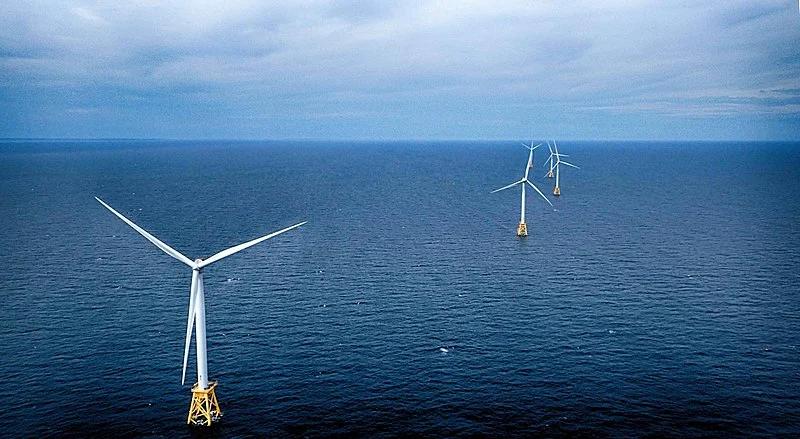
As wind power spins forward in the United States — the five-turbine Block Island Wind Farm is the first offshore wind-energy facility in the country — the giant turbine blades that generate energy are often blamed for the death of birds and bats.
Turbines certainly do kill flying creatures, but how does this oft-maligned form of renewable energy stack up against other sources that are used to power our society? Plenty of research still needs to be conducted — especially concerning bat mortality caused by energy production — but most of the research already done shows fossil fuels are more lethal than spinning blades.
North American wind turbines kill an estimated 140,000 to 328,000 birds annually, according to a 2013 study. Another 2013 study claimed every year 573,000 birds and 888,000 bats are killed by wind turbines. A 2014 report claims turbines kill between 214,000 and 368,000 birds annually.
The peer-reviewed 2014 study by two federal scientists and the environmental consulting firm Western EcoSystems Technology Inc., however, found that number is small compared with the estimated 6.8 million fatalities from collisions with cell and radio towers. The study’s authors estimated that on an annual basis less than 0.1 percent of bird populations in North America die from collisions with turbines.
Collisions with windows, on the other hand, kill between 365 million and 988 million birds in the United States annually.
“Properly sited wind turbines are relatively bird-friendly, especially when compared to fossil fuels,” according to the American Bird Conservancy (ABC). “However, they are far from benign.”
The Virginia-based organization has noted that wind turbines and their associated infrastructure, notably power lines and towers, are among the fastest-growing threats to birds and bats in the United States and Canada. At the end of 2016, there were more than 52,000 operating, commercial-scale, land-based wind turbines in the United States, according to the ABC, producing about 66,000 megawatts of power.
The Migratory Bird Treaty Act makes it illegal to kill any bird protected by the act, even if the death is incidental, such as being struck by a spinning turbine blade, killed during a mountaintop mining explosion, or suffocated in an oil spill. The Bald and Golden Eagle Protection Act recommends that to avoid eagle deaths companies should seriously consider where they site energy projects.
Wind-energy development, like all energy projects and infrastructure, can contribute to habitat loss, which can have significant impacts on birds, bats and other wildlife.
The ABC recommends “bird-smart” wind-energy development that ensures turbines are sited away from bird-collision risk areas; employs effective and tested mitigation to minimize bird fatalities; conducts independent, transparent, post-construction monitoring of bird and bat deaths; and calculates and provides fair compensation for the loss of ecologically important, federally protected birds.
Six decades ago hydroelectric power was celebrated as a source of renewable energy. Hydroelectric power includes both massive hydroelectric dams and the smaller mill dams that once powered the Industrial Revolution, most notably in New England. Now, many dams are being torn down because of their unintended environmental and wildlife impacts, such as changing ecosystems and impeding the path of migratory fish.
A bigger problem for birds and bats is the continued burning of fossil fuels. A 2014 National Audubon Society report noted that hundreds of bird species in the United States, such as bald eagles, are at “serious risk” because of climate change.
A 2009 study using U.S. and European data on bird deaths estimated the number of birds killed per unit of power generated by wind and fossil-fuel sources. It concluded that wind facilities are responsible for between 0.3 and 0.4 fatalities per gigawatt-hour of electricity, while fossil-fuel power power plants are responsible for 5.2 fatalities per gigawatt-hour.
Another study, published four years later, found that wind turbines kill 0.27 birds per gigawatt-hour, nuclear plants 0.6, and fossil-fuel power plants 9.4.
Bat deaths attributed to wind turbines aren't as well documented, but limited research has shown this renewable-energy source does have an impact. In Rhode Island, for instance, turbine owners have reported dead bats at the base of their structures.
Besides the dangers spinning blades pose for the only mammals that can fly, a 2011 study found that bats can succumb to the pressures created when turbine blades pass through the air, a phenomenon known as barotrauma.
While bats normally live for a long time, they, like sharks, are slow reproducers, meaning their populations rely on high adult survival rates.
All energy production comes with costs, especially to ecosystems and wildlife. Source and siting should be about making decisions based on more than just price and profit.
Frank Carini is editor of ecoRI News.
Sculptured love
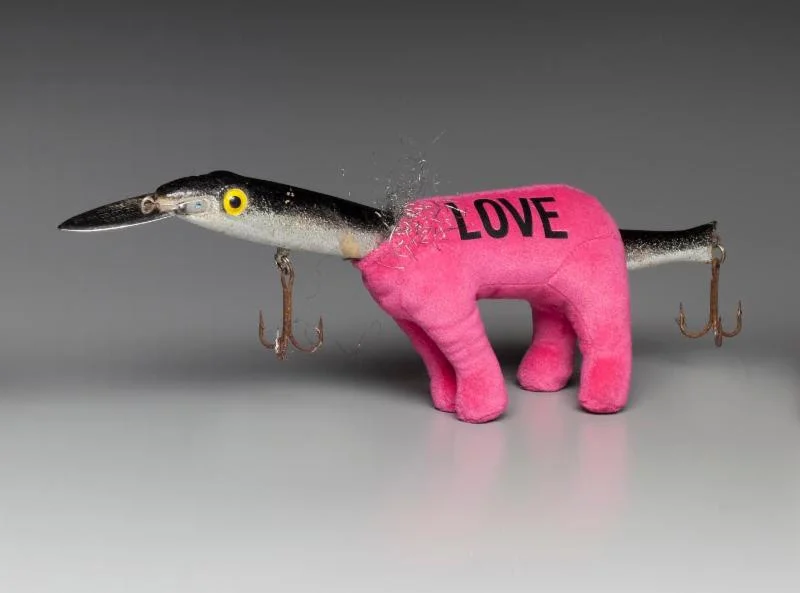
"Jawbreaker,'' by Jodi Colella, in the show heART, at Boston Sculptors Gallery, Jan. 31-Feb. 25. The members show is meant to show the love spectrum from end to end.
Gallery Director Almitra Stanley explained, "Matters of the heart are universal to our life experience. Featuring a wide range of sculptural interpretations-from sweetheart and heart throb, to heartburn, heartbreak, and heartless-this exhibition gives a glimpse into the collective heart of the Boston Sculptors Gallery.''
Llewellyn King: A great process movie about the press; an apology at a famed restaurant
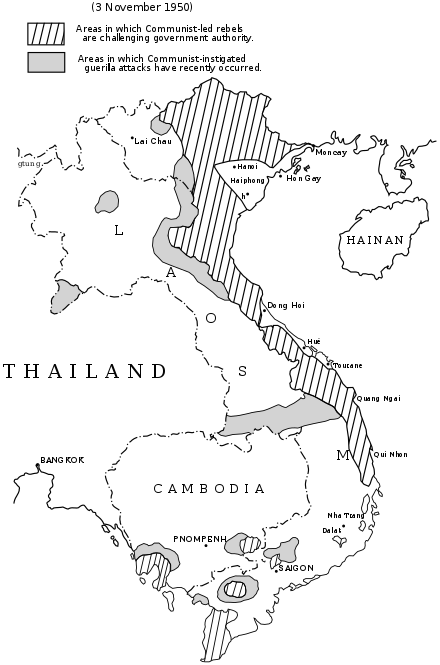
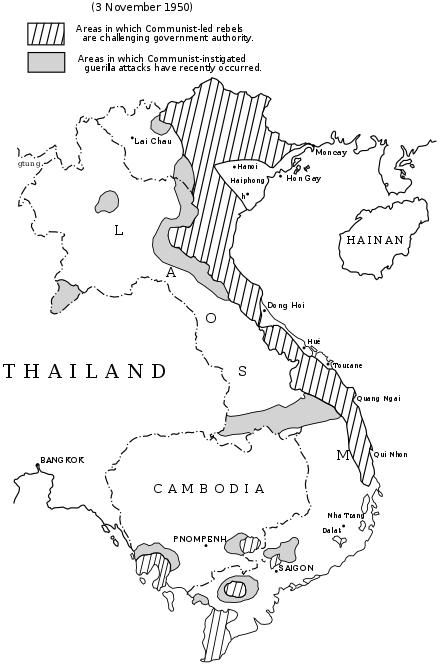
A CIA map of dissident activities in Indochina, published as part of "The Pentagon Papers.''
I read somewhere that director Steven Spielberg says he does not read books. However Spielberg gets his information, he has gotten the newspaper trade right, very right in The Post.
It is one of the best films about the inside workings of a newspaper.
It involves the decision, reached between the publisher of The Washington Post and its editor in June 1971, to publish the collection of secret documents detailing the hopelessness of the Vietnam War from 1964 onwards. Collectively, these are known as "The Pentagon Papers''. They showed conclusively that the government had always known that the war was a losing proposition and covered it up. They also, it must be said, showed that the media, for all the reporters crawling over South Vietnam, did not know what the government knew. The story was missed.
This is a film apposite for our time, both as an illustration of the duplicity of governments, in this case under Democratic and Republican administrations (Eisenhower, Kennedy, Johnson and Nixon), and the key role of a free press in checking government.
It is also a shot in the arm for the newspaper trade, which is under attack frontally from President Trump and his merry band of besmirches and from financial undermining, occasioned by the flight of advertisers to the Internet.
This is a work that is not only fine entertainment but also very accurate. I can make that statement because I was working at The Washington Post at the time and I knew the protagonists, Ben Bradlee, the storied editor, and his publisher, Katharine Graham.
Watching this film I marveled at how much Tom Hanks looked like Bradlee, given he was a little heavier than Bradlee, who delighted in looking like David Niven playing a jewel thief in the South of France. Graham, always called “Mrs. Graham,” is very well replicated by Meryl Streep, although Graham was a little taller and maybe a smidgeon more imperial.
It is Hanks's portrayal of Bradlee that floored me. He is Bradlee, the boulevardier who used profanity as a tool and could drop an expletive as though it were a precision-guided munition.
Graham and Bradlee risked prison to publish the papers, as did editor Abe Rosenthal and publisher Arthur Sulzberger, at The New York Times. You will come out of this movie feeling good about the First Amendment, good about newspapers, bad about governments.
You will be very glad the film industry has a talent as great as Spielberg.
A lesser director might have settled for getting Graham and Bradlee right, but Rosenthal and Ben Bagdikian, The Post's national editor, too? That is meticulous.
Even the atmosphere of the composing room, back when linotype machines clattered and skilled fingers spaced and secured the little lines of type, is authentic. Hot-type aficionados, like me, rejoice.
Those were the days. And this is the movie.
The Night That Paul Bocuse Messed Up
Paul Bocuse, widely described as the most important chef of the last century, has died at 91. He invented "nouvelle cuisine,'' a new form of high French cooking. More fresh produce, lighter sauces and the imaginative pairing of flavors and ingredients marked it. It is reflected in nearly all the fashionable restaurants of today and has influenced chefs around the world.
I was lucky enough to be a guest, along with 11 other diners, at the great man’s legendary restaurant L’Augberge du Pont de Collonges, near Lyon. It was an experience that foodies dream about. The restaurant had an open kitchen of the kind that came to be associated with California: You could watch the chefs work. Bocuse and his wife both stopped by our table.
The food? Exceptional – even though one order got lost. The order just didn’t make it out of the kitchen, and the result was the whole restaurant felt the shame.
When we left one of the captains followed me -- thinking that I might be a food writer, which I was not -- to apologize. He said simply, “Please believe me, we usually do better.”
Indeed, the great chef did, and in doing so changed the world of fine dining.
When I have told this story to people who know more about Bocuse and his legacy than I do, they tell me I may be the only person who left with an apology: a three-star Michelin apology. I am humbled.
The Things They Say
"Facts are better than dreams.''
-- Winston Churchill
Llewellyn King, executive producer and host of White House Chronicle, on PBS, is a veteran publisher, editor, columnist and international business consultant. He's based in Rhode Island and Washington, D.C.
Jill Richardson: About those expletive countries
Via OtherWords.org
We recently learned that Donald Trump referred to African nations and Haiti using a derogatory and profane term. (Accounts differ, but all seem to agree it ended with “hole.”)
Writing off an enormous percentage of the world’s landmass and population as inferior isn’t just nasty, it’s incorrect.
It’s true that some nations have oppressive, despotic, or corrupt governments. Some have high rates of poverty. I don’t envy the citizens of North Korea, as they have both.
But human nature is universal. Human beings in every country demonstrate the same levels of courage and bravery, compassion and kindness, and intelligence and ingenuity as we do here in the United States.
I’ve traveled to five continents (all but Australia and Antarctica) and I’ve met people in each place who excel in ways Americans value — such as by attaining college educations or succeeding in high paying careers.
But I’ve also encountered incredible people proving their greatness in other ways.
In Mexico, I visited boarding schools in which the children, some as young as seventh grade, grew, harvested, and cooked their own food every single day, in addition to attending class and completing homework.
They did this without tractors, refrigerators, or stoves. Making breakfast meant waking up before dawn to light a fire (with wood they chopped themselves) and cooking beans and tortillas from scratch.
In the Philippines, I visited a community that was being exploited by a multinational corporation. The community called in an international non-profit organization to investigate and publicize what was happening. Then they bravely gave their names and told their stories publicly, risking retaliation as they attempted to fight for their rights.
In Kenya, children spend far more time in school than Americans do. I stayed with a family whose two kids arrived at school earlier and stayed later than I ever had to — and they went back for more on Saturdays. In Kenya, such dedication to school work is normal.
In Cuba, I found people who could invent just about anything from simple materials. One man created a hydraulic irrigation device out of a few soda bottles and some plastic tubing. With no electricity, the device turned the water on and off at regular intervals, providing the right amount of irrigation to the man’s guava seedlings.
These were not unusually extraordinary people. Just as many Americans exhibit brilliance, creativity, and hard work, so do people everywhere.
However, there is value in diversity. By traveling and meeting people from five continents, I not only encountered diversity in skin colors, languages, and cuisines — I also encountered diversity in ideas.
Americans can only lose if we shun people from the rest of the world. When we meet and work with people from each different culture on earth, whether here in the U.S. or outside it, we gain from their unique perspectives just as they gain from ours.
Some of the most exciting developments I’ve witnessed have come from two or more cultures working together, combining the ideas of each to create something more than the sum of its parts.
A nation’s poverty isn’t a mark of its people’s intelligence — or their value. By all means, criticize oppressive governments. Hate poverty, war, and disease. But remember that people everywhere possess the same common humanity that makes each culture on earth great.
Jill Richardson, an OtherWords.,org columnist, is the author of Recipe for America: Why Our Food System Is Broken and What We Can Do to Fix It. .
Spare us more show-biz charisma
From Robert Whitcomb's "Digital Diary,'' in GoLocal24.com:
That Oprah Winfrey would be seriously considered as a presidential candidate is just another sign of the American decadence and decline demonstrated in the Electoral College having to present the Oval Office to a con man. But then in a country where fewer and fewer read seriously, ignorance of history and governmental operations is widening and most people get their public information from TV and social media sound and site bites, it’s no wonder that another “charismatic’’ TV celeb would be pushed forward. Perhaps Winfrey’s puffing of various medical and other con artists will block her candidacy, but in a decadent nation, don’t bet on it.
We can hope that successful – and honest -- chief executives, preferably a current state governor who knows how to make government work well, will be the presidential nominees in 2020. (Obama had far too little administrative experience. So did Lincoln, but he was a genius.)
Don’t government experience and knowledge, and judgment under the pressure of very big decisions affecting millions of people, count for much anymore when we’re filling America’s most important job? Have we become that superficial and silly?
Please spare us from another overdose of “charisma.’’
A fence with nothing to do
"Even the sky here in Connecticut has it,
That wry look of accomplished conspiracy,
The look of those who’ve gotten away

With a petty but regular white collar crime.
When I pick up my shirts at the laundry,
A black woman, putting down her Daily News,

Wonders why and how much longer our luck
Will hold.  'Months now and no kiss of the witch.'
The whole state overcast with such particulars.

For Emerson, a century ago and farther north,
Where the country has an ode’s jagged edges,
It was 'frolic architecture.' Frozen blue-

Print of extravagance, shapes of a shared life
Left knee-deep in transcendental drifts:
The isolate forms of snow are its hardest fact.

Down here, the plain tercets of provision do,
Their picket snow-fence peeling, gritty,
Holding nothing back, nothing in, nothing at all.''
-- From "A Winter Without Snow" (1945), by J.D. McClatchy.

'As you twist my arms'
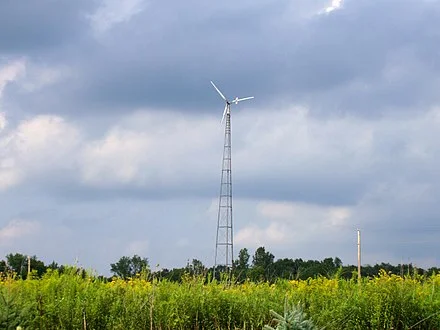
"You think I like to stand all day, all night,
all any kind of light, to be subject only
to wind? You are right. If seasons undo
me, you are my season. And you are the light
making off with its reflection as my stainless
steel fins spin.
On lawns, on lawns we stand,
we windmills make a statement. We turn air,
churn air, turning always on waiting for your
season. There is no lover more lover than the air.
You care, you care as you twist my arms
round, till my songs become popsicle.''
-- From "A Windmill Makes a Statement,'' by Cate Marvin
Island of the 'Stone Sloopers'
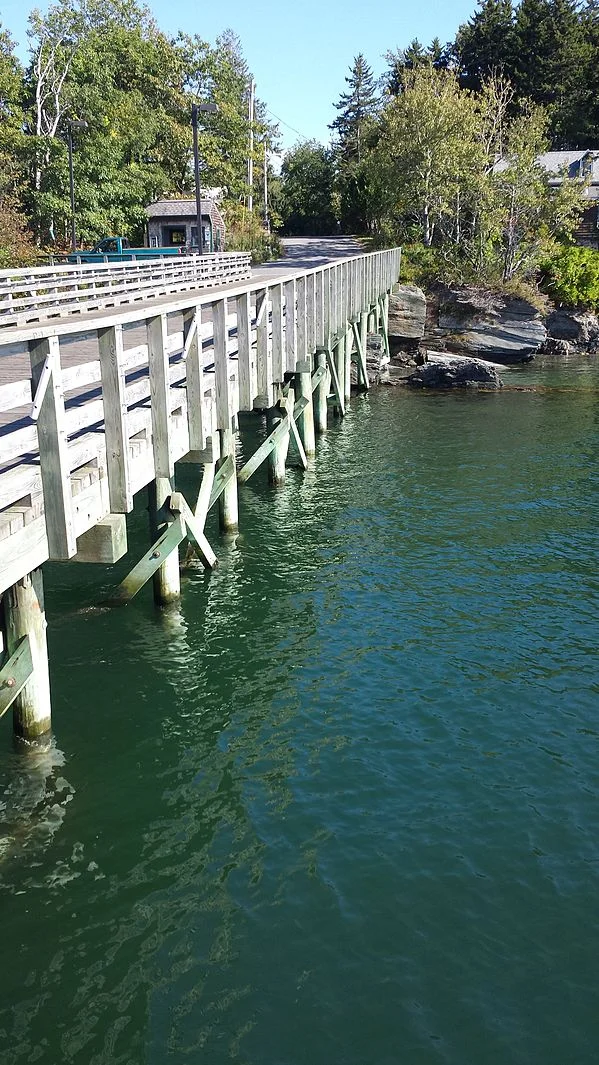
Landing place on Chebeague Island, in Casco Bay.
"Chebeague Island is the largest of the islands in Casco Bay, near Portland Maine. Everyone knew everybody else on the island, and if they were not related, they were friends, or at the very least knew everything there was to know about each other, including what they had in their stew pot at any given time. Most of the islanders, including the Kimberly family, were descendants of the “Stone Sloopers.” On Chebeague Island they built three wharves. The Stone Wharf, or Hamilton Landing as it was known, is still in use today. The one-masted sloops, sometimes known as Chebacco Boats, sailed along the rocky Maine coast transporting granite and stone from Maine’s coastal quarries, to east coast cities as far south as Chesapeake Bay. The Washington Monument and many of the governmental buildings in Washington, D.C., were built of granite brought up the Potomac River by the Stone Sloopers. During the 19th Century, they also supplied rock ballast for the sailing ships that came into New England ports. The Stone Sloopers are also remembered for building Greek revival homes, which can still be seen on the island.”
-- From Seawater One..., by Hank Bracker
LeeAnne Hall: Many have jobs BECAUSE they're on Medicaid
On Jan. 11, the Trump administration issued a cruel announcement: If you can’t find a job, don’t count on being able to get health care.
Under an unprecedented new policy, the administration will let states kick people off Medicaid for the crime of being unemployed. Instead of providing good jobs to struggling people, the administration is offering threats and tougher times.
Those hurt could include the Carrier plant workers from Indiana, whose jobs Trump promised to save when he was campaigning for the presidency. Last year, the company announced 600 layoffs.
Now the last of these employees are being pushed out the door. One worker says she’s “a lost paycheck away from homeless.”
Imagine telling her Medicaid won’t be there for her on top of everything else she’ll lose. The heartlessness is incomprehensible.
Still, her state’s governor is one of ten that’s jumping on the administration’s new proposal to require work or work-related activities. Kentucky’s plan has already been approved.
This is no way to treat people you claim to care about — especially when lawmakers can improve our lives with policies providing child care, paid family and medical leave, and living-wage jobs in a clean-energy economy, to say nothing of affordable health care for all.
Simple facts show that this work requirement isn’t about jobs. Most working-age adults who use Medicaid already work, and many of them have jobs thanks to Medicaid — not despite it.
That’s because Medicaid helps them get and stay healthy enough to work. After Ohio expanded Medicaid, three quarters of those who signed up said getting coverage helped them get work. In Michigan, more than two-thirds also said it helped better at a job they already had.
This policy is another blow for those facing racial or other discrimination on the job. It punishes people in job-scarce communities. It hurts people struggling to find work when they have a past criminal conviction.
And, while the administration says people with disabilities won’t be affected, that could be by only by the strictest definition of disability. Those who’ve been hurt on the job won’t necessarily be protected. Neither may many people struggling with addiction, mental health concerns, or physical conditions that make working difficult or impossible.
We can see from Kentucky’s plan what this could look like. New premiums for struggling families. Paperwork lockouts. A financial or health “literacy test” reminiscent of tests that barred African American people from voting. State officials say 90,000-95,000 people will lose their coverage.
Last year, Americans demanded we not go backwards on health care. Thousands of us showed up at town halls to block the GOP effort to repeal the Affordable Care Act and the gutting of Medicaid.
Everyone should get the care they need.
The expansion of Medicaid under the Affordable Care Act was a step in that direction. It gave many of us hope for the country we can be: one where a family’s fortunes don’t depend on the good graces of a giant corporation, and our lives don’t depend on the size of our wallet.
We still have a long way to go. Many are shut out of health care because of citizenship status, because coverage is still too expensive, or because our states refuse to expand Medicaid.
But the Trump administration and GOP Congress are moving us backward. This new Medicaid scheme is just part of it. There’s also the recent tax bill that will raise insurance premiums while giving huge cuts to corporations like Carrier — which, according to one employee facing layoffs, is “getting money hand over fist.”
Americans want health care expanded, not taken away. They can’t trick us with yet another scheme. Let’s raise our voices again and protect Medicaid.
LeeAnn Hall is the co-director of People’s Action and a member of the executive committee of Health Care for America Now. Distributed by OtherWords.org.
Todd McLeish: Climate change, plastics create rising tide of invasives
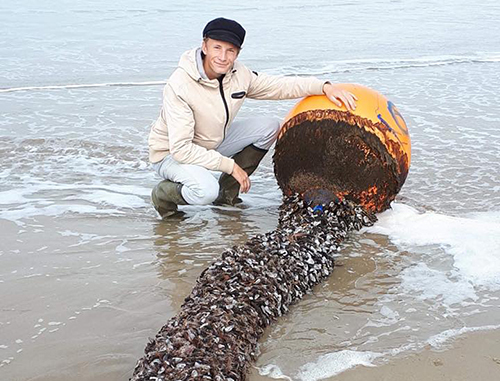
Aaron Fabrice found this Rhode Island-based buoy in early October along the Belgian coast.
-- Photo by Diederik D’Hert
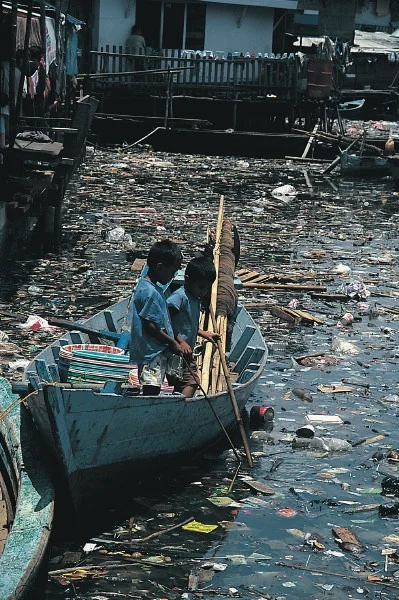
Marine plastic and other debris.
Via ecoRI News (ecori.org)
Aaron Fabrice found this Rhode Island-based buoy in early October along the coast of Belgium.
A large buoy that washed ashore on the coast of Belgium in October — trailing a 10-foot rope that was covered in hundreds of goose barnacles, crabs and shrimp — has been traced to an offshore lobster boat based in Point Judith, R.I.
The discovery of the buoy and attached marine life illustrates one of many ways that non-native marine life finds its way to distant shores. And one Massachusetts scientist believes it’s a vector for invasive species that will become more and more common as climate change produces increasingly severe storms that will toss sturdy plastic debris into the ocean.
Aaron Fabrice, 20, who describes himself as a beachcomber, citizen scientist, conservationist and nature guide, found the buoy Oct. 8 on a beach in the town of De Panne, on the northwest coast of Belgium. He said the discovery was “like a dream” as he and a friend counted 39 Columbus crabs, native to the Sargasso Sea near Bermuda, nestled between hundreds of goose barnacles. He claims it is “the largest observed stranding [of Columbus crabs] on the Belgian coast ever.”
Fabrice also found numerous skeleton shrimp on polyps on the barnacles, a species he said is commonly found attached to floating debris.
After collecting samples of the crabs for the Royal Belgian Institute for Natural Science, Fabrice posted photos of the buoy to beachcombing and lobstering message boards showing the unique combination of letters and numbers printed on it. Two months later, he learned that it belonged to Rhode Island lobsterman Roy Campanale Jr. of Narragansett, who acknowledged to Fabrice that he lost the buoy off his boat Mister Marco sometime in 2016.
“We did not expect that North American floating objects would wash up on our coast,” wrote Fabrice in an e-mail message. “Normally floating objects from North America wash up in Cornwall, U.K., or Brittany, France. There must have been an Atlantic seawater bubble coming through the channel in the North Sea.”
According to Jim Carlton, an ecologist at Williams College, in Williamstown, Mass., who studies marine invasive species, debris from North America shows up on the coast of Europe fairly regularly, and it’s often colonized by a wide variety of marine life. He said that goose barnacles and Columbus crabs are oceanic species that can’t live in the coastal zone, so they are unlikely to become established in Belgium and affect native species.
But, he added, it could be that there were species from North America that were buried within the barnacle-crab community.
Carlton has studied the transoceanic dispersal of marine life in great detail. Last fall he published a paper in the journal Science about the nearly 300 species of Asian marine life he and his colleagues found on debris along the West Coast that they traced to the 2011 earthquake and tsunami in Japan.
He said natural disasters provide a greater opportunity for the dispersal of species across the Pacific than ever before, because of all the plastic objects that make up modern daily life. Before plastic became ubiquitous, most storm-tossed marine debris consisted of wood, vegetation and other biodegradable materials that would disintegrate before they made it across the oceans.
“That got us thinking that the story of ocean rafting has shifted rather remarkably in the last half century,” Carlton said. “The plastic rafts at sea now are very enduring. They’re not degrading and dissolving. Animals can go on a much longer voyage now than they could have historically when they were drifting on a piece of vegetation.”
The implication is quite dramatic. Carlton believes that the tsunami-caused invasion of species from across the Pacific is only a hint of what is to come. As increasingly severe storms — the result of a changing climate — hammer coastlines around the world, more and more marine species will find their way across the oceans on plastic debris, ultimately causing a homogenization of the world’s coastlines.
“Imagine the amount of debris that came off the Caribbean islands during the hurricanes last fall — many hundreds if not thousands of buildings and all of their contents were swept into the ocean,” he said. “The climate models and evidence strongly suggest that we’re going to be entering a world of more of these cyclonic systems, making ocean rafting potentially one of the major new vectors for invasive species.”
Todd McLeish runs a wildlife blog. His next book about threatened wildlife, Return of the Sea Otter, will be published March 20.
Video and text:The man from Worcester who helped bring Modernism to America and then imploded
Scofield Thayer was a rich, brilliant and ultimately insane young man from Worcester who helped bring Modernism to America. Hit this link to learn more, and then plan to see the movie.
And see/hear this interview.

A memorable conflict
Here's a wonderful documentary film about Robert Frost. It's called A Lover's Quarrel With the World.