
Vox clamantis in deserto

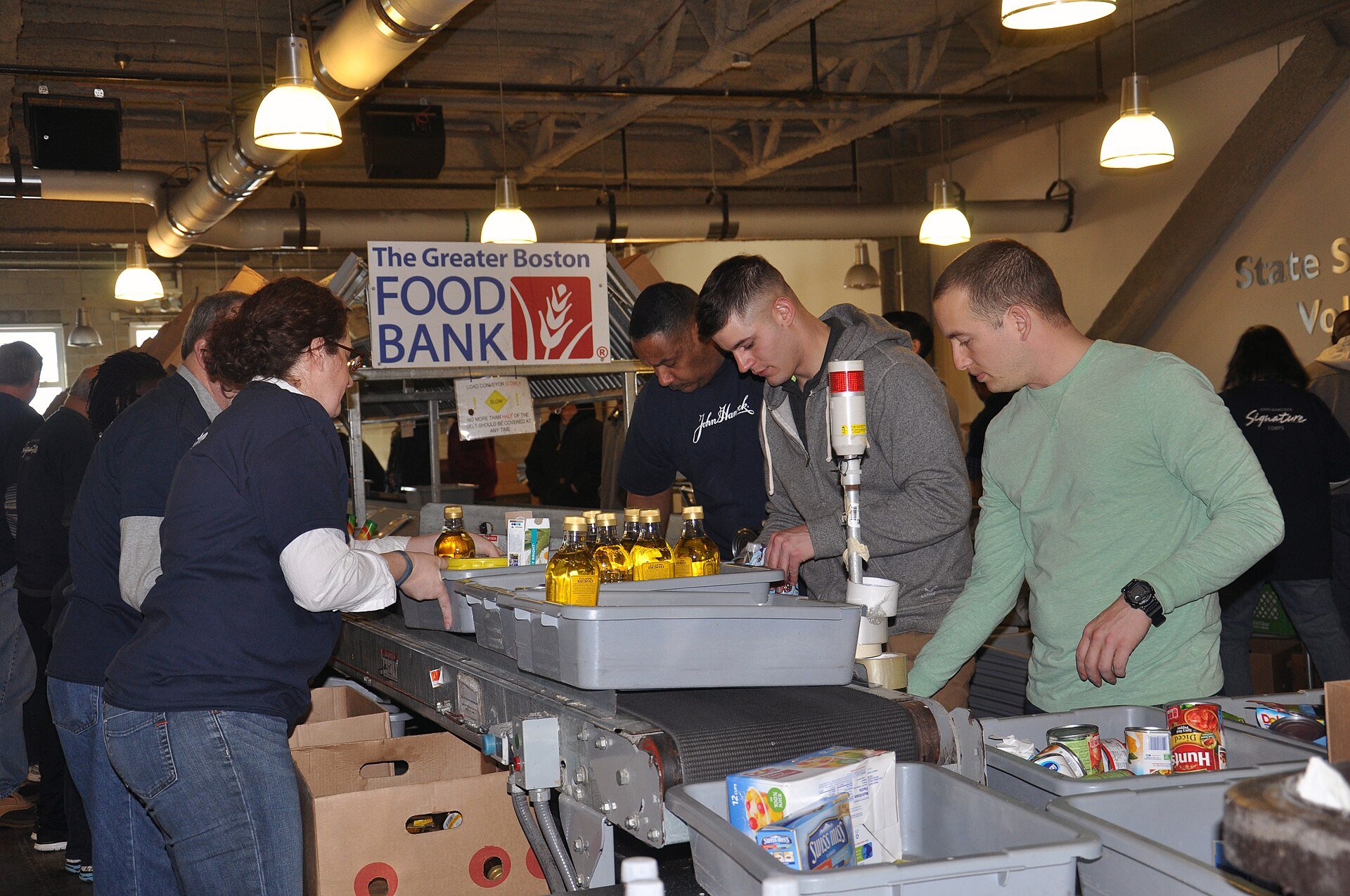
Try to glom onto megacity wealth
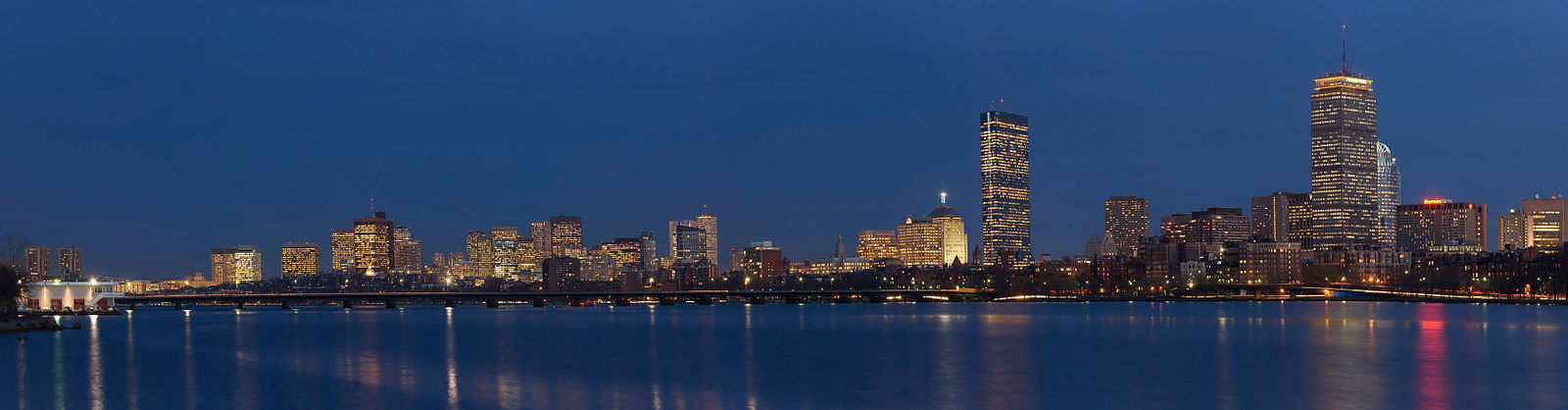
The Boston skyline from across the Charles River in Cambridge.
From Robert Whitcomb's "Digital Diary,'' in GoLocal24.com:
Emily Badger had a very important story in the Dec. 24 New York Times entitled “The Megacity, Untethered: Urban Giants are going global but losing their connections with smaller neighbors’’.
It basically says the such big globalized high-tech cities as Boston, San Francisco and Seattle no longer need as much their old connections with manufacturing centers, both nearby or elsewhere in America. She writes:
“The companies that now drive the Bay Area’s soaring wealth — and that represent part of the American economy that’s booming — don’t need these communities in the same way. Google’s {which also has a large operation in Cambridge/Boston} digital products don’t have a physical supply chain. Facebook doesn’t have dispersed manufacturers. Apple, which does make tangible things, now primarily makes them overseas.’’}
“A changing economy has been good to the {San Francisco} region, and to a number of other predominantly coastal metros like New York, Boston and Seattle. But economists and geographers are now questioning what the nature of their success means for the rest of the country. What happens to America’s manufacturing heartland when Silicon Valley turns to China? Where do former mill and mining towns fit in when big cities shift to digital work? How does upstate New York benefit when New York City increases business with Tokyo?’’
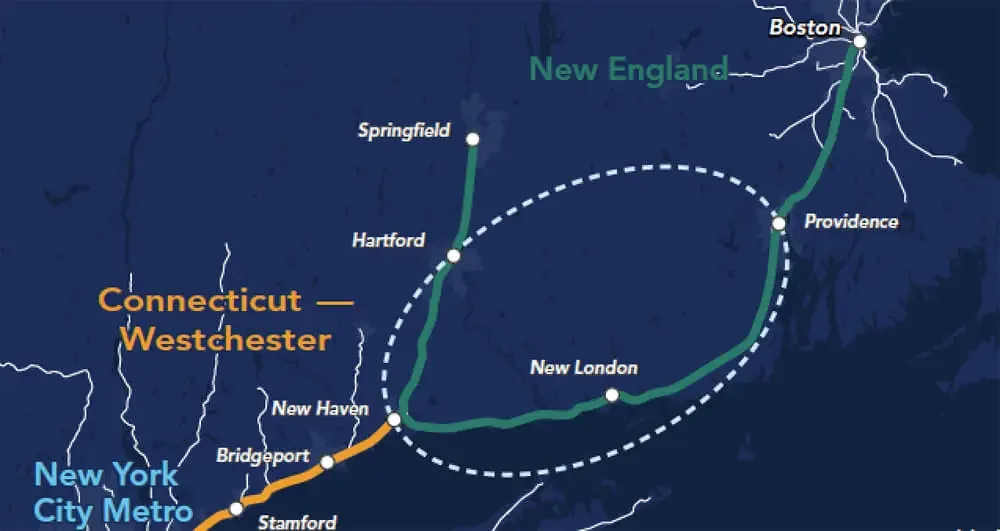
So how do the old manufacturing cities of, for example, Worcester and Providence deal with this problem? They become lower-cost extensions of Greater Boston, using their higher-education institutions to supplement the work being done in Greater Boston. They’re better positioned to do this sort of thing than are most old American mid-sized cities.
'Holes in the roads'

Why we get frost heaves.
"Testing the soul's mettle,
the frost heaves
holes in the roads
to the heart,
the glass forest
raises up its branches
to praise all things
that catch the light
then melt.''
-- From "New England Winter,'' by Erica Jong
'Fleeting fragments'
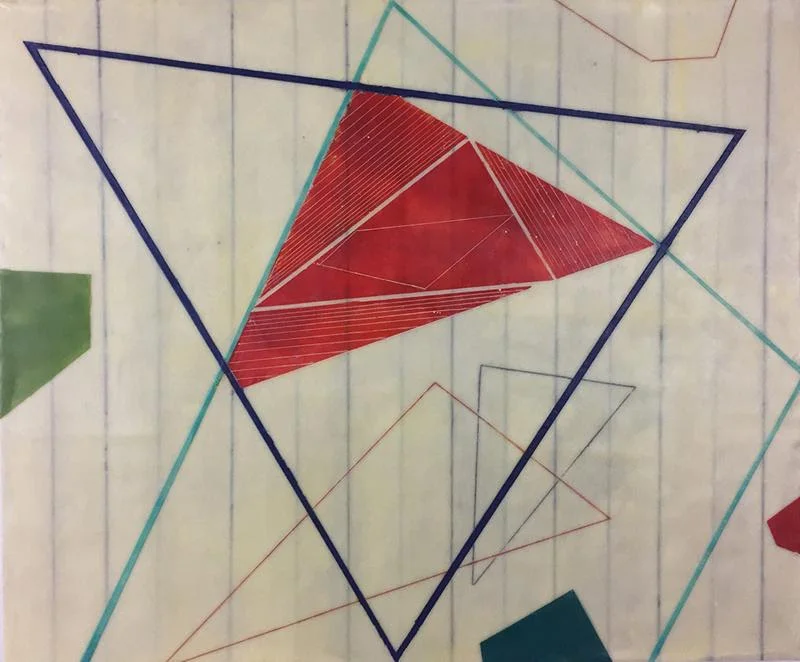
"Ukiyo6'' (encaustic and oil on wood), by Steven J. CabraL, in his show "The Depth of Stillness,'' at Galatea Fine Art, Boston, through Jan. 28.
The gallery says:
"The Ukiyo Series focuses on shifting perspectives and depths. It offers a journey of interactions filled with forms and lines that drift above and glide through atmospheric planes, while evoking a sense of energetic playfulness and movement. This collective body of work is a synthesis of inner thoughts and emotions which are depicted in narrative hues and shapes, meant to capture the fleeting fragments of past, present, and future.''
Schuss to the N.E. Skl Museum
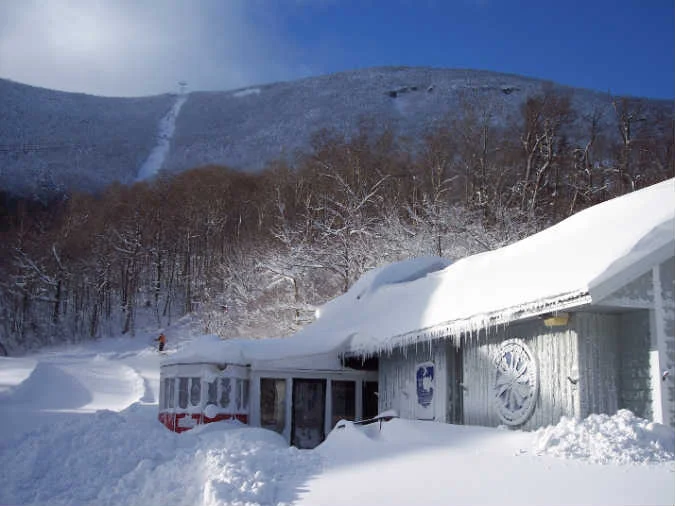
The New England Ski Museum, in Franconia, N.H., in the appropriate time of the year. That's Cannon Mountain behind it.
The Cannon Mountain Ski Area is state-owned and has nine lifts servicing 165 acres of skiing (158 with snowmaking). In the 1930s, the New Deal's Civilian Conservation Corps (CCC) cut six ski trails, some later incorporated into the Cannon Mountain Ski Area. The CCC and the Works Progress Administration (WPA) completed many attractive and useful public works during the Great Depression that are still with us.
The New England Ski Museum is a wonderful place, rich with history. To read about it,
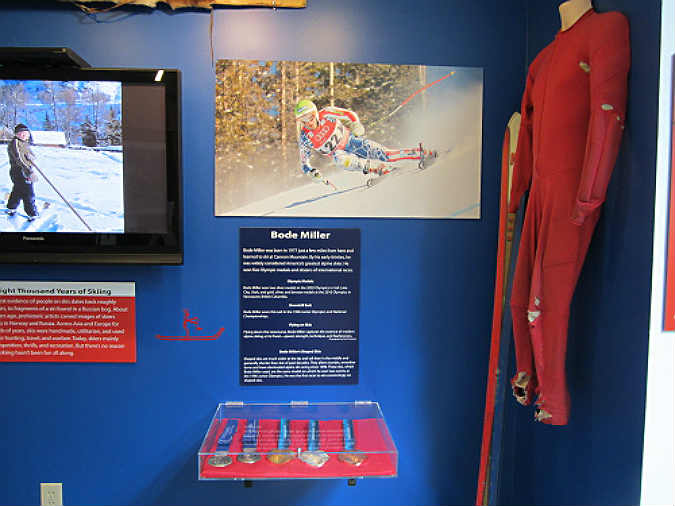
An exhibit in the museum celebrating a local hero.
A big Mormon moves on Vermont

Royalton, Vt.
The White River Valley in Vermont continues to be all shook up by the plan by David Hall, a very rich Mormon businessman from Utah, to build a bunch of 50 “villages,’’ each with up to 20,000 residents (!) in in the now generally bucolic towns of Tunbridge, Stafford, Royalton and Sharon. Mr. Hall’s NewVistas project envisions residents living in tiny housing units, thus letting most of the land be kept as countryside, and assisted by hyper-high-tech gadgets.
Of course, many of the area’s current residents hate this idea. But Mr. Hall has big piles of money as well as patience. (His father invented synthetic diamonds.)_
Why that area? Well, one reason is that Joseph Smith, founder of Mormonism, was born in 1805 on the town line between Sharon and Royalton. There’s an obelisk and museum in Sharon in his honor. It’s well worth a visit. (I’ve spent a lot of time in this rolling countryside.)
As the polite but relentless Mr. Hall pushes his dream, expect an entertaining war with stubborn Vermonters; okay, many of them are from New York.
A funny town?
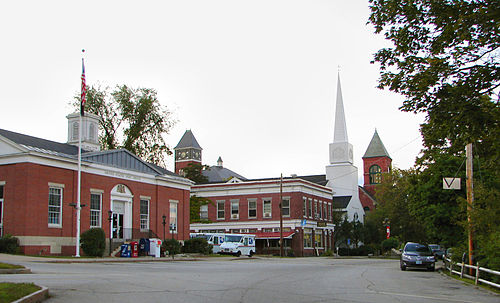
Downtown Plymouth, N.H.
''There's such an odd, eclectic group of people that make up the town of Plymouth, New Hampshire. I don't think I could avoid not coming out of there with a pretty good sense of humor.''
-- Eliza Coupe (actress) and Plymouth native.

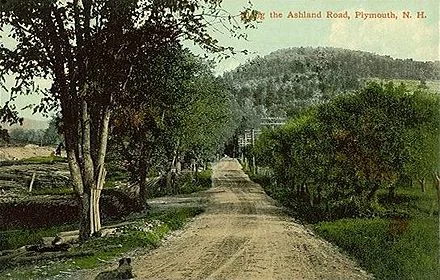
Plymouth country scene, circa 1910.
Alexandra Coso Strong/Caitrin Lynch: Learning from a moonshot
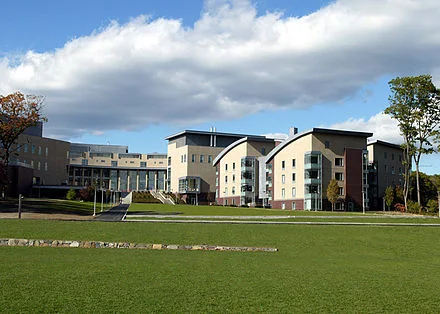
On the campus of the Franklin W. Olin College of Engineering, Needham, Mass.
From the New England Board of Higher Education (nebhe.org):
Each year, colleges around the nation select a common reading book for their incoming students or, in the case of our institution, for the entire college community. In 2017, our institution selected Hidden Figures as a reading meant to provide a common intellectual experience, illustrate the vigor and breadth of our college’s curriculum, and lend itself to a convocation discussion at the start of the school year.
Hidden Figures: The American Dream and the Untold Story of the Black Women Mathematicians Who Helped Win the Space Race, by Margot Lee Shetterly, shares the stories of four women of color who worked as human “computers” at Langley Research Center, in Hampton, Va., at the start of the space program. Katherine Johnson, who turned 99 this past August, was “the girl” whom astronaut John Glenn called on in 1961 to verify that the computer’s calculations were correct. These calculations would dictate the trajectory that would bring his orbital flight capsule safely back to Earth. Through these stories, readers learn about these heroes in science, technology, engineering and mathematics (STEM) and the invisible challenges they faced both inside and outside of work.
Now, in the deep cold of the New England winter, we begin the process of selecting next year’s summer reading. We have been reflecting on how Hidden Figures provided us the opportunity to engage with our students and colleagues on topics we might have not otherwise prioritized at the start of a school year. The form and impact of those discussions underscored for us that a good summer reading book carries with it profound immediate lessons and long-lasting consequences for the shape of intellectual debate in a community.
Fighting hate then and now
Our college community read Hidden Figures during the days surrounding the racist violence in Charlottesville, Va., and around the time of the release of a Google employee’s memo arguing that women are intrinsically less qualified for tech jobs. The historical context of the book’s narrative hits close to home in the wake of these and recent events. Its “hidden figures” point to an under-discussed example of diversity in STEM and allow us to acknowledge the critical role diverse teams have played in our nation’s history.
When our students returned to campus, Hidden Figures gave us a chance to engage in collective dialogue about not only diversity in STEM, but also these timely national issues via a compelling and concrete example. We embarked on these conversations knowing that progress in this area would rely on us building a community of trust and understanding.
Bringing our full selves to work
At a time when our country simmers with hatred, fear and misunderstanding, we, two women professors, an aerospace engineer and an anthropologist, find inspiration in the stories of Katherine Johnson and her colleagues—white and black, women and men. These individuals came together, despite Jim Crow laws and the societal pressures around segregation in the state of Virginia, to build America’s space program.
This collaborative spirit did not happen overnight, though. These Langley co-workers developed respect for and mutual understanding about each other’s backgrounds, family contexts, and skills over time, as they worked together towards a common goal. This is a lesson for all of us today: We are all products of our personal histories and differences, which impact our perspectives and our approach to problems. The Hidden Figures story represents a powerful example of what is possible when we take the time to acknowledge the complexity in the lives of people we ostracize and to join together, regardless of and because of our social differences, to achieve a collective goal.
Engaging history to find a way forward
As professors in an engineering college, this book gave us the chance to consider our work with engineering students and to ask questions about the book’s deep resonance with today’s society. While this book does not provide the answers to the challenges we face as a society, the stories of these women of color can help us shape how we collaborate with our colleagues and students.
These women are the role models we didn’t have in our own educational experiences, yet they paved the way for generations of women of color to pursue degrees and careers in STEM. By helping students connect these and other personal stories and experiences to their own, we can change the narrative of what it means to belong in STEM fields. These unsung heroes in Hidden Figures were the mathematical and engineering brains behind the operations, who helped take America to the moon, in spite of the challenges they faced inside and outside the workplace. As we engage with our students, we continue to think critically about how to support diversity within our community and a sense of belonging by each member within STEM and related fields. Through our curricular designs, we aim to help each student foster the knowledge, skills, and attitudes necessary to be a creative problem solver and an effective team member.
Taking one big step together
Hidden Figures and similar stories must be told as we continue to write our national history. It’s these personal stories, historical and current, that we should discuss with our colleagues and our students in the coming years, recognizing the our opportunities and challenges as a nation are wide-reaching as they affect all individuals, not only those in the military or scientific communities. Through collective engagement about these topics we can better understand how to overcome the workplace, societal, and educational systems and policies that impact our abilities to come together as a community to support one another and our future as a nation. This is our country’s next moonshot.
Alexandra Coso Strong is an aerospace engineer at the Franklin W. Olin College of Engineering and Caitrin Lynch is a cultural anthropologist at the college.
An unusual ad for a law firm
Herewith a very retro and very cutting-edge ad for a Rhode Island law firm. Please hit this link.
From Dartmouth to World Bank to Harvard presidency?
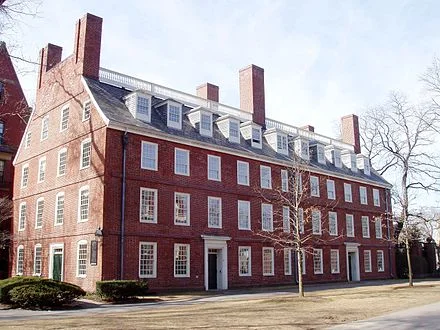
Massachusetts Hall (1720), Harvard's oldest building.
Who are the leading candidates to be the next president of Harvard? One, apparently is Jim Kim, M.D., a former Dartmouth president and the current World Bank president. Hit this link to learn more.
Video: Volcanic New England?
Learn about the molten rock rising under New England by hitting this link.
Don Pesci: The desperate search for a governor independent of parties
The hunger for an independent governor – that is, one who is independent of party allegiance -- begins to approach the intensity of the search for the Holy Grail.
Independence is regarded as a boon for several reasons, one of them best stated by Mark Twain: “Look at the tyranny of party -- at what is called party allegiance, party loyalty -- a snare invented by designing men for selfish purposes -- and which turns voters into chattels, slaves, rabbits, and all the while their masters, and they themselves are shouting rubbish about liberty, independence, freedom of opinion, freedom of speech, honestly unconscious of the fantastic contradiction; and forgetting or ignoring that their fathers and the churches shouted the same blasphemies a generation earlier when they were closing their doors against the hunted slave, beating his handful of humane defenders with Bible texts and billies, and pocketing the insults and licking the shoes of his Southern master.”
Towards the end of his life, following the death of his wife Olivia and the shattering death of his daughter Susy from spinal meningitis at age 24 while Twain and his wife were in Europe, Twain put aside his political inhibitions. His daughter died while Twain was on one of his European jaunts attempting to work his way out of bankruptcy. These were not happy years. His wife, as good wives do, had served as an anchor and political censor for much of his writing life. After her death, all the shackles fell off.
And the first prominent politician who felt Twain's public bite was Theodore Roosevelt, the nation’s first progressive president. Twain thought TR was a successful political showman, but a preposterous fraud: “Mr. Roosevelt is the Tom Sawyer of the political world of the twentieth century; always showing off; always hunting for a chance to show off; in his frenzied imagination, the Great Republic is a vast Barnum circus with him for a clown and the whole world for audience; he would go to Halifax for half a chance to show off and he would go to hell for a whole one.” The disapprobation was returned by TR, who said, “I would like to hang Mark Twain.”
Roosevelt’s independence of party was on display during the 1912 election when, having been refused the nomination of the Republican Party, Roosevelt ran for president under a progressive flag – The Bull Moose Party.”
Both as senator and governor, Lowell Weicker was a progressive independista. Having lost his U.S. Senate seat to former state Atty. Gen. Joe Lieberman, Weicker ran for governor under his own flag, A Connecticut Party, and won the general election by putting up a false front during his campaign. Instituting an income tax in the middle of a recession, said Weicker, would be like pouring gas on a fire. Connecticut’s income tax is Weicker’s legacy to his state. Weicker was as bullish on Weicker as TR was on TR. There was no love lost between Weicker and his Republican Party. Even today, there are Republicans who insist, not without cause, that Weicker, during his last years in the senate, was a faux Republican. But he certainly was – at least in respect to the state’s Republican Party -- an independent. His autobiography is titled “Maverick.” And it should not be forgotten that an income tax is the point of progressivism’s spear, the sharp edge of its sword.
Two party Republican governors followed Weicker in office. One, John Rowland, campaigned on repealing the income tax. Rowland ended up in prison on charges of corruption. Jodi Rell followed Rowland into office, retiring after a full term with an approval rating much higher than that of Gov. Dannel Malloy who, like Weicker, whipped his state with the highest and second highest tax increases in Connecticut history. Rowland and Rell were hobbled by a General Assembly dominated for nearly half a century by Democrats slouching towards progressivism.
Malloy was not inhibited by legislate drag. It would be fairly accurate to say that Weicker and Malloy, both progressives, were independent in this sense: both were rather more like Twain's TR than his William Howard Taft, whom Twain much preferred to TR. Both Weicker and Malloy overcame Republican Party opposition. The failure of progressivism in Connecticut became evident – indeed, obvious to anyone who was not a progressive – towards the end of Malloy’s first term, when the state began to leech entrepreneurial capital and young entrepreneurs to contiguous high tax states such as New York and Massachusetts.
Roland Lemar, a young Democratic state representative who works on campaigns statewide, adequately summed up the chief problem his party will be facing in the upcoming elections: “The Democratic brand in Connecticut is suffering to the point that our natural advantage that we should have in a mid-term election with a Republican president, with Democratic ranks of voters far outnumbering Republicans, we’ve lost that advantage. All the natural advantages that we should have we don’t have right now because our brand has suffered and we don’t have a candidate who can articulate where we should be.” The Democrat Party has moved too far to the left.
The Republican Party, as always, is suffering from timidity. It has not been able in past campaigns to tie the knot – to prevent the thread from slipping from the needle’s eye. But neither party needs a world-savior governor independent of either party. Been there, done that.
Don Pesci is a Vernon,.Conn.-based essayist.
The thaw and the catalogs

"There are two seasonal diversions that can ease the bite of any winter. One is the January thaw. The other is the seed catalogs."
-- Hal Borland
Between creation and collapse
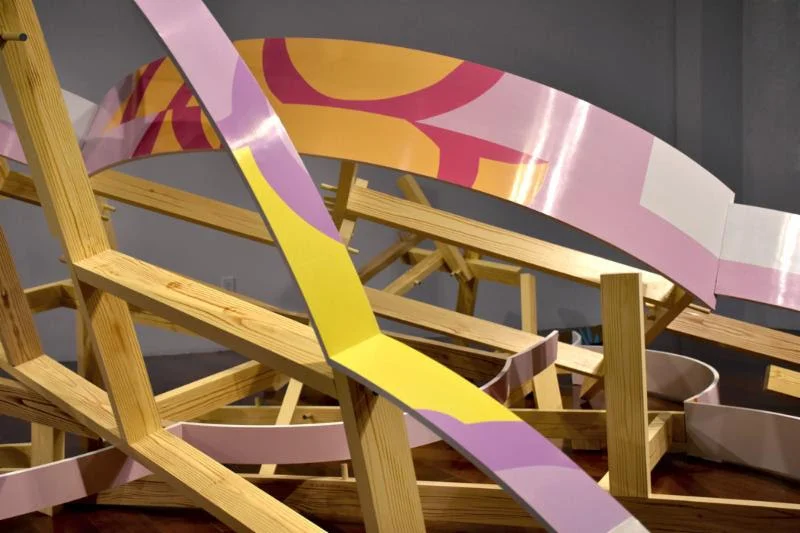
Work by Kirsten Reynolds in her show "Spin,'' through Jan. 28 at Boston Sculptors Gallery
The gallery says: "Poised between perpetual creation and imminent collapse, Kirsten Reynolds' large-scale, site-specific architectural installations activate the agency of uncertainty. Her work explores language, architecture and the body as related rational constructs that become flexible and emergent through humor, curiosity and wonder. The absurd architectural tableaus create a space between fact and fiction that the viewer can enter, becoming a participant in an irresolvable narrative.''
The 'Sacred Cod'
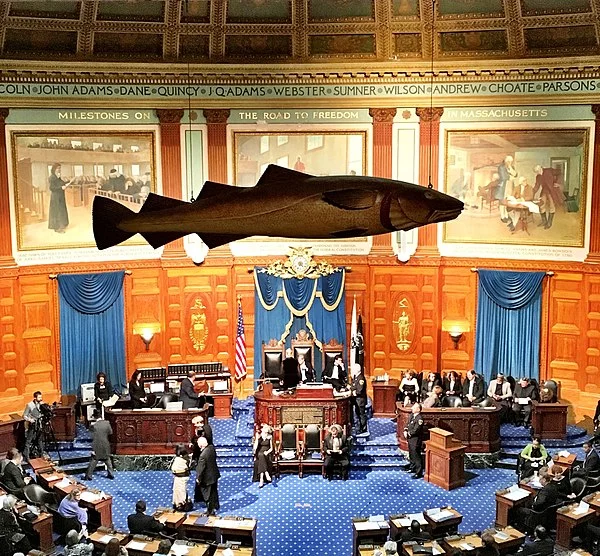
The "Sacred Cod'' hovers over the proceedings of the Massachusetts legislature.
"Generations of mariners have testified to the ocean's bounty -- in the 'Sacred Cod,' that marvelous and deceptively simple carving that hangs in Boston's State House.''
-- From The American Book of Great Historic Places (1957)
'

Joanna Detz: Climate change won't be televised

From ecoRI News (ecori.org)
They say that the revolution won’t be televised. And neither, apparently, will climate change.
But you can be sure that headline-grabbing extreme weather events will be. In the past few days, newscasts have been studded with scary militarized weather terms like Bomb Cyclone and Bombogenesis.
Snowstorm, anyone?
The literal media barrage of storm coverage in advance of the Jan. 4 snowstorm in New England sent the usual panicking crowds to the grocery stores, where the masses stripped the shelves of bread, milk and even broccoli before hunkering down, presumably to watch more storm coverage.
[Cut to the shot of the fur-hooded reporter squinting against the wind informing viewers that, “It’s really coming down out here.”]
The mainstream media, in general, do a great job of covering extreme weather events such as storms — it’s their bread and butter (and milk), so to speak.
But the challenge of contextualizing extreme weather events as part of a larger pattern of climate change continues to elude the news media. Perhaps it’s because climate change is a complex and slow-moving disaster, and one that’s difficult to distill into word cocktails that trigger clicks, hashtags, and retweets.
It could be the media is simply responding to what viewers want. It’s far easier to think about an impending snowstorm than it is the existential threat posed by human-made climate change. Ain’t no amount of bread and milk gonna fix that.
As I watch the falling snow — or is it the “bombing” snow? — I’m still waiting for the day that climate change will begin to inspire the same level of action, anxiety, and preparation that motivates the bread-and-milk crowd before a winter snowstorm.
So, here’s a thought. Let’s start by eliminating the hyperbole around weather terminology. Here are some suggested replacements:
Bomb Cyclone (n.) Snowstorm
Nor’easter (n.) Snowstorm
Bombogenesis (n.) Snowstorm
Snowmageddeon (n.) Snowstorm
Frankenstorm (n.) Snowstorm
As for Climate Change (n.), we need to come up with a far scarier term to get prime media placement and the accompanying attention of those bread-and-milk folks. Please send suggestions to jo@ecoRI.org, subject line: Triple Doppler Threat Tracker.
Joanna Detz is the executive director of ecoRI News.
PCFR: From rare earths to urban Mexico to India must deal with expansionist China
(Passing on this note from Hannah Hazelton, PCFR chairperson.)
To members and friends of the Providence Committee on Foreign Relations (thepcfr.org; pcfremail@gmail.com)
Just added: On April 25th Admiral Nirmal Kumar Verma of the Indian Navy will present a talk titled "China Moves Westward".
Wednesday, January 17th
China's Monopoly of Rare Earth Elements, with Victoria Bruce
American technological prowess used to be unrivaled. But because of globalization, and with the blessing of the U.S. government, once proprietary materials, components and technologies are increasingly commercialized outside the U.S. Nowhere is this more dangerous than in China's monopoly of rare earth elements --materials that are essential for many modern consumer goods, gadgets and weapons systems.
Bruce writes “the tsunami of science and tech companies rolling into China,” is well-known, but free market ideology has blinded us to the political consequences of allowing the Chinese to achieve international hegemony in global markets.
Victoria Bruce is an author with a background in science. Her previous books are No Apparent Danger (HarperCollins 2001), Hostage Nation (Knopf 2010) and Sellout (Bloomsbury Publishing 2017). She holds a master's degree in geology from the University of California, Riverside, where she lived on a volcano and researched the chemistry of volcanic hazards on Mount Rainer in Washington State. She has directed and produced four documentary films, earning the Alfred I. duPont-Columbia University Award for excellence in broadcast journalism.
Wednesday, February 21st
Socio-economic Effects of Palm Oil, with Dan Stechary
6:00, The Hope Club, 6 Benevolent Street, Providence
Palm oil is tainted by environmental destruction and poor working conditions but global production is soaring. As the highest-yielding vegetable oil crop, global production is soaring, and also the cause widespread deforestation over the last four decades. In 2004, a group of environmental non-profits and palm oil companies joined together to set up the Roundtable for Sustainable Palm Oil (RSPO). The roundtable sets out eight principles, citing 163 criteria, which are designed to prevent the worst aspects of palm oil cultivation: illegal deforestation, chemical pollution, greenhouse gas emissions, destruction of biodiversity, water loss, poor employment conditions etc. With nearly 3,600 members, it is the largest multi-stakeholder initiative of its kind.
Dan Strechary is the U.S. Representative of the RSPO. Based in New York, he is now responsible for outreach and engagement activities to members and stakeholder in the U.S., as well as formalizing the RSPO’s presence in this important market.
Thursday, March 8th
Veronica Herrera on Water and Politics: Clientelism and Reform in Urban Mexico
Veronica Herrera is an Assistant Professor of Political Science at the University of Connecticut. She received her Ph.D. in Political Science from the University of California, Berkeley and her B.A. from Swarthmore College. She studies comparative urban and subnational politics and environmental policymaking, with a focus on Latin America. She is the author of Water and Politics: Clientelism and Reform in Urban Mexico (University of Michigan Press, 2017). At the University of Connecticut, Professor Herrera teaches courses on Latin American politics, water and environmental politics, urban politics and policymaking, and qualitative research methods
April 25th
Admiral Nirmal Kumar Verma: China Moves Westward
Nirmal Kumar Verma is a retired Indian Navy admiral who served as the Chief of the Naval Staff of Indian Navy from 2009 to 2012. In November 2012, he was appointed as the Indian High Commissioner to Canada.
Date TBD:
Development in Post-Communist and Post-Conflict Countries, with Richard Farkas
Richard Farkas has been teaching at DePaul University for over 40 years. He holds an honorary degree from Corvinus University and has lectured in Russia, Poland, Hungary, and Croatia. His research compares strategies for political and economic development in post-Communist and post-conflict countries. Professor Farkas has consulted for some of the largest corporations in the U.S. and has appeared frequently on U.S. and international media.

'Salt for Life'

Attention people with heart disease and those who seek to avoid it:
Salt for Life® Sea Salt and Potassium Salt Blend has 75% less sodium than regular salt. It replaces that sodium with potassium salt, a necessary and often under-consumed nutrient.
For more information, please hit this link.
Empathy through metal
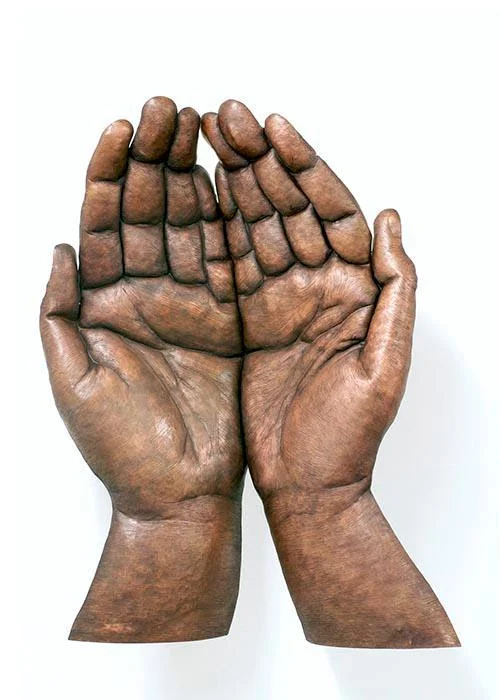
"Envelop'' ( copper with custom brass brackets, hand-formed from one sheet of copper, chased and etched), by Avery Lucas, in his show "Body of Work,'' through Jan. 28, at Bromfield Gallery, Boston. The gallery says he presents
"sculptures using materials including copper, sterling silver and stainless steel, which mimic skin and body as a way to trigger empathy. ''
Two jewels of New England art museums
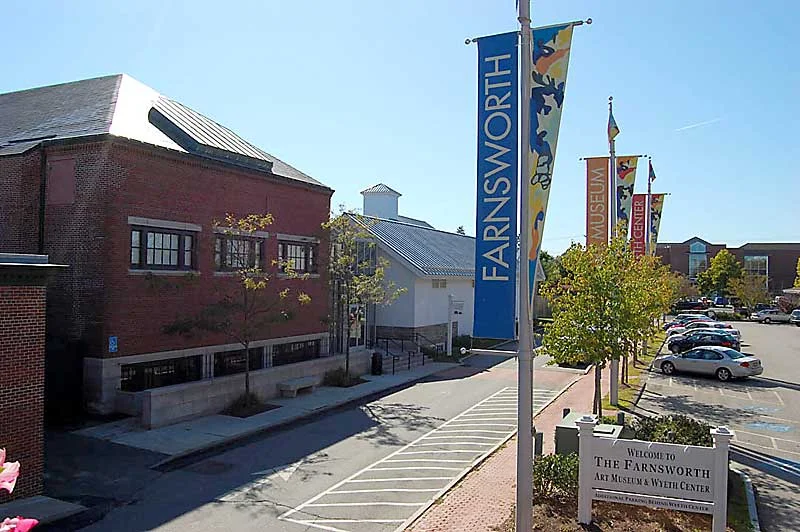
Farnsworth Art Museum, in Rockland, on the Maine coast.
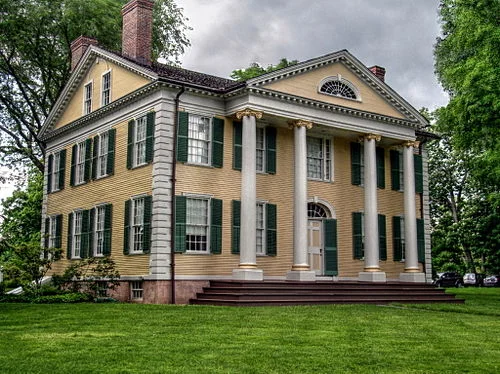
The Florence Griswold Museum, in Old Lyme, Conn.

"Summer Evening'' (oil on canvas), by Childe Hassam, 1886. Collection of the Florence Griswold Museum.
New England has many small but distinguished art museums. One is the Farnsworth Art Museum (actually it's not that small), in the surprisingly important art mecca of Rockland, Maine. Among other works, it has paintings by Andrew Wyeth and his son Jamie -- who are famous for, among other things, their Maine-set paintings. Though the Wyeths were and are from Chadds Ford, Pa., they have long summered in the Pine Tree State.
Another jewel is the Florence Griswold Museum, in Old Lyme, Conn. The museum is in a gorgeous classical building that was once home to the Lyme Art Colony -- an important place for American Impressionist painters such as Childe Hassam. They liked being so close to New York, with the biggest art market in America, and on the generally beautiful coast of Long Island Sound,. Those who take Amtrak can confirm its beauty.