
Vox clamantis in deserto





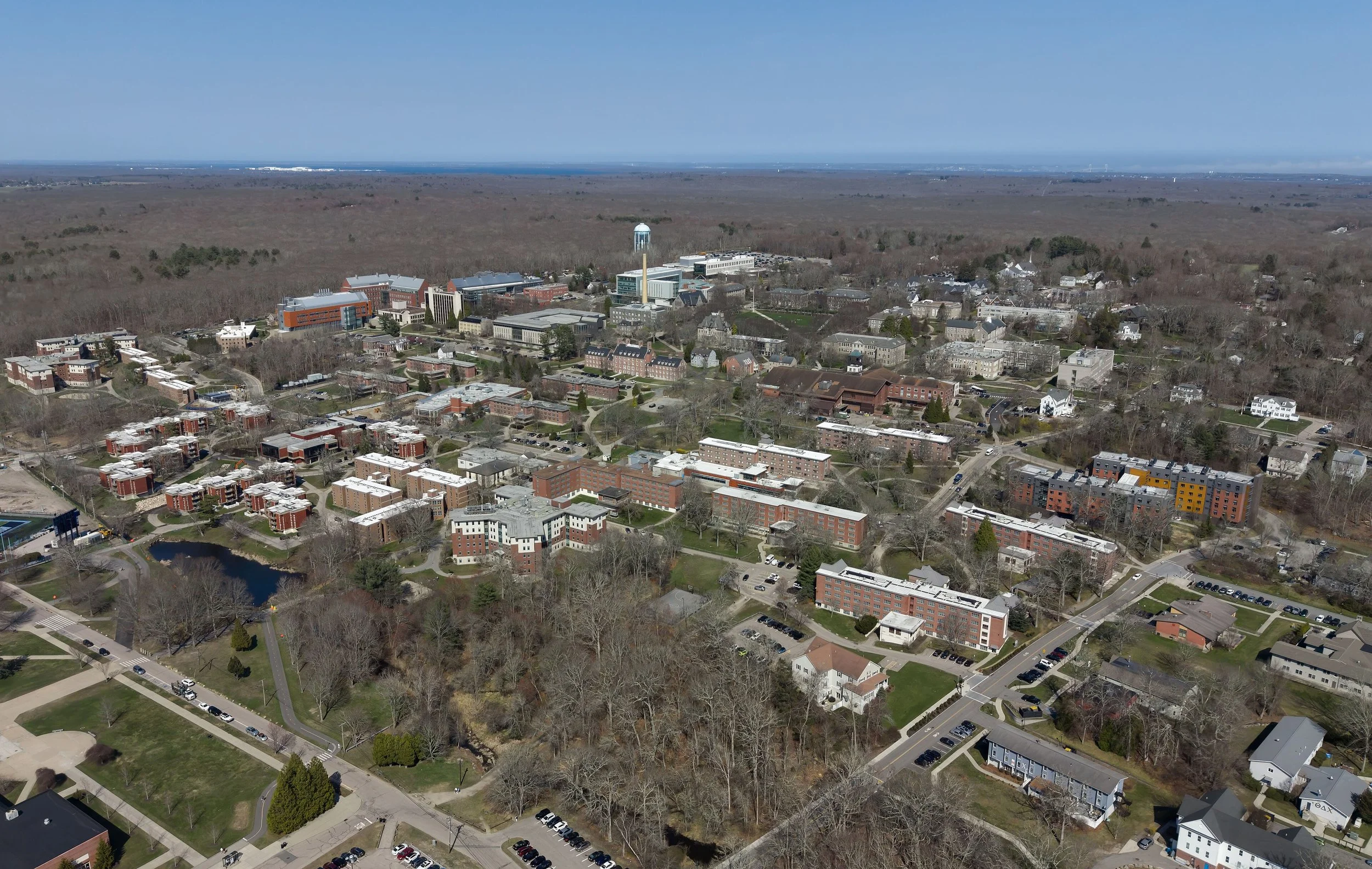
Maybe go back to Europe?

The Pilgrim Monument, in Provincetown. The Pilgrims landed near this spot in 1620.
"They thought they had come to their port that day,
But not yet was their journey done;
And they drifted away from Provincetown Bay
In the fireless light of the sun.
With rain and sleet were the tall masts iced,
And gloomy and chill was the air;
But they looked from the crystal sails to Christ,
And they came to a harbor fair.
The white hills silent lay,—
For there were no ancient bells to ring,
No priests to chant, no choirs to sing,
No chapel of baron, or lord, or king,
That gray, cold winter day.
The snow came down on the vacant seas,
And white on the lone rocks lay;
But rang the axe ’mong the evergreen trees,
And followed the Sabbath day.
Then rose the sun in a crimson haze,
And the workmen said at dawn:
“Shall our axes swing on this day of days,
When the Lord of life was born?”
The white hills silent lay,—
For there were no ancient bells to ring,
No priests to chant, no choirs to sing,
No chapel of baron, or lord, or king,
That gray, cold Christmas Day.
“The old towns’ bells we seem to hear:
They are ringing sweet on the Dee;
They are ringing sweet on the Harlem Meer,
And sweet on the Zuyder Zee.
The pines are frosted with snow and sleet.
Shall we our axes wield,
When the chimes at Lincoln are ringing sweet,
And the bells of Austerfield?”
The air was cold and gray,—
And there were no ancient bells to ring,
No priests to chant, no choirs to sing,
No chapel of baron, or lord, or king,
That gray, cold Christmas Day.
Then the master said: “Your axes wield,
Remember ye Malabarre Bay;
And the covenant there with the Lord ye sealed;
Let your axes ring to-day.
You may talk of the old towns’ bells to-night,
When your work for the Lord is done, 45
And your boats return, and the shallop’s light
Shall follow the light of the sun.
The sky is cold and gray,—
And here are no ancient bells to ring,
No priests to chant, no choirs to sing,
No chapel of baron, or lord, or king,
This gray, cold Christmas Day.
“If Christ was born on Christmas Day,
And the day by Him is blest,
Then low at His feet the evergreens lay,
And cradle His church in the West.
Immanuel waits at the temple gates
Of the nation to-day ye found,
And the Lord delights in no formal rites;
To-day let your axes sound!”
The sky was cold and gray,—
And there were no ancient bells to ring,
No priests to chant, no choirs to sing,
No chapel of baron, or lord, or king,
That gray, cold Christmas day.
Their axes rang through the evergreen trees,
Like the bells on the Thames and Tay;
And they cheerily sung by the windy seas,
And they thought of Malabarre Bay.
On the lonely heights of Burial Hill
The old Precisioners sleep;
But did ever men with a nobler will
A holier Christmas keep
When the sky was cold and gray,—
And there were no ancient bells to ring,
No priests to chant, no choirs to sing,
No chapel of baron, or lord, or king,
That gray, cold Christmas Day?''
"The First Christmas in New England,'' by Hezekiah Butterworth (1839-1905)
200 years to enlightenment
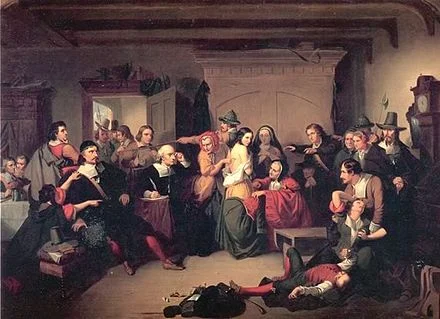
"Examination of a Witch'' (1853,) by T. H. Matteson, inspired by the Salem trials.
"By 1892, enlightenment had progressed to the point where the Salem {witch} trials were simply an embarrassing blot on the history of New England. They were a part of the past that was best forgotten: a reminder of how far the human race had come in two centuries.''
-- Historian Edmund Morgan
Saving Harvard from exclusivity?
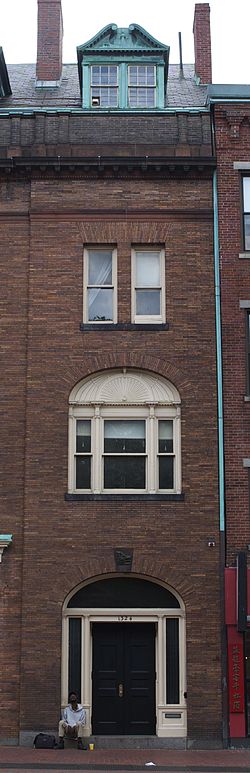
The front of the Porcellian Club, long considered the most exclusive of Harvard's "final clubs.''
So much for freedom of association. Harvard has approved a rule barring students who are members of single-sex clubs (basically meaning fraternities, sororities and “final clubs”) from leading officially approved campus organizations or serving as captains of Harvard sports teams. Further, the school won’t recommend such students for such major scholarships as the Rhodes. Nanny State goes to college. Social engineering 101.
Tim Faulkner: The lessons of the long Cape Wind saga

Via ecoRI News (ecori.org)
NARRAGANSETT, R.I. — Cape Wind may be gone, but it’s still fresh on the minds of attendees and speakers at a two-day southern New England wind energy conference hosted by the University of Rhode Island Graduate School of Oceanography.
Bill White, senior director of wind development for the Massachusetts state agency that advances renewable energy, said the demise of Cape Wind was a personal disappointment, but the 16-year saga offered several teachable moments for the offshore wind industry.
Those lessons, White said, include building further offshore, presumably away from popular recreation and fishing areas such as Nantucket Sound. To speed up permitting, environmental studies should be completed and regulations addressed earlier in the application process, he added.
Cape Wind also established offshore infrastructure that will benefit future projects. It led to construction hubs such as the New Bedford Marine Commerce Terminal, and laid the groundwork for planning, staging, and construction of turbines and their transmission lines.
“Cape Wind in a way served as a catalyst not just for Massachusetts but in a way for the entire East Coast in educating us to the possibility of offshore wind,” White said.
Smaller is better, Deepwater Wind CEO Jeffrey Grybowski said. He noted that the 130-turbine Cape Wind project and other failed offshore wind farms suffered from a process that was pushed by developers rather than by a state-driven model, such as the one Rhode Island embraced for the five-turbine Block Island Wind Farm.
Developers, inspired by large European wind projects, relied on analysis from engineers showing the maximum number of turbines that could be built in an offshore zone, Grybowski said. Large projects like Cape Wind and others off the coasts of Delaware, New Jersey and Long Island “were in essence drawn up on a white board in a developer’s office."
"They were engineered," Grybowski said. "An engineer said, ‘I can build this much in this area.’ They were mechanically engineered and financially engineered to those particular project sizes. And those projects failed.”
Grybowski praised Rhode Island’s ocean mapping plan for providing the locations and process for approving offshore wind projects. Through community and stakeholder involvement, the project was reduced from 100 turbines to eight and then five.
“When you are doing something for the first time going for the large size is not necessarily the right way to go, even though it may make financial sense,” Grybowski said.
Building 400 turbines is feasible and already happening in Europe, he said, “but starting small makes a lot of sense when you look at the long term.”
Starting small and moving slowly makes it easier to recover from mistakes that might derail a larger project. Grybowski didn’t mention specific errors, but the Block Island project encountered some safety and construction problems, along with minor public resistance, all of which were fixed or addressed with alternative plans.
Grybowski described the give-and-take as “enlightened self-interest.” He explained that the turbines benefited Block Island by fulfilling its dual goals of ending its reliance on diesel-fuel power, while connecting the island to the mainland power grid. As an inducement, the transmission line included a fiber-optic Internet connection.
“It means ... making the right concessions for the community and the project that maximizes everyone's goals at the end of the day,” Grybowski said.
The experience of building the Block Island Wind Farm set the course for new and much larger offshore wind projects that will be needed as the country transitions away from fossil fuels. Electrification of the transportation sector and advances in battery storage are escalating the demand for renewable energy and offshore wind is the most practical source of utility-scale power to meet that energy need, according to Grybowski.
Fake news
Science was the focus of the two-day conference (Dec. 11 and 12), with sessions on marine mammals, fish and fisheries, birds, and bats. Grybowski urged scientists to do more to promote their research. Climate-change deniers, Grybowski said, were given legitimacy because scientists didn't adequately “engage in that public conversation.”
“When there was pushback, fake news on the other side, the science community, they were comfortable with kind of putting their studies together," he said. “They weren’t really comfortable engaging in a real way out with people on the other side in the community. So I ask you to do that."
Grybowski pointed to news stories that circulated a dubious claim that noise from the Block Island Wind Farm killed a humpback whale that washed ashore on Jamestown earlier this year.
“When that sort of thing happens, it would be really great to have some researchers who were willing to step up and actually get engaged in that conversation and provide facts and help people make clear judgements about what is and what isn’t happening,” Grybowski said.
Tim Faulkner writes for ecoRI News.
Mark Luskus: Corporate interests use stolen identities to flood Internet with fake comments
Via OtherWords.org
My identity was stolen this year. The perpetrator didn’t open credit cards in my name or gain access to my finances. Instead, they used my name to submit a comment to the Federal Communications Commission (FCC) in support of repealing net neutrality rules.
Those rules, enacted in 2015, declared the internet to be a free and open place. They prevent Internet service providers, or ISPs, like Comcast and AT&T from restricting access to any Web sites — either permanently or to charge you more money to access them.
Imagine your water company charging you more for the water that comes out of your shower than the water that comes out of your sink. Or imagine not being allowed to use your shower at all, even though you pay a water bill.
That’s what net neutrality rules protect consumers from when it comes to the internet.
But Ajit Pai, the current FCC chairman and a former very high-level lawyer for Verizon, and his Republican colleagues on the commission has voted to repeal net neutrality. To do this, he had to solicit public to comment on the matter.
In the past, this has resulted in millions of pro-net neutrality comments — which makes sense, because most Americans support it. But this time, an unusual number of anti-net neutrality comments showed up.
Why? Because of the 22 million comments received, half or more of them appear to be fake, likely posted by bots or special interest organizations attempting to sway the FCC’s opinion. When I checked the FCC’s Web site, I learned that one of those fake comments used my own name and address.
Someone had stolen my identity to advocate for a position that I didn’t agree with.
Several people and organizations, including the New York attorney general, have petitioned the FCC for information on the scale and origin of fake comments. However, the FCC has rejected these petitions.
As a federal agency, the FCC should be far more concerned about the identity theft of the citizens they’re tasked to represent.
Internet providers like Verizon, the former employer of the FCC chairman, complain that net neutrality rules slow their investments in internet technology. However, ISPs exist in a shockingly non-competitive market.
More than 50 million households in the United States have only one choice of provider, and those providers score the lowest customer satisfaction rates of all 43 industries tracked by the American Consumer Satisfaction Index. Personally, I’ve never had an ISP that offers reasonable customer service or internet speeds and reliability at the levels I pay for.
This isn’t an industry that consumers are satisfied with, so why should they hold even more power than they already do? No wonder they have to rely on sleazy tactics like stealing identities and posting fake comments.
The internet has become an essential tool in the 21st Century. A small handful of companies shouldn’t have the power to decide which parts of it people can access.
Corporate-funded lies and identity theft highlight a major threat to the benefits of increased communication. How can we prevent special interest groups from warping the internet to spread misinformation and further their political goals?
That’s a question we must answer, because misinformation campaigns are rampant, and they’re being used to restrict your rights and freedoms. But at the very least, a former Verizon employee shouldn’t hold the power to give ISPs a major win at the expense of consumers — and a free and open Internet.
Mark Luskus is a med student at Emory University, in Atlanta He’s particularly interested in infectious diseases and public policy.

James P. Freeman: A bumpy trip though Massachusetts's circus of 2017

And all our yesterdays have lighted fools”
— William Shakespeare, Macbeth (Act V, Scene V)
The struts and frets of 2017 confirm we are on a portentous path to a dusty death.
Is there a doctor still in the house?
The Massachusetts Medical Society rescinded its opposition to physician-assisted suicide. Perhaps that phrase was too forthright in these sensitive times. So, a statement from the society reads “medical aid-in-dying.” The society’s governing board will, for now, adopt of position of “neutral engagement.” Theirs might be a dutiful death.
Newly offensive public statues and monuments were the rage. In Boston a street sign, “Yawkey Way,” so-named 40 years ago, became an object of moral grandstanding. Red Sox owner John Henry is now “haunted” by the racist legacy of a predecessor owner, Tom Yawkey. Never mind that the Yawkey Foundation is one of the largest charitable organizations in the city. Henry and fellow progressives are more concerned about erasing history than improving it.
The Boston Globe — which Henry owns — haunted many subscribers with delivery and production problems. The Globe got it wrong in asking its readers this question: “Does Boston deserve its racist reputation?” More probing would have been: “How does racism still exist after a century of pure-bred progressivism in Boston?”
Bad news. The Boston Herald filed for bankruptcy and was sold for pennies on the dollar.
Boston Public Schools needed a bigger piggy bank, surprisingly, as it paid certain employees with off-the-books payments, revealed an IRS audit. But they won’t be pressing the snooze button. BPS announced (based upon computer research) the rescheduling of most of its starting times next school year.
Boston Mayor Marty Walsh was overwhelmingly re-elected to a second term. No mention during the campaign that Walsh overwhelmingly crushed free speech and freedom of the press during the Free Speech Rally in August.
Andrea Campbell, 35, will be the first African-American woman to lead the Boston City Council. Her presidency, says The Globe, will make the council the “most diverse in the city’s history.” Forget political diversity, though. Republicans need not apply — there are none on the council.
For all the region’s proud progressives, don’t kiss and tell. The following codswallop appeared in wearyourvoicemag.com: “10 Things Every Intersectional Feminist Should Ask on a First Date.” Warning: “What do you do for fun?” isn’t one of them.
Amazon came calling and Massachusetts went groveling. Twenty-six Commonwealth entities submitted bids to become the company’s second headquarters.
Take the long road home. State Sen. Thomas McGee, a Democrat from Lynn, proposed legislation that would bring more toll roads to Greater Boston. Funds would be allocated to all statewide transportation needs, including the troubled MBTA. For roadways, however, Massachusetts already spends an average of $675,939 per state-controlled mile — a figure exceeded only by Florida and New Jersey.
Massachusetts Atty. Gen. Maura Healey continued her quest as progressivism’s most litigious social-justice warrior. Her personal vendetta against the Trump administration included 24 instances of legal intervention in just the first six months of the year. How about Ticketmaster? Drug dealers?
A high school girl golfer beat a high school boy golfer by shooting the best score in the Central Massachusetts Division 3 boys’ golf tournament this fall. But she did not get the trophy, sparking national headlines and progressive incredulity.
In more gender-related news, the Girl Scouts of America advised against children hugging relatives. Such activity, reported The Washington Post, “could muddy the waters when it comes to the notion of consent later in life.” Meantime, the Boy Scouts of America accepted girls into their ranks to “shape the next generation of leaders.” And the singer Pink is raising her daughter gender-neutral. No wonder kids are confused today.
Poor Johnny and Jane.
Liz Phipps Soeiro, a librarian at Cambridgeport School, refused to accept a gift of Dr. Seuss books from First Lady Melania Trump — a gesture recognizing “National Read a Book Day.” The Seuss illustrations are “steeped in racist propaganda, caricatures, and harmful stereotypes,” she wrote in a letter to Trump. Shortly thereafter, it was discovered Soeiro posed for a picture in 2015 wearing a Seuss outfit and holding a copy of Green Eggs and Ham book. Only in Cambridge. Well, maybe not …
In a letter to parents, the Boyden Elementary School, in Walpole, bizarrely asserted that its annual Halloween costume parade “is not inclusive of all the students and it is our goal each and every day to ensure all student’s individual differences are respected.” Instead, trading a parade for political correctness, the school laughably said that Halloween would be known as “black and orange” spirit day. Call it Banned in Boyden.
Not on my ocean view! Having faced a “very vicious and very well-funded lobbying organization” to protect Nantucket Sound for 17 years, said Bloomberg, the last gale warnings were issued for America’s largest proposed (and now dead) offshore wind project, known as “Cape Wind.” It’s officially kaput. Some wonder if Pilgrim Nuclear Power Station in Plymouth will now close, as scheduled, in 2019. Power down, green protesters!
Scandals ran down Beacon Hill. Former Democrat state Sen. Brian Joyce was indicted in a sweeping federal corruption case. i And Democrat Stan Rosenberg stepped down as state Senate president amid an investigation of sexual-assault allegations against his civil-law husband, Bryon Hefner — while he conducted state business. Rosenberg said the Senate has a “zero tolerance” policy on sexual harassment.
Charlie Baker is running for Comedian-in-Chief of the Commonwealth. When the popular incumbent announced his re-election, a running joke circulated within the GOP: “For which party?” Confirming his unassailable allegiance to progressivism instead of conservativism, the governor signed bills mandating free birth control and bilingual education.
Always in character, thin-skinned progressive U.S. Sen. Elizabeth Warren got her feathers ruffled with faux-outrage, once again. She said President Donald Trump used a “racial slur” during a White House celebration of Native Americans when he referred to her as “Pocahontas.” Funny, did she consider the 1995 eponymous movie to be a slur, too? Millions didn’t. The Disney animation grossed over $141 million during its theatrical release in the United States.
Among the initially named visiting fellows at Harvard University’s Institute of Politics for the 2017-2018 school year were two improbable scholars: former Trump Press Secretary Sean Spicer, and former U.S. Army intelligence-analyst-turned-traitor Chelsea Manning. Harvard students are falling behind … Fordham students. Two students were kicked out of a coffee shop at Fordham University for violating a “safe space” with their “Make America Great Again” hats.
Shootings were up 18 percent in Boston. There was no evidence, nonetheless, that those weapons were modified with “bump stocks.” But bump stocks were outlawed in Massachusetts as a threat to society.
Fifty years after The Summer of Love, take the flowers out of your hair but be sure to put some LSD in your head. People looking to get an “extra edge at work are turning to [the] illegal drug to boost their focus and creativity,” reported fox25boston.com. They are micro-dosing, which involves taking small amounts of the substance about twice a week. Says computational neuroscientist Selen Atasoy, “It’s really like jazz improvisation, what LSD does to your brain.” Will it block progressive impulses in 5/4 time?
Psychedelic meet-up groups are trending in Portland, Ore.; San Francisco, and New York. Cutting-edge hipster millennials in Boston are likely meeting now.
Meanwhile, the opioid crisis rages on. However, for the first nine months of 2017, Massachusetts reported a 10 percent decline in deaths over the like period in 2016, likely a result of more immediate administration of Naloxone, which reverses the effects of overdose. Theirs is a dusky death.
Needham-based TripAdvisor, the travel and restaurant Web site (which includes reviews and public forums), got into trouble when it repeatedly removed posts warning of alleged rape, assault and other injuries at Mexican resorts. And, forbes.com reported, a writer in London tricked TripAdvisor by creating a “fictional eatery” that became the city’s top rated restaurant. Trust but verify.
Snowflakes actually coated the College of Holy Cross in May. A committee was formed to determine what to do about the fact that its founding president owned slaves, and what to do with a now-objectionable sports name: “Crusaders.” As National Review noted, “where there’s a will, there’s a microaggression.”
Not to be outdone, Pope Francis, a leader in thoughts and words, is considering a change in one word of “The Lord’s Prayer.” The pontiff, conversant in nine languages, is concerned about the word “temptation.” He believes that the phrasing in the Our Father prayer “is not a good translation.” Will this translate to stemming high rates of disaffiliation plaguing the Catholic Church?
Next year, should it be tempted to arrive, marks the 45th commemoration of the U.S. Supreme Court’s decision to legalize abortion. Since then, it is estimated that over 58 million abortions have taken place in America. As a stark reminder, the only gravestone on the premises of the chapel at Holy Trinity Church in Harwich reads: “In memory of The Unborn – Denied the Precious Right to Life (1973- ).” Theirs was a despicable death.
James P. Freeman, a former banker, is a New England-based writer and former columnist with The Cape Cod Times. His work has also appeared in The Providence Journal, newenglanddiary.com and nationalreview.com
Year-end hello from the country

Season's greetings from Endolane Farm, in Little Compton, R.I.
-- Picture by Lydia Whitcomb; house by Kevin Vendituoli
Quiet interior

"The Quilter's Daughter, 2012-14'' (oil on linen), by Christopher W. Benson, in the show "Pictures & Windows: The Paintings of Christopher W. Benson from 1975 to 2017,'' at the Newport Art Museum, through Dec. 31. The museum says his scenes are like a less dramatic version of Norman Rockwell's works, showing snapshots of American life that might help show what we have in common in a deeply divided nation.

Llewellyn King: With his attacks on 'mainstream media,' which he, too, depends on, Trump pumps up dictators

Mr. President, one of the things you should know, as your first tumultuous year in office draws to its close, is that the United States has the best media in the world. Only United Kingdom media rivals it.
It is a bulwark of the American Dream, of American exceptionalism.
Its role as the carrier of information in the United States is as important as it is outside the nation.
That is why your situation room in the White House has so many news feeds. Often, despite the huge apparatus of government information gathering, it is reporters who tell it like it is first and give you actionable information.
It is because of the media that we know what is going on in Myanmar, Syria, Yemen and Zimbabwe -- even inside the royal family of Saudi Arabia.
I would have the temerity suggest that even you, despite your seemingly pathological hatred of all information that does not accord with your own views and personal interests, and your administration in times of crisis turn first to the media, and especially to outlets like The New York Times and CNN. In your heart of hearts, you know you are going to find out what is happening there, not on the political networks like Fox, One America News and Newsmax, and not through government’s cumbersome channels of information relay.
Mr. President, we are an irregular army of no-particular hue. We wear no uniform and are the antithesis of unity. We live in a world of miserable pay (the television stars are the exceptions), bad hours, stress, sometimes too much drink, and disrupted private lives. We write about everyone’s hurt but our own. But we love what we do and know when it matters; matters globally as much as domestically.
Dan Raviv, when he was with CBS, described his job his way, “I like to find out what’s going on and tell people.” Exactly.
For all of the academic talk about media and society, that is the job – finding out -- and it is a great and important job. That is why thousands of news people work through the night, or crawl out of bed at 3 a.m., or risk their lives in places like Iraq, Syria and Congo, and will be working on Christmas Day and every other holiday. That is why we eat bad food out of machines, fly in cramped aircraft and go without sleep.
So journalists do not mind personally if you denigrate us, call our work “fake” and impugn our integrity or have your agent, press secretary Sarah Sanders, do so.
But, Mr. President, we do mind and we should mind, and we should be in a state of incandescent rage with the way you are damaging the truth and hurting America at home and, especially, abroad. We do mind and should mind and keep minding when you put journalists’ lives at risk in distant and hostile places.
And we should mind, and you should mind, when you and Sanders give aid and comfort to criminal coddlers, dictators, kleptocratic governments and oppressive regimes.
This scum, these men and women who trash decency as the inherent right of power, now fear the scrutiny of media less. They dismiss the incriminating as “fake.” It happens in Ankara, Beijing, Budapest, Damascus, Moscow, Nairobi, Riyadh and many other places.
You have provided the world’s malfeasants with the great blanket rejoinder: fake.
Everything not laudatory to the abusers is fake and the messengers, the journalists, trade in untruth and should be treated accordingly -- as concoctors, fabricators, liars, spies and even traitors.
Mr. President, you have damaged the world’s safety valve and given huge comfort to the enemies of decency, openness and democracy.
You have armed the dictators with a pernicious weapon by undermining the freedom of the press to find out what is going on and publish it. You have spread the suffering of the politcal prisoner in distant jails and all who are suffering the brutality of oppression. Their hope is often only the faint light cast by inquiring media.
A great shame on you, Mr. President.
Llewellyn King (llewellynking1@gmail.com) is executive producer and host of White House Chronicle, on PBS. He is also a veteran publisher, columnist and international business consultant.
Frank Robinson: 'Senior Moments'/December greetings

"Senior Moments
(written in a retirement community)
Two friends talking to each other,
each one hardly hearing the other.
Such a wonderful democracy –
everyone is old.
For people with a lot of past
and very little future,
what counts is now.
Fragility and strength –
these crowds of people
who should have stayed in bed.
How strange,
after all these years,
not to have a home any more.
In this time of truth,
the only thing to do
is to lie.
“People change.’’
This is the lesson
that we have to learn again.
Too many singles trained to be doubles,
too many workers with nothing to do.
Commune, kibbutz,
New England village,
or resort hotel –
take your pick.
The fear is
I’ll feel too deeply
or I won’t feel deeply enough.
Marriage in old age –
each one waiting for the other
to lose his mind.
“I can remember
a thousand thousand words,
but not the name of my husband.’’
“This is such a funny joke,
every time I tell it,
I laugh.’’
We’re so lucky to be here,
and yet we’d give anything
not to be.
Remembering and forgetting –
diseases of old age.
Each of us knows
how little time there is,
so you’d think we wouldn’t waste it.
At seventy-eight,
I’ve got my health, my hair, my wife –
I’m all set.
This is what it’s like here ---
one long schmooze,
followed by an even longer snooze.
Environmental Poem:
My hair retreats ever year,
like the ice in the Arctic.
If there is a paradise,
I promise to tell you by email
right away.
Canes and ski poles,
walkers and wheelchairs ---
an army on the move.''
-- By Frank Robinson, an Ithaca, N.Y.-based poet, art historian and former head of the art museums at Cornell University and the Rhode Island School of Design. He has written such year-end poems for years.
Holiday readings to you

Merry Christmas and Happy New Year from the Providence Athenaeum.
-- Painting by Nancy Whitcomb
'Lost in the onslaught of parenthood'

OnJan. 20, 10, 2018,, ArtProv Gallery, in Providence, will host an artist talk featuring Jessica Burko.
The gallery says: "In this intriguing talk, Jessica will discuss her series 'Quiet/Loud,' currently on display at ArtProv Gallery. She’ll share her inspiration behind the works and how they reveal her attempt to balance the expected roles of modern womanhood with maintaining a sense of self. Her pieces, which are self-portraits in motion, visualize the contradiction between asserting an identity as an individual and being lost in the onslaught of parenthood. She’ll also describe her many-step process of creating the mixed-media works, and how it is imbued with both meditative and monotonous motion driven by her need to reconcile the disparity of suffering and love.''
'Mellowed by two centuries'

A remnant building of Brook Farm, a utopian community in the 1840s in West Roxbury, Mass., closely associated with Transcendentalists, a group that included such luminaries as Ralph Waldo Emerson and Margaret Fuller and influenced many writers and intellectuals through much of the 19th Century. It was centered in New England.
“Transcendentalism has been called the inevitable flowering of the Puritan spirit. But Puritanism does not necessarily bear blossoms, and the fruit thereof is often gnarled and bitter. In New England, however, the soil was conserved by a bedrock of character, mellowed by two centuries of cultivation, and prepared by Unitarianism. New England Federalism checked the flow of sap, fearful lest it feed flowers of Jacobin red. There was just time for a gorgeous show of blossom and a harvest of wine-red fruit between this late frost and the early autumn blight of the Civil War.’’
-- By Samuel Eliot Morrison, in The Oxford History of the American People.
'Surely tis June'

Northern beech in late autumn.
"That's no December sky!
Surely 'tis June
Holds now her state on high
Queen of the noon.
Only the tree-tops bare
Crowning the hill,
Clear-cut in perfect air,
Warn us that still
Winter, the aged chief,
Mighty in power,
Exiles the tender leaf,
Exiles the flower."
-- "A December Day,'' by Robert Fuller Murray
'Inflexibly territorial'

The harbor of Cutler, Maine. The tiny town is way Downeast.
Many small towns I know in Maine are as tight-knit and interdependent as those I associate with rural communities in India or China; with deep roots and old loyalties, skeptical of authority, they are proud and inflexibly territorial.
-- Paul Theroux, novelist and travel writer
Llewellyn King: A great 20th Century sex scandal; burning coal for bitcoin hoarding

Lewis Morley's 1963 portrait of Christine Keeler
A key player in one of the greatest sex scandals, Christine Keeler, died on Dec. 4.
When it comes to sex scandals, nothing that has been revealed lately has anything on Britain’s Profumo Scandal of the early 1960s. The cast was astounding: two nubile and very sexy young women, Christine Keeler and Mandy Rice-Davies; a society osteopath, Dr. Stephen Ward, who organized sex parties for men at the top; including the minister of war, John Profumo; a KGB officer at the Soviet Embassy, Yevgeny Ivanov, and Lord Astor, a leading aristocrat.
The set: Cliveden, Lord Astor’s famous country estate.
The unraveling: Christine’s two earlier lovers got into a fight and shots were fired outside of Ward’s home. Britain’s libel laws were very strict, and the extent of the sex scandal did not break in the newspapers until the rumors were published in the United States. The security services had already warned Profumo that he was sharing Christine with a Soviet spy, and he ended his affair with her.
The unforgivable factor: Profumo lied to the House of Commons and weeks later had to resign. He left the scene for social work in the East End of London, which he did for the rest of his life.
I met Christine and Mandy at the offices of The Sunday Mirror in 1963. My opinion: Christine was one of the most beautiful and intriguing women I have ever laid eyes on. She had a mystical quality, a Mona Lisa.
Mandy was less attractive, but bubbly and exuded fun. She was a good time-girl, who liked parties and sex by her own admission.
Christine averred these were her interests, too. But she was more: a beautiful, tragic child. She was just 19 and hoped to be model.
When it all came tumbling down, Ward was convicted of living off immoral earnings and committed suicide. Mandy married three times, lived in Israel and the United States, and was involved in the London theater. Christine began a huge and tragic slide that two marriages and two children failed to arrest. When she died, she was living in public housing; fat and raddled, all traces of her daunting beauty gone.
Lord Astor left England for the United States while the scandal cooled.
I always wished that Christine would have thrown her head of dark hair back and said, “I did it and I loved it.” Mandy more of less did.
Scandals don’t have happy endings, laced as they are with hypocrisy and betrayal. Everyone betrayed everyone in the Profumo Scandal. Christine was the most betrayed.
Unexpected consequence of bitcoin hoarding
The bitcoin fever — along with all of the other cryptocurrencies that blockchain technology has made possible — has one interesting consequence: a huge new demand for electricity.
Bitcoin miners, the operators who seek to create new entries and to verify the chain and both to make money and to protect from fraud, use staggering amounts of computing and staggering amounts of energy, including to cool the supercomputers.
But the electric bonanza won’t benefit all the electric utilities: The server farms follow the lowest cost for power. Therefore, electric companies with very cheap power, as those in the Northwest with hydropower, are the winners. But all the winners aren’t domestic: Some are likely to be abroad, and Iceland is a strong candidate to host the next rash of server farms.
Environmentalists are calling this a disaster. If cryptocurrency growth continues at its present wild speed, more electricity is likely to be generated with coal, especially outside of the United States.
It is the great growth area for electricity. While natural gas is becoming dominant in the United States, poor countries that want to jump on the high-tech bandwagon, like Poland, could be burning vast quantities of coal.
See it as the real-life consequences of something that only exists in cyberspace, a ghost materializing. The winner maybe Iceland with mega hydro available.
xxx
“Work is much more fun than fun.” — Noel Coward (1899-1973), English playwright, actor and composer.
Llewellyn King, a veteran publisher, columnist and international business consultant, is executive producer and host of White House Chronicle, on PBS.
A cold paradise

"A winter Eden in an alder swamp
Where conies now come out to sun and romp,
As near a paradise as it can be
And not melt snow or start a dormant tree.
It lifts existence on a plane of snow
One level higher than the earth below,
One level nearer heaven overhead
And last year’s berries shining scarlet red.
It lifts a gaunt luxuriating beast
Where he can stretch and hold his highest feast
On some wild apple tree’s young tender bark,
What well may prove the years’ high girdle mark.
Pairing in all known paradises ends:
Here loveless birds now flock as winter friends,
Content with bud inspecting. They presume
To say which buds are leaf and which are bloom.
A feather hammer gives a double knock.
This Eden day is done at two o’clock.
An hour of winter day might seem too short
To make it worth life’s while to wake and sport.''
-- A Winter Eden,'' by Robert Frost
Structuring the waterfront

"Town Pier No. 11'' ( oil on canvas), by Paul Kelly, in his "Structure Series'' show, at Galatea Fine Art, Boston, Jan. 3-28.
David Warsh: Political imagination and rule-breaking

Image by Judith Montminy, in the National Association of Women Artists show "Courting the Uncontrollable Part 1,'' a Galatea Fine Art, Boston, Jan. 3-28.
STOCKHOLM
The #metoo movement reached Sweden last week in what is, by now, altogether familiar fashion.Dagens Nyheter, Sweden’s leading newspaper, reported last week that 18 women h ad complained of having been assaulted, raped, or otherwise molested over the years by a leading figure of Sweden’s literary establishment. As Agence France-Press reported, the celebrity was not named in print, out of respect for Sweden’s stringent libel laws.
But since the accused was said to be proprietor of an exclusive literary salon, married to a writer with “close links” to the Swedish Academy, and the 18-member body that awards the Nobel Prize in Literature, there was little doubt as to his identity. That he was as said to have routinely tipped to favored friends what he learned from his wife about the committee’s selection in advance of the news only deepened the embarrassment.
I was rescued. For weeks I had been hoping to find a way to write about Kenneth Shepsle’s new book, Rule Breaking and Political Imagination (Chicago, 2017), but I was stymied. Shepsle, of Harvard University, is a leading figure in the university-based study of political life, perhaps the most familiar to those acquainted with the subject, by dint of his introductory text, Analyzing Politics, Rationality, Behavior, and Institutions (Norton, 2010).
Since it first appeared in 1997, Shepsle’s book has been the point of entry through which many of the smartest college students begin their studies of governance. To describe this sort of influence was why my column, "Economic Principals,'' was invented, back when I worked for The Boston Globe.
Introducing the sea change that turned “government” into “political science” in the years after World War II -- from “describing” to “explaining,” from “judging” to “analyzing,” as Shepsle puts it – Analyzing Politics begins, “It isn’t rocket science but…” There follow a series of chapters on how to build formal models of familiar topics once treated almost entirely by measurement and narrative prose: spatial models of majority rule; game-theoretic models of strategic behavior, voting methods, and electoral systems; equilibrium models of cooperation, collective action, and the economics of public goods.
With disarming modesty, Shepsle demonstrated the value to be had in using stripped-down models of persons engaged in the kind of optimizing decisions that came to be described as “rational choice” – the same sort of gains he wrote, in understanding that came from deliberately simplifying such complicated things as planets as spheres, he wrote. In Rule Breaking and Political Imagination, Shepsle recalls “the schizophrenia many of my generation felt in our youth – modelers and methodologist by day but qualitative scholars of substance and history by night.” The predicament came to a head for him, he writes, when at a conference on formal history
“[A] prominent economist dismissed the richness of legislative politics with the observation that we didn’t need much history or description when armed with the median voter theorem and other principles in the formal theory tool kit.”
Not all at once, but gradually, and in the company of many others, Shepsle set out to build bridges between his enthusiasm for the spare assumptions of rational-choice theory and what was known of the rich world of law and government in practice. By the early ’90s, he was in the front ranks of what came to be known as “the new institutionalism.” The movement was recognized by the awards of Nobel Prizes in Economic Sciences to Ronald Coase, in 1991, and Douglas North (and Robert Fogel), in 1993.
Thus in the last third of Analyzing Politics, Shepsle re-introduced the features of the political landscape that had been largely eclipsed as rational-choice methods swept the field in the 1950s, ’60s, and ’70s -- legislatures, bureaucracies, courts and judges, cabinets, parliamentary governments, and so on. These institutions had evolved over the centuries to limit and channel the choices that those “rational actors” made, he wrote. He included the concept he developed, with Barry Weingast, of Stanford University, and Michael Laver, of New York University, of “structure-induced equilibrium.”
Since the ’90s, institutions of all sorts have been a topic of great interest in economics – legal, scientific, educational, not to mention financial and corporate. (So have norms, meaning the formal understandings that govern the behavior of members of a society, but culture is a topic for another day.) The rules governing institutions have come to be seen as creations of rational choice themselves – either imposed by history or evolving as a matter of collective action, but in any event, existing to restrict the choices of individual actors.
But what happens when the rules don’t hem in the most forceful actors? That is the question Shepsle asks in Rule Breaking and Political Imagination. No one interested in the news can fail to be intrigued by the central proposition in his new book. As he puts it, “Institutions do create channels through which behavior flows, but occasionally the banks defining the channels are breached.” These transformative moments occur when leaders exercise political imagination, or break the rules, or, sometimes both.
One of the epigraphs with which the book begins is from the Dalai Lama: “Know the rules well so you can break them effectively.” Even with the different tax bills passed by the Senate and the House headed for a conference to resolve their crucial differences, too much detail is involved in Shepsle’s stories, which are aimed at the most promising students, to bring them to bear for interested laypersons.
The invention of the post-cloture filibuster? Techniques for stealing elections? Finagling the rules to qualify for membership in the European Monetary Union? King David as a rule breaker in the Bible? Julius Caesar flouting the law by marching his army into Rome? (The last story, Shepsle notes, did make a great topic for the first season of HBO’s Rome.)
In Stockholm, it finally occurred to me that a vivid example of political imagination and rule-breaking was right in front of my eyes. Shepsle’s other epigraph, “What’s a constitution among friends?” struck a chord, It is attributed to Boss Plunkitt, of Tammany Hall. But something like its sentiments might have been conveyed to movie mogul Harvey Feinstein by the publisher of The New York Times on the eve of the first of his newspaper’s epic stories about the Hollywood producer’s methodical abuse of women, if the heavy advertiser had complained.
Earlier, The Times had pilloried Fox News chairman Roger Ailes and star commentator Bill O’Reilly for similar patterns of exploitation and abuse, coupled with the plentiful application of money and power to silence their victims. Both were subsequently dismissed, but the firings had relatively little impact, presumably because Fox News was seen as The Times’s ideological foe.
In tackling Weinstein, The Times was making an example of one of its own – not only a longstanding film-making force in New York, often a hero to Times critics, but a man in broad and deep sympathy with The Times’s most deeply held convictions. Weinstein was a liberal whose first attempt to atone for misdeeds was to promise to pump up his efforts on behalf of gun control.
To be sure, no constitution exists by which the media is bound. Instead an immensely intricate body of rules governing conduct and discourse grew up over the century or so since the first Hollywood scandals began to find a home in the tabloid press. Until the first of the cycle of stories began about patterns of sexual exploitation of the powerless by the powerful – in the taste-making industries of Hollywood, Washington, New York, and, last week, Stockholm – what Shepsle named a “structure induced equilibrium” obtained.
One such situation was described in detail by five Times reporters last week inWeinstein’s Complicity Machine. Many others exist. And while newspapers and other media are not among the institutions that theorists have studied in the past, Matthew Gentzkow, of Stanford University, and others, are beginning to change that.
The Times’s coverage stands out as a bold act of both political imagination and, a little less obviously, rule breaking. The playbook was pioneered by Martin Baron, then editor of The Boston Globe (a New York Times Company subsidiary at the time), in that newspaper’s coverage of tolerance of pedophile priests by the Roman Catholic Church. Today Baron is editor of The Washington Post.
That story, too, showed imagination and broke some tacit rules and went around the world, destroying in the process the ambitions of Boston Cardinal Bernard Law to become the first American Pope. This one, as Times editors surely understood, has affected the fortunes not just of outgoing Sen. Al Franken (D.-Minn.) or Alabama Republican Senate candidate Roy Moore, but those of President Trump as well.
David Warsh, a longtime financial, media and political essayist, as well as an economic historian, is proprietor of economicprincipals.com, where this first ran. He is based in Somerville, Mass.
CVS-Aetna merger: Who would benefit besides top execs and other shareholders?

From Robert Whitcomb's "Digital Diary,'' in GoLocal24.com:
Besides senior executives and other Aetna shareholders, who would benefit most from CVS’s $69 billion acquisition of Aetna?
Well, the new behemoth’s pharmacy benefit management operation might use its even greater bargaining power with drug makers to negotiate down the extreme, indeed extortive, cost of so many prescription drugs in such a way as to benefit consumers. But I doubt it. It’s more likely that they’ll keep the savings to benefit CVS-Aetna senior executives and other shareholders and consumers will see little if any benefit from that.
Indeed, if the merger drives competitors out of business, CVS might, in the fullness of time and pricing power, increase other prices for its captive customer base a lot. But with giant insurer UnitedHealth Group also getting into the big-time clinic business, too, maybe that might not happen.
Anyway, much good can come from this combination.
The merger is part of CVS’s plan to turn itself into a much-wider-service health-care provider, building on its rapidly expanding chain of Minute Clinics. There, nurse practitioners, physician assistants and regular nurses are joining with pharmacists to offer many services that you’d once have to go to a doctor’s office or hospital to get, at very high cost. After all, U.S. physicians are highest paid in the world, co-payments are jumping, etc. A brief visit to a hospital emergency room shows that far too many patients go to that very expensive venue for problems that could better be addressed in a, well, Minute Clinic. The aging of the population, and thus a flood of sicker people, especially raises the potential of Minute Clinic-like health-care retailers to slow surging health-care costs, or some of them anyway.
Indeed, whatever happens with drug prices at the likes of CVS-Aetna, consumers can save time, and thus money, by using a facility that will offer many primary-care services beyond pills, such as medical tests, physical exams and medical consultations, as well as food and other products. Life can be frantic. One-stop shopping is very attractive. At the least, these centers might help you cut down on transportation costs.
Getting your health insurance from the same organization where you get much of your health care may also make your life easier. For one thing, the sharing of patient data between the insurance side and the provider (CVS) may facilitate better care, especially for those with such chronic ailments as heart disease. But, yes, it will also make your personal data more vulnerable to computer hacking from crooks domestic or foreign (especially the Russians and Chinese)….
But again, much depends on whether the merger ends up squashing CVS-Atena competitors so much that the behemoth can jack up prices, including for insurance. Many patients may find themselves trapped in expensive “health-care hubs.’’ Always remember that most companies care far more about their senior executives and other shareholders than anyone else.
And the CVS-Aetna deal is more bad news for hospitals and physician groups: The new entity will probably drain away many of their patients.
Unless executives of the new outfit decide they really want the glamour of a big city headquarters and move it to, say, New York or Boston (remember Fleet Financial Group leaving Providence for Boston?), the merger is good news for Rhode Island, both psychologically (having such an even bigger company based here) and in the new employees that CVS-Aetna would presumably need to hire here for additional administrative, marketing and other headquarters-related work.
But don’t bet the farm on CVS keeping its headquarters in Woonsocket. Increasingly, those working at corporate headquarters, especially younger up-and-coming employees, and the executive suite, like to be in a dynamic city instead of some suburban-style office park.
So Providence’s Financial District, once an important banking center, might eventually host CVS-Aetna headquarters. Given that Aetna is a financial company that would be fitting. And the Rhode Island School of Design’s army of graphic and other designers would be next door; a few blocks away would be the Brown Medical School. Both very handy for a consumer health-care chain. There’s been chatter lately that toy-and-entertainment giant Hasbro might consider moving its headquarters to downtown Providence. Wouldn't it be nice if this old city once again became a major corporate headquarters town?