
Vox clamantis in deserto









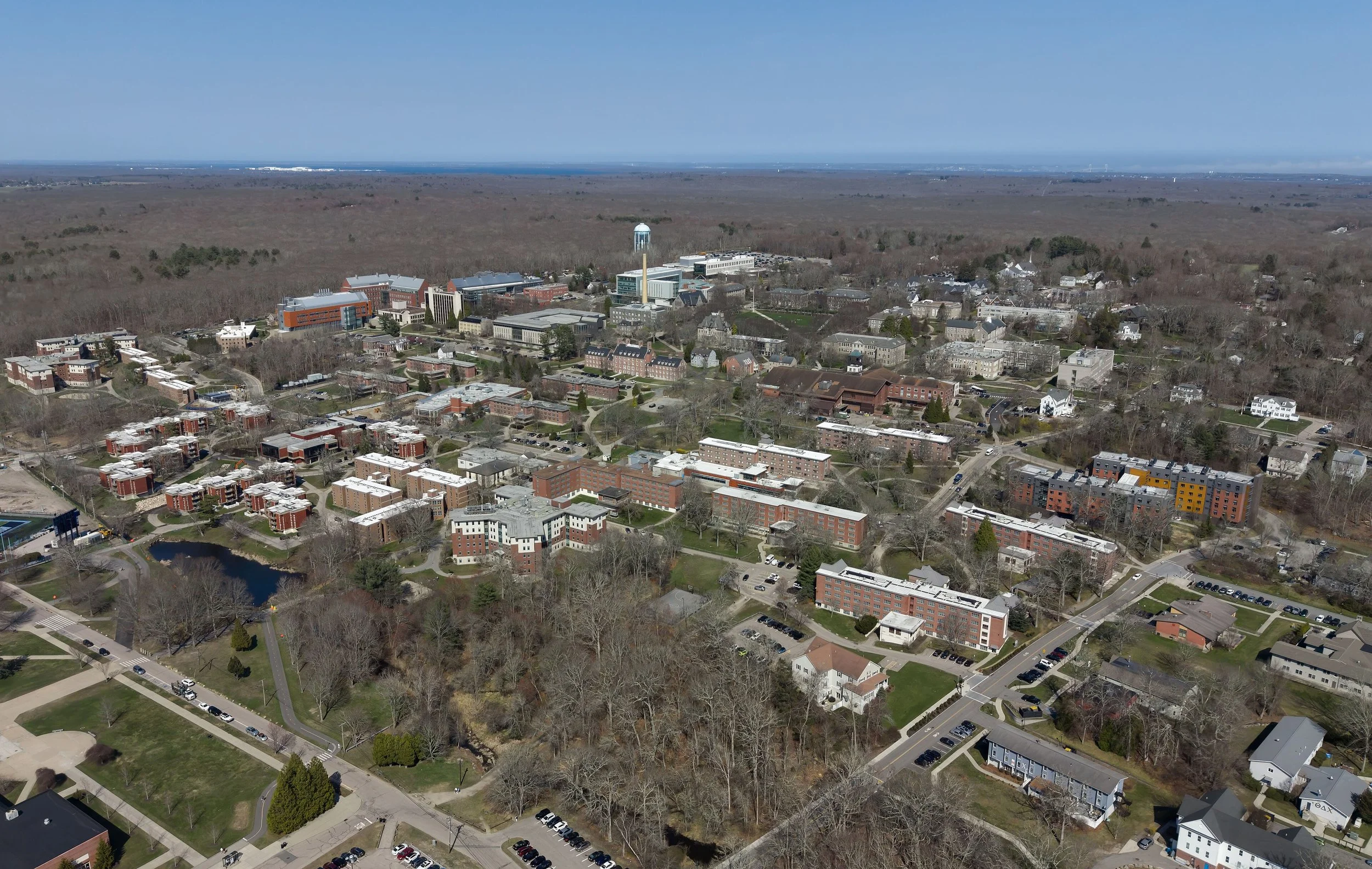
'Season demands endings'
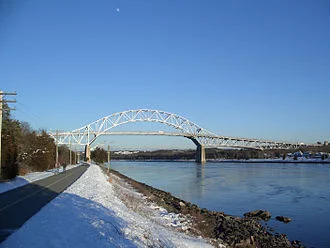
The Bourne Bridge, over the Cape Cod Canal, one of three bridges (one is a railroad span) connecting Cape Cod with the Massachusetts mainland.
"Always the damage is irreparable.
Here the wind is right for suicide,
blowing up from Sagamore and down into Truro;
there the dead girls lie pale by scandal.
The highway curls over the Bourne Bridge, but a widow
has jumped this morning: the season demands endings
here and they come in fashion, dark as
the New York Buicks.''
-- From "Cape Cod Murders, 1968,'' by Mira Fish
--
.
Frank Carini: Oil dumping continues to mar New Bedford Harbor

A weirdly beautiful oil sheen on the waters of New Bedford Harbor.
Photo by Frank Carini
From ecoRI News (ecori.org)
NEW BEDFORD, Mass.
Oil sheens have long stained one of the country’s most historic harbors. Visits by tourists to enjoy seaside sights and sample local seafood at harborside restaurants can be marred by these distinct marine markings.
In late February, the Coast Guard and Massachusetts Department of Environmental Protection (DEP) were called to New Bedford Harbor after oil was spotted lapping up against the docks and fishing vessels at Leonard’s Wharf. About two drums worth of oil was recovered. The source was never identified.
Six months later, in mid-August, Coast Guard crews oversaw a fuel-spill cleanup after a tugboat captain called the Coast Guard to report a 62-foot fishing vessel had sunk and was discharging fuel. The vessel carried about 7,000 gallons of fuel. The spill spread some 1.5 miles to Fairhaven.
Since 2010, the marine-industrial harbor has seen at least one recorded oil spill every month, according to the Buzzards Bay Coalition.
“New Bedford Harbor has a chronic oil spill problem,” a Coast Guard press release noted earlier this year.
The harbor’s spill problem doesn’t mix well with a 2009 study titled “Evaluation of Marine Oil Spill Threat to Massachusetts Coastal Communities,” which noted that, “New Bedford Harbor reported the highest number of vessels, with a fleet size of 500, many of which are large offshore scallopers and draggers. The GPE (gallons of petroleum exposure) for the New Bedford Harbor fishing fleet is estimated at 7,500,000 gallons, more than three times the next largest amount.”
Much of the Port of New Bedford’s petroleum problems can be traced back to the accidental and intentional dumping of oil via bilge water from commercial fishing vessels. Fuel and oil can leak into a vessel’s bilge, or the engine block can be deliberately drained into the bilge. This mixture of water, oil and fuel is released into the marine environment when an automatic bilge pump turns on, or when a boat owner deliberately breaks the law and pumps the bilge out in the harbor or out at sea. It's been a problem for decades.
These chronic oil discharges have been a longtime concern for Joe Costa, executive director of the Buzzards Bay National Estuary Program. The 1991 Comprehensive Conservation and Management Plan (CCMP) for Buzzards Bay highlighted the problem. It remained an identified concern in the 2013 Buzzards Bay CCMP.
It remains a concern today. Since 2016, more than 70 oil sheens have been reported in the water between New Bedford and Fairhaven. In most cases, no one steps forward to claim responsibility, according to the Coast Guard’s New Bedford field office.
Port director Edward Anthes-Washburn acknowledged that the problem is exacerbated when ships pump out contaminated bilge water.
“We have a concentration of vessels like nowhere else on the East Coast,” he said, noting that the working harbor is the home port of 300 fishing vessels and services another 200. “There’s no doubt bilge water is an issue. We’re working on education, and reporting spills.”
Anthes-Washburn, who also serves as the executive director of the New Bedford Harbor Development Commission (HDC), noted that fuel barges operated by oil retailers pump out waste oil for free, as long as it’s not contaminated by seawater.
And therein lies the real issue: too many owners fail to properly maintain their vessels, some of which are 20 to 30 years old. Advocates for a cleaner harbor believe the city needs to be more actively engaged in implementing a solution.
For instance, the HDC’s Fishing for Energy program collects derelict fishing nets and burns them for fuel. But the program doesn’t accept hazardous waste such as used oil contaminated by salt water.
“This problem has been worked on for 30 years and the ending is always the same: nothing gets done,” said Dan Crafton, section chief of emergency response for DEP’s Lakeville, Mass.-based unit. “The city doesn’t want to do anything to increase the burden on fishermen. But there are necessary components to running a clean harbor.”
Slow motion
As far back as the early 1990s, the reduction of discharges of oil and other hydrocarbons into New Bedford Harbor was identified as a high priority. The 1991 Buzzards Bay CCMP noted:
“Commercial fishing vessels, which operate mostly out of New Bedford but also Westport, usually have their engine oil changed (10-120 gallons per boat) after practically every trip. It is believed that the inconvenience and the expense (about 30 cents per gallon) of safely disposing of waste oil has resulted in a number of boat operators blatantly dumping oil into the Bay or offshore waters.”
The 270-page report also noted that, “Although this is illegal, it is difficult to document violations and hence take enforcement actions against the appropriate fishing boats.”
A January 1993 report titled “New Bedford Harbor Marine Pump-Out Facilities Study” and prepared for the HDC by HMM Associates Inc. noted that the disposal of vessel-generated waste oil “is unquestionably the single most important water quality protection initiative that must be implemented by municipal authorities if advances in water quality improvements are to be made within the harbor.”
The report also noted that the “unknown fate of over 252,000 gallons of engine waste oil known to be generated by the home fleet and not collected, is just too important to ignore.”
In 2000, Buzzards Bay National Estuary Program's Costa wrote a proposal titled A Boat Waste Oil Recovery Program for New Bedford Harbor to address the problem and received grant money from two sources. However, the initiative, which included building a bilge-water-oil separation facility along New Bedford’s working waterfront, failed to gain traction, due in large part to a lack of support from local officials. Costa ended up returning the grant money.
Crafton said the city isn't interested in a waterfront bilge-water-oil separator, even if the state funded the upfront costs. The city would have had to provide some operational funding. The cost to boaters to properly dispose of waste oil is about 50 cents a gallon, according to Crafton.
“Jiffy Lube charges car owners to dispose of their waste oil,” he said. “It’s harder to dump oil on the ground and get away with it. Most spills in the harbor happen at night, not during the day. People need to be more environmentally aware.”
Crafton also noted that DEP hasn't been able to find a private property owner interested in hosting a separator facility.
ecoRI News contacted the mayor’s office, but comment for this story was left to the HDC, a city agency. Mayor Jonathan Mitchell is the chairman of the HDC Commissioners.
“Our grant request to DEP for an oil recovery facility will address one major remaining source identified in the CCMP, the accidental and sometimes intentional dumping of tens or hundreds of thousands of oil by commercial vessels via bilge water,” according to Costa’s 17-year-old proposal. “The net environmental benefit of funding this initiative will be the prevention of 100,000 of gallons of oil and hydrocarbons from entering the coastal environment.”
The plan was specifically designed to eliminate “imposing oil disposal costs to an economically disadvantaged fishing industry.” Besides building a bilge-water-oil separation facility, the plan also proposed implementing an oil-recovery recycling program to provide easy and safe disposal of boat engine waste oil, a multilingual outreach/education program, and providing training and assistance to oil retailers.
The 1993 HMM Associates study recommended eight specific actions to address the improper disposal of waste oil, from adopting local regulations requiring oil-free bilges in commercial vessels to creating a private commercial service that would pump out waste oil from commercial vessels free of charge.
Costa’s 2000 proposal noted “little was done to implement these recommendations.” Costa estimated that as much as 60,000 to 120,000 gallons of waste oil are dumped, leaked and spilled into local waters annually by New Bedford Harbor’s commercial fishing fleet.
Today, nearly two decades later, New Bedford’s fishing fleet doesn’t have as many vessels and more boat owners are recycling waste oil properly. But a significant amount of used boat oil, which is considered hazardous waste, is still unnecessarily finding its way into New Bedford Harbor and Buzzards Bay.
Anthes-Washburn said the HDC doesn’t focus on the enforcement of state and federal regulations. He noted that the municipal agency is focused foremost on keeping its customers, the port’s commercial fishing fleet, safe.
“We report everything we see,” he said. “The fleet knows law enforcement is looking at it.”
Those concerned about this marine hydrocarbon problem point to several factors: no identified source or responsible party; poor waste oil management practices; underutilized disposal options; reluctance to report spills; lack of awareness.
“We want to work with fishermen, not against them,” Crafton said. “We’re not trying to harm the fishing industry.”
Addressing the problem
It’s been a while since the practice of pumping contaminated water from the bilges of fishing boats into the ocean has been legal. Under the Federal Water Pollution Control Act, no amount of oil is allowed to be pumped into the sea — understandable, since a cup of oil can create a sheen the size of a football field.
Lt. Lynn Schrayshuen, the Coast Guard’s New Bedford unit supervisor, and her Marine Safety Detachment team patrol New Bedford Harbor regularly looking for spilled, leaked or dumped oil. When an oil sheen is discovered, or reported, the team investigates to determine if it is recoverable, and collects a sample.
Collected samples are taken to the Coast Guard Marine Safety Lab in New London, Conn., for testing. The samples are processed and cleaned of organic material until only oil is left. If the oil fingerprint from the sheen matches the fingerprint from another bilge sample, the team may be able to identify a responsible party.
But the illegal practice, including the common practice of pumping water out from the bilge and then stopping when oil enters the stream, remains a considerable problem for New Bedford Harbor, the city’s coastline, and across the way in Fairhaven.
To deal with the problem, DEP and the HDC ran a pilot program called Clean Bilge New Bedford that offered free pump-outs and inspections to commercial fishing vessels to prevent oil spills, and featured outreach and educational efforts. The 1.5-year pilot, which was state funded, ended earlier this year. During the pilot program, 174 vessels had their bilge pumped out once and 39 had their bilge pumped out at least twice. A total of 58,666 gallons of oily bilge water was recovered — 18,387 gallons, or 31 percent, was oil.
“This is a real issue,” Crafton said. “What would people think if they knew the number one fishing port in the United States is the same place where waste oil is being dumped?”
Frank Carini is editor of ecoRI News (ecori.org)
·
He "most loved a blizzard'

An apple orchard in Hollis, N.H.
“He loved winter more than the other seasons, loved a tender snowfall, loved the savage north wind and the blinding light off a frozen lake, loved most a blizzard, which he faced head-on like a bison. He would not admit these things, however, because in his superstition he believed that by revealing desires about sacred subjects, such as weather and seasons, you would likely receive the opposite of what you wanted.’’
-- From The Dogs of March, by Ernest Hebert
From Mr. Hebert's Wikipedia entry: "He is best known for the Darby series, seven novels written between 1979 and 2014, about modern life in a fictional New Hampshire town as it transitions from relative rural poverty to being more upscale, almost suburban.
Bill Koch gets his way
From Robert Whitcomb's "Digital Diary,'' in GoLocal24.com:
Incredibly, the Cape Wind project, first proposed in 2001, has hung on since then, despite being held up by fierce opposition mostly funded and led by Bill Koch, one of the billionaire right-wing Koch Brothers, who have big fossil-fuel investments. Mr. Koch has a big summer place in Osterville, on the south shore of Cape Cod. He didn’t want to look at the wind turbines that Energy Management Inc., the Cape Wind developers, has wanted to put on an underwater sand bar called Horseshoe Shoal in the middle of Nantucket Sound. On a clear day, the wind farm would be visible on the far horizon from Mr. Koch’s estate. But he’s rarely in Osterville. He has other houses. Still, like most members of the American plutocracy, he’s used to getting his way wherever he is.
Despite seemingly endless obstacles, Energy Management Inc. has continued to make the $88,000 annual federal lease payments on the offshore tract and the Feds recently decided to let the enterprise maintain its long-term lease of the 46-square-mile area. But someone connected with EMI called me Friday to say that the company has decided to give up. They’re worn out by the fight.
Too bad. The site, considering its geology, electric-grid proximity, nearby population density and in some other ways, might have been the best place for a big electricity-generating facility on the East Coast.
The lease would have been valid through 2041!
Chance and choice in a yellow wood

"Arch, North Carolina'' (photo), by Boston area photographer Russell duPont.
"Two roads diverged in a yellow wood,
And sorry I could not travel both
And be one traveler, long I stood
And looked down one as far as I could
To where it bent in the undergrowth;
Then took the other, as just as fair,
And having perhaps the better claim,
Because it was grassy and wanted wear;
Though as for that the passing there
Had worn them really about the same,
And both that morning equally lay
In leaves no step had trodden black.
Oh, I kept the first for another day!
Yet knowing how way leads on to way,
I doubted if I should ever come back.
I shall be telling this with a sigh
Somewhere ages and ages hence:
Two roads diverged in a wood, and I—
I took the one less traveled by,
And that has made all the difference.''
--The Road Not Taken, by Robert Frost
Contrary to what many people think, this very famous poem doesn't mean that the "I'' took the road that worked out best, the one that took the narrator to a good place. Rather it's about chance and choice, about one damn thing coming after another. Frost called it a "tricky'' poem.
Sarah Anderson: Building a movement against immoral tax legislation
Via OtherWords.org
If you’re expecting a gift card from your boss as an end-of-year bonus, enjoy it this year because you probably won’t get one in 2018.
The Senate tax bill would ban such rewards. Why? Because Republican lawmakers are determined to prevent ordinary workers from pocketing a $25 or $50 gift card without reporting it as taxable income.
Meanwhile, these same politicians are planning to dole out billions of dollars in tax breaks to the very wealthiest Americans.
For example, they’re planning to gut or entirely eliminate the estate tax, a curb on extreme wealth concentration that currently applies only to fortunes worth more than $11 million per couple.
Republican Sen. Chuck Grassley explained the reasoning: “Not having the estate tax recognizes the people that are investing, as opposed to those that are just spending every darn penny they have, whether it’s on booze or women or movies.”
Republicans are using this prejudice against working people to justify a massive giveaway to wealthy political donors. While giving the rich and big corporations huge tax breaks, the Republican tax plan would raise taxes on 87 million middle-class families, throw 13 million people off health insurance, and cut Medicare by $400 billion.
This moral abomination is already igniting a firestorm across the country. Over the past two weeks, protests have erupted at 50 universities and in least 100 cities, while nearly 50 people have been arrested on Capitol Hill.
And whether or not President Trump achieves his goal of signing this tax deal into law by the end of the year, this fight is just beginning.
On Dec. 4, prominent faith leaders announced plans for one of the largest waves of civil disobedience in U.S. history. Dubbed the “Poor People’s Campaign: A National Call for Moral Revival,” this effort will mark the 50th anniversary of a similar initiative in 1968 that was undercut by the assassination of Dr. Martin Luther King.
The campaign co-chairs, the Rev. Liz Theoharis and the Rev. Dr. William J. Barber II, are determined to pick up the baton from King and other 1960s leaders. They’ve called the Republican tax plan “an act of gross violence against America’s poor.” But this is just one of the motivations.
“We are witnessing an emboldened attack on the poor and an exacerbation of systemic racism, ecological devastation, and the war economy that demands a response,” Rev. Barber said.
A new Institute for Policy Studies report I edited reveals that conditions in each of these areas have worsened since 1968 by many measures.
It documents the increased number of Americans below the poverty line, the acceleration of economic inequality, and the emergence of new forms of voter suppression and mass incarceration that further entrench systemic racism.
It also highlights the growing imbalance in government spending on the military relative to social programs, and the intensification of racial and income disparities in access to clean air and water.
Starting next spring, the Poor People’s Campaign aims to bring tens of thousands of poor and disenfranchised people, clergy, and other moral leaders to rallies at statehouses in at least 25 states, leading up to a major demonstration at the U.S. Capitol on June 21.
While Republicans may succeed in scoring a short-term win for the political donor class, their tax plan is sparking a new moral movement that will lift up the millions of Americans living in poverty and build power for transformational change.
Sarah Anderson is a co-editor of Inequality.org and the editor of the new Institute for Policy Studies report auditing America 50 years after the Poor People’s Campaign.
Chris Powell: At UConn the fascism of political correctness
Everyone except, apparently, the administration of the University of Connecticut could see coming what happened in a lecture hall there last week. The script is a cliche and UConn let itself be stereotyped by it.
First the College Republicans plotted a provocation, inviting a hyperbolic young "conservative" agitator to speak to them on campus. He obligingly selected a topic calculated to prompt indignation from the university's Stalinist left -- "It's OK to Be White" -- recognizing that the Stalinists would protest and try to obstruct his presentation, thereby giving him his 15 minutes of fame.
Having at least noticed similar confrontations and disruptions at other institutions of "higher education," UConn stationed police officers in the lecture hall. But the university failed to caution people planning to attend that disruptions would not be permitted.
The Stalinists dutifully packed the hall and discovered that disruptions were permitted. As soon as the speaker began his remarks, the Stalinists chanted and shouted to prevent him from being heard. If he advocated any oppression, journalistic reports did not note it. For amid the disruption he could hardly get started. He had provoked the fascist reaction he was meant to provoke -- and then it got better.
One of the Stalinists -- not a student but a state employee from Quinnebaug Valley Community College -- walked up to the podium, swiped some of the speaker's papers, and walked away, prompting the speaker to chase after her and grab her around the neck to recover his papers.
The police who couldn't be bothered to remove the disrupters or protect the podium broke up the tussle and arrested the speaker but not the woman who swiped his papers. Having achieved martyrdom, the speaker was thrilled.
Whereupon university President Susan Herbst, Connecticut state government's million-dollar woman, issued a hand-wringing statement lamenting the affair without actually taking sides against the Stalinists, who, after all, seem to constitute a majority of the university's faculty and students, as they do at most universities lately.
Maybe the incident will raise two issues in court: whether it is legal to try to prevent someone from stealing your stuff, and whether it is legal to steal someone's stuff when he is preaching "hate" and thereby causing you "pain," the rationale claimed by the Stalinists.
Who is to decide when speech becomes "hate" and causes impermissible pain? Of course that is to be decided by the people who don't like what is being said. They claim the power to trump the First Amendment, which almost a century ago Supreme Court Justice Oliver Wendell Holmes Jr. understood to protect "the principle of free thought -- not free thought for those who agree with us but freedom for the thought we hate."
A century ago free thought and speech were principles of the political left, especially in academia, but not anymore, now that the political left has gained control of it.
Connecticut hardly needs its flagship university to coddle the fascism of political correctness. If the university cannot defend free thought and speech and instead will stand by helplessly as the political extremes spoil for violence, Connecticut can save a lot of money by forgoing public "higher education" entirely and instead trying to teach manners and the First Amendment in the primary schools.
That's where people already are supposed to learn to ignore those who make faces at you, thus declining to give nobodies the attention they crave.
Chris Powell is managing editor of the Journal Inquirer in Manchester, Conn.
Mass. regulators oppose Partners takeover of Mass. Eye and Ear
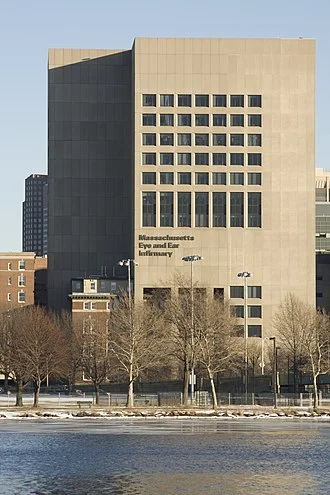
Mass. Eye and Ear, on the Charles River, Boston.
From Cambridge Management Group Inc. (cmg625.com).:
Partners HealthCare and Massachusetts Eye and Ear Hospital are challenging the Massachusetts Health Policy Commission’s finding that Partners’ acquisition of the specialty hospital would significantly raise costs for consumers.
The panel concluded that said the purchase would boost prices for Mass. Eye and Ear’s services, increasing spending by $20.8 million to $61.2 million a year. And it said that the costs would be felt in higher health-insurance premiums.
But Partners, the Greater Boston health system behemoth, and Mass. Eye and Ear, in a formal response to those assertions, said the commission overstated potential cost increases and underestimated Mass. Eye and Ear’s financial problems.
To read a Boston Globe article on this, please hit this link.
Conceptual sculpture

Work by Waldo Evan Jespersen, in his show "Stretched,'' at Boston Sculptor Gallery, Dec. 14-Jan. 28.
The gallery says: "Driven by formalism and problem solving, Jespersen's work represents the distillation of a thought pushed through the filters of reality and compromise. Often engineered to push the boundaries of materials and processes, as well as his own ability, Jespersen's sculptures are surprisingly elegant, whimsical, and deceptively simple in their purity of form. The process spurs an endless playful battle between the juxtaposition of a simple concept and complex construction.''
'Before the merciless grid'

"Predating the merciless grid that seized Manhattan and possessed the vast Midwest, New England towns have at their center an irregular heart of open grass, vestige of the Puritan common, holding, perhaps, a village pump, a weathered monument, a surviving elm. In Rowley {Mass.}, a vacant triangle beside Route 1A that a December narrows becomes suddenly alive with whirling dervishes of Christmas lights….''
By the late John Updike from his essay "Common Land,'' in Arthur Griffin's New England: The Four Seasons
In the Bay State, trying to disable handicapped-parking fraud

From Robert Whitcomb's "Digital Diary,'' in GoLocal24.com:
Massachusetts Gov. Charlie Baker has signed a bill to crack down on people who misuse disability credentials to get handicapped parking spaces. Rhode Island officials would do well to order the same sort of crackdown.
We sometimes see people who seem in very good physical condition using handicapped parking placards in order to park in spaces very close to where they’re shopping, seeing physicians and so on.
The Boston Globe reported that the new law, which increases the authority of the Registry of Motor Vehicles to investigate fraudulent applications for handicapped placards, was enacted after a 2016 report from the state inspector general found that people were misusing placards in every Boston neighborhood that was watched.
“’The use of disability parking placards should be reserved for our most vulnerable residents,’ Baker said. Obviously.
The issue reminds me that the demand for handicapped parking will presumably continue to surge with the aging of the population. But will self-driving cars cool that demand as auto-autos pick up and drop off people exactly where they want to be?
To read The Globe’s article, please hit this link:
And then there are those “therapy animals,’’ mostly dogs, with owners with invisible health problems.
Jim Hightower: A mass murderer's love song to Trump
Via OthertWords.org
We’ve had a great relationship,” exulted a giddy Donald Trump, following his two-day schmoozefest in Manila with the thuggish Philippine president, Rodrigo Duterte.
Duterte, who calls himself a “toughie,” brags that he’s personally killed many people and likes to compare himself to Hitler. He’s been on a murderous rampage since his election last year.
In the name of eliminating the drug trade, Duterte has unleashed a massive military assault across the country, not merely targeting dealers, but also anyone alleged to even use drugs. His onslaught is a human rights atrocity, with untold thousands being executed in what are antiseptically termed “extra judicial killings” — that is, murders.
Yet the present president of the United States says Duterte is his new buddy. Trump stressed in their official discussions that the Philippine president can count on him and the U.S. (which includes you and me) to be a friend. And, as a friend, Trump didn’t bother his authoritarian buddy with any unpleasant talk about those rampant human rights abuses.
Instead, the Duterte-Trump get-together was one of mutual praise and even affection. Indeed, Trump was delighted when Duterte impulsively grabbed the microphone at a gala state dinner and serenaded Trump with a love ballad, crooning: “You are the love I’ve been waiting for.”
In fact, Duterte had earlier demonstrated that love when he named Jose Antonio to be his trade representative to our country. Antonio, a Philippine real estate mogul, happens to be a partner with our president in the luxurious new Trump Tower, now under construction in Manila. Cozy, huh?
Hugging up Duterte might be good business for Trump, but it’s a sorry deal for our national interest — and it’s an insult to our people’s support of human rights.
Jim Hightower is a radio commentator, writer, and public speaker. He’s also the editor of the populist newsletter, The Hightower Lowdown.
From fossil fuel to wind

The now-dead Brayton Point Power Station in a recent winter.
A Missouri-based company, Commercial Development Co., plans to buy the now closed and once heavily polluting fossil-fuel-powered Brayton Point Power Station, in Somerset, Mass., and may turn the 307-acre site into a center for windpower. How fitting.
“Multiple factors attracted us to this site. Of greatest interest was the potential for renewable energy development,” said Randall Jostes, the company’s CEO. The Massachusetts Clean Energy Center sees very breezy Brayton Point as a possible site for an industrial wind port.
Some of us will feel a pang when the two huge and eerie cooling towers at Brayton Point, looming on the south side of Route 195, are torn down. A lot of people have thought that the facility was nuclear.
So get in your cave

"Cave Bears,'' by C.C. White, at the Patricia Ladd Carega Gallery, Center Sandwich, N.H.
David Warsh: Discovering an octopus of their own
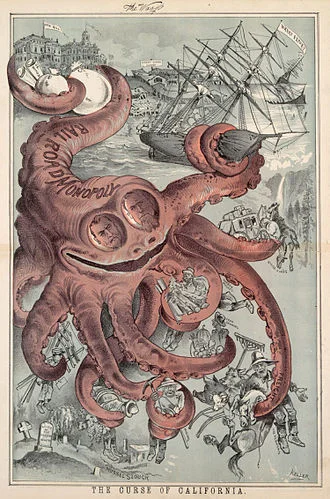
G. Frederick Keller's "The Curse of California,'' which appeared in The Wasp on Aug. 19, 1882, is the likely origin of the depiction of the Southern Pacific Railroad monopoly as an octopus.
SOMERVILLE, Mass.
Last week, when the tax bill and Michael Flynn’s plea deal dominated the news, Secretary of State Rex Tillerson came under increased pressure from the White House to resign. Might that story be almost as important as the others?
The question to ask is, why did the former Exxon CEO take the job? The 65-year-old Texan has grandchildren and well over $50 million in the bank. The secretary and I are not pals, but I think I understand. He did it because he was an Eagle Scout, and because his old hunting buddy, former Secretary of State James A. Baker, III, told him that he thought it would be worth the struggle.
Struggle it has been. The diplomatic press corps has been all over Tillerson for months, accusing him of wrecking, or unravellng, or dismantling the State Department by reorganizing it in an effort to comply with the 31 percent budget cut ordered by Trump.
Tillerson replies that the department’s $55 billion budget was at an all-time high under the Obama administration. He is seeking to impose an 8 percent cut among the agency’s 35,000 employees. His aim, he says, is to make a somewhat smaller department function much as it did under his friend Baker, in the George H. W. Bush administration. No doubt the human costs of careers derailed have been significant; the extent to which the department’s mission had been impaired will be an open question for many years.
Meanwhile, Tillerson has disagreed with the president on nearly every important foreign-policy question: the Paris Climate Accord, the Transpacific Partnership, the pursuit of a diplomatic track with North Korea, the Saudi campaign against Qatar, maintenance of a strong line against Russia in Ukraine. He hasn’t denied calling the president, not just a moron, but a crude slang term for a four-star moron, the highest rank of moron that there is.
Public life has few afflictions more annoying than a specialist press corps whose favorite sources have been spurned. If there were any doubt that outrage has overwhelmed reason at the editorial board of The New York Times, its story "Help Wanted: Top Diplomat'' should resolve it. CIA Director Mike Pompeo, said to be the front-runner to replace him, is “potentially every bit as inimical to the national interest” as is Tillerson, according to the Times. Pompeo, a former Kansas congressman, is very much a member of the president’s inner circle. As Aaron David Miller and Richard Sokolsky wrote yesterday in Politico, Rex Tillerson Isn’t the Problem – It’s Trump.
The president, it is often said, doesn’t like to fire people. He prefers to humiliate them until they quit. My guess is that Tillerson won’t make it easy for him. The clamor of the diplomatic press notwithstanding, actually dismissing Tillerson might cost the president dearly in many quarters – Congress, for example, or the Pentagon – as did firing FBI director James Comey. It is conceivable that, despite the ruckus, Tillerson stays.
William Allen White, turn-of-the-20th-Century Kansas newspaper editor and Progressive sage, wrote in 1905, “It is funny how we all found the octopus.” He was talking about the giant business and money trusts, whose significance he had dismissed only a decade before, in the heat of a populist onslaught.
In a similar way, those in the "mainstream media'' who doubted the existence of a “deep state” a few months ago, mainly for the sinister connotations of the term, may soon be discovering an octopus of their own. An American Establishment exists, attenuated but still powerful. Like the roster of firms that compose the once-dominant Dow Jones Industrial Average, the Establishment’s uppermost ranks have changed a great deal over the years. Broader indices have come into play. But, in the words of another wordsmith, Mark Twain, reports of its death have been exaggerated.
So far the Establishment has caused President Trump to appoint a series of moderates to top jobs, of whom Tillerson and White House Chief of Staff John Kelly are the foremost. Who knows what happens if those bonds give way.
David Warsh is a long-time economic historian and political and financial columnist. He is proprietor of economicprincipals.com, where this first ran.
Mount Mystery

'Untitled." (oil paint and wood), by Matt Chinian, in the "Back Story'' show at Periphery Space Gallery, Providence, Dec. 9-23.
Disappearing souls to count

"I came an errand one cloud-blowing evening
To a slab-built, black-paper-covered house
Of one room and one window and one door,
The only dwelling in a waste cut over
A hundred square miles round it in the mountains:
And that not dwelt in now by men or women.
(It never had been dwelt in, though, by women,
So what is this I make a sorrow of?)
I came as census-taker to the waste
To count the people in it and found none,
None in the hundred miles, none in the house,
Where I came last with some hope, but not much,
After hours' overlooking from the cliffs
An emptiness flayed to the very stone.
I found no people that dared show themselves,
None not in hiding from the outward eye.
The time was autumn, but how anyone
could tell the time of year when every tree
That could have dropped a leaf was down itself
And nothing but the stump of it was left
Now bringing out its rings in sugar of pitch;
And every tree up stood a rotting trunk
Without a single leaf to spend on autumn,
Or branch to whistle after what was spent.
Perhaps the wind the more without the help
Of breathing trees said something of the time
Of year or day the way it swung a door
Forever off the latch, as if rude men
Passed in and slammed it shut each one behind him
For the next one to open for himself.
I counted nine I had no right to count
(But this was dreamy unofficial counting)
Before I made the tenth across the threshold.
Where was my supper? Where was anyone's?
No lamp was lit. Nothing was on the table.
The stove was cold—the stove was off the chimney—
And down by one side where it lacked a leg.
The people that had loudly passed the door
Were people to the ear but not the eye.
They were not on the table with their elbows.
They were not sleeping in the shelves of bunks.
I saw no men there and no bones of men there.
I armed myself against such bones as might be
With the pitch-blackened stub of an ax-handle
I picked up off the straw-dust-covered floor.
Not bones, but the ill-fitted window rattled.
The door was still because I held it shut
While I thought what to do that could be done—
About the house—about the people not there.
This house in one year fallen to decay
Filled me with no less sorrow than the houses
Fallen to ruin in ten thousand years
Where Asia wedges Africa from Europe.
Nothing was left to do that I could see
Unless to find that there was no one there
And declare to the cliffs too far for echo,
'The place is desert, and let whoso lurks
In silence, if in this he is aggrieved,
Break silence now or be forever silent.
Let him say why it should not be declared so.'
The melancholy of having to count souls
Where they grow fewer and fewer every year
Is extreme where they shrink to none at all.
It must be I want life to go on living.''
-- "The Census Taker,'' by Robert Frost, set in New Hampshire.
'As if evening found us young'
I
"Only this evening I saw again low in the sky
The evening star, at the beginning of winter, the star
That in spring will crown every western horizon,
Again… as if it came back, as if life came back,
Not in a later son, a different daughter, another place,
But as if evening found us young, still young,
Still walking in a present of our own.
II
It was like sudden time in a world without time,
This world, this place, the street in which I was,
Without time: as that which is not has no time,
Is not, or is of what there was, is full
Of the silence before the armies, armies without
Either trumpets or drums, the commanders mute, the arms
On the ground, fixed fast in a profound defeat.''
-- From ''Martial Cadenza,'' by Wallace Stevens
Term limits look better and better in Connecticut
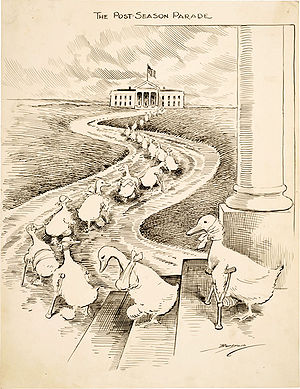
The lame ducks depicted in this Clifford K. Berryman cartoon are defeated Democrats heading to the White House hoping to secure political appointments from President Woodrow Wilson.
Columnist Jim Cameron in the Stamford Advocate has curtly written off Connecticut Gov. Dannel Malloy: “Our governor is a lame duck. Because he’s announced he’s not running for re-election, he has the political clout of a used teabag. And even though he’s our state’s leader for another 11 months, nobody cares about him or his ideas any longer.”
Malloy’s lieutenant governor, Nancy Wyman, has decided she would rather be spending time with her family than running for governor, which would necessarily entail a hearty defense of Malloy’s ruinous policies.
After two terms making Connecticut great again, Malloy himself has decided to take a hike.
Atty. Gen. George Jepsen, whose time in office was spent avoiding media notoriety -- unlike his predecessor, Dick Blumenthal, for whom fawning media attention was the River Styx in which he bathed frequently – has called it a day after two terms as Connecticut’s AG. And no, the former chairman of the State Democratic Party has no plans to run for governor. Both Blumenthal and former Atty. Gen. Joe Lieberman used the AG’s office as springboard to a U.S. Senate sinecure.
Mayor of Hartford Luke Bronin, once Malloy’s chief counsel, having said he would need a couple of terms in office to turn the U.S.S. Hartford around, has rushed into the vacuum created by Malloy’s departure. Connecticut’s capital is taking on water. Only a few weeks ago, Bronin was palavering with lawyers about a bankruptcy declaration, and if he now feels the governor’s office is a politically safe haven compared to the mayoralty of Hartford, he’s one bright cookie. Most lawyers are not dummies. despite the usual bad rap on the comic circuit. Question: What do you call a lawyer with an I. Q. of 50? Answer: Your honor.
An open Democrat gubernatorial field has yanked Ned Lamont from the shadows. Lamont, a cable millionaire and great-grandson of a late chairman of J.P. Morgan & Co. Thomas Lamont, successfully challenged then U.S. Sen. Joe Lieberman in a Democrat primary; he then lost to Lieberman, who successfully defended his seat as an independent in a general election. “Lamont spent $26 million of his cable television fortune on his run for the Senate and for governor,” Neil Vigdor of CTPostreminds us, and Lamont was, of course, supported by former U.S. Sen. Lowell Weicker, who is still recovering from his 1988 loss to Lieberman.
“I just care about whether I think I can make a difference and get this state back on track,” Lamont said. “We’ve got so many amazing assets. We’re just not making the best out of our potential.” Lamont indicated that he would decide by January whether he would throw his hat into the gubernatorial ring. By that time, the floor on both sides of the political barracks will be littered with hats.
These bow-outs of Malloy, Wyman and Jepsen have kicked the doors open on an election that promises to be alarmingly interesting. If anyone wants to know how term limits might introduce into Connecticut’s sclerotic political system the verve and energy of a new day, they have only to look about them. Had term limits been in force midway between Dick Blumenthal’s agonizingly long 20-year term as the state’s attorney general he might have been a U.S. senator or possibly governor more than 10 years earlier; for it is not true that term limits would end political careers. They would simply move the pieces on the political chessboard toward different political functions. PAC committees, easily captured by incumbents, would have to decide, upon a governor or a senator leaving his post, who they might want to corrupt in the future; in the absence of a healthy turn-over in various offices, corruption has become routine, predictable and automatic. Term limits would invigorate political parties, and awaken all the nerve tingling juices of reporters during election cycles.
This is precisely what is happening right now that three prominent officeholders have decided in effect to term limit themselves.
Jepsen’s political career has been well rounded: In 2018, he will have put in eight years as attorney general. But Jepsen also served in the State House for four years and the State Senate for 12 years. He served as chairman of the state Democratic Party for two years. These terms in different political offices approximate term limit spans. Jepsen circulated himself through a now sclerotic political system, and no one is complaining that the state Senate, for example, has been irreparably damaged because Jepsen did not spend as much time there as Blumenthal had in the attorney general’s office.
Had term limits been in operation for the last few election cycles, no one in the Democratic Party would be wincing at the prospect that a Bridgeport mayor who spent years in prison for corruption might become the next governor of Connecticut. The gubernatorial field on the Democratic side would now be crowded with recirculated Democrats, some of whom just might be able to pull Connecticut out of its progressive mire by its former moderate and pragmatic bootstraps.
Don Pesci is a Vernon, Conn.-based columnisf.
'Like living on an actual ship'

"Northeaster' (on the Maine Coast), by Winslow Homer.
“Say the words ‘New England,’ and one person will think of a white church spire and a village green; another will see a covered bridge or the Vermont hills in autumn; and still another will conjure up a farm along the Connecticut River. For me, the words evoke the sounds and smells of the sea, and the storms and fogs that make life along the New England coast a good deal like living on an actual ship, subject to the whims of the weather.’’
Nathaniel Benchley, in “The Sea,’’ in New England: The Four Seasons.