
Vox clamantis in deserto





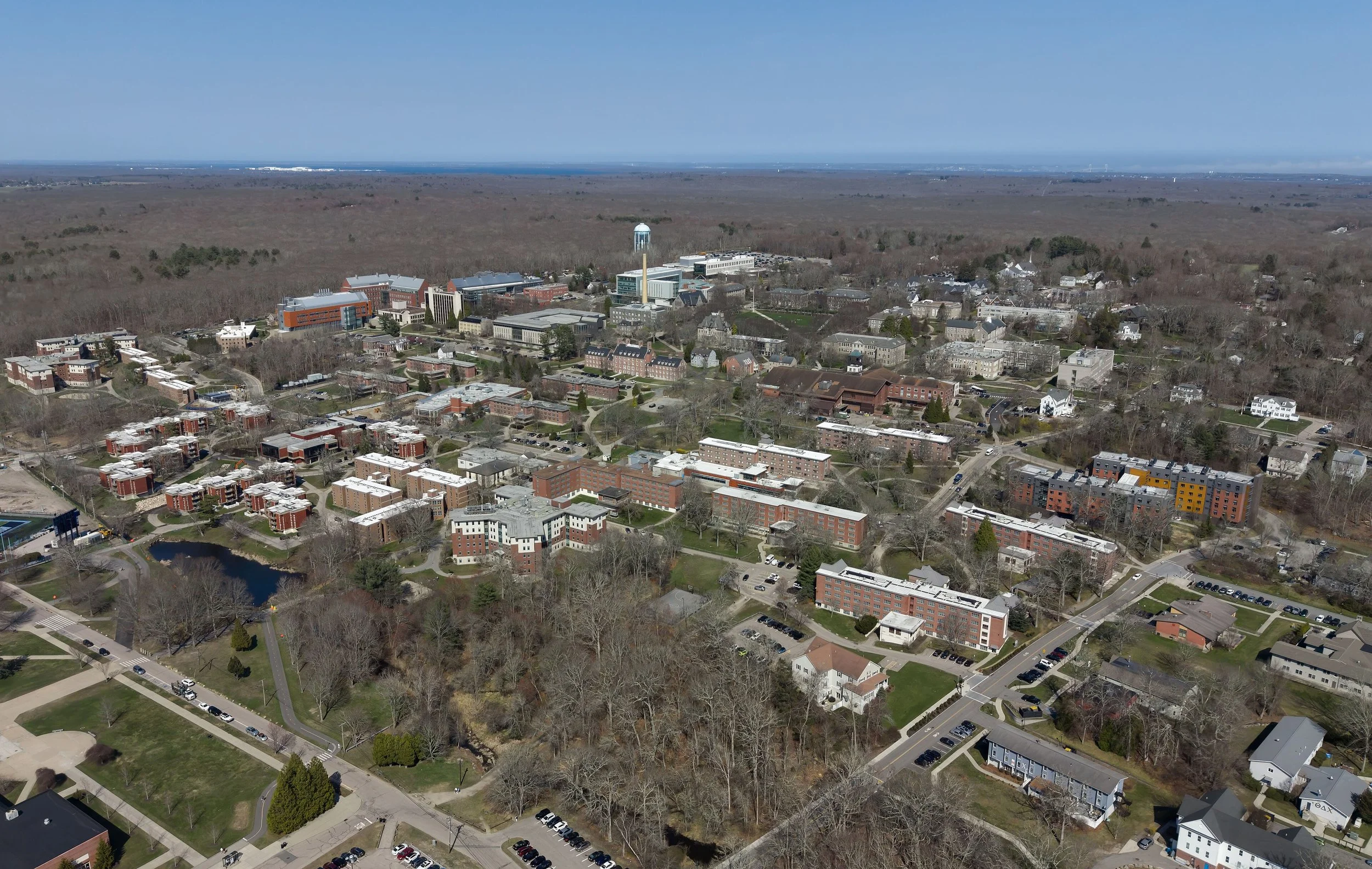
Expanding the urban forest

From Robert Whitcomb's "Digital Diary,'' in GoLocal24.com
Some other happy news about public-private partnerships came in Nicholas Boke’s charming Nov. 8 ecoRI News article headlined “Community Togetherness: Planting an Urban Forest’’.
It’s about the highly successful Providence Neighborhood Planting Program (PNPP), which is charged with maintaining and expanding the city’s “urban forest.’’ My family has fond memories of the tree planting in a related program in front of our house 25 years ago. The sapling then was about 5 feet high. Now it’s over 20 feet high and has turned into a very popular and lush abode for various bird species.
The PNPP is a joint venture of the private Mary Elizabeth Sharpe Providence Neighborhood Planting Program Fund, the city’s Parks Department and local residents, who get lessons from the program in how to plant and nurture the trees. It’s enlightened self-interest: Trees help clean the air, reduce heating bills in the winter and air-conditioning bills in the summer and their beauty raises real-estate values.
City Forester Doug Still told Mr. Boke that the program plants a total of about 500 trees a year in 25 neighborhoods while the city directly plants another 200. For more information, please hit this link for information about the program:
To read the ecoRI news piece, please hit this link:
https://www.ecori.org/green-groups/2017/11/8/community-togetherness-planting-planning-an-urban-forest
Linda F. Nathan: When grit isn't enough
Everyone knows money is important. For those privileged to have enough of it, money is not an obstacle for living a decent life or for college access. My husband and I frequently say,
Money isn’t everything,” but only the freedom of having money allows us to say such a thing. We didn’t want our own children restricted in their college choices. Of course, we hoped that they would consider attending Tufts University, where my husband is a professor, so that, if admitted, they would be eligible for tuition remission. But we didn’t want to limit their explorations or plans. Many of my friends will espouse similar statements: “We will take out loans if we have to” or, “I’ll be working to pay this tuition off for another 20 years.” Many of our friends began a college fund when their children were born. I know of many families who enlist the help of a grandparent to pay for a grandchild’s tuition. So, for the children of the “haves,” the cost of college is a consideration, perhaps, but it doesn’t predetermine the future.
However, within the urban public school arena where I have worked for four decades, the assumption that “money isn’t everything” is patently false. We hope our students will receive adequate scholarships or federal loans. We urge students to go to state colleges and universities where tuition might be more affordable. We counsel kids against taking on too much debt. But no matter what approach we take, cost is a huge obstacle in accessing quality higher education.
A recent study reports that state funding for higher education has fallen by 18% since 2008. Money, or the lack of it, can easily determine the kind of future a young person will have. Some families have the good fortune to assume that no matter the monetary demands, college is accessible. But that is just not true if you are poor or don’t have the social or cultural capital to navigate the system of higher education. The data are incontrovertible: Elite colleges and flagship universities enroll more students from the top 1% of the income distribution than from the bottom half.
Kevin remembers being encouraged to dream big about college. He knew he was talented. He had excellent grades in both visual arts and academics. “We had heard since we came here [to Boston Arts Academy] as freshmen, even in freshman orientation, that we could all go to college. It was part of the curriculum.” Kevin recalls the intensity of senior year with his peers. Classes revolved around writing college essays and preparing portfolios as well as practicing for interviews. “‘Where are you applying? Is your portfolio finished?’ That’s all we talked about. Everyone was going to go somewhere.” In this case, the assumption was, there is a college for everyone.
Kevin received a full scholarship to the nearby Massachusetts College of Art and Design, a four-year, public arts college, but he desperately wanted what he called the “full college experience” of going away from home and being around a diverse mix of kids. “I’d been doing art so intensely for four years in high school. I just wanted to see what else was out there.” So instead of going to MassArt, where he had a full scholarship, he went to another state school: the University of Massachusetts Dartmouth, where he would need financial aid. Pell grants wouldn’t cover the cost of in-state tuition with room and board. Kevin qualifying for financial aid, and he understood that he would have to repay some loans when he graduated.
During freshman and sophomore year, Kevin had a great adviser who made sure that he did all his financial-aid paperwork on time. But junior year, he was assigned a new advisor in his major. That advisor didn’t know Kevin well, and he wasn’t as methodical about checking in with Kevin about issues such as aid deadlines. Kevin recalls when his life began to unravel. “I was so busy at the end of sophomore year. I was working for Unity House [for students of color], and I was performing and deejaying all over to earn money for books and everything. I was also working 30 hours a week in the cafeteria. Of course, I had a full load of classes too.”
When he returned in September of his junior year, he discovered he didn’t have housing. “Alarm bells should have gone off. I should have realized right away something was wrong. But I just thought it was a housing thing and it would work out. Lots of my friends had had housing issues. So I stayed on a friend’s couch for September, waiting for housing to come through. That wasn’t so unusual with my friends. But when I went to the housing office to find out when I’d get a room, they just laughed and said I wasn’t even enrolled. There was a hold on my account. I was so confused. How could that be? I was like big man on campus. Everyone knew me and loved me. I was involved in everything. Why would I have a hold?” Too late, Kevin realized that he had neglected to apply for financial aid for his junior year.
It was already mid-October and he was too embarrassed to tell his mother that he actually wasn’t a student. “She just wouldn’t have understood. She had sacrificed her whole life for me to get here.” He stayed involved with all his college activities. He kept his on-campus job and even kept going to classes, but slowly things began to catch up with him, and he realized that now he had all this debt and he didn’t know what to do. He dropped out of college and worked two jobs trying to pay off some of the loans, but he couldn’t make much of a dent in the debt he was accumulating while also paying for rent and food. “The debt just went higher and higher with the interest. At some point I think I realized that I owed $42,000 and there was literally no way I could be paying that off and live.”
Kevin didn’t want to acknowledge that his dreams of a college degree had vanished. He was working 40 hours a week cooking in a diner and also making money on the weekends performing and deejaying, but he still couldn’t see how he’d ever be able to return to school.
He knows that he should have been responsible for understanding when and how to reapply for financial aid, but he also recognizes the role that his first adviser had played in helping him keep track of the paperwork. “I shouldn’t have relied on my advisor, but, you know, if you don’t grow up knowing all about financial aid and the deadlines, and you don’t have a parent to remind you, it’s really important that someone at college can help with that. I’m not the only one who missed deadlines. Sometimes I think colleges should be measured on how many students actually graduate rather than how many enroll. And if a lot drop out, like what happened to me, maybe tuition and loans should be even less. Why isn’t the college held responsible at all?”
I’m intrigued by Kevin’s last comment. Why, indeed, don’t we hold colleges responsible for graduation rates? And how are graduation rates tied to money? There is a direct correlation between the ability to access financial aid and graduation rates. At UMass–Dartmouth, graduation rates are under 50%. How much of that attrition is due to the fact that money is an obstacle for too many students? I don’t think this disappointing graduation rate means that UMass Dartmouth is a bad school. Many of my Boston Arts Academy students who have gone there, whether or not they have graduated, have spoken in positive terms about their classes and the education they received. Even though many students commute, Arts Academy graduates have found that UMass Dartmouth has a strong community of color, but offers few programs that adequately help first-generation students, especially with respect to financing. There are no required meetings for these students. There are no regular check-ins. Kevin was lucky to be assigned such an attentive advisor his first few semesters. But luck should not be the reason students graduate or not.
My students desperately want to believe what we have taught them: They can go to college. Money isn’t everything. They will get scholarships. They can even take out loans. Kevin and so many students like him realize too late that money, in fact, is everything. They also realize that making one small mistake means the difference between securing a future that they dreamed of in high school and a future that may not be better than their parents’. Money, white privilege and the ethos of meritocracy have created extraordinary barriers for too many. We have created a two-tiered system that seems to have no end in sight.
Again, relative privilege ensures this will not happen with my own children. I have been able to help them with college and even graduate school. My son, a medical school student, will be able to make a choice about whether he wants to become a primary care physician and he will not have to enter a more lucrative specialty field just to pay back loans. This kind of freedom shouldn’t be available only to the affluent.
Could we imagine a more holistic conversation between higher education leaders, high school principals, guidance counselors, nonprofit leaders and funders—both private and governmental—about the kind of supports necessary to ensure that money is not an obstacle for success in college? Students across the country are engaging in protests about the tiny numbers of students of color attending many of our private and more elite colleges. These Black Lives Matter protests are laudable. They harken back to the student movement of the 1960s. But I fear that the students are missing the point by focusing solely on the percentages of students admitted. Colleges must also be accountable for graduating those students they accept. The real question is how all institutions of higher education can ensure that the Kevins of this country are afforded access to finishing college and earning a degree. If we believe that college access for poor and working-class youth and adults is an important vehicle for democracy to continue to regenerate itself, the entire nation must commit to changing our policies so that money does not continue to be an obstacle.
When my book came out and I had the opportunity to be interviewed on the radio and in the press. Some of my alumni heard me or read the interviews. I received a stunning email from one of them: “Thank you, Ms. Nathan, for giving voice to what I ‘ve been feeling all these years. I have felt like such a failure for my inability to finish college. I have been paying off those loans forever. There just hasn’t been a way back to school. I know I’m smarter than the job I have now, but without loan forgiveness, this is my life now.”
Another, Laura, told me that she could have been Kevin if it hadn’t been for an administrator on campus who intervened and made sure that she got housing after helping her get rid of the “hold” on her account. Laura had missed an email about needing to waive health insurance and so she was locked out of housing or enrolling in the next semester classes. The administrator wasn’t just any administrator, but a vice president. “They had to listen to her at the housing and enrollment offices.” But these issues of missing an email shouldn’t create such potentially devastating situations for students and yet they are all too common.
I have been asked: What can be done? What are the steps forward for creating better outcomes?
I write about many of the ways high schools could be strengthened to provide more support for their students. However, I am convinced that higher education institutions have a responsibility to find solutions to alleviate the financial constraints for low-income students, first-generation students and students of color. Here are my suggestions:
Release of transcripts. All college leaders could agree to release transcripts for courses that students already paid for. In this way, students would be able to hold on to some of the credits they had earned and not forfeit everything. In Kevin’s case, this would mean that he would have two years toward his college degree. I can already hear the protests from many higher education circles about how this enables young people. However, I can imagine a system where credits are released and then students are required to pay a little back each year over a period of time. But, holding all credits back ensures that the student will NEVER be able to return to college unless, like another of my alumni, they literally hit the jackpot and win the lottery. When I have asked college administrators about the rationale for not releasing credits already paid for, they return to the issue of students still owing money. They seem unable to separate money paid and money owed.
Success Offices. Colleges could commit to robust Success Offices with clear and continuous communication to students about deadlines and upcoming opportunities. The goal of these offices would be to ensure college completion of enrolled students. Imagine if during the regular orientation, students had the chance to work with trained personnel about financial aid deadlines, what you can choose to waive (like health insurance) and myriad other issues that crop up constantly for which many students are unprepared. Imagine if these offices were staffed with students who understand the invisible web that can trap low-income students too easily. Since finishing my book, I’ve learned about an organization called Persistence Plus that sends text messages to students asking them where they are planning on studying since finals are coming up, or whether they have checked in at the tutoring center. I’m intrigued by these online applications, and impressed with the positive data reported by the organization. Nevertheless, I argue in my book, that while individual effort is clearly important in college success, we should not let colleges off the hook. They too have a responsibility to help students persist and graduate.
Additional orientation sessions for first-generation students. As countless students told me, “the Success Office can only do so much.” My alumni explained that people in the financial aid office, student accounts, health … “all those places where we have to interact, also need to know that their job is to help us and not prevent us from graduating.” I was told over and over again that these offices need to hold regular and required meetings for their students—and that these offices and individuals need to communicate with one another.
Professional development in supporting low-income population. Colleges could collaborate on professional development focused on working with first-gen students for all employees who work in student accounts, financial aid and other areas. In addition to having good accounting skills, these employees could benefit from broad training in how to support low-income students in their college going years, including sensitivity training around poverty and immigration status. (An alum just called to tell me that the financial aid person on her campus as recently as last month referred to “illegal aliens” instead of undocumented students, or students without official papers. Terms such as “illegal alien” are actually hurtful to my students.)
Rethinking accountability for success in rating colleges. All colleges and universities should be required to publish data that reports graduate rates by “subgroups.” (“Subgroups” is the term used by the state to define non-white students, special education students, or students in poverty.) All pre-K-12 public schools’ test scores are reported annually in the newspaper and by the Massachusetts state Department of Education and the U.S. Department of Education using such “subgroups.” Why is it that higher education institutions are not obligated to play by the same rules? A professor friend of mine at a four-year “second tier” private college tells me her president doesn’t want to release the scores of graduation rates for African-American students because they are so abysmal. This lack of transparency renders the crisis difficult to analyze and address.
Debt forgiveness. Higher education institutions could lobby the federal government so that loan forgiveness programs are widely adopted. Student debt continues to be one of the most serious ways in which low-income young people are trapped. Just recently, a Boston Globe article headlined, “Debt load hits black students hardest,” noted that “African-American students who started college in 2003-04 typically owed 113 percent of their student loan 12 years later. … By contrast white borrowers had paid down their debt and owed only 65 percent of the original amount, and Hispanic borrowers had knocked down their debt to 83 percent of the initial loan.”
Rethinking the role of Accuplacer tests in community colleges. It is clear to me that these tests are serving a harmful role in the advancement of young people. I would like to see community colleges eliminate them and use GPA, recommendations and transcripts for placement. In so doing, students can take “co-requisite” work alongside their college-level classes.
More investment in community colleges. As I have noted in my book, per-pupil expenditures in Massachusetts are abysmal. It is difficult to provide the necessary supports to the myriad students who attend community college. I would like to see community colleges offering more online, self-paced courses with more extensive supports for students than currently offered. I would also like to see financial aid cover developmental courses.
Competency-based college degrees. In my book, I discuss a program that College for America at Southern New Hampshire University is working on with Match Inc., the Boston-based public charter school. I think these programs need more analysis on outcomes for participants; otherwise, I fear that we are developing a two-tiered system. College for America programs began with a focus on providing bachelor degrees for employees at companies like Panera Bread, who wanted to move up in the ranks. But I am not convinced about the quality or depth of the coursework as compared with more traditional four-year degrees. Nevertheless, I would be intrigued by a pilot program that allows careful analysis of how students do in a non-time-based or credit-based system as compared with a more traditional one. For some students, I believe the results will be strong. Currently, I’m supporting a former colleague to matriculate and gain his bachelor’s degree after working for 30 years in the performing arts field. I believe that he makes a strong candidate for a competency-based degree.
If we implement some of these suggestions, we may have better chances of graduating students like Kevin. As Kevin reminded me, “We are sort of like the America dream. We are what this country is made from. And if we don’t make it, I can’t help but wonder if the whole country will make it.”
I couldn’t agree more. And looking at the current tax bills before Congress, I cynically wonder if we want more Kevins to graduate from college.
Linda F. Nathan is executive director of the Center for Artistry and Scholarship and teaches at Harvard University and University of Massachusetts, Boston. She was the founding Headmaster of Boston Arts Academy. This piece includes excerpts from her recent book, When Grit Isn’t Enough: A High School Principal Examines How Poverty and Inequality Thwart the College-for-All Promise (Beacon Press, 2017). Reprinted with permission from Beacon Press.
Making an impression

"Cows at a Watering Hole" (1863 -- red chalk with stumping on paper), by Charles-Francois Daubigny, in the show "The Impressionist From Degas to Toulouse-Lautrec,'' at the Clark Art Institute, Williamstown, Mass., through Jan., 7.

Using ribbed mussels to clean water

Ribbed mussel.
From ecoRI News (ecori.org)
MILFORD, Conn.
Ribbed mussels can remove nitrogen and other excess nutrients from an urban estuary and could help improve water quality in other urban and coastal locations, according to a study in New York City’s Bronx River. The findings, published in Environmental Science & Technology, are part of long-term efforts to improve water quality in the Bronx River estuary.
Researchers at the National Oceanic and Atmospheric Administration's Fisheries Milford Laboratory began the two-year pilot project in June 2011. They used a 20-by-20-foot raft with mussel growing lines hanging below as their field location in an industrial area near Hunt’s Point, in the South Bronx, not far from a sewage-treatment plant. The waters were closed to shellfish harvesting because of bacterial contamination. Scientists monitored the condition of the ribbed mussels and water quality over time to see how each responded.
“Ribbed mussels live in estuarine habitats and can filter bacteria, microalgae, nutrients and contaminants from the water,” said Julie Rose, a research ecologist at the Milford Laboratory, part of the Northeast Fisheries Science Center, and co-author of the study. “They are native to the East Coast so there are no concerns about invasive species disturbing the ecosystem, and they are efficient at filtering a variety of particles from the water. Ribbed mussels are not sold commercially, so whatever they eat will not be eaten by humans.”
Farming and harvesting shellfish to remove nitrogen and other excess nutrients from rivers, estuaries and coastal waters is known as nutrient bioextraction, or bioharvesting. Mussels and other shellfish are filter feeders, and as the organisms grow, they take up or assimilate nutrients in algae and other microorganisms filtered from the surrounding waters.
Nitrogen, phosphorus and other nutrients occur naturally in the environment and are needed by plants and animals to grow, but too much of any of them is harmful. Excess amounts from human activities often end up in rivers, streams and coastal environments, causing algal blooms, loss of seagrass and low oxygen levels, which can kill large numbers of fish.
Researchers found that the Bronx River mussels were generally healthy, and their tissues had high amounts of a local nitrogen isotope, indicating that they removed nitrogen from local waters. They also had lower amounts of trace metals and organic contaminants than blue mussels collected from the seafloor nearby. An estimated 138 pounds of nitrogen was removed from the river when the ribbed mussels were harvested.
The researchers estimate that a fully populated 20-by-20-foot mussel raft similar to the one used in the study would clean an average of 3 million gallons of water and remove about 350 pounds of particulate matter, such as dust and soot, daily. When harvested, the animals could be used for fertilizer or as feed for some animals, recycling nutrients back into the land.
The mussel raft was placed at the confluence of the East River tidal strait and the Bronx River in a high-nutrient, low-chlorophyll system, making the site unsuitable for large-scale mussel growth. Future projects using ribbed mussels for nutrient remediation will need spat or larvae from another location or from hatchery production.
“Management programs to reduce the effects of excess nutrients in the water have largely focused on land-based sources, such as human and livestock waste, agriculture, and stormwater runoff,” said Gary Wikfors, Milford Laboratory director and co-author of the study. “They really haven’t looked much at recovering the excess in the water itself. Nutrient bioextraction using shellfish is becoming more common, and this study demonstrated that it could be an additional tool for nitrogen management in the coastal environment.”
The Bronx study is the first to examine the use of ribbed mussels for nutrient bioextraction in a highly urbanized estuarine environment. A previous study comparing the Bronx River to the more productive Milford Harbor estuary indicated that ribbed mussels were able to adapt in just a few days to low food availability and feed with the same efficiency in the Bronx River site as populations at the Milford River site. That study also supports the use of ribbed mussels as a management tool for nutrient bioextraction in a range of coastal environments.

Jim Hightower: President Trump and other people's money

Via OtherWords.org
If you’ve been to any of the cities graced with a Trump hotel, casino, or resort, you know that The Donald splashes his name in giant, gaudy letters across every structure he owns — preferably in gold or at least golden paint
Now he’s taken ownership of a massive new structure, but he might not want his name on this one. It’s Trump’s towering re-do of America’s tax law. And it’s truly golden — for the super-rich, that is.
The plan reveals in hard numbers whom this presidency really serves: Not just the 1-percent, but the one-tenth of 1-percenters who are multimillionaires. People like Trump himself.
First and foremost, the Trump tax plan slashes the payments that giant corporations make to support our nation. He claims that this will let corporate elites raise the wages of workers and create jobs, winking at the fact that, of course, the elites will pocket every dime of his tax giveaways.
And — shhhh — he doesn’t mention a little secret gotcha: A third of his corporate benefits go to foreign owners of American corporations.
Meanwhile, Trump’s luxurious new tax structure eliminates many benefits for middle class families, such as tax deductions for medical expenses, college tuition, and interest paid on student loans.
He wants modest-income families to pay more, so he can eliminate current taxes on his own uber-rich family — including killing the alternative income tax paid by the rich, and the estate tax, which applies only to the immense fortunes of a handful of America’s richest families.
Did I mention that the gilded tax structure proposed by this self-described business genius would hang an additional $1.5 trillion in debt around our children’s necks?
No surprise, for Trump’s grandiose luxury projects were often built with other people’s money. Trump would cash in before he slipped away, leaving others to grapple with the bankruptcy.
Jim Hightower is a radio commentator, writer, and public speaker. He’s also the editor of the populist newsletter, The Hightower Lowdown.
Wood, wood, wood

"Window to the Past'' (wall carving of American linden, mahogany, butternut, Douglas fir, black walnut), by Daniel Faia, of Wakefield, N.H., in the current show "Conversations in Craft: Furniture from The Trustees Collection & North Bennet Street School Artisans,'' at the Fruitlands Museum, Harvard, Mass.
Shot by a Commie, not a Bircher
Adapted from Robert Whitcomb's "Digital Diary,' in GoLocal24.com:
The other week my friend Bruce Newbury asked me on his radio show (WADK-AM -- 1540) what I was doing on Nov. 22, 1963 when shots were fired in Dallas.
I was cutting open a dead white rat soaked in formaldehyde in my high-school bio lab when some kid rushed in to say that “some {John} Bircher shot Kennedy.’’
The John Birch Society (still around) is a radical-right wing organization far more famous then than now. (Among other things the society asserted that the fluoridation of public water supplies was a Communist plot and that Dwight Eisenhower was a Commie fellow traveler. The Birchers in the ‘60s were sort of proto-Tea Partiers.)
My lab mate and I went to find a TV set in a common room. As we got there Walter Cronkite, then the CBS News anchorman, looking stunned and near tears, took off his glasses for a few seconds, and announced that Kennedy was dead.
In fact, of course, it was the Communist Lee Harvey Oswald, a former resident of the Soviet Union, who shot Kennedy. I increasingly think that others were involved in the assassination, too.
I was never a huge Kennedy fan, but the horrific way in which his administration, and in 1968 his brother Robert’s presidential campaign, ended have scarred American politics to this day. And we would have done better without the Camelot myth and the cults of personality that went with it.

Chris Powell: Halt the sex-abuse hysteria: Distinguish between common boors and the real predators

Obsession with the sexual misconduct of celebrities and politicians has gotten so bad that maybe Inside Edition will report breathlessly tonight that 60 years ago young Howdy Doody was molested by old Mister Bluster.
Scandal it all may be but it is an awfully old one, from the rape of the Sabine women in ancient Rome to Cole Porter's "Well, Did You Evah?," which Bing Crosby and Frank Sinatra sang so cleverly in the 1956 movie High Society, which was meant to be seen as set in Newport.
Have you heard that Mimsie Starr,
She got pinched in the Astor bar?
Maybe the next Dead Sea scroll will reveal that before Adam settled down with Eve he was stalking her cousin Lilith.
Really, is there anyone on the planet who, when young, was not leered at, harassed, molested, seduced, exploited, or worse by someone older, bigger, stronger, or more powerful? A Quinnipiac University poll last week reported that 60 percent of women admit having been sexually harassed. The poll did not survey men, but boys and young men long have been harassed and molested too.
Indeed, lost in last week's hysteria over celebrities and politicians was the arrest of a woman teacher at a high school in Oklahoma who was caught carrying on with a male student.
The county sheriff observed, "I'm no longer surprised by the people who commit these crimes, because predators come from all walks of life."
That is, they're not all celebrities and politicians. They're everybody.
So other than distinguishing the predatory criminals from the mere boors and immediately calling the police about the former instead of being wrongly embarrassed and ashamed, what are we supposed to learn from this stuff?
Yes, the predatory criminals should be prosecuted, convicted, and locked up, but what about the mere boors?
Are even the butt pinchers to be not just rebuked and embarrassed but also driven into darkness forever, beyond redemption, prevented from making a living and supporting their families, forced to beg on the streets and sleep in boxes under bridges?
That seems to be the suggestion of the hysteria -- no "second-chance society" for them.
Meanwhile, the national government is bombing remote villages in the name of civilizing barbarians, destroying the medical insurance system, and normalizing financial and political corruption, and state government is degenerating into a pension and benefit scheme that incidentally if at great expense turns children into ignoramuses for life. Nothing sexy there.
Have you heard? It's in the stars:
Next July we collide with Mars.
Well, did you evah?
What a swell party this is.
P.C. TOPS HARTFORD'S AGENDA:Hartford city government is insolvent, the city's bonds have been reduced to junk status, and the city is about to come under the supervision of a state financial management board as the price of the extra financial aid needed to postpone the city's filing for bankruptcy.
But topping city government's agenda last week was an ordinance proposed by Mayor Luke Bronin to regulate agencies that try to dissuade women from having abortions.
It is said that employees of anti-abortion agencies sometimes impersonate abortion clinics by dressing their employees in white coats as if they are doctors or nurses, thereby misleading women. But this complaint is weak. If any impersonation is going on, it will not take a woman long to figure out that an agency that opposes abortion is not going to give her one. Women are not as dumb as the advocates of the ordinance pretend.
For the real objection is that these agencies have a First Amendment right to exist and to try to talk to women considering abortion. While abortion is never going to be outlawed in Connecticut, even mere criticism of it must be suppressed in the name of political correctness.
Hartford is riddled with crime and government corruption and incompetence. The city can't afford to spend a dollar or a minute enforcing political correctness or defending against the lawsuit that likely will result from enactment of the ordinance, any more than the city could afford $80 million and two years of controversy for its new minor-league baseball stadium, for which state government now is picking up the bill.
Being almost insolvent itself, state government can't afford more political correctness in Hartford either.
Chris Powell is managing editor of the Journal Inquirer, in Manchester, Conn.
Matthew A. Morris: GOP's shortsighted tax on colleges
Via the New England Board of Higher Education (nebhe.org):
If there is one area of common ground between the Republican leadership in the U.S. Senate and House of Representatives, it is that the time has finally come for those entities that are not currently paying their fair share of taxes to step forward and be held accountable. Both the Senate and House tax reform bills propose that these entities—which have traditionally been afforded favorable tax treatment under the Internal Revenue Code—should no longer be entitled to shield their revenues from U.S. income tax. What are these taxpayer-subsidized entities that the Senate and House both agree should be subject to new tax burdens? Many readers will be surprised to hear that the answer to this question is private, non-profit U.S. colleges and universities rather than multinational, for-profit corporations.
The following is a summary of the common threads and points of departure for the portions of the Senate and House tax reform bills relating to college and university endowments and tuition assistance programs.
Common threads
Both the Senate and House bills propose an excise tax equal to 1.4% of the net investment income of an “applicable educational institution.” This proposal generally means that private colleges and universities with an annual endowment of $125 million (at least 500 students at $250,000 each student) or more would be subject to the new net investment income tax (“NIIT”) on investment income. Although the threshold for determining which institutions will be subject to the NIIT is based on the amount of the institution’s annual endowment, the 1.4% tax will apply only to the institution’s investment earnings rather than the annual total of its endowments.
Both the Senate and House bills propose to essentially double the standard deduction for individuals, which the Tax Policy Center projects will reduce the number of taxpayers who itemize their deductions by 84%. Increasing the number of taxpayers who claim the standard deduction will generally reduce the tax incentive for taxpayers to make deductible contributions to colleges and universities, although both bills also propose to increase the income-based percentage limit for individual charitable contributions from 50% to 60%.
Points of departure
The House bill proposes to repeal Code section 127, which excludes tuition waivers and discounts from the gross incomes of undergraduate and graduate students, whereas these waivers and discounts would continue to be tax-free for students under the Senate bill.
The House bill proposes to replace the two standard tuition credits under current law—the American Opportunity Credit worth a maximum of $2,500 per year for each eligible undergraduate student and the Lifetime Learning Credit worth a maximum of $2,000 for each eligible undergraduate or graduate student—with a single American Opportunity Credit worth a maximum of $2,500 for each eligible four-year undergraduate student with a 50%-reduced credit in the fifth year, which essentially means that there are no tuition credits for graduate students under the House bill. The Senate bill does not propose any changes to the current tuition credit structure.
The House bill proposes to repeal the current employer-paid tuition credit worth as much as $5,250 for each eligible student, whereas the Senate bill would retain that credit.
The House bill proposes to eliminate tax-exempt private activity bonds (PABs), which many colleges and universities issue in order to finance major development projects by paying tax-free interest to bondholders at very low interest rates. The Senate bill does not propose any changes to the current tax treatment of PABs.
The House bill proposes to eliminate the individual deduction for student loan interest, whereas the Senate bill retains this deduction.
Bottom line
Subsidizing corporate tax cuts by increasing tax burdens on universities and their students is shortsighted tax policy
The House bill and, to a lesser extent, the Senate bill include a package of comprehensive revisions to the traditional tax-exempt status of colleges and universities that would be unlikely to withstand scrutiny if proposed independently of major tax reform legislation. But in the context of so many other significant tax reform proposals—most notably, reducing the corporate income tax rate to 25% and shifting to a territorial corporate tax system—these proposed tax changes for colleges, universities, and their students fly relatively low on our collective radar.
However overshadowed these college and university tax changes may be, they will nevertheless have a major impact on endowment programs nationwide. The House bill would impose significant additional individual tax burdens by repealing tuition waivers and graduate tuition credits and would impose additional college and university-level development burdens by repealing PABs, but the Senate’s reluctance to repeal these particular tax benefits indicates that some form of compromise is likely on the horizon. In contrast to these House-specific provisions, the 1.4% tax on investment income—which would have the most immediate and detrimental impact on colleges and universities with high endowment-to-student ratios—is present in both the Senate and House bills and is therefore likely to remain in the final version of the legislation.
What are the stakes associated with these tax changes for colleges and universities? As Paula A. Johnson, president of Wellesley College, aptly states in her most recent letter to the Wellesley community, “Congress’ tax bill as proposed would take a damaging toll on Wellesley’s ability to sustain the financial aid policy that enables the college to enroll a socioeconomically diverse student body.” A healthy endowment is essential for colleges and universities to keep pace with changing technology and to recruit those students whose academic potential significantly exceeds their families’ financial means.
In the midst of the pervasive narrative that the proposed tax legislation represents an across-the-board tax decrease, New England colleges and universities must vigilantly defend the position that corporate tax cuts should not even be partially subsidized by reversing tax advantages for academic institutions that have persevered as a matter of public policy for over 100 years.
Matthew A. Morris is a partner at the law firm of Bowditch & Dewey LLP. He focuses his practice on federal, state, and international tax planning and tax controversy resolution for businesses, individuals and nonprofit entities.
Contradictory materials

Untitled work by Veronica A. Perez (saudade, hair, steel, mortar and fake flower), in her show "Veronica A. Perez: untitled,'' at Kingston Gallery, Boston, Jan. 3-28. The gallery says she uses material as language to express displacement, discomfort and the desire to belong, using contradictory materials.
No quotas, no fish

An Atlantic cod.
From Robert Whitcomb's "Digital Diary, '' in GoLocal24.com:
No fishing regulations, no fish. It’s good to remember that when reading the news that the National Oceanic and Atmospheric Administration has ordered around 60 fishermen and 22 vessels, mostly out of New Bedford, to return to shore as a result of cheating on fishing catches of cod, haddock, flounder and some other ground fish. The owner of many of the boats, Carlos Rafael, aka “The Codfather,’’ has been convicted in federal court of massive fishing violations.
The fishermen haven't been keeping accurate counts of their catches: Translation: They’ve been cheating on the quotas meant to protect the viability of valuable species in the waters off New England. The cod population is under particular pressure, with surveys saying that it has fallen to about 6 percent of what’s needed for long-term sustainability.
We almost made the American bison (buffalo) extinct by acting for decades as if they were inexhaustible. We sometimes seem to be taking the same attitude toward fish in the sea. Anyway, this is bad news for New Bedford for the next couple of year
The ignominy of being 'on the town'
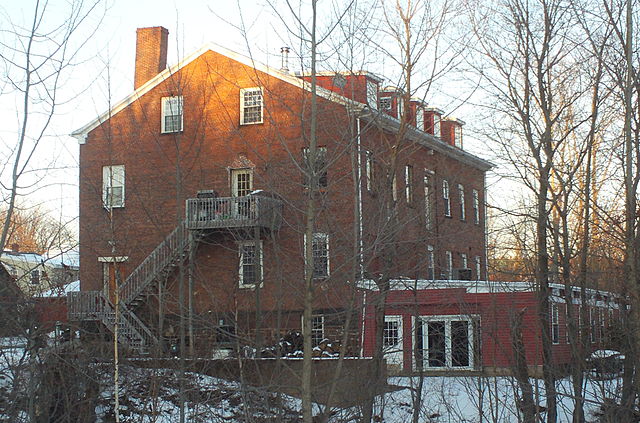
The Middletown (Conn.) Alms (Poor) House, where the town's indigent would live at the expense of the town.
“In a society still under the sway of Calvinist attitudes, as were the rural communities of New England, a degree of disgrace would attach to the condition of being poor….Thus to “go on the town’’ would be viewed as an ignominy to be avoided if at all possible – and of course it would be a public ignominy, for everyone knew who the poor were and often they would be discussed in town meeting.’’
-- From The New England Town in Fact and Fiction, by Perry Westbrook.

James P. Freeman: Boston's mayor should keep his ambitions within reality

Boston Mayor Martin ("Marty'') Walsh.
“Believe or not I’m walking on air
I never thought I could be so free
Flying away on a wing and a prayer, who could it be?
Believe it ornot it’s just me”
— Theme from The Greatest American Hero (“Believe It or Not”)
In homogeneously progressive Boston pell-mell fantasy can exceed partisan reality.
Appearing on WGBH's Greater Boston a day before Election Day to promote his book Bobby Kennedy: A Raging Spirit, MSNBC’s Chris Matthews, former aide to the late U.S. House Speaker Tip O’Neill, was getting a second thrill going up his leg. When asked who in the Democratic Party today is closest to the late senator (presumably in temperament and spirit), Matthews responded with understated hyperbole: “Maybe the mayor here.”
And on WCVB-TV’s Sunday political program OTR five days after Election Day, the usually rational Patrick Griffin was clearly under the influence of hypnosis. Or something else. When asked during the roundtable discussion who had the “best week,” the Republican strategist responded with overstated gusto. “Marty Walsh!” Where the mayor, newly reelected, is now poised and positioned to begin a “national narrative.” Well.
Cue the needle scratching over the record.
With little enthusiasm (just 27 percent voter turnout in the general election; 14 percent in the primary), little competition (his challenger lost by over 30 percentage points), and little in the way of transformational advancement during a single term (understandable after following the longest-serving Boston mayor, the late Thomas Menino (five terms, 1993-2014)), Boston Mayor Marty Walsh won re-election. And, summoning ghosts in machine politics, Walsh is — so say observers — now worthy of higher office in Massachusetts and, possibly, a position in national affairs. Play me a new song.
Walsh’s parochial progressivism may in fact appeal to those outside Routes 128 and I-495. And that may even extend beyond, to the hills of Williamstown and West Stockbridge, if he were to seek statewide office. But it stops there. (Besides, he will have to wait until 2022 to run for governor, when, presumably, Charlie Baker will be leaving, with the state in better condition than when he found it, after serving two terms.)
Thrilling for conservatives, Walsh’s platitudinous progressive record will play like warped vinyl on the national stage. It will be punched through with holes, and its collection of Democratic covers will be relegated to the bargain bin of bad ideas. Like abandoned vinyl records.
Still, it will be fun listening. (Will he reprise Hillary Clinton’s “Listening Tours”?)
How does Walsh propose to solve problems in the country that he hasn’t been able to solve in the city or the commonwealth? The playlist is long but exposes progressivism’s universal shortcomings: affordable housing, income inequality, climate disruption, sanctuary cities (some calling for sanctuary states), and public education.
And his first forays into the national spotlight proved opportunistic and potentially disastrous: He essentially blamed his hyper-interest in Boston’s 2024 Olympic bid as a form of payola, a political payoff to honor the legacy of a commitment made by the Menino administration. No friend of the First Amendment, he essentially suppressed freedom of speech and freedom of the press during the monstrously overblown Free Speech rally last August on Boston Common, despite favorable media coverage. That won’t work on the National Mall.
In many regards, Walsh is instinctively progressive but he has learned lessons from his Massachusetts mentors.
If you can’t fix it, expand it. Former Gov. Deval Patrick proposed in 2013 massive growth of the state’s transportation system, while he ignored the troubled MBTA. If you can’t improve it, market it. Sen. Elizabeth Warren’s persistent message in tweets and books is that ever more government is what is needed to make America great again.
Walsh hasn’t written any books, but that didn’t stop him in 2016 from actually issuing a suggested reading list to all Bostonians. Reading is not fundamental in Boston. The booklist directive reflects the new soft sell of progressive bullying: from the cold engineering of public power to the warm “engagement” of like-minded citizens. For Walsh’s Boston (like Warren’s America) believes in diversity of all aspects of life. Except thought. Or political party.
Walsh can’t even claim one thing that Patrick and Warren could: reaching across the aisle to work with Republicans. Because there are no Republicans in the elected part of Boston government.
City Hall is not a standard steppingstone to the Oval Office. Only two mayors have gone on to become president of the United States. The first was Grover Cleveland, former mayor of Buffalo, N.Y. (1882), who is the only president to serve two non-consecutive terms (1885-1889 and 1893-1897). And the last was Calvin Coolidge, former mayor of Northampton, Mass. (1910-1911), who, as vice president, became president in 1923, when President Warren Harding died of a heart attack. Coolidge is the only American to be a mayor, lieutenant governor (1916-1919, Massachusetts), governor (1919-1921, Massachusetts), vice president, and president. He might be the last.
Mayors fare better becoming senators. Today, they include Dianne Feinstein (San Francisco), Bernie Sanders (Burlington, Vt.) and Cory Booker (Newark, N.J.). There might be a practical explanation behind these histories.
As citymayors.com explains, “Americans, not surprisingly, have come to respect big-city mayors as managers, but not necessarily as custodians of important values.”
Over the last 30 years, Massachusetts politicians have had difficulty articulating ideas — exporting local values? — that resonate with voters outside of the commonwealth, into electoral victory for national office. Probably, their loud, turgid progressivism is incomprehensible to the nation. And moderates are undoubtedly viewed with suspicion — guilty-by-approximation to progressives. Walsh must be acutely aware of the performance of the late Sen. Ted Kennedy (1980), Gov. Michael Dukakis (1988), the late Sen. Paul Tsongas (1992), Sen. John Kerry (2004), and Gov. Mitt Romney (2012) in presidential contests. What will happen to Elizabeth Warren in 2020?
With or without Warren, Walsh may decide next decade, cape in hand, that he will be the Greatest American Hero to progressive causes. For now, though, those lofty aspirations are prematurely foolish.
Should America reject Warren and Walsh’s propulsive progressivism, the consolation prize might be membership in an exclusive club. They could join George McGovern, who won just one state in 1972. In a landslide, he swept Massachusetts. As they likely would too.
James P. Freeman, a former banker, is a New England-based writer and former columnist with The Cape Cod Times. His work has also appeared in The Providence Journal and here, in newenglanddiary.com.
'The real tin thing'
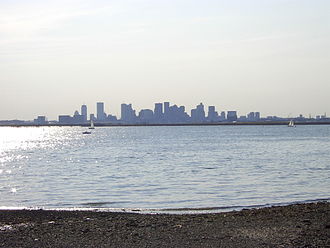
View of Boston from Winthrop's Point Shirley in 2003. Sylvia Plath lived in Winthrop for a few years in her childhood. She later wrote about the town, a peninsula north of Boston.
"I can taste the tin of the sky —- the real tin thing.
Winter dawn is the color of metal,
The trees stiffen into place like burnt nerves.
All night I have dreamed of destruction, annihilations —-
An assembly-line of cut throats, and you and I
Inching off in the gray Chevrolet, drinking the green
Poison of stilled lawns, the little clapboard gravestones,
Noiseless, on rubber wheels, on the way to the sea resort.''
-- From 'Waking in Winter,'' by Sylvia Plath
'Woodcut revolution'
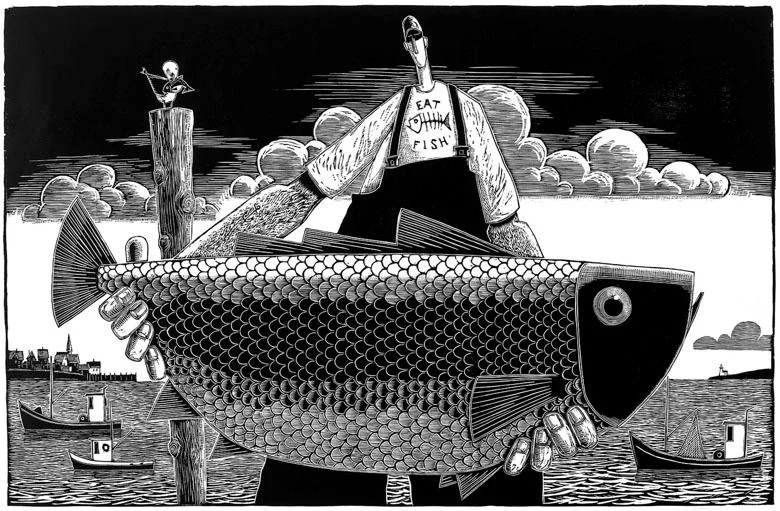
"Lyell'' (woodcut), by David Whitbeck, in the show "BIG INK: Large-Scale Prints From the Woodcut Revolution,'' at the Brickbottom Gallery, Somerville, Mass., Dec. 7-Jan. 13.
David Warsh: 50 years of the WSJ's supply-side quackery on taxes

SOMERVILLE, Mass.
Fifteen years after the 9/11 attacks triggered its ill-starred invasions of Afghanistan and Iraq, the United States finds itself engaged in a three-way contest for global influence with its old rival Russia and a surging China. Climate change is a growing threat around the world. In response, the Republican Party is seeking a tax cut.
The heart of the undertaking is a reduction of relatively high U.S. corporate-tax rates. That much is a measure on whose desirability experts right and left can agree.
{Editor's note: Many large companies pay much less than the 35 percent top corporate-tax rate because of loopholes, etc. Indeed, some don't pay any taxes.}
But to compensate for revenue losses arising from various accompanying provisions in the 440-page bill (including inheritance-tax abolition, personal-income tax cuts), versions in both the House and Senate rely on an array of tax hikes and implicit spending cuts aimed squarely at the middle class.
The measure would add an estimated $1.5 trillion, or around 5 percent of its current level, to the national debt, over the course of the next decade, and, possibly, a good deal more. By the end of that time, either most tax cuts will expire, or further spending cuts will be required on virtually every government program but defense – especially Social Security and health care. The beneficiaries of the tax cut? Mainly the rich.
Martin Wolf, the respected economics columnist of the Financial Times, wrote the other day, “How, one must ask, has a party with such objectives successfully gained power?” Wolf identifies three main channels. Give disproportionate power to the wealthy. Foment animosity toward and among the less fortunate. And, first, and perhaps most important, tell a story:
"[F]ind intellectuals who argue that everybody will benefit from policies ostensibly benefiting so few. Supply-side economics, with its narrow focus on tax cuts, has been the main theory employed, because it directly justifies tax cuts for the very wealthy.''
As it happens, I have been reading George Melloan’s Free Markets Free Minds: How the Wall Street Journal Opinion Pages Shaped America (Encounter, 2017) the better to remember where the tax cut obsession came from, long ago.
Melloan, 90, retired in 2006, after 54 years at the WSJ, first as a reporter, then as a foreign correspondent, and, for well over half of that time, an editorial writer. He joined the editorial board of the paper in 1970, under the beloved Vermont Royster, and, practically alone among then-current members, survived the transition to Robert Bartley, Royster’s successor, in 1972. (Interim editor Joseph Evans had died suddenly.)
For 30 years, Melloan served as Bartley’s deputy. He was 10 years older than his boss, an in-house “anchor” to counterbalance the effects of the “sail” of the younger man’s more extravagant enthusiasms. In 1987, after Daniel Henninger was named Bartley’s official understudy, Melloan and his wife lived in Brussels, while he edited the editorial pages of the European and Asian editions of the paper.
Victors write our history – at least they try to. Melloan relates the official version. The way he tells it, supply-side dogma devised by Robert Mundell, of Columbia University, and elaborated on by University of Chicago Graduate School of Business assistant professor Arthur Laffer, supplanted Keynesian demand-side fiscalism, at least in the minds of Bartley and editorial writer Jude Wanniski.
Mundell and Laffer may have been academics, public intellectuals, but they had ceased to be economists, inasmuch as they no longer sought to persuade other professionals of the validity of their views. They appealed directly to the public instead. (Many years later, Mundell was recognized by a Nobel Prize for work he had done in the 1950s on currencies.)
In the beginning, in the 1970s, Bartley, Wanniski, Laffer, Mundell and their confederates in the Congress – quarterback-turned-congressman candidate Jack Kemp in particular – exhibited a raffish charm in an age that otherwise took itself too seriously, an appeal whose spirit I sought to evoke last week by reprinting a piece written long ago. Bartley related the origin story himself, in 1992, in The Seven Fat Years: and How to Do It Again, a book whose message was blunted by seven even fatter years under President Bill Clinton, who began his term by persuading Congress to raise taxes.
Bartley responded with his crusade against “Arkansas mores,” a campaign not entirely misplaced, but memorable chiefly for its no-hold-barred bitterness and perverse effects. Bartley died in 2003, at 66, months after the invasion of Iraq, an adventure he had strongly supported.
Melloan’s plain-spoken account of a hundred years of Wall Street Journal history is a pleasing exercise in nostalgia, displaying precisely the eyes-wide-open sophistication that the corps of Midwesterners of which he was a member brought to what had been a parochial Manhattan financial daily before World War II. His version of the foundational story of how General Motors pulled its advertising after the Detroit bureau scooped the company’s annual-model pageant, only to later meekly return to the fold, is especially good.
Omitted from Melloan’s account is most of the story of how editorial writer Lindley Clark, a monetary economist who had been among Milton Friedman’s first students at the University of Chicago, was squeezed out of the editorial page by the choice of Bartley. Clark returned to the news pages as a columnist for several years, and, with colleagues Alfred Malabre, Jr. and Paul Blustein, conducted guerilla campaign against the editorial pages’ extravagant claims.
Nor does Friedman himself come up, except in passing. Friedman’s record as an economic forecaster wasn’t perfect, but he was a far better guide to the action than gold-standard enthusiast Mundell. Nor is mentioned the role of Harvard University economist Martin Feldstein in straightening out Reaganomics. Economist Bruce Bartlett’s early advocacy is cited approvingly—but not his long-running and trenchant apostasy.
The fact is that WSJ economics has been dominated by quacks in the nearly 50 years since Bartley turned its editorial page into the nation’s principal voice of economic reform. (Ralph Waldo Emerson: “The two parties which divide the State, the Party of Conservatism and that of Innovation, are very old, and have disputed the possession of the world since it was made…. Now one, now the other gets the day, and still the fight renews itself as if for the first time, under new names and hot personalities….. Innovation is the salient energy; Conservatism the pause on the last movement.”)
For the most part the strategy worked, though mostly not for the reasons given. Monetary stringency, deregulation, tax simplification, trade legislation, and budgetary discipline all had far greater influence. Tax-cutting itself apparently contributed relatively little to economic growth.
Thirty-five years after the “supply-side revolution,” the WSJ has little to show for it except books by its staffers and columnists. As far as I can tell, the GOP tax bill has no significant allies, no outside endorsers, besides the Republican congressional leadership and those who will benefit from (and repay) their largesse.
Those who write the editorials seldom display signs of having gotten wise to themselves. I’ve read those pages every day for nearly 50 years, and, with the exception of regular forays into the microeconomics of particular situations, on which they (and Holman Jenkins, in particular) remain sharp, today the editorials seem so cautious and hamstrung by their inconsistencies as to be interesting mainly when they contradict themselves.
No amount of back-channel complaints by professional economists, much less carping by the likes of me, is going to change things. There is, however, a solution. When Old Man Rupert Murdoch finally loosens his grip on the newspaper he bought, in 2007, to serve as his flagship, his sons should hire back Bret Stephens, 44, to replace editorial page editor Paul Gigot, 62.
Stephens quit the WSJ last spring to become a columnist for The New York Times. For months he had become ever more critical of Donald Trump’s candidacy – and of the surprising tolerance of it shown by his fellow editorialists. Melloan judges Stephens to have been “no longer comfortable with the Journal’s traditions.”
In fact, the WSJ’s post-Royster traditions of innovative reform have deteriorated from their peak to the point of self-parody. Stephens at one point defined conservatism as “a principled commitment to limited government, free markets, constitutional rights, equal opportunity, personal responsibility, e pluribus unum and Pax Americana.” But Stephens, at least as I read him, is no originalist. My guess is that he would renew the newspaper’s commitment to intelligent true conservativism – that is, defending the state of things as they are.
David Warsh, an economic historian, is a longtime economics and political columnist and proprietor of economicprincipals.com, where this first appeared. He is also a former reporter for The Wall Street Journal.
A matter of latitude?

"My mind matches this understated land.
Outdoors the pencilled tree, the wind-carved drift,
Indoors the constant fire, the careful thrift
Are facts that I accept and understand....
"My outer world and inner make a pair.
But would the two be always of a kind?
Another latitude, another mind?
Or would I be New England anywhere? ''
From "New England Mind,'' by Robert Francis
His own Florida
"{A} Connecticut River Valley farmer ... was told that his farm was really in New Hampshire, instead of in Vermont as he'd always thought. 'Thank God,'' he said. 'I didn't think I could stand another of those Vermont winters.''
-- From The Connecticut River, by Evan Hill
Musical art

"Tanglewood'' (reference to famed music venue in the Berkshires), by Sorin Bica, at Fountain Street Gallery, Boston, through Dec. 17.
So how would you pay to fix damage to roads done by trucks?

Fare-collection gantry over the Massachusetts Turnpike in Newton.
From Robert Whitcomb's "Digital Diary,'' in GoLocal24.com:
hope that Rhode Island House Republican leader and gubernatorial candidate Patricia Morgan will spell out very precisely how she would pay to fix the state’s worst-in-the-nation highway and bridge infrastructure if not through Gov. Gina Raimondo’s truck tolls. (Trucks do most of the damage to roads and bridges.)
Ms. Morgan might drive down the Northeast Corridor and note that every state has a highway toll system except Rhode Island and Connecticut, and the Nutmeg State may well soon restore tolls on Route 95 there (what used to be called the Connecticut Turnpike). The Ocean State now levies tolls only on the Newport/Pell Bridge.
Not coincidentally all these states have better transportation infrastructures than Rhode Island.
There’s a magical-thinking wing of the GOP that calls for lower taxes and better infrastructure. (And don’t cut my Medicare!)