
Vox clamantis in deserto




Bob Lord: The $170 billion lie in the GOP tax plan
Via OtherWords.org
House Republicans and Donald Trump are ballyhooing the wonders of their new tax plan. It’s called the “Tax Cuts and Jobs Act,” which we’re told will mean “More Jobs, Fairer Taxes, and Bigger Paychecks.”
Hallelujah! We can see the Promised Land!
But before we pop the champagne corks, let’s double-check the sticker price: $1.5 trillion over the next decade. That’s just shy of $5,000 for every man, woman and child in America. For a nation over $20 trillion in debt, that seems pricey.
But that’s only the beginning. The deeper costs of their tax plan are so large and so obvious that the failure of Republican leaders to disclose them is, for all practical purposes, a lie.
The premise of the House plan is, in fact, a $170 billion lie.
The vast majority of these proposed cuts — some 80 percent — go to the top of the income ladder. But to sell the plan as beneficial to the middle class, Republican House leaders included a tax credit of $300 for each family member, plus a larger credit of $1,600 for kids under 17.
Without that “Family Flexibility Credit,” the House plan would be a net benefit to far fewer families. Remarkably, however, the House Republicans crafted the Family Flexibility Credit to expire after only five years — after which middle-class families with college-aged kids will see a big tax hike.
So will the break be extended? Republican leaders promise it will be. But the $170 billion cost of extending the Family Flexibility Credit through 2027 isn’t included in the stated cost of their plan.
It’s worse than just that. The repeal of the federal estate tax, which is exclusively paid by a handful of multimillionaire families, will indirectly allow ultra-wealthy Americans and their heirs to avoid tens of billions in income tax. That lost income tax revenue isn’t reflected in the stated cost of the House plan either.
Nor are the tens, perhaps hundreds, of billions in revenue that will be lost when tax lawyers develop structures to squeeze tax savings out of the new 25 percent tax rate for so-called “business income” — a big discount from the otherwise applicable top rate of nearly 40 percent.
Amendments to address the concerns of powerful interest groups will likely raise the cost further. One example: A concern raised by multinational corporations regarding an excise tax provision was addressed by the House Ways and Means Committee, increasing the cost of the plan by $60 billion.
Even regular people will make adjustments that drive up the cost of the plan.
To minimize the impact of rules reducing the tax benefits they get from charitable contributions, some will bunch several years’ worth of gifts into a single year. If they no longer get a tax benefit from paying mortgage interest, some will forgo other investments that generate taxable income to pay their mortgages down at a faster rate.
None of this is news to Republican House tax writers.
But if their plan becomes law, you can count on those same Republicans to tell us how Social Security and Medicare benefits are driving the national debt too high and must be cut. In reality, they caused the problem themselves, by lying about the costs of their huge giveaway to the rich.
And that stinks.
Bob Lord is a veteran tax lawyer who practices and blogs in Phoenix. He’s an associate fellow of the Institute for Policy Studies.
Llewellyn King: Notebook --The new publishing giants; failing upwards; U.S. gastronomic capital?
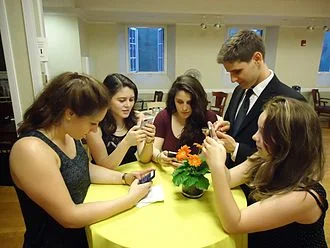
When A.J. Liebling said that freedom of the press meant freedom for those who owned the presses, he spoke in a time when there were nearly 2,000 daily newspapers in the United States. Today there are fewer, and they depend on more than presses to stay in business. They depend on the indulgence of Google, Facebook and Twitter.
Freedom of the press now depends on those few companies that own the algorithms on which all publishers depend to get a wider range of readers, even while making no money off them.
The newsboys and newsgirls of yesterday delivered the papers. That is all. The news deliverers of today control the whole publishing world. They can determine success or failure and, as we are seeing, have the power to censor.
William Horsley, a retired BBC correspondent who is involved with media studies at the University of Sheffield and is vice president of the Association of European Journalists, says that the newsboys are now the publishers.
In the billions of words that have been spouted about freedom of the press here and around the globe, Horsley has identified a new and terrible reality about the freedom of the press and along with it, the freedom of ideas.
Quite simply, we now live in an era in which an algorithm buried somewhere in the secret depths of Google can do more to change what we know, think and say than any dictator has been able to achieve.
While the creators of Google, Facebook and Twitter probably did not dream of such power, such control, such hegemony, it has come to them.
The mind reels with possibilities, each more disturbing than the previous, of what would happen if any of the Internet giants fell into the hands of malicious owners or a dictator. Think of the damage if Steve Bannon, who presides over Breitbart, or some like ideologue, were at the helm of Google, Facebook or Twitter.
George Orwell, at his most pessimistic, could not have imagined the existential evil that could await us, courtesy of technology, plus a sociopath.
Dumb Luck, Sir. Dumb Luck.
A professor at Brown University congratulates me on my life choices. He implies that my peripatetic journey through the world, clutching a press card, has been because of sound choices. To which I have to respond, “My life has been one of dumb luck and failure.”
Luck, I say, because it is what determines your being at the right place at the right time. Failure, I say, because it is possible to fail upwards: I have, often.
Had my career been on an even keel, I would have finished high school, maybe gone to university and then gotten stuck in one of the early jobs, making it my “career.” As it is, I dropped out of high school, went into journalism and failed a lot.
If I had kept any of those jobs I failed at, I might have had a duller life: a jobbing writer in Africa, a news writer at ITN in London, the creator of America's first women's liberation magazine (which failed to liberate any women, but liberated all my money) in New York, an assistant editor at The Washington Post, and a trade journal reporter at McGraw-Hill.
So, Mr. Professor, I recommend that you prepare students for the success of failing upwards. Sometimes that goes for relationships and marriages. Do not bivouac too early on life’s open road.
The Gastronomic Capital of the U.S.: Is it Rhode Island?
In France, it is pretty well agreed, the area around Lyon is the gastronomic capital.
In the United States, New Orleans is mentioned. Well I have eaten many a meal in New Orleans, especially during a time when I was making a lot of speeches at conventions in New Orleans. But I have to say that good food rolls in Rhode Island. So much so that smart visitors come to Li'l Rhody on gastronomic tours, including friends of mine, who, like myself, have eaten the world over.
Now there are a few quibbles, to be sure. One big one is that there are woefully few French restaurants in the state, and the Italian influence in the restaurants is pervasive. Also I think that there could be more top-of-the line and regional Chinese restaurants, although a Uighur restaurant has just opened in Providence. Other Asian cuisines -- Korean, Indian, Thai and Japanese -- are well represented.
Still, the eating in the Ocean State leaves New Orleans with a way to go in my book.
{Editor’s Note: Rhode Island does have a few good French restaurants, such as Chez Pascal, on Hope Street in Providence.}
Llewellyn King (llewellynking1@gmail.com) is executive producer and host of White House Chronicle, on PBS.

An accounting of tribal art

From the show "Picturing History: Ledger Drawings of the Plains Indians, '' through Dec. 20, at the Fairfield {Conn.} University Art Museum, featuring the artwork of Plains Indians from the late 19th Century.
The museum explains that the works are called ''ledger drawings" because they were drawn on accounting ledgers; no two are the same, with some drawn with graphite, others painted with watercolors.
The museum says that the drawings are practically unknown to most scholars. When they have been studied, it's usually as historical documents, not as art.
Going with the grain

"Up Around the Sun'' (diptych) (acrylic on wood), by Rose Olson. in her show "BRIGHT COOL and HOT,'' at Kingston Gallery, Boston, Nov. 29-Dec. 30. She paints on wooden panels patterned with natural grain, as the gallery says, "each specific to their character as a once-living tree. These patterns are as unique as fingerprints and as important to Olson as the colors she uses.''
Llewellyn King: Putin regime uses vast lie machine to try to undermine European democracies
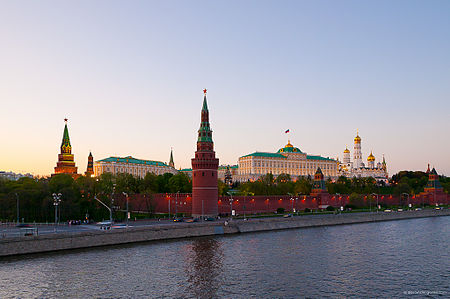
Putin's Kremlin -- a cesspool of corruption and brutality.
VILNIUS, Lithuania
"Fake news" in Europe is a clear-and-present danger from Vladimir Putin’s Russia.
That was the message loud and clear at the annual congress of the Association of European Journalists (AEJ) in the country’s capital last week. The rubric of “fake news” covers a parcel of Russian subversion, from phony news to staged events with surrogate players and stunts, such as sending in Russians posing as skinheads to imply the presence of fascists when none are there.
To Europe – especially to those countries near or bordering Russia — the threat is most keenly felt. At the AEJ congress, speaker after speaker spoke of it not in abstract terms, but as part of a continuing struggle.
Russia is waging its war with Europe, using new tools, such as social media, but with old KGB tactics, according to Marius Laurinavicius, senior expert at the Vilnius Institute of Policy Analysis. “We are at war with Russia. It’s a different war: There are no tanks or fighters. It’s their perception, not mine,” he said.
The three Baltic nations — Estonia, Lithuania and Latvia — are under relentless attack by Russian disinformation and dirty tricks.
Whereas much of the world is indifferent to Russia’s seizing of Crimea, the insurgency in eastern Ukraine, and Russian troops in Georgia, to the Baltics, those acts are a scenario for their re-occupation.
When the Baltics were part of the Soviet Union, they suffered in ways not fully comprehended elsewhere. In Vilnius, for example, the former KGB headquarters is a museum of horror, open to the public. Here are the torture chambers and the execution cell. Those who were not killed in this building, right in the center of town, were shipped to Siberia — an incredible 300,000 Lithuanians out of a population of just under 3 million.
Putin has said that Russia is entitled to come to the aid of any Russian-speaking minority which is (he asserts) being maltreated: his rationale for invading Crimea. All three Baltic states have Russian-speaking minority populations listening to and watching Russian radio and television broadcasting ceaselessly fake news to stir them up and denigrate their host countries.
At the AEJ congress there were tales of Russian subversion across Europe, from the French and German elections to the attempted Catalonian secession from Spain. Russia has a huge apparatus for fomenting trouble in the democracies, according to Brian Whitmore of Radio Free Europe/Radio Liberty. Thousands of people working on fake news in dozens of languages, factories of lies.
Why does Russia do it? One reason is that Russia is deeply unhappy at having NATO on its borders, fanning an old Russian paranoia about the countries to its west. Another, according to Whitmore, is that “Russia is doing to the West what it believes the West is doing to it: It believes the West is trying to undermine it.”
At the AEJ congress a year ago, in Kilkenny, Ireland, the buzz was all about then-presidential candidate Donald Trump and his likely impact in Europe. This year in Vilnius, less so. The big issue is Russia and how the media can deal with the Russian propaganda onslaught, sorting out the real from the fake. It is a daily challenge for Europe’s journalists: Is it a scoop or a state-sponsored lie?
Delegates heard from Laurinavicius that the Putin administration in Moscow is a kind of C-suite of corruption, built around the old KGB (where Putin was No. 2 in East Germany), mixed with the Russian Mafia and collaborating oligarchs. Taken together a potency of evil, seeking to make mischief and possibly to conquer weak and unprepared democracies by lies and fakery.
On Twitter: @llewellynking2
Llewellyn King is executive producer and host ofWhite House Chronicle, on PBS.
Order in chaos
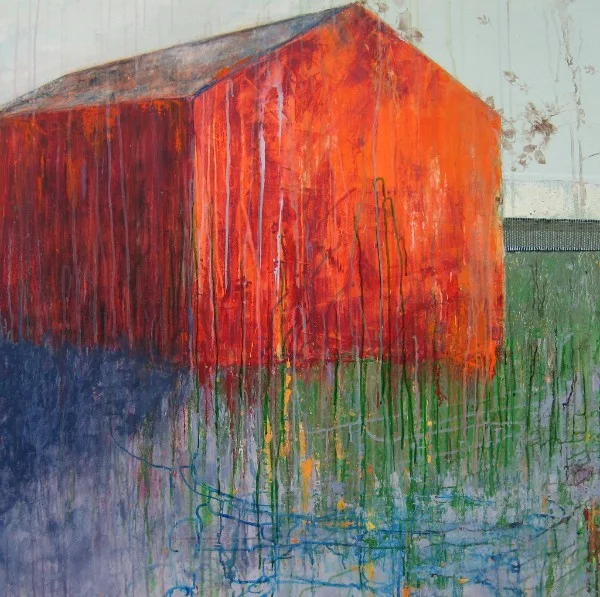
Mixed media work by Brenda Cirioni in her joint show with Leslie Zelamsky, "Common Sensibilities, '' at Fountain Street Gallery, Boston, through Dec. 17. The gallery says she uses "the house icon as a counterpoint to her energetic, chaotic surroundings. Cirioni's selection of materials reflects her interest in the environment, using repurposed house paint, fabric and wallpaper remnants and other debris.
Riding the rails to the slopes
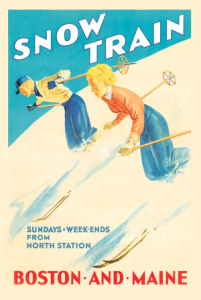
Poster that can be seen in the station of the Conway Scenic Railroad. For more information about this fun organization, please hit this link.
"Despite the proximity of the hills for the Yankee rural population, it was the city people who first embraced skiing in a big way. In the winter of 1931-1932, the Boston & Maine Railroad began running a 'snow train' out of North Station in Boston up to Conway, New Hampshire, and back each Sunday. The first run filled three cars with 197 people. By 1940 {with the Great Depression ending} the Boston Snow Train carried some 3,000 skiers. Trains then ran every Sunday out of New York, and frequently from Albany, Hartford, and Springfield, Massachusetts.''
From Mountain New England: Life Past and Present, by William F. Robinson
Tax your enemies!
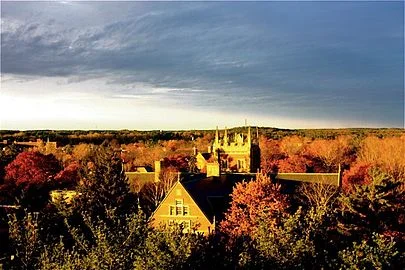
View of the Bowdoin College campus, in Brunswick, Maine, from Coles Tower. Bowdoin is one of the rich institutions that would be hit by the GOP endowment tax plan.
From Robert Whitcomb's "Digital Diary,'' in GoLocal24.com:
The Trump regime and its allies in Congress are trying to use the powers of the federal government to attack groups that they see as political enemies. There are numerous examples in the House and Senate tax bills, both of which measures are excessively aimed at further expanding the wealth of the very rich and their families and descendants as the current Gilded Age rolls on.Fr
One of particular interest to New Englanders is a plan by congressional Republicans to impose a 1.4 percent tax on the annual income spun off by the endowments of the about 60 schools whose endowments exceed $250,000 per student. This has put pressure on some of our region’s famous private institutions – as The Boston Globe has noted, “including Harvard, Dartmouth and a dozen other New England schools.’’
Now, I have long complained that some of these “not-for-profit’’ schools have long been run in ways that raise eyebrows, especially with the astronomical salaries and perks that they pay too many of their administrators. And one wonders why so much money is spent for luxury frills such as climbing walls, gourmet food and spas.
Still, most of their endowment income is spent to pay for such traditional college functions as teaching, research, financial aid and building maintenance. And many of these institutions have international reputations that draw the brightest students, teachers and researchers, who help strengthen the U.S. economy and wider society, especially through innovation. New England, with its renowned collection of celebrated colleges and universities, has especially benefited from this sector. It bears noting that the bigger the endowment, the more money for scholarships and other forms of financial aid.
The Trump regime and some Republicans in Congress are trying to use the byzantine tax code to weaken institutions associated with the highly educated voters who often oppose the current demagogic version of the Republican Party and who believe in such things as science.
Meanwhile, Harvard Business School Prof. Clayon Christensen predicts: "50 percent of the 4,000 colleges and universities in the U.S. will be bankrupt in 10 to 15 years." Please hit this link to read more: https://www.cnbc.com/2017/11/15/hbs-professor-half-of-us-colleges-will-be-bankrupt-in-10-to-15-years.html?__source=twitter%7Cmain
He’s right. There are too many colleges
Chris Powell: Students lose a chance to learn about a huge religion

This is the Peaceable Oak, on Route 69 in Bristol, where Indians met to barter goods and colonists held town meetings when the nearby tavern proved too stuffy in summer.
Last week's hostility in Bristol, Conn., to a middle school teacher's plan to have a Muslim woman visit a world history class to discuss her religion and experiences, evoked the bigoted ignorance satirized in Woody Allen's movie Love and Death.
Child: What's a Jew?
Russian Orthodox priest: You never saw a Jew? Here -- I have some sketches. There are Jews.
Child: No kidding? They all have these horns?
Priest: No, this is the Russian Jew. The German Jew has these stripes.
The school superintendent canceled the Muslim woman's visit out of concern about security, since some of the hostility was threatening. Now there is talk about calling a townwide assembly on religious diversity. But as some Islamic leaders protested, the cancellation rewarded the threats. Surely Bristol's police could have stood by during the presentation -- and the need for security would have been a good lesson in itself.
Some people in Bristol said the public schools are not the proper place for religion. But religion is a huge part of history, and no one was to have been indoctrinated by the Muslim woman's presentation. For many students her visit might have been the first time they saw a Muslim in person rather than one on television being described as a terrorist. That too would have been a good lesson.
Yes, people are committing terrorism in the name of Islam, just as people have committed terrorism in the name of most other religions. Kids need to be shown the difference between the good guys and the bad guys.
Unfortunately many adults need to be shown too.
xxx
First Connecticut Gov. Dannel Malloy and the General Assembly's Democratic majority approved a new contract with the state employee unions that prevents state government from economizing with labor costs as much as it should.
Then a bipartisan majority of the legislature passed a state budget that, while not increasing taxes as much as Democrats wanted, directed the governor to find hundreds of millions of dollars in spending cuts that the legislature failed to specify.
So last week the governor did the specifying, and his cuts included social services and town aid, whereupon Democratic and Republican legislative leaders alike exploded in indignation.
A spokesman for the governor, Kelly Donnelly, shot back at the Senate Republican leader, Len Fasano, with criticism that could have been aimed at the Democratic leaders too.
"If the senator wanted to direct where these savings should come from," Donnelly said, "he could have passed statutory language with those details. He didn't do that. Rather, he took the much easier -- and much more politically safe -- route of accounting for the savings but leaving it to the governor to allocate them. ... He can still work with his colleagues to amend the budget, making specific cuts or perhaps raise taxes to avoid making these tough decisions. Until then he's just trying to have his cake and eat it too."
In fact, everybody at the Capitol is trying to have it both ways. The Democrats took care of the unions at the expense of everyone else, and then Republican and Democratic legislators alike posed as the friends of the taxpayer without taking responsibility for the cuts they required the governor to make.
Since the governor isn't seeking re-election next year, all the blame is being assigned to him when he deserves only half of it.
Chris Powell is managing editor of the Journal Inquirer, in Manchester, Conn.
'Palsy to the land'

"It is a universal network
Written across the sky,
Cut in swaths through the woods,
Amplified in cages
Marked 'High Voltage'. Its agitation
Planted from pole to pole
Gives palsy to the land.''
-- From "High Tension Wires,'' by the late Allan Block, of Francestown, N.H.
Does the GOP donor class care at all about America?
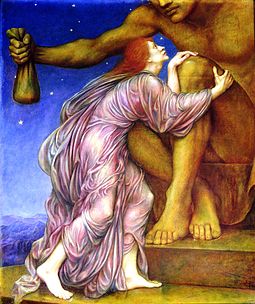
“The Worship of Mammon,’’ by Evelyn De Morgan.
"And for four decades, the Republican Party has shown itself to be the party of reckless budgets, runaway deficits and exploding entitlement spending. Just because the GOP donor class is willing to overlook those glaring failures in exchange for a corporate tax cut doesn’t mean other voters will be so blind. This is another Republican tax plan that helps the rich, hurts the poor, increases inequality and blows a hole in the debt. It will also lead to more GOP losses at the polls next year. To the big-money donors driving this bill, all I can say is good luck with House Speaker Nancy Pelosi.''
-- From former Republican Congressman and now TV host Joe Scarborough
Not afraid of a challenge

This is Robert S. Mueller as a Marine lieutenant in 1968, in Vietnam, at the height of the war there. Now, of course, he's the special prosecutor in the probe of the Trump circle's collusion with the regime of Russian dictator Vladimir Putin. He at least used to be a Republican.
Charles Pinning: On Thanksgiving, a bloody early lesson in gratitude
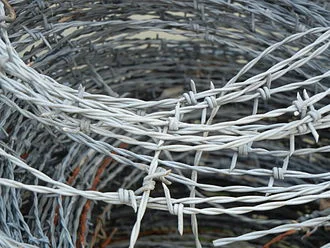
There I was, an eight-year-old wunderkind jumping from one round bale of barbed wire to another. They were laid on their flat end, sitting like hassocks, and as each jump landed me successfully atop the next, I triumphantly spouted, “Jolly good!”
It was Thanksgiving Day and my parents and grandparents, aunts and uncles were inside my grandparent’s farmhouse that overlooked Green End Pond in Middletown, R.I., gabbing away and enjoying drinks and savories before dinner.
About to perform yet another feat of heroic leaping I slipped and pitched forward, my open palms mashing down on the next spool and then my knees. I was stuck and disengaged myself by rolling slowly off. Blood poured from my hands and my pants bloomed red at the knees.
Fearful and crying, I staggered out of the storage building and towards the farmhouse. My older brother appeared from behind the big green tractor where he’d been sneaking a cigarette. “What happened to you?” he said, rushing up to me.
“Fell on barbed wire.”
He ran inside the house and came out with my mother, followed by my father.
Hysteria! Towels! And here we go again: rushing me up to Newport Hospital.
My father was really ticked. He’d been settled into a well-deserved highball, enjoying animated conversation with my uncles and now this.
“Why in God’s name were you jumping on barbed wire?”
My mother had a towel wrapped over my knees and I gripped another in my hands as we sped down the lane alongside the calm pond with the delicately arching branches of the weeping willow trees dipping into it. The cows lifted their heads at the sound of our bounding car.
They were gnarly gashes and Dr. Houston, Newport’s most prominent surgeon, who was having his own Thanksgiving dinner, was called in. The shine on his eyeglasses made me think of the pond and he was just as calm. My father was really putting on a show, perhaps to distance his DNA from mine, and my mother was going through her usual hypochondria hysteria. “Was the barbed wire rusty? Could he get lockjaw?” My brother told my parents: “Why don’t you go back to the farm. I’ll stay with him.”
My parents looked at Dr. Houston, who reassured them that I would be fine, and they left, with instructions for my brother to call as soon as I was ready to be picked up.
I could see that Dr. Houston was relieved they were gone and he went about his business with a relaxed precision.
He laid in stitches on my hands and my knees. It took almost an hour for the uneven flaps of skin to be sewn together, and then I was bandaged so that I couldn’t open or close my hand fully. My knees also were taped so that I couldn’t bend them. I was put in a wheelchair.
“You look tough,” said my brother, with a kind of admiration.
A nurse brought us into a lounge area and we were served Thanksgiving dinner on aqua fiberglass trays. There was turkey and mashed potatoes and cranberry sauce. I thought it was good. My brother had to feed me. While we were eating, we heard sirens.
Afterwards, my brother pushed me around the hallways. Back then, Newport Hospital wasn’t very large, and we soon found ourselves coming upon the emergency department. There was crying and looking inside a room, we saw a little boy on a table. He lay very still and crooked. A nurse noticed us and shut the door.
“Is he dead?” I asked my brother.
Ashen-faced he replied, “Yes.”
Back at the farm, everyone made a big fuss over me.
“We’re so grateful you’re OK,” I heard over and over. “You must be grateful too.”
“I am,” I said, thinking about the boy in the hospital. That night I told my parents about the little boy and cried. They comforted me as best they could, but what can anyone say? Inasmuch as you can, avoid hurting yourself and anyone else. Try to be helpful and enjoy it while it lasts. Amen.
Charles Pinning is a Providence-based essayist, novelist and photographer.
Did they talk about politics?
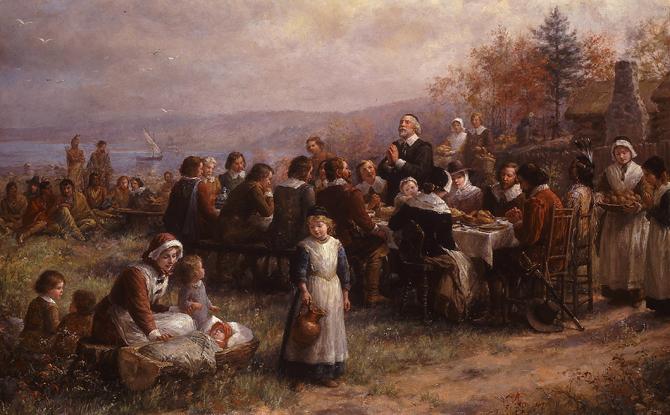
"The First Thanksgiving at Plymouth'' (oil on canvas), by Jennie A. Brownscombe (1850-1936), at the National Museum of Women in the Arts.
Up and down

"Sunset & Low Tide'' (oil on canvas), by Janis Sanders, at Alpers Fine Art, Andover, Mass. That New England has the nation's greatest tidal range lends a certain daily drama to its coast.
Barren but beautiful

In the Litchfield Hills of northwestern Connecticut.
"Now that flow of fruitfulness has ceased. Human husbandry has ended, and the wild seed is sown, and the earth lies resting from its prodigious labors.
But these spare fields, these now barren hillsides, the broad brown valley, and these irregular pastures nuzzling their way between silent sentinel wood lots, still breathe the richness and fullness of life itself, Connecticut version, to which it is a dear and irreplaceable privilege to belong.''
- From the November section of In Praise of Seasons, by Alan H. Olmstead.
Brigham and Women's plans big expansion of its ER
This from the New England Council:
"Brigham and Women’s Hospital is planning a $73.2 emergency room expansion.
"The prestigious Boston hospital’s emergency room has not been updated for almost two decades and their nearly 2 percent annual growth in recent years makes the renovations even more necessary. The hospital will be buying new equipment, expanding and reorganizing its emergency room, and allocating more resources to emergency radiology capacity, behavioral health, and oncology. The hospital filed paperwork with state for the expansion in early November.
“Brigham and Women’s currently operates at or above capacity nearly every day, so looking ahead, we anticipate the need for additional treatment spaces to meet the demand for emergency services,” the hospital said in a statement. “The BWH ED serves as the main access point for emergency care for Dana-Farber patients, and these patients have unique needs. The oncology pod will include staffing with specialists in oncologic emergencies, a separate waiting area, dedicated bathrooms and the ability to control negative vs positive pressure in the room.''
Don Pesci: De Sade would approve: Libertine culture led to scandals around public-figure 'pervs'
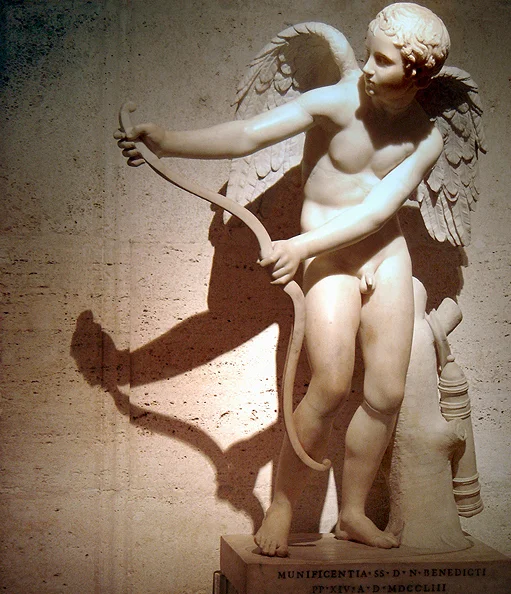
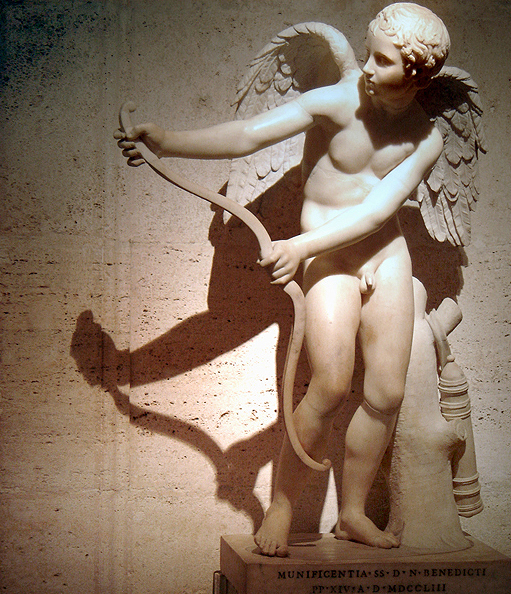
"Eros Stringing His Bow,'' statue in the Capitoline Museum, in Rome.
-- Photo by Ricardo Andre Frantz
The “Me Too” movement is a long delayed reaction to libertinism, which is not ordered liberty, liberalism or even libertarianism. The father of libertinism was French revolutionist and eros anarchist the Marquis de Sade, an aristocrat gone bad. His erotic works, many of them written while a prisoner in the Bastille, combine philosophical discourse with pornography and depict in an approving manner violence, crime and blasphemy against Christianity. He favored unrestrained freedom free of morality, religion and law. In the 21st Century, he might have been richly rewarded as a Hollywood film producer.
So far, the reaction has swept in its undertow media celebrities such as Charlie Rose, politicians such as Roy Moore, the founder and president of the Foundation for Moral Law now running for the U.S. Senate in Alabama; John Conyers, a Michigan congressman and a civil rights icon, U.S. Sen. Al Franken, of Minnesota, dubbed by one critic “a non-funny comedian,” powerful Hollywood producers such as Harvey Weinstein, and other quivering libertines still swarming in the shadows.
Conservative Boston-based columnist and radio talk show host Howie Carr has introduced a new segment into his broadcast -- the perv (short for pervert) walk of shame. Carr is not likely to run out of material any time soon. Even New York Mayor Bill de Blasio has come aboard. Times change, said de Blasio. In response to a reporter’s question de Blasio agreed with a statement made by New York U.S. Sen. Kirsten Gillibrand that had the Monica Lewinsky scandal occurred today, President Bill Clinton would have been forced to resign. Given Bill Clinton’s checkered past, which includes accusations of rape, it is not possible to exclude the former President from observations about juvenile cupidity and bullying of women.
“If it happened today,” said de Blasio, “there would have been a very different reaction. No question. I don’t think you can rework history. I think if it happened today — if any president did that today — they would have to resign.” Gillibrand, who occupies a seat in the U.S. Senate vacated by Hillary Clinton after she was named secretary of state by President Obama, has since softened her statement.
It would be rash of us to assume that modern libertines have suddenly become puritanical. Gillibrand is the author of a bill that would protect transgendered military personnel from being summarily discharged. The Puritans of pre-revolutionary Boston would not have unblinkingly supported her bill. Harvey Weinstein, were he a U.S. senator, would have supported the bill with great enthusiasm. Rap music will not put on sackcloth and cover its misogynistic lyrics with ashes. Hollywood will continue its genuflections to eros. Pre-pubescent boys, confused about their gender and slouching towards “re-assignment” surgery, will continue to be featured approvingly on the front page of National Geographic.
The Greek comic playwright Aristophanes understood that eros is a disturber of the peace, as did Boccaccio and Shakespeare and, coming closer to our own day, a repentant Charlie Rose and Harvey Weinstein. We deserve Harvey Weinstein; he’s our Frankenstein. We made him.
What only three decades ago might have been considered illicit sex will not be tossed on the ash heap of history. However, senators in bathrobes may not in the near future be so incautious as to display their wares to female interns – for a while. Business manners will improve -- for a bit. Millionaire smut producers in Hollywood may for a time content themselves with obtaining sex from their trophy wives. We have miles to go before all the accusations are holstered.
Both the guilty and the innocent will have their day, if not in court, then in the court of public opinion. Charges of lewd brutality are not time-sensitive, and there is no statute of limitations on commentators deploring the sins of others; though it is, of course, passé to regard unwanted sexual intimacies as sins.
Congress, as usual, has hedged its bets by creating a tax-funded, post de Sade slush fund that already has paid out $17 million on 264 claims. It is difficult to view that fund as other than an insurance policy against whistleblowing women, men, boys and girls who will be further intimidated by high-priced lawyers whose services that the fund will buy.
Let’s have the names of the congressmen who have tapped the tax-supported de Sade slush fund before the “me too” effort peters out. Someone should call the seven all Democratic members of Connecticut’s sainted U.S. congressional delegation and get them on board.
Don Pesci is a Vernon, Conn.-based essayist.
How and why the Kremlin put its man in the Oval Office
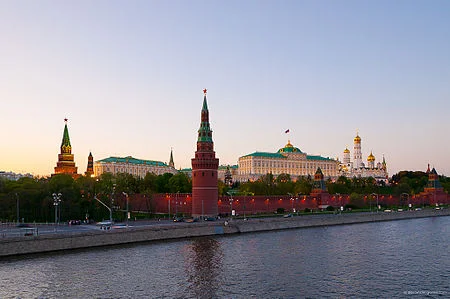
The biggest winners of the 2016 U.S. presidential election work here.
Collusion: Secret Meetings, Dirty Money, and How Russia Helped Donald Trump Win,by Luke Harding, published by Penguin Random House.
(To hear an NPR interview with Mr. Harding, please hit this link.)
Amazon describes this book:
"An explosive exposé that lays out the Trump administration’s ties to Moscow, and Russia’s decades-in-the-making political game to upend American democracy.
"December 2016. Luke Harding, the Guardian reporter and former Moscow bureau chief, quietly meets former MI6 officer Christopher Steele in a London pub to discuss President-elect Donald Trump’s Russia connections. A month later, Steele’s now-famous dossier sparks what may be the biggest scandal of the modern era. The names of the Americans involved are well-known—Paul Manafort, Michael Flynn, Jared Kushner, George Papadopoulos, Carter Page—but here Harding also shines a light on powerful Russian figures like Aras Agalarov, Natalia Veselnitskaya, and Sergey Kislyak, whose motivations and instructions may have been coming from the highest echelons of the Kremlin.
"Drawing on new material and his expert understanding of Moscow and its players, Harding takes the reader through every bizarre and disquieting detail of the 'Trump-Russia' story—an event so huge it involves international espionage, off-shore banks, sketchy real estate deals, the Miss Universe pageant, mobsters, money laundering, poisoned dissidents, computer hacking, and the most shocking election in American history.''
Thanksgiving on the Cape

In Sandwich, Mass.
-- Photo by Andrewrabbott
From Robert Whitcomb's "Digital Diary,'' in GoLocal24.com
Fairly early on, I started to dislike Thanksgiving. For one thing, it happens in a depressing, lowering time of the year. (Please, New England, join Canada’s Maritime Provinces in Atlantic Time so we can have light longer in the afternoon!) For another, the feast segment usually takes place in the afternoon, leaving participants heavy and groggy for the rest of the day. And making the meal requires hours of work by increasingly irascible cooks, servers and cleanup staff. That most Thanksgiving meals contribute to heart disease is a minor matter.
Anyway, when I was about 10 my family, or fragments of it anyway, gave up on Thanksgiving at home, and would journey to the Daniel Webster Inn, in Sandwich on Cape Cod, where my white-haired, very dignified and laconic paternal grandfather, looking like a cross between the poets Robert Frost and Wallace Stevens, would preside with what was probably forced congeniality over the three to five children and four or five other adults. The whole damn thing would take at most two hours, and with the inevitable rationing of food portions at a for-profit establishment, be healthier than what we’d consume at home.
The dinner always included the assertion that we were related to the statesman, orator and, to a certain extent, crook, Daniel Webster. That’s because a great-great grandfather of my siblings and me was named Daniel Webster Butler. He was born in Falmouth, the one on Cape Cod, in 1838. The assertion of the Webster kinship was never challenged or researched by anyone in the family until a few years ago, when I discovered it was baloney.
In fact, no one else in the family had the Webster name. Clearly Dan Butler got his middle name because “Black Dan’’ Webster was among the most famous men in America in 1838. And the use of middle surnames was starting to be very popular, especially in New England. Maybe a touch of Anglophilia or an effort to suggest genealogical grandeur, however fraudulently. Sort of like someone being named Franklin Roosevelt Jones a century later. But every family has its myths, and some need them….
After the dinner, my grandfather, a widower, would happily drive back alone to his house on West Falmouth Harbor, light up a Parliament, work on a crossword puzzle in a desultory way and occasionally stare at the lights on freighters in Buzzards Bay, on the other side of the breakwater and, presumably ruminate on the transience of everything, including families.