
Vox clamantis in deserto







Summer steals back
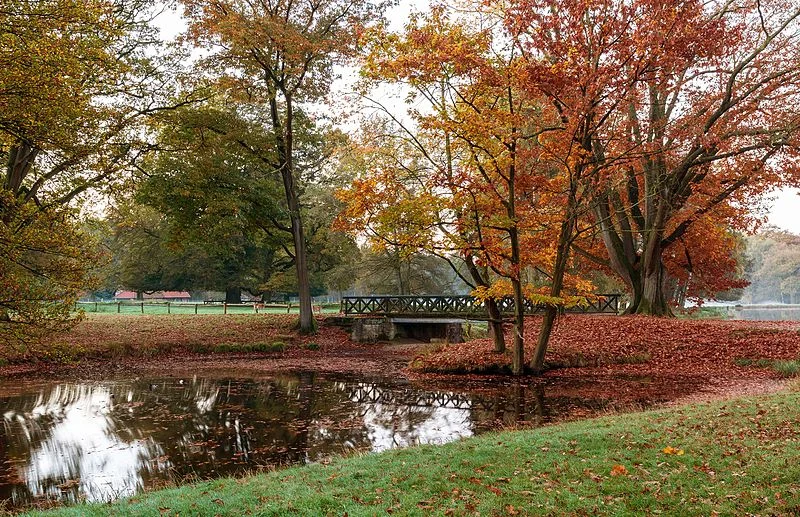
-- Photo by Dietmar Rabich
Bending above the spicy woods which blaze,
Arch skies so blue they flash, and hold the sun
Immeasurably far; the waters run
Too slow, so freighted are the river-ways
With gold of elms and birches from the maze
Of forests. Chestnuts, clicking one by one,
Escape from satin burs; her fringes done,
The gentian spreads them out in sunny days,
And, like late revelers at dawn, the chance
Of one sweet, mad, last hour, all things assail,
And conquering, flush and spin; while, to enhance
The spell, by sunset door, wrapped in a veil
Of red and purple mists, the summer, pale,
Steals back alone for one more song and dance.
-- "October,'' by Helen Hunt Jackson
Desperately chasing business
From Robert Whitcomb's "Digital Diary,'' in GoLocal24.com:
Worcester is putting in its own bid to get Amazon’s “second headquarters’’ in addition to being part of the Massachusetts application to the Seattle-based monster. Not a bad idea – two lottery tickets instead of just one. But it is hard to see Worcester having the infrastructure, techno personnel and tax-break resources to lure Amazon and what the company asserts will be 50,000 new employees. Maybe, like Providence, they could get a couple of small slices of the pie if Amazon picks Boston. (I still bet on Austin.)
xxx
I ask again: Why does Massachusetts, a rich state, refuse to help pay to build sports stadiums for private companies while much poorer Rhode Island is looking to cough up such money for the Pawtucket Red Sox?
Confident Sununu running for re-election as N.H. governor
The New England Council (newenglandcouncil.com) sent this along from New Hampshire Public Radio:
"During a wide-ranging speech in Bedford Wednesday morning, Governor Chris Sununu touched on Washington politics, President Trump, health care, millennials, and, almost as an afterthought, confirmed he’s running for re-election in 2018.
"With no script in hand, Sununu addressed several dozen members of The New England Council, a regional business group, from inside the wood-framed Bedford Village Inn. While the crowd worked on a breakfast of scrambled eggs and orange juice, Sununu worked to come across as a capable leader, a pro-growth Republican, and to carry out his perhaps most favored role: that of cheerleader for all things New Hampshire.
"And with a 62% approval rating and GOP majorities in the statehouse, there was also Sununu, the confident politician.
"'I’m running for Governor again…I love my job, I think we are doing great things. And I feel very confident that we are going to be here in a couple of years and I’ll be giving another boring speech a couple of years from now,' he said to laughs. "But at the same time, I tell my team, put your head down, assume nothing. Get everything done you can, as fast as you can, because that’s what people expect of us: to do our job.'''
To read the whole piece from New Hampshire Public Radio, please hit this link.
Background family identities and American ones

"Reliquias'' (archival pigment print), by Tori Purcell, in the "Up-Root'' show at Periphery Space gallery, Pawtucket, R.I., Oct. 21-Nov. 18. The nine-person show explores in various media the gaps between their family ethnic and national heritages and their identities as Americans.
James P. Freeman: Charlie Baker is sort of Nixonian
In his marvelously insightful book, A Man and His Presidents: The Political Odyssey of William F. Buckley Jr., Alvin S. Felzenberg recalls the 1960 presidential contest when the National Review founder saw then-candidate Richard Nixon as “less the leader of the GOP than as the ‘amalgamator’ of all the forces that composed it.” More than a half century later, a sensible survey of the Republican Party reveals that Massachusetts Gov. Charlie Baker and President Donald Trump are, likewise, “amalgamators.” They share similar Nixonian propensities.
Despite the differences in their personalities and philosophies, Baker and Trump understand 2017 politics: Recalcitrant Republicans — particularly conservatives — can be circumvented in the political process, and more importantly, in the creation of public policy. Baker and Trump exhibit a marked disdain for real conservatives. As did Nixon.
Writing for National Review in 2013, commemorating Nixon’s 100th birthday, John Fund reasoned that the president “governed more as a liberal than anything else.” Nixon, he wrote, “didn’t really like or trust conservatives, even if he hired a bunch of them.” Furthermore, “he used them and freely abandoned their principles when convenient.”
Fund cited Nixon’s numerous liberal domestic initiatives, such as creating the Environmental Protection Agency and calling for universal healthcare. These initiatives also included sweeping regulations on the economy (wage controls), affirmative action (employment quotas), and massive increases in welfare (Food Stamps). And international initiatives (opening up to China). Such actions reflected Nixon’s own background and association with what Nixon himself called the “progressive” wing of the party.
Fund concluded that “at best, it’s the record of a progressive Republican who, in the end, didn’t view conservatism as a valid governing philosophy — even though it was the basis of the republic created by the Founding Fathers.”
Today, a political amalgamator is understood as one who feels compelled to forge bipartisan coalitions with the hope that it produces suitable progress for those believing that government — at all levels — is dysfunctional. The urgency for bipartisanship is especially acute for Baker and Trump, neither of whom who hold a core political philosophy other than a kind of modulating progressivism, which floats from one issue to the next. They must know — especially Baker — that while this may be a glamorous way of governing, it is a hazardous way for securing their future. For Baker, this is strategic; for Trump, it is more tactical.
But the message is clear: Amalgamate Republicans incinerate conservatives.
Last year, Robin Price Pierre, writing in The Atlantic, believed that Nixon’s 1968 presidential campaign bore a “striking resemblance to the 2016 presidential race: Both have highlighted primal American fears.” The 1968 election, Pierre suggested, offered insight into why Trump’s supporters identified themselves as the “Silent Majority,” a term that Nixon employed to describe the electorate “whose fears and insecurities he successfully rode into the White House.”
Both elections ultimately signaled that “America, its values, and its power structure were under threat by a violent, liberal agenda.” Like Nixon in 1968, Trump in 2016 came into office after eight years of progressive governing. And those respective elections heralded shifts in political power and rhetorical discourse.
This past March, conservative commentator Mark Levin, on Facebook, asked, “Is Trump channeling Nixon?” On his syndicated radio show he said that there is a “Nixonian aspect to this administration.” Massive spending proposals on infrastructure and family-leave entitlements, coupled with talk of severe protectionism have fed Levin’s frenzy. He bemoaned the lack of any constitutional conservatives in Trump’s most senior policy and political circles. Those closest to the president include nationalist populists and progressive liberals, he noted. But no conservatives.
In the wake of Trump’s Sept. 6 agreement with Democrats — not Republicans — on spending (the continuing resolution), the debt ceiling, and Hurricane Harvey aid, Levin again spoke of the president’s “Nixonian habits.” Trump’s recent actions were “lurching left,” raising fears that he would continue in that direction.
Levin warned that “radical progressives,” including House Minority Leader Nancy Pelosi and Senate Minority Leader Chuck Schumer, with whom Trump has suddenly and surprisingly become friendly — “have absolutely no intention of supporting bipartisan government.”
At the White House, on Sept. 13, with Trump speaking to a “bipartisan group” and working in a “bipartisan fashion” (his phrasings), the real news wasn’t a purported deal he sought on DACA, over dinner with Pelosi and Schumer. The real news was Trump declaring, in response to a reporter’s question about skeptical conservatives: “Well, I’m a conservative,” and “if we can do things in a bipartisan manner that will be great.”
Conservative?
Like Bitcoin, the cryptocurrency, Trump is a cryptoconservative: virtual, speculative and fleeting. A novelty. But the megalomaniac Trump is intent on using cryptographic techniques to strike any deal; whether or not a good deal, whether or not with Republicans, is irrelevant.
Baker suffers no such grandiose illusions. But he also tears a big page out of the Nixon playbook. Only more emphatically.
His first attempt at purging the party of conservatives began during the 2014 primary season, at the Massachusetts Republican Party nominating convention, in a nasty fight with Tea Party member Mark Fisher. The party ultimately settled a lawsuit in early 2015 with Fisher, for which he was paid $240,000.
The lawsuitcame from this situation: In Massachusetts a GOP candidate must receive 15 percent of the vote of delegates at convention to secure a position on the primary ballot. Baker’s people say that Fisher never achieved that threshold but Fisher’s people asserted that Baker suppressed convention votes on Baker’s favor, effectively manipulating the vote against Fisher. So Fisher sued. He ultimately got on the primary ballot but it made no difference. The settlement was reached after the 2014 gubernatorial general election.
In the March 2015 issue of The Atlantic, Molly Ball called Baker a “technocrat” who, during the 2014 gubernatorial election, “aggressively promoted his liberal stances on hot-button issues.” Boston liberals, Ball wrote, “seem grateful to Baker for being a Republican they can get behind.” Shortly after Baker’s victory, he assembled a bipartisan cabinet “that included several Democrats and independents.” No mention of conservatives. (A Boston area blogger observing the transition said Baker’s team took “a nonpartisan approach to state government and its problems.”)
Ball wondered if Baker’s election augurs a return to liberal Republicanism reminiscent of Nelson Rockefeller. But the governor did not see himself as a model for others. He is not a model. Rather, he is an anomaly: A progressive masquerading as a Republican, who enjoys a 71 percent approval rating (higher than Sen. Elizabeth Warren’s) in a progressive state with a legislature dominated (over 80 percent) by Democrats.
Baker has described his governing style as “relentless incrementalism,” which may have inspired National Review in August 2016 to conclude Baker “resembles an older variety of conservative.”
Conservative?
That characterization now needs a thorough reassessment. Today, Baker resembles a Nixonian conservative, which is to say progressive Republican. Which is to say not a conservative.
In retrospect, Baker is about as affectionate to conservatives as sharks are to seals; his lurch left over the last 12 months has been remarkable. He appointed a progressive, Rosalin Acosta, as labor secretary. He angered conservatives for vowing to replace Planned Parenthood funding with state dollars if Washington pulls its support for the program. And incrementalism will not fix the troubled MBTA transit system or the state’s towering indebtedness and unfunded pension obligations. These problems were indeed created by partisan progressives over decades, who certainly did not consider bi-partisanship while committing such grand malfeasance. These problems desperately need definitive conservative solutions. What happened to fiscal conservatism?
There are worrisome challenges looming on Baker’s horizon.
Just last month, Joe Battenfeld in the Boston Herald alarmingly reported that some leading conservatives simply won’t vote for Baker in next year’s gubernatorial race. And last June, Jim O’Sullivan, in The Boston Globe, wrote that the governor “recently told his fund-raisers that he wants nearly a third of Democrats and almost three in five independent voters to support him.” Baker, O’Sullivan admitted, “holds greater appeal among moderates and less among the GOP base.” He won in 2014 by a margin of only 40,000 votes, or less than 2 percent. His political calculus may discount Republicans and conservatives in 2017 but Baker will need every one of the state’s 479,237 registered Republicans, who still account for nearly 11 percent of all registered voters, in 2018 to win reelection.
With perverse irony, it is possible that Baker and Trump might, at their peril, galvanize conservatives. Classical conservatives, furious at being sidelined, could coalesce with libertarian progressives to forge a new political partnership, a disruptive third party. There is still time in Massachusetts to do this as a form of protest, to punish Baker’s leftward drift. He surely loses with substantial vote-splitting.
Conservatives could simply stay home, too. As Felzenberg summarizes Bill Buckley’s thinking during the 1960 presidential election between John Kennedy and Richard Nixon: “‘We actually increase our leverage,’ Buckley told a friend, ‘by refusing to join the parade’.”
James P. Freeman is a New England-based writer and former columnist with The Cape Cod Times. His work has also appeared in The Providence Journal, newenglanddiary.com and nationalreview.com.
'Wild to an Easterner'
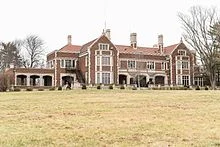
The Waveny Mansion, in New Canaan.
"{Added to the reasons for moving} is the charm of New Canaan (Conn.), a New England village at the end of a single track railroad with almost wild country in three directions, i.e., wild to an Easterner. An ideal place for bringing up children in the way they should go, girls anyhow.''
The late great Scribner's book editor (including of Scott Fitzgerald and Ernest Hemingway) Max Perkins on moving to New Canaan, as quoted in A. Scott Berg's 1978 biography Max Perkins, Editor of Genius (1978).
Editor's note: This is a rather romantic, rustic description of a rich New York City suburb.
Public-private, two-state school deals
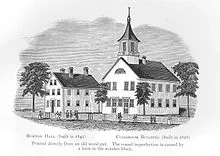
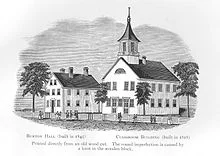
19th Century woodblock of Thetford Academy.
From Robert Whitcomb's "Digital Diary,'' in GoLocal24.com:
I was intrigued by the agreement thatVermont’s private Thetford Academy (founded in 1819), in the Upper Connecticut Valley town of the same name, has with several public schools in the area, including the Lyme, N.H., public schools, that lets students attend Thetford Academy. (Lyme has no high school.)
In this very unusual two-state arrangement, about 25 percent of Lyme’s high-school students go to Thetford Academy. Another 25 percent go to the also private St. Johnsbury Academy, way up the river in the town of the same name. About half go to Hanover (N.H.) High School, a regular public high school, and a small number to other schools in the region.
Adding to the Upper Valley’s very usual (for the U.S.) relationships is that, as I’ve recently written, Hanover is part of the two-state Dresden School District- -- the only one in America. Rather complex cross tuition/voucher arrangements pay for this.
The principal of the Lyme School District, Jeff Valence, told the Valley News: “The relationship we’ve built over the years…has brought something really special to the educational landscape here. The fact that families can choose to send their kids to an independent academy, while still upholding the tenets of public education, is very important to us.’’
Such arrangements may provide models for schools elsewhere, especially in tight, densely populated southern New England. Connecticut, Rhode Island and Massachusetts school officials should study the northern examples, which might be applicable to them, especially for communities along state lines and with a good mix of private and public schools.
To read more, please hit this link:
http://www.vnews.com/Lyme-School-and-Thetford-Academy-revise-long-standing-partnership-agreement-12652007
The big picture

"Above'' (oil on linen), by Lully Schwartz, in the show ''New England Pastoral,'' at Alpers Fine Art, Andover, Mass.
Into the color
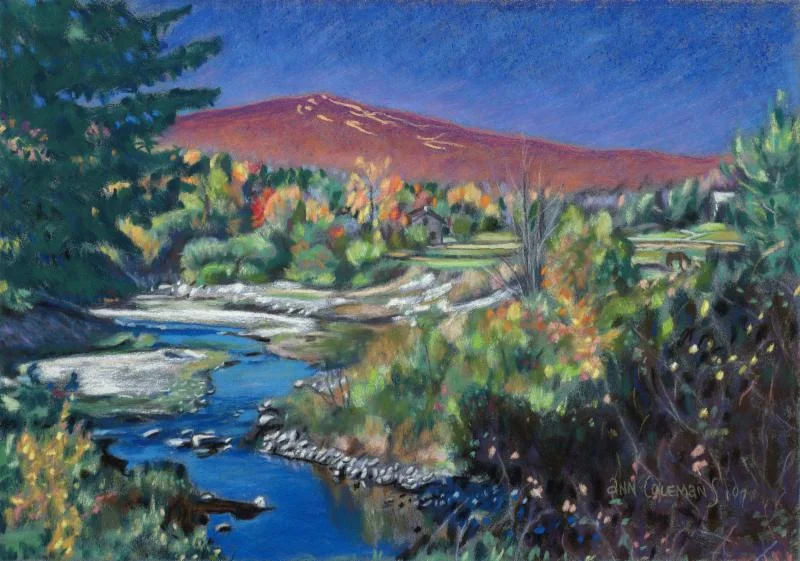
"Deerfield (Vt.) Autumn,'' by Ann Coleman, at Ann Coleman Gallery, Wilmington, Vt.
Frank Carini: Zoologist sees human overpopulation as world's central problem

James 'Skip'' Lazell in nature.
Via ecoRI news (ecori.org)
JAMESTOWN, R.I.
Even as a kid in the 1950s, James “Skip” Lazell knew that there were too many people living on the third rock from the sun. He got a vasectomy in 1960, when he was 21.
“Population has been a hot topic of mine for some time, but there’s very little we can do about it,” he said. “The economic system is a Ponzi scheme that requires growth, growth, growth to sell more and more products. More consumers are needed year after year. Overpopulation is the root cause of all of our problems, from excess carbon dioxide to global warming.”
His evolving concerns about human population and its impact have been formulated by his life’s work, plenty of discussion and much reading, such as the controversial bookThe Population Bomb, by Paul R. Ehrlich. The 1968 book sold millions. While Ehrlich’s doomsday scenario — the Stanford University biologist predicted hundreds of millions would starve to death in the 1970s — didn’t materialize, hunger is a major problem on a planet now inhabited by some 7.4 billion people. Our population is projected to exceed 9 billion by 2050. Our numbers are driving the planet’s sixth mass extinction.
While global population growth must be part of the conversation about sustaining the planet, it’s seldom discussed. Lazell has seen the issue sidelined for most of his 78 years.
“Sea-level rise, desertification and ocean acidification are linked to overpopulation,” he said. “Human-induced climate change is going to wipe out entire species and ecosystems. It’s likely going to end with catastrophic population decline."
Lazell, however, isn’t alone when it comes to talking about an issue that most of the world largely ignores. Geologist Walter Youngquist has called for a “greatly reduced” population as a critical element to the solution of natural-resource shortages.
In his 2016 paper, "Framework of the Future,'' Youngquist draws on his professional experience as a petroleum geologist and earth scientist to predict a grim future for the world’s people and its energy resources.
“It is doubtful the 7.4 billion people here now, and the billions more expected, can be sustainably supported in any decent standard of living beyond the time of the widespread use of fossil fuels,” he wrote. “This is the human dilemma. We have built a world based on fossil fuels ... and moving on to much less energy-dense and much less versatile alternative sources in the face of an ever-growing population is a challenge before us. ... If there is a solution to this problem it is a greatly reduced and much less affluent population.”
Youngquist and the Virginia-based organization Negative Population Growth both have noted the conspicuous absence of any official U.S. population policy. Author Alan Weisman’s 2013 book, Countdown, looked at how many peoplethat the planet can sustain. Lazell believes thatit’s a billion. The longtime/part-time Rhode Islander is concerned that the crush of humanity will wipe out many of the creatures he has spent his life finding, studying and conserving.
“We’re pretty smart, but we need leadership to get interested in overpopulation,” Lazell said. “The United States devours the most, and much of the rest of the world wants to live like Americans. Our consumption level is unsustainable.”
ecoRI News visited with Lazell last month at his modest home on Swinburne Street, Jamestown, a house he bought in the late 1960s. We sat in his living room for more than an hour talking about the natural world and the many pressures squeezing it. While he has long been concerned with human population, his life’s real passion, animals, most notably reptiles and amphibians, also began when Lazell was a child.
As a youngster, Lazell spent hours reading and studying his world atlas. His interest in geography often focused on islands. His scientific niche naturally grew into “island biogeography.” In its Dec. 8, 1957 edition, the Philadelphia Inquirer magazine featured an article about the 18-year-old naturalist and how he had, among other things, recently captured crocodiles in Jamaica.
Lazell was born in New York City and grew up in suburban Philadelphia. His accent, however, has been softened by boyhood summers spent with family in Jackson, Miss. But Rhode Island, specifically Conanicut Island (Jamestown), has served as his summer and fall base for decades.
Lazell earned a Ph.D. from the University of Rhode Island — he also has graduate degrees in biology and zoology from Harvard University and the University of Illinois. In 1988, in Jamestown, a friend’s mother introduced Lazell to a Chinese-born woman, Wenhua Lu, who would become his wife. Wenhua, who also earned a Ph.D. from URI, married Lazell in 1992. They don’t have any children, for obvious reasons.
While zoologist Lazell focused on amphibians and reptiles — his thesis was on lizards of the West Indies — his 62-year-old wife is an entomologist with a keen interest in beetles.
When he was 17, the Philadelphia Zoo paid for Lazell to go to the West Indies to collect specimens. It’s where his doctoral work on Anolis, a genus of iguanian lizards, first came into focus. He returned a year later on another zoo-funded trip.
In fact, Lazell visited the West Indies every year from 1957 to 2014, making his last visit when he was 75. His favorite island there is Dominica.
For this work researching clouded Anole on the uninhabited West Indies island of Redonda, Lazell rented a boat, was given a compass and was wished good luck. He loved the experience, a wide grin formed on his face when he recalled the tale. His 30 years of work on Guana Island reportedly produced the most comprehensive, long-term record of the natural history of a Caribbean island.
Iguanas, salamanders and crocodiles, however, haven’t consumed all of Lazell’s professional time. He first recognized the potential for successful reintroduction of flamingos to the salt ponds of Anegada in the early 1980s.
He has been published in scientific journals more than 200 times; he’s discovered some 30 new species and rediscovered some of the planet’s rarest ones. In 1985, Lazell made Rhode Island’s first official recording of spring salamanders, commonly called gyros, in Foster.
His 1976 book, This Broken Archipelago: Cape Cod and the Islands, Amphibians, and Reptiles, has detailed chapters on 38 species of frogs, salamanders, toads, turtles and snakes, their natural history, and how they got there. His 2005 book, Island: Fact and Theory in Nature, describes Guana’s flora and fauna against the backdrop of islands worldwide and their ecology, evolution and conservation.
The longtime naturalist worked with the late Roger Conant, a herpetologist, author and educator who wrote one of the first comprehensive field guides for North American reptiles, in 1958. He also was director emeritus of the Philadelphia Zoo.
Lazell studied with the late Ernest Edward Williams, a noted Harvard University herpetologist. Before founding a Jamestown-based nonprofit in 1980, Lazell had stints with The Nature Conservancy and the Audubon Society. He taught biology at the Palfrey Street School in Watertown, Mass.
He founded the The Conservation Agency to work globally to provide and publish scientific data “contributing to the protection of biodiversity and promoting sustainable relationships with valued wildlife.” Lazell was the organization’s president until a few years ago, when his former Palfrey Street School student Numi Mitchell took the reins. He said the founding of The Conservation Agency was the “biggest thrill” of his career.
Now 78, Lazell, who is recovering from open-heart surgery, still speaks enthusiastically and passionately about his life’s work and the wondrous natural world in which we live. He and his wife will return to Jackson, Miss., to his late parents' home, in early November as usual, after they enjoy New England’s fall foliage and crisp air.
His proudest accomplishment, though, may be this:
“I was the only person to be a full-time employee at both Yale and Harvard with a full beard, earring and tattoo,” he said with a smile.
Frank Carini is editor of ecoRI News
Bright urban jungle

Image from Mark Freedman's show through Nov. 16 at the University of Massachusetts at Dartmouth Art Gallery, in New Bedford. The curator says the exhibition features "paintings of the urban environments with their unique ability to capture and hold light.''
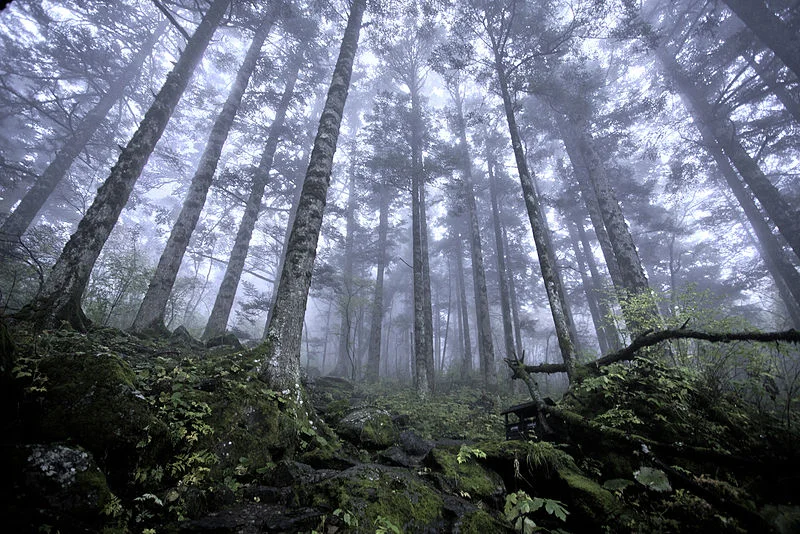
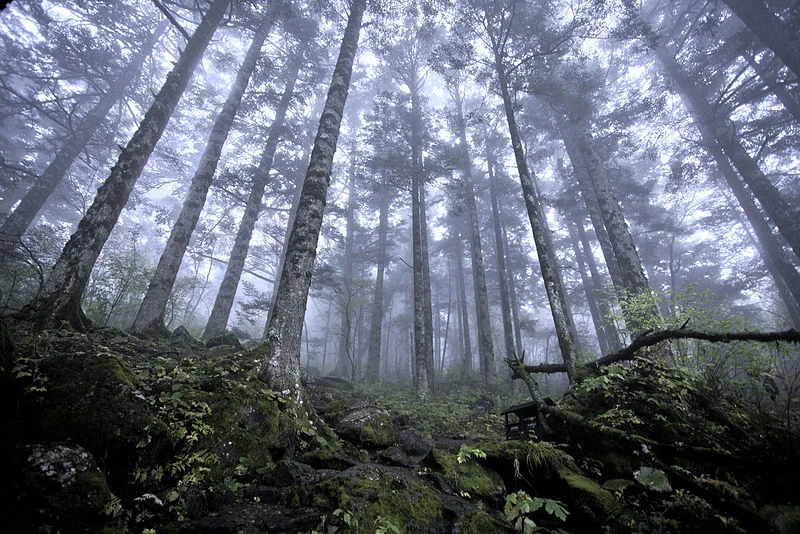
N.E. woodlands are now shrinking
Borderland State Park, in Easton, Mass. Another photo below.
From Robert Whitcomb's "Digital Diary,'' in GoLocal24.com
Many New Englanders know that much of New England used to be open farmland, a lot of it pasturage, but with lots of cropsgrown in the valleys, especially the Connecticut River’s. But as the region’s farming declined, and manufacturingand then modern services became dominant, the woodlands returned, eventually making New England one of the most densely populated but thickly wooded areas in the world.
I once had one of those panoramic photos, taken about 1905 of the hills of Norwich, Vt., as seen from Hanover, N.H., which showed open fields with sheep grazing on them. New England used to have a big woolen-textiles industry. I looked at the same hills the other week and they seemed completely covered with trees. When the leaves fall off in the autumn you can see houses owned by the affluent people who have moved to town, at least from May to October.
The small town-becoming–a-Boston suburb I lived in as a boy had several farms; one was across the street from us. I’m told that one is now part of the estate of a Fidelity Investments executive. We loved going over there and irritating a bull.
Now a new Harvard Forest report says that reforestation had halted. The region was losing 24,000 acres of woodland a year to development from 1990 to 2010, most of it to residential building. Such deforestation is thought to be continuing although more recent data are lacking. The researchers also found that funding for land conservation in the region has fallen 50 percent since the financial crash of 2008 and that the acreage of woodland being conserved annually has dropped from 333,000 to 50,000 a year since 2010.
Jonathan Thompson, a senior scientist at Harvard Forest and one of the study’s authors, told Harvard Gazette: “Peak forest cover is over in New England. For more than 150 years, forests expanded and regrew. That history is how we gained the status of as among the most populated and most forested regions in the world.’’
At the current rate of deforestation, Mr. Thompson said, the region will lose woodlands equivalent to twice the size of Rhode Island by 2060. (Poor Little Rhody – the yard stick for everything.) This would mean the destruction ofsome eco-systems, and thus possibly the extinction of some regional flora and fauna. It will also undermine attempts to slow global warming: Woodlands lock up carbon dioxide.
Let’s hope that state and local policymakers take stronger measures to protect New England’s woodlands, which, with our plentiful water, may be our greatest environmental comparative advantage.
To read more, please hit this link: https://news.harvard.edu/gazette/story/2017/09/harvard-research-reports-major-forest-loss-in-new-england/
-- Photo by Evilbish
Bob Lord: Trump prepares to use tax-cut plan to cut himself a huge check

The Worship of Mammon (1909), by Evelyn De Morgan.
Via OtherWords.org
What’s the largest personal stake a U.S. president has ever had in legislation he signed into law? Whatever it was, it’ll be dwarfed by what Donald Trump’s signature will be worth — to himself — if Congress passes his proposed tax plan and puts it on his desk.
If that happens, Trump will be effectively cutting himself a check from the U.S. Treasury for several billion dollars.
Call me cynical, but it seems that’s exactly what Trump has in mind. His plan just fits his tax situation — or what we know of it, without access to his tax returns — too perfectly.
The president’s tax proposal eliminates two taxes that mostly benefit the wealthy, and cuts a third tax roughly in half. That would bestow a windfall worth billions on the Trump family.
First, there’s the elimination of the alternative minimum tax, or AMT.
The AMT applies to taxpayers whose income tax liability otherwise would be reduced excessively by certain deductions, including deductions commonly claimed by real estate owners like Trump. It’s like an alternative tax system in which the rates are lower but fewer deductions are allowed.
The one glimpse we’ve had of Trump’s tax returns suggests he stands to benefit massively from the repeal of the AMT. In 2005, Trump’s income exceeded $150 million, but his regular tax liability was just $5.3 million — that’s barely a 3.5 percent tax rate.
But the AMT increased Trump’s tax liability that year by over $31 million. Had Trump’s tax plan been in effect in 2005, it would’ve saved him that $31 million.
Still, that’s chump change in comparison to the tax windfall he hopes to bestow upon himself by cutting the top tax rate on the bulk of his income by more than half, from nearly 40 percent to 15.
We’re not talking about the corporate tax rate here. Trump could reap a tidy personal benefit from slashing the corporate income tax too, but the far bigger prize in his plan is its treatment of income from businesses that don’t pay corporate taxes.
Under current law, the income of those businesses is taxed to their owners at individual income tax rates. Under Trump’s plan, income from those businesses would receive preferential tax treatment, with a maximum tax rate of 15 percent.
That would be the final act in turning our nation’s tax policy on its head.
In 1980, before Ronald Reagan’s election, the maximum rate on workers’ wages — earned income — was less than the maximum rate applicable to all other types of income except long-term capital gains.
Under Trump’s tax plan, the maximum tax rate workers pay, after accounting for employment taxes, will be higher than the rate applicable to any other type of income.
That means no matter how Trump invests his billions — in real estate, bonds, stocks, business ventures, etc. — the income he generates would be taxed at a rate lower than what workers pay on their wages.
Trump’s preferential rate for business income is unprecedented. Is it a coincidence that the first politician to propose it just happens to be a real estate magnate with interests in literally hundreds of unincorporated businesses?
The biggest tax windfall Trump hopes to secure for himself, however, is one he won’t live to enjoy. I’m referring to the estate tax, of course — a federal levy on estates worth over $5.5 million for individuals.
Trump’s plan would eliminate that tax, no matter how large the estate. For Trump, that would mean as much as $1.4 billion on an estate estimated by Forbes at $3.5 billion.
The bottom line: If Trump’s tax plan passes, he’ll have secured for himself billions in tax benefits in less than a year as president. Not bad work if you can get it, huh?
Bob Lord is a veteran tax lawyer who practices and blogs in Phoenix. He’s also an associate fellow of the Institute for Policy Studies.
Checking in
"One more arrival. Parking in the drive
of our house that too much of the time is yours,
I think of an evening down at Holbrook's Wharf
when I glanced up from supper to speak to you,
but stopped my breath as a motor launch slid in....''
-- From "Commuter Marriage: Homecoming,'' by Henry Taylor
That special light

“She ran into the early-October afternoon. The light came at a low slant through the oaks across the street, gold and green, and how she loved that light. There was no light in the world like you saw in New England in early fall.”
-- Joe Hill, book author and comic-book writer and a son of Bangor, Maine-based novelist Stephen King.
Entrepreneurial New Hampshire
"In New Hampshire, we know that small businesses and entrepreneurs are the engines of economic growth in the 21st-Century economy, and our state has long been defined by the entrepreneurial spirit of our people. ''
-- U.S. Sen (and former Gov.) Maggie Hassan
Chris Powell: Lies and betrayal from Vietnam through today; rich school employees
With their 10-part series The Vietnam War just broadcast on PBS, documentary makers Ken Burns and Lynn Novick have done a great service not only to history but also to contemporary public policy.
The documentary emphasizes that the famous Tet offensive of Communist North Vietnam and its guerrillas in South Vietnam, launched in January 1968, was actually a military triumph for the United States and South Vietnam but also a political disaster for them. For it exposed the U.S. government's years of lies that the war was close to won.
Indeed, President Lyndon B. Johnson and his political associates libeled the anti-war movement as disloyal and Communist even as they confessed to each other in private that the war was going poorly and was ill-conceived. So the war was continued for another seven years just to save face.
The series also brilliantly contrasted the astounding courage and heroism of U.S. soldiers with the equally astounding stupidity of the strategy that their generals pursued.
A former soldier summarized that strategy this way: Walk into the jungle and see if you can draw fire. Of course, our soldiers did draw fire, suffered terrible casualties, and then withdrew to remote and poorly defended fire bases without ever holding the territory that they had won with so much blood. The United States dropped more bomb tonnage on the Vietnam War theater than it dropped on Europe during World War II, but that didn't hold territory for long either. That former soldier said he especially resented having to fight to take the same ground multiple times.
Of course, this is pretty much the "strategy" now being used in the 17th year of U.S. military intervention in Afghanistan: Draw fire and then retreat with your casualties.
At least the Trump administration, unlike the Johnson administration, doesn't pretend that the war is going well. But like the Johnson administration, the Trump administration continues the war anyway without any plausible plan for winning it -- and this time the American people and even supposedly humane members of Congress are indifferent to another endless war of attrition in Asia.
So maybe in a decade or so Burns and Novick will be able to make a documentary called The Afghanistan War. They could quote the quatrain from Kipling that belongs at the graves of Johnson and Nixon and will belong at Kissinger's:
And the end of the fight is a tombstone white
With the name of the late deceased,
And the epitaph drear: "A Fool lies here
Who tried to hustle the East."
LUXURIOUS EDUCATION: A community activist in Hartford, Kevin Brookman, notes that the city's school system employs about 70 people with salaries of $100,000 or more, many of them above the governor's salary, $150,000, not counting insurance and retirement benefits. The city's new school superintendent is paid $260,000.
If the Connecticut General Assembly doesn't quickly pass a state budget he likes, the governor, operating the state by executive order, may divert to Hartford and a few other cities all the education money state government has been giving to the rest of the state's municipalities.
What will Hartford do with it all? Create more $100,000-a-year positions? Build another stadium?
If experience is any guide, the city won't improve education with it, since student educational performance is almost entirely a matter of family cohesion, of which Hartford has little.
Chris Powell is managing editor of the Journal Inquirer, in Manchester, Conn.
Boston Guardian has an opening for reporter
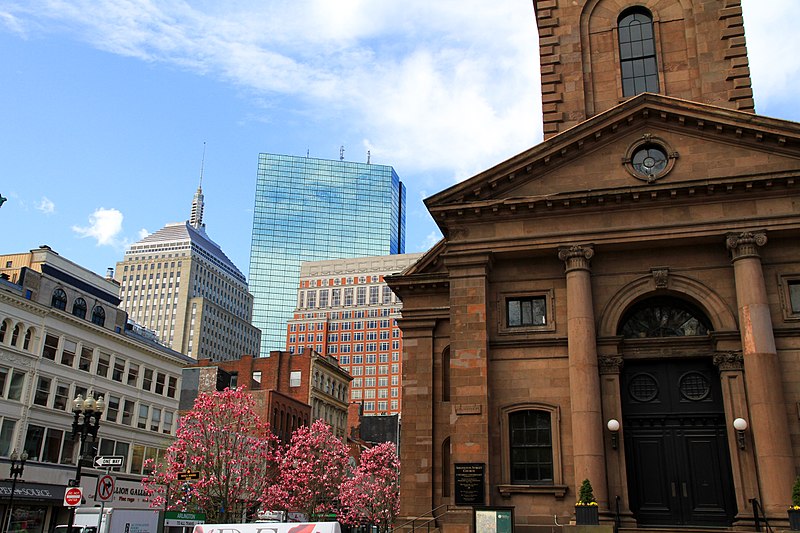
The Arlington Street Church, very close to the headquarters of The Boston Guardian.
The Boston Guardian, the city's biggest weekly and covering the most dynamic parts of Boston, has an opening for a reporter with two or three years experience. If interested, please contact David Jacobs, publisher, at:
djacobs@thebostonguardian.com
Fall fashion

"The morns are meeker than they were,
The nuts are getting brown;
The berry's cheek is plumper,
The rose is out of town.
The maple wears a gayer scarf,
The field a scarlet gown.
Lest I should be old-fashioned,
I'll put a trinket on.''
-- "Autumn,'' by Emily Dickinson
Mysterious African minimalism at UMass

Untitled painting by Fred Wilson, in his show "5 takes on African Art,'' at the University Museum of Contemporary Art, at the University of Massachusetts at Amherst, through Dec. 17.