
Vox clamantis in deserto







BU may take over Wheelock College

This is from The New England Council (newenglandcouncil.com):
"Boston University (BU) and Wheelock College have confirmed they have entered discussions of a possible merger in recent weeks.
"Wheelock College, about a mile away from BU’s south campus, has faced declining enrollment over the past few years, leading Wheelock’s new president, David Chard, to consider a merger. Wheelock received six responses to its Request for Proposals (RFP), but believed merging with BU would best preserve its mission of educating students in teaching and social work.
"In the merger, Wheelock’s School of Education, Child Life, and Family Studies would merge with BU’s School of Education to create the Wheelock College of Education and Human Development. An official date, among other details, have not yet been released by either institution.
“'Over the upcoming weeks the leadership of Boston University and Wheelock College will be working with our faculties and our academic and administrative leaders to shape the vision of our merged academic units and services,' the joint statement said. 'We believe the merger will enhance Boston University’s programs, as well as preserve the mission of Wheelock College to improve the lives of children and families.”'
Editor's note: There seems to be an overpopulation of small colleges in New England, and dozens might close over the next decade.

Wheelock(College) Family Theater.
Chris Powell: U.S. shouldn't have betrayed its principles and Free China

Republic of China (Taiwan) flag.
President Richard Nixon and Henry Kissinger, who was first his national-security adviser and then his secretary of state, are supposed to have been foreign-policy geniuses, most notably for their approach in 1971 and 1972 to what we then called Red China. The Nixon-Kissinger idea was to further separate the government in Beijing from its great fellow Communist ally, the Soviet Union, and induce both countries to diminish their support for North Vietnam's war against South Vietnam, where the United States was doing most of the fighting.
Recognizing Red China should have been no big deal ordinarily, for the primary criterion for recognizing governments is not their politics or decency but simply whether they rule distinct territory. But as a Republican U.S. representative and senator, Nixon had been an instigator of the great red scare of the early 1950s and had blamed the Democratic administration of Harry Truman for losing China to communism. So Nixon's reversing his posture on China was almost as sensational as the sudden alliance of Nazi Germany with the Soviet Union in August 1939. Nixon got away with it because most people agreed with the new policy, and so his old red-baiting was forgotten.
But as things turned out China and the Soviet Union did not curtail their support for the Communist side in the Vietnam War, and the U.S. side was defeated two years after Nixon visited China and just after he resigned the presidency to avoid impeachment. Opening China to trade with the United States, normalization boosted China's development and led to the decline of much of U.S. industry.
It also caused the United States to betray its longstanding ally, the Republic of China -- the losing side in the Chinese Civil War, which had moved to the island of Taiwan. The Republic of China was expelled from the United Nations and its diplomatic relations with the United States were demoted from formal to informal, though Taiwan also governed and continues to govern distinct territory.
Now the United States and its Asian allies are being threatened by North Korea as it develops nuclear weapons and the missiles to deliver them. North Korea's neighbors and sponsors, China and Russia, resist cutting off the troublesome country. China is becoming an imperial power (like the United States itself) and is creating islands in the South China Sea to gain control over international navigation there. China claims sovereignty over Taiwan and at China's insistence Taiwan is being denied even observer status in international organizations and is losing diplomatic recognition from other countries.
So what does the United States have today to show for the supposed Nixon-Kissinger genius in Asian policy? Not much.
Yes, Communist Vietnam, which defeated the U.S.-backed side in Vietnam's civil war, is increasingly friendly to the United States. But this is despite the Nixon-Kissinger policies, not because of them. That is, like other countries nearby, Vietnam feels threatened by China and on the whole the Vietnamese and the Chinese long have detested other.
Meanwhile Taiwan, whose demotion throughout the world was triggered by the United States' bid to woo mainland China, has become a vigorous and prosperous democracy that might better be called Free China. The brave little country strives quietly to maintain its sovereignty in anticipation of the eventual dissolution of the totalitarian regime that threatens it.
So it seems that the United States would have done better to stay true to its principles and loyal to Free China, whose simple example may be the best hope for democracy on the mainland.
Chris Powell is managing editor of the Journal Inquirer, in Manchester, Conn.
The woods are 'lovely, dark and deep'

"Birches, Maine,'' by Russell duPont in his show "A Sense of Place: Photographs by Russell duPont,'' through October, at the Whitman (Mass.) Public Library. Mr. duPont has also just published a coming-of-age novel, King & Train, that is available on Amazon.
Tim Faulkner: On the edge in Narragansett Bay

Narragansett Bay.
Via ecoRI News (ecori.org)
This year’s Watershed Counts report again describes a bay and shoreline under duress and facing an uncertain future. The causes aren't new, but the overarching threat to the Narragansett Bay region is climate change. To illustrate the current and future perils, the report analyzes three topics: oysters, saltwater marshes and waterfront homes. The three make for an ideal summer setting in Rhode Island, but from an ecological perspective they are on the cusp of significant change.
Marshes
The report's profile of saltwater marshes is compelling for its clear illustrations and concise description of one of Narragansett Bay’s most underappreciated resources. Marshes teem with ecological diversity and provide important functions such as sequestering carbon, filtering pollution, and protecting the shoreline from floods and erosion.
Yet, sea-level rise is submerging these habitats faster than they can naturally elevate themselves. Since 1999, the water level in the bay has risen 3 inches, compared to a 1.125-inch accretion rate for marshes. As water becomes trapped atop marshes, the grasses turn to mudflats and eventually open water. According to the report, if sea-level rise increases 5 feet, as projected, the bay will lose 87 percent of its remaining marshes.
Experimental marsh preservation projects are underway in Middletown, Charlestown and Narragansett, R.I. To elevate marshes, sediment from dredged navigation channels and breachways is sprayed on top of the grasses. But the report acknowledges the it will be a challenge to keep up with the inevitable.
“Even if emissions were halted today, it could be at least a hundred years for ocean temperatures and seal level rise to change course," according to the report.
Oysters
Oyster farming is a re-emerging industry that reached its peak in 1922, when farms covered 22 percent of Narragansett Bay. Although oyster farming is a fraction of the size today, they are the state’s largest source of shellfishing revenue. The industry is projected to grow, thanks to strong oversight and management plans from state agencies such as the Coastal Resource Management Council (CRMC) and Department of Health. But warming water impacts spawning, alters the taste of oysters and escalates the likelihood for diseases. Climate change also increase stormwater runoff, which pollutes the bay and leads to shellfish closures.
Even with these threats, however, the report concludes that oyster farming can grow and thrive.
“Rhode Island is well positioned to identify and manage current and future impacts of climate change to the oyster aquaculture industry," according to the report.
North Kingstown, for one, has partnered with state institutions to map and assess the town’s vulnerability to projected sea-level rise. (CRMC)
Waterfront homes
The pursuit of waterfront property is coming back to haunt Rhode Islanders. The development of the coast has destroyed marshes and hardened the shoreline with manmade barriers such as seawalls.
Since the 1970s restrictions have slowed building on marshes and construction of artificial barriers. But with 30 percent of the the bay's shoreline “hardened” by development and rising seas there isn’t much room for nature to adapt or help lessen the force of more powerful storms and erosion wrought by climate change.
Waterfront property owners have to make expensive decisions. Retreat, elevate their homes, or install natural buffers to protect against the inevitable damage expected from the encroaching ocean.
CRMC will initiate the transition to these options with its Shoreline Special Area Management Plan, or Beach SAMP. The guide for coastal property owners about hazards is still being written, but the website offers maps and information about at-risk neighborhoods. Other tools and information about coastal climate risks are available for municipal planners, property owners and the public, such as the recently launched PREP-RI learning site.
The Watershed Counts report warns that shoreline property owners should act soon, as the likelihood of a 100-year storm battering Rhode Island increases. Otherwise, 4,853 coastal homes will be underwater by 2100 thanks to sea-level rise, according to projections.
Watershed Counts is facilitated and paid for by the University of Rhode Island Coastal Institute and the Narragansett Bay Estuary Program, with funding from the Environmental Protection Agency.
Tim Faulkner writes for ecoRi News.
Running to paralyze a city
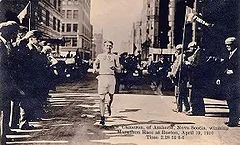
Boston Marathon finish line in 1910.
Adapted from Robert Whitcomb's "Digital Diary,'' in GoLocal24.com:
It’s past time to end traffic-paralyzing and potentially dangerous road races in downtown Providence. The Sept. 17 CVS Health Downtown 5K showed what a mess these events can make.
Yes, besides being an ad forWoonsocket-based CVS, this event raises money for some nonprofits. But these promotions can also bring other activities to a halt in the middle of New England’s second-largest metro. They can block police, fire and rescue vehicles and prevent consumers from getting to stores, restaurants and hospitals. Members of the public should just send money to their favorite local charities, without the city going through these disruptive events.
The charity, teamwork and goodwill associated with these races are very nice. But if we must have them why not keep them out in the country or suburbs, where they can’t snarl life for many thousands of locals for hours?
Yes, the Boston Marathon goes into, well, Boston, but mostly on a straight line, not curving around constantly, as doraces in tight little downtown Providence. And most of the Boston Marathon route is in the exurbs and suburbs. Further, it's an international event that really does bring money into Boston. Not so these runs in Providence.
David Warsh: U.S. Russia policy -- containment or cautious engagement?
The abrupt deterioration in U.S.-Russian relations that began in February 2014, when Ukraine President Viktor Yanukovych fled Kiev on the last day of the Sochi Olympics, just as Russia sought to show its best face to the world in an elaborate closing ceremony, is the most serious crossroads in the relationship of the rival nations since the Cuban missile crisis.
The parallels are imprecise. This present episode is much more complicated than those famous thirteen days in October 1962 for having unfolded much more slowly, and for having affected the interpretation of a U.S. presidential election in the process. Yet for all of that, it has the potential to be as dangerous as the Reagan buildup/Soviet collapse of the early 1980s, given the impetus it has imparted to a new race to manufacture easy-to-use nuclear weapons equipped with hair triggers.
It is important, therefore, to frame properly the events before and after. “Putting Putin in Perspective’’(revealingly retitled “The Putin Problem” by the editors), a useful contribution by two specially well-qualified authors, appeared in the Boston Review earlier this month.
Thomas Graham, a managing director at Kissinger Associates, was senior director for Russia on the US National Security Council 2004-07. Rajan Menon, a professor at the City University of New York, is author of The Conceit of Humanitarian Intervention (Oxford, 2016).
“At the core of Russian identity,” they argue, “is the deeply-held belief that Russia must be a great power and that it must be recognized as such. Ever since Peter the Great brought Russia into Europe at the beginning of the eighteenth century, the belief in Russia’s predestined role in the world has informed Russian thinking and actions.”
This is particularly true of the last three Russian leaders, they say – Mikhail Gorbachev, Boris Yeltsin and Putin, explaining that Dimitri Medvedev, president from 2008-12, never escaped Putin’s shadow. “All three were – or are – consumed by Russia’s future as a great power.”
The article is the best-informed and most persuasive narrative of the last 35 years of U.S.-Russian relations that I have seen. It bears reading by anyone seriously interested in the situation today because, as the authors note, their argument is almost completely at odds with “mainstream thinking” in the U.S., as reflected in political debate and much press coverage: to wit, the conviction that all the blame belongs on Putin.
For purposes of a column I will condense their argument to two main themes – Russian humiliation since the collapse of the USSR in 1991; and U.S. top-loftiness, especially in the form of NATO enlargement since 1995. I compress in order to emphasize an important inflection point in the relationship that Graham and Menon add to a standard list of five others since 1999. Each of these accounts Russia gave of itself was little noted and much less widely understood. (One was somewhat indirect.) They should have been plain for all to see, since, in each case, Putin was addressing and seeking to persuade a global audience.
· Putin’s broadside, “Russia at the Turn of the Millennium,” issued in 1999, just as he took the reins of government, in which he sounded an alarm: “Russia is in the midst of one of the most difficult periods in its history. For the first time in the past 200-300 years, it is facing a real threat of sliding to the second, and possibly even third echelon of states in the world. We are running out of time for removing this threat.”
· Putin’s Munich speech, in February 2007, when, with Defense Secretary Robert Gates and Senators John McCain and Lindsey Graham in the audience, he excoriated the United States for having invaded Iraq without winning widespread consent; threatening Russia with NATO expansion; encouraging nuclear proliferation by behaving lawlessly; and for touching off a missile defense arms race.
· The first hack – when Assistant Secretary of State Victoria Nuland’s famous “fuck the EU” cell-phone conversation with the U.S. ambassador to Ukraine was recorded by Russian security officials during a street demonstration in Kiev, and posted on the Web in an appeal to world opinion via YouTube.
· Putin’s speech in March 2014 to a room full of dignitaries in Moscow explaining the decision to annex the Crimean peninsula after what he described as a coup in Ukraine. “If you compress the spring, it will snap back hard,” he said.
· Putin’s March 2017 private offer to President Trump via diplomatic channels of an extensive re-set, disclosed to BuzzFeed earlier this month, presumably by the Russians, conceivably by the Americans, quickly confirmed by both sides, and reported by CNN, the WSJ, and Economic Principals last week. The offer seemed to demonstrate how little the Russian understood the situation as it had developed in the United States.
The sixth inflection point, the one that Graham and Menon added to the standard list, may be the most important. It has been much less hashed over because Putin spoke to a Russian audience about one episode and on the eve of another.
· “The turning point,” they write, “came in Fall 2004, with the September terrorist attack in Beslan in the Caucasus and Ukraine’s Orange Revolution, which started in November.” To that point the U.S. and Russia had cooperated successfully in dealing with Islamic extremists. Putin was the first to reach out to the U.S. after 9/11, and Russia provided valuable support in the early stages of the U.S. war in Afghanistan.
That autumn Chechen terrorists seized a school in Beslan, in the Caucasus, and held it until negotiations broke down. Nearly 400 persons were killed, most of them children, in the rescue attempt. The U.S. had refused to work closely with Russia against the Chechen rebels, some of whom were moderates in Washington’s eyes, their secessionist grievances legitimate. Not long after the tragedy, Putin spoke obliquely to a television audience about the U.S. and what he considered its goals:
“Some want to tear off a big chunk of our country. Others help them do it. They help because they think that Russia, one of the greatest nuclear powers of the world, is still a threat, and this threat has to be eliminated. And terrorism is only an instrument to achieve these goals.’’
A month later, the Orange Revolution began in Ukraine. In Moscow’s reading, the United States had master-minded the protests and streets scenes in order to install a pro-Western figure as president instead of Yanukovych, the candidate Putin had endorsed. He soon came to view it as a dress rehearsal for regime change in Russia itself. (The authors don’t mention it, but this was the very zenith of George W. Bush’s “Freedom Agenda”: having taken Baghdad, the administration was being urged by neoconservative strategists to drive on to Teheran.) Soon after Viktor Yushchenko was installed, Putin warned,
“It is extremely dangerous to attempt to rebuild modern civilization, which God had created to be diverse and multifaceted, according to the barracks principles of a unipolar world.’’
So it has proved to be. Around the corner, in 2008, were the short war with Georgia, on behalf of a couple of small self-proclaimed republics (South Ossetia wanting to remain within the Russian sphere, Abkhazia simply wishing to be free of Georgia); and, in 2011, the beginning of the Arab Spring. Russia developed two policies to resist the United States abroad, Graham and Menon observe: preserving Russian preeminence in much of the former Soviet space; and supporting alternative global institutions.
Domestically Putin cracked down, especially after winning election to a third term, in 2012. He blamed former Secretary of State Hillary Clinton for encouraging protests beforehand. Opposition leaders were arrested; Western-funded non-governmental organizations were shut down; laws were passed narrowing the scope for political debate. Putin then embarked on “a wide-ranging cyber and disinformation campaign in the West to tarnish the image of Western democracy and sow domestic discord, of which the interference in last year’s presidential election is only the most prominent example,” the authors say. Nearly everyone in the West agrees the Russians went too far with their cyber-measures, it seems to me, but no such rough consensus has yet emerged as to the intent, scope, tenor and effect of the campaign.
What’s next? The authors list three options: treat Russia as an adversary and pursue containment; return to the minimalism by which the U.S, dealt with Moscow from 1920 to 1933 during which time it didn’t even have diplomatic relations with Russia; or undertake what Graham and Menon call engagement leavened by realism. Pretending that Russia doesn’t exist is no longer an option in the modern world, so the choice is basically between containment, with the risk of confrontation, and cautious cooperation. The authors warn of the risks of the former:
“[of] a future of freewheeling rivalry punctuated by intermittent crises, which will have to be managed in an atmosphere of mutual mistrust, even hostility. Moreover, they could spiral into a confrontation. The breakdown in communication and bellicose back-and-forth rhetoric would increase the probability of misperception and miscalculation during dangerous episodes. Given the conventional military power Russia now wields – to say nothing of its nuclear weapons and cyber capabilities – the dangers should be obvious and are already presaged by the hair-raising encounters in the Baltic Sea and the Black Sea between U.S. ships and aircraft and Russian warplanes.’’
Engagement leavened with realism would, they say:
“{W}elcome the emergence of democracy in Russia but wouldn’t allow quotidian policy to be shaped by the attendant hope. It would assume that the internal differences between Russia and the United States and the dissimilar geopolitical circumstances each faces would inevitably produce divergent interpretations of, and responses to, events – the wars in Ukraine and Syria being examples. It would expect Russia to regard itself as a great power, defend its interests as defined by its leadership, and, even in times of weakness, act on the premise that recovery and resurgence are inevitable.’’
Crises would continue to erupt, but with the expectation that they could be resolved. Meanwhile, they say, shared interests would accumulate and opportunities accrue.
Consider, for instance, advancing arms control and nuclear non-proliferation; averting war on the Korean peninsula or unregulated rivalry in the Arctic, the thawing of which has made it a maritime passageway as well as a new energy frontier; coordinating policies against terrorism and climate change; avoiding accidental military clashes; stabilizing Syria; and preventing bilateral crises from escalating into armed, especially nuclear, confrontations.
Now, if only we had a president capable of saying as much in his own words – or even persuasively reading speeches written by others! Their prescription is, the authors point out, not very different than how the United States and the USSR dealt with one another (and China) during much of the Cold War – an approach that produced notably soft landings. It may even be Donald Trump’s instinctive response to the situation, but it has been quite beyond him to deliver.
To refresh my memory of the Cuban missile crisis, I went back to Graham Allison’s famous book: Essence of Decision: Explaining the Cuban Missile Crisis (1971). It’s as good as I remember it, with its overlay of what modern political scientists had to say, mostly then new-fangled rational-actor theory, superimposed on a commonsense interpretation, with a substrate devoted to comparing the two accounts (those of “scientists” with “artists”) and fashioning a third model, in search of a satisfying explanation. Allison’s analysis had its good effect, none greater than when he emphasized the gospel of his mentor, Nobel laureate Thomas Schelling: It helps to regularly put yourself in the other person’s shoes before acting.
Most distressing at the present moment, however, is the role of two leading U.S. newspapers, The New York Times and The Washington Post, in preferring condemnation and confrontation at every turn (The Times throughout the paper, The Post mainly on its editorial pages). Granted, the situation has been further confused by Donald Trump’s election as president.
But long before that, the coverage of Putin reminded me of the demonizing of Saddam Hussein in the build-up to Iraq (or, for that matter, The Times’s initial cheerleading for the Vietnam War, 40 years before). Truth-seeking, in the form of listening to the other side, is often severely wounded before the war begins.
Certainly it is not auspicious that The Times abolished the position of public editor, its in-house critic, just as the controversy heated up. “Our followers on social media and our readers across the internet have come together to serve as a modern watchdog, more vigilant and forceful that one person could ever be,” wrote publisher Arthur Sulzberger, Jr., explaining the decision.
In her final column, public editor Liz Spayd replied:
“It’s not really about how many critics there are, or where they’re positioned, or what Times editor can be rounded up to produce answers. It’s about having an institution that is willing to seriously listen to that criticism, willing to doubt its impulses and challenge the wisdom of the inner sanctum. Having the role was a sign of institutional integrity, and losing it sends an ambiguous signal: Is the leadership growing weary of such advice or simply searching for a new model?’’
We’ll find out soon enough.
Incidentally, I wouldn’t have known about either of these articles, the BuzzFeed scoop and the Boston Review narrative, but for Johnson’s Russia List, the compendium of Russian and Western news reports prepared almost daily by the independently minded scholar David Johnson.
When the history of the Ukraine crisis is finally written, Quaker-raised Johnson will, I think, be a major hero of the story. Neither The Times nor The Post – nor, for that matter, The Wall Street Journal– has yet cast light on his long and invaluable reconnaissance throughout the borderlands of democracy.
David Warsh, a veteran columnist and economic historian, is proprietor of Boston-area-based economicprincipals.com, where this first ran.
Sam Pizzigati: We get sick, they get rich

Via OtherWords.org
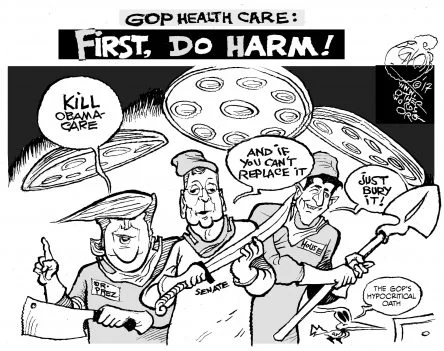
Our current health-care system in the United States works just fine — for the corporate executives who run it.
Take, for instance, Michael Mussallem, the CEO at Edwards Lifesciences — a California-based company that makes heart valves and assorted other medical devices. Since 2010, Mussallem has pocketed an astounding $246 million in compensation.
Actually, astounding might not be the right word here. In the health-care industry, colossally large paychecks for top executives have become standard operating procedure. In fact, four health-industry CEOs have made more than Mussallem since 2010.
One made much more. John Martin, the former top executive of the pharmaceutical giant Gilead Sciences, has collected $863 million over the past seven years.
Overall, the CEOs at 70 major American health-care companies have grabbed a combined $9.8 billion since 2010. That comes to an average annual take-home of $20 million per executive.
All these numbers come from researchers at Axios, an online news media outlet. Two top corporate watchdogs — University of Massachusetts-Lowell economist William Lazonick and Matthew Hopkins of the Academic-Industry Research Network — have confirmed the Axios pay figures.
The health-care industry is doing its best to ignore and dismiss these findings. The national outlay for health care last year hit $3.35 trillion. Next to those trillions, the industry reasons, the mere billions that go to health-care executives amount to no more than a tiny drip from an IV.
But this glib defense of executive excess in health care totally ignores the real danger in the big bucks cascading into corporate CEO pockets. Outrageous pay gives CEOs an incentive to behave outrageously — at the expense of our health.
How so?
The vast bulk of corporate executive pay today comes in the form of stock awards. The higher a company’s share price, the heftier the CEO’s compensation. This stock connection encourages CEOs to single-mindedly focus on raising their company share prices by any means necessary.
Among those means: Pharmaceutical CEOs will jack up prices on prescription drugs and do whatever they can to get doctors to prescribe more pills. Health providers will push unnecessary tests and procedures. Hospital chiefs will downsize support staffs for patients.
All these decisions fatten corporate bottom lines, pump up corporate share prices, and leave our health care poorer.
How could health care get better? Blue-ribbon commissions have all sorts of suggestions. They urge us to eliminate unnecessary procedures, tests, and devices. We need to better coordinate care and lower prices.
Corporate CEOs in the health industry have no incentive to take any of these steps. They want to keep the health-care industry a “free market” wild west where the biggest corporate players get to keep whatever they can grab.
We need to break that power.
And that brings us to the good news: Prospects for real change in health care are rapidly moving onto America’s political center stage. We now have 17 U.S. senators on the record supporting an overhaul of the U.S. health-care system — introduced by Vermont Sen. Bernie Sanders — that places people first, not CEO paychecks.
This “single payer” Medicare for all overhaul would both guarantee every American access to health care and give the American public bargaining power against the corporate health-care industry.
Just a few short years ago, this industry had both our major political parties too cowed to even discuss a move to Medicare for all.
That discussion has now begun.
Sam Pizzigati, an Institute for Policy Studies associate fellow, co-edits Inequality.org, where an earlier version of this op-ed appeared.
Blended gasoline and milk

"Barn with Cow'' (ink and watercolor), by Tom Pirozzoli, at the Patricia Ladd Carega Gallery, Center Sandwich, N.H.
Will Amazon spawn old-fashioned Main Street retailing?
"View of Manchester, Vermont, '' by DeWitt Clinton Boutelle (1870)
From Robert Whitcomb's "Digital Diary,'' in GoLocal24.com:
What will become of cities as more and more work is done on the Internet and more and more stuffis delivered by mail (and drones?). At first glance you might think that these changes will hollow out the cities.
But people seek respite from screens and, for that matter, much paid work will continue to be done off screen. Consider that big growth areas for future jobs include such trades as electricians, plumbers, roofers, linemen, etc.
Seeing people in the flesh, not just virtually, will become more attractive as we become sated with screen life. Indeed, it’s essential for good health. And important decisions will continue to be best completed, and new ideas most cogently expressed, in real encounters. That’s one reason that Manhattan still thrives, in spite of its high costs. You can’t do a merger deal online. You have to meet in person.
Young adults, especially those with children, will continue to move to, or stay in, the suburbs, but future suburbs will look different from ‘50s- and ‘60s-style subdivisions. For one thing, they will have dense, very walkable centers for shopping, distribution and entertainment, and, especially, meeting people, with many smaller specialty stores in place of the vast malls and even vaster windswept parking lots around them. There will be fewer ugly big-box stores because so much of their brand-name stuff will be shipped directly to customers via Amazon, etc.
Highly specialized stores, many with unique items – some of them locally made ---can do well in these suburbs-becoming-mini-cities within broader metro areas. They’ll be staffed by salespeoplevery knowledgeable about their products and services and with long-term relationships with customers.
The Boston Globe reports: “Credit Suisse has predicted that upwards of a quarter of the 1,200 malls in America will close in the next five years.’’
“Today, if you know what you need, you go to Amazon and buy it,’’ Pam Danziger, president of the Pennsylvania-based Unity Marketing, told The Globe. “Where you’re going to find interest is on Main Street and not in these homogeneous same-old, same-old outlet stores. Main Street — where people really know you — that’s where the future of retail is.’’
Read the highly instructive case of toney Manchester, Vt., suffering from the decline in shopping at its many national chain outlets and so now looking to go more local. Please hit this link:
https://www.bostonglobe.com/metro/2017/09/15/there-app-for-this-retail-town-suffers-age-commerce/uArZDDp6UX5lzQlB0nsciP/story.html
Meanwhile, the car culture, even in the suburbs, will probably continue to fade with further proliferation of such ride-sharing services as Lyft and Uber and the expansion and diversification of mass transit associated with our aging population and environmental concerns.
Some suburbs are starting to look like center cities. Consider Tysons Corner, in suburban Fairfax County, Va., outside of Washington. Tysons looms like a mini-Manhattan, with office and residential towers. And then there are the small old cities within broader metro areas, of which there are many in New England – think Concord, N.H. and Portland, Maine. I think that they’ll grow as people seek the conveniences of more than traditional suburban density but without the costs of living in such big cities as Boston and New York, whose centers are increasingly for the rich.
Relatively new suburban places such as Tysons are called“edge cities’’ . But we’ve got what are small old “edge cities’’ around here, such as Pawtucket, R.I., which might have the urban bones to become more lively and prosperous.
Then there are the mid-size cities, such as Providence, Worcester and New Haven. They’ll draw people with their commercial and cultural attractions but won’t have the critical mass to become big cities. Rather, they’ll be ancillaries that will perform some of the services provided in nearby big cities -- e.g., Boston and New York. They’ll continue to lure folks who want to live in real cities but want/need somewhat less density and considerably lower costs than in Boston and New York.
Even Hartford, now an urban disaster area, ought to be able to eventually turn itself around and market its assets (especially its riverfront) as well as, say, Providence has done with its advantages.
Then there will be new mini-metro areas far away from big cities. One is the Lebanon, N.H.-Hanover, N.H.-White River Junction in the Upper Connecticut River Valley. There, the intersection of two major Interstate highways – Routes 89 and 91 -- along with the presence of a well-known university (Dartmouth College) and associated large medical center has for several decades been creating a kind of city – still sprawling but gradually being pulled together by, among other things, public transportation (encouraged by the proliferation of facilities, many of them high-end, for the elderly in areas with major colleges and medical centers).
New England, with its many still well functioning towns and small cities with an almost European settlement pattern, would seem well placed to benefit from the technological and behavioral changes roiling the country, the sprawling , utterly car-dependent metro areas of much of the Sunbelt and Middle West less so. People will continue to seek community. At leastin New England that will be easier to find and/or rebuild than in most of the country.
'Old earth smiles'
-- Photo by Diego Delso
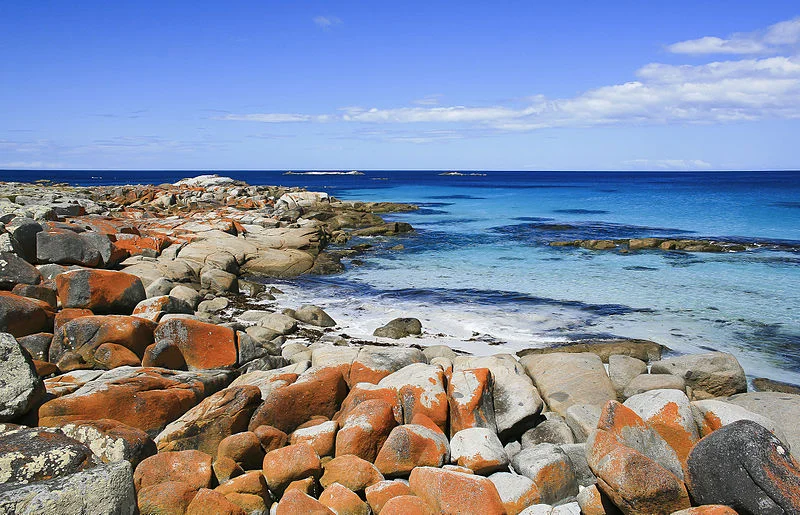
"Oh, good gigantic smile o’ the brown old earth,
This autumn morning! How he sets his bones
To bask i’ the sun, and thrusts out knees and feet
For the ripple to run over in its mirth;
Listening the while, where on the heap of stones
The white breast of the sea-lark twitters sweet.
That is the doctrine, simple, ancient, true;
Such is life’s trial, as old earth smiles and knows.
If you loved only what were worth your love,
Love were clear gain, and wholly well for you:
Make the low nature better by your throes!
Give earth yourself, go up for gain above!''
-- "Among the Rocks,'' by Robert Browning
Terry Hartle: Seeking transparency in college sexual-assault cases
Via The New England Board of Higher Education (nebhe.org)
When U.S. Education Secretary Betsy DeVos announced on Sept. 7 that her department would revisit how Title IX rules are enforced with respect to campus sexual assault, she said the first step would be a “transparent notice and comment process” to replace the 2011 “guidance” (and follow up 2014 guidance) that has been criticized for its one-size-fits-all presumption and lack of flexibility for campuses.
The U.S. Department of Education announced more details last week about how that process will work.
On Friday, Sept. 22, the department issued a “Dear Colleague” letter and Q&A documenton Title IX and sexual assault. The Dear Colleague letter rescinds the 2011 and 2014 guidance and states that the department will develop a policy that “responds to the concerns of stakeholders and that aligns with the purpose of Title IX to achieve fair access to educational benefits” through a rulemaking process. The schedule for this process is unclear.
In the interim, the department will rely on the “Q&A on Campus Sexual Misconduct,” developed using the 2001 “Revised Sexual Harassment Guide.” In some areas—such as letting colleges choose whether to use the “preponderance of evidence” or the “clear and convincing” evidentiary standard—the Trump administration is clearly making a change from current practice. In other areas, the new Q&A requires the same thing as the existing guidance. For example, the 2011 guidance and the Trump administration’s Q&A both require schools to have a title IX coordinator.
It should go without saying that schools should be very careful about altering current practices and only do so after close examination of the Q&A. And keep in mind that any changes may be temporary. The regulatory process the department intends to pursue is very likely to result in further changes in federal requirements.
But as the process for updating the Title IX campus sexual assault enforcement rules gets underway, let us not forget how notable it is that this is happening in the first place.
At one level, a regulatory process is not a big deal. The Education Department does it all the time on many issues.
Just since 2000, hundreds of higher education rules have been modified, created or eliminated.
However, the department rarely uses the regulatory process for Title IX. Indeed, OCR has gone through the formal rulemaking process just three times since initial Title IX regulations went into effect in 1975. Only two of these affected higher education. The first time involved revoking the prohibition on discrimination in the application of the codes of personal appearance in 1982. In 2000, OCR altered Title IX regulations to implement the Civil Rights Restoration Act of 1987, the so-called “Grove City” law that overturned a 1984 U.S. Supreme Court ruling that held that Title IX applied only to student financial aid, not other parts of the college that received federal dollars. The Civil Rights Restoration Act ensured that Title IV student financial aid triggered Title IX exposure for the entire school.
OCR has been more inclined to simply issue “guidance” that interprets Title IX regulations pertaining to campus sexual assault rather than pursue a formal rulemaking process. For example, the 2011 Dear Colleague Letter was developed “in house” without any suggestions from affected parties.
It is significant that the Trump administration is attaching a great deal of importance to getting the serious and complicated issue of campus sexual assault enforcement right. Promulgating regulations affecting Title IX is infrequent, hard and important. It is always a good idea to give all the parties involved an opportunity to comment and give their views on public policy.
Institutions, in responding to claims of sexual assault, have a responsibility to support the victim and to be fair to both parties. Figuring out exactly how to do that, when there may be different stories about what happened, no witnesses, and substance abuse may have been involved, can be extraordinarily difficult.
What we have had is a set of requirements, some of which are legally mandatory, others of which may or may not be mandatory. For colleges and universities the result has been uncertainty and complexity with no way to be sure in advance if they are doing the right thing. In this environment, it’s hardly surprising that schools have run afoul of OCR.
In the short run, any tweaking of campus policies or proceedings is likely to be at the margins. It is unlikely that colleges and universities will immediately change policies that they spent the last six years writing—and sometimes rewriting. And no institution will back off the commitment to prevent sexual assaults from occurring in the first place and handling cases that do occur with compassion for the survivor and fairness to both parties.
But replacing legally binding but unclear guidance with legally binding and clearregulations, and soliciting input from all sides in doing so, is a very good idea that will result in clearer regulations and, we hope, greater protections for all students.
Terry Hartle is senior vice president of government and public affairs at the American Council on Education.
Hierarchies perpetuating injustices

From Brian Gaither's show "Allegory of Justice,'' through Sept. 29 at the University of Massachusetts at Amherst's Augusta Savage Gallery. Mr. Gaither's paintings look at how hierarchies uphold social relations and perpetuate injustices.
Greg Gerritt: Menhaden -- foundational species

Atlantic menhaden.
Via ecoRI News (ecori.org)
PROVIDENCE
I went for a walk on a recent morning in one of my favorite places, on the very old path along the Seekonk River at the edge of Swan Point Cemetery, on the East Side of Providence. I have been walking there for 21 years, ever since I moved to the city. It’s called a river, but it’s really the northernmost extension of Narragansett Bay, with a dredged channel for boats heading up to Pawtucket, and a wide mudflat on the Providence side of the water.
The East Providence side is dominated by a sewage-treatment plant and an old landfill. The Providence side is one of the most majestic forests in New England, a mile along the river of steep bluff filled with 170-year-old hardwoods. Even cooler is that when the old trees fall down, they leave them there. I often sit on a log that likely fell into the water just before I moved here. It’s seriously decaying, lost all its branches a decade ago, but the trunk leaning down from the stone wall protecting the path from high tide, except in big storms, into the sea will still support me when I sit on it, on dry days. Like today.
The spring after I moved here, I saw my first Rhode Island osprey from that fallen tree, and I have even seen a small flatfish swim under me once. Later that same year, I saw my first menhaden and was amazed. For nine months I had been looking into the water every day as I walked the river and saw little life in it, but come August I saw endless streams of 3-inch fish swimming by, almost rivers of fish. I eventually learned what they were. I also started seeing menhaden in August and September downtown in the Providence, Woonasquatucket and Moshassuck rivers.
I started Friends of the Moshassuck shortly after that, as that little river surely needed friends after its 300-plus-year industrial history. I walk by almost every day. Eventually, Friends of the Moshassuck developed a video project on urban wildlife in the watershed. The focus is mostly on breeding toads and the restoration of breeding habitat a ways upstream, but come August and September, I walk along the Canal Street and South Water Street waterfront with video camera in hand, because menhaden continue to fascinate and are the one giant flash of wildlife we see each year in the city.
But I want to return us to the Seekonk River waterfront. On the morning I write of, it was 60 degrees, sunny, calm and the tide was in, lapping the stone wall. And walking along the path for the half-mile I covered, almost everywhere were very young menhaden. From 1.5 to 3 inches, with of course the majority, the great majority, being the smallest size class. A few times I saw menhaden jumping offshore, larger ones from the size of the splashes, which means they are being hunted from below. And below an osprey’s favorite perch, there were the quite stinky remnants of adult menhaden all over the place.
Between the stinky adults, the jumpers offshore, and the rivers of tiny ones below, I could only think of what else happens during menhaden season along the Seekonk River. The osprey have a nest on a platform at the Bucklin Point sewage-treatment plant. This year, for the second straight, they seem to have three youngsters, as I occasionally catch glimpses of five hunting at one time. All summer we have been seeing one or two, but come August, when the flow of menhaden is at its peak, its time to fledge the osprey chicks, and teach them to hunt. And menhaden is what they learn on, in numbers that even a beginning hunter can make a living on.
But is is not just the osprey. Cormorants are seen year-round, but during this time of year they are found in flotillas. Blue heron numbers multiply in August and September, and one seldom sees egrets except in late summer. Kingfishers are darting everywhere. Even the gulls are fishing. Gulls are not really designed to hunt mobile prey like menhaden; they scavenge and pick up stranded crabs. But this time of year you see gulls sitting on the water trying to catch little fish in the water. I have never seen a gull catch a fish, but clearly it must be a worthwhile source of food as the behavior persists, and one can only think that it works because it is directed at a prey so numerous that even a clumsy gull can catch its fill of prey that swims just below the surface eating plankton.
It was that eating of plankton that drew me to an analogy. I went to Yellowstone a few years ago, and there is one place in Yellowstone in which it is easy to see bison, the Madison River Valley. You look over the valley and there are bison everywhere. Bison need to drink pretty regularly, so they need to stay close to rivers. And then you realize that at one time, 200 years ago, there were herds of bison along almost every river in the grasslands of North America. And now there is one river valley that has a free-ranging herd and you remember what we have lost when you see what we still have.
Menhaden are the keystone species of the coastal estuaries in eastern North America. Osprey have returned since we stopped using DDT, but their continued recovery depends very much on menhaden. Eagles eat many as well, and the return of bald eagles to Rhode Island is an ongoing wonder. Three kinds of herons, egrets and kingfishers all rely upon menhaden to build up a little fat before the hard times of winter.
Seals have returned to Rhode Island, and stripped bass and bluefish make fishermen happy; they all depend upon schools of menhaden. One way you know this is true is because the schools of little ones always vastly outnumber the schools of big ones. Many die to keep the circle of life flowing.
Straying a bit from the bison analogy, we can’t afford to have menhaden in just a few places, and even more than bison, menhaden need the whole sea to do their work, to be food for all things great and small. No park could contain a school. What we have to do is protect the entire species, make sure that when people take some for our needs, that we leave enough for everything else. We must manage menhaden based on ecosystems needs, not human greed.
I strongly urge you to support menhaden management based on leaving enough in the sea for the circle of life to flow abundantly along our coasts.
Greg Gerritt is the founder/watershed steward for the Providence-based Friends of the Moshassuck.

The Seekonk River.
Don't pick me yet!

Tomato flower.
"The whiskey stink of rot has settled
in the garden, and a burst of fruit flies rises
when I touch the dying tomato plants.
Still, the claws of tiny yellow blossoms
flail in the air as I pull the vines up by the roots
and toss them in the compost.''
-- From "September Tomatoes,'' by Karina Borowicz
Don Pesci: Ah, those political friendships....
Political friendships, as we all know, are not usually long-lived. They usually end when the political clock runs out and the favored politician, putting active politics behind him or herself, enters into history.
Hillary Clinton's time as an active politician – one who may run for public office again – is over; so at least she says. Her political friends, attentive while she was an active politician – a first lady, a senator from New York, a secretary of state in the Obama administration -- will now recede into the background.
Political friendships are temporary at best. Those politicians who prefer public adulation to the adulation of their wives and children, are trading permanent friendships for part-time working relationships; for that is what a successful marriage is – a permanent friendship, more reliable and steadfast than the affections of lobbyists or partisan political comrades.
There is a quip obliquely attributed to President Harry Truman: “If you want a friend in Washington, get a dog.” Active politicians do not find it necessary to keep up friendships with politicians who have left the public stage. The political sandbox in Washington is forever changing. In DC, politicians come and go, speaking of Michelangelo. They write their memoirs, take up hobbies and, if they are former presidents, busy themselves with their libraries and try their best not to be underfoot. As has-beens, they become politically invisible.
When one-term former Connecticut Gov. Lowell Weicker retired from politics, after having hung an income tax, like a hangman’s noose, around Connecticut’s neck, there were no knocks on his door, and his phone didn’t ring. Occasionally, a journalist would call to ask a pointed political question, usually about budgets, deficits, or politically active Republicans. On this last point, all Republicans fell short in Weicker’s estimation, pock-marked as they were by conservativism. In any case, the redundantly rich Weicker was out of the stream, loitering on a far bank, perhaps reading the poetry of Hilaire Belloc, whose advice to the rich was: “Get to know something about the internal combustion engine, and remember – soon, you will die,” a dollop of humility that few active politicians are willing to swallow.
Die at some point we all will. But politicians die twice: once when they leave active politics behind them, and again when they shuck off their mortal coil.
The most certain indication that Hillary Clinton, permanently retired from active politics, has lost political luster is U.S. Sen. Dick Blumenthal’s sharp, cold-shoulder swipe.
Due to appear at two venues in Connecticut to peddle her newest book, What Happened. Blumenthal, a fast friend of the Clinton’s since their days together at Yale Law School, commented, “The majority of Connecticut voters supported her,” including, it should be noted, Blumenthal, whose support at the time seemed warm and genuine.
Would Blumenthal then attend the book signing? The response to this question had icicles hanging from its eves. According to an account in the Connecticut Post, "Blumenthal said he hasn’t read Clinton’s book and doesn’t have plans to attend either signing, however. ‘I’m not her agent,’ he said.” Here we glimpse the flower cast by an active politician on the soon to be buried casket of a dearly departed former friend.
Since Hillary Clinton lost the presidential election to Donald Trump, Blumenthal has pledged his troth to socialist Bernie Sanders of the People’s Republic of Vermont. Supporting universal health care – AKA socialized medicine – however devastating government supported health care might be to insurance jobs in Connecticut, once known as the insurance capital of the world, Blumenthal announced dramatically which side his progressive bread was buttered on, and he meant to brashly announce his solidarity with the progressive wing of the Democratic Party. What better way to do it than by trumpeting socialized medicine?
Socializing healthcare in the United States would involve moving from the private market to a government run market about 18 percent of the country’s gross domestic product (GDP). The transference would devastate the private health insurance employment market in Connecticut, because insurance companies would no longer be able to compete on “a level playing field” – an expression often employed by Blumenthal in different contexts – with monopolistic, ta -supported, socialized medicine.
In essence, the former private health-insurance market would become a boutique enterprise, much reduced, selling more expensive and more comprehensive plans to a limited market comprised of rich people such as Blumenthal. U. S. senators wisely avail themselves of federal retirement plans and Thrift Saving Plans that together offer far superior benefits than their constituents enjoy in a private marketplace; and of course they much prefer private insurance to Obamacare, viewed by many as a baby step on the way to a universal healthcare system. Rarely do congressmen include themselves as beneficiaries of the redistribution schemes that pour off their drawing boards.
The last thing that federal legislators such as Blumenthal want is a level playing field that would put them in the same game as the constituents they intend to help. When the authors of The Federalist Papers assured their countrymen that legislators in a functioning republic would not likely pass laws that would adversely affect themselves, they were yet unaware of the socialistic strategies of the Machiavellian legislators of our day.
Don Pesci is a veteran Vernon, Conn.-based columnist.
A town on 'uncouth' ledges
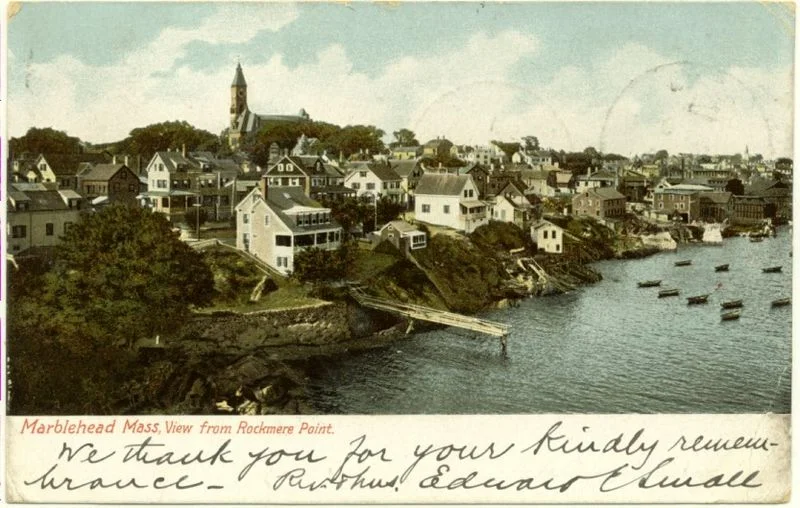
Marblehead in a 1905 postcard.
"They have covered a bare and uncouth cluster of gray ledges with houses, and called it Marblehead {Mass.} These ledges stick out everywhere; there is not enough soil to cover them decently. The original gullies intersecting these ledges were turned into thoroughfares, which meander about after a most lawless and inscrutable fashion...We expect to see sailors in pigtails, citizens in periwigs. and women in kerchiefs and hobnail shoes, all speaking in an unintelligible jargon.''
-- Samuel Drake, writing in A Book of New England Legends and Folk Lore (1872)
A big museum in a little town
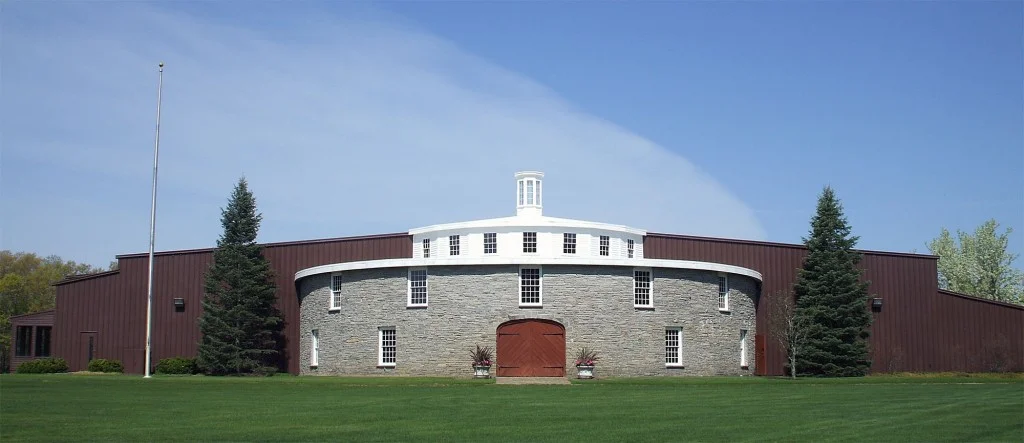
The American Heritage Museum, in Stow, Mass.
The Worcester Business Journal reports that the Collings Foundation has been buildingits 65,000-square-foot American Heritage Museum, in tiny, rich, exurban Stow, Mass. (The neighbors in the residential neighborhood are not particularly pleased.)
The museum will have exhibits from America’s wars. These are said to include 12 warplanes; the largest U.S. private collection of military vehicles – 115 of them -- a life-size replica of a World War I trench and special effects that “re-create sights, sounds, and smells of war (i.e. ‘trench stench’)’’; a theater; classrooms; interactive exhibits, and such other artifacts as a Revolutionary War cannon, a 1917 American tank and a Scud-B missile from Desert Storm. Yikes! But no nuclear bombs yet.
It’s been increasingly said that there are too many museums competing for too many visitors. Perhaps this one will prosper, especially if it can partner with enough news media, documentary filmmakers and school, although the associated crowds won’t please the residents of mostly tranquil Stow. People enjoy entertainments based on wars, if not wanting to actually be in one.
There’s an International Museum of World War II in Natick, Mass., by the way.
To read the Worcester Business Journal article, please hit this link.
The maid will clean up this
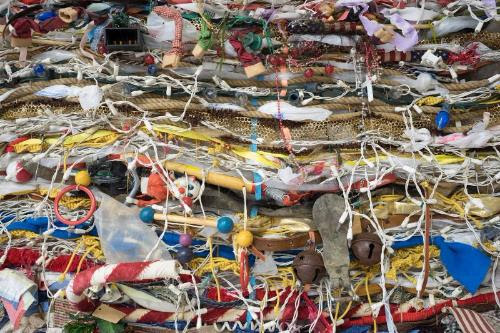
Work by Woomin KIm in her show "Urban Nest: Work by Woomin KIm,'' at Maud Morgan Arts Chandler Gallery. Cambridge, Mass., through Oct 27. Her work, recalling the old line that "one man's trash is another's treasure,'' uses a wide range of materials, including glass from broken bottles, assorted fibers and hair extensions.
The old Garden's challenges
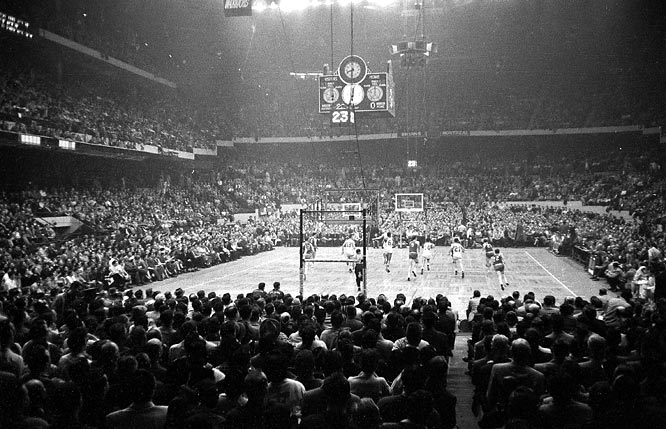
The old Boston Garden.
"The old Boston Garden seats, some of which were placed here, were, as we remembered not much fun to sit in. The museum displays a sense of humor, by placing one seat behind a pole, symbolizing the 1,895 such seats.''
-- Jim Sullivan, writing on the Sports Museum of New England ,in the April 11, 2002 Boston Globe.
'I miss me too'
When people say they miss me,
I think how much I miss me too,
Me, the old me, the great me,
Lover of three women in one day,
Modest me, the best me, friend
To waiters and bartenders, hearty
Laugher and name rememberer,
Proud me, handsome and hirsute
In soccer shoes and shorts
On the ball fields behind MIT,
-- From "Days of Me,'' by Stuart Dischell