
Vox clamantis in deserto





Don't pick me yet!

Tomato flower.
"The whiskey stink of rot has settled
in the garden, and a burst of fruit flies rises
when I touch the dying tomato plants.
Still, the claws of tiny yellow blossoms
flail in the air as I pull the vines up by the roots
and toss them in the compost.''
-- From "September Tomatoes,'' by Karina Borowicz
Don Pesci: Ah, those political friendships....
Political friendships, as we all know, are not usually long-lived. They usually end when the political clock runs out and the favored politician, putting active politics behind him or herself, enters into history.
Hillary Clinton's time as an active politician – one who may run for public office again – is over; so at least she says. Her political friends, attentive while she was an active politician – a first lady, a senator from New York, a secretary of state in the Obama administration -- will now recede into the background.
Political friendships are temporary at best. Those politicians who prefer public adulation to the adulation of their wives and children, are trading permanent friendships for part-time working relationships; for that is what a successful marriage is – a permanent friendship, more reliable and steadfast than the affections of lobbyists or partisan political comrades.
There is a quip obliquely attributed to President Harry Truman: “If you want a friend in Washington, get a dog.” Active politicians do not find it necessary to keep up friendships with politicians who have left the public stage. The political sandbox in Washington is forever changing. In DC, politicians come and go, speaking of Michelangelo. They write their memoirs, take up hobbies and, if they are former presidents, busy themselves with their libraries and try their best not to be underfoot. As has-beens, they become politically invisible.
When one-term former Connecticut Gov. Lowell Weicker retired from politics, after having hung an income tax, like a hangman’s noose, around Connecticut’s neck, there were no knocks on his door, and his phone didn’t ring. Occasionally, a journalist would call to ask a pointed political question, usually about budgets, deficits, or politically active Republicans. On this last point, all Republicans fell short in Weicker’s estimation, pock-marked as they were by conservativism. In any case, the redundantly rich Weicker was out of the stream, loitering on a far bank, perhaps reading the poetry of Hilaire Belloc, whose advice to the rich was: “Get to know something about the internal combustion engine, and remember – soon, you will die,” a dollop of humility that few active politicians are willing to swallow.
Die at some point we all will. But politicians die twice: once when they leave active politics behind them, and again when they shuck off their mortal coil.
The most certain indication that Hillary Clinton, permanently retired from active politics, has lost political luster is U.S. Sen. Dick Blumenthal’s sharp, cold-shoulder swipe.
Due to appear at two venues in Connecticut to peddle her newest book, What Happened. Blumenthal, a fast friend of the Clinton’s since their days together at Yale Law School, commented, “The majority of Connecticut voters supported her,” including, it should be noted, Blumenthal, whose support at the time seemed warm and genuine.
Would Blumenthal then attend the book signing? The response to this question had icicles hanging from its eves. According to an account in the Connecticut Post, "Blumenthal said he hasn’t read Clinton’s book and doesn’t have plans to attend either signing, however. ‘I’m not her agent,’ he said.” Here we glimpse the flower cast by an active politician on the soon to be buried casket of a dearly departed former friend.
Since Hillary Clinton lost the presidential election to Donald Trump, Blumenthal has pledged his troth to socialist Bernie Sanders of the People’s Republic of Vermont. Supporting universal health care – AKA socialized medicine – however devastating government supported health care might be to insurance jobs in Connecticut, once known as the insurance capital of the world, Blumenthal announced dramatically which side his progressive bread was buttered on, and he meant to brashly announce his solidarity with the progressive wing of the Democratic Party. What better way to do it than by trumpeting socialized medicine?
Socializing healthcare in the United States would involve moving from the private market to a government run market about 18 percent of the country’s gross domestic product (GDP). The transference would devastate the private health insurance employment market in Connecticut, because insurance companies would no longer be able to compete on “a level playing field” – an expression often employed by Blumenthal in different contexts – with monopolistic, ta -supported, socialized medicine.
In essence, the former private health-insurance market would become a boutique enterprise, much reduced, selling more expensive and more comprehensive plans to a limited market comprised of rich people such as Blumenthal. U. S. senators wisely avail themselves of federal retirement plans and Thrift Saving Plans that together offer far superior benefits than their constituents enjoy in a private marketplace; and of course they much prefer private insurance to Obamacare, viewed by many as a baby step on the way to a universal healthcare system. Rarely do congressmen include themselves as beneficiaries of the redistribution schemes that pour off their drawing boards.
The last thing that federal legislators such as Blumenthal want is a level playing field that would put them in the same game as the constituents they intend to help. When the authors of The Federalist Papers assured their countrymen that legislators in a functioning republic would not likely pass laws that would adversely affect themselves, they were yet unaware of the socialistic strategies of the Machiavellian legislators of our day.
Don Pesci is a veteran Vernon, Conn.-based columnist.
A town on 'uncouth' ledges
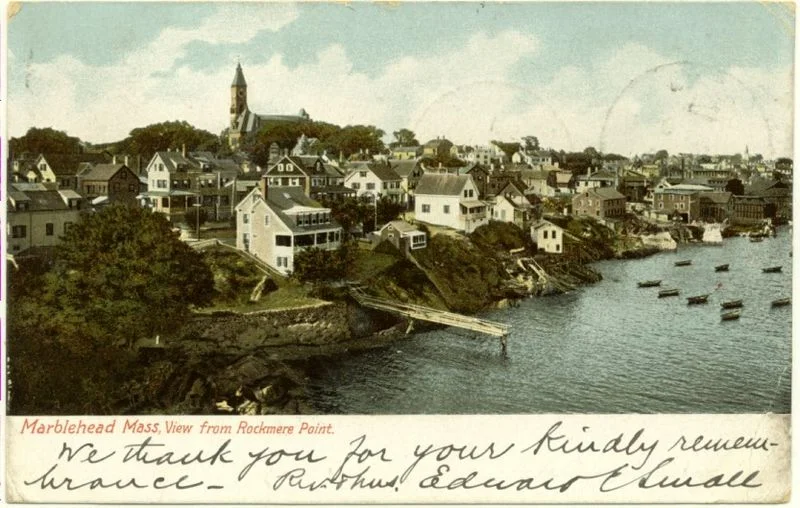
Marblehead in a 1905 postcard.
"They have covered a bare and uncouth cluster of gray ledges with houses, and called it Marblehead {Mass.} These ledges stick out everywhere; there is not enough soil to cover them decently. The original gullies intersecting these ledges were turned into thoroughfares, which meander about after a most lawless and inscrutable fashion...We expect to see sailors in pigtails, citizens in periwigs. and women in kerchiefs and hobnail shoes, all speaking in an unintelligible jargon.''
-- Samuel Drake, writing in A Book of New England Legends and Folk Lore (1872)
A big museum in a little town

The American Heritage Museum, in Stow, Mass.
The Worcester Business Journal reports that the Collings Foundation has been buildingits 65,000-square-foot American Heritage Museum, in tiny, rich, exurban Stow, Mass. (The neighbors in the residential neighborhood are not particularly pleased.)
The museum will have exhibits from America’s wars. These are said to include 12 warplanes; the largest U.S. private collection of military vehicles – 115 of them -- a life-size replica of a World War I trench and special effects that “re-create sights, sounds, and smells of war (i.e. ‘trench stench’)’’; a theater; classrooms; interactive exhibits, and such other artifacts as a Revolutionary War cannon, a 1917 American tank and a Scud-B missile from Desert Storm. Yikes! But no nuclear bombs yet.
It’s been increasingly said that there are too many museums competing for too many visitors. Perhaps this one will prosper, especially if it can partner with enough news media, documentary filmmakers and school, although the associated crowds won’t please the residents of mostly tranquil Stow. People enjoy entertainments based on wars, if not wanting to actually be in one.
There’s an International Museum of World War II in Natick, Mass., by the way.
To read the Worcester Business Journal article, please hit this link.
The maid will clean up this
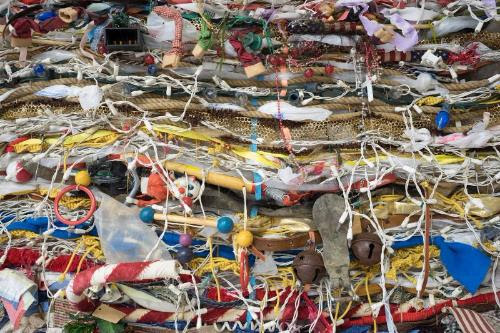
Work by Woomin KIm in her show "Urban Nest: Work by Woomin KIm,'' at Maud Morgan Arts Chandler Gallery. Cambridge, Mass., through Oct 27. Her work, recalling the old line that "one man's trash is another's treasure,'' uses a wide range of materials, including glass from broken bottles, assorted fibers and hair extensions.
The old Garden's challenges

The old Boston Garden.
"The old Boston Garden seats, some of which were placed here, were, as we remembered not much fun to sit in. The museum displays a sense of humor, by placing one seat behind a pole, symbolizing the 1,895 such seats.''
-- Jim Sullivan, writing on the Sports Museum of New England ,in the April 11, 2002 Boston Globe.
'I miss me too'
When people say they miss me,
I think how much I miss me too,
Me, the old me, the great me,
Lover of three women in one day,
Modest me, the best me, friend
To waiters and bartenders, hearty
Laugher and name rememberer,
Proud me, handsome and hirsute
In soccer shoes and shorts
On the ball fields behind MIT,
-- From "Days of Me,'' by Stuart Dischell
I'm feeling confused

By Don Doe, from the group show "Saints, Sinners and the Collective Unconscious,'' at the University of Massachusetts at Amherst Fine Arts/Center/Hampden Gallery.
Past time for go after sleazy Equifax, et al.
From Robert Whitcomb's "Digital Diary,'' on GoLocal24.com:
Credit-rating companies’ neglect of adequate cybersecurity obligations is well known. Thus the catastrophic hacking into the personal data of 150 million Americans at Equifax – including, God help us, Social Security numbers! – wasn’t a total surprise, as outrageous as it was. Taking the expensive actions necessary to improve security at least enough to prevent a hack of this magnitude might cut the companies’ quarterly earnings and stock price. That would be unacceptable to their grossly overpaid senior executives. Now, of course, the future of this far too powerful and arrogant enterprise may be in doubt.
Energetic lobbying by these companies has ensured that they pay a small price for presiding over an environment in which their customers’ economic lives can be ruined. Proposed regulations mandating much tougher cybersecurity provisions and punishment for breaches have been blocked.
And laws must be changed to hold data-product companies, such as Equifax, liable, via lawsuits, for the damage that their negligence (and worse) does to the public, just as are companies that sell physical things. At the same time, GOP efforts to kill the Consumer Financial Protection Bureau should be stopped. With too-powerful credit-rating agencies and corrupt banks such as Well Fargo, consumers need all the champions they can find.
Of course, we know that everything is hackable. There is no final security in cyberspace, and it’s an increasingly nasty place, in which we’re trapped. But many American companies make hacking remarkably easy because they don’t want to spend the money to reduce it.
In any event, “Everything is going to be hacked eventually. That’s just the way it goes,” Russell Vines, a cybersecurity expert at Consumers Union, told The Washington Post. “So everyone has to make provisions for what happens after.”
That means, of course, such measures as changing passwords and combing through credit-card bill and bank statements – for as long as you live.
The convenience of online activities and companies’ relentless campaigns to make you put as much of your life as technologically possible in cyberspace so that the firms can lay off more employees has left us all in swamps teeming with criminals. But you can cut your chances of being hacked and stolen from by reducing your online financial activities as much as possible. For example, online banking is a menace. Keep it to minimum. Stick to paper as much as you can.
Meanwhile, the Feds and businesses need to come up with ways to reduce the very dangerous reliance on Social Security numbers as primary identification. Consider that these numbers are connected to jobs, taxes, loans, government benefits and security clearances. We need alternate forms of identification. It’s getting urgent.
Equifax isa truly sleazy operation. (Try calling them, by the way.) They discovered the hack on July 29 but didn’t deign to tell the world until Sept. 8. Why? Well, it’s interesting to learn that three Equifax execs sold $2 million of Equifax stock right after the company discovered the breach in July. The execs denied that they knew about the breach.
Given the high-level of the execs that’s very hard to believe. The officers are:
Chief financial officer John Gamble; president of U.S. information solutions Joseph Loughran, and president of workforce solutions Rodolfo Plode.
Llewellyn King: TV talking heads rarely include the main human subjects of the shows
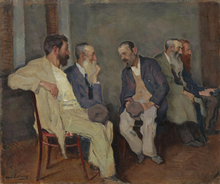
"The Conversation,'' by Arnold Lakhovsky (circa 1935).
Guess you’ve noticed: There are no politicians on the politics-obsessed cable news channels. Instead, there are journalists talking about politicians and politics; rafts of journalists organized into “panels” to comment, in seconds, on events.
Twenty years ago, it was different. So much so that I started a television program with the avowed intention of letting the public see who was writing the political news in the newspapers. We are still on the air, but with fewer journalists commenting.
In that seemingly distant time (which was, in reality, not very long ago), the principal political talk shows were The McLaughlin Group, under the pioneering John McLaughlin; Inside Washington, formerly Agronsky & Company, with Gordon Peterson, and the long-lived Washington Week in Review, with Ken Bode.
They were weekly, half-hour programs and mine, White House Chronicle, joined the roster as a distant “also ran.” We aimed at introducing print journalists to a TV audience. Other programs had set round tables that included Tribune Media’s Clarence Page, because he was a delight to work with — as we found on our program — and because he was informed and entertaining.
Women were fewer and they were led by Elizabeth Drew, of The New Yorker, Eleanor Clift,of Newsweek, Cokie Roberts of NPR, and syndicated columnist Georgie Anne Geyer.
Cable news meant CNN, then still trying to be magisterial.
Fast forward and television is chock-full of journalists talking about the news in what is now a staple of cable television; and rather than occupying half an hour a week these “panels,” as the hosts call them, are on pretty well 24/7.
The New York Times publishes under the slogan “All the News That’s Fit to Print.” On television, it’s all the news that can be talked about — and they do, endlessly. I think that is pretty entertaining and most of the talking heads seem to have really good sources; they are on the news — all the politics that can be talked about. It is the fat and sugar diet of TV.
What is missing are the subjects. Few members of Congress, with the exception of the leaders, are seen or talked about by name on television. They have been cleared from the television politics smorgasbord. Even the talking heads do not name them. The ubiquitous panelists talk about “my sources” or “a conservative congressman” or “a Democratic member.” No names. No faces.
There are reasons aplenty for this. One, now that there is more party discipline, except for a few people such as Sen. John McCain ( R-Ariz.), it is known what the party line will be: It is there in the talking points — and that makes for little news and boring television.
Another is that while journalists go for instant analysis, a cable television staple, politicians are scared of “stepping in it.” Search technology is so fearsome now that almost anything any politician says can be retrieved and put on the screen. That is fodder for future “gotcha” moments. The late Tim Russert, of Meet the Press, was a master of this. “In 2003, you said” and there it was, right on the screen, the politico making a regrettable remark.
Also, there is always the question of what the public wants (ratings to the TV industry). The public appears to be more interested in journalists debunking political leaders than the nuts and bolts of legislation or even what is happening in, say, science or the rest of the world. Salt and fat gets the eyeballs.
The late Arnaud de Borchgrave lamented that in his day, aspiring reporters longed to be foreign correspondents, now they yearn to cover Capitol Hill and the White House. Ralph Nader — who was once a prized “get” in the parlance of television bookers — has just issued a paper regretting the dominance of political chatter in the news space. Maybe he will be asked to talk about it on television, but it is unlikely.
On the upside, there are some awesome new talents, and more women in the Washington journalistic firmament — even if some of us like it when journalists, in the words of radio veteran Dan Raviv, just set out to “find out what’s happening and tell people.” No salt, no fat, just the facts.
Llewellyn King (llewellynking1@gmail.com), a veteran publisher, columnist and international business consultant, is host of White House Chronicle, on PBS. This piece first ran in Inside Sources.

Chris Powell: In Conn., another self-funding rich Republican ignoramus running for governor
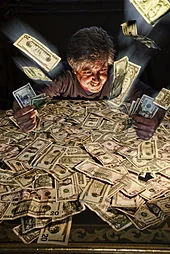
"Avarice,' by Jesus Solana.
David Stemerman, 48, of Greenwich, a successful investment fund manager, announced the other day that he is closing his fund and planning to become a candidate for the Republican nomination for governor of Connecticut.
Those who hope for change in state government's direction may be forgiven for thinking: not again. For Connecticut's minority party has an unfortunate habit of giving major nominations to candidates whose main qualification seems to be just their having enough money to finance their own campaigns.
Now that Connecticut's program of government financing of campaigns for state office is in doubt because of the state budget mess, a candidate's ability to finance his own campaign may seem more important to Republicans, especially since their legislators, considering it an extravagance, are the ones who want to do away with the Citizens' Election Program. But from multimillionaire Brook Johnson's campaign for U.S. senator in 1992 to multimillionaire Linda McMahon's campaigns for U.S. senator in 2010 and 2012 to multimillionaire Tom Foley's campaigns for governor in 2010 and 2014, Connecticut's Republican Party has failed, even when political circumstances were highly favorable.
As it turned out, campaign money wasn't nearly enough. Candidates also need a record in Connecticut's public life and some knowledge of the state and its government, and those self-funding Republican candidates didn't have it. Worse, they didn't care to learn, and it showed embarrassingly.
In a letter to his fund's investors disclosing his political ambition, Stemerman tried to take the edge off his wealth. "I am deeply concerned that a small number of people in our state are thriving while many are struggling to make ends meet," he wrote. He also tried to make a virtue of his political inexperience: "I do not claim to have all the answers, but as an outsider with a fresh perspective, I believe that I can bring a different approach."
"All" the answers? Even one might be nice.
Of course, someone without a record in the state's public life has as much right as anyone else to run for governor and may have valuable insights. But since Stemerman has no record, only a lot of money, Republicans and others who want political change in Connecticut should be concerned about what may be discovered about him by the opposition shortly before the election. That sort of thing badly damaged the candidacies of McMahon and Foley.
The Republicans already have a few potential candidates for governor who, while possessing no special wealth, at least have records and an idea of the state's problems. Whether they have the courage to speak about these problems as the state's sad circumstances require remains to be seen, but in any case the worst disaster that could befall Connecticut next year would be another self-funding ignoramus.
xxx
PUERTO RICANS LONG HAVE BEEN CITIZENS: Since many Connecticut residents are from Puerto Rico or have family there, the damage done to the island by the recent terrible hurricanes has been big news here. But it would be nice if journalists interviewing local Puerto Ricans stopped saying that so-and-so "came to the United States from the island," as if today's Puerto Ricans are or ever were foreigners.
They're not. They're Americans. The United States seized Puerto Rico during the Spanish-American War and federal law conferred citizenship on Puerto Ricans in 1917, if only because Congress wanted to make more men eligible for the military draft in World War I.
Chris Powell is managing editor of the Journal Inquirer in Manchester, Conn.
Coming up at the PCFR: War with China? Refugees on Lesbos; Selling out U.S. tech
Coming up at the Providence Committee on Foreign Relations (thepcfr.org; pcfremail@gmail.com):
On Wednesday, Oct. 11, comes Graham Allison, who will talk about, among other things, Chinese expansionism in the South China Sea. He'll discuss his new book Destined for War: Can America and China Escape Thucydides's Trap?
Graham Allison was director of Harvard's Belfer Center for Science and International Affairs from 1995 until July 2017. Allison is a leading analyst of U.S. national security and defense policy, with a special interest in nuclear weapons, terrorism and decision-making.
On Wednesday Nov. 15, comes prize-winning journalist Maria Karagianis, who will talk about the refugee crisis on the Greek island of Lesbos.
In May 2015, she traveled to Lesbos, which is within sight of Turkey. At that time, hundreds of thousands of refugees were spilling onto the beaches in leaky boats, many of them dying, trying to find freedom from war-torn Syria. The Greek people of the island, who have been nominated for a Nobel Peace Prize for their generosity, are now facing an economic catastrophe with tourism, their main source of income, which is now destroyed. She is currently a Woodrow Wilson visiting fellow and has traveled across the United States speaking at colleges and universities. She is a former guest editor and award-winning writer on the editorial board of The Boston Globe..
On Wednesday, Jan. 27, comes Victoria Bruce, who will talk about China's near monopoly of rare-earth elements.
She is the author of Sellout: How Washington Gave Away America's Technological Soul, and One Man's Fight to Bring It Home. This is about, among other things, China’s monopolization of rare earths, which are essential in electronics.
Victoria Bruce holds a master's degree in geology from the University of California, Riverside, where she researched the chemistry of volcanic hazards on Mount Rainer in Washington State. She has directed and produced four documentary films, earning the Alfred I. duPont-Columbia University Award for excellence in broadcast journalism for her film, The Kidnapping of Ingrid Betancourt. She also received the Duke University Human Rights Book Award for Hostage Nation.
On Wednesday, Feb. 21, comes Dan Strechay, who will talk about the environmental and socio-economical effects of the vast palm-oil agribusiness.
He is the U.S. representative for outreach and engagement at the Roundtable on Sustainable Palm Oil (RSPO). He'll discuss, among other things, the massive deforestation associated with producing palm oil in the Developing World and what to do about it. Prior to joining the RSPO, he was the senior manager for Sustainability Communications for PepsiCo.
Mass. creates a wilderness

The Quabbin Reservoir.
"In front of me stretched the water of the Quabbin (Reservoir}. It was for this water that the Swift River Valley {of central Massachusetts} was flooded. It was because of this water that the wilderness, with its eagles and its extensive woodlands and abandoned cellar holes, exists in the Quabbin region.''
-- From Quabbin: The Accidental Wilderness, by Thomas Conuel
Come into my catacomb

A photo from the show "Recent Photography by Ron Rosenstock,'' at the Hopkinton Center for the Arts, Hopkinton, Mass., through Ot. 26.The show's photographs, all black and white, are of complex forms, large in scope and rich in detail, both natural and manmade. The gallery says that the images, although disorienting in their large scale, are also beautiful and peaceful.

'Undifferentiated life forms' in Conn.

From Robert Whitcomb's "Digital Diary,'' in GoLocal24.com:
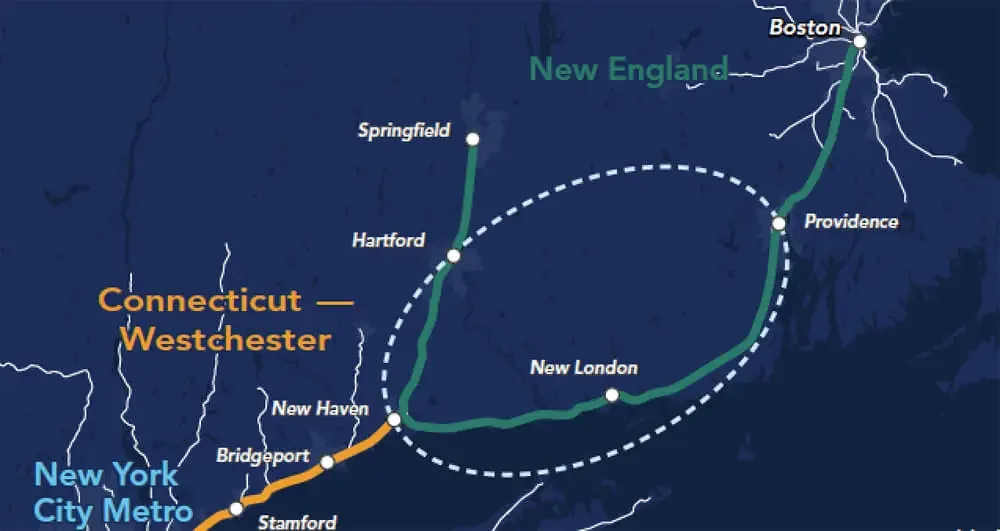
In an orgasm of political correctness and, well, silliness, Metro-North, thepublicly owned commuter railroad that serves southwestern Connecticut and thelower Hudson Valley, announced that it will no longer note a purchaser's gender identification on month-long train tickets.
The railroad said that it had used such identification to make it more difficult for riders to let others use their monthly passes. Makes sense! And one would think that police seeking suspects on trains or in train station might, from time to time, like to know the sex of suspects they seek. Gender-identifying tickets could help.
But Connecticut Gov. Dannel Malloy opined. "We should not be using antiquated gender norms as a method of personal identification.’’
The wonderful Chris Powell, managing editor ofthe Manchester (Conn.) Journal Inquirer asked:
“{H}ow can the governor be sure that there are no longer any circumstances in which it is useful to distinguish male from female? While the governor seems to think that the right of anyone to assume either gender at any time trumps the right of sexual privacy in bathrooms, he strangely has not yet insisted on erasing the divisions between boys and girls and men's and women's sports. ‘’
“But even if the governor really thinks that gender norms are ‘antiquated,’ there's not enough time left in his term for him both to run Connecticut's creaky old government and to persuade the rest of the world that there are no longer boys and girls and men and women, just undifferentiated life forms.’’
'Comely thing'

"Know'st thou not at the fall of the leaf
How the heart feels a languid grief
Laid on it for a covering,
And how sleep seems a goodly thing
In Autumn at the fall of the leaf?
And how the swift beat of the brain
Falters because it is in vain,
In Autumn at the fall of the leaf
Knowest thou not? and how the chief
Of joys seems—not to suffer pain?
Know'st thou not at the fall of the leaf
How the soul feels like a dried sheaf
Bound up at length for harvesting,
And how death seems a comely thing
In Autumn at the fall of the leaf? ''
-- "Autumn Fall,'' by Dante Gabriel Rossetti
Amy Hahn: A primer on the risks of green energy

From The New England Journal of Higher Education, part of The New England Board of Higher Education (nbehe.org)
It is difficult to travel on any road today without seeing solar panels on the rooftops of houses, larger solar farms across vast fields or wind turbines in the distance. With larger initiatives to create more environmentally sustainable energy and reduce carbon footprint, many universities are reviewing their options for alternative energy sources.
Three of the most common types of alternative energy solutions being installed today are solar panels, wind turbines and cogeneration plants. Ensuring that these efforts to “go green” have long-term success requires an understanding of possible risks and how best to manage them.
A primer:
Solar (photovoltaic) panels
Solar panels convert sunlight to electricity. The individual panels comprise multiple photovoltaic cells. Typically, the panels will be installed as part of a solar array, either on a roof or mounted in a field. Solar is one of the fastest-growing segments in renewable energy and it’s easy to see why. With low maintenance costs and high reliability, solar panels can lower overall electricity costs and add some independence from the electrical grid and its peak prices.
But the addition of solar arrays does carry some potential risk that needs to be taken into account, including:
Roof penetrations can lead to leaks
For wind load requirements, ballasted assemblies should be used, rather than mechanical attachments
For snow load, the weight of panels plus ballasted securement requires structural analysis
Electrical hazards because solar panels are “always on” and need a way to be isolated from the inverter system
Fire hazards can be of higher risk with solar panels and conduit located on a rubber membrane roof covering
Hail damage to the solar panels.
In addition to these specific hazard considerations, it’s important to understand who will be financially responsible for the array. In most cases, arrays tend to be owned by a third party, which can complicate risk mitigation and damage repair efforts. Be sure that this is decided on and understood early on.
Wind turbines
Wind turbines convert kinetic wind energy into electricity, using this to turn the blades of a rotor that is connected to a main shaft, which then spins a generator to create current. Along with solar, wind is a rapidly growing option and one of the most visible of the green-energy sources. Like solar, it has some key benefits, including the use of a free, abundant resource (wind) to create the electricity, as well as relatively low operational costs. Like solar, wind also has risks that should be factored into planning, installation and operation, including:
Noise from the whirring of the rotors, especially at large scale, can be quite disruptive
When equipment breaks down, replacement parts are expensive and lead times are long
Catastrophic failures can present projectile dangers (i.e., blades) to humans and buildings
Installation risks including falls, confined space, fire, electrical hazards, machine guarding, arc flash and elevation leave workers vulnerable to injury
Projects can take as long as two years to complete.
Cogeneration
Cogeneration systems are so-named because they produce both heat and power. The excess thermal energy produced in the production of electricity is captured and used for heating buildings or water, or even for powering absorption refrigeration to provide building cooling. As with both solar and wind, cogeneration can provide a measure of grid independence and insulation against price spikes and outages, and—in many areas—provide an income stream from excess energy sold back to the utility.
Like the systems themselves, the downsides of cogeneration can be a bit more complex. They include:
Substantial initial investment in equipment, construction and building upgrades
Complex systems requiring experienced operators and mechanics
Presence of pressurized oil lines near heat sources.
Ensure early, open and regular communication between risk management and the design teams
Involve your insurance broker and carrier early in the process to gain a full understanding of potential insurance implications of the project
As with any project, follow a general construction guide that includes risk management and insurance company involvement
Obtain credentials, licensing and insurance certificates for all contractors involved. Ensure the contractor is experienced and reputable. This applies to both installation and subsequent third-party operation
Obtain proper warranty documentation for any new equipment.
As technologies have matured, environmental concerns have grown and, where other fuels have become more unpredictable in cost, going green has gained real momentum. So, bringing some form of renewable energy to campus is likely a question not of “if” but of “how.” Risk is real, but with foresight, planning and insurance, it can be easy—and beneficial—to be green.
Amy Hahn is a lost-control engineer and certified fire-protection specialist at Risk Strategies Company, which is based in Boston.
David Warsh: A little-reported visit by the Russians
SOMERVILLE, Mass.
The story raised eyebrows in my circles. Vladimir Putin had dispatched one of his diplomats to the State Department in April to deliver a bold proposal: an across-the-board re-normalization of the many channels that had been severed after Moscow’s military interventions in Ukraine and Syria — diplomatic, military and intelligence.
“The broad scope of the Kremlin’s reset plan came with an ambitious launch date,” wrote John Hudson, a foreign-affairs reporter for Buzzfeed: “immediately.” In early May, President Trump received Russia's foreign minister, Sergei Lavrov, and its ambassador to the U.S.,, Sergey Kislyak, at the White House. The earlier overture remained secret until last week.
Johnson’s Russia List, the most widely read agglomerater of news about Russia, circulated Hudson’s story. Putin’s press secretary confirmed the authenticity of the offer at a news conference in Moscow. The White House and the State Department acknowledged the offer had been received but declined to tell Hudson who had delivered the offer.
The WSJ had replicated the story and advanced it the next day: "Moscow Acknowledges Effort to Woo Donald Trump’s Administration''. For the next four days, The New York Times and The Washington Post gave Hudson’s scoop a good leaving-alone.
Instead, The Times continued reporting on its discovery of “a cyberarmy of bloggers posing as Americans and spreading propaganda and disinformation about an American electorate on Facebook, Twitter and other programs.” It front-paged a dispatch on Russian military exercises: “With War Games, Russia Creates a Fake Enemy, but Real Alarm.” And it reported that the U.S. banned the use of Russian-made Kaspersky software on computers of federal agencies.
The story seem likely to appear eventually, but two things already seem clear
Putin thoroughly misunderstood the political situation in the United States as of April, when he made its offer.
The editors of the The New York Times, have a great deal of explaining to do. Editors are curators of narratives. They are entitled to mull over the meaning of Hudson’s story. But they also obligated to report news when it breaks. Much is to be learned from the lags.
. xxx
Another report likely to be in the news for months to come appeared this week. “Are Ideas Getting Harder to Find?” published as a working paper by the National Bureau of Economic Research. Authors Nicholas Bloom, Charles I. Jones, Michael Webb, all of Stanford University; and John van Reenen, of MIT, answer unequivocally in the affirmative.
“Across a broad range of case studies we find that [new] ideas — and in particular the exponential growth they imply — are getting harder and harder to find.”
Among the case studies were Moore’s Law, or computer performance per watt of electricity; agricultural crop yields; and mortality and life expectancy and the productivity of medical research.
Economic Principals is traveling and unable to pursue either story right now. Expect more in due course.
David Warsh, a veteran economic and political columnist and an economic historian, is proprietor of Greater Boston-based economicprincipals.com, where this essay first ran.
'Ripe brown body'

Ragweed.
"{W}we had to conclude that something in the September combination of waning sun and increased humidity released vapors a stronger sun or an earth more parched would have beaten down or imprisoned and that the fragrance was indeed a distillation of all the things it suggested --- of the late flowers in the meadows and the low, matted tangle of the half-rotted undergrowth, of the turning grape and of the falling apple and of the ragweed and the breath of the trees and the September rose and of the ripe brown body of Autumn herself.''
-- From In Praise of Seasons, by the late Alan J, Olmstead, a Connecticut newspaper editor and an essayist.
New Hampshire's first great industry

"For more than a century, the big business of Gravesend was lumber, which was the first big business of New Hampshire. Although New Hampshire is called the Granite State, granite -- building granite, curbstone granite, tombstone granite -- came after lumber; it was never the booming business that lumber was. You can be sure that when all the trees are gone, there will still be rocks around; but in the case of granite, most of it remains underground.''
-- From the novel A Prayer for Owen Meany, by John Irving