
Vox clamantis in deserto







Restoring the ecology of the Herring River estuary

Enjoying the Herring River.
A $700,000 Massachusetts state grant was recently awarded to help advance the restoration of the Herring River estuary in Wellfleet and Truro, one of the largest ecology-restoration projects in the Northeast. The grant leverages a total of $985,034 in funding for the project in fiscal years 2017 and 2018 from the National Oceanic and Atmospheric Administration (NOAA) Restoration Center.
Spanning some 1,000 acres across the Cape Cod National Seashore, the Herring River estuary hosts one of the largest river and wetland systems on Cape Cod. In 1909, a dike was built across the river’s mouth, severing its connection to Wellfleet Harbor and the life-giving tides of the Atlantic Ocean. Without that connection, the salt marshes decayed, the river turned acidic, shellfish beds were contaminated by bacteria, and multiple fish kills resulted from low dissolved oxygen. The loss of tidal flow transformed this once-thriving and productive coastal ecosystem into the highly degraded landscape found there today.
The towns of Wellfleet and Truro are working with the National Park Service, the Department of Fish and Game’s Division of Ecological Restoration (DER) and other partners to revive the health of the Herring River and its wetlands. The project will rebuild the main dike at the river’s mouth and make other improvements across the estuary, allowing carefully controlled restoration of tidal flow to the ecosystem while protecting low-lying roads and other structures from flooding.
Reconnecting the estuary to the ocean will improve water quality, increase habitat productivity for fisheries and other wildlife, restore large areas of shellfish beds, and enhance boating, fishing, and other commercial and recreational opportunities, according to state officials.
“We look forward to the day when a restored Herring River estuary provides much-improved habitat for waterfowl, shorebirds, river herring, white perch, and other fish and wildlife,” Department of Fish and Game Commissioner Ron Amidon said. “The project will also greatly enhance people’s access to the natural environment by improving opportunities for shellfish harvest, fishing, boating, and other outdoor recreation.”
The DER grant will also support engineering design and permitting to prepare the project for construction. The project is being managed by Friends of Herring River, a nonprofit organization based in Wellfleet.
'September Song'

-- Photo by Aplaster
Hit this link to hear Walter Huston sing "September Song,'' from a 1938 musical play called Knickerbocker Holiday. He was the father of the director and actor John Huston and paternal grandfather of the actress Angelica Huston.
Proud but abandoned
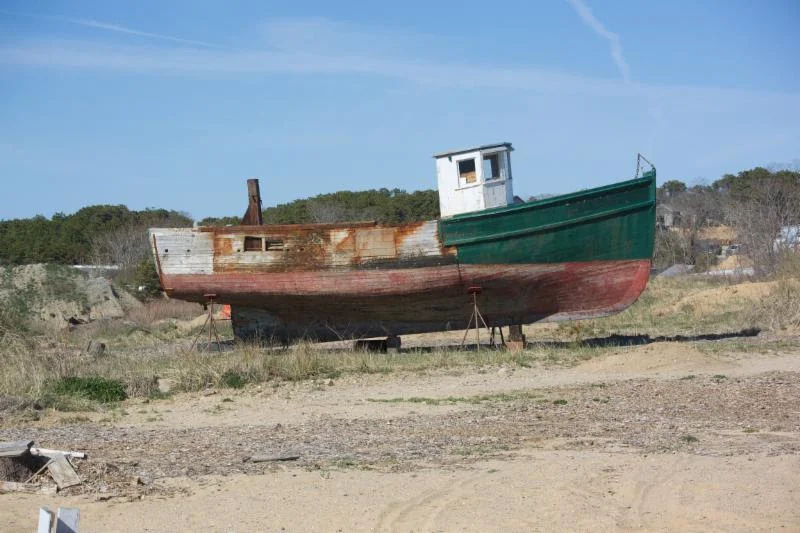
"Abandoned (Truro, Mass.)'' (archival pigment print), by Eleanor Steinadler, in her show "Off the Beaten Path: New Photographs by Eleanor Steinadler,'' at Galatea Fine Art, Boston, Oct. 4-29. The gallery says:
"This exhibition will counterpose two new series of Eleanor Steinadler's photographs from 2016-17 -- the "Abandoned Construction'' series from Truro, on Cape Cod, and the 'Edge of the Sea' series shot on the Matador Island, in the Florida Keys.
"The poignancy and the humor often coexist in the Abandoned series photographs. A long-abandoned ship out of the water, sits in the middle of nowhere. In the clarity of full unforgiving sun it casts a strong stark shadow. A battered hull still preserves some of its proud bearing, as well as the remnant of a carefully chosen two color paint job''
Chris Powell: Ditching 'antiquated gender norms' on Metro North
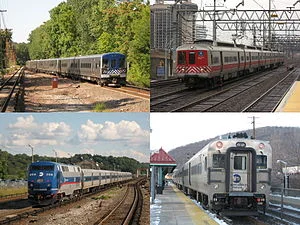
Metro-North, the biggest commuter railroad in the country, which serves southwestern Connecticut and the lower Hudson River Valley, announced the other week that it no longer will note a purchaser's gender identification on month-long train tickets.
The railroad said it used gender identification to discourage people from letting others use their monthly passes. But that did not impair people in lending their passes to others of the same sex -- and what harm would have come from that anyway? If ticket sharing increased ridership, the railroad could have increased the price of the monthly passes. Besides, unlike airline passengers, train passengers are not carefully screened. Screening them would require a lot more train staff and would impossibly lengthen boarding times.
But in praising the railroad for dropping gender identification on the monthly passes, Gov. Dannel Malloy drew a cosmic conclusion in pursuit of the political correctness that has characterized his administration. "We should not be using antiquated gender norms as a method of personal identification," the governor said.
Yes, some men want to be and dress as women, some women want to be and dress as men, and some people don't want to identify with either sex. But do such people number even one in every thousand? And what about everyone else, the overwhelming numbers who, antiquated as the governor may view them, continue to choose to identify as men or women, a choice in which they are supported by biology?
Given those numbers, how can the governor be sure that there are no longer any circumstances in which it is useful to distinguish male from female? While the governor seems to think that the right of anyone to assume either gender at any time trumps the right of sexual privacy in bathrooms, he strangely has not yet insisted on erasing the divisions between boys and girls and men's and women's sports. (That might take the University of Connecticut's women's basketball team down a peg.) And what would become of bird watching?
Of course public policy should not seek to make life harder for those who are uncomfortable in their biological gender. But even if the governor really thinks that gender norms are "antiquated," there's not enough time left in his term for him both to run Connecticut's creaky old government and to convince the rest of the world that there are no longer boys and girls and men and women, just undifferentiated life forms. He should leave that task to his successor, assuming that he, she, or it is another Democrat.
Higher education isn't that high
While the governor was hailing the supposed end of gender, his president of the Connecticut State Universities and Colleges system, Mark Ojakian, was striking another politically correct pose.
In a letter to students and faculty, Ojakian called "devastating" President Trump's phasing out the official amnesty given to about 800,000 young people living illegally in the country. Ojakian added: "We once again pledge our commitment to our students who feel targeted based on their immigration status."
"Feel targeted"? That sounds like what is illegitimate is not to enter the country illegally but to enforce immigration law.
It would have been one thing for Ojakian to say the university system supports the efforts of the students at issue to legalize their residency. But such students are not being "targeted" any more than any other lawbreakers are.
Instead Ojakian said in effect that the university system supports those of its students who claim that their pursuit of higher education puts them above the law. But higher education is not yet that high.
Chris Powell is managing editor of the Journal Inquirer, in Manchester, Conn.
Not ready for the Realtors
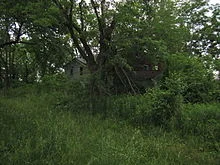
"I am going to make up a legend.
It is going to concern a pink house in Connecticut.
There are going to be four people in my legend.
A husband, a wife, a son, and a daughter.
Their house is about to be surrounded by trees.
The lawn grows higher and higher.
Sometimes the curtains are not opened for days on end.
Lights are seen at all hours of night.''
-- From "The Writer's House,'' by Dick Allen
Carolyn Morwick: GOP infighting in N.H. legislature's budget battles
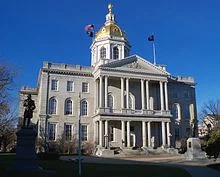
The New Hampshire State House, built in 1816-19. Public-building architects in the 19th Century loved golden tops.
From The New England Journal of Higher Education, a unit of The New England Board of Higher Education (nebhe.org):
New Hampshire lawmakers ended hard-fought budget deliberations on June 22 and passed a two-year $17.7 billion budget along party lines. During House budget deliberations, Republicans faced opposition in their own party coming from the newly formed Freedom Caucus. The result was the Republican-dominated House failed to produce a budget, which hadn’t happened in several decades.
The Republican House and Senate eventually overcame the objections of conservative factions, including the House Republican Alliance and the Freedom Caucus. The final budget represents an increase in overall spending of 4.1% with cuts in the business tax, elimination of the electricity consumption tax and new mobile scratch tickets, all of which Republicans say will balance the budget.
The budget:
Cuts the business profits tax from 8.2% to 7.5% for business with more than $50,000 in receipts
Cuts the business enterprise tax which is applied to wages, interest and dividends, lowering the rate from 0.72% to 0.5 %
Adds $100 million to the state’s Rainy Day Fund
Invests in mental-health and child-protection services, including $22.6 million and 60 new beds for community treatment options, and creates a fourth rapid response mobile crisis unit to divert hospitalizations for mental health issues.
Eliminates the Department of Resources and Economic Development (DRED) and creates two separate agencies; the Department of Natural and Cultural Resources, which will oversee two divisions; Parks and Recreation and Forests and Lands, and, the Department of Business and Economic Affairs, which will oversee the current Economic Development and Travel and Tourism Divisions
Creates the first youth drug treatment center in New Hampshire; doubles the Alcohol Fund, adding $7 million for treatment and recovery services over the next two years; and establishes a $4.5 million drug-interdiction program to bring together federal, state and local resources to disrupt the supply chain that brings drugs into the state
Increases funding by $57 million for the developmentally disabled community to reduce the wait list for services
Increases funding for roads, bridges and school buildings
Increases state aid to cities and towns
Increases funding for charter schools by $15 million.
The budget provides no funding for full-day kindergarten, which has been a priority of Gov. Chris Sununu. However, a Republican-backed bill, SB 191, passed and was signed by the governor to fund full-day kindergarten with proceeds from Keno. Cities and towns must decide on whether to allow Keno.
Legislation Signed Into Law
Marijuana, Penalties
HB 640 An Act Relative to the Penalties for Possession of Marijuana
Reduces the penalties for possession of one ounce or less of marijuana-infused products by a person age 21 or older from a misdemeanor to a violation. Violators will receive a $100 fine for the first and second offenses instead of a year in prison and a $2,000 fine for a third offense.
Guns
SB 12 An Act Repealing the Licensing Requirement for Carrying a Concealed Pistol or Revolver
Increases the length of time that a license is valid to carry a pistol or revolver. Allows a person to carry a loaded, concealed pistol or revolver without a license unless such person is otherwise prohibited by New Hampshire statute; requires the director of the division of state police to negotiate and enter into agreements with other jurisdictions to recognize in those jurisdictions the validity of the license to carry issued in this state; and repeals the requirement to obtain a license to carry a concealed pistol or revolver.
Voting, Principal Residence
SB 3 An Act Relative to Domicile for Purposes of Voting
In order to vote, someone would have to prove that the address they are providing as a domicile is “the principal or primary home ... in which habitation is fixed and to which a person, whenever he or she is temporarily absent, has the intention of returning after a departure or absence.”
Legislation That Failed
Children’s Savings Accounts
SB 193 An Act Establishing Education Freedom Savings Accounts for Students
Establishes education freedom savings accounts from the Department of Education for children ages 5 to 20. The program allows the parent of an eligible child to contract and receive a grant from a scholarship organization to pay for qualified educational expenses.
Union, Collective Bargaining
SB 11 An Act Prohibiting Collective Bargaining Agreements That Require Employees to Join or Contribute to a Union
Prohibits collective-bargaining agreements that require employees to join or contribute to a labor union. No person shall be required, as a condition of employment, to resign or refrain from membership in a labor organization, or become or remain a member of a labor organization or pay dues, fees, assessments or other charges to a labor organization.
Common Core Standards
HB 207 An Act Prohibiting the Implementation of Common Core in Public Elementary and Secondary Schools
Prohibits the department of education and the state board of education from requiring any school or school district to implement the common core standards
K-12 Education Funding
The fiscal 2018 budget provides additional per-pupil aid to charter public schools of $625 per pupil; provides $45 million in special education aid; $14.8 million in career and technical education tuition and transportation aid; establishes the dual- and concurrent-enrollment program, which will provide up to $250 per STEM-related course at a public schools for robotics teams.
The budget includes $10 million in new student scholarship programs over the next two years, and provides grants to schools that encourage student engagement in the STEM science, technology, engineering and math) fields. The budget upgrades and rehabilitates the Plymouth and Rochester Career Technical Schools to provide workforce-ready students by age 18.
Higher Education Funding, Tuition
The University System of New Hampshire was flat-funded at $81 million for each of the two years of the biennium. The budget signed into law also provides for $3 million in capital improvements at Plymouth State University and $10 million for the Governor’s Scholarship Program.
USNH Chancellor Todd Leach in his budget request to the governor sought $88.5 million for fiscal years 2018 and 2019, which represents a 12.5% increase over the two-year cycle. In return, Leach offered to freeze in-state tuition for two years and offer free tuition for all valedictorians and salutatorian graduates from New Hampshire high schools who apply to a USNH institution.
The Community College System of New Hampshire faired better in the budget with an increase in funding for the system of $6 million or an overall increase of 7% in the two-year budget. An additional $10 million was included for the system’s capital budget.
Carolyn Morwick directs government and community relations at NEBHE and is former director of the Caucus of New England State Legislatures.
Those pesky island police logs

Downtown Block Island from the New London ferry.
Block Island Police Chief Vincent Carlone doesn’t want the island’s weekly newspaper, the Block Island Times, to publish police logs identifying people arrested for such offenses as drunken driving because, he says, it’s unfair to shame them in this way. Or is it because he thinks that publishing such logs would be bad for business on the resort island, which is almost entirely dependent on tourists (many of whom are not averse to getting drunk) and rich summer residents? (B.I. has turned into something of an extension of the Hamptons in recent years.)
In a Sept. 4 story, headlined “Chief lobbied paper not to run crime stories,’’ the chief told The Providence Journal:
“This is a nice community, and I’ve made that representation to them {a request that the paper not publish on paper or online police logs}.’’ And he said that the paper has “apparently agreed at some level.’’ Indeed, the paper has not published the arrest log for quite some time, although it had been a tradition for years.
Well, I think that people on such a small place as Block Island deserve to know what’s going on and to be able to decide for themselves what constitutes a serious offense. Drunk driving, for one, would seem to fall under that heading, since it can get people killed. John Pantalone, who’s chairman of the University of Rhode Island’s journalism program, told The Journal how he sees the problem:
“If the Police Department has chosen to withhold this information so as not to embarrass people in a small community, that seems like a bad policy. Communities need to know about misbehavior both for their own protection and to discourage further, perhaps more serious, misbehavior.”
The biggest problem in publishing such police logs is that sometimes a charge doesn't hold up and/or anarrest is found invalid. News media are morally obligated to inform the public when that happens but they often don’t, or they publish the update so inconspicuously that virtually no one sees it. Very unfair!
In any event, these logs are public records. It’s up to the Block Island Times what to do with them.
Of course, most people love to read the dirt on local bad behavior. Most of us have a voyeuristic streak and a touch ofschadenfreude – pleasure at seeing someone else’s misfortune. No matter how bad we think things are for us, someone near us has it worse. How comforting!
Not running police logs cuts readership. The Providence police reports once were among the most read things in The Providence Journal and the very droll “Crime and Punishment’’ section of The Boston Guardian (on whose board I sit) may be the most read part of that paper, Boston’s biggest weekly. (More exciting might be a story there about an apartment at 39 Beacon St. being rented for $50,000 a month – another sign of just how fancy downtown Boston has become because ofmoney from financial services, health services, tech and flight capital flowing in from around the world. If only Providence could siphon off more of that moolah. So near and yet so far.)
It’s unclear if the police logs policy has anything to do with the paper’s sale last year to Michael Schroeder, who owns several Connecticut newspapers, and has links with casino mogul (and Trump pal) Sheldon Adelson.
Hit this link to read the Block Island story:
http://www.providencejournal.com/news/20170903/block-island-police-chief-says-hes-lobbied-to-keep-crime-stories-out-of-print.
Shorthand for let's talk

"Covers and Conversation'' (mixed media/collage), by C.C. White, at the Patricia Ladd Carega Gallery, Center Sandwich, N.H.
Sometimes 'camouflaged as summer'

In New Hampshire's White Mountains.
Photo by Someone35
"A New England fall has the sort of reality summer will never have. Summer is an idyll; lush, throbbing, lazy, it delivers promises and fantasies spun in February. Fall puts an end to the dreaming; But while it is an end, it is also a beginning. Things start up once more. You regather and regroup.
"As for Nature in fall, she's in a tricky mood. The fields pulsate yet with the sound of cricket and cicada. The trees are round and full as they were in mid-July; the ponds lie there misty, warm, seductive. One day camouflaged as summer, fall can easily toss of this disguise and appear as a prophet: cold, wet, angry. ''
-- By the novelist Anne Bernays, from her introduction to the "Fall'' chapter of New England: The Four Seasons, by Arthur Griffin.
Trying to get back where they came from?
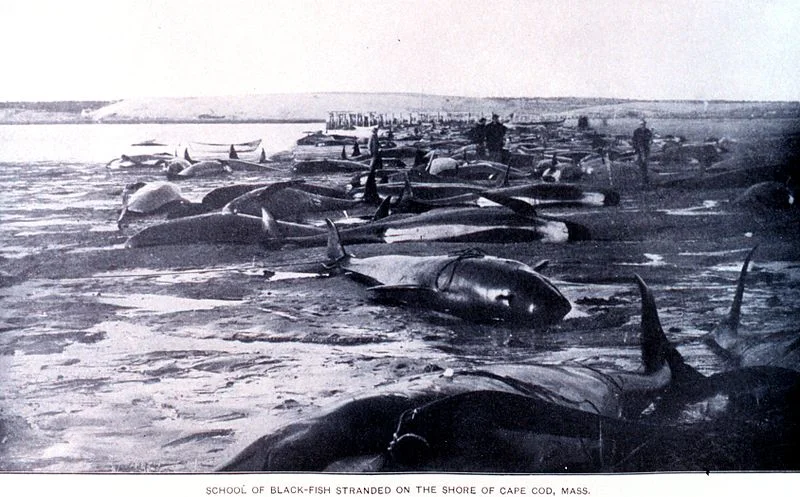
Mass stranding of pilot whales (often called black fish in the past) on a Cape Cod beach in 1902.
"Whale on the beach, you dinosaur,
what brought you smoothing into this dead harbor?
If you’d stayed inside you could have grown
as big as the Empire State. Still you are not a fish,
perhaps you like the land, you’d had enough of
holding your breath under water. ''
-- From "Whale,'' by Anne Sexton
Quiet urban hero

Adapted from Robert Whitcomb's "Digital Diary,'' in GoLocal24.com:
A charming if a bit sad article in the Worcester Telegram the other week told the story of Peter Paradis, who is basically the only municipal employee charged with picking up the litter in downtown Worcester. He’s had this usually thankless job since 2008.
He noted how nasty the downtown would look if the plastic bags, bottles, cigarette butts and so on weren’t picked up for a week (which ispresumably what happens when he’s on vacation). “I think it would be quite nasty. The owners of buildings don’t clean out in front of their buildings. And people just don’t use the trash bins that much,’’ even though there are two trash barrels on most blocks.
“Some just accept that someone else is going to pick it up.’’
Poor Mr. Paradis, diligently doing battle against America’s slob culture. Hit this link:
Carolyn Morwick: It was supposed to be a quiet year in Vt. Legislature...

The Vermont State House, in Montpelier -- the smallest state capital, with only about 7,900 residents.
From The New England Journal of Higher Education, a unit of The New England Board of Higher education (nebhe.org.)
From January to April, there appeared to be an unusual degree of cooperation among legislators and newly elected Vermont Gov. Phil Scott. The House and Senate passed a budget with minor differences. Up until this point, some legislators were characterizing the session as “boring.” All that changed on April 20, when Governor Scott proposed that the Legislature adopt the Vermont School Boards Association’s plan for a statewide teachers’ health-insurance proposal that would save Vermont taxpayers $26 million. Scott campaigned in earnest for his proposal and told legislators that he would veto their budget, which included their version of a teachers’ health insurance savings proposal.
No headway was made despite several meetings between the governor and legislative leaders. In the early morning hours of May 19, a budget was passed and the Legislature adjourned.
As he had promised, Scott vetoed the state budget and a bill for setting property-tax rates. Lawmakers returned to the capitol on June 21 for a special session where the budget stalemate was finally broken. A compromise was achieved which required school districts to find $13 million in savings and create a commission to study a statewide teachers’ healthcare plan. The $13 million will come from school budgets that voters have already passed. Rep David Sharpe, chairman of the House Education Committee, noted that insurance premiums are expected to drop by $75 million next year, giving school districts some leverage to negotiate plans for their employees while saving money.
On June 28, Scott signed the Fiscal 2018 budget, which does not raise taxes or fees, including property taxes. The budget includes a $35 million bond for housing, which state officials expect to generate $100 million investment in affordable housing.
On July 21, Scott and legislators learned that revenue for the FY18 base operating budget would be short by $28 million. A rescission plan to cut $12.6 million from the budget was proposed by Scott and approved by the Legislature’s Joint Fiscal Committee.
Legislation Passed, Signed Into Law
Immigration
SB. 79 An Act Relating to Freedom From Compulsory Collection of Personal information
Prohibits Vermont officials from sharing information with the federal government that would be used to establish a registry based on religion, immigration status or any other personal characteristics.
Retirement Plan
SB.98 An Act Relating to the Public Retirement Study Committee
Creates the Green Mountain Secure Retirement Plan—voluntary retirement option for employers with 50 or fewer employees, none of whom have a retirement plan.
Economic Development
SB. 135 An Act Relating to Promoting Economic Development
Improves the Employment Incentive Growth Program. Lifts the cap on Tax Increment Financing (TIF) Districts and adds additional TIF districts.
Oversight of Race, Criminal Justice
HB. 308 An Act Relating to the Racial Disparities in the Criminal and Juvenile Justice System Advisory Panel
Voids any aspect of the Vermont fair and impartial policing policy that would conflict with federal law, requires all police agencies to adopt every part of the revised policy. The legislation also sets up a panel to make recommendations about how to reduce racial disparities in Vermont’s criminal and juvenile justice system.
Mental Health for Minors
HB 230 An Act Relating to Consent by Minors for Mental Health Treatment
Allows LGBTQ teens to seek counseling to discuss their sexual orientation without their parents’ approval.
Legislation That Failed
Marijuana
SB. 22 An Act Relating to Eliminating Penalties for Possession of Limited Amounts of Marijuana by Adults 21 Years of Age and Older
A last-minute compromise passed by lawmakers legalized the recreational use of marijuana. The governor subsequently vetoed the measure. Other states have approved similar measures by ballot questions including Maine and Massachusetts.
K-12 Funding
Scott proposed freezing funding for K-12 budgets.
Higher Education Funding
According to Patricia Coates, of Vermont State Colleges, the system’s FY18 budget ends several years of budgets stressed by low state support, a decline in the number of Vermont high school graduates, increased competition from New England and northeastern regional colleges through tuition discounting, and increases in health insurance costs. This year, Vermont college presidents submitted budgets that reflected strategic management of resources, which resulted in a balanced VSCS budget that realizes savings through a new, systemwide approach to business processes.
The fiscal year 2018 budget was buttressed by several significant initiatives:
A $3 million increase in the base appropriation from the state
$880,000 in state support for the unification of Johnson State College and Lyndon State College into Northern Vermont University, which followed $770,000 in FY17
$1 million in savings consolidating the administrations of Johnson and Lyndon in FY18
$2.6 million from a major debt refinancing and restructuring
Over $1 million in savings from business process efficiencies, benefit changes and spending reductions.
Carolyn Morwick directs government and community relations at NEBHE and is former director of the Caucus of New England State Legislatures. .
'Cherish in hand'

-- Photo by Maseltov
"My long two-pointed ladder’s sticking through a tree
Toward heaven still,
And there’s a barrel that I didn’t fill
Beside it, and there may be two or three
Apples I didn’t pick upon some bough.
But I am done with apple-picking now.
Essence of winter sleep is on the night,
The scent of apples: I am drowsing off.
I cannot rub the strangeness from my sight
I got from looking through a pane of glass
I skimmed this morning from the drinking trough
And held against the world of hoary grass.
It melted, and I let it fall and break.
But I was well
Upon my way to sleep before it fell,
And I could tell
What form my dreaming was about to take.
Magnified apples appear and disappear,
Stem end and blossom end,
And every fleck of russet showing clear.
My instep arch not only keeps the ache,
It keeps the pressure of a ladder-round.
I feel the ladder sway as the boughs bend.
And I keep hearing from the cellar bin
The rumbling sound
Of load on load of apples coming in.
For I have had too much
Of apple-picking: I am overtired
Of the great harvest I myself desired.
There were ten thousand thousand fruit to touch,
Cherish in hand, lift down, and not let fall.
For all
That struck the earth,
No matter if not bruised or spiked with stubble,
Went surely to the cider-apple heap
As of no worth.
One can see what will trouble
This sleep of mine, whatever sleep it is.
Were he not gone,
The woodchuck could say whether it’s like his
Long sleep, as I describe its coming on,
Or just some human sleep.''
-- "After Apple-Picking,'' by Robert Frost
'Land, Sea, Sky'

'Bellagio Stroll'' (oil on canvas), by Nick Paciorek, in the group show "Land, Sea, Sky,'' at Art Prov Gallery, Providence, Sept. 16-Nov. 4. The gallery says the works of the artists in the show "depict both the majesty of the natural world and its solitude through the use of shape, texture, color and light.''

Over-ranked rankings

Most people seem to love to read rankings – of cities, colleges, best places to retire, etc., etc. But just about all these rankings are comparing apples and oranges. Each of these places is unique.
National city rankings, for instance, usually fail to include such qualities as convenience, as measured by compactness and proximity to nearby important cities; cultural complexity and interest, and the beauty of the built environment. Rather they emphasize such financial metrics as low taxes for retirees. And thus boring SunBelt cities tend to be ranked much higher than, say, Providence, which all in all, is a much more interesting place than most Sun Belt cities. (Perhaps the most exciting Sun Belt cities are seedy, dangerous, exciting New Orleans and Miami, the sort of place that the writer Somerset Maugham called a “sunny place for shady people’’.)
I’m quite aware of Providence’s shortcomings.
And college rankings take little note of the big differences between a rural college and city university or even between a large and small institution, which can have big impact on how courses are taught and the overall college experience. The rankings industry is big, but it sells very misleading stuff.
A flowery end

"Days like this, I want to
go out and take off my clothes and put on
a cassock of dry leaves and carry
a crotched stick and get
down on my knees and give
the last rites to all the wilted dahlias
in kind Mrs. Higginson's backyard.''
-- From "Days Like This,'' by John Stevens Wade (a Maine native)
Age your clothes before entry
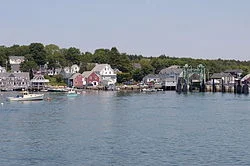
Waterfront, North Haven.
"From Harper's Bazaar, which is my Bible, I learn that the Boston group in North Haven {an island in Maine} frown on new garments in their summer colony, and that a man in a new pair of sneakers is snubbed. 'The older the clothes, the bluer the blood,' says the writer....I am aging a pair of sneakers and a jacket in case I should meet a Bostonian in warm weather.''
-- E.B. White, 1944.
"A longing to be 'someplace'''


"Breath and Murmurs'' (diptych -- images should actually be side by side -- oil on canvas), in her show "Breath And Murmurs,'' at Atelier Newport (Newport, R.I.) Oct, 1-Nov. 4.
The very well known Vermont- and Rhode Island-based painter writes:
"For me a painting or drawing of some 'place' is, in fact, a reorganization and reinterpretation of the sensory input from various places and experiences over many fragments of time. Sounds, smells, temperature shifts, histories, close visual observations and momentary impressions merge with the act of making marks for its own mysterious pleasure. Painting is a synthesis of multilayered sensory data with the materials on hand. It is a representation of time-spent thinking without words.
"My work in this show is about the attention and focus painting gives to my accretions of sensory awareness. Painting allows me to create places on the canvas on which I can recall and give form to memories of trees in the wind, frogs at dusk, incessant insect concerts, vague full-body sensations while swimming, smells, sounds, temperature shifts. All are specifically observed or subconsciously lurking.
"The point of painting for me is to create a visual language, a physical representation of some of the most fleeting of human experiences ....an acute multilayered awareness of one's surroundings, including memories, observations and fleeting impressions......, which cannot exist in words. Through the language of paint, I search for the places in mind, which excite me and contain the most personally resonant information. For me, there is a longing to be 'someplace' which only painting seems to relieve. Therefore, the time it takes to make a painting is in itself an expression of the place realizing its form.''
David Warsh: 5 big issues wrapped around Russia
The fine new biography Mikhail Gorbachev: His Life and Times (Norton), by William Taubman, of Amherst College, is just what we don’t need today. An interesting and decent man, Gorbachev steered the Soviet Union into its transition in 1985, then made a mess of it, turning a collapsing economy over to Boris Yeltsin after an attempted coup in 1991. Recognized with a Nobel Prize for Peace, Gorby was a hero everywhere but his own country.
If you’re interested in the part that Gorbachev played in easing tensions between superpowers in the 1990s, read instead The End of the Cold War 1985-1991 (Public Affairs, 2015), by Robert Service. The high degree of trust and cooperation that unexpectedly developed between Gorbachev and Ronald Reagan, and their seconds, Foreign Minister Eduard Shevardnadze and Secretary of State George Shultz, is the real story.
Otherwise, lean forward and pay attention to the present day.
The manner of the recent closing of the Russian consulate in San Francisco and trade missions in Washington and New York, represented a significant escalation in the tit-for-tat diplomatic penalties of the last two years. This time the Russians were given two days to clear out before their San Francisco buildings were searched by U.S. security services – hence the black smoke emanating from the consulate fireplace.
Five quite different issues are wrapped up in almost every story about Russia these days.
1. Donald Trump’s unacceptability as president to a wide segment of the electorate is almost always present.
2. The possibility exists that members of the Trump family and some associated with the Trump campaign colluded with various Russians to defeat Hillary Clinton. That the president himself might have sought to obstruct an investigation of his campaign’s practices is the focus of Special Counsel Robert Mueller’s investigation for the Justice Department.
3. That Russian government-sponsored interference in the 2016 U.S. presidential election took place, with a view to damaging the Clinton candidacy, now seems beyond doubt, though few believe it was decisive. Whatever went on is part of a much larger story about the advent of what has become known as hybrid warfare, pioneered by the United States, Russia, China, Iran, Israel, North Korea and various non-state terrorist groups. The Russians say that the U.S. employed its techniques in support of various “color revolutions” on Russia’s borders. The U.S. accuses Russia of all manner of tricks in, as one commentator for the government’s Radio Free Europe puts it, “a widespread effort to undermine, corrupt, and cripple the institutions of liberal democratic governance” around the world.”
4. A loose coalition of interests is devoted to painting Vladimir Putin in the worst possible light, for one reason or another. The problems Russia faces building out its economy are thus obscured. We could do with a good deal more economic and business coverage, in the manner of this story by Bloomberg’s Leonid Bershidsky, or this one, by Andrew Higgins, of The New York Times.
5. Finally, the military-industrial complex in the United States is quietly seeking to foment a new high-tech arms race. A new array of smaller tactical nuclear weapons is the latest hot-button issue. Missile defense is a hardy perennial. And, of course, NATO remains the largest arms market in the world. There is even less coverage of this aspect of things.
Disentangling one element of the story from another takes plenty of time and focus. The current fever will subside one day. Let’s hope it doesn’t take a war to bring it down.
. xxx
Economic Principals went off half-cocked three weeks ago when it sought to draw attention to the presumed availability of Federal Reserve Board vice chair Stanley Fischer to replace Janet Yellen should she be denied the opportunity – or prefer not to serve – a second term as chair
Fischer resigned last week after three years as a member of the board of governors, citing “personal reasons.” Fed-watcher Tim Duy speculated that “a serious health issue” may be involved. May blessings attend the Fischer family. He would have made a terrific chair.
David Warsh, proprietor of economicprincipals.com, is an economic historian and veteran journalist.
We rejected each other
"I was raised as an upper-class WASP in New England, and there was this old tradition there that everyone would simply be guided into the right way after Ivy League college and onward and upward. And it rejected me, I rejected it, and I ended up as a kind of refugee, really.''
-- The late Spalding Gray (1941-2004) -- a writer and actor who grew up in Barrington, R.I. He committed suicide in New York City.