
Vox clamantis in deserto






Don Pesci: The Antifa fascists

Statue of Christopher Columbus at Columbus Circle on Manhattan.
On Aug. 21, The Baltimore Sun reported that a monument to Christopher Columbus had been vandalized by vandals, a perfect word to describe the members of Antifa, a group that claims to be anti-fascist but does not scruple to employ the methods of fascists, including the beating of non-violent protesters by masked, black-clad brownshirts.
The destruction of the oldest monument to Columbus in the nation occurred one week after city fathers had decided to remove “four controversial monuments: a statue of Confederate Generals Robert E. Lee and Stonewall Jackson, the Confederate Women’s monument, the Confederate Soldiers and Sailors Monument and a statue of Supreme Court Chief Justice Roger B. Taney, who authored the 1857 Dred Scott decision that upheld slavery.”
Columbus, we may state with certainty, was not a fascist. We know this because fascism dates from Mussolini’s reign in Italy, well after Columbus sailed the ocean blue in 1492. Neither did Columbus approve of slavery; nor did his patrons, King Ferdinand and Queen Isabella. According to a story printed in The Hill, a Washington, D.C., publication, “it was Spain that forbade slavery of most Native Americans and made them Spanish citizens.” The Hill also noted “that Columbus seems to have faced arrest by his fellow explorers for punishing — even executing — those who had abused Native Americans.” The zealot “most often cited in smearing Spanish exploration and with it Columbus,” The Hill noted, was “Bartolome De Las Casas … the one who proposed African slavery for the New World.”
One can’t expect the Antifa brownshirts to take notice of such exculpatory data before they deface statues or infiltrate peaceful protests for the purpose of creating havoc and suppressing free speech. Fascists, nihilists and anarchists are not likely to be dissuaded by sweet reason, which appears to infuriate them. The defacement of the Columbus monument in Baltimore was recorded on YouTube by the defacer for posterity and the delectation of fellow brownshirts.
The past, we all know, is the gateway to the future. George Orwell knew this, as do most historians. William Faulkner used to say that the past is not over; it’s not even past. Stalin, Hitler and Mao claimed the future by refashioning the past according to their ideological predispositions. Orwell’s Big Brother, patterned after Stalin, was a successful revisionist. “He who controls the past controls the future. He who controls the present controls the past,” wrote Orwell in “1984.”
Buffeted by three major forces, the Soviet Union – which, like Hitler’s Third Reich was supposed to last a thousand years – at long last began to crumble. When Pope John Paul II set his foot on Polish soil in 1979, Poland’s past, phoenix-like, rose from the ashes. Once again, the country began to live its history, which had long been suppressed by Communists. Shackles on souls were loosened, minds were liberated. The publication of The Gulag Archipelago, by Alexander Solzhenitsyn, resurrected the real de-romanticized past of Soviet Communism, as had Khrushchev’s earlier denunciation of Stalin in a special address to Communist Party comrades three years after Stalin’s death. History’s boot was crushing the hobnailed boot of Communism.
The past is too important to leave to the new revisionists – Antifa, nihilists, masked anarchists, and the anti-Columbus crowd.
Before we can understand Antifas, America’s new fascist party, we must make an attempt to understand what fascism is. Fascism, like anarchism and nihilism, is ungoverned dynamism. It is pure spirit, void of reason, murderously directed to an end – the destruction of life, property and culture.
As early as 1914, Albert Camus tells us in his book The Rebel, Mussolini “proclaimed the ‘holy religion of anarchy,’ and declared himself the enemy of every form of Christianity.” Camus adds, “Men of action, when they are without faith, never believe in anything but action… To those who despair of everything” – here Camus had in mind post World War I Germany – “not reason, but only passion, can provide a faith.” Dynamism for dynamism’s sake is an act of contempt of both past and future. Camus again: “Fascism is an act of contempt, in fact. Inversely, every form of contempt, if it intervenes in politics, prepares the way for, or establishes, Fascism.”
Camus's book, not much read in political philosophy classes these days, earned him the contempt of Sartre and other proto-Communist philosophers in France. The Rebel should be on the bedside table of anyone in our increasingly secular culture who wants to know something about the forces arrayed against the Western experiment in liberty and law.
There are people among us – nonanarchists – who do not believe that this experiment should continue, and these are dog-whistling the contemptuous enemies of the Western world, like the fellow who took a sledge hammer to the Baltimore Columbus statue. It is easy to assault a statue, more difficult to strike through the mask at the reality that lies behind it. That would require intelligence and a due regard for reason and order. But as soon as one allows oneself to be guided by reason and order, he leaves anarchism, undifferentiated dynamism, far behind him. The Antifa fascist who struck the Columbus statue in Baltimore was expressing through his thoughtless contempt for the Columbus he does not know his boiling contempt for America. And that is really the point of all these ungrateful, disordered anarchists: contempt is the opposite of gratitude.
I’d like to place one more point on the shelf before ending these comments. Columbus and those who still admire him, while conscious of the defects he shared with his own age, can never be friendly towards Klu-Kluxery. The fury of the KKK was of course directed pitilessly at African Americans. But the KKK was also contemptuous of Jews and Catholics, and this boundless contempt was expressed in violent acts against the faith of non-Protestants who were not Anglo Saxon. The African American antifa who destroyed the Baltimore statue of Columbus was, by his act of contempt, marching hand in hand with the Klu-Klux-Klan.
So, what are we to make of someone like Mayor of New York Bill de Blasio, whose knees shake whenever antifas whispers “fascist” or “KKK”? The mayor of New York City, still teeming with Italians, is considering removing a statue of Columbus in Columbus Circle. DeBlasio is Italian; he must have learned something about Columbus sitting on his father’s lap as a young boy. DeBlasio’s wife, Chirlane McCray, is African American. Surely both know that Italians, many of them Catholic, in addition to Jews and African Americans were victims of the KKK and other deeply prejudiced Americans.
The monument in Columbus Circle was dedicated in 1941, 50 years after the largest mass lynching in U.S. history. The lynching of 11 Italian Americans occurred after a trial in which 19 Sicilians had been indicted in the murder of New Orleans Police Chief David Hennessy. The jury regarded the evidence presented at trial as highly suspect and insufficient. Six defendants were acquitted and a mistrial was declared for the remaining three because the jury failed to agree on their verdicts. A mob incited by a lawyer, William Parkerson, and led by John Wickliffe, editor of the New Delta newspaper, advanced on the prison shouting “We want the Daqoes!” and murdered the exonerated Sicilians.
Most newspapers of the day approved of the vigilantly injustice. The New York Times, covering itself in blood and shame, editorialized, “These sneaking and cowardly Sicilians, the descendants of bandits and assassins, who have transported to this country the lawless passions, the cut-throat practices, and the oath-bound societies of their native country, are to us a pest without mitigation. Our own rattlesnakes are as good citizens as they...Lynch law was the only course open to the people of New Orleans.”
The modern descendants of the lynch mob – including the KKK and Antifa – have now taken to lynching statues of Columbus, erected in part as a rebuke to lawless anarchy and the terrible silence surrounding prejudice that makes lynching possible.
I will close by pointing out that these are issues long resolved. We could let the dead bury their dead, and certainly there is no need to fight the Civil War all over again. However, the attack on Columbus is now, and always has been, an assault, waged these days mostly by nihilists and anarchists, on the very foundation of the American experiment in liberty. In law and life, silence signifies assent.
“Silence in the face of evil,” said Dietrich Bonhoeffer, hanged by Nazis in 1945, “is itself evil; God will not hold us guiltless. Not to speak is to speak. Not to act is to act.” Camus, an atheist, no doubt would agree. Silence in the face of anarchy and cultural dissolution is itself an approval of anarchy and cultural disintegration. In an anarchic universe, we have nothing to lose -- but everything.
Don Pesci is a Vernon, Conn.-based essayist.
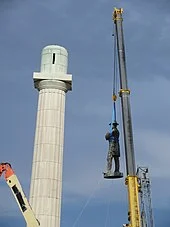
'The Lost Cause' of historical literacy
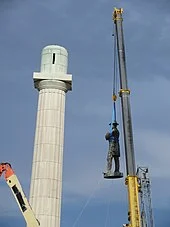
The statue of Robert E. Lee in New Orleans being lowered last May 19.
Adapted from Robert Whitcomb's "Digital Diary,'' in GoLocal24.com:
I go hot and cold on whether the time and expense of removing Confederate statues from certain public places is worth it. There’s a strong argument for doing it along the lines of the reasoning that has removed Nazi statuary from public places in Germany and Communist statuary from some places in central and eastern Europe. On the other hand, there’s an argument to be made that statues of defenders of slavery should be kept up as a reminder of, and points of discussion, about history.
That argument would be stronger if Americans knew more about their history. But in fact, as suggested above, history and civics knowledge has been plunging as schools cut back on teaching what should be essential subjects for citizens of this and any other republic.
I thought of that while reading a New Hampshire Public Radio piece about a controversy over a mural in a U.S. Post Office in the college (UNH) town of Durham, N.H. The building has a long and complicated mural of images depicting the town’s development on its wall.
The images are mostly bland. But one shows a Native American ‘’crouching,’’ in NHPR’s words, “behind a bush looking out at a colonial cabin. He’s carrying a bow and arrows, and in one hand is a flaming torch. The image is entitled ‘Cruel Adversity.’’’
“The painting is meant to represent the threat of Native American attacks on the town….,’’ NHPR reported.
Now some people want this image removed for its alleged derogatory attitude toward Native Americans; and they complain that the mural doesn’t show the savagery of European colonists. Hit this link for the full story:
https://nenc.news/post-office-mural-depicting-cruel-native-americans-sparks-debate-n-h-town/
Well, both sides were often savage (and Native American tribes were often very savage against each other), and students should be taught that; they should also know about past bigotry. Leaving the image up helps do that. The real problem in this case is the abysmal state of history teaching. If we improved that, the people looking at these murals, statues and so would have the context (including understanding the associated racism) to understand why they went up in the first place.
There may be exceptions in some places, but I’ve come around a bit to President Trump’s remark about taking down statues of Confederate luminaries: “Where does it end?’’ There are just too many of these public reminders of very bad causes, including the horrible “Lost Cause’’ of the Confederacy, which sought to maintain and even expand the horror of slavery. So, on further reflection, in most places, I’d leave up these reminders.
I’d even leave up the statue of the great mass murderer Vladimir Lenin at 178 Norfolk St., in New York City.
xxx
Meanwhile, here’s what might be the idiotic PC moment of the summer? Yale University has changed a campus stone carving of a Puritan and a Native American by cementing over the musket that the former was carrying but keeping the Native American’s bow visible. A committee had ruled thatthe sculpture was bad because it depicted colonial violence against Native Americans. The sculpture, now at an entrance to the Sterling Memorial Library, will be taken away to be shown at a less conspicuous place.
Yale was created by Puritans. This controversy reminds me of the lyrics of the start of (Yalie) Cole Porter’s famous song “Anything Goes’’:
“Times have changed
And we've often rewound the clock
Since the Puritans got a shock
When they landed on Plymouth Rock.
If today
Any shock they should try to stem
'Stead of landing on Plymouth Rock,
Plymouth Rock would land on them.’’
'Rent asunder'
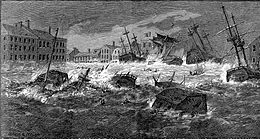
"The Great September Gale'' of Sept. 23, 1815, as it hit Providence.
"I'm not a chicken; I have seen
Full many a chill September,
And though I was a youngster then,
That gale I well remember;
The day before, my kite-string snapped,
And I, my kite pursuing,
The wind whisked off my palm-leaf hat;
For me two storms were brewing!
It came as quarrels sometimes do,
When married folks get clashing;
There was a heavy sigh or two,
Before the fire was flashing,
A little stir among the clouds,
Before they rent asunder,--
A little rocking of the trees,
And then came on the thunder.
Lord! how the ponds and rivers boiled!
They seemed like bursting craters!
And oaks lay scattered on the ground
As if they were p'taters
And all above was in a howl,
And all below a clatter,
The earth was like a frying-pan,
Or some such hissing matter.
It chanced to be our washing-day,
And all our things were drying;
The storm came roaring through the lines,
And set them all a flying;
I saw the shirts and petticoats
Go riding off like witches;
I lost, ah! bitterly I wept,--
I lost my Sunday breeches!
I saw them straddling through the air,
Alas! too late to win them;
I saw them chase the clouds, as if
The devil had been in them;
They were my darlings and my pride,
My boyhood's only riches,--
'Farewell, farewell,' I faintly cried,--
'My breeches! O my breeches!'
That night I saw them in my dreams,
How changed from what I knew them!
The dews had steeped their faded threads,
The winds had whistled through them!
I saw the wide and ghastly rents
Where demon claws had torn them;
A hole was in their amplest part,
As if an imp had worn them.
I have had many happy years,
And tailors kind and clever,
But those young pantaloons have gone
Forever and forever!
And not till fate has cut the last
Of all my earthly stitches,
This aching heart shall cease to mourn
My loved, my long-lost breeches!''
- - "The September Gale,'' by Oliver Wendell Holmes (1809-1894)
The "gale'' that Holmes (a Boston physician and poet) referred to was the great hurricane of Sept. 23, 1815, which pummeled southern New England. Meteorologists believe that it was a Category 4 storm.
They don't want visitors

"On the Road" (oil on panel), by Mike Howat, at the "Fall Art Exhibit,'' at Mill Brook Gallery & Sculpture Garden, Concord, N.H., through Dec. 24.
Llewellyn King: Businesspeople flummoxed by Trump but must work with him
After more than six months of vilifying, ridiculing and laughing out loud at President Trump, Washington is getting down to realizing that he is the president — and he will not be gone, by some miracle, in the morning.
Ergo, it is time for companies, lobbyists and Congress to find a mechanism to work with Trump or around him. It might be described as a dance: the perplexity quickstep. Fleet feet are essential.
Business is treading with increasing alarm and tentativeness. Lobbyists are seeking White House sources for steps guidance. And Congress is tripping over new choreography.
A lot of business leaders thought that Trump, himself a businessman, would see government from the Oval Office as though he were still sitting in the corner office. They believed that he would seek the best path forward, going for the main chance and strategizing how to get there. Instead, the business community — from the chairmen of some of the largest companies, with whom I have spoken, to those of small- and medium-size companies — is flummoxed, reviling Trump in private and seeking advice from a variety of Washington gurus on what to do going forward.
Business people, who think that they understand cause and effect, cannot find a pattern that suggests the president has any understanding of that relationship. Business hankers for certainty, Trump for adulation. Business worries about the bottom line, Trump about the television commentariat. Business people who want to get a point of view across to the president are trying to get on television — particularly on the morning shows on Fox.
The trade associations, among the most effective lobbies in Washington, are working under the old rules while trying to learn the new dance steps. So they continue to “applaud” Trump appointments and to “congratulate” administration policy. Business and its lobbyists truly hope for lower corporate taxes and for loosening of regulations but they worry about the future of trade and trade agreements — and the concept that America can pull back all its overseas commitments. “America First” is a harbinger of bad things to come for global companies.
Many CEOs, including Elon Musk, of Tesla, Tim Cook, of Apple, and some other bold Silicon Valley C-suiters, have criticized Trump and quit his advisory committees. This has earned them public plaudits, but in doing so they have reduced their ability to affect things. Many others ask, “With Trump, isn’t it better to be on the inside, as close to the president as possible?” Trump is said to believe the last person with whom he spoke.
In Washington’s new dance, the hope is that when the music stops, you are the one standing next to him. You cannot do this if you have taken off to California in high dudgeon.
Many corporations are in the awkward position of needing good relationships with the White House because they are involved in government contracting — and most large corporations are, even as they like to denounce government. Less government, more contracts is the dichotomy of the business-government relationship.
So many corporations with interests in Washington are learning the perplexity quickstep: two quick steps to the right, two quick steps to the left, and circle to the rear. Dance near Trump and he might heap praise on you. Dance far from him and he might come after you for manufacturing overseas. Like his own party and the press, business waits for the new choreography which often arrives by Twitter in the early morning.
This was a week to marvel at the perplexity quickstep: Trump decided on the Deferred Action for Childhood Arrivals Program, or DACA, putting the fate of nearly 800,000 young undocumented immigrants in lawmakers’ hands before undermining the whole effort by tweeting that if Congress did not act in six months, he would insert himself back into the process. Then he danced the GOP right off the floor and cut a deal with the House and Senate Democratic leaders, Nancy Pelosi, of California, and Chuck Schumer, of New York. Dizzying.
Llewellyn King (llewellynking1@gmail.com) is executive producer and host of White House Chronicle, on PBS.

Way, way Down East
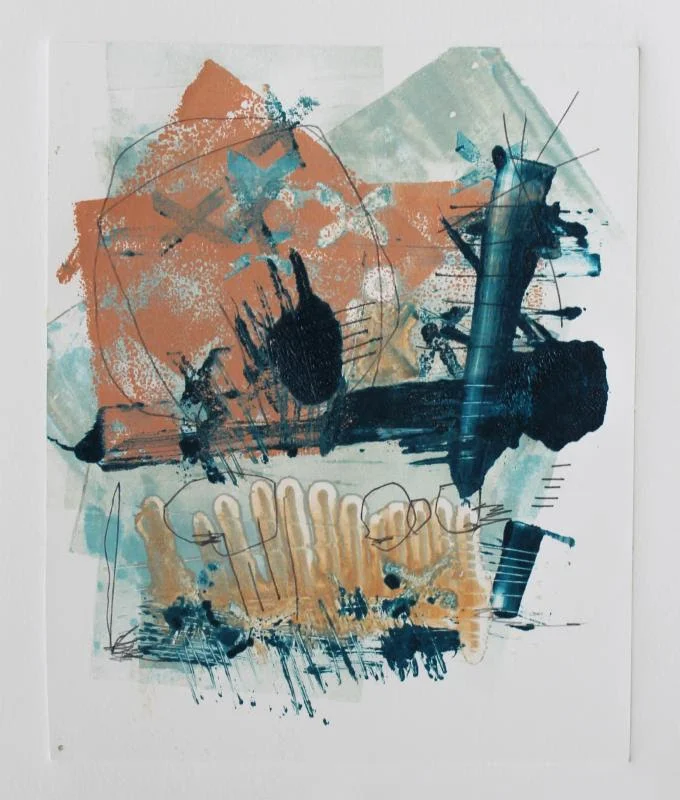
"Legend Has It'' (monotype with additions), by Megan Snyder, in the show "Down East,'' at the Saco Museum,' Saco, Maine, through Oct. 28. Strong colors, deep mystery and a sense of violence.
Keep me away from there!
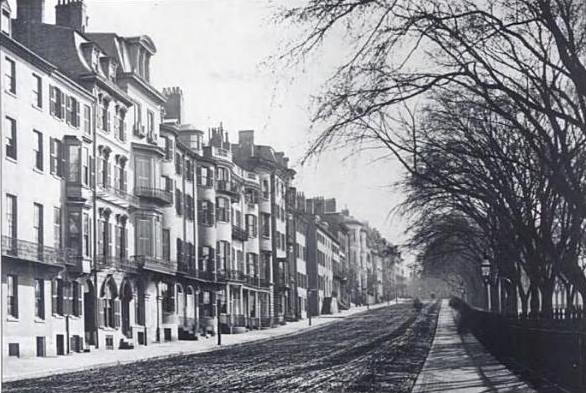
Beacon Street in about 1870.
"I care a great deal to prevent myself from becoming what of all things I despise, a Boston prig....Anything which takes a man morally out of Beacon Street, Nahant and Beverly Farms, Harvard College and the Boston press, must be in itself a good.''
-- Henry Adams, in an 1875 letter.
Seaside social trauma

Bailey's Beach after Superstorm Sandy in 2012, with "Rejects' Beach'' in the foreground.
From Robert Whitcomb's "Digital Diary,'' in GoLocal24.com:
U.S. Sen. Sheldon Whitehouse is a Democrat, and Democrats pride themselves on representing a wider range of ethnic and socio-economic groups than Republicans, who, whatever their populist rhetoric, in practice display a special affection for the rich. Democrats present themselves as particularly sensitive to the needs and aspirations of low-and-middle-income people and ethnic minorities.
The senator is gearing up for his re-election campaign in 2018.
So the senator may feel himself in a quandary about the all-white, all-rich Bailey’s Beach club, in Newport. (The official name is the Spouting Rock Beach Association.)
He has a very close association with the club as a former member and through his wife’s continuing membership. He has many friends there. Furthermore, the club is very conveniently close to their Newport house.
Freedom of association is a wonderful thing and a cousin of the First Amendment, but for practical political reasons – i.e., “the optics’’ – Mr. Whitehouse, who is very much part of the old WASP aristocracy, will presumably face considerable political pressure to separate himself from such a symbol of exclusion as the campaign heats up. It’s his business of course. And his capacity to be agood senator would seem little affected one way or the other. But Bailey’s will come upnext year, though he’ll almost certainly be re-elected.
I have been to Bailey’s Beach and found the members I metthere cool, cordial and quiet. But as a reminder of the fragility of all human institutions, an overly fragrant mass of seaweed covered much of the lower beach that day.
'Her perfect self'

"Deep in Deering Oaks,
bright among the ancient trees,
floats a solitary swan
like a delicate suspended note.
She contemplates the silence of her perfect self.''
-- From "Hard Edge of Beauty,'' by Floyd C. Stuart

Deering Oaks Park, Portland, Maine.
Jim Hightower: And now, the great American subprime auto-loan bubble
Via OtherWords.org
The self-described “Geniuses of Wall Street” are being stupid. Again.
In 2007, their stupid schemes and frauds crashed our economy, destroying middle-class jobs, wealth, and opportunities. Far from being punished, however, the scofflaws were bailed out by their Washington enablers — so the moral lesson they learned was clear: Stupid pays! Go Stupid!
Sure enough, here they come again.
Rather than investing America’s capital in real businesses to generate grassroots jobs and shared prosperity, Wall Street is siphoning billions of investment dollars into speculative nonsense — such as bundles of high-risk, subprime auto loans.
It works like this: Car dealers, eager to goose up sales, hawk new vehicles to lower-income people, offering quick loan approval, even to those with poor credit ratings. Banks — eager to hook more people on monthly car payments — okay these subprime car loans without verifying the buyer’s ability to pay.
Then, a Wall Street bank’s investment house buys up thousands of these iffy individual loans, bundles them into multimillion-dollar “debt securities,” and sells them to wealthy global speculators.
Last year alone, Bloomberg reports, banks sold $26 billion worth of these explosive bundles of car loans.
This is a gaseous repeat of Wall Street’s subprime mortgage bubble that burst a decade ago. The scam generates easy money at the start for speculators and banksters. But as more and more buyers are unable to make their car payments, defaults build up — and the whole financial bubble pops.
Wasting America’s much-needed investment capital on a scheme that intentionally puts people in cars they can’t afford with loans they can’t repay isn’t only stupid, but immoral — and it’s killing our real economy. Why are we letting elite Wall Street loan sharks do this to us?
Jim Hightower is a radio commentator, writer, and public speaker. He’s also the editor of the populist newsletter, The Hightower Lowdown.
North Korea's latest

Work by Steve Heller, in the "Flying Horse Outdoor Sculpture Show,'' at the Pingree School, South Hamilton. Mass., through Nov. 5. The curator says Mr. Heller is a self-taught artist who uses wood, metal and car parts. His sculptures, despite being made of harsh metal, are playful and whimsical.''
Explaining Putin; Will China and U.S. go to war?

The friendly face of Vladimir Putin.
To members and friends of the Providence Committee on Foreign Relations (thepcfr.org; pcfremail@gmail.com).o.
With Russian intrusion into American politics and government such an issue, we thought it would a good idea to recruit a Russia expert to start off our season. Thus we have the distinguished Prof. David R. Stone of the U.S. Naval War College lined up for Wednesday, Sept. 13.
He'll explain Putin and the new Russian nationalism and how it affects us.
Professor Stone received his B.A. in history and mathematics from Wabash College and his Ph.D in history from Yale University. He has taught at Hamilton College and at Kansas State University, where he served as director of the Institute for Military History. He has also been a fellow at the Center for Advanced Study in the Behavioral Sciences at Stanford University. His first book Hammer and Rifle: The Militarization of the Soviet Union, 1926-1933 (2000) won the Shulman Prize of the Association for Slavic, East European, and Eurasian Studies and the Best First Book Prize of the Historical Society. He has also published A Military History of Russia: From Ivan the Terrible to the War in Chechnya (2006), and The Russian Army in the Great War: The Eastern Front, 1914-1917 (2015). He also edited The Soviet Union at War, 1941-1945(2010). He is the author of several dozen articles and book chapters on Russian / Soviet military history and foreign policy.
On Wednesday, Oct. 11, Graham Allison, who has been running Harvard’s Belfer Institute, will talk about, among other things, Chinese expansionism in the South China Sea. He'll talk about his new book Destined for War: Can America and China Escape Thucydides's Trap?
Ignorance the bigger problem
From Robert Whitcomb's "Digital Diary,'' in GoLocal24.com:
Very, very few Americans are sympathetic to the “Alt Right,’’ the KKK or neo-Nazis. Thus the huge “counter-demonstration’’ against the Aug. 19 “Free Speech Rally’’ in Boston was ridiculously overwrought.
The “Free Speech Rally’’ was conducted, such as it was, by an outfit called the Boston Free Speech Coalition, which says it’s “a coalition of libertarians, progressives, conservatives, and independents.” The counter-demonstrators tried to label the coalition as a bunch of extreme right wingers and effectively quashed their freedom of speech. I have no idea what the real views of the members of the coalition might be. But I do know that their First Amendment rights were thwarted by this trendy counter-demonstration against “hate,’’ as if you could ban something that everyone feels from time to time.
The biggest problem in all this is not bigotry but massive ignorance about American constitutional rights and American civics and history in general. (Certainly if the Alt Right or outright fascists took over they’d curb or prohibit free speech themselves and knock a lot of heads in the process.)

Chris Powell: Conn. deportation cases rife with cynicism; a portrait to take down

Most of Connecticut's recent heartbreaking deportation cases follow a pattern of cynicism on both sides.
That is, illegal entry for economic reasons is disguised by a claim for refugee status and asylum. There is a failure to appear at an immigration hearing, lest the refugee claim be scrutinized and disproved, a failure later represented as an accident or someone else's fault when it gets in the way of an appeal. There is issuance of a deportation order followed by multiple delays of enforcement over the course of many years as the executive branch of government declines to enforce the law, thereby allowing unskilled foreign labor to drive the national wage base down for the benefit of capital.
Meanwhile illegal immigrants build families in this country, with spouses and children to be used as hostages against enforcement.
Then there is the new national administration's refusal to delay deportation again, the setting of a deportation deadline, and an emergency appeal to an immigration court or the regular federal courts, making a claim of new evidence. At last there is still another stay of the deportation order, or else the illegal immigrant's relocation to a church purporting to provide "sanctuary."
This pattern demonstrates that the entire immigration system has been a racket in which the immigrants have been confident that the U.S. government was unlikely to enforce immigration law against them, and the government, through administrations of both political parties, prior to the current administration, indeed has declined to enforce the law as often as it has enforced it.
Since the government is as culpable as the illegal immigrants here, little good is likely to come from destroying families by deporting a father or mother who would leave citizen children here. But the country won't ever regain immigration law and control of its borders until deportation for illegal entry is swift and sure.
CLEAN UP THE CAUCUS ROOM: Before Connecticut commits itself to the cultural revolution that is toppling Confederate statues in the South, masking or breaking politically incorrect engravings and windows at Yale, and prompting New York City to contemplate renaming Columbus Circle for Hillary Clinton or Sacco and Vanzetti, Democrats in the state Senate might consider a more modest reform.
The walls of the Senate's Democratic caucus room at the state Capitol display portraits of past Democratic lieutenant governors, who presided over the Senate. Among those depicted is T. Frank Hayes, who was simultaneously lieutenant governor and mayor of Waterbury in the 1930s and who, in the latter position, looted the city, was convicted and sent to prison for it, and helped cause the defeat for re-election of his former ticket mate, Gov. Wilbur L. Cross, at once the most erudite and homespun governor the state ever had.
So if the walls of the Democratic Senate caucus room are to be places of honor, why is Hayes's portrait still hanging there?
Surely the Democrats could find a portrait of another prominent Democrat who did not disgrace himself and the state. A painting or poster of the Charter Oak is always appropriate to fill extra space in any official gallery in Connecticut. Hayes's portrait could be removed for storage at the archives at the State Library across the street from the Capitol.
Yes, Hayes didn't wage war against the United States, nor did he own slaves. Connecticut can be glad that, unlike some other states, it has few connections to such profound offenses. But Hayes's offense is bad enough and it shouldn't require a cultural revolution to take him down and replace him with someone or something better.
Chris Powell is managing editor of the Journal Inquirer, in Manchester, Conn.
"Life's Declivity'
"As Summer into Autumn slips
And yet we sooner say
"The Summer" than "the Autumn," lest
We turn the sun away,
And almost count it an Affront
The presence to concede
Of one however lovely, not
The one that we have loved --
So we evade the charge of Years
On one attempting shy
The Circumvention of the Shaft
Of Life's Declivity."
-- "As Summer Into Autumn Slips,'' by Emily Dickinson
Keep drivers guessing

"In Vermont no back road of any pride is content to have only one name. In the next town to me and its neighbors to the north, for example, Grassy Brook Road becomes Archie Jones Road, becomes Lower Road, becomes Route 35, becomes Weaver Brook Road, becomes Cambridgeport Road -- all in the course of about 15 miles of the same thoroughfare.''
-- "Unimproved Roads,'' by Castle Freeman Jr., in the March 1998 issue of Yankee magazine.
Channeling 'social upheaval'

"Red Flag'' (painted aluminum with silver and bronze leaf), by Charlie Hewitt, in his show "Heart of Gold,'' at Heather Gaudio Fine Art, New Canaan, Conn., through Sept. 9.
The gallery says: "Hewitt's work channels the social upheaval of the 1960s, the laborers and mill-towns of his native Maine, and the gritty urban landscape of the Bowery,in New York City. He expresses his life experiences through an abstraction rich with emotive content. These personal associations come through in colorful, energetic, at times scrappy and idiosyncratic mixed-media compositions on canvas, works-on-paper, prints, welded sculpture, and ceramics.''
Some Kennedys at it again
From Robert Whitcomb's "Digital Diary,'' in GoLocal24.com
Poor Massachusetts Congressman Joseph P. Kennedy III – the thoughtful, very well informed and disciplined young man who has put a lot behavioral space between himself and a family too many of whose members are known for out-of-control and arrogant (“Do you know who I am?!”) behavior.
He must have been very embarrassed when his Uncle Max Kennedy and his daughter Caroline, both acting deranged, were arrested on Aug. 30 in a fancy rented house near the Kennedy compound inHyannisport, onCape Cod, after arguing with police officers responding to neighbors’ complaints about a very loud party there.
The cops said Max Kennedy was, among things, “screaming incoherently and throwing himself at the wall’’ and smashing a cabinet filled with glass valuables.
After he was put into a police cruiser, Caroline tried to get her father out of the vehicle and was arrested herself. At the police station, the cops said, she told them proudly: “I went to Brown and I’m a teacher, sweetheart!’’
Oh, well, as my late father used to say, bitterly, “Your friends you can pick; your relatives you’re stuck with.’’
Admirable ignorance

"It is what he does not know,
Crossing the road under the elm trees,
About the mechanism of my car,
About the Commonwealth of Massachusetts,
About Mozart, India, Arcturus,
That wins my praise. I engage
At once in whirling squirrel-praise.
He obeys the orders of nature
Without knowing them.''
-- From Richard Eberhart's "On a Squirrel Crossing the Road in Autumn, in New England''