
Vox clamantis in deserto


David Warsh: High-powered economists but the boat trip was the best part

Lindau Island, in Bavaria.
It began as a bootstrap adventure: a pair of physicians, practicing in a Bavarian backwater, recognized the extent of damage to German science that had occurred since 1933 when the Nazis took over. Four years after World War II had ended, students’ isolation from the international conversation about the frontiers of medical knowledge was still nearly complete.
So Gustave Parade and Franz Karl Hein made a pitch to the city fathers of Lindau, a late-medieval island in a beautiful lake, occupied since the war by the French army, with a casino willing to underwrite a “medical science convention.”
On another island, at the other end of the lake (the third-largest in Europe, known as the Bodensee or Lake Constance), was a member of the Swedish royal family, a grandson of the king. Mr. Lennart Bernadotte was looking for ways to make ends meet.
Swedes had been roaming around southern Germany since the Thirty Year’s War; but a 23-year-old Bernadotte had been given the island of Mainau only in 1932, by his maternal grandmother, the daughter of a German grand duke, as a wedding present, of sorts.
He had married a commoner without royal consent, so lost his princely title, and needed to get out of Stockholm with his wife. Bernadotte had spent the war in Sweden, but he returned to Mainau afterwards, wondering how to make a go of it. He agreed to the use of his name to appeal to Nobel laureates to travel to Lindau to meet with German science students.
Parade and Heim hardly knew who among European laureates in medicine and physiology were still alive, much less how to reach them. But somehow they managed to put together a successful meeting of around 200 students with seven laureates (including one, William Murphy, from as far away as Boston), who gave lectures on whatever topic they pleased. The first conference was followed by a similar meeting of chemistry laureates the next year.
A boat trip to Mainau Island, an arboretum since the mid-18th Century, was part of the program from the start. Punctuated by a picnic, it offered an opportunity to mix and mingle on the last day of the week.
For 30 years, the Nobel Foundation refused to have anything to do with the meetings. By the ’80s, however, it had become clear that the meetings had evolved a successful method. Laureates were eager to come for “family reunions”; they were glad to meet with students to “inspire, motivate and connect.” Most were too polite to mention it, but often the young scientists they met weren’t all that inspiring themselves. The meetings were virtually unknown outside of Germany, and almost any West German student who asked could attend. East Germans stopped coming after 1964.
Bernadotte meanwhile, divorced in 1971, remarried and added five more children to the four from his first marriage. He had been re-ennobled by Luxembourg, as Count of Wisbourg, in 1951. With his children, he had turned his island into a major tourist attraction, its botanic garden booking a million visitors a year. But at the other end of the lake, the Lindau Laureate Meetings were still living hand-to-mouth well into the ’90s.
That changed when a management consultant signed on to write a plan for strategic development. Wolfgang Schürer, an economist, had already established one successful international meeting – the International Management Symposium (today the St. Gallen Symposium). Over the next 15 years (he retired from the Lindau meetings last year), he organized another, a story laid out in Science at First Hand, by Ralph Burmester, originally produced for the fiftieth anniversary and updated twice since.
Schürer recommended casting the net for students far more widely than before, essentially around the world; and selecting them more carefully, from nominations forwarded by their home institutions. He advocated for opening a professional meeting office. He successfully raised funds from a wide variety of corporate and government sponsors, beginning with a landmark 10-year grant from the Swiss pharmaceutical giant Novartis.
He pressed, too for adding a meeting to the summer calendar for prize laureates in economic sciences, first awarded in 1969, a new Nobel Prize in everything but name. (Officially it’s the Swedish Central Bank Prize in Economic Sciences in Memory of Alfred Nobel.) The first such meeting, anchored by Robert Solow, was held in 2004; and so enthusiastic were its guests and funders that they tried it again for a time at two year-intervals.
The Sixth Annual Lindau Meeting on Economic Sciences concluded a week ago, 16 laureates (a 17th forgot his passport!) and 233 up-and-comers from 66 countries. Most groups self-segregate, and apparently Nobel economists are no exception. In general, laureates identified in their post-Nobel career mainly as authors (at least in my mind) stayed away: Not there were Joseph Stiglitz, Paul Krugman, Robert Shiller, Angus Deaton, Daniel Kahneman, George Akerlof, Edmund Phelps, and Michael Spence.
The 16 who showed up were all in some degree still trying to influence economics from the inside. Some celebrated teachers were absent (Alvin Roth, also an author, and Eugene Fama come to mind). Incipient authors were among those who were present. Jean Tirole has a new book appearing this month, Economics for the Common Good. But, in general, the sample reflected the different agendas to which economics laureates devote themselves after their new-found fame: continue to work in the field, or seek to persuade a lay audience.
Thus one day that Daniel McFadden lectured on “Foundations of Welfare Economics’’; Peter Diamond on “Good Pension Design’’; Robert Aumann on “Mechanism Design: Why Consciousness Evolved’’; Sir James Mirrlees on “Bounded Rationality and Economic Policy’’; and Roger Myerson on “Local Agency Cost of Political Centralization’’.
The next day Lars Peter Hansen lectured on “Wrestling with Uncertainty in Climate Economic Models’’; Bengt Holmström on “Debt and Money Markets’’; Finn Kydland on “Innovation, Capital Formation, and Economic Policy’’; Edward Prescott on “Fiat Value in the Theory of Value’’; Christopher Sims on “The Myth of the Stand-alone Central Bank’’; Sir Christopher Pissarides on “Work in the Age of Robots’’.
And on the day after that, James Heckman lectured on “Unordered Monotonicity’’, Myron Scholes on “The Evolution of Investment Management’’; Oliver Hart on “Should a Company Pursue Shareholder Value’’; Tirole on “Moral Reasoning, Markets and Organizations’’; and Eric Maskin on “A Better Way to Choose Presidents’’. Vernon Smith, turned aside by passport difficulties, would have spoken on Adam Smith on “Conduct and Rules: Trust Games, Emergence of Property, Wealth Creation’’.
Afternoons, laureates divided up and presided over nine “master classes,” sessions in which students took turns presenting ten-minute talks on their work in exchange for comments for the front row.
Between times there were three panel discussions of which the last, on inequality, was the best.
It was an exhilarating experience for those who were there. In my judgment, nothing was said that was particularly newsworthy, including Mario Draghi’s keynote speech – at least nothing that won’t take a good deal more shoe leather to turn into an item.
The boat trip is still the best part.
David Warsh, a veteran financial and political journalist, is proprietor of economicprincipals.com, where this first ran.
'Deterred by Retrospect'
"The last of Summer is Delight --
Deterred by Retrospect.
'Tis Ecstasy's revealed Review --
Enchantment's Syndicate.
To meet it -- nameless as it is --
Without celestial Mail --
Audacious as without a Knock
To walk within the Veil."
-- Emily Dickinson, "The Last of Summer is Delight''
PCFR and Putin; Macron update; U.S. & China to war? Backstabbers
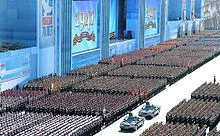
Russia troops march in 2015 military parade in Moscow.
To members and friends of the Providence Committee on Foreign Relations (thepcfr.org; pcfremail@gmail.com).
For news about non-PCFR local events and an article or two that caught our eyes, please go to the bottom of this memo.
Meanwhile, with Russian intrusion into American politics and government such an issue, we thought it would a good idea to recruit a Russia expert to start off our season. Thus we have the distinguished Prof. David R. Stone of the U.S. Naval War College lined up for Wednesday, Sept. 13.
He'll explain Putin and the new Russian nationalism and how it affects us.
Professor Stone received his B.A. in history and mathematics from Wabash College and his Ph.D in history from Yale University. He has taught at Hamilton College and at Kansas State University, where he served as director of the Institute for Military History. He has also been a fellow at the Center for Advanced Study in the Behavioral Sciences at Stanford University. His first book Hammer and Rifle: The Militarization of the Soviet Union, 1926-1933 (2000) won the Shulman Prize of the Association for Slavic, East European, and Eurasian Studies and the Best First Book Prize of the Historical Society. He has also published A Military History of Russia: From Ivan the Terrible to the War in Chechnya (2006), and The Russian Army in the Great War: The Eastern Front, 1914-1917 (2015). He also edited The Soviet Union at War, 1941-1945 (2010). He is the author of several dozen articles and book chapters on Russian / Soviet military history and foreign policy.
The next dinner after that will be with French Consul General Valery Freland, who will talk about how the French presidential-election outcome might change that nation’s foreign policy and the Western Alliance, on Wednesday, Sept. 27. By the way, he went to school with French President Macron.
Then on Wednesday, Oct. 11, Graham Allison, who has been running Harvard’s Belfer Institute, will talk about, among other things, Chinese expansionism in the South China Sea. He'll talk about his new book Destined for War: Can America and China Escape Thucydides's Trap?
On Wednesday, Nov. 1, comes Michael Soussan, the writer and skeptic about the United Nations. He’s the author of, among other things, Backstabbing for Beginners, about his experiences in Iraq, which is being made into a movie starring Ben Kingsley.
In January, at a date to be announced, we’ll have Victoria Bruce, author of Sellout: How Washington Gave Away America's Technological Soul, and One Man's Fight to Bring It Home. This is about, among other things, China’s monopolization of rare earths, which are essential in electronics.
On Wednesday, Feb. 21, we'll have Dan Strechay, the U.S. representative for outreach and engagement at the Roundtable on Sustainable Palm Oil (RSPO), who talk about the massive deforestation and socio-economic effects associated with producing palm oil in the Developing World and what to do about them.
Prior to joining the RSPO, he was the senior manager for Sustainability Communications for PepsiCo.
The dates of the dinners for the rest of the season to be announced.
Suggestions for speakers and topics are always much appreciated. We’re all in this together.
In other news:
For movies and other upcoming events about Brazil at Brown’s Watson Institute, see:
http://watson.brown.edu/events/series/brazil-initiative
Hear Edward Luce talk about the decline of Western liberalism:
http://watson.brown.edu/events/2017/edward-luce-retreat-western-liberalism
Former Timor Leste President Xanana Gusmao will speak on Monday, Sept. 18 at the Pell Center at Salve Regina University, Newport. The event will begin at 11 A. M.
Timor Leste itself is at a crossroads. The clock is winding down on a novel test of dispute resolution, a first-time effort under the United Nations Convention on the Law of the Sea (UNCLOS) to settle a maritime boundary dispute not through arbitration, but through mediation. The principals in this dispute are the young democracy of Timor-Leste and its neighbor, Australia.
Meanwhile, scary North Korean news. See:
https://www.theguardian.com/world/live/2017/sep/03/north-korea-nuclear-test-south-korea-yohap-kim-jong-un-live
President Macron may actually succeed in fixing French labor law. See:
https://www.washingtonpost.com/world/europe/emmanuel-macron-scores-a-win-where-presidents-failed-to-overhaul-frances-labor-laws/2017/09/01/049c9222-8f14-11e7-9c53-6a169beb0953_story.html?utm_term=.40828bb11738
China uses money to try to curb free speech about it at American colleges
Adapted from Robert Whitcomb's "Digital Diary,'' in GoLocal24.com.
Americans should worry about the increasing efforts of Chinese interests to try to curb free speech about that nation at U.S. and other Western colleges and universities, including some prestigious New England schools, such as Harvard. This push for self-censorship includes financial incentives by big donors linked to these regimes and threats to curtail access to the hugeChinese market.
There was at least a modest victory against the march of the dictators when Cambridge University Press reversed itself and decided to republish hundreds of articles on its Chinese site that the university had previously supinely blocked at Beijing’s request.
The Wall Street Journal reported that Cambridge had “blocked more than 300 articles dealing with sensitive topics ranging from pro-democracy Tiananmen Square protests to Tibet on its Chinese site.’’
In reinstating the articles after academics denounced the self-censorship, Cambridge University Press said: “Academic freedom is the overriding principle on which the University of Cambridge is based.’’ Good to hear, if belated!
Of course, severe Chinese government censorship of the Internet in that nation will continue, as will efforts by Chinese interests to silence criticism of the regime wherever they can around the world. Those who believe in liberty and free inquiry shouldn’t be encouraging these authoritarian aggressions.
John Pomfret, former Beijing bureau chief of The Washington Post, described the regime’s efforts in a Post essay headlined “China’s odious manipulation of history is infecting the West’’. Among his remarks:
“China’s move to demand self-censorship {by Cambridge} is not an isolated case. It’s just one of many the Communist government has taken in recent years to mold history and historians to serve the needs of the Chinese Communist Party. Party boss Xi Jinping has led a campaign against what he calls ‘historical nihilism,’ the party’s shorthand for attempts to write honestly about the past and mistakes committed by China’s Communist leaders. As part of that campaign, historians and writers have been silenced and jailed, books have been banned and party censors have launched a nationwide campaign to expunge any positive mention of Western political ideas from Chinese college textbooks.’’
.

Procedural religion and bad roads
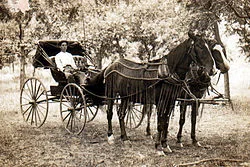
''Even after thirty years, I still think New Englanders sound funny, that they expect too much of the Red Sox, that their religiosity is procedural than deeply felt, and that their highways were built with the conviction that automobiles could not possibly replace the horse-drawn buggy, and therefore need not be wide, permanent, or especially well-designed.''
-- C. Michael Curtis, in Contemporary New England Stories (1992)

The interior of the Arlington Street Church, in Boston, sometimes called "The Unitarian Vatican.'' The old line about the Unitarians was that they respected "The fatherhood of God, the brotherhood of man and the neighborhood of Boston.''
Cute, and you don't have to walk her

"Yellow Lab'' (Raku fired ceramic), by Ronnie Gould, at the Patricia Ladd Carega Gallery, Center Sandwich, N.H.
September smells

"The breezes taste
Of apple peel.
The air is full
Of smells to feel --
Ripe fruit, old footballs,
Burning brush,
New books, erasers,
Chalk, and such.''
-- From "September,'' by the late John Updike, who lived most of his adult life on the Massachusetts North Shore.
5 new solar farms in Mass.
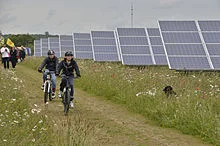
This is from the New England Council (newenglandcouncil.com):
"New England Council (NEC) members Blue Cross Blue Shield of Massachusetts and Ameresco are celebrating the opening of five new solar farms across Massachusetts.
"Three of the projects are on the 650-acre Twin Elm Farm in Mendon and the other two are in Hopedale. The projects hold a combined 6.9 megawatts of renewable power and will increase solar production in Massachusetts by 13%, lower carbon emissions and help almost 200 local residents and businesses to lower their electricity bills. The solar farms are owned by Ameresco, co-developed by BlueWave Solar and supported by Blue Cross Blue Shield, which purchased 2.6 MW of net metering credits that will be applied to its utility bills. The opening of the solar farms was celebrated with ribbon cutting at the Twin Elm Farm in Mendon in August 2017.
“'Community solar projects like these allow local citizens and businesses to benefit directly from the energy produced by these projects,' said Michael T. Bakas, Senior Vice President, Ameresco. 'We are honored to support Blue Cross, a leader in providing high-quality health care, in their efforts to positively impact the environment. Their commitment to sustainability and environmental stewardship is a model for all to follow.”'
Realty tax breaks benefit whom the most?
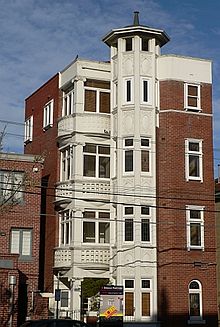
Adapted from Robert Whitcomb's "Digital Diary,'' in GoLocal24.com:
This comment from the Providence Rules Web site is well worth discussion in most cities:
“The City of Providence is giving away tens of millions of dollars in tax subsidies to real estate developers to do what they were going to do anyway. Booming demand for residential housing — particularly rental units for students and trainees in our educational and healthcare institutions — has made real estate development a profitable enterprise without any government subsidy. These real estate tax subsidies are not enhancing economic development in Providence. They are simply enriching a few individuals at the expense of the rest of us.’’
Hit this link to read more.
The taxes that others don’t pay because of these deals, the rest of us have to make up for. And the hype of the entry into a city of a big-name company obscures that, say, 10 smaller, little-known companies may be leaving. Of course, sometimes a big, famous company comes in and starts buying a lot of goods and services from local companies. Economic development is complicated.
Kitschy but lovable
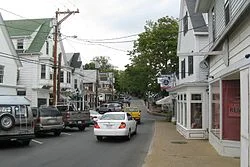
Downtown Vineyard Haven.
"{In Vineyard Haven} I like the whole barefoot, chattering melee on Main Street -- even, God help me, the gawking tourists with their Instamatics (a now extinct camera} and their avoirdupois. I like the preposterous gingerbread bank and the local lady shoppers with their Down East accents, discussing bahgins.
-- The late novelist William Styron, from "In Praise of Vineyard Haven,'' in On the Vineyard II (1990).
Linda Gasparello: Cruising and learning on the Baltic and beyond

Photos by Linda Gasparello
Photo taken from under one of St. Petersburg's 400 bridges. There are four rearing horses in the bridge.
To take or not to take shore excursions. That is the question for cruisers.
Having cruised on five continents, my answer is to take them. The guides are competent — mostly moonlighting high school teachers and college professors — and often they’re characters.
The first cruise my husband, Llewellyn King, and I took, on the Black, Aegean and Adriatic seas in the early 1990s with the now-defunct Royal Cruise Line, introduced us to shore tour theater.
In Constanta, Romania’s largest and most important port city on the Black Sea, our shore excursion guide was a droll fellow named Mikhail. We visited the city not long after dictator Nicolae Ceausescu and his wife, Elena, were tried by a hastily arranged military tribunal that was set up on Dec. 25, 1989, put up against a wall and shot, all within an hour. It was a city still in shock from 24-years of their mismanagement that brought food shortages in a country with dark, rich soil; torture and executions, and, most famously, state neglect of orphans and disabled children.
During our tour of the city, we stopped at a Belle Epoque hotel, where, Mikhail told us, “Nazi leaders lodged comfortably in the early years of World War II.” The hotel manager made us feel welcome by setting out trays with tiny fruit tarts and small glasses of tuica (Romanian “white lighting” made from plums) on a large table in a paneled, ground-floor reception room. As we entered the room, the staff, who stood at the opposite end, watched as most of us sampled the tarts and tuica. As the last person in our group walked out of the room, I looked back and saw the staff make a dash for the table, grabbing whatever was left.
We traveled north to the Greco-Roman city of Histria. Mikhail gave us a detailed tour of the city, which was founded by Greeks in the 7th century BC and thrived for seven centuries. He interspersed his commentary about Histria, which became the richest city in Ionia (Asia Minor), with sarcastic comparisons to Romania’s “golden age under the Ceausescus.”
We returned to Constanta on a coastal road. Nearing the city, we saw thick pipes that seemed to stretch for miles along a beach. “That would be a beautiful beach, but the pipes lead to a chemical plant that Mrs. Ceausescu built. She had a doctorate in chemistry, but she did not even graduate from high school. Fancy that!”
Mikhail said Mrs. Ceausescu was nicknamed “Codoi,” referring to her mispronunciation of the chemical compound CO2 ( “C” for carbon, “O” for oxygen, and “doi” which is Romanian for “two”). He added that “codoi” was a word in Romanian, too, meaning “big tail.”
“Her big tail was her nose. She would kill anyone who took her picture in profile,” he said.

Pastel colored buildings on the Neva River embankment, St. Petersburg.
For nine days this month, Llewellyn and I cruised the Baltic Sea on the Getaway, a Norwegian Cruise Line megaship. Anna, our guide on a day cruise along the Neva River in St. Petersburg, was a notable shore tour entertainer.
On the bus, as we drove from the cruise ship to the river boat, Anna told us that men in Russia were “as precious as diamonds. So ladies, hold onto your husbands. Do not lose them. And please send us your sons, nephews, brothers, uncles.”
Anna teaches Russian history in a St. Petersburg high school, and she wrangled us as though we were her students on a field trip. She taught us how to say “I love you” in Russian. “Ya lyublui vas. Just say, ‘yellow blue bus.’ We Russians are so emotional.”
The sunny day brought out what Anna called her “Russian emotions.” Pointing to the buildings decorated like wedding cakes along the river, many designed by the 18th-century Italian architects Bartolomeo Rastrelli and Carlo Rossi, she said, “Rastrelli, who built the Winter Palace, which you can see along the embankment, liked pale blues and greens, and Rossi liked pale yellow. These colors make us happy. They are good for our emotions.”
So, too, is vodka. Anna said, “When you have a cold, you drink vodka with lemon. When you have a headache, you drink vodka with pepper. And when you are depressed, you drink vodka.”
But the funny lady was serious about showing us St. Petersburg’s historical sights: no significant edifice on the banks of the Neva or ship moored on it (including the great, gray cruiser Aurora which fired the blank round at 9:45 p.m. on Oct. 25, 1917 that started the Bolshevik Revolution) escaped her commentary.
“Just look at the taste and temperament of Peter the Great. Here is his small, elegant Summer Palace. But across the river, on Vasilyevsky Island, is the Peter and Paul Fortress, which he designed. It was the Bastille of the tsars,” Anna said.
Across from the fortress, she pointed to the Soviet-era KGB (now FSB) headquarters. “That’s the ‘Big House,’ ” she said.
Those of us seated on the upper deck were grateful that Anna was serious about reminding us to duck when we approached one of the many low bridges across the Neva.
“Please keep seated,” she said. “But if you want to be like Catherine the Great and get rid of your husband, have him stand up.”
How emotional, how Russian.

While I prefer to go to souvenir shops of my own volition, I’ve stopped resenting being shanghaied into them on cruise shore excursions. Sometimes, they’re sights that shouldn’t be missed, like the Grand Bazaar in Istanbul: a maze of souvenir shops.
After our Neva River day cruise, we were bussed to a cavernous souvenir store. Norwegian Cruise Line billed it as a “bathroom stop.”
It was just that, for some on our bus. But busloads of tourists, including many on ours, were just raring to hit the mirrored shelves laden with fur hats, amber jewelry, Faberge-style Easter eggs and matroyshka dolls — especially after getting emotional on complimentary cranberry vodka, served at the entrance by young women wearing traditional, red jumper dresses.
Against a wall, near one of the store’s side exit doors, stood colossal Presidents Vladimir Putin and Donald Trump matroyshka dolls. As I took a picture of them, I heard one shopper say, “Same size as their egos.”
The store occupies part of what was once a movie theater in St. Petersburg. The theater’s architecture is Stalinist big box. The huge concrete-slab marquee over the entrance advertised four movies or other events. Riveted onto cement columns near the entrance are metal sheets imprinted with scenes of bears frolicking in a forest, peasants threshing wheat, and people going about their business on a wintry day in St. Petersburg. There is one of Russian troops tending their wounded in the Crimean War – a war that stirs up sacred memories, leading to actions even unto this day.
More is more. That was the approach of the two greats, Peter and Catherine, and Empress Elizabeth asked their European architects to take in St. Petersburg.
The city’s historic center is a feast — a grand bouffe — of Baroque and Neoclassical buildings, including the Admiralty, the Winter Palace, and the Marble Palace. UNESCO designated it a World Heritage site in 1990, noting, “The unique urban landscape of the port and capital city of Saint Petersburg, rising out of the Neva estuary where it meets the Gulf of Finland, was the greatest urban creation of the 18th century.”

Lahkta Center.
The more-is-more approach is operating today with the construction of the Lahkta Center, which includes a twisting glass-and-steel tower that will serve as the headquarters of the state-owned energy giant Gazprom. The project, which was proposed in 2005, has changed its name (as many times as St. Petersburg) and location, due to criticism from preservationists and residents that its 1,515-foot tower — which will be the tallest in Russia — would destroy the city’s horizontal harmony and violate a law prohibiting new buildings higher than 157 feet in the historic center.
In 2010, the project moved to a site northwest of Vasilyevsky Island, overlooking the Gulf of Finland. It is scheduled for completion in 2018.
Designed by the architectural firm RMJM London, the center’s website says “the tower bears more than a passing resemblance to a ship’s mast, while the building that lean against its base represent the hull. This theme continues through the wave-like bearing structures and the overall organic form of the building, both of which symbolize the power of the sea.”
The project already holds a Guinness World Record. Between Feb. 27 and March 1, 2015, it set a new record for largest continuous concrete pour, with 25,667 cubic yards poured over a period of 49 hours.
Some of the Lakhta Center’s remarkable innovations include:
- It will be the first skyscraper in St. Petersburg to employ an ice formation-control system. To prevent ice accumulations and help maintain good visibility, the glass on the highest floors will be heated; and to prevent ice formation, the tower’s spire will be made of metal gauze.
- The center’s lighting will be designed to make it bird-safe during migration in the fall and winter months, complying with the World Wide Fund for Nature and FLAP’s (Fatal Light Awareness Program) bird-friendly building program.
This project has Petrine boldness. While it could suit a man who would be a great, Putin, he has yet to weigh in on it.
Linda Gasparello is a veteran journalist and co-host of White House Chronicle, on PBS.
Look, don't hug
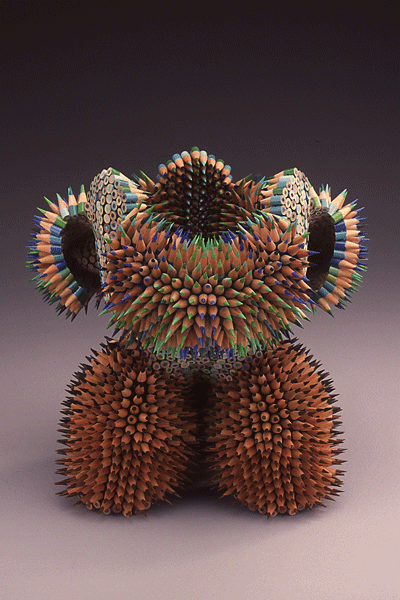
"Naiad'' (pencils), by Jennifer Maestre, in the show "Wood as Muse,'' at the Art Complex Museum, Duxbury, Mass., through Sept. 3.
Llewellyn King: Houston may bring about sea change in climate public policy
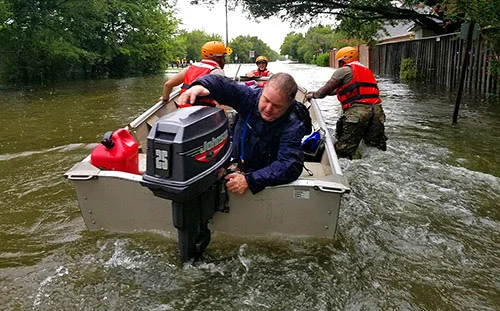
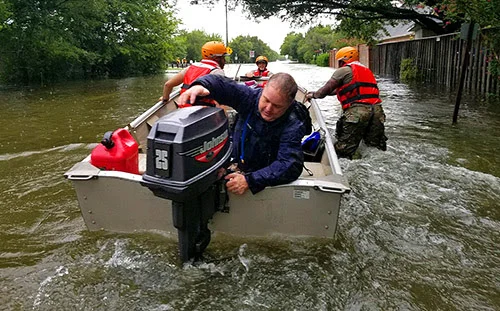
On a street in Houston this week.
Almost every word that can be used to describe a disaster has been used to describe the one that has befallen Houston. But there is one that hasn’t been used yet: seminal. It means a work, event, moment or figure strongly influencing later developments.
The flooding of Houston and the Gulf Coast is such an event. It will influence public policy for decades to come.
First, there is going to be the gigantic national job of rebuilding the nation’s fourth-largest city — and quite possibly abandoning large parts of it. It will affect property values in flood-prone cities, like Miami, New Orleans, New York and Tampa, Fla. It will result in urgent calls for the construction of new flood barriers, or the beefing up of those that already exist in cities like Providence and New Bedford, Mass.
Going forward, there will be a new existential threat felt in the United States: climate uncertainty. It will not matter whether the Houston disaster is linked to the burning of fossil fuels. What will matter is that the warnings of dramatic changes in climate will have an influence they have not hitherto had.
The sky has fallen.
The aberrant weather — which has not only assaulted Houston, Beaumont and Port Arthur, Texas, with flooding but also, among other weather disasters around world, to agriculture in much of Sub-Saharan Africa with severe drought — now will be a real concern to Americans. We will start to take notice of floods in faraway places.
Leaving aside whether human activity is contributing to the disasters, climate uncertainty will move to the very front of the national agenda, and it will influence our politics and sensitize us to the warnings of scientists. Those who have thought climate change to be some kind of liberal scheme to punish big coal, big gas and big oil will get short shrift in the court of public opinion.
President Trump went out on a limb, urging more coal production, trashing the Paris climate accord, disbanding the federal advisory panel for the National Climate Assessment, shrinking the Environmental Protection Agency and undoing its rules, including the Obama-era Clean Power Plan. But the Houston disaster may have him climbing back.
There will be other changes affecting public policy as the nation moves forward. A debt ceiling increase without a shutdown is now assured: No one in Congress or the White House will want stories of Federal Emergency Management Agency employees being furloughed while people are still in shelters in and around Houston — and where they might be for a very long time.
There might be a change ahead for Trump’s plan, still vague, for a tax overhaul. Large tax cuts may not be appealing to Congress as it contemplates the enormous new costs for cleanup, demolition and construction along the Gulf Coast, and for fortifying coastal cities.
Texas will be seeking and getting masses of federal aid. With its powerful congressional delegation and political friends at all levels in the Republican Party, Texas will be hard to deny. It is going to be all Texas, all the time on the news and on Capitol Hill for weeks and months, even years.
Meanwhile, huge flooding in Bangladesh, India and Nepal will help to buttress climate fear. According to the United Nations, The New York Times reports, at least 41 million people in those three countries have been directly affected by flooding and landslides resulting from severe monsoon rains this summer; and more than 1,000 have died in floods across South Asia.
This will increase the pressure on the Trump administration to make climate a policy priority. If the president won’t, Congress will; and it will be because of Houston. New electric generation — wind, solar and possibly nuclear — and electrified cars and trucks will be the winners.
It’s no longer the economy, stupid. Now it’s the climate, stupid — and it will be for decades. Something truly seminal has happened.
Llewellyn King (llewellynking1@gmail.com) is executive producer and host of White House Chronicle, on PBS, and a frequent contributor to New England Diary. This first ran in Inside Sources.
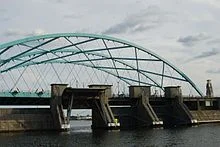
The hurricane barrier in Providence.
Sharks off the beach!

White shark cruising the surface.
Photo by Brocken Inaglory
Adapted from Robert Whitcomb's Digital Diary, in GoLocal 24.com
Every time there’s a very rare (and always much publicized) attack by a white shark on swimmers or surfers (or surfboards) off Cape Cod, there’s a new proposal to kill as many of these creatures as possible off the Cape’s beaches. Consider the proposal that surfaced last week to use drum line traps to kill the sharks. That’s a terrible idea. Sharks are part of the eco-system and wiping them out in certain waters will hurt other species, too. Everything in the sea is connected.
The best advice to swimmers and surfers in waters known to be occasionally visited by sharks is not to go out beyond the surf line. White sharks, the scariest ones, like deep water and usually attack prey from below. It’s good to remember how rare shark attacks on people are in New England, with no more than half a dozen in Massachusetts since 2000. (There’s some confusion about the exact number of documented attacks.) The last fatal attack in the state was off Mattapoisett, on Buzzards Bay, in 1936.
The seal population has swollen along the southeastern New England coast in recent years, attracting sharks. If you see seals, you might want to keep closer to the shore. At the same time, people are using the beaches more than ever. But that’s no excuse for humans to destroy yet another piece of the marine eco-system.
Meanwhile, with global warming, we may see more white sharks on the New England coast.
Sculpture and poetry
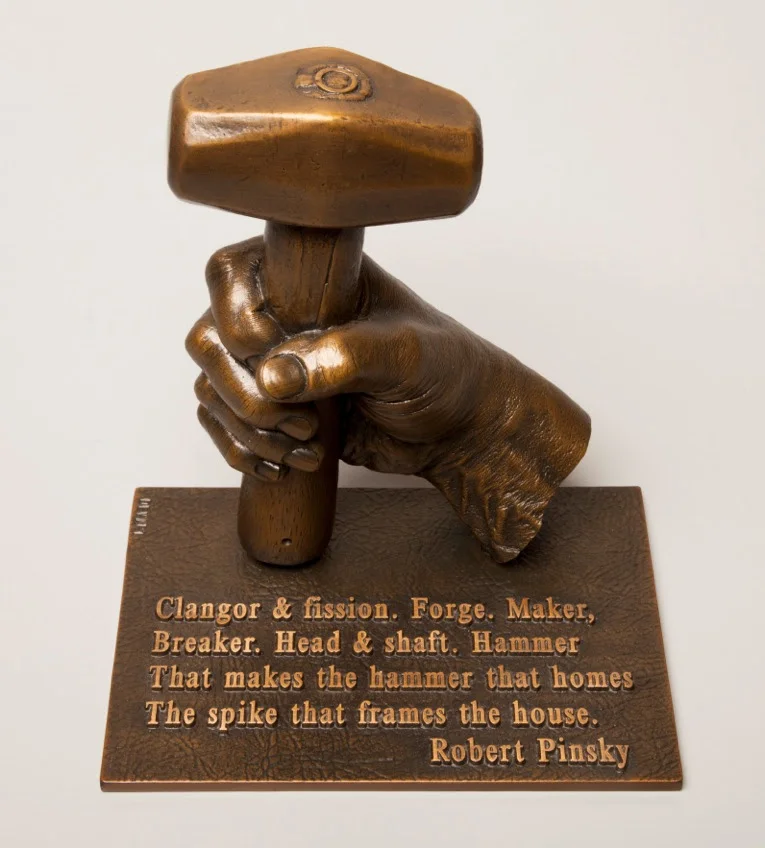
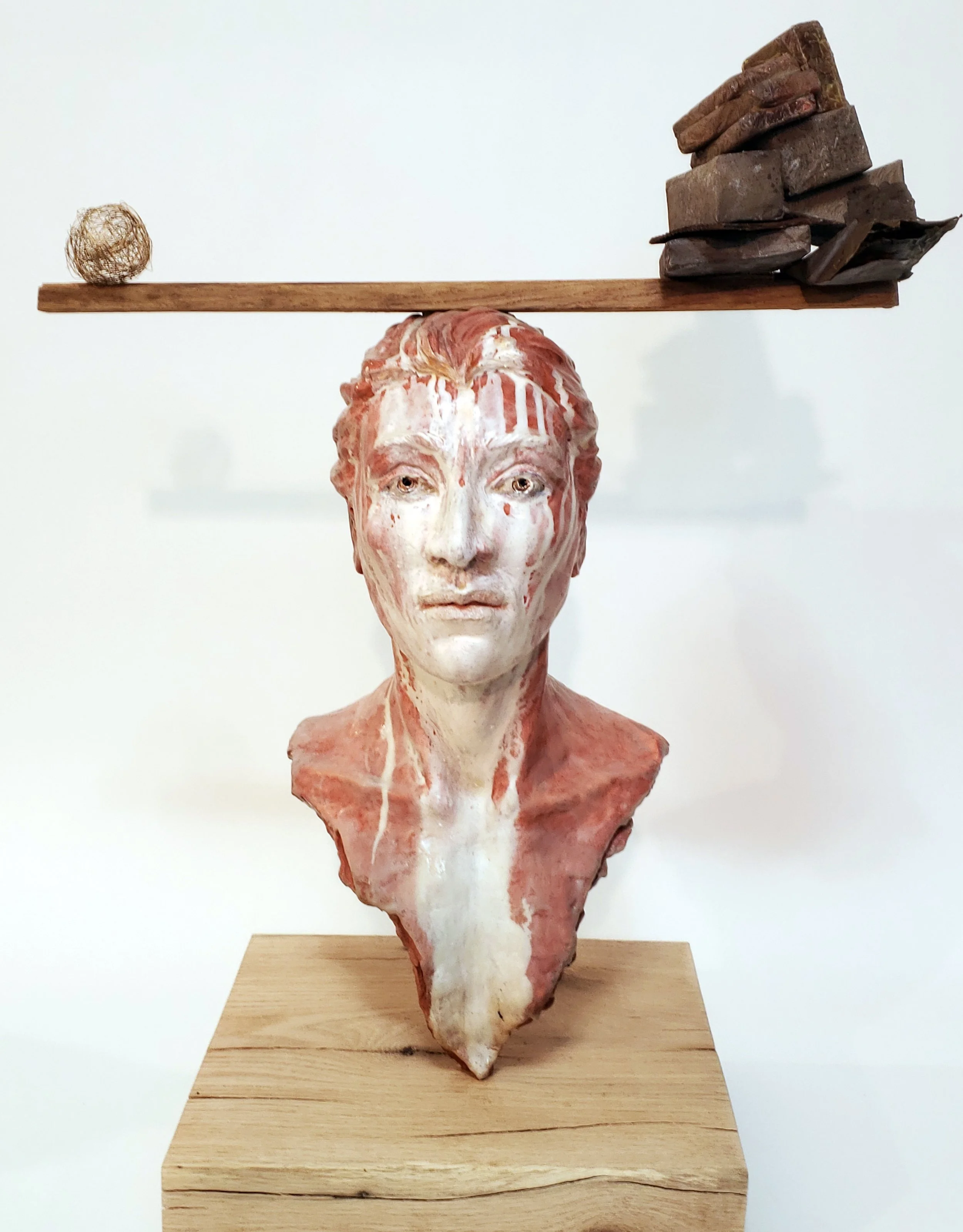
Work by Murray Dewart, in his show "Spirit Level,'' at Boston Sculptors Gallery, through Oct. 1
'''Spirit Level' features new work by Murray Dewart. An illuminated gateway, tall and translucent, looms in a darkened interior, while a beautiful soulful sound track plays. A large water vessel is accompanied by projected video imagery of gardens and parks, creating a lyrical meditation on the natural world. Several small bronzes fill one wall, and a fine example of Dewart's signature one-ton granite and bronze gates is also on display.
"Dewart is an internationally recognized sculptor. For over thirty years, he has been recognized by Boston Globe critics for his craft, his spiritual understanding, and for his serene sculptures reflecting the quest for a universal language of form. Christine Temin wrote, 'Dewart has a fine gift for creating not just a pleasing play of shapes, but shapes that have something to say...and a lesson for living.' Cate McQuaid praised his work's 'quiet majesty and spiritual gravity.'
''Dewart is the editor of the Random House anthology: Poems About Sculpture. Recently, he has been traveling around the country giving readings along with former U.S. Poet Laureate Robert Pinsky (see sculpture above), who wrote the book's introduction. ''
Jill Richardson: Amazon selling farm-fresh electronics at Whole Foods
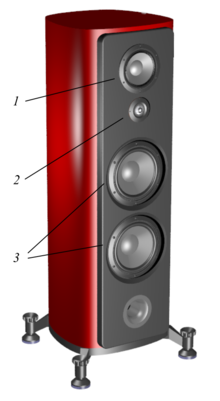
Home loudspeaker.
Via OtherWords.org
Now that Amazon’s taken over Whole Foods, the "natural-foods'' grocery known for its high prices, the new owners have pledged to lower prices.
I stopped by the store to see what had changed. In addition to a few discounts — organic apples went from $2.99 to $1.99 per pound — I noticed a big display in the middle of the produce section.
“Farm Fresh,” it read. “Just Picked.”
What agricultural product was this ad for? Amazon Echo — a wireless speaker.
Presumably Amazon grew the electronic devices on a nearby farm and, once ripe, harvested them off the vine and shipped them to the produce aisle in my local Whole Foods.
The same day, while browsing hiking socks online, I came across a brand I hadn’t seen before called Farm to Feet.
Seriously? Farm to Feet?
It’s true that wool — and the socks were mostly made of wool, in addition to a few synthetic fibers like spandex — comes from a sheep, and sheep are raised on a farm. The socks certainly had more of a connection to a farm than an Amazon Echo.
But I think we can officially say that “Farm to Table” has jumped the shark.
Initially, sellers who claimed to offer “Farm to Fork,” “Farm to Table,” or “Farm to School” goods supported a closer connection with your local farmer.
The idea was — and is — a great one. Get to know a local grower and learn more about where your food comes from. Support a local business. Better yet, you’ll get to eat foods that are fresh picked because they weren’t shipped halfway across the world in order to reach you.
One farm I visited near my home in Southern California grows blackberries that are bigger than some plums. These juicy giants simply can’t survive shipping. You can eat them locally or not at all.
When I lived in the Midwest, my favorite local farmer grew luscious varieties of pears and apples I’d never heard of before. They’re more delicious than apples I’ve found at any grocery store.
Often, when farmers sell directly to consumers, it’s a win-win. Farmers can charge higher prices than they can charge wholesalers, while consumers pay lower prices than they’d pay at a store.
When restaurant chefs work with farmers, they can ask farmers to grow specific varieties they want to serve, and promise the farmers a guaranteed market for their produce once it’s harvested.
My local school system found that smaller sized fruits, which farmers would otherwise be unable to sell, were the perfect size for young schoolchildren. Their Farm to School program gave a market to nearby growers while providing nutritious food to kids for lunch.
But advertising a pair of socks as “Farm to Feet” because the wool came from some farm, somewhere — that’s missing the point.
As for advertising electronics as “Farm Fresh,” I have no words. I’ve visited a lot of farms on five continents, and I’ve yet to meet a farmer who grows electronics.
Getting to know where your food comes from is a great idea. Supporting farmers in your community is wonderful. It’s a privilege that not everyone has, and it’s enriched my life immeasurably to be able to thank the people who grow my food face to face.
But for some, it’s just a marketing slogan. If your product doesn’t directly connect consumers to farmers, you shouldn’t advertise it as “Farm to” Anything.
Jill Richardson is the author of Recipe for America: Why Our Food System Is Broken and What We Can Do to Fix It.
How microbiomes affect disease
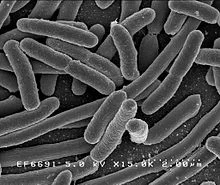
Escherichia coli: a long-term resident in our gut
This is from the New England Council (newenglandcouncil.com):
"IBM and Massachusetts General Hospital (MGH) are joining forces to study how human microbiomes affect various diseases.
"In collaboration with the Broad Institute, the University of California {at} San Diego and the Simons Foundation’s Flatiron Institute, IBM and MGH will attempt to map the three million bacterial genes found in the human microbiome to further understand how to treat diseases such as Type 1 diabetes, Crohn’s disease, and ulcerative colitis. Research at this level is unprecedented and a massive amount of computing power is required for analysis which is where IBM’s 'citizen science' World Community Grid enters the picture. The World Community Grid is a hyper-secure software that can gauge when a personal computer has processing power to spare and then remotely run experiments for the project. Anyone with Internet can chose to contribute to the study by joining the Microbiome Immunity Project through IBM’s World Community Grid.
“'This type of research on the human microbiome, on this scale, has not been done before,' said Ramnik Xavier, co-director of the Infectious Disease and Microbiome Program at the Broad Institute of MIT and Harvard and chief of the gastrointestinal unit at MGH. 'It’s only possible with massive computational power.'''
'Treetops seething'
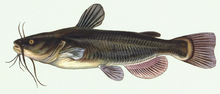
Bullhead
"I was fishing in the abandoned reservoir
back in Quinapoxet {Mass.},
where the snapping turtles cruised
and the bullheads swayed
in their bower of tree-stumps,
sleek as eels and pigeon fat.
One of them gashed my thumb
with a flick of his razor fin
when I yanked the barb
out of his gullet.
The sun hung its terrible coals
over Buteau's farm: I saw
the treetops seething.''
From "Quinapoxet,'' by Stanley Kunitz
Too hot not to cool down

"But now in September the garden has cooled, and with it my possessiveness. The sun warms my back instead of beating on my head ... The harvest has dwindled, and I have grown apart from the intense midsummer relationship that brought it on."
-- Robert Finch

Robert Whitcomb: Banned and enjoyed in Boston

Scollay Square, Boston, in the late 19th Century. The neighborhood was a center of "sin'' for many decades. The square is long gone.
A version of this first ran in The Boston Guardian
Wicked Victorian Boston, by Robert Wilhelm (History Press, $21.99)
In this entertaining and well-illustrated, if sometimes repetitive, anecdotal survey of “vice’’ and efforts to control it in mid- and late 19th-Century Boston, Mr. Wilhelm looks at how the remnants of Puritan Boston sought to suppress the widespread prostitution, drunkenness, drug abuse, gambling and occasional murder and mayhem that you'd find in any large American city of that time – and ours.
All this titillated residents of other, more, er, relaxed cities given Boston’s reputation for straight-backed rectitude, which wentback to the 17th Century.
The author tries to put the behavior in the context of the city’s rapidly changing ethnic and socio-economic environment. For instance: “The changing ethnic complexion of Boston in the Victorian era was also altering the nature of vice in the city. The rapid influx of Irish immigrants was disconcerting for the old Yankees; they despaired at the newcomers’ fondness for hard drink and gambling and feared that the Catholic newcomers would owe their first allegiance to the pope….’’
But some members of the Yankee community, both Brahmins and middle class, also enthusiastically participated in the sin community, as “young debutantes dabbled in pornography; civic leaders were sued for domestic abuse and {mostly Protestant} clergymen were charged with adultery.’’
Mr. Wilhelm often focuses on such centers of sin and iniquity as “The Black Sea,’’ along the waterfront, and later, the West End. In these places illegal gambling, prostitution, drunks, violence and con men were thick on the ground. Later on, a thriving Chinatown offered such new services as opium dens. Gambling activities included such ghastly spectator “sports’’ as betting on how many rats a dog could kill in a “rat pit’’. Meanwhile, the “third tier’’ of theaters became venues for prostitution. Even such seemingly innocent (if bizarre) sporting events as “pedestrian races’’ would be tinctured with corruption.
Then there were such scams as spiritualists promising access to the dead and quack “doctors’’ selling their services to the gullible. I particularly enjoyed reading about the latter professionals, who provided “oxygenized air’’ (nitrous oxide) for all matter of ailments.
To confront the perceived moral collapse were such anti-vice crusaders as the Methodist minister Henry Morgan and the wonderfully named New England Society for the Suppression of Vice, later to be called the Watch and Ward Society. But, as Mr. Wilhelm writes, that “{The} lines of morality were becoming blurred, and social standing was not a solid indicator of righteous behavior’’ made the war more difficult to wage. (When and where was social standing a “solid indicator of righteous behavior”?)
The anti-vice community succeeded in driving some gambling establishments and brothels out of business, and temperance organizations, in which women had major roles, succeeded in closing some of the worst saloons. Still, human nature remained human nature and new criminal enterprises arose as Boston entered the 20th Century, especially what we now call “organized crime’’.
Now that Boston has become a much more secular and international city these battles over morality seem rather quaint.
Robert Whitcomb is editor of New England Diary and president of the board of Guard Dog Media, which owns The Boston Guardian.