
Vox clamantis in deserto




David Warsh: Invasion of Iraq was America's 21st Century original sin

U.S. soldiers at the Hands of Victory monument in Baghdad during the invasion of Iraq in 2003.
SOMERVILLE, Mass.
Fourteen years ago today, a U.S.-dominated coalition of forces began bombing Baghdad. The U.S. had demanded that Saddam Hussein leave Iraq within 48 hours. When he didn’t, coalition forces attempted to kill him and his sons in the first hour of their “shock and awe” bombing campaign, beginning the morning of March 19, 2003. George W. Bush went on television that evening to describe the purpose the war to follow: “to disarm Iraq, to free its people, and to defend the world from grave danger.”
The invasion of Iraq was the fulcrum on which much has shifted since. Vladimir Putin’s speech in February 2007 to the Munich Conference on Security Policy dissented sharply from Washington’s vision of a unipolar world and warned against further NATO expansion along Russia’s southern borders.
The “Arab Spring,” beginning in Tunisia in late 2010 (“gripped by the narrative of a young generation peacefully rising up against oppressive authoritarianism to secure a more democratic political system and a brighter economic future,” in one interpretation), swept through Egypt, Libya, Yemen and Syria with profoundly mixed results.
The Islamic State of Iraq and Syria (ISIS) found its footing in the villages and towns along upper Euphrates and Tigris rivers, accelerating the European refugee crisis and contributing to Britain’s vote to leave the European Union. The fall of a friendly government in Kiev in 2013 led to Russia’s annexation of Crimea and civil war in Ukraine. The financial crisis of 2008-09 proceeded separately, contributing greatly to the strain.
The disaster in Iraq is well understood. The best book I know on the war itself is Overreach: Delusions of Regime Change in Iraq (Harvard, 2014), by Michael MacDonald. The broader context is well covered in America’s War for the Greater Middle East: A Military History (Random House, 2016), by Andrew Bacevich. Rise of the Vulcans: The History of Bush’s War Cabinet (Viking, 2004), by James Mann, traces its origins to the experience of America’s defeat in Vietnam.
Yet like a repressed bad dream, the decision to invade Iraq is routinely overlooked as a landmark event. George W. recanted only in joking. Solidarity with his brother helped cost Jeb Bush a primary campaign he was expected to win. Hillary Clinton’s slippery views on Iraq counted against her in the recent election and almost certainly cost her the 2008 Democratic nomination. And Donald Trump, skewered when he claimed he had opposed the war before it started, has scarcely mentioned it since.
As for the newspapers, the editorial board of The Wall Street Journal still thinks that the war was a great idea. The Washington Post has renounced its zest for the war only a little. Even The New York Times has trouble remembering the role its coverage played in fomenting the war. Economicprincipals.com, my Web site, still burns with shame.
The U.S. made various mistakes in the 1990s, when it stood alone as the as the world’s dominant power, but there is a sense in which invasion of Iraq was the 21st Century's original sin, costing credibility around the world – never mind the lives of 5,000 of its soldiers, those of at least half a million Iraqis, and some $3 trillion so far. Until the U.S. comes to terms with its miscalculation, it can expect to misunderstand and be misunderstood
The aftermath of the war is central to today’s controversy with Russia. And with Secretary of State Rex Tillerson warning of a much harder line against North Korea, it could hardly be more relevant. Let March 19 become a national day of reflection.
David Warsh, a longtime columnist on economic, political and media affairs, is proprietor of economicprincipals.com, where this first ran.
Llewellyn King: Look around the world for what works best in health-care systems
''Nothing is ever done until everyone is convinced that it ought to be done, and has been convinced for so long that it is now time to do something else. ''
— F.M. Cornford
There are no simple solutions to complex problems — unless they’ve become so complex that only a simple solution will do. Welcome to health care and insurance in all of their complexity.
Engineers like to say that if a new machine of structure has too many parts, it’s not ready. Not a bad idea to keep in mind when creating a societal structure like health care. One should know where one wants to go; knowing what one doesn’t want isn’t a starting point.
I submit that the goal of health policy, stripped of its advocates, denigrators and rentiers, should be to get everyone insured for the minimum amount of money and best care result. Simple, eh?
Some aspects:
There ought to be enough money for the United States to have universal health care, not a patchwork — a crazy quilt with holes and weak seams. We spend 19 percent of our GDP on health care, but Germany and the Netherlands spend just under 12 percent of theirs on hybrid public/private, comprehensive systems.
Insurance is a probability game, ergo it’s not unreasonable to ask the able-bodied to pay for the sick.
Mandates are not alien to us. We are mandated to pay taxes, drive with licenses and even wear clothes.
The more people covered by insurance, the lower the cost to all.
There seems to be no good explanation in the public record as to why medicine is so expensive in the United States — so much more expensive than elsewhere on earth, under wildly different systems.
The United States is the only country that leans on employers to provide health insurance to employees and to administer the policy and deal with issues that arrive with disputes.
The cost of the service patients receive is opaque once a third-party payer is responsible: the insurer. The basis of a hospital charge is hidden from the patients and policymakers. The patient has little idea what a procedure costs and who benefits from the expenditure, including doctors who own imaging companies, testing labs and even operating theaters. At the time of delivery, as Norman Macrae noted in The Economist years ago, neither the doctor nor the patients has an interest in the cost.
Hospitals are burdened with emergency rooms that can’t refuse the uninsured and hide this cost by overcharging elsewhere.
For more than 30 years I operated a publishing business and provided health care for my employees. It cost. It cost in time. It cost in premiums. It cost in employee well-being because as the premiums (well before Obamacare) rose by 15 percent to 25 percent, I was forced to shop for providers — which meant, in many cases, new doctors for my employees every year.
After salaries, health care was the big expenditure. I thought I was in the publishing business, but I was also, reluctantly, in the health care business.
I was keen that people have the security that goes with not having to be frightened of getting sick or falling off a bicycle. Some of my employees were on a spouse’s policy as well as mine and didn’t tell me. One man, a printer, said he didn’t like to fill in forms, so he, his wife and three children just told the hospital emergency room that the family had no money. He wanted me to give him what I was paying the insurer so he could spend it.
None of the proposals now before Congress, nor those codified in Obamacare, address the fact that as a nation we backed into health care and created complex set of stakeholders — some of whom should leave the field.
For someone who has wrestled with health care as a provider, as in other things, I believe that if the purpose is not defined, you’ll get the wrong result no matter how hard you try.
The big questions Congress should be asking of the House Republican health care plan, backed by President Donald Trump, are: Will it save money? Will everyone be covered adequately? From my point of view, Congress is proposing to replace a monster with a monstrosity.
That’s no prescription for a healthy nation, free from fear of accident or illness. Time to grab a clean sheet of paper and start again, maybe check on what works around the world, if that isn’t too damaging to our self-esteem.
Llewellyn King (llewellynking1@gmail.com) is host and executive producer of White House Chronicle, on PBS, and a veteran publisher, columnist and international business consultant. He's a frequent contributor to New England Diary. This piece first ran in Inside Sources.
Empress of Everything
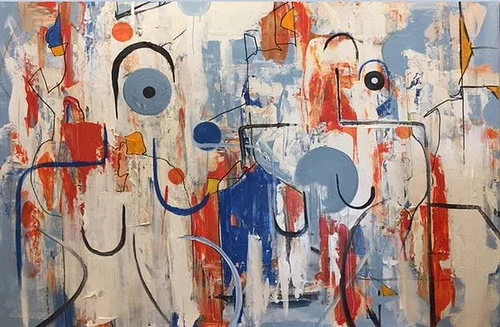
"Woman and the Universe'' (acrylic, graphite and ink), by Steve Lyons, at the Bloomingdale's store in Chestnut Hill, Mass.
Chris Powell: Those creepy arranged marriages and Mideast immigrants
Legislation pending in the Connecticut General Assembly to forbid people under 18 from marrying shows how times have changed in Connecticut. Fifty years ago Connecticut probate courts often approved the marriages of men in their 20s or older to girls 16 and younger for a purpose that now seems quaint -- to hold the men to account for the statutory rape by which they had impregnated the girls and to protect the girls and their children themselves
The courts figured that it was better to give a pregnant minor girl a husband bound by law to support her and their child and to give their child a father in the home than to put the man in jail, opportunistic as he had been.
Then the U.S. Supreme Court proclaimed the era of abortion, in which older men still impregnate minor girls but can arrange to get rid of the problem without the girls' parents and law enforcement ever finding out. This has been made easier in Connecticut by the state's refusal to enact a parental-notification law, a refusal grounded in the belief that abortion is a high social good, higher even than deterring child rape.
So today the problem that Connecticut sees with minor girls marrying is the practice of arranged marriages involvingmen from Middle Eastern cultures who have emigrated to this state. It doesn't seem to occur to anyone in authority that this problem results from uncontrolled immigration -- from the failure of government to enforce any immigration law and to analyze immigrants individually for pernicious cultural and political inclinations.
Connecticut's political class applauds this failure and wants it made permanent because requiring immigrants to meet any qualifications is considered "discrimination," and of course it is. But what is wrong with discrimination against the oppression of women and against the fascism, theocracy and barbarism that come with it?
xxx
QUID TUA MEA? State Sen. Ted Kennedy Jr. (D.-Branford and the son of the late U.S. Sen. Edward Kennedy), would bring the intrusiveness of government to new heights with his legislation to register every driver's license holder as an organ donor unless a licensee files an objection.
Kennedy means to address the long waiting list of afflicted people needing donation of one organ or another. But the arrogant presumption he proposes to put into law is hardly the only way of increasing organ donations. Publicity campaigns could be attempted, as with leaflets about organ donation inserted into license and auto registration renewal mailings from the state Motor Vehicles Department.
More or less compelling people to become organ donors will just breed suspicion of and resistance to government instead of encouraging generosity and altruism. If Kennedy's legislation is enacted, Connecticut might as well change its motto from "Qui transtulit sustinet" ("Who transplanted sustains") to "Quid tua mea" ("What's yours is mine") -- if the Democratic Party hasn't already copyrighted it.
xxx
VICIOUSNESS IS ENOUGH: That white students from Canton (Conn.) High School taunted black and Latino players from Hartford's Classical Magnet School at a basketball game last month by chanting "Trump! Trump! Trump!" doesn't make the president racist, as much as his critics pretend it does.
The chanting doesn't even make the chanters racist, since, while they may be, they also may have been responding mainly to Connecticut's politically correct atmosphere, which insists that members of racial and ethnic minorities should hate Trump. What the chanting showed for sure was hardly news at all -- that kids are vicious and hateful brats as often as they are good sports, and that politics can be just another mechanism of their viciousness.
Chris Powell is managing editor of the Journal Inquirer, in Manchester, Conn.
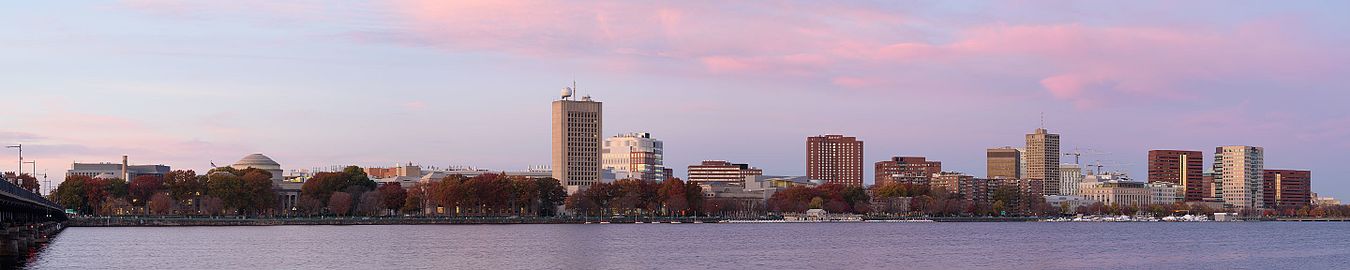
'Winter passes'
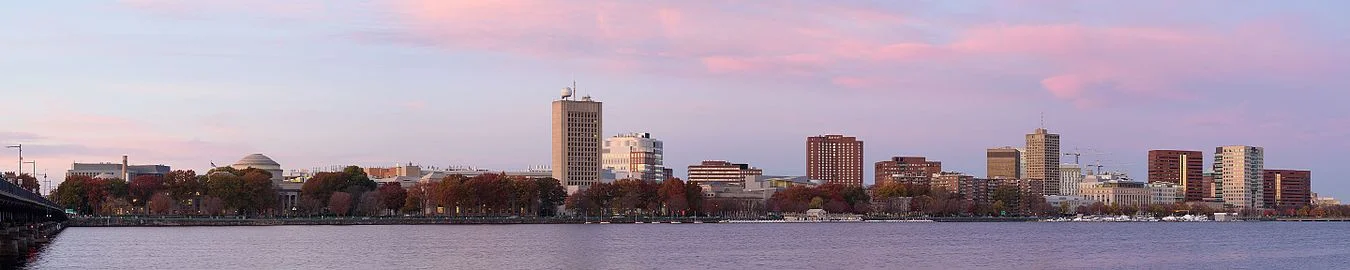
Panorama of Cambridge in 2016 from across the Charles River.
At last the air fragrant, the bird's bubbling whistle
Succinct in the unknown unsettled trees:
O little Charles, beside the Georgian colleges
And milltown New England; at last the wind soft,
The sky unmoving, and the dead look
Of factory windows separate, at last,
From windows gray and wet:
for now the sunlight
Thrashes its wet shellac on brickwalk and gutter,
White splinters streak midmorning and doorstep,
Winter passes as the lighted streetcar
Moves at midnight, one scene of the past,
Droll and unreal, stiff, stilted and hooded.
-- Delmore Schwartz, "Cambridge, Spring 1937''
Jean Lesieur to speak on French elections, future of Western Alliance in Brexit/Trump era

To members and friends of the Providence Committee on Foreign Relations (thepcfr.org; pcfrmail@gmail.com).
Our next speaker comes on Wednesday, April 5, when Jean Lesieur, one of Europe’s most distinguished journalists, joins us. Mr. Lesieur is a novelist, a co-founder of France 24, the French version of CNN, a former foreign correspondent and a former senior editor at Le Point and L’Express, among other publications. Among other things, he’ll talk about Europe in the Brexit/Trump eras, the state of the Western Alliance and, of course, the wild French election campaign.

Psychotropic America

Adapted from an item in Robert Whitcomb's "Digital Diary,'' in GoLocal24.com
Former Rhode Island Congressman Patrick Kennedy is quite right to say that legalizing recreational marijuana throws “gasoline’’ on America’s addiction problems. (And you can bet thatlots of “medical marijuana’’ is being used entirely recreationally.) For some people, pot is yet another gateway drug to worse ones and mental illness.
However, now that there’s so much cash and potential big tax revenue in the marijuana industry, don’t look for policymakers to follow Mr. Kennedy’s advice and crack down on this drug, whose use will soon be pervasive everywhere, including among drivers – if it isn't already.
Of course, most of the nation's adults are on psychotropic drugs (coffee is a big one) because of depression, anxiety, boredom, fatigue, search for adventure or group cohesion. And many of the kids, too. And the advertising industry will help keep it that way.
After our lost weekend
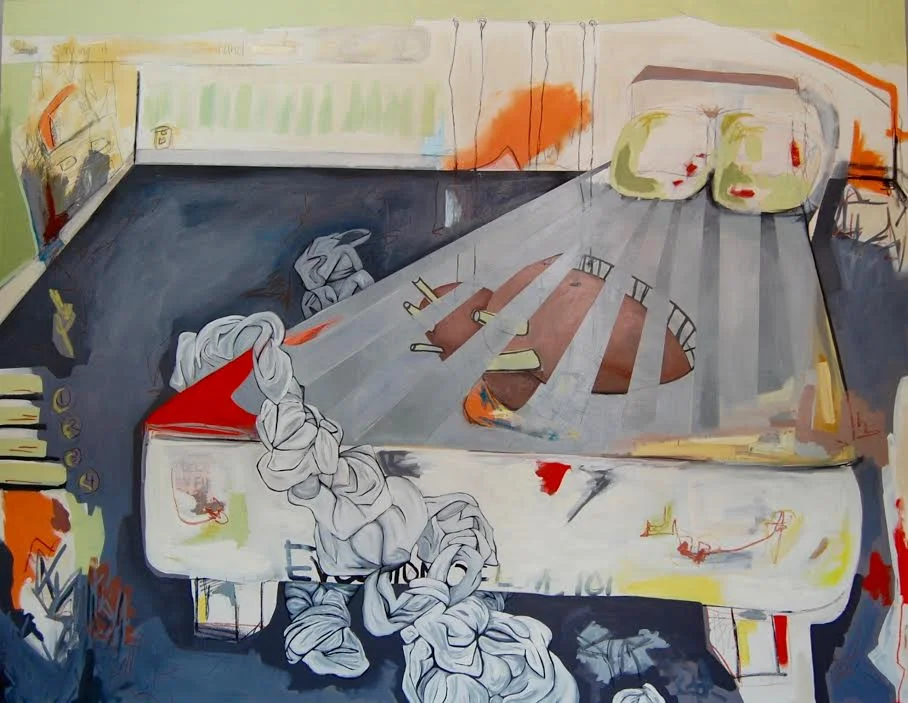
"Evolution of Love" (oil and mixed media on canvas), by Hilary Tait Norod, in a show at University Place Gallery, Cambridge, Mass., March 31-April 28.
'Blanks in all its rays'

"The day is turning ghost,
And scuttles from the kalendar in fits and furtively,
To join the anonymous host
Of those that throng oblivion; ceding his place, maybe,
To one of like degree.
I part the fire-gnawed logs,
Rake forth the embers, spoil the busy flames, and lay the ends
Upon the shining dogs; *
Further and further from the nooks the twilight's stride extends,
And beamless black impends.
Nothing of tiniest worth
Have I wrought, pondered, planned; no one thing asking blame or
praise,
Since the pale corpse-like birth
Of this diurnal unit, bearing blanks in all its rays -
Dullest of dull-hued Days! .
Wanly upon the panes
The rain slides as have slid since morn my colourless thoughts;
and yet
Here, while Day's presence wanes,
And over him the sepulchre-lid is slowly lowered and set,
He wakens my regret.
Regret--though nothing dear
That I wot {knew} of, was toward in the wide world at his prime,
Or bloomed elsewhere than here,
To die with his decease, and leave a memory sweet, sublime,
Or mark him out in Time . . .
--Yet, maybe, in some soul,
In some spot undiscerned on sea or land, some impulse rose,
Or some intent upstole
Of that enkindling ardency from whose maturer glows
The world's amendment flows;
But which, benumbed at birth
By momentary chance or wile, has missed its hope to be
Embodied on the earth;
And undervoicings of this loss to man's futurity
May wake regret in me.''
-- Thomas Hardy, "A Commonplace Day''
"Dogs'' is an old expression for the metal supports for logs in a fireplace.
So he can study at Brown?!
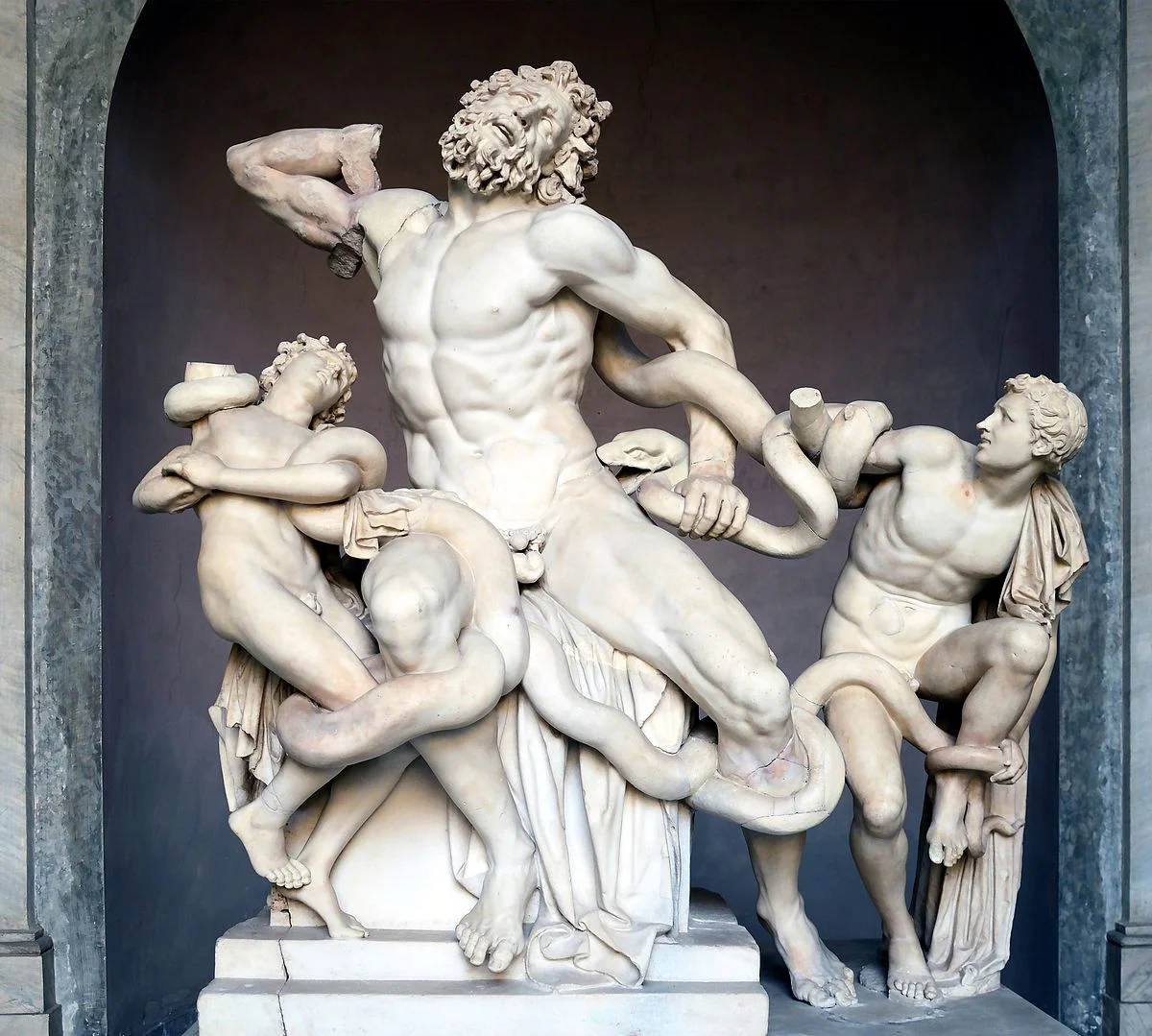
''Laocoon and His Sons,'' believed to have been created for a wealthy Roman between 27 B.C. and 68 A.D. It's now at the Vatican Museums.
You Are Old, Father William (with apologies to Lewis Carroll)
(Slightly revised from the version that appeared in The Los Angeles Times and used here by permission)
"You are old, Father William," the young man said,
"And the money's become very tight,
And yet you'll spend anything not to be dead --
Do you think, at your age, it is right?"
"In my youth," Father William replied to his son,
"I figured that old folks should die,
But now that I'm perfectly sure that I'm one,
I do not see a good reason why."
"You are old," said the son, "as I mentioned before.
So consider your grandson's position,
Since the money that keeps you away from death's door
Could be used for his college tuition.''
"I am old," Father William replied with a frown,
"But I've not taken leave of my wits!
I should croak so young Willie can study at Brown?
Be off, or I'll blow you to bits!"
-- Felicia Nimue Ackerman
Don Pesci: Lessons for the wise men of Connecticut
VERNON, Conn.
In most fairy tales, the way out of the dark forest is the way in -- in reverse. Sometimes the hero of the story will take care when entering the bewildering forest to lay out the way back by leaving behind markers, beans strewn on the ground, so he will not forget the entrance and exit routes. The moral of all these tales is the same: if you’ve make a mistake, reverse your errors. It is a lesson politicians in Connecticut might take to heart. With a little courage and the virtue of foresight, the lucidity of remembrance brought to bear on current difficulties, there is no difficulty that cannot be overcome.
In a recent piece in National Review, senior fellow at the Manhattan Institute Stephen Eide gives us a summary view of Connecticut’s weaknesses. The top marginal income-tax rate in Connecticut now stands at 6.99 percent, Eide writes, “almost two points higher than the 5.1 percent in neighboring Massachusetts. The income tax has generated a flood of new revenues — $126 billion over 25 years, according to the Hartford-based Yankee Institute for Public Policy — but somehow state lawmakers neglected to direct adequate funds to the pension system. As a consequence, Connecticut’s state employees’ retirement system is funded at only 35.5 percent, one of lowest rates in the nation. Despite a slew of recent tax increases, state government now faces deficits of $1.5 and $1.6 billion in the next two fiscal years.”
Such is Connecticut’s forest, dark and dank. As grown-ups, we should candidly admit that marginal tax rates do not increase automatically; they are raised over time by people who do not perceive the connection between high tax rates and diminishing revenues. President John Kennedy did understand the connection, which is why he proposed in a speech studiously ignored by Democratic progressives in Connecticut to reduce marginal tax rates for the express purpose of boosting federal revenue. His reductions fueled business expansion, which flooded federal coffers.
The flood of new tax revenue mentioned by Eide -- $126 billion over 25 years – was misused by politicians who chose not to “direct adequate funds to Connecticut’s pension system.” Connecticut now “faces deficits of $1.5 and $1.6 billion in the next two fiscal years” because spending has outstripped revenue collection, despite historically large tax increases. After the imposition of a state income tax in 1991, after Gov. Dannel Malloy imposed on Connecticut both the largest and the second largest tax increases in state history, deficits continue to pile up – because spending follows in the wake oftax increases: the more you get, the more you spend. So, where’s the exit?
It should not take the wise men of Gotham to propose the proper remedy for what ails us – cut spending, “a thing easy to say, but hard to do,” as the fairy tales continually remind us. It turns out in the fairy tales that the wise men of Gotham sometimes come up short on sensible solutions. Having decided to raise money by establishing two ponds and filling both with sell-able fish, the wise men of Gotham one day discover that a large eel had ravaged one of the ponds.
“A mischief on this eel, for he has eaten up all our fish. What shall we do with him?”
The wise men take council with each other. One says, “Kill him!” Another advises, “Chop him into pieces.” A third says, “No so. Let’s drown him!” All say, “Be it so!” And with that the eel is taken from the pond where he has eaten all the fish and thrown into the second pond full of fish, where he is left, so the wise men of Gotham think, to drown. This is not, wise men of Connecticut will agree, a fit solution to the problem.
For a quarter century, Connecticut politicians, mostly progressive Democrats tied to the iron apron strings of state employee unions, have been throwing the eel back into the fish pond, thinking in this way they might drown the troubles of the state. It hasn’t worked, it cannot work, it will not work. Following the imposition of the Lowell P. Weicker income tax in 1991 and Malloy’s two crippling income taxes increases –tax increases that have twice prolonged national recessions and offered irresistible inducements to boost spending – our state, somewhat like Malloy’s approval ratings, is scraping the bottom of an empty barrel. And there is little indication that Malloy or other Democratic progressives, operating from a failed economic model, have even bothered to read the writing on the wall, which plainly calls for permanent tax and spending reforms.
Don Pesci is a Vernon, Conn.-based political writer.
Yankee in spirit if not in name -- especially in N.H.
''In the end, what you think of as Yankee qualities do persist. But you'll find them in people with a lot of non-Yankee names."
--David H. Watters, director of the Center for New England Culture at the University of New Hampshire.
Connecticut needs some dialects
''I'm from Connecticut, and we don't have any dialects. Well, I don't think we have any dialects, and yeah, it's very complex. That Rhode Island/Massachusetts New England region is arguably the hardest dialect to nail. ''
--- Seth MacFarlane (creator of the animated TV show Family Guy, set in fictional Quahog, R.I.
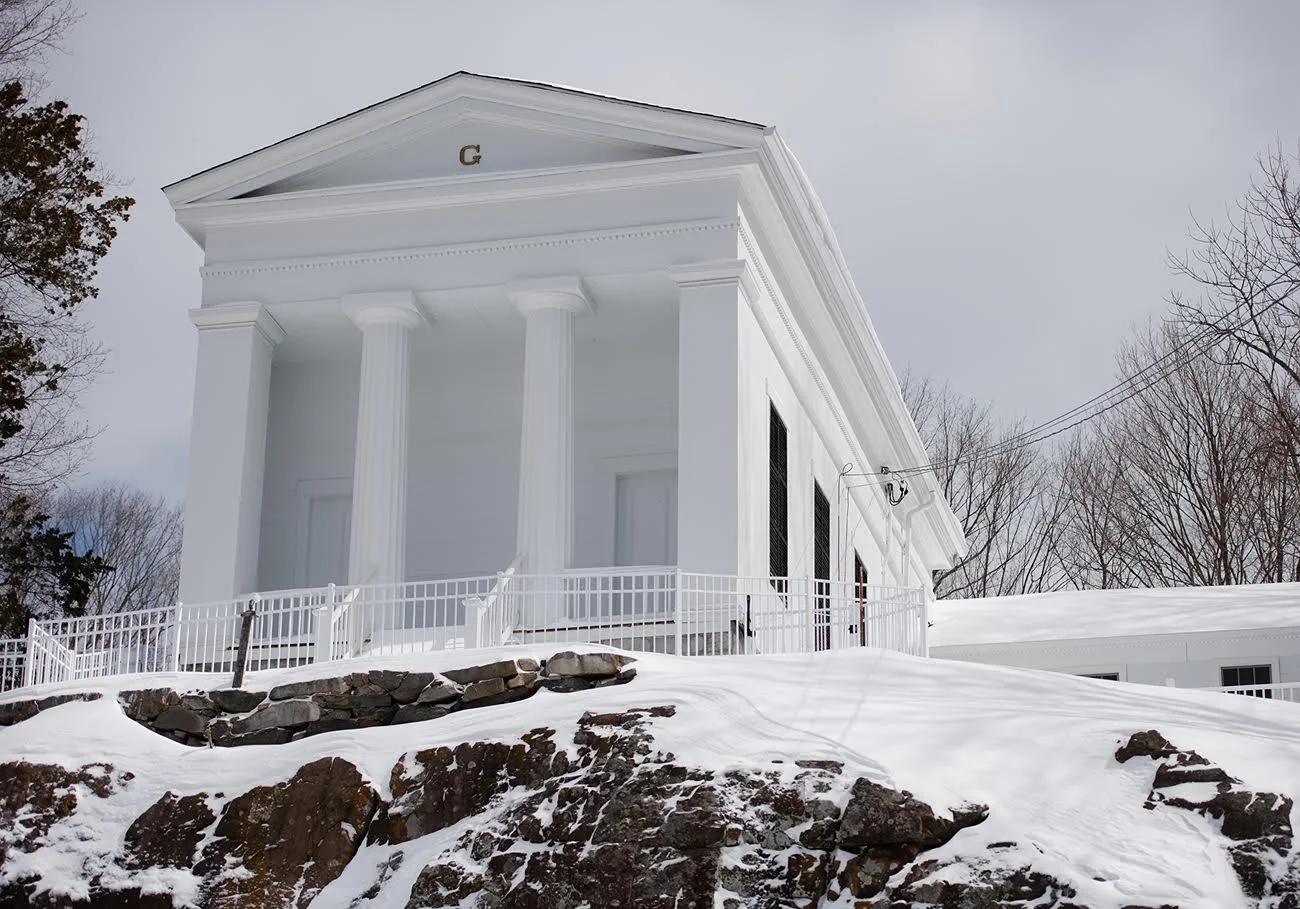
A civic temple's white over white
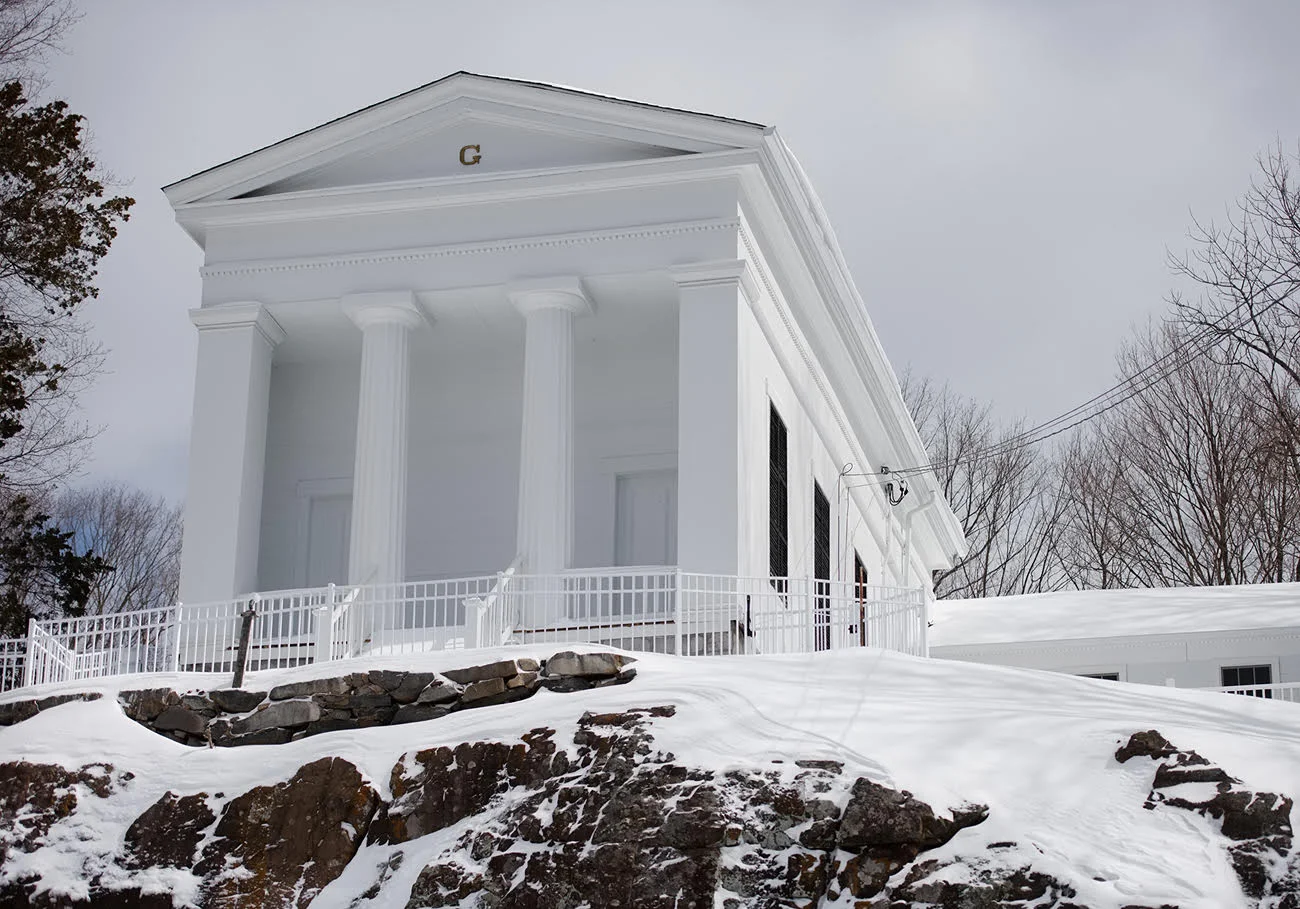
Photographer and New England Diary contributor Thomas Hook took this gorgeous picture after the recent snowstorm and reported: "This is King Solomon’s Lodge No. 7, in Woodbury Conn., serving Freemasons from the local area. It appeared confidently at rest on its perch above all the messy snow and traffic along the busy street below. It was built in 1838 at the cost of $700.''
The Masons, while long ago associated with anti-Catholicism and nativism, morphed into centers of healthy fellowship as well as of charity and other civic good works. Sadly, they have faded as Americans have abandoned much of their once famous love of community organizations in favor of extreme individualism and self-absorption.
Belatedly, Worcester gets its due

The Hanover Theatre for the Performing Arts reopened in Franklin Square, Worcester, in 2008
The travel guide publisher DK Eyewitness Travel calls Worcester the 11th most overlooked -- or, (aka, underrated) -- destination city in the United States.
DK writes: "Once firmly in Boston's shadow, Massachusetts' second-largest city is fast developing as a creative hub in its own right. The phenomenal collection at the Worcester Art Museum, as well as contemporary galleries and arts programs such as ARTSWorcester, Worcester Windows, and the Worcester PopUp, contrast with historic attractions such as the elegant Salisbury Mansion, built in 1772."
"Foodies won't be disappointed either; the city pioneered the classic dining car, with Miss Worcester Diner open since 1948, and the current craft-beer scene championed by Wormtown Brewery.’’
So there!
Actually, Worcester, Boston and Providence now effectively comprise one big metro area.
And self-flying

"Faster Than a Speeding Bullet'' (oil on canvas), by James Cole, at Galatea Fine Art, Boston.
Our skillful 'New England brethren'
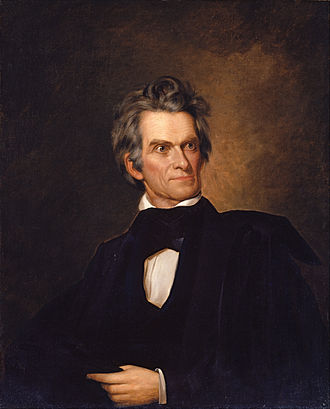
''What people can excel our Northern and New England brethren in skill, invention, activity, energy, perseverance, and enterprise?''
--- John C. Calhoun
John C. Calhoun (1782-1850), was statesman from South Carolina, including as U.S. senator, secretary of state, secretary of war and vice president. He was the nation's most famous advocate of slavery, whose fiercest foes tended to be New Englanders. He was a graduate of Yale, which named a residence hall after him, but that hall was recently renamed for Grace Cooper because of his support for slavery. Cooper (1906-92), who earned a Ph.D. at Yale, was a pioneering computer scientist and a real admiral.

Will GOP health plan slow nonprofit hospitals' outreach to communities?
By SHAFALI LUTHRA
For Kaiser Health News
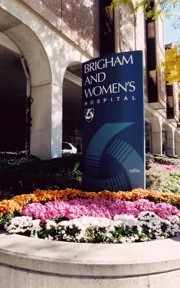
For the past six years, Mardi Chadwick has run a violence prevention program at Boston’s Brigham and Women’s Hospital. The program’s goal is to address broader, community-based health issues and social problems that make people ill or prone to repeated injury from gunshots, stabbings or environmental causes.
In Chadwick’s view, this endeavor — almost from its inception — made a big difference in nearby neighborhoods. But its profile in the eyes of hospital administrators got a boost from an Affordable Care Act provision that required nonprofit hospitals to conduct triennial assessments of local health needs and devise strategies, updated yearly, to address them. Falling short would trigger a financial penalty.
“Everyone, all of a sudden, cares about the social determinants of health,” she said. “Our expertise is being brought in. … We have a bigger seat at the table.”
But will programs like this one continue to get such attention? As the GOP-controlled Congress works to scrap Obamacare, the answer is uncertain.
Requiring this “community health needs assessment” was part of a broader package of rules included in the health law to ensure that nonprofit hospitals justify the tax exemption they receive. Another directive was that these facilities establish public, written policies about financial assistance available for medically necessary and emergency care and that they comply with limits on what patients who qualify for the aid can be charged.
These requirements add to the ongoing controversy about whether all nonprofit hospitals do enough to deserve a tax break. People on one side of the issue view the assessment rule, for instance, as an undue, unfunded burden while others say it doesn’t do enough. So far, though, the community health assessment requirement hasn’t exactly been a hot topic in the repeal-and-replace debate and was not addressed by the House Republicans’ health plan unveiled March 6.
Sen. Chuck Grassley (R.-Iowa), who has long urged that more scrutiny be applied to nonprofit hospitals’ tax status, championed the provision. His spokeswoman said he will continue to advocate that it remains in effect in whatever new health policy plans emerge. Regardless, the financial uncertainty of any overhaul of the health law could undermine some hospitals’ efforts.
The decades-old nonprofit tax status, granted by the Internal Revenue Service to institutions that meet the “community benefit” standard, spares hospitals from paying federal taxes and is collectively worth billions of dollars. Nonprofit hospitals have generally cited the uncompensated or “charity” care they provide, as well as initiatives they undertake to promote public health, as sufficient proof that they earn their tax exemption. But for-profit hospitals, which do pay taxes, cry foul, saying they make similar contributions.
The new requirements overall were meant to hold nonprofits to a higher standard — and penalize those that didn’t deliver. Under the law, hospitals that fail to complete the assessment and implementation strategy face a $50,000 fine — which can seem small next to their overall operating budgets. But down the line, the penalties can accumulate and ultimately could jeopardize their valuable tax exemption.
Meanwhile, federal data show that as recently as 2011 nonprofit hospitals targeted less than 10 percent of their operating expenses to benefit the community — this includes charity care, unreimbursed costs from Medicaid and other government programs and medical research and education. Less than 1 percent went to community health improvement services like Chadwick’s.
Advocates hoped the health law would change this. The idea was to push nonprofit hospitals to invest more in public health initiatives that do not directly earn them money — giving such programs more value on the balance sheet. But it’s hard to gauge whether that’s happened.
“You can find hospitals that have done this. But … are we seeing a real shift in the hospital community? Or are these a few hospitals that are outliers?” said Gary Young, director of the Center for Health Policy and Healthcare Research at Northeastern University. “We’ve asked them to make a sea change in how they’re doing things. And that can’t happen overnight.”
Part of the problem, analysts say, is that the underlying idea — reaching into the community to help people navigate the social and economic factors that can influence health — goes beyond what hospitals have traditionally viewed as their mission. Despite the potential for long-term payoff, administrators tend to focus on the immediate questions: How many beds are full? What medical services are being provided? How are they doing with their operating budget?
“It’s a new world out there in terms of the hospital not being the center of the universe,” said Lawrence Massa, president of the Minnesota Hospital Association, the state’s hospital trade group, which has been tracking hospital response to the health assessment requirement.
Initially, they found the money nonprofit hospitals put toward “community needs” went up after the assessment requirement: from about $355 million in 2011 to $459 million in 2013, according to an analysis by the association. (The needs assessment requirement took effect in between, for the tax year starting after March 2012.) But the increase leveled off in 2014 — the most recent year for which data are available.
Massa’s conclusion: Caring for the health of people before they come into the hospital is unfamiliar territory. Not everyone took naturally to it. “We saw some communities that embraced this, and did a nice job. … In other communities, there’s been friction between public health and the acute setting — and lack of understanding.”
With continued time and sustained emphasis, that could have changed, said Sara Rosenbaum, a professor of health law and policy at George Washington University.
But now? Even if the community benefit requirements remain intact, she and others fear this accountability effort could take a hit. Repeal of the health care law is likely to create fresh financial challenges for hospitals. For instance, although the House GOP’s American Health Care Act would restore some of the uncompensated-care funding cuts hospitals absorbed under the ACA, the coverage changes proposed in Republicans’ plan could mean tens of millions more uninsured people.
That scenario, policy experts and trade groups say, would increase the amount of free care nonprofit hospitals provide, creating new budget pressures that could lead them to tamp down on efforts to promote community health work.
“We could be right back in a situation where there is a fair amount of charity care, and that could become a large component of how hospitals are justifying their nonprofit status,” said Ken Fawcett, a physician who runs a community health worker initiative at Spectrum Health in Grand Rapids, Mich.
Meanwhile, the health assessment’s impact has been evident at Boston-based Massachusetts General Hospital. There, administrators used it to devise an intervention strategy around drug abuse — partnering, for instance, with local schools and community organizations, and hiring former addicts to help patients navigate recovery.
“There’s no question the Affordable Care Act required us to bump up our game,” said Joan Quinlan, its vice president for community health. If people lose coverage, she added, hospitals will increasingly argue that’s enough reason for a tax break. It could stifle efforts to promote more substantial community benefit.
“If the ranks of the uninsured or underinsured grow, then charity care will increase. And the ability to do some of these more creative downstream efforts will be hampered,” she said. “There might be heightened awareness. But if there aren’t resources to address them, it’s going to be hard.”

'Smartflower' points to more N.E. energy independence

A "smartflower'' solar-energy device.
Adapted from an item in Robert Whitcomb's "Digital Diary'' column in GoLocal24.com
Much of the future of electricity will involve “distributive power,’’ in which instead of getting our electricity from big power plants, we’ll get a lot of it via small-scale renewable energy, often generated right where we live or work. This reduces the political problems and endless delays of siting big power plants and gives far more control to consumers. With recent huge efficiency improvements in renewables the “distributive-power’’ revolution can only speed up. (There are electricity-grid issues posed by this decentralization.) This is particularly attractive in New England, which must import from outside the region far too much of its energy.
A new example of the possibilities is “smartflower,’’ (smartflower.com) an Austrian solar-energy system that tracks the sun for maximum efficiency. Looking like giant flowers, smartflower systems fold out every morning and then fold in at dusk. The manufacturer says it gets up to 40 percent more yield from sunlight than does a roof-mounted system.
You can put these things in your yard or on flat roofs; they take only an hour or two to be installed. And this fall, storage batteries will be available. Smartflower systems cost about $25,000 to buy and install; clean-energy tax credits would let you recoup some of this expense. And you can take these things with you when you move.
A smartflower unit will be on display at the entrance to the Rhode Island Home Show March 30-April 2 at the Rhode Island Convention Center. Take a look! And no, I do nit have any financial stake in this company.
Blame it on New Hampshire

“The blast that swept him came off New Hampshire snow-fields and ice-hung forests. It seemed to have traversed interminable leagues of frozen silence, filling them with the same cold roar and sharpening its edge against the same bitter black-and-white landscape.
Edith Wharton, from her story "The Triumph of the Night''