
Vox clamantis in deserto







Sea-level rise threatens East Coast marshes

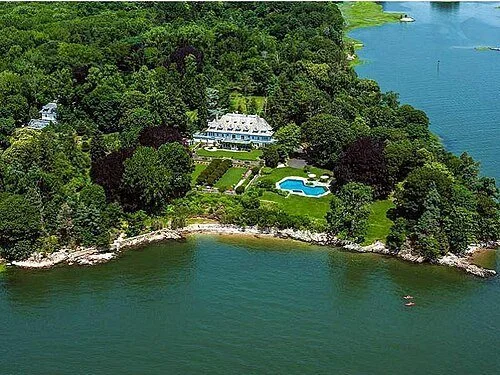
Salt marsh on the Connecticut coast.
Via ecoRI News
As the rate of sea-level rise quickens, a study published in Biological Conservation last November examines the ability of tidal marshes to keep pace. Conducted by the National Estuarine Research Reserve System, this nationwide assessment reveals that marshes along the Pacific Coast appear more likely to survive than those along the Atlantic. Two marshes in southern New England, in Massachusetts and Rhode Island, were found to be the most vulnerable of those evaluated.
Waquoit Bay’s Sage Lot Pond and Narragansett Bay's Nag West are more vulnerable than most along the East Coast.
Research Reserves conducted this study at 16 sites in 13 coastal states. It was based on an approach that evaluated the ability of tidal marshes to thrive as sea levels rise according to five categories of resilience: marsh elevation; change in elevation; sediment supply; tidal range; and rate of sea-level rise.
“This study shows that not all tidal marshes are equally vulnerable to sea-level rise,” Rebecca Roth, executive director of the National Estuarine Research Reserve Association (NERRA), said. “It also gives coastal managers the capacity to understand and compare the ability of marshes to persist in the face of rising seas. This will inform decisions focused on protecting marshes for generations to come.”
Tidal marshes provide many benefits. They protect people and property against storm surges and flooding, improve water quality, and create habitat for fish and wildlife. For millennia, most marshes have kept pace with rising seas by increasing in elevation, according to the 2016 NERRA study.
With sea levels projected to increase much faster in the future, the fate of many marshes is now uncertain. The NERRA says the ability to understand and compare the likelihood of marshes to persist in the face of rising seas can inform strategies to protect them. For example:
Marshes found to be highly resilient are likely to thrive and provide value for a long time; ensuring that they are protected is a good investment for the future.
Moderately resilient marshes can survive if actions are taken to help them thrive, such as reconnecting them to the rivers that nourish them with sediment.
The least resilient may not survive in their current locations; they might be saved through intensive management strategies or by finding opportunities for them migrate to higher ground.
Sarah Anderson: Past time to go after the opioid-epidemic profiteers
Via OtherWords.org
Travis Bornstein never told his friends about his son Tyler’s drug problem. He was too embarrassed.
Then, on September 28, 2014, Tyler’s body was found in a vacant lot in Akron, Ohio. The 23-year-old had become addicted to opioid pain killers after several sports-related injuries and surgeries. Unable to afford long-term treatment, he ultimately turned to a cheaper drug — the heroin that killed him.
“Now I have no choice but to speak out,” the elder Bornstein, president of Teamsters Local 24 in Akron, told a crowd of thousands at the union’s convention in 2016. As he shared the unvarnished tale of how a middle-class, star athlete wound up in that vacant lot, Bornstein lit a fire under the 1.4-million-member organization.
The Teamsters pledged $1.4 million for a nonprofit organization the Bornstein family set up to expand treatment for addicts in Ohio. They’re also going after the drug industry CEOs who’ve been profiting off a national opioid problem of epidemic proportions.
According to the Centers for Disease Control, the number of overdose deaths involving opioids (including prescription drugs and heroin) has quadrupled since 1999. In 2015, opioid deaths in the United States hit a record-breaking 33,000.
The labor union is targeting the three largest U.S. prescription-drug wholesalers — McKesson, Cardinal Health, and AmerisourceBergen — for flooding hard-hit areas with the highly addictive pills.
Between 2008 and 2012, for example, these companies shipped 780 million hydrocodone and oxycodone opioid doses to West Virginia — 433 for every man, woman, and child in the state. During that time period, 1,728 people in the state overdosed on the painkillers.
The companies deny any wrongdoing, pointing the finger instead at corrupt doctors and pharmacists who sell pills directly to addicts and dealers. But as West Virginia Governor Earl Ray Tomblin recently told the Charleston Gazette-Mail, “Obviously, they had to know, with a state this size, and that many pills coming in, that something wasn’t right.”
The Teamsters are using their clout as pension fund investors to demand that drug wholesalers take responsibility for their role in the epidemic, conduct full investigations of their distribution practices, and hold CEOs accountable.
At AmerisourceBergen, for example, CEO Steven Collis hasn’t coughed up a penny of the tens of millions of dollars he pocketed as the firm was reaping opioid windfalls — even though the company has paid $16 million to settle a West Virginia case over their negligence.
The Teamsters are demanding that some of the CEO’s pay be “clawed back,” in the same way that Wells Fargo executives involved in last year’s bogus account scandal had to forfeit some of their compensation.
They’ve made similar demands on McKesson, where CEO John Hammergren’s compensation has amounted to an astounding $368 million over the past five years.
Part of the problem with accountability at McKesson, according to the Teamsters, is the fact that Hammergren serves as both CEO and chairman of the company. The union is filing a shareholder resolution urging the board to appoint an independent chair.
Meanwhile, Travis Bornstein is continuing to speak out, telling his son Tyler’s tragic story to students, policymakers, and others as he works to expand the availability of drug treatment for communities ravaged by the opioid crisis.
Since Tyler’s death, he’s learned that opioid addiction isn’t a moral failure, but rather a disease, like cancer or diabetes. “Now my son is my hero for everything he was able to accomplish with such a gut-wrenching disease,” Bornstein said. “I was the fool.”
Sarah Anderson directs the Global Economy Project at the Institute for Policy Studies and co-edits Inequality.org.

Llewellyn King's Notebook: Of seaweed baths, the Humbert School and Boston's mega-Irish

St. Patrick’s Day will be celebrated with special gusto in Boston. But then it should: The Boston Irish are, if I might say so, more Irish than their relations in the Old Sod.
I used to be the American director of one of Ireland’s summer schools -- peculiarly Irish institutions, dating back to when Ireland was a lot poorer than it is today, and when vacation travel was a lot more expensive.
The Irish used to stay at home for their summers rather than flying, as they do now, to the United States, the Canary Islands or mainland Spain, and other countries. They traveled to their own sea coasts, which are lovely but the weather does not always favor swimming.
So, other entertainments abounded, such as seaweed baths. These – there are few left – are rather fun, though slimy. You are immersed in a bathtub with, if you like, your nearest and dearest -- there are doubles. It is filled with warmed seawater and lashings of seaweed.
In Enniscrone (also spelled Inniscrone, and officially named Inishcrone), a small seaside town in County Sligo, I got slimed with my wife. It does a world of good, and it keeps you out of the pub for a while -- at least that is what I was told when I was getting initiated into the joys of seaweed bathing.
For those who wanted to do something a little more inspiring than take a slime bath, they could attend the so-called summer schools.
The one I was affiliated with, which is no longer in operation, was the Humbert International Summer School. These are not schools with desperate students attending make-up classes over the summer. Rather the summer schools -- there are as many as 40 of them -- are think-tank weekends or longer.
They started with literary schools, as you might expect in Ireland. Soon musical schools opened and in due course, as you also might expect, knowing the Irish love of politics, political schools.
For example, there is a Yeats School, for scholars of the famous writer and a Parnell School, named for the great Irish politician and member of the British House of Commons, until he fell afoul of the prudery of his time and was destroyed by his love affair with Kitty O’Shea, nominally a married woman.
The Humbert School, created and directed for three decades by John Cooney the Irish historian and journalist, was named for the French Gen. Jean Joseph Amable Humbert, who led an expedition to liberate Ireland in 1798: The Year of the French. Humbert and his 1,100 men were defeated by Gen. Charles Cornwallis and his British regulars, who then took a terrible revenge on the Irish patriots, hanging them 20 at a time. The song, “The Wearing of the Green,” commemorates the fact that after the 1798 rebellion, wearing green was assumed to be a sign of defiance, punishable by death.
The Humbert School, which was based in Ballina, County Mayo, concentrated on the troubles in Ulster and Ireland’s position in the world. The current Irish prime minister, or taoiseach, Enda Kenny, was a frequent participant, as was the first woman president of Ireland, Mary Robinson. Over three decades, all the Irish prime ministers participated in the Humbert School as well as some names from Northern Ireland, including John Hume, David Trimble, Gerry Adams and Martin McGuinness, with whom I debated.
Back to Boston and the joy that will be overflowing there this Friday. Some of the revelers there might find Ireland not quite what they expected.
Over the years, everyone I invited to attend the Humbert School – none had been to Ireland before -- were enthralled with the place, except the American Irish. It just was not, well, Irish enough.
The worst sufferer from this culture shock was a dear friend and one time co-worker from Boston, who had very definite ideas about what Ireland would be like -- and it was not like that. He even dressed head-to-toe in Donegal tweed. My Irish friends asked, “What’s your man wearing?” I had to tell them to drink up and be nice because he was from Boston -- where they are sure they know what the real Irish are like. And maybe they do.
Slainte, Boston!
Llewellyn King is executive producer and host of White House Chronicle, on PBS. His e-mail is llewellynking1@gmail.com.

James P. Freeman: Will daily newspapers go the way of sailboats?

“We cannot direct the wind, but we can adjust the sails.”
— Bertha Calloway, activist and historian
—
“People are hysterical about the death of newspapers, and I would say, ‘They’re not dying; they’re just kind of reinventing themselves.’”
— Jared Kushner, former publisher of Observer Media and son-in-law of Donald Trump
Rhode Island Monthly magazine, in its investigation published last December about the evolving evaporation of the country’s “oldest continuously published daily newspaper,” The Providence Journal, illuminated two imperatives for the viability of the print newspaper: serving the public and making money. Over the last two decades those two objectives have not lived in peaceful harmony, so the Journal joins the ranks of The Boston Globe and other big newspapers in their daily struggle to avoid writing their own obituaries.
But what are the real reasons for the decline of the newspaper business?
Video may have killed the radio star, and likewise, the growth of television news may have killed the evening edition of newspapers. Yet despite widespread popular belief to the contrary, the digital disruption of Internet is not killing the printed newspaper. In fact, newspapers’ embrace of all things digital, begun in earnest 20 years ago, may be more to blame; it has diverted their attention from the core product.
Writing in politico.com last October, Jack Shafer, a journalist and media commentator, wondered why print news has been “chasing the online chimera.” For years, Shafer asserts, “the standard view in the newspaper industry has been that print newspapers will eventually evolve into online editions and reconvene the mass audience newspapers enjoy there. But that’s not what’s happening. Readers continue to leave print newspapers, but they’re not migrating to the online editions.”
A recent study determined that there has been almost zero growth in online readership of the top 51 online newspapers since 2007. While total newspaper print revenues (circulation and advertising) have plunged from $22.8 billion to $16.4 billion from 2010 to 2014, they still represent 82 percent of total newspaper revenue.
Online versions, therefore, have not entirely cannibalized hardcopy versions. From September 2015 to August 2016, total paid distribution of the print edition of The Boston Globe, for instance, averaged 136,196, while electronic sales during the same period averaged 88,047.
Offering another view, as a scathing indictment, Lee Procida, in reassociated.press, demands: “Stop Blaming The Internet For Killing Newspapers. Start Blaming Editors.” As the leaders of newsrooms, he says, editors “have largely gotten off the hook in the modern tragedy of newspapers.” Additionally, Procida writes, “rethinking the content newspapers produce is a fundamental evolutionary step toward saving the quality journalism newsrooms are capable of, but journalists hardly even acknowledge it as a possibility.”
But Robert Whitcomb has some valuable observations, too.
Whitcomb retired as editorial page editor of The Providence Journal in 2013, after 44 years in the business. Straight out of central casting, he still looks like the old-school editor you remember: tortoise-rimmed glasses, graying hair, complementary jacket and tie, brimming with Yankee sensibilities. After working in the summer of 1969 for the old tabloid The Boston Record American, he began his full-time career in 1970 as a writer for The Boston Herald Traveler, and has also held editorial positions at The Wall Street Journal and International Herald Tribune (where he was the finance editor), among other publications.
He believes that the transition of much newspaper ownership from privately held family arrangements to publicly-held corporate structures has accelerated the decline of the industry more than any other factor. The resulting product of these changes has led to layoffs in staffing and a reduction in journalistic standards. Furthermore, despite so-called allegiances to “local coverage,” many editorial decisions are made by corporate parents far away from local journalists.
A report, “The Rise of a New Media Baron and the Emerging Threat of News Deserts,” explains these developments and supports Whitcomb’s thesis. More than 33 percent of U.S. newspapers have changed ownership since 2004, including the Journal and the Globe. “At the end of 2004, the three largest companies owned 487 newspapers with a combined circulation of 9.8 million. Today, the three largest companies own about 900 papers that have a combined circulation of 12.7 million.”
Because of this disturbing trend, “profits derived from cost cutting have not been reinvested to improve their newspapers’ journalism, but used instead to pay loans, management fees, and shareholder dividends.”
The real motivation behind owning and operating a newspaper today, Whitcomb says, is “money and influence.” And he predicts that The Providence Journal (now owned by GateHouse Media) within five years may not print a daily edition and he believes many more are in jeopardy of suspending daily editions. There were 126 fewer newspapers in 2014 than in 2004 and 20,000 positions have been eliminated from 1994 to 2014.
Not all hope is gone, however grim the new realities appear. Some new owners are experimenting with a business model of reinvention — not liquidation — that is reminiscent of the old-fashioned press lord. Whitcomb looks favorably at this development and points to The Washington Post.
Since acquiring the Post three years ago for $250 million, and pulling its finances out of the public eye and distancing himself from editorial decisions (at least publicly), Amazon founder Jeff Bezos has reinvigorated the paper. “Many U.S. newspapers would benefit from a steward willing to sacrifice short-term profit for a longer-term vision,” wrote Jennifer Saba, in breakingviews.com.
John Henry, principal owner of the Boston Red Sox, purchased The Boston Globe in 2013, and he apparently holds a similar vision. “Stewardship carries,” he wrote, “obligations and responsibilities to citizens first and foremost — not to shareholders. This is especially true for news organizations.”
It is fascinating to watch the Journal and the Globe (under different ownership structures) navigate the storm.
Henry Ward Beecher in Proverbs from Plymouth Pulpit, with a romance of ink and pulp unrecognizable today, wrote, “That endless book, the newspaper, is our national glory.” Maybe. But for realists, like Robert Whitcomb, the printed paper may go the way of the sailboat. Diminished in the fleet of massive global seafaring vessels surely, but, nonetheless, “still around.”
James P. Freeman, a frequent contributor to New England Diary, is a New England-based writer and former Cape Cod Times columnist as well as a financial-services professional. This piece first ran in New Boston Post, a conservative-leaning news and commentary Web site.
David Warsh: Hypocritical Republicans try to hide that the 'individual mandate' was their invention
How did a Republican program introduced on the eve of the George H.W. Bush administration wind up in the crosshairs of the Republican Congress under House Speaker Paul Ryan (R.-Wis.) many years later? Here, at the beginning of the attempt to repeal Obamacare, let’s take a quick trip down memory lane.
It was in 1989 that economist Stuart Butler proposed an individual mandate in a Heritage Foundation monograph, “A National Health System for America,’’ practically on the eve of Bush’s inauguration:
The requirement to obtain basic insurance would have to be enforced. The easiest way to monitor compliance might be for households to furnish proof of insurance when they file their tax returns. If a family were to cancel its insurance, the insurer would be required to notify the government. If the family did not enroll in another plan before the first insurance coverage lapsed and did not provide evidence of financial problems, a fine might be imposed.
That autumn, in “Assuring Affordable Health Care for All Americans,’’a conference talk, Butler explained why the provision of healthcare is unlike almost all other markets:
“If a man is struck down by a heart attack in the street, Americans will care for him whether or not he has insurance. If we find that he has spent his money on other things rather than insurance, we may be angry but we will not deny him services – even if that means more prudent citizens may wind up paying the tab.’’
In 1991 Mark Pauly, of the University of Pennsylvania, elaborated on the concept, in a widely read article in the journal Health Affairs. The individual mandate became the basis for a congressional Republican proposal introduced in 1993 as an alternative to Hillary Clinton’s anticipated proposal of a single-payer national health service. The scheme was subsequently endorsed by Newt Gingrich.
And in 2006, Massachusetts Gov. Mitt Romney, who was preparing to run for president, explained his health-insurance plan for Massachusetts this way in a Wall Street Journal op-ed article:
“Some of my libertarian friends balk at what looks like an individual mandate. But remember, someone has to pay for the healthcare that must, by law, be provided: Either the individual pays or the taxpayers pay. A free ride on the government is not libertarian.’’
When the individual mandate became the basis of Obamacare, in 2010, Butler sought to wiggle out of credit for the idea:
“The confusion arises from the fact that 20 years ago, I held the view that as a technical matter, some form of requirement to purchase insurance was needed in a near-universal insurance market to avoid massive instability through ‘adverse selection’ (insurers avoiding bad risks and healthy people declining coverage). At that time, President Clinton was proposing a universal healthcare plan, and Heritage and I devised a viable alternative.’’
Why do today’s Republicans hate the individual mandate so much? The roots are to be found in the 2010 mid-term congressional election that produced the Tea Party. As libertarian law professor and Tea Party theorist Randy Barnett told James Taranto, of the WSJ editorial page, in an interview in 2011:
“What is the individual mandate? I’ll tell you what the individual mandate, in reality, is. It is a commandeering of the people. . . . Now, is there a rule of law preventing that? No. Why isn’t there a rule of law preventing that? Because it’s never been done before. What’s bothering people about the mandate? This fact. It’s intuitive to them. People don’t even know how to explain it, but there’s something different about this, because it’s a commandeering of the people as a whole. . . . We commandeer people to serve in the military, to serve on juries, and to file a return and pay their taxes. That’s all we commandeer the people to do. This is a new kind of commandeering, and it’s offensive to a lot of people.’’
This is, of course, profoundly misleading. Nearly a century ago, states began to compel motor vehicle owners to purchase liability insurance in case their vehicles are involved in accidents causing harm to others. (Then, too, Massachusetts and Connecticut led the way.) Professor Barnett has proposed a constitutional amendment that would outlaw the practice.
A succinct statement defending the individual mandate is a 2013 letter signed by 30 prominent economists, led by the late Kenneth Arrow, the founder of modern healthcare economics:
[I]nsurance reform without subsidies and mandates has consistently failed. In the five states that have tried comprehensive insurance market reform without an individual mandate, healthy people chose to stay out of insurance, sick people took it up, and premiums increased. Only broad participation markets can end the cycle of insecure coverage and high costs.’’
As for Obamacare, is it broken, as the president and the Republican congressional leadership asset, or not? MIT Prof. Jonathan Gruber, an architect of both the Romney plan and Obamacare, told CNN last autumn that it was merely under siege:
“I think probably the most important thing experts would agree on is that we need a larger mandate penalty. We have individuals who are essentially free-riding on the system. They’re essentially waiting until they get sick and then getting health insurance.’’
Healthcare restructuring in the United States is a little like the issue of retarding climate change in the larger world. If you believe the science, the question is not if, but rather how and when. In each case, different paths are available: carbon taxation vs. cap and trade for atmospheric emissions; individual mandates vs. a single-payer system like Medicare for the provision of health care. Sooner or later, we must choose one or the other – or decide to let the uninsured heart-attack victim die in the street.
xxx
MIT Sloan School economist Steven Ross died earlier this month, at 73, of a heart attack. Many economists will not have known his work well. He did not win a Nobel Prize for his arbitrage pricing theory, though he came very close in 2013. He spent a good deal of time consulting and managing money.
As an apostle of what he called neoclassical finance, Ross is sometimes absent-mindedly excluded from economics altogether. Indeed, two weeks ago I left him (and his fellow Cal Tech alumnus Robert Barro) off a short list of prominent students who studied with the late Kenneth Arrow during Arrow’s Harvard years. Yet it was Ross who, in 1972, wrote down the first broad underpinning of the basics of agency theory, the then-new and surprising exploration of what happens when one person hires another to make decisions.
There is always a lot of this sort of baleful news going around. But Ross was “truly exceptional,” according to Robert Merton, also of MIT Sloan; “a giant” in the ranks of economists in the last third of the twentieth century, in the words of Bengt Holmstrom, also of MIT. Plans for services and a celebration at MIT Sloan School of his life are forthcoming.
David Warsh, a veteran financial, political and economic columnist, is proprietor of Somerville, Mass.-based economicprincipals.com, where this first ran.
Equine excitement

"Untitled" (oil on panel) by Melissa Mason, in the group exhibition "The Horse Show,'' at ArtProv Gallery, Providence. The show depicts the power and beauty of horses. It will run April 5-May 20 and get you riled up for the Kentucky Derby, the Preakness and the Belmont.
Mormon mega-project in Vermont

Obelisk in Vermont's White River Valley marking the birthplace of Joseph Smith, the founder of Mormonism.
Adapted from Robert Whitcomb's "Digital Diary,'' in GoLoca24.com.
In perhaps happier Vermont news, voters in Sharon, Royalton, Strafford and Tunbridge have denounced a plan by a Utah engineer and Mormon activist to build a planned community for thousands of people known as “NewVistas”
Residents of Royalton, Sharon, Strafford and Tunbridge overwhelmingly approved resolutions opposing the “NewVistas’’ development.
David Hall, of Provo, has been buying up land on which to build a self-sustaining community of 20,000 on a 5,000-acre grid near the birthplace of Joseph Smith, the founder of the Church of Later Day Saints, aka the Mormons. (I have visited the museum marking Mr. Smith's origins -- quite interesting. A guide tried to get my then 10-year-old younger daughter to become a Mormon; she demurred.)
“We have used these hills for hunting, fishing, a little bit of everything, and if David Hall comes in and does what he thinks he wants to do, I’m sure we’re not going to have a Tunbridge, or Sharon or Strafford or South Royalton anymore,” Ted Hoyt, an eighth-generation farmer, told Tunbridge Town Meeting.
Having spent a lot of time in the area at issue, I’m very sympathetic to Mr. Hall’s foes, who want to preserve this verdant pocket of old-time villages in a pastoral landscape. But if by some remote chance Mr. Hall gets this project done, you can bet that it will be among the healthiest, cleanest and best-run places in America, given Mormon rules and habits -- although perhaps not a very exciting place to live.
'On and on...until..'

“A small and sinister snow seems to be coming down relentlessly at present. The radio says it is eventually going to be sleet and rain, but I don't think so; I think it is just going to go on and on, coming down, until the whole world...etc. It has that look.”
Edward Gorey, from Floating Worlds: The Letters of Edward Gorey and Peter F. Neumeyer

Chris Powell: What kind of a state would depend on money from casinos and potheads?

At the Connecticut state Capitol the issue is being framed as whether Connecticut should legalize marijuana. But that's not really the issue at all, since marijuana long has been effectively legal in the state for several reasons: because of its common use and the reluctance of courts to punish people for it; because possession of small amounts has been reduced to an infraction; because marijuana production and sales have been legalized for medical purposes; and because the federal government has stopped enforcing its own law against marijuana in those states that don't want it enforced.
The real issue is whether state government should get into the marijuana business -- licensing dealers and taxing sales in the hope of raising as much as $100 million a year to offset state government's financial collapse. Such a scheme would introduce marijuana to many more people, especially minors, who, even if the age for purchase is set at 21, will get it from their older friends, just as minors now get alcohol.
As has happened with legalization in Colorado, many more students will come to school stoned or get stoned there. Intoxicated driving will increase, even if much of the increase will result from Connecticut's refusal to prosecute first offenses. And since Connecticut's criminal sanctions against marijuana have largely disappeared already, legalization won't give the state much financial relief on the criminal-justice side of the budget.
There's another problem with licensing and taxing: It would constitute nullification of federal drug law. Nothing obliges Connecticut's criminal statutes to match the federal government's, but licensing and taxing, profiting from federal crimes, is secession -- and unless federal drug law was changed, the federal government could smash Connecticut's marijuana infrastructure at any time. In any case the half-century of President Nixon's "war on drugs" has shown that drug criminalization is futile and may have only worsened drug addiction while maiming millions of lives with prison sentences.
The drug problem needs to be medicalized, which, while increasing the availability of drugs, will also increase treatment and eliminate most crime and imprisonment expense. But the General Assembly isn't considering medicalization. Instead the legislature is giving the impression that the state's salvation lies in taxing potheads and more casino gambling. Even if that could close its budget deficit, what kind of state would this be?
xxx
The big argument for the Connecticut General Assembly's approval of Gov. Dannel Malloy's renomination of Justice Richard Palmer to the state Supreme Court was that judicial independence required it. This was nonsense, a rationale for accepting whatever appellate judges do to rewrite constitutions. The freedom of judges to decide particular cases within established frameworks of the law is one thing. The freedom of judges to rewrite not just the law but constitutions themselves is another, which is what Palmer did in the Supreme Court's decisions on same-sex marriage and capital punishment.
His decision invalidating capital punishment was dishonest, opportunistically misconstruing the legislature's revision of the capital punishment law, which precluded death sentences for future crimes while sustaining pending sentences. Palmer maintained that the legislation signified that the public had turned against capital punishment though the new law was written as it was precisely because the public very much wanted the pending death sentences enforced. Public officials in Connecticut have certain insulation but none is completely above deliberative democracy. Governors and judges can be impeached, legislators expelled, and judges denied reappointment. The legislators who voted against reappointing Justice Palmer had good cause consistent with good constitutional practice.
Chris Powell is managing editor of the Journal Inquirer, in Manchester, Conn.
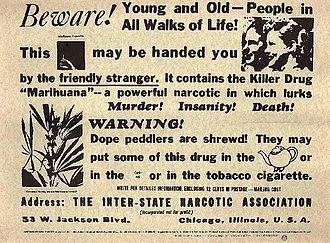
Anti-marijuana-use poster from 1935.
And none of them happy

"Three Men in a Gallery,'' by Kathy Dixon, in the show "Shore Shore Photographers,'' at the South Shore Art Center, Cohasset, Mass., through April 30.
Looking at Brazil and the Southern Cone after a wild year
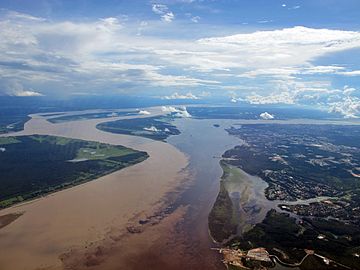
Over Brazil's Amazonia.
March 14, 2017
To members and friends of the Providence Committee on Foreign Relations (thepcfr.org; pcfremail@gmail.com).
Distinguished Brazilian political economistand commentator Evodio Kaltenecker (whom some of you may remember from a few years ago) willspeak on Thursday, March 16, about the challenges and opportunities facing that huge nation (the world's fifth biggest, both in population and area) as well as conditions in South America’s Southern Cone – Uruguay, Argentina and Chile.
Brazil, of course, has had a difficult time in the past couple of years, with economic depression, political upheaval, Zika and a fraught Olympics.
The official title of Mr. Kaltenecker's talk:
"Brazil: 2018 and beyond and the pro-market wave in Latin America''.
Modernist chowder

Today we take New England clam chowder as something traditional that makes our roots as American cooking very solid, with a lot of foundation. But the first person who decided to mix potatoes and clams and bacon and cream, in his own way 100 to 200 years ago, was a modernist.
-- Jose Andres (Spanish-American chef)
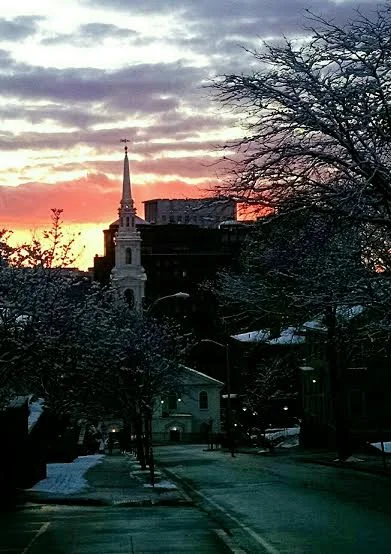
Late-winter dusk
--Photo by Charles Pinning
Rolling down Angell Street at dusk on College Hill, Providence.
Gray matter

"One on One'' (off Coast Guard Beach, Eastham, Mass.), by Bobby Baker. Copyright Bobby Baker Fine Art Photography.
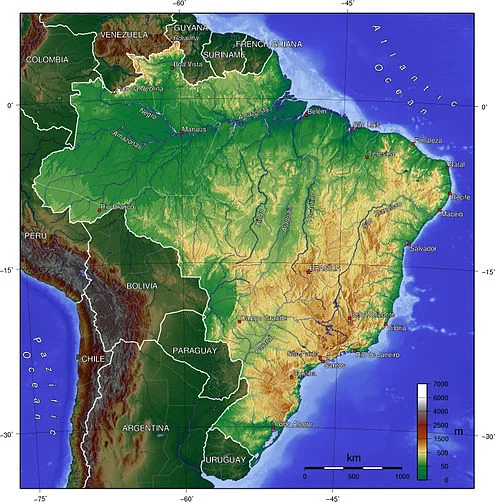
The road from Rio
March 12, 2017
To members and friends of the Providence Committee on Foreign Relations (thepcfr.org; pcfremail@gmail.com).
New England’s bizarre climate – the worst part of the winter comes near its end this year!
Distinguished Brazilian political economist and commentator Evodio Kaltenecker will speak on Thursday, March 16, about the challenges and opportunities for that huge nation as well as conditions in South America’s Southern Cone – Uruguay, Argentina and Chile. The recent past has been very tumultuous in Brazil particularly. Will the instability continue?
The title of his talk:
Brazil: 2018 and beyond and the pro-market wave in Latin America.

At least they don't look unfriendly

"The Silent Ones'' (acrylic on canvas), by Michael Shores, in his show "Cloud Creatures and Other Delusions,'' at Galatea Fine Art, Boston, April 1-30.
He says that many of his paintings were "inspired by a visit to a sacred ancient place in the American Southwest where "I experienced an epiphany of biomorphic forms in sandstone....Perhaps a visit to another planet might be the closest feeling. Being there completely convinced me of the existence of an alien life form that existed million of year before man.''
Retrofitting Art Deco buildings ain't cheap
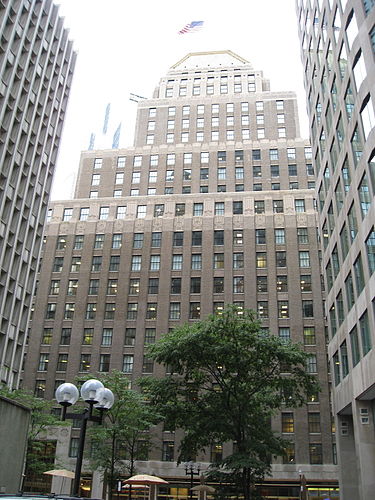
The United Shoe Machinery Building, on Federal Street in Boston's financial district.
Adapted from Robert Whitcomb "Digital Diary,'' in GoLocal24.com
Providence’s Industrial Trust Building (aka the Superman Building) might be best used for design studios for Providence’s big art and design community on the first few floors over the ground floor (which could have restaurants and shops), and then apartments and condos and then a restaurant near the top. If none of these soon become economically plausible, then tear the damn thing down; it’s starting to fall apart. The building is probably too clunky and outdated (with its step-backs) to lurea big company.
Of course, if Providence were as rich as Boston, there would be enough money around to retrofit the mini-skyscraper as well as was done at the great art deco United Shoe Machinery Building in downtown Boston.
He needed that

"The way a crow
Shook down on me
The dust of snow
From a hemlock tree
Has given my heart
A change of mood
And saved some part
Of a day I had rued.''
-- Robert Frost, "Dust of Snow''
Frank Carini: The horrific effects of plastic pollution

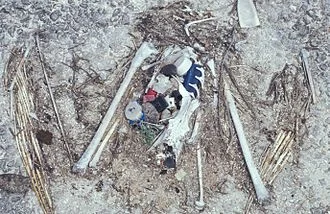
The remains of this Laysan albatross chick on Midway Island in the Pacific show the plastic it ingested before death, including a bottle cap and lighter.
The amount of plastic choking the planet, most notably the world’s oceans, is unfathomable. The evidence of this unrelenting assault overwhelming. The scale of this toxic pollution horrifying.
Consider:
It’s estimated that there are 5.25 trillion pieces of plastic debris in the ocean, from 269,000 tons afloat on the surface to some 4 billion plastic microfibers per square kilometer in the deep sea.
Plastic bags break up into smaller pieces, but their footprint never vanishes. If they do break down, it’s into polymers and toxic chemicals. Some 500 billion single-use plastic bags are used annually worldwide. If you joined them end to end, these petroleum pouches would circumnavigate the globe 4,200 times. Only a minuscule fraction are recycled or reused.
Twenty-five billion Styrofoam cups are thrown out annually in the United States alone.
A single tube of facial scrub can contain more than 330,000 plastic microbeads. A single microbead can be a million times more toxic than the water around it.
Nearly 3 million plastic bottles, every hour of every day, are used in the United States. Less than 30 percent are recycled.
More than 300 million plastic straws are used every day in the United States. Straws are too small to be easily recycled, so they typically become trash. Plastic straws are one of the top beach polluters worldwide.
Eight million tons of plastic are dumped into the world’s oceans every year.
About 100,000 marine creatures die every year from plastic entanglement.
About a million sea birds are killed every year by plastic. A record 276 pieces of plastic where found in one dead bird. It was 90 days old.
At least two-thirds of the world’s fish stocks are suffering from plastic ingestion.
A 2016 study warns that there will be more waste plastic, by weight, in the ocean than fish by 2050, unless humans clean up their act.
“We’ve plasticized the entire biosphere, including our bodies,” said Marcus Eriksen, research director and co-founder of the 5 Gyres Institute. “The impact of plastic is widespread, and it’s destroying the oceans.”
Eriksen was one of four guests who spoke March 4 at Brown University during a panel discussion titled “The Plastic Ocean.” The discussion also featured photographer Chris Jordan, Georgia State University professor Pam Longobardi and author Carl Safina.
In January, ecoRI News hosted a screening of A Plastic Ocean at the Cable Car Cinema, in Providence. Both events highlighted a serious problem.
Plastics production has increased twenty-fold since 1964, according to last year’s The New Plastics Economy: Rethinking the future of plastics study. Production is expected to double again in the next 20 years, and almost quadruple by 2050.
The world’s plastic problem was first identified in the 1970s. In 1987, a law was eventually passed to restrict the dumping of plastics into the ocean. The Marine Plastic Pollution Research and Control Act went into effect Dec. 31, 1988, making it illegal for any U.S. vessel or land-based operation to dispose of plastics in the ocean.
However, this act and other laws like it, such as the Microbead-Free Waters Act of 2015, can’t compete with mass consumption and throwaway societies.
In 2000, Eriksen traveled to Midway Atoll — a 2.4-square-mile island roughly equidistant between North America and Asia — where he found hundreds of dead Laysan albatross with plastic-filled stomachs. The visit narrowed Eriksen’s environmental focus, and led to the creation of his Los Angeles-based nonprofit that empowers action against the global health crisis of plastic pollution through science, art, education and adventure.
More than 600 animal species are impacted by plastic, through ingestion or entanglement, both of which can sicken or kill them, according to the 5 Gyres Institute. Birds, fish, turtles, dolphins, sharks and whales can be poisoned or trapped by plastic waste.
“There’s pieces of plastic out there with shark bites, turtle bites,” said Eriksen, noting that smaller pieces of plastic can be found everywhere in the world’s oceans. “The world is covered by microplastic particles. The fact we can find plastic in the middle of the ocean is a tragedy of the commons.”
Photographer Chris Jordan followed Eriksen to Midway Atoll. He has visited the far-flung island in the North Pacific Ocean several times. His photographs have vividly captured the destruction caused by plastic. The experience was soul-crushing.
Jordan, the first speaker at the recent panel discussion, introduced himself this way: “I’m the guy who took the horrible photos of the birds with plastic in their stomachs.”
As the Seattle-based photographer shot pictures and videos of plastic-ridden bird carcasses, he found himself sobbing. “Being with dying birds and seeing their suffering ... I felt the grief,” he said. “I never knew how much I cared about these animals.”
“We could be living in such a different way,” Jordan said. “There’s nothing standing in the way of radical change in global behavior. Science is telling us that we need this change.”
Pam Longobardi with some of the plastic she has collected from beaches around the world during the past 10 years. She makes art with some of it, to raise awareness of the world’s plastic problem, archives some of it and recycles as much of it as she can. (Drifters Project)
In 2006, after discovering mountains of plastic on remote Hawaiian shores, Pam Longobardi founded the Drifters Project. During the past decade, the nonprofit has removed tens of thousands of pounds of debris, mostly plastic, from the natural environment and reused the material as communicative social sculpture, to create awareness of the problem.
“The ocean ecosystem is full of life ... and it’s in trouble,” Longobardi told those gathered in the Brown University auditorium. “The ocean is vomiting plastic because it’s full.”
She called plastic a crime against nature, and noted that all this pollution is creating an environmental and racial crisis.
“Plastic comes back to haunt us,” she said. “It’s the ghost of our consumption.”
Longobardi has led “forensic beach cleanings” around the globe, from emptying plastic-filled caves on Kefalonia, an island in the Ionian Sea, west of mainland Greece, to scrubbing beaches in Hawaii. She’s currently running a project in Lesbos, a Greek island in the northern Aegean Sea off the coast of Turkey.
Change is possible, and the four speakers noted that, despite the best efforts of lobbying groups such as the American Chemistry Council, a tipping point is fast approaching.
For instance, applying circular economy principles to global plastic packaging flows could transform the plastics economy and drastically reduce negative externalities such as leakage into oceans, according to the 2016 report by the World Economic Forum and Ellen MacArthur Foundation.
“Why are we packing yogurt that lasts three weeks into containers that last forever?” Eriksen asked.
Individual behaviors are also changing.
“When I see a piece of plastic, I pick it up,” Longobardi said. “I know it won’t be consumed by a bird or animal.”
Frank Carini is editor of ecoRI News, where this first ran.