
Vox clamantis in deserto






'Celestial time'' and 'manipulated landscape'

Photo from David Shannon-Lier's show "Of Heaven and Hearth,'' at the Foster Gallery at Noble and Greenough School, Dedham, Mass. The large-format black and white photographs "explore the relationship between celestial time and space and a manipulated landscape that dwells underneath it,'' says the gallery.
John Feffer: My dystopian novel accidentally predicted Hurricane Trump

Graffiti, referring to George Orwell's novel 1984, on a wall in Donetsk, in eastern Ukraine, which has been under attack by Russia.
Via OtherWords.org
It’s terrifying when your dystopian nightmares begin to come true.
Donald Trump is consolidating a circle of extremist advisers. Hardline restrictions on immigration are going up, regulations on Wall Street are tumbling down, and ordinary Americans can no longer agree on simple truths, let alone politics.
Abroad, Europe may be splintering, too, Asia looks volatile, and wars continue to rage in the Middle East. And everywhere, climate change creeps forward.
For me, however, the rise of the Trump era held a special terror.
My novel Splinterlands, which I finished in March 2016 and published in December, imagines a world that breaks into a million little pieces. It begins with the destruction of Washington, D.C.C, by a terrible storm — which I called Hurricane Donald — and goes downhill from there.
I tell the story of the unraveling of a family, which takes place against the backdrop of the break-up of the European Union, the collapse of China, the disuniting of the United States, and a massive financial crisis that wipes out the middle class everywhere.
After submitting the final draft of the book to my publisher, I watched in bewilderment as the British public voted to withdraw from the EU. I was astonished some months later when the American public elected Donald Trump. And I was dismayed to watch the new administration begin to undermine U.S. democracy even before it officially took office.
I also felt a strange sense of déjà vu. It was a feeling akin to traveling back in time to watch the unfolding of an assassination or the lead-up to a world war. I’d already gamed out these scenarios when I was plotting my novel.
I’m no Nostradamus, and I didn’t intend Splinterlands as a prediction of the future.
When I was writing the book, I was concerned about the rise of far-right extremists, the rollback of democracy, and growing divisions here and abroad. And the half-measures the international community adopted to address climate change didn’t bode well for the health of the planet either.
I wanted my new novel to serve as a wake-up call. The world — and our country — could easily fragment, I warned, if we didn’t pay more attention to the sources of the new populist nationalism.
Economic globalization was benefiting some and leaving others behind. Faith in the democratic process was eroding as political elites engaged in corruption. Social media was undermining the distinction between real and fake news.
In past eras, progressives challenged these developments with calls for greater economic equality, more democracy, and solidarity across social identities. But mainstream progressive parties have often backed the same 1 percent-friendly policies as the right, leading to skyrocketing inequality.
The decline of the left has provided enormous political opportunities for the far right.
They’re climbing in the polls all over Europe. And here in the States, the white-supremacist alt-right played a critical role in getting Donald Trump elected.
But novelists don’t write dystopias because they think that the dismal future they portray is inevitable. 1984, Brave New World, The Handmaid’s Tale: These were all calls to arms. If humanity didn’t change its ways, the novelists warned, those dystopias would be more likely.
Americans, fortunately, are already responding to the threat.
The protests following Trump’s inauguration brought millions of people onto the streets. And the executive order banning Muslims from seven countries from entering the United States has generated unprecedented backlash.
The United States is divided, but still it stands.
I’m terrified. But I’m also hopeful. My novel Splinterlands remains mostly fiction, and I’ll work hard with millions to keep it that way.

Mass. and N.H. top US News's "Best States'' rankings, winter and all

Apple orchard in Hollis, N.H. New England winters help keep out the worst bugs and tropical diseases.
Adapted from an item in Robert Whitcomb's 'Digital Diary,'' in GoLocal24.com:
Yet again, after many decades of Sun Belt hype, we have another measure of how the generally northern and mostly Blue States are, by important metrics, the best states to live in. That’s largely because of their tradition of strong education and infrastructure. US News & World Report’s first ranking of the best states list in the top 10: Massachusetts, New Hampshire, Minnesota, Washington State, Iowa, Utah, Maryland, Colorado and Vermont. (Connecticut was 12th, Maine 18th and Rhode Island 21st.)
The publication said:
“Some states shine in health care. Some soar in education. Some excel in both – or in much more. The Best States ranking …draws on thousands of data points to measure how well states are performing for their citizens. In addition to health care and education, the metrics take into account a state’s economy, the opportunity it offers people, its roads, bridges, Internet and other infrastructure, its public safety and the integrity and health of state government.
“More weight was accorded to some state measures than others, based on a survey of what matters most to people. Health care and education were weighted most heavily. Then came the opportunity states offer their citizens, their crime & corrections and infrastructure. State economies followed closely in weighting, followed by measures of government administration. This explains why Massachusetts, ranking No. 1 in education and No. 2 in health care, occupies the overall No. 1 spot in the Best States rankings. And it explains why New Hampshire, ranking No. 1 in opportunity for its citizens, ranks No. 2 overall in the Best States rankings.’’
The low-tax (except for their regressive sales taxes) low-public-service Red States in the South generally did very poorly.
Massachusetts Gov. Charlie Baker, a Republican and a very able executive who’s expected to run for re-election next year, said:
“We have a lot of really smart people, we have a lot of great schools. That has led to a whole series of terrific what I would call ‘ecosystems’ around technology and health care and finance and education. And you put it all together, and in this day and age, in this kind of global economy and global world we live in, it’s a terrific mix.” Of course, Massachusetts has had some great institutions since the 17th Century; it had a running start.
Mr. Baker will probably get some credit for the ranking, but the essentials of the Bay State’s health have been in place for a long time. Governors and U.S. presidents have remarkably little impact on the economic health of their jurisdictions; there are far too many variables.
As for New Hampshire, it has the overwash of wealth from the very rich Greater Boston area, the Granite State’s good public education, political integrity, local and state civic-mindedness, a tradition of having many well-run small and medium-size companies and industrial craftsmanship. And as befits a state that is mostly suburban, exurban and rural, lower taxes than Massachusetts’s.
US News folks did note that Massachusetts, despite of, or because of, its very low unemployment rate, had too little “affordable housing’’ (whatever that means exactly) and very wide income inequality. But the latter is due largely to the vast wealth collected by the senior execs and shareholders of very successful enterprises founded in, based in or with major operations in the Bay State and the large number of well paidvphysicians, engineers, financial-services honchos and other very highly skilled professionals.
Another advantage of New England: It's so far north that tropical diseases rarely make it to the region. There are some advantages to having the cool snap we call "winter.''
3 freezings are the charm

Spring Peeper.
"After the frogs begin to sing in the spring, if they are frozen in three times, you may be sure that afterwards you will have warm weather.''
-- Clifton Johnson, from his book What They Say in New England.
An intimate moment at the New England Aquarium

When I would visit my octopus friend, Octavia, at (the} New England Aquarium {in Boston}, usually she would look me in the face, flow right over to see me, and flush red with emotion when she took my arms in hers. Often when I'd stroke her she'd turn white beneath my touch, the color of a relaxed octopus.
-- Sy Montgomery
Sea Research Foundation/JASON Project CEO to speak at PCFR
March 6, 2017
To members and friends of the Providence Committee on Foreign Relations (thepcfr.org; pcfremail@gmail.com).
Our next guest will be Dr. Stephen Coan, on Wednesday, March 8.
Dr. Coan is president and chief executive officer of Sea Research Foundation, Inc., a 501c3 non-profit organization which operates Mystic Aquarium, Institute for Exploration and Immersion Learning. He is also chief executive officer of The JASON Project, an internationally acclaimed science program for classroom students, also managed by Sea Research Foundation in partnership with the National Geographic Society.
He’ll talk about the condition and future of the oceans in a time of global warming and other environmental challenges, especially the manmade ones.
Don Pesci: Of Lincoln and today's politics
Don Pesci, a Vernon, Conn.-based political writer and frequent contributor to New England Diary, have the address below at Meriden’s Fourth Annual Lincoln Day Dinner.
The day is named after Abe Lincoln, and well named too. I suppose this year those attending these remarks will thank God – who else? – that they are not called upon to celebrate the Jefferson, Jackson Bailey Dinner, which used to be a day of feasting and merriment for Connecticut Democrats. This was before conscience-stricken Democrats re-named their annual event. They did so because Democrats decided, three quarters of a century after President Jackson died, that he had owned slaves – who knew? -- and was not kind to American Indians. Though somewhat debased, Jackson, revered as a populist, is still regarded as the founder of the modern Democratic Party.
Lincoln owned no slaves and, in fact, prosecuted a bloody Civil War to emancipate them. He had a wicked sense of humor, unlike the stern, forbidding, disputatious and humorless Andy Jackson. On one occasion, in the midst of a speech, a heckler in the audience cried out that Lincoln was two-faced. Lincoln replied, “If I had two faces, do you think I’d be wearing this one?” His was a face only his wife and Mathew Brady, the famous photographer, could love.
I like to think that the modern Republican Party carries within its political DNA some of the characteristics of its founder. One has to have a robust sense of humor, after all, to have survived eight years of President Barack Obama, or the possibility that his Secretary of State, Hillary Clinton, might have become president, a near miss for which the nation must thank God – who else? – or six years of Gov. Dannell Malloy, whose approval rating, when last I looked, was scraping the bottom of the barrel at 25 percent – not as low as the approval rating of many journalists, but getting there.
So, what Lincolnian virtues should Republicans carry forward into the still nascent 21st Century?
Foremost, I think, would be an unflinching regard for the founding documents: the Declaration of Independence, the Bill of Rights to the U.S. Constitution and the Constitution itself. Superman presidents come and go, but we are still a nation of laws dedicated, as Lincoln would have it, to certain timeless principles, among which is that government should interfere as little as possible with life, liberty and the pursuit of happiness.
This last formulation – the pursuit of happiness – properly understood, may grate on modern ears. The founders thought the pursuit of happiness was intimately bound up with property rights, the right to own, enjoy and dispose of property. Most scholars agree that the expression comes down to us from John Locke, who wrote in his Two Treatises of Government that political society existed to protect property, which he defined as a person’s “life, liberty, and estate." For “estate,” Jefferson, in the Declaration of Independence, had substituted “the pursuit of happiness.”
The Virginia Declaration of Rights, written by George Mason and adopted in June 1776, relying heavily on Locke, states, “That all men are by nature equally free and independent and have certain inherent rights, of which, when they enter into a state of society, they cannot, by any compact, deprive or divest their posterity; namely, the enjoyment of life and liberty, with the means of acquiring and possessing property, and pursuing and obtaining happiness and safety.” A Virginian himself, Jefferson would have been familiar with the Virginia Declaration of Rights. Jefferson regarded Locke as one of the most important apostles of liberty. He was himself, modern libertarians will tell you, a champion of liberty viewed as the absence of governmental force, and also, sexual liberationists never tire of reminding us, a bit of a hedonist. George Washington defined government in a single word: “Government,” he said, “is force.” And because it is force, it must be used sparingly and well.
So then, rights of property, liberty, which is the absence of unnecessary coercion, rational general laws and public virtue, best secured by republican forms of government, are the principle movers of right human action. Lincoln most heartily believed this, and he prayed for an end to the Civil War so that our nation would experience “a new birth of freedom” rooted in republican perceptions. Near the close of the Civil War, speaking for the nation at large, his words drifting over Gettysburg’s hallowed and blood-soaked ground, Lincoln prayed “that this nation, under God, shall have a new birth of freedom -- and that government of the people, by the people, for the people, shall not perish from the earth.”
Self-government, then, is intimately related to natural-law rights, or God-given rights, or imprescriptible rights that are part of our nature as human beings. We have a right of assembly because human beings are by nature social animals; we have a right of unhampered speech because as social animals we communicate with each other by means of words and signs, and if we were not at liberty to do so, there could be no social forms – no families, no neighborhoods, no municipal governments, no state governments, no federal governments; we have a right of freedom of religionbecause religious institutions, like political institutions, provide a theatre in whichwe may freely speak and assemble; a church – which is the gathering of the faithful, and not a brick building with a pulpit inside -- is a social theatre of thought and action, like a town hall.
Where are we today? Emerging from the Continental Congress that gave to the nation a Constitution of liberty -- a form of governance -- Ben Franklin was accosted by a woman who asked him, “Well Sir, what have you given us?” And his reply rings down the ages as a challenge thrown at the feet of future generations. “A republic, madam,” he said “— if you can keep it.” All the founders, students of history, every one, knew that republics were perishable forms of government, giving way, usually, to ambitious autocrats and followed by borderless displays of power. So it was with Rome, a promising republic at the beginning that ended with Suetonius’ “The Twelve Caesars,” many of whom – but most emphatically Caligula and Nero – proceeded to govern as demi-gods in whom naked power had replaced honor and public virtue. Caligula is the real precursor of Hitler, Stalin and Mao, three demoniac, totalitarian disturbers of the peace operating in the 20th century, possibly the bloodiest century in the history of the world.
So then, let’s take a survey of what V. I. Lenin used to call “the correlation of forces” right here in Connecticut in year 2017 to see if we have kept the republic.
Governor Malloy, no stranger to the use of naked force, is the most progressive governor Connecticut has had since Wilbur Cross, a Yalie belle lettrist and a Depression0-era governor. I do not here mean to suggest that Malloy is a belle lettrist – far from it; I cannot recall a single line of his uttered during his two terms as governor that is quotable or even memorable. But both he and Cross may properly be characterized as progressives; Cross in the era of Franklin Delano Roosevelt, no mean progressive himself, and Malloy in the era of progressive President Barack Obama and Bernie Sanders, a Vermont socialist who may justly be compared with Eugene Debs, Sanders’s political guardian angel. Debs ran for president as a socialist a number of times.
Progressivism is the doctrine that anti-republican government not only knows best; it can and should be both omni-present and omni-competent, somewhat like the demi-god Caligula who, following his mother’s death, tore open her womb because he wanted to see the place where Caligula-The-God had been born. Progressivism is the doctrine that government is productive of good, an article of faith among both progressives and socialists. Given this presumption, government should be unbounded by such restraints as constitutions, the traditional balance of powers constitutionally hardwired into our republican form of government, long-standing traditions – all of them considered by progressives to be outworn social artifacts -- a lucid view of history and the collective common sense of a people that continues to insist, perversely, that theirs should be a government of, by and for the whole people. There are and must be no limits to true progressive government. We should have known something was up when the newly elected Obama told us that the U.S. Constitution was a document that insured “negative liberties.” The Constitution, in Obama’s view, said what the government may not do. But what the country really needed at the beginning of a regime committed to radically changing the political DNA of the United States was a living constitution that would spell out in precise terms what the government ought to do, a declaration of progressive action. After implementing this new declaration of dependence, the people should let Obama be Obama.
With some very few critics chirping in the background, the nation did allow Obama to be Obama. The results were not encouraging. Obama’s Affordable Care Act, the central pillar of the former president’s legacy, such as it is, carelessly implemented, became unaffordable; in due course, insurance companies took a hike. Obama’s two Secretaries of State – Hillary Clinton and John Kerry – brought war not peace to the Middle East. Vladimir Putin, now nuzzling up to President Donald Trump, bit off a large piece of Ukraine, successfully supported Bashar Assad – a tyrant even more bloody-minded than his father – in Syria, where Obama once drew a quickly disappearing red-line. ISIS, settling into northern Iraq and Syria, claimed responsibility for having blown up Paris -- numerous times. Ambassador to Libya, Chris Stevens, is still dead, his tortured ghost crying out for justice. At Obama’s leave-taking, the national debt stood at $20 trillion, the now former president having doubled the debt within the space of eight years. Obama concluded a disastrous treaty with Iran, which is quickly becoming a client state of Putin’s, the terms of which were never submitted to congressmen such as U.S. Sen. Dick Blumenthal, who signed off on a “deal” that exploded a successful Iranian embargo and gave the mullahs there, all of whom have pledged to push Israel into the sea, millions of dollars in cold cash they doubtless will use to finance the services of Hamas, the militant spear-point cunningly fashioned to pierce Israel’s heart. In his last few weeks in office, the out-going president tried his best to hobble the incoming president – but there are only so many hours in the day, and the days ran out. Thanks to term limits, future damage has been halted, for the time being, and any repair job on Obama’s disastrous legacy was cut short by the unexpected victory of Donald Trump over Hillary Clinton. These are some of the bitter fruits of a borderless “rule by executive order” government.
Here in Connecticut, Malloy has followed a similar progressive course. Almost everywhere today, it is assumed that Connecticut does not have a revenue problem; how could it, following Malloy’s two major tax increases, the first the largest and the second the second largest in state history? It is now generally agreed, except in some “of course the earth is flat” quarters, that Connecticut is suffering from a spending problem. Malloy had to be dragged, kicking and screaming, to this golden perception. He has several times promised there will be no new tax increases, but he is not opposed to measures that will enhance revenue, and lately he has waffled on the matter of tax increases. He also has waffled on the ideological nature of his administration. Allow me a parenthetical remark: I am here using the word “ideological” in its non-pejorative sense. An ideology is a logical and ordered – not necessarily desirable – body of thought. The opposite of an ideology is a thoughtless, random assemblage of illogical, half-baked ideas.
Malloy has said both that his is the most conservative and the most progressive government, depending upon which group of people he is addressing. Mr. Malloy asked Connecticut reporters at the beginning of the New Year, “Who is the most conservative governor that any of you have worked with in the last whatever period of time you’ve been here?” Here we find him taking an undeserved conservative bow. A couple of weeks later, he was telling reporters that he had accepted an invitation to Trump’s inauguration ceremony because he thought progressive governors should be represented atthe affair. No Connecticut reporter has yet shouted out at a media-availability that Malloy is two-faced.
Only those willing to be fooled are fooled by any of this. Malloy is a progressive, pure and simple. At the beginning of Malloy’s second term, Jim Dean, Howard Dean’s brother, noted that Malloy “has been cited by some progressives like Mayor (Bill) de Blasio, of New York City, as an example of a Democrat who can win by emphasizing progressive themes, while many Democrats who moved in the other direction were defeated." And de Blasio himself draped the progressive mantle over Malloy’s shoulders: “And don't forget Gov. Dan Malloy -- who was written off by so many in his re-election bid in Connecticut. Malloy raised taxes so he could invest more in education each year (at a time when other governors were slashing education to close budget gaps). Malloy passed earned sick time and a minimum wage hike. And in his re-election bid, he proudly stood alongside Obama.” Malloy’s most articulate apologist, Roy Occhiogrosso, recently popped up to confirm that the earth is not flat and his former boss is indeed a progressive.
Lincoln, who believed that men and women should retain the wealth they had earned by the sweat of their brows, was neither a progressive nor a socialist.
Three lines are sometimes quoted from Lincoln’s First Inaugural Address to show that he harbored socialistic tendencies. Here are the lines: “Labor is prior to and independent of capital. Capital is only the fruit of labor, and could never have existed if labor had not first existed. Labor is the superior of capital, and deserves much the higher consideration.” One imagines Karl Marx, whose articles appeared in New York Papers from 1852-1861, nodding his head in affirmation. The First Inaugural Address was delivered years earlier than Marx and Engles’s Communist Manifesto, and if both had paid close attention to it, incorporating its measures into their ideology, the world would have been spared much trouble.
It is true that labor is superior to capital and must be attended to. “The effort to place capital on an equal footing with, if not above, labor in the structure of government,” Lincoln says, leads to a series of false assumptions. The false assumption that capital rather than labor is preeminent leads to other dangerously false assumptions.
Here is Lincoln again: “It is assumed that labor is available only in connection with capital; that nobody labors unless somebody else, owning capital, somehow by the use of it induces him to labor. This assumed, it is next considered whether it is best that capital shall hire laborers, and thus induce them to work by their own consent, or buy them and drive them to it without their consent. Having proceeded so far, it is naturally concluded that all laborers are either hired laborers or what we call slaves. And further, it is assumed that whoever is once a hired laborer is fixed in that condition for life.”
The notion that laborers, once fixed in their jobs, do not advance and improve their lot but remain part of a permanent class – the central presumption of Marxist socialism – is simply not true in Lincoln’s United States.
Listen closely to a uniquely American perception of the relationship between labor and capital:
“Labor is the superior of capital, and deserves much the higher consideration. Capital has its rights, which are as worthy of protection as any other rights. Nor is it denied that there is, and probably always will be, a relation between labor and capital producing mutual benefits. The error is in assuming that the whole labor of community exists within that relation. A few men own capital, and that few avoid labor themselves, and with their capital hire or buy another few to labor for them. A large majority belong to neither class--neither work for others nor have others working for them. In most of the Southern States a majority of the whole people of all colors are neither slaves nor masters, while in the Northern a large majority are neither hirers nor hired. Men, with their families--wives, sons, and daughters--work for themselves on their farms, in their houses, and in their shops, taking the whole product to themselves, and asking no favors of capital on the one hand nor of hired laborers or slaves on the other. It is not forgotten that a considerable number of persons mingle their own labor with capital; that is, they labor with their own hands and also buy or hire others to labor for them; but this is only a mixed and not a distinct class. No principle stated is disturbed by the existence of this mixed class.”
Lincoln never thought in bumper-sticker captions. His last law partner, William Herndon, said of him that Lincoln “not only went to the root of the question but dug up the root and separated and analyzed every fiber of it.” A fellow attorney, Leonard Swett, warned, “Any man who took Lincoln for a simple-minded man would very soon wake up with his back in a ditch.”
Listen now, and try to hear Lincoln’s words with the ear of your heart:
“Again, as has already been said, there is not of necessity any such thing as the free hired laborer being fixed to that condition for life” – no permanent class structure. He continues, “Many independent men everywhere in these States a few years back in their lives were hired laborers. The prudent, penniless beginner in the world labors for wages awhile, saves a surplus with which to buy tools or land for himself, then labors on his own account another while, and at length hires another new beginner to help him. This is the just and generous and prosperous system which opens the way to all, gives hope to all, and consequent energy and progress and improvement of condition to all. No men living are more worthy to be trusted than those who toil up from poverty; none less inclined to take or touch aught which they have not honestly earned. Let them beware of surrendering a political power which they already possess, and which if surrendered will surely be used to close the door of advancement against such as they and to fix new disabilities and burdens upon them till all of liberty shall be lost.”
The substance and tone here is Reaganesque; no one would be surprised to find these words, or words like them, printed in a contemporary conservative press – not, of course, in Connecticut.
Lincoln left us a legacy we can draw on to advance liberty, the foundation stone of republican government. He was a man ahead of his time because his thoughts were not entirely bound up with momentary political events – which are not to say that Lincoln was not a political creature. He most certainly was a better politician than most men of his period, such as General McClellan, whom Lincoln more or less fired because McClellan, unlike Grant, was not overly concerned with the destruction of the South’s army. McClellan – who ran for the presidency against Lincoln and got shellacked – was a lesser general than Lincoln, who was intimately familiar with Napoleon’s successful military tactics, and who glimpsed in Grant the steel necessary to win a war and keepFranklin’s republic.
Studying the speeches of Lincoln – even his casual remarks – and comparing them with the sound-bite rhetoric of any modern politician you care to mention, one is forced to the conclusion that the Darwinian notion that a final product is more complex and perfect at the end of any developmental process is pure hokum. Only a political process that retains what is best and purifies our politics by speaking to the angels of our better nature can be called an improvement, a step forward toward beauty and perfection.
We must understand this about Lincoln: Secession, the abolition of slavery and most importantly the Civil War are the distortion lenses through which the character of Lincoln shines through. Lincoln used to say that all men can abide adversity; but if you want to test a man’s character – give him power. He wended a tortuous way during his own time between Radical Republicans rushing forward at warp speed, less impulsive Conservative Republicans, War Democrats who turned against him mostly for political reasons, and Copperheads, the foot-draggers of the age. Lincoln understood the mind of the country better than any other president before or after him. And he was a masterful commander-in-chief, says James McPherson in a book called Tried by War; Abraham Lincoln as Commander in Chief.
The war ended; the union was preserved; slavery was abolished. Ten years after Lincoln was assassinated, Fredrick Douglas was asked to say a few words about Lincoln on the occasion of the dedication of the “Freedmen’s Monument” in Lincoln Park east of the U.S. Capitol. This is what he said: “The honest and comprehensive statesman, clearly discerning the needs of his country, and earnestly endeavoring to do his whole duty, though covered and blistered with reproaches, may safely leave his course to the silent judgment of time. Few great public men have ever been the victims of fiercer denunciation than Abraham Lincoln was during his administration. He was often wounded in the house of his friends. Reproaches came thick and fast upon him from within and from without, and from opposite quarters. He was assailed by abolitionists; he was assailed by slaveholders; he was assailed by the men who were for peace any price; he was assailed by those who were for a more vigorous prosecution of the war; he was assailed for not making the war an abolition war; and he was most bitterly assailed for making the war an abolition war.”
A man of character was Lincoln. I think it was Henry Adams – the black sheep of the Adams family who, consciously attempting to wound puritanical sensibilities in Boston – placed the highest point of Western Civilization in the 12th Century. It was all downhill from there, Adams thought. Having written columns about Connecticut politicians for some 35 years, I hope you will forgive me if I say Adams may have a point.
In an unresolved season

"Resolutions'' (oil on canvas), by Julia Purinton, at Alpers Fine Art, Andover, Mass.
James P. Freeman: With the Trump vaudeville show, it's back to 'Laugh-In'
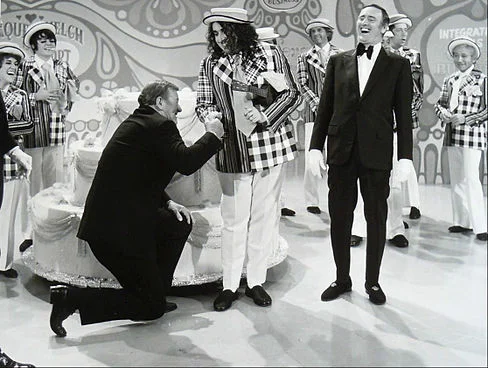
John Wayne and Tiny Tim helped Laugh-In celebrate its 100th episode in 1971. Co-host Dan Rowan yucks it up in his tuxedo.
“… let’s go to the party!”
— Dan Rowan
Without a trace of transgression, Time recently described Donald Trump and his nascent administration as “a vaudeville presidency.” The other week, with absurd appearances by several of the president’s principal architects, the Conservative Political Action Conference (CPAC) unwittingly staged this politically charged vaudeville act, replete with comedy, contortion, and commotion that, at times, resembled the television program Rowan & Martin’s Laugh-In that ran in the late 1960s and early 1970s.
“Groovy!”
Hosted by comedians Dan Rowan and Dick Martin, the unique variety show was, says tv.com, “a fast-moving barrage of jokes, one-liners, running skits, musical numbers as well as making fun of social and political issues” of the period. And so was, CPAC 2017.
Writing for The New York Times Magazine in 1968, Joan Barthel observed that “whatever else it is — and at one time or another Laugh-In is hilarious, brash, flat, peppery, irreverent, satirical, repetitious, risqué, topical and in borderline taste — it is primarily and always fast, fast, fast! And in this it is contemporary. It’s attuned to the times. It’s hectic, electric …”
And so is the Trump administration, which, in its first month has proven to be a series of recurring, improvisational sketches, careening with disorder. Hence, the surreal Laugh-In connection.
“You bet your sweet bippy!”
In the television program, “guests” at the “Cocktail Party” would mill around with drinks in hand or dance to music that would suddenly halt when a party-goer would face the camera to deliver a one-liner or a quick joke. (Today’s party stops and starts again after President Trump transmits on Twitter his version of one-liners. (Remember the infamous tweet about the “so-called judge”?)
CPAC was, without a hint of hysteria, hijacked by a few of its guests vicariously reprising several popular segments of Laugh-In: “Mod, Mod World,” (Russian sabotage?); “Laugh-in Looks at the News” (fake news?); and the “Joke Wall” (the great Wall of Mexico?). With life imitating art, these cameo appearances made this year’s CPAC disturbingly memorable. And laughable.
Kellyanne Conway, counselor to the president, a few weeks ago on Meet the Press said that the White House press secretary used “alternative facts.” (Of which Rolling Stone rightly said, “the Trump presidency had its first laugh line.”) Telling attendees on Feb.23 in anticipation of Trump’s appearance the next day of the conference — stop the music! — “Well, I think by tomorrow this will be TPAC.”
But what was lost among the intermittent laughter was this stunning punchline: “Every great movement,” Conway said, “ends up being a little bit sclerotic and dusty after a time.” That line was directed at Reagan conservatives. Just as Laugh-In had obliterated conventional variety show boundaries, Trump World is eschewing traditional conservatism, simultaneously ransacking it and redefining it. Even as Conway formally announces the end of the Reagan Revolution, President Trump cleverly says his victory was a “win for conservative values.”
“Verrrry interesting!”
Apparently, Vice President Mike Pence was never let in on the punchline. After finishing his introductory remarks to CPAC with the jab, “all kidding aside,” Pence delivered this bizarre, if not ridiculous comparison: “From the outset, our president [Trump] reminded me of somebody else. A man who inspired me to actually join the cause of conservatism nearly 40 years ago. President Ronald Reagan.” Later, Pence quoted Scripture. Stop the music, again!
And then there was the question-and-answer session with the dynamic duo, Steve Bannon, White House chief strategist, and Reince Priebus, White House chief of staff. Trying to convey a patina of unity and order to this “fine-tuned machine,” Priebus said, “the truth of the matter is … President Trump brought together the party and the conservative movement.” And Priebus also compared Trump to Reagan saying the former also sought “peace through strength.”
Gannon (who led the crusading “alt-right movement” while at Breitbart, used to host his own counterprogramming conference to CPAC, called the “Uninvited”), straight faced, said, “The reason why Reince and I are good partners is that we can disagree.” Hilarious.
Laugh-In fashioned its aesthetic from the counterculture of the 1960s (“sit-ins,” “love-ins,” and “teach-ins”), reasons britannica.com. The show “tapped into the zeitgeist in a way no other show had, appealing to both flower children and middle-class Americans.” And Bannon, a counterculture conservative, likewise believes that “the power of this movement” will appeal to a broad spectrum of people too. Or will it?
One board member of the American Conservative Union (CPAC’s host) told The Daily Beast that, “‘The craziest elements of the [party] have managed to get every single thing they wanted over the past year … This is the shape our movement is in today.’”
“And that’s the truth!”
But first, a few words from our president, who openly mocked CPAC in his monologue-cum-speech Feb. 24 by declaring, “You finally have a president.” (Read President Reagan’s elegant 1981 CPAC speech, and his 1987 CPAC speech in which he imagined the future of conservative values; “a vision that works.”) Trump in his stand-up said, “We’re going to put the regulation industry out of work and out of business. And, by the way, I want regulation.” On his Cabinet: “I assume we’re setting records for that. That’s the only thing good about it, is we’re setting records. I love setting records.”
Recalling his first CPAC speech years before, with “very little notes, and even less preparation,” Trump quipped, “So, when you have practically no notes and no preparation, and you leave and everybody was thrilled, I said, ‘I think I like this business’.”
During the 1968 presidential campaign, candidate Richard Nixon taped a six second clip for “Laugh-In,” reprising one of its signature gag lines. Nixon won the election and Dick Martin jokingly confessed, “A lot of people have accused us.” After CPAC 2017, Reagan conservatives are the butt of the joke and target of that gag line:
“Sock it to me!”
James P. Freeman, an occasional contributor to New England Diary, is a writer and financial-services professional. He’s a former columnist for The Cape Cod Times. This piece first ran in the New Boston Post.

Llewellyn King: Guilt-stricken meat eater; review of train stations; our beaches are better

'They treat us like equals''
NOTEBOOK
Italian Veal Caper
Let me be out front about my hypocrisy when it comes to eating animals. I’m a shameless carnivore, but I hate to think of the herds of cattle, pigs and sheep that I've eaten.
In my heart, I’m a vegetarian, but my stomach has an hereditary attachment to the hunters who preceded me. So I eat meat and wish I didn’t.
The best I can do to atone for this sin is to avoid bacon, not because I don’t love it; I do, but I think, along with Winston Churchill, that pigs are pretty terrific creatures. Of course, I do gobble the odd pork roast and chop; so my hypocrisy flourishes.
In case you’ve forgotten, this is what Churchill had to say about pigs, “I like pigs. Dogs look up to us. Cats look down on us. Pigs treat us as equals.”
Well, all of this is by way of a gastronomic enquiry: Why is there so little veal on the menus of Italian restaurants, which abound in New England? Rhode Island's numerous Italian restaurants just give a nod to veal, once the staple meat of the fine Italian table, north and south.
Now, I find chicken has replaced veal on Italian restaurant menus. Such standards as veal franchese, veal saltimbocca and veal marsala are mostly made with chicken.
Osso buco (braised veal shank) has almost disappeared from restaurant menus. You can't make it with chicken. My wife, Linda Gasparello, makes delicious osso buco. But buying the veal shanks for a recent dinner party involved perseverance.
Are we saving the calf and sacrificing the chicken? Looks that way. Eat up and leave the agonizing to me.
Train Trials: Amtrak Stations That Are OK, Great and Awful

In the main room of the Providence train station. On the floor is carved the lovely phrase from Robert Louis Stevenson: "For my part, I travel not to go anywhere, but to go. I travel for travel's sake. The great affair is to move.''
As readers may know, I’m the fat man in the bow tie, so often seen on the Amtrak train between Providence and Washington, D.C. I take the Northeast Regional in times of low economic activity, as it's now for me, and the Acela when economic activity is robust.
The train is really pretty good or, at least, agreeable. But the stations are something else.
Starting at the head of the line, Boston's South Station has lots of places to eat, but few to sit and wait for your train.
Providence's Amtrak station is a train-rider's joy. A small rotunda with a wonderful sandwich bar – with possibly the best sandwiches in the state – Cafe La France
Going swiftly to my next alighting point: New York's Penn Station. It's just scary, with too much third-rate retailing, too many people squeezed together under a ceiling that’s too low. It's filthy, unfriendly, probably unsafe and everything that train travel used not to be. Even a Zaro's Bakery outlet can't redeem it.
Union Station in Washington, D.C., is an architectural masterpiece and the main hall has been fabulously restored. However, Amtrak, which operates the facility, which also serves commuter trains into Maryland and Virginia, seems to care more about rental income than people. There's too much retailing near the train gates, too little use of the glorious main hall. Worse, passengers waiting for trains have to hunt for the few broken chairs in the station.
It’s a pleasure to get on train just to sit down. I hasten say that Union Station isn't as awful or threatening as Penn Station, but it could use some passenger-friendly improvements.
California Beaches Versus New England Beaches

Recently, I found myself again in one of those arguments that won’t be settled and won’t go away: Where are the best beaches? This argument usually boils down to a contest between California and southern New England.
Let me be partisan: Our beaches are best.
The reason has nothing to do with the tonnage of sand per bather. Rather, it's our secret weapon: the Gulf Stream, which in the summer and early fall sends water that can get well up into the 70s to the southern New England coast, most noticeably into Buzzards Bay. It means that in summer, there's no beach that isn't bather-accessible. You can go in the water.
I've done some pretty thorough research on the western shores of the country and they do have great sand, surf and sunsets -- maybe the best -- but the water is cold. I once ran naked into the Malibu surf to impress an actress: It didn’t work and I froze. In fact, you have to go as far south as San Diego before the water is swimmable.
Sunsets and sand are nice, but you do want to run into the water? We win.
Llewellyn King (llewellynking1@gmail.com), a frequent contributor to New England Diary, is executive producer and host of White House Chronicle, on PBS. He’s also a veteran publisher, editor, columnist and international business consultant
'We are all old-timers'
After a hearty New England breakfast,
I weigh two hundred pounds
this morning.
 Cock of the walk,
I strut in my turtle-necked French sailor's jersey
before the metal shaving mirrors,
and see the shaky future grow familiar
in the pinched, indigenous faces
of these thoroughbred mental cases,
twice my age and half my weight.

We are all old-timers,
each of us holds a locked razor.
-- Robert Lowell, from "Walking in the Blue,'' inspired by Lowell's stay in McLean Hospital, the famous psychiatric institution in Belmont, Mass.
And now he's our capo di tutti capi

Grandiose Trump Tower, in midtown Manhattan, base of the Trump Organization and presenting a hugely difficult and expensive (for the taxpayers) security challenge.
Adapted from Robert Whitcomb's "Digital Diary'' column on GoLocal24.com:
Many Americans, the great majority of whom remain surprisingly ignorant of Donald Trump’s business career, have been taken aback by the volatile, seat-of-the-pants way he acts as president. But that’s how he runs the Trump Organization (runs, not ran: whatever the bad ethics involved he is still effectively running the Trump Organization, and indeed seeking to make lots of money for it in his new gig in the Oval Office). I’m also impressed by how much this man, who has so successfully avoided paying federal income taxes, is, with his jet-setting family, costing the taxpayers around $10 million a month in travel expenses – 10 times the rate of President Obama and his family. Mr. Trump is on track to be by far our most expensive president.
The president’s company was never publicly owned. Rather it is a secretive family enterprise centered on the intensely narcissistic if sometimes paternalistic Donald Trump, with power radiating out from him through family members and retainers. It recalls a Mafia operation (and the Trump Organization is not entirely unfamiliar with mobsters). Compared to a public company, the Trump Organization has had relatively few constraints on how it operates and has been able to operate with remarkable opaqueness.
Given Mr. Trump’s history, age and character, it seems very unlikely that he’ll change his operating style in any major way. Rather, he will tend to run the White House as he runs his company – very arbitrarily. He must tell himself: “Hey, it got me this far!’’ Let us hope that some of the grown-ups in the Cabinet can moderate his worst impulses.
So do something now

The Coolidge homestead in Plymouth, Vt.
"We cannot do everything at once, but we can do something at once."
-- Calvin Coolidge (1872-1933).
The 30th U.S. president was born in Plymouth, Vt., but spent most of his life in Northampton, Massachusetts, a state that he served as governor.
'Pompous joy'
"March is the month of expectation,
The things we do not know,
The Persons of Prognostication
Are coming now.
We try to sham becoming firmness,
But pompous joy
Betrays us, as his first betrothal
Betrays a boy."
-- Emily Dickinson, "XLVIII''
Todd McLeish: It's a busy time at the Mystic Aquarium's Seal Rescue Clinic

via ecoRI News (ecori.org)
MYSTIC, Conn.
The Seal Rescue Clinic at Mystic Aquarium is a modest, outdoor, fenced area where seals, sea turtles and other marine animals rescued from nearby beaches are cared for until they are ready to be released back into the wild. And in winter, it’s a busy place.
Last week, swimming in a 12-foot-diameter tank containing 3,200 gallons of water, was a young harbor seal found malnourished on a Long Island beach in December. A few steps away in one of five 700-gallon intensive care tanks was a newly arrived gray seal pup recovered from a beach in Maine, and another gray seal pup — this one stranded on Fisher’s Island, N.Y. — rested in a smaller tank.
Inside an adjacent tent, food and medications were being prepared by staff and interns to ensure that the animals recover as quickly as possible.
“January to April is our busy season for responding to live animals,” said Janelle Schuh, who directs the clinic and the aquarium’s Animal Rescue Program. “That’s when we see gray seals pupping off our shoreline and when harp seals and hooded seals are migrating into our area.”
Aquarium staff and about 250 trained volunteers respond to some 150 reports of sick, stranded and dead marine mammals in southern New England and Fisher’s Island, N.Y., annually — about 70 percent of which come from Rhode Island.
When it’s deemed necessary to rescue an animal, it’s herded into a mobile kennel and delivered to the Seal Rescue Clinic for round-the-clock care. When necessary, veterinarians may conduct surgeries and other procedures in the aquarium’s new veterinary hospital, which opened in December.
The clinic also rehabilitates animals recovered by organizations elsewhere in the Northeast that don’t have their own clinics, including a manatee found on Cape Cod last fall that was eventually flown to Florida by the Coast Guard.
Last year was the aquarium’s busiest year for rehabilitating seals. About 30 animals were rescued and brought to Mystic — half of them harbor seal pups recovered in the summer in Maine — and 25 of them were nursed back to health and released at Blue Shutters Beach in Charlestown. Most were young seals struggling with malnourishment, dehydration and traumatic wounds such as shark bites. Other animals were suffering from human interactions, such as fishing-gear entanglements or boat-propeller wounds.
How long the animals remain at the aquarium depends on their age and the severity of their malady.
“This time of year, we often turn around a dehydrated harp seal in a month, gray seal pups in two or three months, and days-old harbor seal pups are usually here four or five months,” Schuh said. “They’re sometimes here for over a year if they have bad injuries.”
She said the number of stranded animals isn’t increasing, but it’s unlikely that it will decrease enough to put her out of a job.
“There’s always going to be a need,” she said. “Marine mammal populations are increasing significantly, especially seal populations, and there will always be human interactions as the number of animals increases.”
While few seals have been rescued from disease in recent years, an outbreak of the avian flu virus in harbor seals in 2011 resulted in ongoing research projects that require aquarium staff to collect biological samples from every animal that comes into the clinic.
According to Schuh, one of the benefits of the Animal Rescue Program is the public education that results from the rescue, rehabilitation and release of the animals. The public learns first-hand how their actions, such as the irresponsible disposal of plastics, can affect marine creatures.
Those who observe a seal or other marine mammal or sea turtle on a beach are encouraged to report it to the Mystic Aquarium Animal Rescue Program at 1-800-572-5955, ext. 107. The aquarium advises the public to give the animal plenty of space, don’t touch it, keep pets away, and be observant for obvious signs of injury, general body condition and any identification tags.
“It’s human nature to do what we can to help an animal in need,” Schuh said. “That’s the philosophy we take here. If we see an animal in need, we’re going to help it and take care of it regardless of what’s happening to the population in the wild. In some cases, they’re too far gone to help, but we can still ease their suffering. It’s the least we can do.”
Todd McLeish runs a wildlife blog and is a contributor to ecoRI News..

'Dawn chorus'

Male blackbird emoting.
The birds were singing very loudly this morning, in what ornithologists and others call the "dawn chorus.'' Given how cold it was this morning -- indeed, one of the coldest mornings of this generally very mild winter -- this might sound surprising, but the birds are reacting to the bright March sun, not the temperature. The dawn chorus is loudest in the spring. The noise is related to the birds trying to lure a mate, defend a breeding territory or call in the flock of members of the same species in the same neighborhood. Sounds very human....
I've long wished that New Year's Day came on March 1 instead of Jan. 1 because about now is when things start growing again in southern New England, at first slowly and with much hesitation but by late April, explosively. On Jan. 1, on the other hand, you can't look forward to different weather or visible outdoor biological change for weeks.
Lots of crocuses and snow drops came up and bloomed in the past week or two with the extraordinarily warm weather and now they're in frozen ground. But they're tough and they'll look good again by the the middle of this week when it gets into the fifties. Life is resilient, especially in New England, with the wild weather swings that go with being at the crossroads of such different climate zones.
A few folks around here say they heard some spring peepers (a kind of tiny frog) this past week -- very early in the season indeed. They'll be silent for a couple of days but I wouldn't be surprised if they're heard again in just a few days.

Salt thicker than snow.
Is it really necessary to put salt on the roads that's thicker than the snow it is supposed to melt? That's what they do in Pawtucket, R.I., which must be a triumph for the cause of water pollution and vegetation killing. And what a waste.
Elsa Nunez: 'Dreamers' are at heart of the American Dream
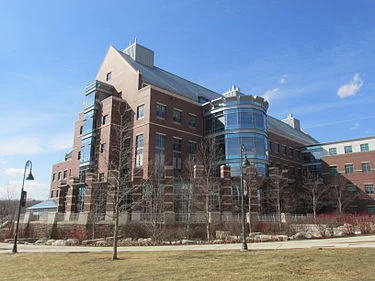
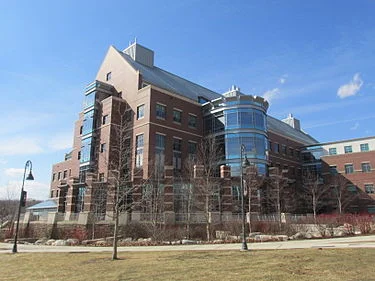
Science Building at Eastern Connecticut State University, in Willimantic.
WILLIMANTIC, Conn.
The recent controversy surrounding a proposed ban on immigration from seven Middle East countries recalls similar times in our history. More than 130 years ago, Chinese immigration was restricted. In 1924, Japanese immigrants were effectively barred from entering the U.S., and Mexicans living here during the Depression were the subject of repatriation, even those who were U.S. citizens. Other restrictions on immigration have marked our history, based on the domestic and global politics of the times.
The latest policy pronouncements reaffirm the need for comprehensive immigration reform in this country. It is time for Congress to decide how to balance securing our borders with the need for a path to citizenship for the 11 million undocumented people already in the U.S.
While we wait to see what Congress does, 1.8 million young people deserve better. Known as “Dreamers,” this entire generation of talented, dedicated students was born abroad but raised in this country without documented legal status. Since 2012, more than 740,000 Dreamers have been given Deferred Action for Childhood Arrivals (DACA) status, allowing them to receive a renewable two-year period of deferred action from deportation and eligibility for a work permit.
DACA students came to this country as children, they have grown up here, been schooled here, and dream of having productive, engaged lives here as American citizens. They think of themselves as Americans. They are exactly like the children of immigrants arriving in our country throughout most of our nation’s history, and today, they are like the children sitting next to them in school, except for the matter of permanent legal status.
Even with DACA status, these young people still face an uphill battle to achieve the promise of a college education. In 16 states, DACA students are either prevented from attending their in-state public college or university, or are forced to pay prohibitively expensive out-of-state tuition to attend their home-state public institutions. “Locked out” states include Alaska, Arkansas, Georgia, Idaho, Indiana, Iowa, Louisiana, Mississippi, Missouri, North Carolina, North Dakota, Pennsylvania, South Carolina, South Dakota, West Virginia and Wisconsin.
TheDream.US, a national foundation created by former Washington Post publisher Donald Graham and his wife, Amanda Bennett, has established the Opportunity Scholarship program to support upwards of 500 Dreamers over the next few years. Opportunity Scholars receive sufficient scholarship funds to fully pay for their tuition, fees, room and board.
In fall 2016, Eastern Connecticut State University was one of two institutions nationally—Delaware State University is the other—to enroll the very first cohort of Opportunity Scholars. In addition to 42 eligible Dreamers from the 16 locked-out states, the Dream.US foundation is also supporting five DACA students from Connecticut to attend Eastern. No public funds are being used to support Eastern’s Dreamers, and no in-state students are being denied admission because of the program.
Our 42 out-of-state Dreamers come from eight locked out states—Georgia, Idaho, Wisconsin, North Carolina, South Carolina, Pennsylvania, Missouri and Indiana—and from 13 different countries, ranging from Brazil to India, Ecuador and Zimbabwe. Applications are already being accepted for fall 2017, and Eastern will likely enroll another 75 Opportunity Scholars.
How are our Opportunity Scholars doing in this first year at Eastern? All 42 out-of-state Opportunity Scholars—as well as all five from Connecticut—have successfully weathered their first semester on campus and are back for the spring. The median GPA of our out-of-state Dreamers is an impressive 3.58! They are already becoming campus leaders—as members of the Honors Program, as resident assistants and as senators on the Student Government Association. The key has been to treat them with respect—they aren’t singled out nor housed in a single dormitory or made to feel different from their peers on campus. They receive the same personal attention for which our close-knit, public liberal arts campus is known.
When I speak to our Opportunity Scholars—and I make an effort to seek them out individually whenever possible—I am struck by their gratitude and their determination to succeed. These young people—like the native-born citizens they sit next to in class—are our nation’s future leaders, doctors, lawyers, accountants, teachers and business leaders. Their talents, work ethic and diversity bode well for our economy and society.
As much as this success story at Eastern is uplifting, the broader issue of the future of Dreamers in our country is a test of this nation’s moral fiber. Everyone in this country—except Native Americans—has ancestors who originally came from other lands to create the rich diversity we have today in the U.S. Like other members of American society, motivated, high-achieving immigrant students, no matter their nation of origin, should also have access to education—the key to social mobility and economic security in the U.S. That must be our commitment to them, knowing that what we get in return—a rich diversity of culture, religion, race and political thought—is the core strength of our democracy.
It is not by accident that our nation is the world’s melting pot, brimming with people of all nationalities and backgrounds. The U.S.—the greatest experiment in democracy the world has ever known—has enjoyed a moral standing throughout the world because it serves as a beacon of hope to all who long for freedom and opportunity. Acknowledging the right of today’s Dreamers to pursue a college education will reaffirm this moral high ground. Returning them to home nations that they cannot remember would be a disservice to these young people, would prevent them from making a contribution to our society, and would diminish our moral standing around the globe.
At Eastern, we will continue to enroll, support and advocate for the outstanding Opportunity Scholars who have come to us to earn their college degree. We urge all educators—all Americans!—to lobby our congressional leaders to do the right thing—extend the American Dream to a deserving generation of Dreamers while pursuing a viable long-term solution to the immigration issue.
Elsa Nunez is president of Eastern Connecticut State University. This piece first ran on the Web site of the New England Board of Higher Education (nebhe.org).
Just don't plug it in

"Untitled" (lead, mixed-media installation), by Marilu Swett, at Boston Sculptors Gallery.