
Vox clamantis in deserto





Vt. might embrace some GOP-style healthcare changes

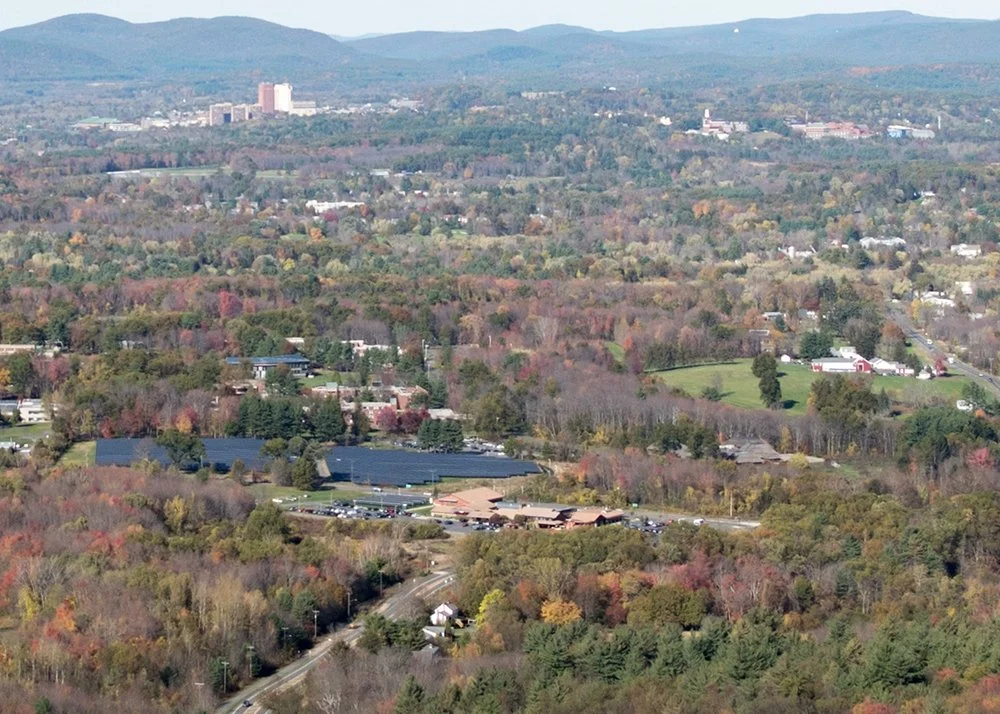
Looking toward Mt. Mansfield, the summit of Vermont.
— Photo by K. Kemerait
From Cambridge Management Group (cmg625.com)
Paradoxically, generally Democratic Vermont (but now with new Republican Gov. Phil Scott) could be setting the pace for some of the healthcare reforms touted by by the Trump administration and the Republican Congress.
The Green Mountain State won got a broad federal waiver last October to redesign how its healthcare is provided and paid for. This includes new payment systems, a stepped-up effort to prevent unneeded treatments, cutting overall growth in the cost of services and drugs, and more effectively dealing with such public-health problems as opioid abuse.
The six-year initiative follows a failed effort under former Democratic Gov. Peter Shumlin to adopt a single-payer plan for all residents.
The hope is that the program eventually will involve 70 percent of the state’s population, almost all of its 16 hospitals and 1,933 physicians and would include patients covered through their employment as well as those in Medicare and Medicaid.
Med City News noted that while the Obama administration approved the experiment it “fits the Republican mold for one way the Affordable Care Act could be replaced or significantly modified. The Trump administration and lawmakers in Congress have signaled that they want to allow states more flexibility to test ways to do what Vermont is doing — possibly even in the short-term before Republicans come to an agreement about the future of the ACA.”
T0 read more please hit this link.

Tracy Hassett: Can New England colleges collaborate to cut costs?

Tuition prices at colleges and universities are high. On that, pretty much everyone—from parents to students to college administrators—can agree. It’s also true that salaries and benefits are the single biggest chunk of every higher education institution’s (HEI) budget. And one of the largest and most difficult costs to contain is group employee health insurance. In fact, health insurance represents on average 4% to 5% of the total operating budgets at most private HEIs in New England.
The situation is particularly difficult for smaller New England HEIs because they don’t have the power to bargain with commercial insurers enjoyed by, say, MIT or Harvard. They are forced to fend for themselves in negotiating for benefit packages, whose costs—including all benefits paid for by the employer and employee—have increased on average 20% over the past five years.
Yet, colleges and universities are under increased scrutiny to create efficiencies and bring costs under control. Some institutions are doing that by hiring more part-time workers, to avoid the expense of offering a full-time benefits package. Others have begun limiting the number and kind of benefits packages they offer or passing along more of the cost to employees. Still others are trying something relatively new in higher education—collaborating on health insurance benefits.
Collaboration is not new to HEIs. The key benefit of collaboration is to shift risk away from a single HEI experimenting with a new approach and providing a broader proof of concept with less risk. In a report by the Davis Educational Foundation (DEF) in November 2012, there was widespread appreciation for the work of the educational consortia in New England—the Association of Vermont Independent Colleges, the Boston Consortium, Colleges of the Fenway, Five College Consortium, New Hampshire College and University Council and the Worcester Consortium—for their efforts to increase collaboration, share faculty and staff, and reduce procurement, health and other insurance expenses and other common cost areas. It was suggested that future DEF grants should encourage more sharing and collaboration.
In the same report, “The cost of providing medical insurance was uniformly mentioned [by presidents of HEIs] as a growing concern. The increase in premiums continues to pressure already constrained operating budgets and there appears to be no end in sight.”
Thanks to a grant from the DEF and investment by 22 other institutions, the Collaborative Educational Ventures of New England (CEVoNE) was formed. Of those 22 institutions, six created a startup called Educators Health (edHEALTH), building on the collaboration model. EdHEALTH currently comprises a dozen small and mid-sized education institutions, which own and govern the organization. Instead of reducing benefits and limiting plans, these institutions, which may be competing for students, are collaborating on controlling healthcare costs. The schools contract with traditional insurers for the administrative work, but instead of paying claims from a commercial insurer, they are paid our of pooled resources, thus spreading the risk.
EdHEALTH is an independent organization with members who are also in the Boston Consortium, the Higher Education Consortium of Central Massachusetts, and the Association of Independent Colleges of Rhode Island.
There are some early metrics to suggest that in this particular case, the collaboration model seems to be working, although overcoming some initial skepticism from administrators wasn’t easy.
Due to the usual institutional aversion to change, many HEIs decided to take a wait-and-see approach until edHEALTH “proved” itself. In addition, several finance administration officials expressed serious concerns about taking on the financial risk of self-insuring their employee healthcare.
Health insurance impacts almost all employees and their families and is a significant recruiting tool. From the beginning, it was not easy to get new colleges to become members/owners. HR officials were particularly worried about any disruption their employees might see, such as having to change doctors, health plan designs, or increasing their share of health insurance premiums.
HR professionals were also concerned about losing control over plan designs and the ability to use their own independent broker/consultant and health insurance carriers. Not all brokers are supportive of their clients joining edHEALTH, as their own compensation may decrease. As a result, many brokers/consultants may not have the institutions’ best interest in mind as they consider and recommend alternatives to the rising cost of employee healthcare to prospective member institutions.
Now three years in, edHEALTH can allay many of the concerns. A total of 12 HEIs in two states have become members/owners of edHEALTH including: Berklee College of Music, Boston College, Brandeis University, Emerson College, Lasell College, Olin College of Engineering, Regis College, Salve Regina University, Wellesley College, Wentworth Institute of Technology, Wheaton College, and Worcester Polytechnic Institute.
Our members have learned that as owners of the collaboration, they determine the plan designs. Furthermore, all the schools who joined edHEALTH with a broker/consultant have maintained the relationship with their individual brokers/consultants.
From a financial perspective, the average yearly premium rate increase for edHEALTH members from 2015 to 2017 was just 3.5% versus industry average increases of 6% to 9% per year. This has translated into savings of over $25 million in just three years for the HEIs and the employees. In fact, since edHEALTH’s inception, HEIs have retained $4.5 million in savings that would have otherwise ended up in the hands of insurance companies. Furthermore, edHEALTH paid the full $1.2 million back to all 22 of the CEVoNE members who invested $50,000 each to see edHEALTH come to fruition.
During this time when the future of the Affordable Care Act is in question, edHEALTH is an example of a collaborative and innovative effort taking shape. While collaboration takes time, there is strong evidence that it is necessary to bend the trend in the rising costs of and within higher education.
Tracy Hassett is president and CEO of Educators Health. This piece first ran on the Web site of the New England Board of Higher Education (nebbe.org).
Fresh out of the drier

"Nitty Gritty'' (wood, plastic and lint), by Carl McMahon, in her show "Specimentos,'' at the Bromfield Gallery, Boston, through March 26.
Lauren Owens Lambert: Trying to rescue sea turtles on Cape Cod beaches.

A Kemp's Ridley sea turtle.
Via ecoRI News (ecori.org
Winters are harsh on the shores of Cape Cod. They’re not a place where you would expect to find tropical sea turtles. But each winter, greens, loggerheads and Kemp’s Ridleys wash up, stunned by the cold ocean temperatures and disoriented by the unfamiliar geography.
Tony LaCasse, of the New England Aquarium, calls the hook-like shape of the geography “The Deadly Bucket.”
With help from volunteers and biologists at Mass Audubon and the New England Aquarium, the turtles are rescued, rehabilitated and flown to warmer waters to be released. Turtle strandings averaged about 90 annually until 2014, when there was a record 700.
The most commonly found stranded species is also the most endangered, the Kemp’s Ridley sea turtle.
“We are not sure why we are seeing an increase in strandings while also noticing an overall decline in population of ridleys,” said Connie Merigo, director of the New England Aquarium’s Marine Animal Rescue Program, one of the oldest programs of its kind in the country.
Sea turtles are some of the world’s great navigators, but for this part of their journey a little help is needed.
Massachusetts resident Lauren Owens Lambert runs a photo journalist Web site.
'Inches away'
"The sun is brilliant in the sky but its warmth does not reach my face.
The breeze stirs the trees but leaves my hair unmoved.
The cooling rain will feed the grass but will not slake my thirst.
It is all inches away but further from me than my dreams."
--- M. Romeo LaFlamme, ''The First of March''
Breakthrough

On this weekend, snowdrops push through last year's oak leaves in a Connecticut yard.
Photo by THOMAS HOOK
Not yet nursing homes
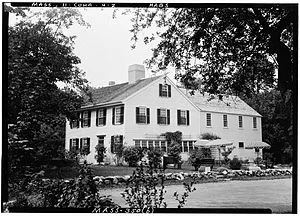
“Another historical peculiarity of the place was the fact that its {New England town's} large mansions, those relics of another time, had not been reconstructed to serve as nursing homes for that vast population of comatose and the dying who were kept alive, unconscionably, through trailblazing medical invention.”
John Cheever, from Oh What a Paradise It Seems
While Cheever lived much of his life in New York City and Westchester County, N.Y., just to the north of it, he remained almost obsessed by where he had grown up on Greater Boston's South Shore.
'Besides his reason'
"Tinsel in February, tinsel in August.
There are things in a man besides his reason."
-- Wallace Stevens
Overused consultants
Adapted from Robert Whitcomb's "Digital Diary'' column in GoLocal24.com
The bungled rollout of Rhode Island’s new public-benefits computer system, a launch whose primary vendor was Deloitte Consulting, raises some questions about how much governments should depend on private-sector contractors that may not understand the complexities of creating or revising systems to serve the general public. There have been many other rather similar bungled launches by state governments, with those in Vermont, Kentucky and Oregon among the most dramatic screw-ups.
Sometimes it may make much more functional and financial sense to have government employees do the jobs now being done by consultants, assuming that the political leadership obtains adequate resources for training them and indeed hires more state employees to ensure that a new system is properly managed over coming years. Many in the public complain that Rhode Island government is overstaffed. It is not.
What can go wrong in hiring outside consultantsto do jobs that are more properly those of government employees was vivid in Iraq, where after the U.S. invasion in 2003, the Bush administration sent in thousands of very highly paid consultants(some being employees of consultancies with political connections) to do what military and other federal employees should have been doing. As a result, there were scandals involving inappropriate physical force as well as vast cost overruns and administrative snafus.
Sometimes hiring outside consultants to do government work can be a great big fat false economy.
It was good to hear Gov. Gina Raimondo again take ultimate responsibility the other week for the mess; she has removed some of the state executives who had been involved in the launch.
The welcome fruit

"Pineapple'' (graphite on bristol board), by Hillary Irvine, in the show "Fresh,'' at the Rocky Neck Art Colony, in Gloucester, Mass., through March 12. The pineapple has long been a symbol in New England of welcome, which is odd since we don't grow them here (maybe in a few years we can....)
Retail rage
Overheard in Providence's Macy's yesterday: one rather small and effeminate young man loudly denouncing a big and bearded colleague thus: "You make working here nearly impossible!''

Chris Powell: Suburbs prosper by zoning out the poor; coercion by liberals is quite all right; sanctimony cities

Old County Jail Museum in semi-bucolic Tolland, Conn.
MANCHESTER, Conn.
Chest-thumping is resounding in Connecticut's suburbs as Gov. Dannel Malloy proposes to transfer their state financial aid to the cities. The thumping may be loudest in Tolland, where at a Town Council meeting the other day Town Manager Steve Werbner pandered to a standing-room-only audience.
Werbner said: "They've taken a town like Tolland, which has done every thing right for many years, and penalized us for all that we've done."
Tolland is a great town but what it and many other suburbs have done "right" has been mainly to zone out the poor and dysfunctional by minimizing cheap apartments, figuring that this way the burden of the slob culture coddled by the welfare system could be confined to the cities forever.
Not anymore. With the governor's budget the government and welfare classes are cannibalizing the state even though taxpayers are tapped out. This cannibalizing is being done in the name of alleviating poverty, though for more than half acentury Connecticut's cities have only manufactured poverty.
The failure of state poverty policy to achieve its nominal objective has made it hard to blame the suburbs for zoning out the poor. But at last the suburbs may have to answer financially for their indifference to that failure. Maybe the suburbs now will discover that doing "everything right" requires them to start holding the poverty factories and their enablers to account.
xxx
For weeks the left, especially inConnecticut, where it is led by Governor Malloy, has been indignantly insisting that the federal government should not try to coerce states and municipalities into helping to enforce federal immigration law, as President Trump wants them to. On immigration the political left, especially in Connecticut, has taken a state's rights position and even a nullification position.
So what happened last week when the Trump administration adopted its own states' rights position, withdrawing Obama administration "guidelines" directing states to allow male students who want to be female and female students who want to be male to use whichever gender's bathroom they choose?
The left freaked out that the federal government now will leave the bathroom issue to the states, though there is no federal legislationspecifically addressing the point, as there is with immigration. Governor Malloycalled the federal action "outrageous." It seems that coercion by the government must be reserved for enforcing a liberal agenda and nobody else's.
xxx
People from 50 churches around Connecticut and New York who gathered last weekend at a synagogue in Hamden seemed to think that God wants the UnitedStates to have no immigration law. According to the New Haven Register, they discussed not only how to protect ordinary illegal immigrants against deportation but also even illegal immigrants who have been criminally convicted.
The event's organizer, Rabbi Herbert Brockman, of Hamden's Congregation Mishkan Israel, quoted Leviticus from the Old Testament: "When a stranger resides with you in your land, you shall not wrong him."
People from 50 churches around Connecticut and New York who gathered last weekend at a synagogue in Hamden seemed to think that God wants the UnitedStates to have no immigration law. According to the New Haven Register, they discussed not only how to protect ordinary illegal immigrants against deportation but also even illegal immigrants who have been criminally convicted.
The event's organizer, Rabbi Herbert Brockman of Hamden's Congregation Mishkan Israel, quoted Leviticus from the Old Testament: "When a stranger resides with you in your land, you shall not wrong him." So is any immigration law enforcement necessarily doing wrong? Besides, just how much moral authority does Leviticus retain when its very next chapter, not quoted by the rabbi, demands the murder of homosexuals?
The immigration issue is complicated. It involves not just what to do with the estimated 11 million people who have broken into the country illegally or stayed here illegally, and their innocent children, but also preserving the country's secular and democratic culture, which some immigrants abhor and want to destroy. It also involves justice for the low-skilled native-born facing greater competition for jobs, and the value, if there is to be any, of citizenship itself. The meeting in Hamden displayed the faction in the controversy that refuses to acknowledge all these issues. In pursuit of sanctuary cities, this faction is giving the country sanctimony cities.
Chris Powell is managing editor of the Journal Inquirer, in Manchester, Conn., and a frequent contributor to New England Diary.
The fate of the oceans

To members and friends of the Providence Committee on Foreign Relations (thepcfr.org; pcfremail@gmail.com).
Our next guest will be Dr. Stephen Coan, on Wednesday, March 8
Dr. Coan is president and chief executive officer of Sea Research Foundation, Inc., a 501c3 non-profit organization which operates Mystic (Conn.) Aquarium, Institute for Exploration and Immersion Learning. He is also chief executive officer of The JASON Project, an internationally acclaimed science program for classroom students, also managed by Sea Research Foundation in partnership with the National Geographic Society.
He’ll talk about the condition and future of the oceans in a time of global warming and other environmental challenges, especially the manmade ones.
Then:
Brazilian political economistand commentator Evodio Kaltenecker willspeak on Thursday, March 16, about the challenges and opportunities for that huge nation as well as conditions in South America’s Southern Cone – Uruguay, Argentina and Chile.
On Wednesday, April 5, famed French journalist, novelist and broadcaster Jean Lesieur will speak on the global order being turned upside down by the advances of dictators, the retreat of democracies and the presidency of Donald Trump, not tomention the existential crisis of the European Union.
Dr. Rand Stoneburner, the international epidemiologist, is now scheduled to speak on Wednesday April 19. He’ll talk about Zika, Ebola and other global health challenges.
James E. Griffin, an expert on ocean fishing and other aspects of the global food sector, will speak to us on Wednesday, May 17.
David Shear, Assistant Secretary of Defense for Asian and Pacific Security Affairs, under the Obama administration, will speak to us on Thursday, June 1. (He is leaving office of Jan. 20, 2017.) He previously served as United States Ambassador to Vietnam. He was also formerly deputy assistant secretary for East Asian and Pacific affairs at the U.S. Department of State. He’ll talk about Chinese expansionism in the South China Sea, North Korea and other Asia/Pacific topics.
Joining us on Wednesday, June 14, will be Laura Freid, CEO of the Silk Road Project, founded and chaired by famed cellist Yo-Yo Ma in 1998, promoting collaboration among artists and institutions and studying the ebb and flow of ideas across nations and time. The project was first inspired by the cultural traditions of the historical Silk Road.
Meanwhile, we’re trying to keep some flexibility to respond to events. Everything in human affairs is tentative. ”We make plans and God laughs….’’
Suggestions and contacts are always appreciated!
'Balanced on a human scale'

The Lyme, N.H., green (a few months from now).
"When people who have never lived in New Hampshire or Vermont visit here,
they often say they feel like they've come home. Our urban centers, commercial
districts, small villages and industrial enterprises are set amid farmlands and
forests. This is a landscape in which the natural and built environments are
balanced on a human scale. This delicate balance is the nature of our
'community character.' It's important to strengthen our distinctive, traditional
settlement patterns to counteract the commercial and residential sprawl that
upsets this balance and destroys our economic and social stability."
~- Richard J. Eward, from "Proud to Live Here'' {the Upper Connecticut River Valley}

Dangerous mission
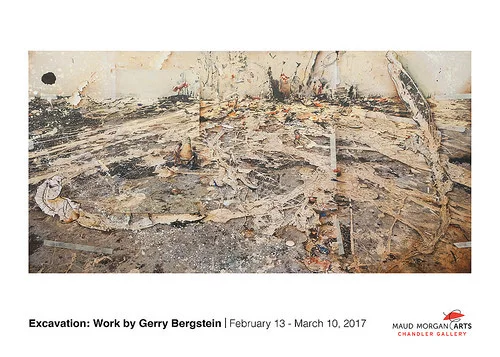
In his show at the Maud Morgan Fine Arts Chandler Gallery, in Cambridge, Mass., Mr. Bergstein shows how he has used his studio floor as "an archaeological site in which to explore my own mind."
The gallery says that "For over a decade, he has added paint and collage to an ever-evolving studio installation that serves as a figurative and literal starting point for his artwork. The pieces ... combine photographs of his studio collage with additional visual elements, intentionally blurring the lines between photography, painting and collage.''
Self-exploration can be the most traumatic exploration of all.
Playing the probabilities

South Station, for many years gritty but now one of the nicest big train stations in America -- indeed at a European level of beauty and cleanliness. The editor of this site, who used South Station often as a youth in the '50s and '60s, well remembers when it was filthy, had few services besides ticket sales and for long stretches of the day was occupied by many derelicts.
“At least when I get on the Boston train I have a good chance of landing in the South Station
And not in that part of the daily press which is reserved for victims of aviation.”
-- Ogden Nash (1902-1971), in Hard Lines

Photo by "fletcher6''
Early-morning blanket

A wonderful warm fog was being swept up the street from Narragansett Bay early this morning. The light from the street lights refracted through this ground cloud was gorgeous. Dawn is the best, cleanest time of the day, before the clutter of the day's obligations and usually worthless distractions. Don't let the "urgent'' become the enemy of the important....
-- Robert Whitcomb
Gun show for the anti-NRA types

"Swords Into Plowshares,'' by Cynthia Eid, in the show I.M.A.G.I.N.E Peace now at the Society of Arts + Crafts, Boston, through June 10,
The show features more than 90 decommissioned guns transformed into art objects, The gallery says the show challenges "audience members to think about gun violence in America through artistic expressions of peace.''
Or get them thinking about buying a lovely gun themselves. Would this show fly in Dallas?
Llewellyn King: Mass deportation: The surfacing of the worst in us
The accelerated deportation of illegal immigrants is brainless, cruel, antagonizing to many allies and neighbors and, ultimately, banal. It is antithetical to our better natures and to the humane face of America that has made us an exemplar for human rights, a voice for the voiceless and, as Ronald Reagan said, “a shining city on a hill.”
It is American exceptionalism abandoned for petty prejudice.
There is linkage -- there always is linkage -- between the desecration of the Jewish Chesed Emeth Cemetery in University City, Mo., and those knocks on the door as the men from Immigration and Customs Enforcement (ICE) perpetrate the obscenity, ordered up by those in authority. Prejudice has been affirmed by government.
No country in this disturbed world can allow unfettered immigration, but to turn on those who have crossed the border for the simplest human reason -- need -- with the full force of the state and to send them to a place where they fled for a better life, for a dream -- the American Dream -- is to implement a crime against humanity.
Hate is easily inflamed. The darkest passion of human beings is to love to hate, to blame all of life’s ills on others and to seek to punish them for just being. It is what produced the sectarian violence in Ireland, perpetuated apartheid in South Africa, and caused the great horrors of the last century, including the Armenian massacre in Turkey and the Holocaust. Not only do people love to hate but hate becomes hereditary, handed down through the generations.
The United States has struggled against its incipient hates and even appeared, with the election of Barack Obama, to be able to put them aside. But we have come through a political season where hate has been dog whistled and it has come running.
If you think what you have just read is far-fetched, let me tell you that every time I write about immigration and the plight of the dispossessed, I am deluged with virulent, hate-filled emails. Once this evil genie is loose, no prejudice is out of possibility.
All my e-mails repeat this political phrase out of last year’s campaign, “What part of ‘illegal’ don’t you understand?” How many things that were illegal in my lifetime are now legal? Try segregated lunch counters and homosexuality, for starters. The goal posts move.
You can build a single act of illegality -- in this case crossing a border to get a better life -- into a crime of giant proportions without statute of limitations: a mark of Cain, an indelible stain. But it is not. The hard-pressed father and mother, breaking the law by working without papers, and yet holding it all together so that the children might have it easier, is the face of these criminals. Lives in extremis.
Study after study has shown that they are less likely to commit violent crimes or to disturb the peace than Americans whose ancestors arrived on these shores as immigrants in another time.
To break up families, to send people to countries where they are de facto foreigners with no means of supporting themselves and where they will encounter hostility and danger, in the name of legality, is preposterous. It is something that will pass into history as a time when our country – America the Great – did something totally unworthy of its better nature.
When the state moves people by the millions for its own purposes, terrible injustice and human suffering result.
We did that: We have the mark of slavery in our DNA. In small measure we expiated that, until this dark time. Shame!
Llewellyn King is executive producer and host of White House Chronicle, on PBS and a frequent contributor to New England Diary. His e-mail is llewellynking1@kingpublishing.com.
Bitterness and boating

“New England: All of the Bitterness, Most of the Boating, None of the Bullshit.”
-- Caroline Kepnes, in "You''