
Vox clamantis in deserto




Yankee humor and marketing
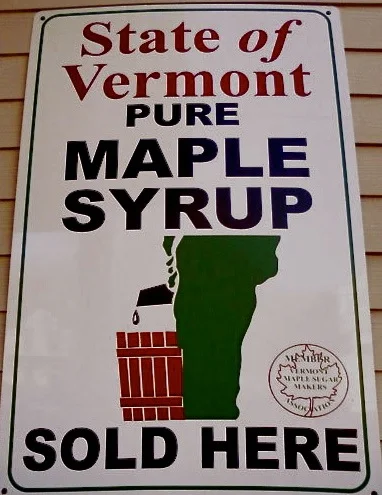
By the way, in the past couple of weeks, the maple-tree sap has often been running in northern New England as if it's been March.

Architecture as 'symbol of cultural values and history'

From the show "Scenes From Late Capitalism,'' by Nathan Heuer, at the Brookline (Mass.) Art Center, Feb. 3-March 10.
The gallery writes:
"Heuer's work is largely concerned with the role of architecture in society as a symbol of cultural values and history, using watercolor and graphite to create both small- and large-scale works. ''
Chris Powell: Responsible parents needed much more than social workers
MANCHESTER, Conn.
Connecticut Voices for Children, which clamors for state government to spend a lot more money remediating the consequences of child neglect and abuse without ever contemplating their causes, has proposed raising state taxes by $3 billion per year.
"A cuts-only approach," the organization said the other week, "may offer a short-term solution to the budget deficit, but it does so at a significant cost to the long-term economic and social structure of the state."
What about the cost to the state's long-term economic and social structure resulting from the removal of another $3 billion from the private economy, a tax increase of about 18 percent? Connecticut Voices for Children has no more concern about that cost than it has about state government's subsidizing childbearing outside marriage.
How much money could state government save if, instead of social workers, children had parents prepared to support them? Why don't children have such parents? Connecticut Voices for Children would be far more valuable to Connecticut and children alike if it looked into those questions rather than muse about throwing a lot more money at remediation, therebyv accepting neglect and abuse.
Also missing the point is Jamie Whitman of Stonington, who, writing in The Day of New London, angrily reports that the state Department of DevelopmentalServices is planning to cut in half the services provided to his mentally disabled cousin. Whitman predicts that his cousin will end up in hospital emergency rooms more often and cost more anyway.
Whitman writes: "The message the state is sending is that people who are developmentally disabled are expendable." Yes, but state government's message here is actually an old one, a message thatWhitman and others advocating for the innocent needy are only beginning to notice.
State government has been sending this message for decades with collective bargaining for state and municipal government employees, binding arbitration of their union contracts, and defined benefits for their pensions, laws that have turned the ever-rising expenses of government employees into "fixed costs," costs beyond control by the ordinary democratic process.
By contrast, as a matter of law the costs of care for the innocent needy are merely discretionary. There are no binding arbitration and contracts for them. For as a matter of law everything in state government is subordinate to the compensation of government's own employees. Down to its last dollar, as a matter of law state government will throw the helpless into the street to keep its employees happy.
Such priorities are disgraceful. But the advocates of the innocent needy do not yet seem to realize that "to govern is to choose." If advocates of the innocent needy want a different outcome, they will have to persuade elected officials to confront the special interest that consumes the bulk of government spending. But those who consider complaining about these arrangements must beware.
Forstarters, the president of the state AFL-CIO, Lori Pelletier, whose organizationis dominated by the government employee unions, will accuse anyone who puts theinnocent needy first of having "hatred" for government employees.
Assert that the innocent needy should take precedence and Pelletier's followers will accuse you of "conservative ideology" and of betraying the journalistic ideal of comforting the afflicted and afflicting the comfortable -- as if government employees in Connecticut are generally the afflicted and not the comfortable.
Of course, being employed by government is no crime, but neither does it make anyone a liberal or particularly virtuous. No, being employed by government makes one only an expense to be considered impartially against government's other expenses. Doing so can seem revolutionary only in a state dominated by special interests.
Chris Powell is managing editor of the Journal Inquirer, in Manchester, Conn.
Agri-tourism divides bucolic town
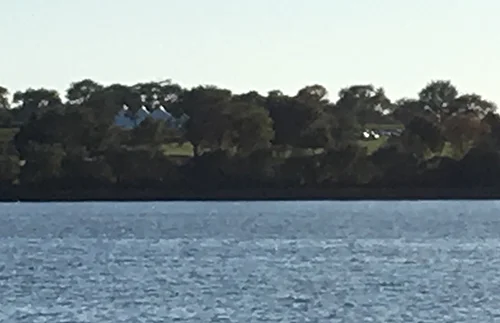
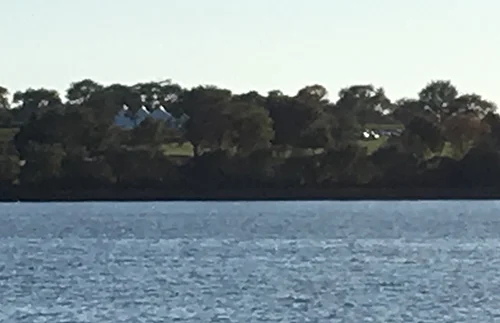
The Eliasons' house across from Sakonnet Vineyard.
By FRANK CARINI, for ecoRI News
LITTLE COMPTON, R.I.
Neighbors across Watson Reservoir from Sakonnet Vineyard, in this bucolic town in southeastern Rhode Island were long used to an occasional solo performer or a small acoustic band playing the works of Simon and Garfunkel, if they even noticed the music at all. But wedding DJs playing Nicki Minaj late into the night is hard to miss.
“It used to be a guy playing a keyboard on the grass,” Burchard Avenue resident Natalie Eliason said. “Now there’s a concert stage and music blaring until 10 and 11 at night. You can’t put a fence around noise and light.”
The Alex and Ani Summer Concert Series began in 2015 with 13 Thursday night shows. The vineyard refers to the area where bands perform as a pergola. Neighbors, like Eliason, call it a stage. Since the vineyard was bought by Dionysus Acquisition LLC and Equity of Sakonnet Vineyard LLC in 2012, concerned residents claim that both the frequency and noise levels of events such as concerts and weddings have increased considerably.
Eliason said the vineyard “went crazy” with events in summer 2015. Neighbors claim that summer the West Main Road operation hosted 29 weddings and 28 concerts, including the Thursday night series. In 2016, the number of concerts remained the same, but neighbors said the number of weddings dropped to nine.
After buying the property in late 2012, Carolyn Rafaelian, the founder and chief executive officer of Alex and Ani, changed the name to Carolyn's Sakonnet Vineyard. She also began advertising a vineyard concert series, including on an Interstate 195 billboard.
The October 2016 edition of Rhode Island Monthly noted that Rafaelian “ushered the winery’s transformation into more of an entertainment venue, where its seasonal concerts and Sunday jazz series are as big of a draw as the varietals.”
The vineyard’s added entertainment and the noise and traffic it has caused forced Eliason and her husband, Brian, to hire a lawyer, Christopher D’Ovidio.
“There are days I can’t work in my garden because the music is so loud,” said Brian Eliason, who has lived at his Burchard Avenue home for nearly two decades. “I’d get a headache. Under previous owners you wouldn’t even know there was music. It wasn’t the commercial enterprise it is now. It became the Cape Cod Melody Tent overnight.”
Founded in 1975, the vineyard sits on 162 acres, 30 of which are used to grow the grapes used in the operation’s winemaking.
ecoRI News spoke with the Eliasons and three other concerned residents in early January at the home of Daune Peckham and husband George Purmont on West Main Road, a few miles down the street from Carolyn's Sakonnet Vineyard.
This group of residents and others in town are concerned that past and proposed entertainment activities at the vineyard violate the property’s deed to development rights regarding the protection and preservation of agricultural lands.
In 2008, the U.S. Department of Agriculture, the Rhode Island Agricultural Land Preservation Commission and the Little Compton Agricultural Conservancy Trust bought the development rights to 94 acres of vineyard land for $2.25 million.
Both vineyard neighbors and local residents are concerned that there is no pre-set limit to attendance, claiming that some concerts have drawn nearly 2,000 attendees — about half the year-round population of Little Compton. They mentioned the summer tour buses that enter and exit the property.
They’re also concerned about the current use of deeded land for parking, and the potential for that protected land to be paved over.
Longtime Haffenreffer Lane resident Larry Anderson said current vineyard operations are less about agricultural activities and more about commercial music events.
Anderson, who lives on the other side of town from Carolyn's Sakonnet Vineyard and isn’t impacted by the increased intensity of events being held there, is concerned about the precedent that could be set if the vineyard is allowed to host “non-agricultural uses that are arguably prohibited,” such as weddings and regularly scheduled concerts. He said if such activities become the vineyard norm, it would increase the likelihood that other agricultural properties in rural Little Compton could be developed in a similar fashion.
He said scheduled summer concerts on Thursdays and Sundays and seasonal weddings are vastly different than selling local produce and honey from a small stand, or even hosting an annual festival, such as the popular Little Compton Gratitude Festival.
“The vineyard explicitly promotes the Alex and Ani brand,” said Anderson, a past president of the Sakonnet Preservation Association. “They’re transforming a working vineyard into an entertainment center, concert and wedding venue that sells Alex and Ani merchandise. Wine has become secondary.”
According to Little Compton zoning ordinances, “Agricultural uses including the growing, processing, value added production, displays, education, promotion and sales of agricultural products including, but not limited to wineries.”
Agri-tourism on the rise
The issue of accessory uses on farms and agricultural lands is being hotly debated in many Rhode Island communities, and at the Statehouse. In fact, accessory farm uses is a growing trend nationwide.
Farming in Rhode Island, like just about anywhere else on the planet, is hard. It’s not an easy way to make a living, especially for small- and medium-sized operations competing against the handful of multinationals that control the global food supply.
A few bad seasons or prolonged drought can shutter a local farm. To help diversify an operation’s revenue stream, a farmer, as one example, could open a small roadside fruit and vegetable stand. During the next few seasons, the farm stand’s popularity grows, a small, permanent structure is built, and a light lunch menu is incorporated.
Over time, both traffic and noise generated by this accessory use increase. Parking is added and signs posted. Neighbors complain. Public hearings are held, and legal action taken. The farmer eventually decides to sell the land to a developer.
Since the 1940s, Rhode Island has lost more than 80 percent of its farmland to development, according to the state Department of Environmental Management.
In 2014, the General Assembly amended Rhode Island’s Right to Farm Act to include mixed uses of farms and farmlands, including such events as tours, petting zoos, hayrides and other “special events.” There is no mention of weddings.
Agricultural tourism is a commercial enterprise at a working farm, typically designed to generate supplemental income. Agritourism can include a farm stand, U-pick operations, a farmers market, farm stays, tours and classes, corn mazes and pumpkin patches, festivals, Christmas tree sales, weddings, farm-to-table dinners and barn dances, depending on state laws and local ordinances.
Rhode Island municipalities generally address proposed accessory farm uses on a case-by-case basis, because of the high number of variables, from concerns about public-safety and environmental impacts to the type of add-on use being proposed.
These complexities, uncertainty in the approval process, lack of enforcement, and outdated, cumbersome and vague ordinances are conspiring to divide communities and create red tape.
In the past few years the Rhode Island General Assembly has held committee hearings regarding the issue of enhanced farm operations, including a House panel that discussed whether to add weddings to the group of acceptable activities that can happen on designated farmland under the Right to Farm Act. The bill didn’t pass.
Another bill that failed to get approval sought to eliminate a municipality’s right to place restrictions on such events as weddings and concerts. Local ordinances and bylaws supersede the Right to Farm Act.
This past summer, a Washington County (R.I.) Superior Court judge ruled against a property owner who was holding weddings in violation of Exeter ordinances, as the town had argued.
The Portsmouth Town Council recently amended zoning ordinances to allow wedding receptions and other non-agricultural uses on farms, such as festivals and concerts, with a special-use permit granted by the zoning board. The change came after Greenvale Vineyards had filed a lawsuit to continue holding wedding receptions on its 73-acre farm overlooking the Sakonnet River.
Little Compton resident Carol Lynn Trocki, a Rhode Island Land Trust Council board member and a self-employed conservation biologist, told ecoRI News late last year that mixing agriculture uses with non-agricultural events on farmland can end up pitting corporate interests against community interests.
“There are plenty of weak zoning ordinances on the books,” she said. “Little Compton is scrambling to improve its ordinances so it can better control what’s happening in town. We’re too reactionary. Instead of always being on the defensive and feeling threatened by development, we need to determine what we want and be proactive in defining it.”
Trocki said Rhode Island’s cities and towns need to decide what they want their communities to look like now and 50-100 years into the future. She noted that the state’s more rural communities need to enact well-crafted ordinances if they want to protect their agricultural look and fell.
“Sakonnet Vineyard scaled up its events, built a bandstand and then lawyered up,” said Trocki, noting the difficulty volunteer town boards and commissions face when they go up against a “room full of 400-dollar-an-hour lawyers.”
Hired guns
In its fight against the Eliasons and their supporters, Carolyn's Sakonnet Vineyard is being represented by Adler Pollock & Sheehan, the same firm that is representing the Chicago-based corporation attempting to build a fossil-fuel power plant in Burrillville, R.I.
Purmont, a concerned West Main Road neighbor of the vineyard’s expanding operations, said few from Carolyn's Sakonnet Vineyard speak at local meetings or to agitated neighbors, just hired guns.
“Corporate pressure is their only form of communication,” he said.
The Eliasons said the vineyard’s attorneys show up at meetings with their own stenographer. “It’s been a show of force since day one,” Brian said. “It’s a money-making machine that could ruin the look and feel of this town."
He noted that this isn’t an anti-agriculture argument, saying "we’re against the bastardization of agriculture."
The Eliasons’ attorney, D’Ovidio, says the town concluded and the vineyard conceded in 1992 that concerts and weddings weren’t permitted. A Nov. 13, 2016 letter from Little Compton's zoning official, George Medeiros, to the Town Council president regarding vineyard activities verified that claim, stating “weddings and concerts are not accessories to uses to, and required for, the operation of the principal use and therefore are not allowed.”
The vineyard’s owners disagree. The matter is likely headed to court.
The Eliasons, however, aren’t fighting Carolyn Rafaelian alone. About 100 Little Compton residents, both year-round and part-timers from out of state, have joined the resistance, donating time and/or money to the cause. The group has so far spent about $60,000, according to Brian Eliason.
Opponents of the event intensification at the vineyard said they want their local farms and farmers to be successful. Noise generated by farm machinery is not their concern.
“We’re not trying to shut down farming. Farming is what we want,” said Anderson, who has a conservation easement on 15 acres (held by The Nature Conservancy) of his 20-acre Haffenreffer Lane property. “This isn’t about a bunch of cranky neighbors. Public interests are at stake. There’s a big difference between a 160-acre vineyard holding weddings and concerts and a farm selling heirloom tomatoes at the end of a driveway. We all could be hosting weddings and concerts.”
Frank Carini is editor of ecoRI News.
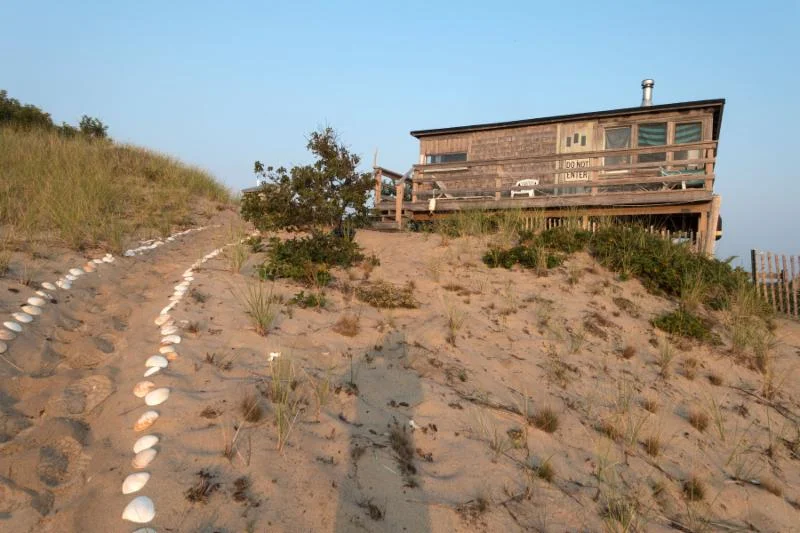
Rent it before it washes away
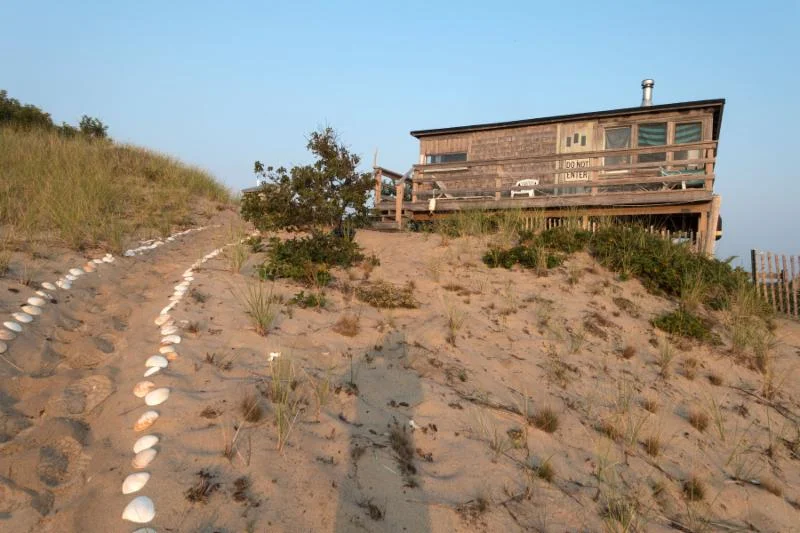
"Wells Dune Shack (Provincetown)'' (archival digital photo), by Jane Paradise, in her show "Dune Shacks of Provincetown,'' at Galatea Fine Art, Boston, March 1-March 29. Do you prefer sandy coasts or rocky ones?
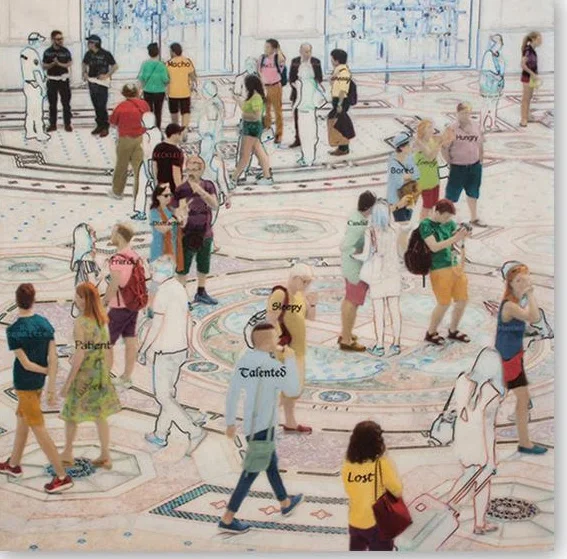
The incoherent crowd
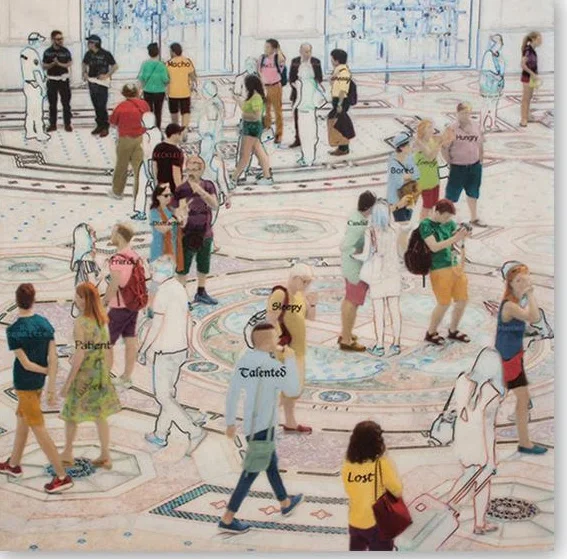
"Quick Takes'' (photo montage, oil and resin on panel), by Sherry Karver, in her show at Lanoue Fine Arts, Boston, through Feb. 25.
Llewellyn King: Showmanship is not statesmanship
It is a generally good thing for politicians to honor their campaign promises. In that, President Donald Trump is acting in an exemplary way.
But does he have to do it so fast?
In a campaign ideas and ideology dominate, details languish. But once office is won, especially the highest office in the land, there is time to contemplate not just the journey but the best route.
There is a vast amount of know-how and knowledge to be tapped that might, on consideration, temper the ideas of the campaign.
For example, the president, before commanding the hiring of 5,000 more U.S. Customs and Border Protection agents, might have learned how difficult it is to recruit and train these men and women. He might have taken note that there are 1,200 vacancies along the border right now, despite strenuous recruiting efforts.
His early action in pulling the United States out of the Trans-Pacific Partnership (TPP) — a trade deal that was negotiated between 12 Asia-Pacific nations who represent more than 40 percent of the global economy — was done in haste, which might set world history off in a direction that the nation and the world will rue.
One of Trump’s campaign promises, if not the theme of his campaign, was that the United States would be led by the world’s best negotiator, its top dealmaker. Why would he tear up a deal before he had taken time to improve it? There is no art in trashing a deal.
Why would he willingly relinquish a leadership role in global trade to China, which he has called out time and again?
On the face of it, Trump will now have to direct the U.S. Trade Representative to negotiate separate deals with the TPP signatories, possibly taking years. China has proposed the Free Trade Area of the Asia Pacific and the Regional Comprehensive Economic Partnership, stepping right in where the United States has stepped out. Does Trump want to be known as the president who lost Asia? History is cruel; its mistakes devastating.
Would Trump prefer 28 bilateral trade deals with Europe when he could have 27 plus one, Britain? Europe is our largest trading partner, a relationship worthy of tender loving care, but Trump has encouraged its breakup.
Trump loves to make a grand entrance. He showed that with his stately ride in the company of his wife, Melania, down an escalator in Trump Tower on Fifth Avenue in New York City before announcing his candidacy on June 16, 2015. It was dramatic: the quintessential Trump, showman and grandstander.
His entrance into Washington has been louder and splashier — almost as though it is a finale, not an opening. The city is reeling, the world is agog and the Republicans — to say nothing of the president’s Cabinet nominees — are in the dark about his policies; where his head is at?
The president may not have had as many people at his inauguration as he had wished, but his actions have turned him into a show of shows. Even as the Ringling Bros. and Barnum & Bailey Circus goes out of business, Donald Trump is its temporary replacement: The Greatest Show on Earth. But this big top stands for four years, and no performance lasts that long.
Entrances and showmanship are not statesmanship. Trump needs to begin to show that he can stay the course beyond a grand entrance; he needs to be seen to negotiate for the United States, not just to be the great treaty abrogator.
Trump made more than 650 promises on the campaign trail. Some he can keep, particularly when they have no more depth than reversing his predecessor’s executive actions.
Having failed to prove the theory that former President Obama was born in Kenya, he seems determined to expunge as much of Obama’s legacy as he can get his hands on.
The big promises, like creating 25 million jobs, boosting the growth rate to between 4 percent and 5 percent and balancing the budget, may require the great dealmaker to do some deals with the country’s expectations.
Grand entrances can lead to ignoble exits.
Llewellyn King is executive producer and host of White House Chronicle, on PBS.

Ringling Bros. at the old Boston Garden
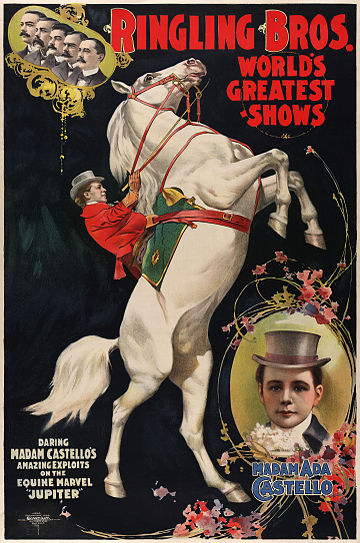
Excepted from Robert Whitcomb's "Digital Diary'' in GoLocal24.com
I felt a pang the other day when reading that Ringling Bros. and Barnum & Bailey Circus would close after its current season ends after 146 years.
The writing has probably been on the wall for some time. Increasingly, people, and especially kids, have sought entertainment on screens and not, well, in real-life performances. And coercing animals into cleverly designed but silly acts has become increasingly unpopular among many groups.
The most popular animals at the circus have usually been the elephants. Ringling Brothers stopped using them last year, which accelerated the decline in attendance that has been underway for years.
Feld Entertainment, which owns the circus, retired its elephants to its elephant conservation center in Florida last year. As for its still-working animals – lions, tigers, kangeroos, llamas, alpaca, donkeys and camels -- the company says they will go to good homes. I’m sure that the Humane Society will monitor these transfers.
My parents took all five of their children at various times to Ringling’s “The Greatest Show on Earth’’ several years in a row at gritty old Boston Garden. My strongest memories of these events is the smell of the manure, the ominous, near-hysterical music (like the track from a Fellini movie) and the chameleons, sold in Chinese restaurant takeout boxes. They were often dead by the time we got home.
It may a good thing that Ringling Bros. is closing. But, as with zoos, the undignified and for a long time brutal (those whips!) display of circus animals also raised the public’s affection for such charismatic animals and thus has helped boost campaigns to save them. The biggest threats to wild animals are the destruction of countryside because of human overpopulation, global warming and the hideous trade in ivory and other animal parts, centered in China. Indeed, the Chinese may still succeed in exterminating the African elephant.
Late last year, China’s Communist dictatorship announced that it would ban all ivory trade and processing by the end of this year. Very, very late in the game. Meanwhile, the trade in other the parts of other endangered animals, such as tigers, continues virtually unabated in that country. Much of it is based on ridiculous but long-held ideas that parts of some animals have aphrodisiac qualities for humans.
Maybe they'll leave the light on for you

"Rooms for Rent'' (mixed media on wall-mounted construction), by Joe Landry, in his show "You Are Here, '' at the Bromfield Gallery, Boston, Feb. 1-26.
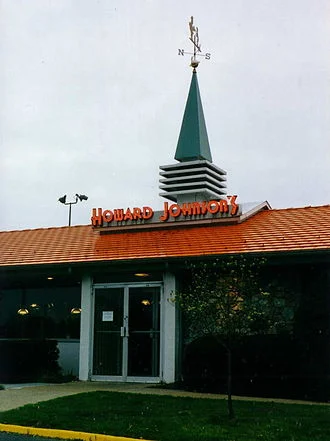
Robert Whitcomb: New England-born HoJo's and the rise of roadside family restaurant chains
Flavors of Mid-Century
A History of Howard Johnson’s
How a Massachusetts Soda Fountain Became an American Icon
By Anthony Mitchell Sammarco
(American Palate, 157 pp., $19.99)
The rise and fall of the Howard Johnson Company says a lot about American society and business from the 1920s on.
It was quite a ride, some of which I was familiar with before reading Mr. Sammarco’s chaotic and seemingly unedited history of the famous chain of restaurants and, later, motels, too. Howard Deering Johnson started his company in Wollaston, a section of Quincy, Mass., close to my hometown, Cohasset. And the Howard Johnson Company bought a rival ice-cream parlor chain, Dutchland Farms (with windmills – high kitsch!), owned by friends of my father, in the late ‘30s. As the shoe companies in the area folded, the locals felt proud about having another local enterprise grow into a national powerhouse.
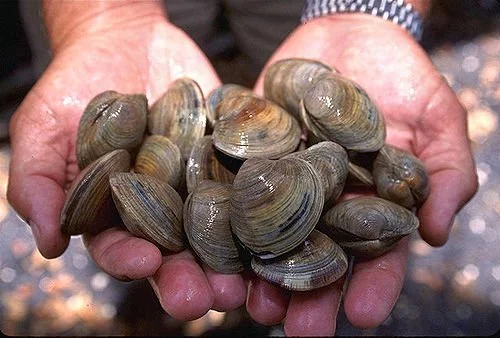
Mr. Sammarco’s book is rife with repetitions, confusion (there’s lots of quoted stuff but you often don’t know who’s being quoted) andalmost nonstop breathless copy about the company’s “delicious foods and ice cream’’ (ice cream perhaps not considered a food?), including ‘’clams so fresh and delicious that they were called ‘Tendersweet’ clams.’’ Then there such mysteries as the chain’s “ceramic broiled steaks, chops, chicken and lobster.’’
There also many side trips with extraneous information that has little or, in some cases, nothing to do with the main history. And yet, the monomaniacal Mr. Johnson and the company he created are so interesting that you keep reading Mr. Sammarco’s boyishly enthusiastic ramblings. And the many old pictures are delightful, if randomly placed. And, praise be to God, there’s an index!
Mr. Sammarco got the main point right about the long success of “The Wonderful World of 28 Flavors’’ and its importance in American business history: “Standardization of quality, preparation and portion control ensured uniformity throughout the orange-roof restaurant chain.’’ People like Ray Kroc, of McDonald’s, said they learned a lot from Howard Johnson.
Even as the company went national, the emphasis on ice cream (always a huge favorite in New England) and such regional specialties as fried clams and Yankee pot roast, and, at many HoJo restaurants, pseudo-Colonial Revival architecture, reminded many around America of the company’s regional roots. Fried clams, that very New England heart-attack enabler, may have been the chain’s most famous food after ice cream.
I remember well the heyday of HoJo’s, in the ‘50s and ‘60s, when the restaurants, with their famous “28 Flavors’’ signs were all over America. Almost all of them were expertly situated and promoted, on or near major roads and with strong signage. It wasn’t an exciting place to go (except for small children drawn to the ice cream), but it was comfortingly predictable for travelers, weary or otherwise.
Mr. Johnson came to understand early on that the automobile would profoundly change Americans’ dining and lodging habits.
He started out by buying a Wollaston drugstore in 1925 and, recognizing the profit potential from New Englanders’ love of ice cream, experimented with many new flavors, all using more butterfat than most ice cream makers did. They were hits with patrons of the store’s soda fountain. The desire to pay off the debts from his late father’s cigar business helped drive his work ethic.
He responded to the popularity of his “28 Flavors’’ of ice cream by expanding his operation to summer ice cream stands along streets at the region’s urban beaches as the number of people with cars to get there was rapidly increasing.
Then, in 1929, he opened his first real full-service restaurant, in downtown Quincy. Eugene O’Neill gave him a boost: The censors in Boston (remember ‘’banned in Boston’’?) prohibited his play Strange Interlude from being shown in the city. So it was moved to the Quincy Theater, right across the street from Mr. Johnson’s new establishment, which thrived from thebusiness from the playgoers, many of whom told their friends how good the food was (at least compared to the contemporary bland New England “cuisine’’ of the time).
The Depression hit Mr. Johnson’s new creation hard. But the workaholic came up with a scheme to expand anyway. In 1935, he arranged a franchise relationship with a friend/businessman at a busy (especially in the summer, of course) intersection in Orleans on Cape Cod.
Under this arrangement, the Howard Johnson Company would let a franchisee use the by now well-known Howard Johnson’s name, buy all (highly standardized) food and other supplies from a central HoJo’s commissary and adhere to Mr. Johnson’s “Bible’’ on how the final food preparation and table and counter services would be done.
Mr. Johnson insisted on uniformity: “When you get the same kind of {Howard Johnson’s} sundae in New York that you get in Florida, you are more likely to buy one in Maine,’’ he said.
While franchises were not unknown at the time, it was Howard Johnson who established it in the restaurant business, along with aspects of what would come to be called “fast food’’ – stuff to take out, as well as brisk counter service, albeit not nearly as fast as in today’s computerized fast-food establishments.
After tough times during World War II because of rationing, Mr. Johnson’s empire grew rapidly into hundreds of company-owned restaurants and franchises. And starting in the mid-‘50s, the company got into the “motor lodge’’ (AKA motel) business.
Perhaps no businessman understood the business opportunities associated with Americans’ love affair with (andmandatory reliance on) driving as well as did Howard Johnson. As the Interstate Highway System got going in the late ‘50s, the company’s growth accelerated. As Time magazine said in 1960:
“The travel-weary U.S. motorist has been conditioned to think of food—and a chance to let the kids out of the car—when he spots a roof of bright orange tile along the highway. This ‘landmark for hungry Americans’ is the trademark of Howard Deering Johnson, a onetime cigar salesman who has become a part of Americana (teenagers call his places "HoJos") by catering to the common denominator of U.S. taste and haste.’’
Mr. Sammarco writes that the chain “served a traveling public with fine food.’’ I’d call it “reliable’’ food.
When the company went public, in 1961, Mr. Sammarco writes, “it consisted of 605 Howard Johnson’s restaurants (265 operated by the company and 340 by licensees {franchisees}, 10 Red Coach Grill {more upscale} company-owned restaurants and 88 Howard Johnson’s Motor Lodges, all of them franchisees.’’
By 1975, the empire included more than 1,000 owned and franchised restaurants, over 500 motor lodges, vending and turnpike operations and a massive manufacturing and distribution system.
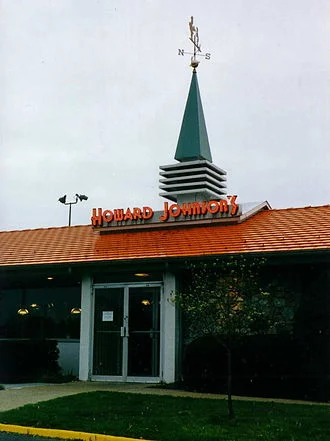
The orange roofs and blue shutters of the chain, along with the predictable and safe food, seemed to have become a permanent fixture of the American road.
The ‘50s and ‘60s were the heyday of the American nuclear family. The extended families of earlier generations – lots of uncles, aunts and cousins living close by – were in steep decline but illegitimacy was not yet in ascendency and intact families, with a married mother and father, and often a lot of kids, dominated domestic life in times that were becoming increasingly prosperous.
Thusthe “family restaurant’’ approach taken by Howard Johnson (who was married four times!) was in a fertile field. Take the kids to HoJo’s! No unpleasant surprises there.
But things started to get a bit strange in patches, too. The company, in the Mad Men period of the early ‘60s, hired two French chefs – Pierre Franey and Jacques Pepin – to help develop new meals, and, also wandering far from its roots, got Dior to design new uniforms for HoJo waitresses! Were these fire bells in the night that the company was losing focus?
By 1975, the empire included more than 1,000 owned and franchised restaurants, over 500 motor lodges, vending and turnpike operations and a massive manufacturing and distribution system, including frozen food.
Clouds were gathering. New competitors, most famously McDonald’s and Burger King, were pressing to dominate the downscale side of the restaurant business. And while more affluent folks still tended to want a somewhat leisurely sit-down meal, especially in the evening, many other people wanted more speed -- both takeout and in-house service --and lower prices. I suspect that’s in part because growing work pressures, shrinking inflation-adjusted average incomes and the influx of many women into the workforce meant that there was less time and less income for more traditional restaurant meals for many Americans. And the richer folks found HoJo’s boring: It was too standardized.
You also have to wonderwhether the expansion of the company into the motel business seriously weakened the company’s focusand undermined its brand identification amongst the public even as so many competing restaurant chains were entering the market.
Meanwhile, quality was slipping. Howard D. Johnson retired as president in 1959, with his son, taking over. Because of his fear of debt, the elder Mr. Johnson had tended to keep too tight a lid on certain expenses, especially the number of employees and their pay. So many of his establishments were understaffed, causing slow service, and things got worse under his son.
Even before his retirement as president, the elder Mr. Johnson started to spend less time making spot visits to his restaurants to check on the quality of the food and service, which gradually declined in his later years, even as he spent more time in places like Manhattan’s Stork Club. (That may have pleased his employees: Mr. Johnson was a large and fierce-looking man.)
His smooth and preppy son, Howard B. Johnson, was also obsessed with cutting costs, and spent too little time checking on quality and keeping up with demographic and other changes in American life that would help or hurt a restaurant chain. Rather than working out of Wollaston, the official headquarters, he operated from an office in Manhattan. He was not an operations guy like his father.
Mr. Sammarco usefully quotes Brian Miller, writing in the Journal of Hospitality & Tourism Education:
“The fall of the Howard Johnson’s brand {in the ‘70s} was faster than it took to build. When the reins of the company were passed down from father to son, the son appeared to quickly lose control over the direction of the company. Without the persona of his father inhis corner, the younger Johnson was leading a company that lacked a vision.’’ Well, that’s not quite right. The younger Mr. Johnson had quite a few successful years at the helm but he did lack a unified longterm vision.
That HoJo’s had become a public company also probably undermined its long-term prospects. The younger Johnson wanted to keep the stock price as high as possible but this meant avoiding needed but costly improvements and innovations. Given the choice between working for a closely held company (assuming that the owner/owners were halfway civilized) and apublicly held one, I’d choose the former any time: The former is more likely to take the long view and reinvest.
Thus the company’s profits and revenues started to slide in the ‘70s, and in 1979, Howard B. Johnson sold the company to Imperial Group Ltd., which in 1985 sold it to Marriott. Various financial permutations and combinations led to rapid shrinkage over the next couple of decades, and as of this writing there is only one Howard Johnson’s restaurant left, in Lake George, New York.
There may never again be a chain of “family restaurants’’ quite like HoJo’s in our much multicultural stew of a country, but that one was created, and provided decent service to all, and joy to some, especially children, is edifying and a soothing memory of mid-century Americana.
Robert Whitcomb is editor of newenglanddiary.com, a columnist for GoLocal24.com, former finance editor of the International Herald Tribune and former editorial-page editor of the International Herald Tribune
Stop the theft from stone walls
By TIM FAULKNER for ecoRI News
Via ecori.org
PROVIDENCE
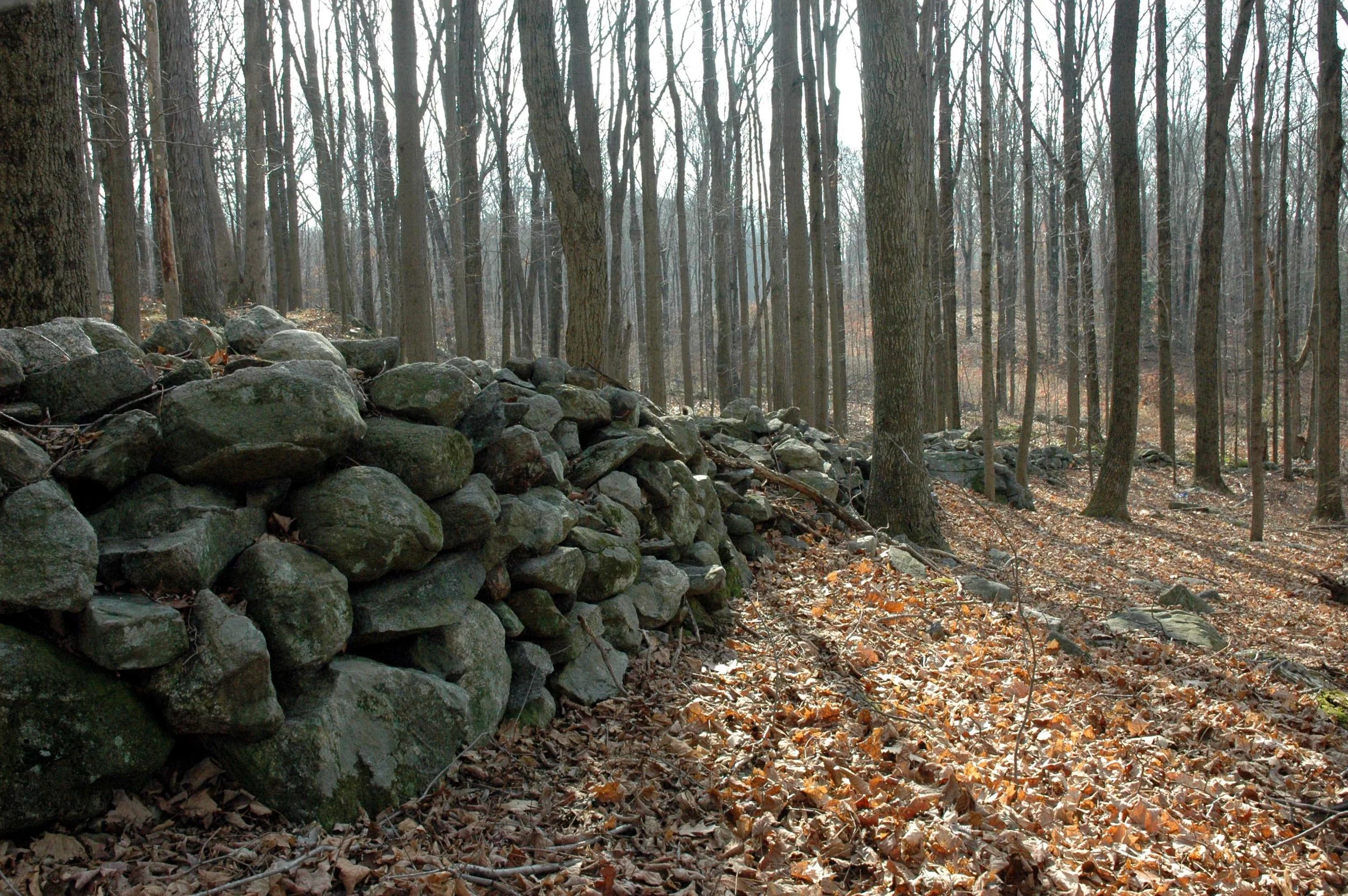
Preserved open space in Rhode Island needs additional protections, because poachers steal rocks from stone walls and nearby residents cut down trees to improve their views.
Currently, there is no deterrent or penalty for intentionally damaging or building on land protected from development. If caught, the thief or vandal simply has to pay a portion of the value of the damaged or stolen items, such as the timber value of a cut tree.
Rupert Friday, director of the Rhode Island Land Trust Council, testified at the Rhode Island General Assembly on Jan. 18 in favor of a bill that would make such offenses a civil violation.
“The current penalties are little more than a hand slap,” Friday said. “The current penalty if you steal a stone wall and you get caught and convicted is you have to put the stone wall back. It’s pretty lucrative if you don’t get caught.”
Meg Kerr, senior director of policy for the Audubon Society of Rhode Island, said such legislation would help protect 9,500 acres of open space and wildlife habitat that Audubon owns and manages. Kerr said it’s common for landowners living near protected coastal areas to cut down trees on protected land to improve their views of the water.
“This legislation will provide a greater deterrence and keep people from blatantly damaging our communities’ open space and our significant investment to protect these special place,” Kerr said in testimony before the House Judiciary Committee.
The bill was held for further study and will likely have another hearing on Jan. 24. It's the third year in a row that the bill has been introduced. Last year, the bill passed in the House but stalled in the Senate.
The bill is modeled after a bill passed in Connecticut in 2006 that was intended to address the same problems faced by land trusts, municipalities, the state, environmental groups, and other owners and managers of open space.
In the legislation, open space is defined as any park, forest, wildlife management area, refuge, preserve, sanctuary or green area owned by one of those entities. Damage, called encroachment, is defined as intentionally erecting structures, roads, driveways or trails. It includes destroying or moving walls, cutting trees and vegetation, removing boundary markers, installing lawns or utilities, and storing vehicles, materials and debris.
The civil fine for a violation could amount to five times the cost of the damage up to $5,000.
The bill is sponsored by Rep. Cale Keable (D.-Burrillville).

Of time, place and health

This just in from the Dedee Shattuck Gallery, in Westport, Mass., about the show “where lines meet,’’ which runs to Feb. 19. The gallery describes the show, in part:
“’where lines meet’ is a photographic installation to create a space for contemplation, conversation, and community. This project addresses artist Heather Hobler's ongoing investigation into well being.
‘“where lines meet’ is an installation of medium format film photographs of the same vista facing south over Buzzards Bay, the view from Heather's home. The project began innocently as snapshots meant to record time, but quickly built into a reflective rhythmic ritual of getting back to life and art after the artist’s battle with cancer. Beyond the beauty of each photograph, the collection intrigues and soothes with the dynamic and subtle power of both its consistency and comparison. It was in the collecting of the images that it became obvious to Heather this was a continuation and distillation of her art and her life.’’
An all-season resident

-- Photo by THOMAS HOOK
The White-Breasted Nuthatch, this one in that giant aviary known as Southbury, Conn., is another tough species that stays in New England year round. Very unfashionable: It winters where it summers.
Kevin Morrell: The ancient Greeks had 'post-truth politics' and a Trump-like demagogue
Following Donald Trump’s inauguration as U.S. president the world is anticipating a new, and potentially radically different, era for the U.S. The inauguration also prompts questions about this new style of politics. Trump’s surge to leading the most powerful nation in the world was fueled by a rhetoric we associate with a new term: ‘’post-truth’’. The Oxford Dictionary named ‘’post-truth’’ its word of the year in 2016, and defined it as “circumstances in which objective facts are less influential in shaping public opinion than appeals to emotion and personal belief”.
Brexit’s and Trump's success were new lows for many of us, particularly in higher education, precisely because facts came a distant second to populist appeals.
But, as a number of people have identified, post-truth didn’t begin with Trump.
A reference point for the two campaigns that 2016 will be remembered for has been the propagandism of the 1930s, and two wickedly cynical pieces of advice: Repeat lies often enough until they are accepted as true, or remember, if you are going to lie, tell a big lie.
But almost a century earlier, in the 1850s, there were far dirtier U.S. election campaigns when an anti-immigration party, The Know Nothings (aka the American Party), thrived on pretending to be ignorant of their own party’s activities.
Further back still, before U.S. independence, the satirist John Arbuthnot wrote: “Falsehood flies, and the truth comes limping after it, so that when Men come to be undeceived, it is too late… like a physician who has found out an infallible medicine after the patient is dead.” The title of his 1712 essay? “The Art of Political Lying’’.
And way, way before Arbuthnot, in 350 BC, Aristotle’s Constitution of Athens describes the demagogue Cleon in a way Trump critics might recognize: “The cause of the corruption of the democracy by his wild undertakings.”
A closer look at Cleon invites several parallels with how critics see Trump. Cleon inherited his wealth from his father in the form of a tannery - a leather factory: certainly the Athenian equivalent of blue-collar.
He rose to power in 430 B.C., during a desperate time for Athens: It was at war with Sparta and was devastated by plague. Plutarch describes him as someone who “catered to the pleasure of the Athenians” with a combination of “mad vanity”, “versatile buffoonery” and “disgusting boldness.”
Cleon had a distinctive and shocking communication style, one Athenians had never seen before. While speaking, he would hitch his cloak up and slap his thighs, running and yelling at the crowds.
Aristotle says that he was “the first to use unseemly shouting and coarse abuse”. Aside from this radically new communication style, Cleon’s populism was based on attacking two enemies.
First, though rich himself, he was an anti-establishment figure, pursuing a “relentless persecution of the upper classes”.
Second, he was a flag-waving xenophobe, antagonistic towards Athens's rival and (partly thanks to Cleon) bitter enemy Sparta, as well as to the city of Mytilene, who wanted independence from Athens.
The Athenian general and historian Thucydides even records a speech when Cleon expresses admiration for Mytilene’s “unassailable” walls.
Parallels don’t end there. A later Athenian writer, Lucian, suggested that Cleon profited from exploiting his office, as some warn Trump is set to do, and that he was “venal to excess” (as Trump detractors suggest).
He was boastful, once bragging that he could win a war against some Spartans by himself. He was thin-skinned and censorious, as well as a litigious bully.
Cleon tried, unsuccessfully, to have the satirist Aristophanes prosecuted for writing The Babylonians, which he considered a treasonous play -- in the process turning Aristophanes into a life-long enemy.
He accused Athenian generals of incompetence and, in establishment-bashing mode tried, unsuccessfully, to prosecute one of them, Laches.
Cleon was held responsible for the eventual exile of another, Thucydides, who, as well as being a general, is sometimes described as the founder of history.
Indeed Thucydides’s contribution was to found a tradition of historians as being concerned with facts and the truth.
Throughout this period Cleon was the biggest obstacle to normal relations with Sparta and within a year of his death a peace treaty was agreed.
History was certainly not kind to Cleon, and perhaps Trump will not be showered in praise either.
In Cleon’s case this was no surprise, perhaps, given that he exiled the most eminent Athenian historian and tried to silence the most eminent Athenian satirist.
Nowadays Cleon is most well-known through Aristophanes’s play, The Knights (far ruder than Saturday Night Live).
This has an unusually small cast because it is essentially a relentless assault on the character Paphlagon, who is obviously based on Cleon: “the leather-seller” with a “gaping arse”, “a perfect glutton for beans” who loudly “farts and snores”, an “arrant rogue” and “mud-stirrer” with a “pig’s education” and the “stink of leather” -- “this villain, this villain, this villain! I cannot say the word too often, for he is a villain a thousand times a day”.
Cleon may well have had a front-row seat for The Knights, where he would have seen Aristophanes playing Paphlagon/Cleon, presumably because no-one else dared to.
Characters in these plays were masked, but no prop-maker dared make a mask resembling Cleon.
We might imagine Cleon later reviewing The Knights as: “A totally one-sided, biased show -- overrated! The theatre must always be a safe and special place. Apologize!”
What matters is that Aristophanes’s contemporaries awarded The Knights first prize at the Lenaia festival (something like Athens’s Cannes Festival).
Cleon’s brand of post-truth politics flourished because when life is extremely hard, facts are not as novel or distracting as sensationalism.
Some Athenians were won over by the novel spectacle of yelling, coarse abuse and thigh-slapping - and distracted by diversionary ranting against Sparta.
Critics of Brexit and Trump might say that voters were won over by bus-sized gimmicks or tweet-sized slogans - where both camps painted "enemy" over an anonymous other.
2016 was a bad year, in which millions were desperate for change, but perhaps what we saw was an age-old spectacle. Populism and appeals to emotion always work on some people. When times are bad enough they work on enough people.
One consolation for Trump's opponents and Remainers (those who want the U.K. to stay in the European Union) is that the Athenians kept Cleon partly in check using existing governance mechanisms -- the courts.
They can also take comfort that contemporary culture remembers Cleon through the eyes of his bitter enemy Aristophanes. Cleon’s era was horrific yet it also became a golden age for satire and saw the birth of the discipline of history.
The worst fears for the Trump presidency are bleak, but civilization survived Cleon. Shortly after his death we saw another kind of Athenian golden age - with Socrates, Plato and Aristotle laying down the basis for Western philosophy and civilization.
They taught the importance of skepticism and scrutiny, and of virtue. They placed the ultimate premium on the search for knowledge and truth.
Aristotle gave us all the tools we need to see through a Cleon.
Kevin Morrell is a professor of strategy at Warwick Business School, in Britain. He researches rhetoric in politics.
Standing by a vile president is 'morally treasonable'
"To announce that there must be no criticism of the President, or that we are to stand by the President, right or wrong, is not only unpatriotic and servile, but is morally treasonable to the American public. Nothing but the truth should be spoken about him or any one else."
-- Theodore Roosevelt, in The Kansas City Star, May 7, 1918

Bring on the hardy kiwi

From Robert Whitcomb's "Digital Diary'' column in GoLocal24.com.
The Boston Globe ran a fascinating article on Jan. 9 (“The hardy kiwi: scourge or savior for farmers?’’) about afruit, called a “hardy kiwi,’’ related to the famous fuzzy kiwi you can find in supermarkets. The hardy kiwi has a smooth skin and is smaller than its fuzzy cousin. It’s also delicious and, reports The Globe, has “twice the vitamin C of an orange, twice the dietary fiber of an apple and as much potassium as a banana.’’
But of particular interest here is that is hardy enough to grow very well even in most of New England. It could become quite a cash crop.
The trouble is that some people, such as at the Audubon Society, see the plant, which is a fast-growing vine, as an invasive species that would strangle some woodlands as has kudzu, which has been moving north with global warming. So there’s a campaign underway to add hardy kiwi to the state’s prohibited plant list. Of course, you could say that all plant and animal species (especially people!) are originally invasive. Life spreads around, whether we like it or not
Trying to ban the plant would be a mistake. For one thing, there’s little evidence that that it would take over a lot of woodland. Foes point to hardy kiwi’s proliferation in a section of Lenox, Mass., but that’s because the plants there are basically remnants of those used ornamentally at the big Gilded Age estates in the Berkshires a century ago after they were brought in from Japan. There’s no indication that they’ve been spreading willy-nilly across New England inthe past century!
Finally, the hardy kiwi offers the opportunity for New England to have another – and very healthy – product, like cranberries and blueberries. Now, another invasive species – bittersweet – is quite another thing. It spreads very fast and doesn’t produce anything you can eat.
xxx
And New England’s hardy kiwi may not have to be so hardy in coming years. Climate scientists at the University of Massachusetts at Amherst’s Northeast Climate Science Center predict that New England’s temperatures will rise by an average of 3.6 degrees Fahrenheit above pre-industrial levels by 2025 – a faster rise than in most places. Scientists cite New England’s position in the prevailing westerly winds, the region’s latitude and dramatically warming temperatures in the Gulf of Maine as among the reasons.
This is another wake-up call to reduce carbon emissions and to prepare coastal regions for higher sea levels and thus disastrous flooding. One good step would be ending at least the current version of the National Flood Insurance Program (NFIP), which subsidizes irresponsible building, mostly by affluent people, on beaches (and some flood-prone inland places).
Lloyd’s, the giant London-based insurance market, has called on the federal government to stop providing these subsidies to homeowners and businesses to build in coastal areas exposed to risks related to climate change.
And Lloyd’s says that NFIP subsidy regime is financially unsustainable. The program is now in the red by more than $24 billion, largely because of such coastal flood disasters as Hurricane Katrina, in 2005, and Superstorm Sandy, in 2012. It will probably get worse.
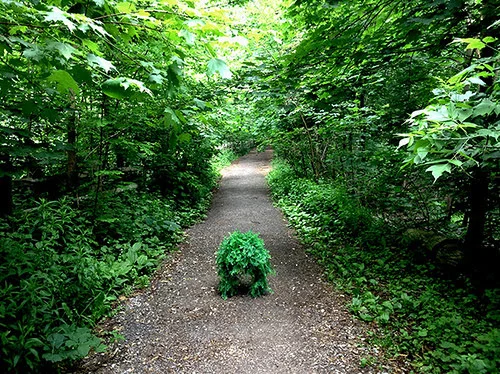
Border greenery
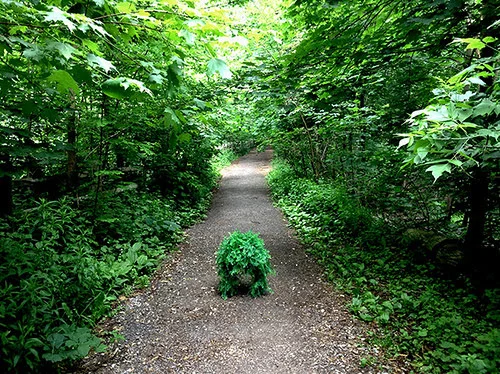
"ENT-e, 2014'' (robotic installation, video and art intervention, by Gabriela Munguia, in the group show "Last Frontier,'' at the Cantor Art Gallery, at the College of the Holy Cross, Worcester, through April 14.
The show presents some work of contemporary Latin American artists from what the gallery calls "a diverse array of perspectives and geographies.'' The idea is to explore the border/frontier as a "dividing line'' between nations and ''the dissolution of borders through globalization, borders as an experience of 'us' vs. 'them' and the blurring lines between virtual and natural spaces.''
New England is lucky that its border with a foreign nation -- stable, prosperous Canada -- is so much less fraught that the United States's border with Mexico.
An excuse for inaction?
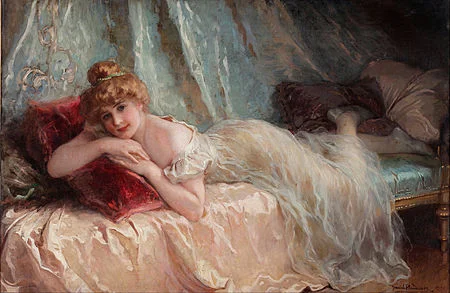
"Idle Woman, by Daniel Hernández Morillo
"Winter is a time of promise because there is so little to do, or because you can now and then permit yourself the luxury of thinking so."
-- Stanley Crawford