
Vox clamantis in deserto






Don Pesci: GOP tide might even be rising over Connecticut
It’s always possible for politicians to learn from current events, mend their ways and move on. Owing to the failure of questionable progressive policies, national Democrats this election year kept the House and the Senate and won the presidency.
Republican gains have brought to a full stop a serious progressive movement that began when Barack Obama assumed office in 2009. Flush with success – Democrats that year captured both houses of Congress and the presidency – Mr. Obama ran a progressive plank above shark-infested waters and invited Democrats to take a stroll. They did. Eight years later, Democrats have 12 fewer governorships, 13 fewer Senate seats and 69 fewer seats in the House.
The losses cut deep and will be long remembered. During Mr. Obama’s two terms, according to MarketWatch Democrats lost more than 1,000 seats at the state and national level, leaving Republicans in control of 4,170 state legislative seats. The GOP holds 33 governorships and in 25 states controls both the governorship and two houses of the state legislature, whereas Democrats hold five. Clearly, the Democratic political trek from the heights to the depths is the most dramatic rejection of a nascent progressive movement in living memory.
In Connecticut as well, the progressive political arc now bends downward. In 2011, Connecticut Democrats seized the governorship for the first time in two decades, displacing two Republican governors and Lowell Weicker, whose political affections, even when he represented Republicans in the U.S. Senate, put him firmly in the Democratic Party camp. Mr. Weicker’s liberal American for Democratic Action (ADA) rating during his last year in the Senate was higher than that of U.S. Senator Chris Dodd’s, and the income tax he draped around the state’s neck like a hangman’s noose stood him in good stead with Democrats.
Ripping a page from Mr. Obama’s campaign book, Gov. Dannel Malloy simply refused to do political business with Republicans, and the Democrats in due course passed two budgets freighted with massive tax hikes, the first the largest and the second the second largest tax hikes in Connecticut history -- with predictable results.
In the most recent election, Republicans evened the numbers in the state Senate and made substantial gains in the House. “For the first time in 125 years,” one reporter noted, “Democrats and Republicans are tied in the state Senate. With a shift of just four votes on the House of Representatives side, the Democratic majority could lose control of issues due to their 79 to 72 advantage – the narrowest margin in more than 50 years.”
The numbers cited – “first time in 125 years… narrowest margin in more than 50 years” -- point to historic, even momentous Republican gains. The power shift in the General Assembly – and, Republicans hope, in the upcoming gubernatorial race in the next two years -- will be momentous if Republicans are able to seize the moment and turn it to their political advantage, by no means a foregone conclusion.
And if Republicans and moderate Democrats working, one hopes, hand in glove to make permanent life-saving, long-term adjustments in Connecticut’s economic and social policy, are unsuccessful -- beaten back by progressives in the General Assembly who want to increase taxes to support an already too expensive unionized public employee sector -- what then? Chris Powell, managing editor of the Journal Inquirer, in Manchester, put it very bluntly in a recent column, Connecticut has wasted 40 years enriching its government class: “Since enactment of its state income tax in 1991 Connecticut has been declining steadily, and despite that tax increase and the others, state government is broke. Now Connecticut has nothing to do but strive desperately to subordinate the government class and unfix its ‘fixed costs’ -- or die.”
Mr. Powell is right. At stake in the next budget is not the welfare of a party, unions or a progressive ideology -- but the welfare of the state. Connecticut’s “fixed costs,” the untouchable expenditures written into budgets that cannot be adjusted, crowds out and marginalizes the government’s disposable revenue, and the bulk of the state’s fixed costs are tied to pension and salary agreements between state employee unions and a government that a) has been overgenerous to unions in the past, and b) retreats behind the curtain of “fixed costs” whenever anyone suggests permanent spending reductions, the only way Connecticut may lift itself up from permanent deficits and frequent cuts in services to the deserving poor.
Moreover, even the most progressive Connecticut governor since Wilber Cross knows in his bones that further tax increases will plunge the state into a “fixed tailspin” from which it is not likely to recover.
The next budget offered by Mr. Malloy to the General Assembly will fix Connecticut’s fate well beyond the next elections. Now is the time – perhaps the last opportunity – for all good men and women to come to the aid of their state.
Don Pesci is a Vernon, Conn.-based political writer.
At UMass-Dartmouth, images of the refugee crisis

From the promotion of the show "Artists Respond to the Refugee Crisis,'' at the Galleries of the University of Massachusetts at Dartmouth, through Jan. 29.
Featuring the work of Gohar Dashti in conjunction with Mehdi Ghadyanloo, Pantea Karimi, and Jodi Stevens
"Stateless'' brings together the work of four artists who reflect on the recent refugee crisis and issues of human displacement and migration.

James P. Freeman: Friedman's partly conservative look at adapting to accelerating change

Gentle reader, if the feverish pace of change in technology, globalization and climate change both fascinates and frightens you, read Thomas Friedman’s new book, Thank You for Being Late. His forensic examination and farsighted explanation of the acceleration of everything is an exercise in expeditionary learning and his prescription for adapting to this new world disorder should also appeal to conservatives.
Friedman, a New York Times columnist, is perceived to be as progressive as the paper he writes for. But that assessment doesn’t apply here. As he described it last year, he belongs to the party of “nonpartisan extremism” and his political alignment is “to the far left and the far right at the same time.”
Thank You for Being Late (Farrar, Straus & Giroux), currently ranks number 10 on the New York Times Combined Print and E-Book Nonfiction List and, published last fall, essentially is an epilogue to Alvin Toffler’s 1970 best-seller sensation, Future Shock (a book about feeling overwhelmed by change). Toffler’s assessment 47 years ago, was, basically, he wrote, “first approximations of the new realities.” So is Friedman’s for a world dominated by cyberspace.
The central argument of Friedman’s book is that technology (due to “Moore’s Law” — whereby computing power has been doubling every two years for the last 50 years), globalization (the “Market”) and climate change (“Mother Nature”) have all collided and now constitute the “age of acceleration.” These three accelerations “are impacting one another” and, at the same time, are “transforming almost every aspect of modern life.”
Friedman believes that the collision occurred roughly 20 years ago, 2007, with technological advancements in computing power (processing chips, software, storage chips, networking, and sensors) that formed a new platform. This platform “suffused a new set of capabilities to connect, collaborate and create throughout every aspect of life, commerce, and government.” These capabilities are smarter, faster, smaller, cheaper and more efficient. It is not coincidental, therefore, that that year saw the advent of the first iPhone, symbolic of this massive transformation.
The challenge posed by these exponential rates of change is our ability to absorb and adapt to them. “Many of us,” Friedman writes, “cannot keep pace anymore.” Eric Teller, head of Google’s X research and development lab, said, “[T]hat is causing us cultural angst.” And Teller warns that “our societal structures are failing to keep pace with the rate of change.”
Our fragile customs, traditions and mores are certainly being pressured in this all-digital, frenetic — if not homogenized — globalized environment. But Friedman is concerned that government itself has not kept up. The process of government — its lawmaking and structural components — should live in parallel with, and not be an impediment to, this age of accelerating change, he advises.
Former House Speaker Newt Gingrich, a sort of conservative futurist, nearly a decade ago understood that government is not forward-thinking. In his book Winning the Future, he observed that “We live in a world defined by the speed, convenience, and efficiency of the 21st century, but with a government bureaucracy invented in the 19th century.”
This may partially explain the phenomenon of the presidency of Donald Trump and many Americans’ presumed desire to radically reform government. Trump may have tapped into the belief that today’s government is not only not operationally progressive but too philosophically progressive — that it is out of sync both with technological advances and with the will of the people.
But what will attract cautious conservatives who wish to retain American ideals within a constitutional republic in an era of trans-global bits and bytes that have no allegiance to American values? They face this while addressing this troubling fact, in Friedman’s words : “That we are creating vast new ungoverned spaces — free from rules, laws, and the FBI, let alone God — is indisputable’’.
Amidst the columnist’s 461 pages of analytics and anecdotes he understands that “geo-politics has to be reimagined in the age of accelerations, just like everything else.” He also realizes that we must “reimagine our domestic politics too.” Much of his list of 18 ideas should appeal to conservatives (which includes support for free-trade agreements, tightening border security, reforming bankruptcy laws and review of the Dodd-Frank financial regulations), despite his constant clamoring for immediate action on climate disruption. (In the 1970s, some in the news media warned of a coming ice age.)
Conservatives should also be elated with this novel nugget: “Today we need to reverse the centralization of power that we’ve seen over the past century in favor of decentralization. The national government has grown so big bureaucratically that it is way too slow to keep up with change in the pace of change.” Today, a centralized government is inefficient and out of step with the maddening drive towards efficiency and push for better performance.
Still, Friedman is bullish on the future. He is indeed optimistic that a better world will be made by, and we can adapt to, these accelerations. He sees local government starting to embrace these concepts.
Thank You for Being Late does not delve into the psychological ramifications about the effects of such rapid change on individuals and societies that Future Shock does; nor does it capture the sense of dislocation being experienced today. But it is just as compelling.
And there is exquisite irony in the timing of this new effort. Toffler died last year just months prior to the publication of Friedman’s captivating book. He nonetheless would have agreed with Friedman’s conclusion about these new realities. “I hope that it is clear by now that every day going forward we’re going to be asked to dance in a hurricane.”
James P. Freeman, an occasional contributor, is a writer who also works in financial services. This piece first ran in The New Boston Post.
The big wind of the next two days

"Northeast Wind'' (acrylic and watercolor on raised panel), by Tamara Gonda, at Alpers Fine Art, Andover, Mass.
Winter resident

-- Photo by THOMAS HOOK
A Black-Capped Chickadee in Southbury, Conn. Chickadees are probably the bird most associated with winter in New England. You can hear them chirping on the coldest days. By the way, will global warming lead semi-tropical birds to stay in our region through the winter? We think of the flock of gray parrots that for years lived on a point in East Providence, on Narragansett Bay.

John O. Harney: NEEP sees regional growth and then massive uncertainty

The New England Economic Partnership (NEEP) explored "What’s Ahead After This Historic Election?" at the group's outlook conference held Jan. 17 at the Federal Reserve Bank of Boston, right across the street from South Station.
Their general conclusion: New England's economy will stay robust through 2017 and 2018 ... but then watch out! (And that's just economists—groups of scientists, multiculturalists, educators, philosophers and others would presumably voice similar cautions.)
Brandeis International Business School Senior Lecturer John Ballantine opened the NEEP proceedings by urging the crowd to reexamine its "confirmation bias," noting that the northern congressional district in Maine voted for Donald Trump and Clinton won New Hampshire by only about 2,700 votes.
NEEP's frequent national forecaster, Moody’s Analytics Chief Economist Mark Zandi, reassured the audience that the U.S. is in the midst of its second-longest economic expansion in history, including a record-setting seven consecutive months of job growth, record-low layoffs and nearly full employment. It would take a lot to derail that in 2017, he said.
The conference theme—Trump's election—is another story. Zandi was in London on election night and went to bed expecting a Clinton victory, only to take a call from his daughter in the U.S., who was crying over the results. He said he wouldn’t read too much into the post-election reaction in financial markets. Investors are responding to pledges of lower taxes, less regulation and deficit-financed government spending on the military, infrastructure improvements and other items, he said. But “there’s a boatload of uncertainty” here.
Tweets browbeating specific companies have made businesses anxious, Zandi said. And while U.S. policy since World War II has been to embrace the world, the Trump administration would use tariffs and other sticks with countries it sees as cheating. Zandi conceded that China and Mexico would probably retaliate, touching off a trade war. In addition, tough immigration standards will constrain growth in the U.S. labor force. We actually need more immigration, skilled and unskilled, he said. He added that immigrants tend to be more entrepreneurial, so immigration is the best way to increase productivity. Zandi suggested if you're in the recession-prediction business, look out for the end of Trump’s term, when some of the worst disruption (not in the current fashionable sense) will kick in.
Ross Gittell, chancellor of the Community College System of New Hampshire and NEEP vice president, noted that the New England economy has tracked the U.S. economy and should see strong growth in 2017 and 2018. But he too worried about uncertainty in the outer years of forecast.
New Hampshire posted the lowest unemployment rate in the U.S., at 2.5%, and Massachusetts the third lowest rate in the U.S., at 3.3%. (South Dakota, at 2.7 percent, was the second-lowest.) The New England average was 5% in 2015, down from a regional peak of 8.7% in 2010, and NEEP projected that it would fall to 3.7% in 2018. That's when things may go south, in part, because all that employment constrains room for more growth and, in part, because the Trump risks begin to kick in at that point. Among those risks, Trump's anti immigration stands would deal big blows to New England's already-vulnerable labor pool and the region'shigher-education sector, which relies so much on foreign talent.
Different states may meet different fates. For example, Trump could offer perverse pluses in Connecticut: tax cuts for the rich and more submarines for a defense buildup. Massachusetts could also benefit from the Pentagon spending, but could be hurt by changes to the Affordable Care Act (so-called Obamacare) as well as immigration policy.
Massachusetts also has net inflow of domestic and international Millennials, said Alan Clayton-Matthews, associate professor of public policy at Northeastern University. An audience member asked why people in their 20s are migrating to Massachusetts, but people in their 30s are migrating out. Panelists didn’t seem to know. Bird suggested that New Hampshire is the opposite, losing people in their 20s who return in their 30s for a perceived quality of life.
Ryan Wallace, project director at the Maine Center for Business and Economic Research at the University of Southern Maine, noted that Maine employment won’t return to pre-recession peaks until 2018. The oldest state in the nation by median age, Maine is among the few states where deaths outpace births. But since 2010, Maine's population has grown by 4,200—almost all through international migration. The state had been famous for welcoming Somalis to Lewiston and other cities. But more recently, Maine stories focus on cutting safety nets. On a different front, Maine’s governor has threatened cuts to the state workforce.
Independent economist Jeff Carr gave the Vermont forecast. “I don’t think there’s been a time where we’ve been more uncertain about where we’re going,” Carr said. He agreed that 2019 and 2020 will be the danger years. Among other risks, Vermont—like Maine and Rhode Island—gets a high percentage of funds from the Feds, led by Medicaid.
Every New Hampshire industry is hiring, except government, partly because a declining school-aged population means less demand for teachers, according to Greg Bird, economist with the New Hampshire Center for Public Policy Studies. Bird also noted a serious divide between counties tied to Greater Boston and more rural counties, which are treading water, or evenstill in recession. New Hampshire—like Maine and Vermont—hasn’t seen labor force growth from 2012 to 2015. Bird said the state's prosperity is not sustainable because of its demography and already Granite State businesses are having trouble finding people to hire.
Rhode Island had the highest unemployment rate in New England in November at 5.3%. But that's a far cry from the 9.1% it hit in November 2013. Edinaldo Tebaldi, associate professor of economics at Bryant University, noted that Gov. Gina Raimondo’s economic development emphasis includes attracting jobs from GE and Johnson & Johnson and proposing free tuition at the Ocean State's public higher- education institutions.
Patrick Flaherty, assistant director of research and information at the Connecticut Department of Labor, said employment is hitting record highs in Connecticut, though the state has recovered less than three-quarters of jobs lost in the recession. Healthcare has been a key employer in Connecticut, but is currently restructuring with hospital mergers. Also, the number of school-age children is projected to keep shrinking, while the 65-and-over age groups, especially 85 and over, keeps growing. Also a Trump tax policy that favors high-income individuals could help Connecticut's affluent population, as could the defense buildup: Connecticut is still the fourth largest state in aerospace employment … and a major producer of submarines.
Song for Europe
In addition to regional economic forecasts, NEEP counts as part of its mission providing indepth discussions on key issues. This time around, some of that focused on the economic and political crises facing Europe—not unrelated to the Trump reflections.
Jeffry Frieden, professor of government at Harvard University, explained how confidence in government has collapsed and support for the European Union has plummeted. And the economy has been suffering a long time; for some, it may be not a lost decade, but a lost generation. In addition, poor Spanish are more likely to share values with poor Germans than with well-off Spanish. And, said Friedan, if the NEEP crowd thinks New England’s demography is threatening, the labor force constraints in Europe are even tighter.
John O. Harney is executive editor of the New England Board of Higher Education, on whose Web site this essay first ran.
Back to a crust of bread
‘’The simplicity of winter has a deep moral. The return of Nature, after such a career of splendor and prodigality, to habits so simple and austere, is not lost either upon the head or the heart. It is the philosopher coming back from the banquet and the wine to a cup of water and a crust of bread.’’
-- John Burroughs, "The Snow-Walkers," 1866
Massachusetts's nice problem to have
From Robert Whitcomb's "Digital Diary'' column in GoLocal24.com.
Massachusetts’s jobless rate in December was 2.9 percent and the state’s average wages are among the highest in the nation. Massachusetts employers need more skilled workers to staff the many well-paying and sophisticated jobs available in the Bay State. That its public schools are probably the best in America, and that the state hosts world famous colleges and universities, helps to churn out great workers. But so successful are so many Massachusettscompanies that they’re desperate for more highly skilled workers. In a sense, a nice problem to have!

A giant protein factory

"Oak Island'' (oil on canvas), by Judy Purinton, at Alpers Fine Art, North Andover, Mass.
Chris Powell: The Democrats' ignore their role in bringing Trump to power
MANCHESTER, Conn.
On his way out of the White House this week, President Obama assured the country that all will be well. But Obama is not returning to Chicago, which is engulfed by the violence of social disintegration, nor even to Illinois, the most insolvent of states, and if everything was well he wouldn't be delivering the White House to anyone like Donald Trump.
Trump has been elected precisely because most people, including even many people who did not vote for him, understand that the country has declined during the Obama administration -- that living standards for the majority are eroding, that the touted national health-insurance legislation has only made costs explode without covering everyone, and that the country's standing in the world has diminished with both imperial wars and appeasement in the Middle East.
Having lost the popular vote by a large margin, nearly 3 million votes, Trump has no mandate. His election was largely a fluke, caused first by the Republican Party's division among a dozen more responsible candidates and, then, more so, by the Democratic Party's inability to hold on to its own voters in three usually Democratic “Rust Belt” states -- Pennsylvania, Michigan and Wisconsin --whose economies are not half as strong as the Obama administration pretended.
Trump's Cabinet nominees, a bizarre mix of plutocrats and ignoramuses, may make even Warren Harding's look ethical and brilliant. With their evasions and comments contradicting their boss, they already have made the incoming administration seem incoherent.
But unable to recognize its responsibility for Trump, the political left is apoplectic and would not even concede him an ordinary inauguration. Trump's every tweet must be protested. Under no circumstances can the left allow any dialogue that might imply the right of the other side to its contrary views and that might acknowledge that much of the country is opposed to the largely failed agenda of the Democrats and their cheerleaders in the news media.
There cannot be even a prayer that Trump, like other people suddenly installed out of their depth, could be humbled by his new office and sense a profound obligation to try to rise to the occasion.
As he seems always to be spoiling for a fight and thumping his chest, it is hard to imagine such an effort from Trump. He has given much cause to be considered temperamentally and even psychologically unfit to wield power in a democracy, where some respect or ordinary courtesy must be paid to dissenters so that divisions don't turn the country against itself and weaken it against its enemies.
But circumstances soon may force Trump to realize that always spoiling for a fight is not the path to political success, especially since public opinion of him has gotten only lower since the election and since the Senate is almost evenly divided, its narrow Republican majority including members who are both sensible and capable of putting the country's interests above partisan interests. Indeed, moderate Republican senators may come to control the agenda.
The apoplectic protest is premature but people on the left and right alike should resolve not to be intimidated, as dissenters were during the administrations of Lyndon Johnson and Richard Nixon. Johnson was as megalomaniacal as Trump, and Nixon as much of a liar -- and when enough people stopped being intimidated and started resenting lies, democracy brought both presidents down.
For in the end the people themselves are the guardians of their own liberty, and even if Trump works out for the worst, he will have reminded some people who very much need reminding that ever-larger, more powerful and centralized government is a two-edged sword, one that can cut on the left side as well as the right side of politics.
Chris Powell is managing editor of the Journal Inquirer, in Manchester, Conn.

'Love's austere and lonely offices'

"Sundays too my father got up early
And put his clothes on in the blueback cold,
then with cracked hands that ached
from labor in the weekday weather made
banked fires blaze. No one ever thanked him.
I'd wake and hear the cold splintering, breaking.
When the rooms were warm, he'd call,
and slowly I would rise and dress,
fearing the chronic angers of that house,
Speaking indifferently to him,
who had driven out the cold
and polished my good shoes as well.
What did I know, what did I know
of love's austere and lonely offices?"
-- Robert Hayden, "Those Winter Sundays''
Sociological lessons from public offices
Thewaiting room of the Providence Social Security office, which has been moved and spiffed up, provides some examples of a changing America. These include that many of the folks in the waiting room speak little or no English. (This is probably one of the changes that has distressed many Trump fans.)
For another, very few people these days bring anything to read to pass the time. Most folks just stare ahead or occasionally look at their cellphones. Catatonic America? Or do they just not feel well? Indeed, the clientele look remarkably unhealthy.
The Rhode Island Traffic Tribunal is also sociologically fascinating. One is struck by the number of people who cannot pay even very small fines (say $60) in spite of the fact (or because?) they have big cars; the number of people driving with marijuana in their vehicles; the number of people whose car windows have such dark tinting that the judge orders them to remove it so that law-enforcement people canidentify the people within – and what they’re doing -- and how many confused people are fined after being videotaped passing school buses parked on the wrong side of the street with their stop flags extended and lights flashing but no driver or children in sight.
It’s a very good business: the videotape company (now an outfit called Student Guardian) gets 75 percent of the fine, the state 12.5 percent, and the city or town where the violation occurred 12.5 percent. Theeconomic impetus is to keep the flag extended and the lights flashing as much as possible. In any case, stay as far away as you can from school buses, for the kids’ sake and your wallet’s.
Some wags have suggested that the inside of the buses also be videotaped to prove that they are occupied but that would violate the privacy of the children.
You also, as you’d expect, see lots of speeding tickets in relatively wide-open parts of the state, such as Burrillville, but far more school-bus-passing offenses, driving without insurance, license and/or registration, marijuana possession, excessively tinted windows and so on in urban areas – for example, East Providence.

Angry artists

"Monsters Under the Bed'' (charcoal, graphite powder, binding threat and collage on canvas), by Hilary Tait Norod in a one-day group show titled "Re-Volt-Ing'' in protest of the coming to power of Donald Trump. The show will be 7 to 10 p.m. Jan. 20 at The Distillery Gallery, South Boston.
Josh Hoxie: Repealing the ACA another windfall for the rich
Via OtherWords.org
Great magicians are masters of diversion. They attract our attention with one hand while using the other to trick us into thinking a supernatural act is taking place.
But even the best street performers could learn a lesson from the folks in Congress who are trying to repeal the Affordable Care Act, also known as Obamacare.
When we talk about repealing Obamacare, we almost never talk about the windfall payday it would bring to multi-millionaires and billionaires. In fact, this massive tax cut is the proverbial card hiding in the sleeve of lawmakers pushing repeal.
A new study from the Center on Budget and Policy Priorities shows the 400 richest Americans, a group whose average annual income tops $300 million each, would get a combined annual tax cut of $2.8 billion if the Affordable Care Act is repealed.
In other words, people who already have more money than they could spend in a dozen lifetimes would get a massive pile of cash.
Meanwhile, those who make less than $200,000 per year — also known as “the rest of us” — would see no benefit. That’s because the two taxes that funded the expansion in healthcare coverage included as part of Obamacare don’t extend to these moderate-income households.
And many of us would do worse.
In fact, about 7 million low-income people would actually see their taxes go up if the law’s repealed, since they’d lose insurance premium tax credits that were enacted as part of the bill.
So, to be perfectly clear on this point, repealing Obamacare equals payday for the wealthiest households and higher taxes for the poorest households — millions of whom would also lose their health coverage.
Remember the story of Robin Hood? It’s just like that, but backwards.
Poll after poll shows Americans have no idea how concentrated wealth inequality is today — it’s far worse than most suspect.
A report I co-authored last year looked at the 400 wealthiest individuals in the country. This group together owns more wealth than the entire GDP of India, a country with over a billion people.
The report also showed this great concentration of wealth splits largely, although not exclusively, along racial lines. The 100 wealthiest Americans, none of whom are black, today own more wealth than the entire African-American population combined.
Unsurprisingly, most of us would like to live in a much more egalitarian society. If we can’t swing it, economist and author Thomas Piketty warns, we’re heading towards a hereditary aristocracy of wealth and power, where the children of today’s billionaires will dominate our economy and our government.
As we look back at the Obama legacy, we see a number of efforts aimed at beginning to bridge that massive wealth divide. From expanding opportunities for low-income children and families to asking the ultra-wealthy to pay their fair share, progress has been made on this front in the past eight years.
The Affordable Care Act was one of these efforts, and it touched directly on issues of life and death.
Don’t be fooled by the smoke and mirrors of today’s illusionists: Repealing it will directly counteract this progress. It will further concentrate wealth into fewer hands and strip low-income families of what little resources they have.
Josh Hoxie directs the Project on Taxation and Opportunity at the Institute for Policy Studies.
Llewellyn King: Left should start trying to influence Trump, via television
Through the nation and across the world the liberals, the centrists, the traditionalists and the orthodox are in shock: Donald J. Trump will be America's 45th president and they don’t like that one bit, or like him at all.
I have some advice for those who are beating their breasts and crying, “The sky is falling!”: Get over it, and get to work.
Trump is the man. Those who fear his changes ought to start using the man’s own tool: leverage.
According to The Washington Post's Robert Costa, who covered Trump's presidential campaign, and interviewed him again last week, the president has no particular ideology. But he gets ideas from Steve Bannon, his senior counselor and chief White House strategist.
The forces opposed to Trump would do better to focus their fire on Bannon. Criticize him, even ridicule and revile him, but endeavor to get the message straight to Trump.
How can one direct invective at those around Trump, but speak to him directly?
The tool for reaching Trump is television.
Television is a medium associated with mass communication, but now it has a chance of being a medium of singular communication: the way to whisper in the president’s ear in plain sight.
Trump told Chuck Todd, host of Meet the Press, that he gets his information from “the shows like yours.” Trump’s early Cabinet appointments show the veracity of this: What he knows, how he thinks and how he'll act is influenced by what he sees on television much more than by learned discourse in the press. Trump tweets because what he has to say fits in the written equivalent of a sound bite.
Trump is a creature of television, and it's a two-way street for him: He loves being on it and gets his information from it. That's why he appoints people who he's seen on television. He appointed Monica Crowley as senior director of strategic communications at the National Security Council, but she has relinquished the post amid a plagiarism scandal. Reportedly he was considering Laura Ingraham for White House press secretary. Both are television chirpers.
If you want money to build a new nuclear reactor, more funding for the National Institutes of Health to do research on a certain disease, or if you want to change the fortunes of a small country, take your message to television.
This means the political communications machine needs retooling.
You cannot persuade Trump with dense arguments in journals of opinion. Instead, you must persuade him with easily grasped ideas that will make their way onto television -- especially onto the Sunday morning talk shows.
Fox has the edge with Trump, which makes the sale of some ideas more difficult. But he's open to a catchy concept; something that he can rework into a slogan of his own, while his administration incorporates it into policy.
The other route to Trump are his daughter, Ivanka, and her husband, Jared Kushner. Liberals should stop whining about their having a role in the White House. Let them have it. It’s a good thing – and an excellent thing for these times.
Even though they've been shielded by wealth from many of the realities of life, they can't be totally immune to what their generation thinks and says. They are in their middle thirties; Trump is 70. That's important. It wouldn't be so if they didn’t get a hearing from Trump. But he relies on them, uses them as sounding board. They could be of value in balancing what Trump hears from Bannon and National Security Adviser Michael Flynn.
Only a child can say to a parent, a parent who dotes on that child, “You’re full of it.”
That’s what everyone needs to hear sometimes, and Trump especially. Bring them on!
Llewellyn King is executive producer and host of White House Chronicle on PBS. His e-mail is llewellynking1@gmail.com.
Time to join Atlantic Time
From Robert Whitcomb's "Digital Diary'' column in GoLocal24.
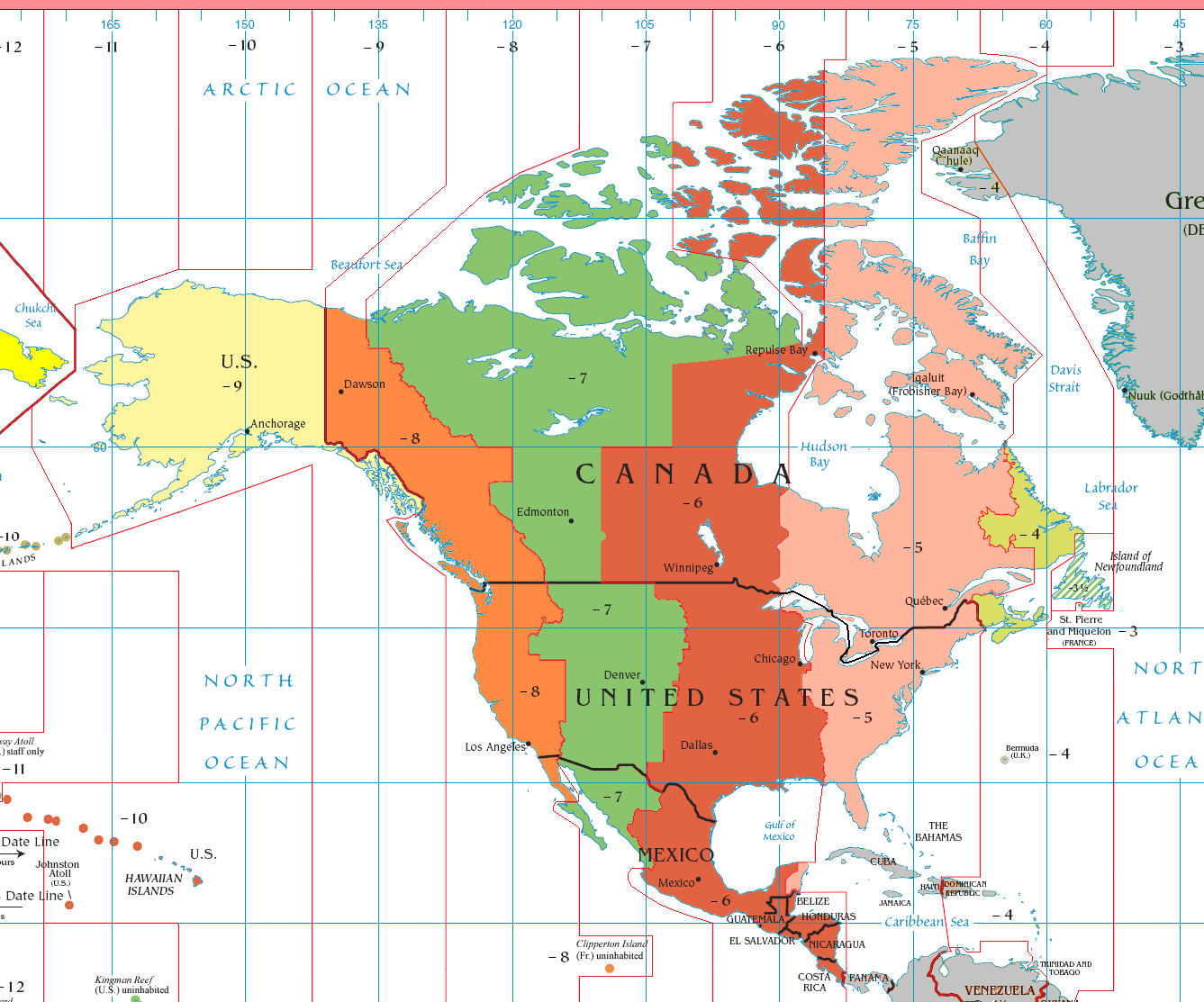
Good news: The Massachusetts legislature is studying whether to have the state join Canada’s Maritime Provinces (and Puerto and the U.S, Virgin Islands) by ditching Eastern Time and joining Atlantic Time. Since New England is so far east, this would make a lot of sense. It would give us more afternoonsunlight in the late fall and winter and end the sleep deprivation caused by our move into Eastern Daylight Time in March. If New England’s dominant state makes the move, then the rest of the region, perhaps excepting Connecticut, or just its Fairfield County, which operates almost as part of New York, would have to follow suit.
Atlantic Time matches the time that New Englanders already use in the summer; adopting it would simply mean that in the fall, we wouldn’t have to fall back but rather we’dkeep the clock an hour forward all year.
The change would, based on current school hours, result in kids going to school when it’s still dark some of the year. So open school an hour later than now. You’d probably get more alert students: Studies have suggested that the sleeping cycles of young people, especially teens, clash with the typical 7:20-8 a.m. openings of public schools.
We’re in the wrong time zone. Consider that Boston lies so far east in the Eastern Time Zone that during standard time, Boston’s earliest nightfall of the year – Dec. 7 -- is a mere 27 minutes later than in Anchorage, Alaska.

Moments of innocence

"Early Morning, Duck Creek, Wellfleet'' {on Cape Cod} (oil on recycled wood), by John Mulcahy, at Alpers Fine Art, Andover, Mass.

David Warsh: Should Trump get his own FBI director?

SOMERVILLE, Mass.
The editorial page of The Wall Street Journal on Jan. 14 signaled what may become the first major battle of the Trump administration, when it called upon FBI Director James Comey to resign.
“[I]f the director has demonstrated anything in the last year, is that he’s lost thetrust of nearly everyone in Washington, along with every American who believes the FBI must maintain its reputation as a politically impartial federal agency.”) If he doesn’t quit on their motion, the WSJ editorialists continued,
“Jeff Sessions should invite him for a meeting, after {Mr. Sessions} is confirmed as Attorney General, and ask him to resign. If Mr. Comey declines, Donald Trump should fire him in the best interests of the nation’s most important law enforcement agency.’’
In a season of bad ideas, the proposition that Donald Trump should have his own FBI director is the worst one yet. It should be laughed off and then dismissed.
It won’t be, though, because Comey has become the focal point of dissatisfaction by leaders of both parties and pundits left and right. Democrats blame him for swinging the election by notifying Congress that a small cache of previously unexamined Hillary Clinton e-mails had turned up. Republicans blame him for absolving Clinton of criminal conduct in the private email server.
Last week Justice Department inspector general Michael Horowitz announced he would undertake a wide-ranging review of FBI actions before the election. Comey welcomed the investigation, and the rest of us should, too. It will take a few months to complete. Horowitz mentioned six areas of specific concern.
The first instance was Comey’s decision last July to call a press conference to announce the results of a year-long investigation requested by Congressional Republicans. He excoriated Hillary Clinton for “extremely careless” conduct in her use of a private server for State Department business but added that that carelessness didn’t amount to criminal conduct.
The second occasion came in October, ten days before the election, when Comey wrote to the same Congressional leaders to say that a small trove of unexamined Clinton e-mails had been located in an unrelated investigation. Three days before the election, he announced that they had been found to contain nothing new.
The third topic that the Inspector General promised to investigate has to do with the circumstances that led Comey to announce the discovery of the new e-mails.
According to stories by Devlin Barrett, of the WSJ. Comey was dealing with furious dissent over the Clinton investigation in at least four FBI field offices – New York, Los Angeles, Washington, DC, and Little Rock – offices in which agents had extended their investigation to practices of the Clinton Foundation. Candidate Trump himself surmised as much, telling a Colorado crowd in late October, “I’ll bet you without any knowledge there was a revolt in the FBI.”
A fourth matter concerns whether FBI Deputy Director Andrew McCabe should have been recused from the case, either before or after his wife, a candidate for the Virginia Senate, accepted a large donation from a prominent Clinton backer, Virginia Gov. Terry McAuliffe.
A fifth involved the use of an FBI Twitter account to publicize the release, days before the election, of 129 pages of internal documents under terms of a Freedom of Information Act request – material pertaining to Bill Clinton’s pardon of financier Marc Rich nearly 16 years before.
A sixth pertained to some potentially inappropriate contact between Assistant Attorney General for Legislative Affairs Peter Kadzik and John Podesta, Hillary Clinton’s campaign chair. WikiLeaks hacks disclosed a series of e-mails between the two; Kadzik had previously been Podesta’s attorney.
The office of the Justice Department Inspector General, created in 1989, celebrated its twenty-fifth anniversary a couple of years ago. Horowitz, a longtime Justice Department and Sentencing Commission administrator, worked briefly for Comey twenty-five years ago, as a prosecutor in the Southern District of New York. The fourth attorney to serve as IG, he was sworn in on April 16, 2012.
The irony, as recounted here inOctober, is that Comey is famously perpendicular to the political special interests that routinely test any FBI director. No doubt that the courses that Comey chose in July and October were irregular; in each case he was dealing with an irregular situation – a congressional attempt to stampede the bureau in the summer, the prospect of open revolt among its rank-in-file two weeks before the election. To have explained the matter more fully would have almost certainly made things worse; to have done nothing would have risked mutiny, a disaster.
The FBI, the nation’s top law-enforcement agency, is deeply divided along partisan lines. Some significant faction still want to send Hillary Clinton to prison. Agents have been communicating indirectly with advisers to the president-elect and to the press. Strong and principled management at the top is required. Democrats and sensible Republicans should sit back and wait for the Inspector General’s account.
David Warsh, a longtime financial journalist and economic historian, is proprietor of economicprincipals.com.

New England's shoe-business redux
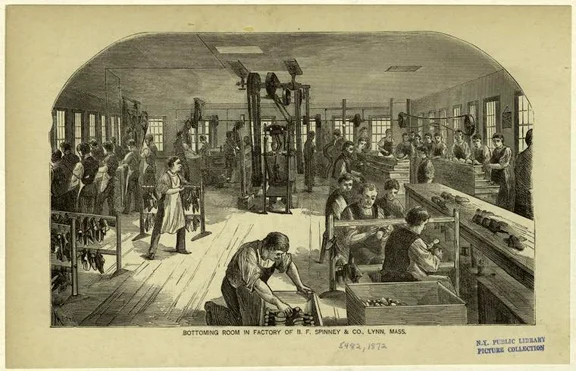
In the B.F. Spinney & Co. shoe factory in Lynn, Mass., in 1872.
From Robert Whitcomb's "Digital Diary'' column in GoLocal24.com:
From the late 19th to the middle of the 20th Century, Massachusetts was often called “The Shoe Capital of the World’’ because of its many shoe factories, most notably in Brockton but also in towns north of Boston, particularly Lynn. Most of the factories were closed as the companies either went out of business or moved their operations south in search of cheap labor, aided by new industrial air-conditioning. Same thing with the textile companies.
But the Bay State and New England in general have been pretty good at reinventing themselves. Even in shoes. Nowadays footwear companies are drawn to (or stay in) Greater Boston because of the increasingly rich design, marketing, manufacturing technology (such as robotics) and other expertise available there. Consider the following companies with headquarters operations in the area: New Balance, Puma, Alden of New England, Wolverine, Clarks, Earth Brands, Reebok, Vibram, Rockport and Converse.
A particularly evocative development is the recent move by British-owned Clarks Americas into the former Polaroid factory in Waltham. In its glory days in the ‘50s and ‘60s, Polaroid, the instant camera and film company, was considered a leader among the Massachusetts technology companies that were spouting up along the recently built Route 128. The company was called a “juggernaut of innovation.’’ (There’s been a minor revival lately of using Polaroid cameras. Like vinyl records?)
A big change since the ‘60s is that many tech companies now prefer to be in Boston and Cambridge because the executives, and their younger workers, find them more stimulating than the suburbs. The most dramatic recent example, of course, is General Electric deciding to leave its boring Fairfield, Conn., corporate campus and move to Boston’s trendy waterfront.
Gary Champion, president of Clarks Americas, succinctly explained to The Boston Globe the lure of Greater Boston:
“The skill is what brings us here, even still.’’
Having spent summers in high school working for a trucking company in Boston (on the then grubby and arson-rich waterfront) much of whose business was servicing the shoe and related business, I find this comforting.
Massachusetts’s jobless rate in December was 2.9 percent and the state’s average wages are among the highest in the nation. Massachusetts employers need more skilled workers to staff the many well-paying and sophisticated jobs available in the Bay State. That its public schools are probably the best in America, and that the state hosts world famous colleges and universities, helps to churn out great workers. But so successful are so many Massachusetts companies that they’re desperate for more highly skilled workers. In a sense, a nice problem to have!
Depends what you mean by reality

Deob"Reality Principle 8,'' by Sumin Son at Gallery BOM, Boston, through Feb. 15.