
Vox clamantis in deserto


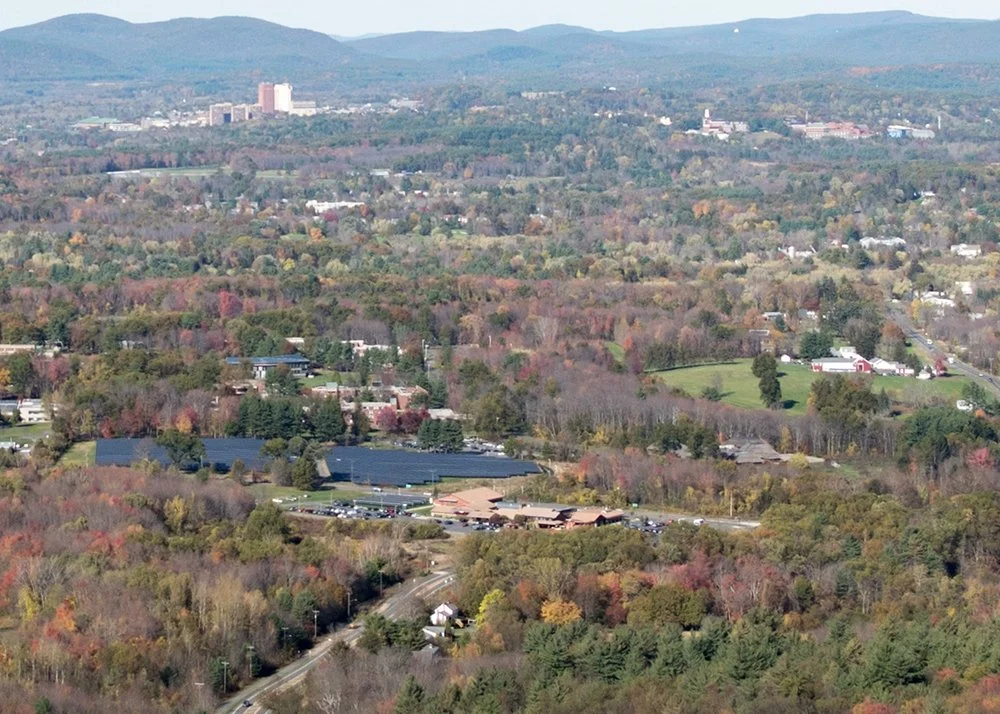





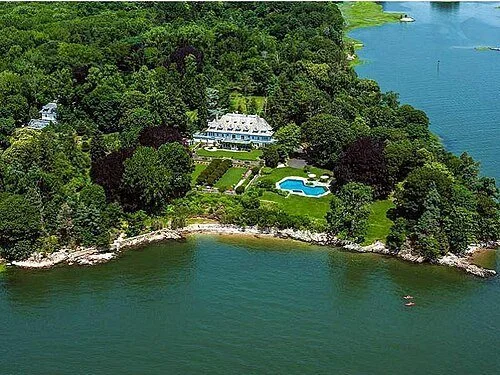

'What an angle you make'
"Long yellow rushes bending
above the white snow patches;
purple and gold ribbon
of the distant wood:
what an angle
you make with each other as
you lie there in contemplation."
-- William Carlos Williams, ‘’January Morning – XII’’
David C. Pate, M.D.: America's healthcare-payment system must be transformed
At this stressed moment in Washington, this is as good a description of American healthcare "system'' challenges as I've read in a while.
-- Robert Whitcomb
David C. Pate, M.D., a physician and lawyer who has been president and CEO of St. Luke’s Health System, based in Boise, Idaho, since 2009, spoke Dec. 14 as part of the Boise Metro Chamber of Commerce’s CEO Speaker Series. These remarks are edited for length and clarity from a transcript prepared by the chamber’s public-relations director, Caroline Merritt.
There’s a lot of discussion about healthcare, a lot of fear about what’s going to be happening with healthcare from a national level. I think there are answers — answers that healthcare providers are best prepared to implement, not Washington.
For the seven years that I’ve been here, we have been working at St. Luke’s, building the capabilities and competencies necessary to manage healthcare in a very different world than has existed.
Six months after I got here, the Affordable Care Act was enacted. We at St. Luke’s did not support the Affordable Care Act. Not because it doesn’t have a lot of really good features. It does. The discussion at the time was that if we add tens of millions of people to the newly insured in what was at the time, and still is, a broken healthcare delivery system, we’re going to end up saving money. We did not believe that. We have seen with the Affordable Care Act the continued growth and cost in healthcare. Something different has to happen.
Now the discussion is, “Let’s repeal and replace the Affordable Care Act.” I think it’s going to miss the mark as well. In both cases, Republicans and Democrats are coming up with the right answers to the wrong question.
Get a service, pay a bill
Most experts in healthcare would agree that the single biggest problem is our reimbursement model. It’s what’s called fee-for-service. You go to the doctor, you get a bill. You get a lab test, you get a bill. You go to the hospital, you get a bill.
It leads to a fragmented healthcare-delivery system. Everything is being paid by this unit-of-service or episode-of-care. Regardless of whether it helped you or not. Regardless of whether it provided value. Regardless of whether there was a less costly alternative.
An ideal reimbursement system ought to align the incentives of the payment with what we say are the important objectives that we want. You go places and you’re always having to repeat the same things because nobody seems to have all the information. You get bills from all the different ones.
It’s estimated that, at minimum, 30 percent of all healthcare spending in the United States goes to low-value or no-value services. So we are spending money on things that don’t help people. With fee-for-service, we pay for a lot of duplication.
One of the consequences is that we have these consistently rising premiums, and they have outpaced the growth in incomes. In Idaho this is particularly serious, because premiums as a percentage of average income [are] about 17 percent, and even the federal government with the Affordable Care Act said affordable is less than 9.5 percent.
High-deductible health plans don’t help
What has been a response is, “Let’s create really high-deductible health plans that make the patients have skin in the game and make them a little bit resistant to buy these services unless they really need them.”
Most of us can remember the day when we thought a high deductible was a thousand dollars for an individual. These high-deductible plans now are in the neighborhood of up to $6,000 for an individual, $12,000 for a family. Nearly half of Idahoans don’t have enough liquid assets to be able to pay the deductible.
So insurance is increasingly become more like a catastrophic health plan, not something that you can really use. People do avoid getting care, but they avoid getting the care they need as well as the care that you’d like to discourage. This isn’t working.
Now imagine a new world that I’ll call pay-for-value. Imagine that I’m getting paid $500 a month for people to provide all of their healthcare, and that’s all I’m getting,
The majority of the population [accounts for] a very small amount of the healthcare spending – 4 percent. In fee-for-service, Saint Al’s {Boise-based St. Alphonsus Health System} and St. Luke’s would go broke. They just don’t use many services.
Today, in fee-for-service, what I want to know when I come to work is: Are all our hospital beds full? Are our emergency departments full? Are women lined up down the hallway to give birth? Because this is how we get paid.
When [a patient is] ready to be discharged, we’re going to wheel [her] out in a wheelchair to the front sidewalk, and her family members are going to pull up, and we’re going to put her in the car and close the door. We’re done. Now, if anything else happens to her, that’s fine, come on back. We’d be glad to have you, and we’ll do it again. Re-admissions aren’t really a problem for us under fee-for-service. It’s just an opportunity to make more money.
New financial incentives for better care
Think about pay-for-value. I’m getting $500 per month. Is there any hospitalization that you can have for under $500 that you can think of? No.
Now don’t misunderstand me. We’re still going to have hospitalizations, even under pay-for-value. But we’re looking at them differently: Could we have prevented this?
Under pay-for-value, complications are very expensive, and now they’re our expense, because we’re just getting that $500. And we’re looking at two things. How can we give the right care 100 percent of the time? And how can we get to zero complications?
If you have a knee or a hip replacement, one of the dangers is that the prosthesis, the artificial part of it, can get infected. We figured that if someone got an infection from their knee or hip surgery, it added about $120,000 to the cost. That’s a lot of $500 premiums to pay for that complication. So what we’ve been doing is trying to figuring out how do we get to zero complications.
With hip and knee infections — I’m going to oversimplify — there are two ways you can get infected. One is: There can be bacteria on the skin that we don’t get off, so in the operation we put the bacteria in it. But today, the bigger problem is there’s particulate material in the air. We’ve got your wound open. That particulate matter can settle in your wound.
So we partnered with Micron and Boise State University to come into our operating rooms and to study about these particulate counts. Who knew there were such things as air engineers, but there are, and Boise State has one. And what we found is that every time the OR door opened, it stirred up the particulate count in the room. Just by us making sure everything is needed is in the room, and putting in new procedures about minimizing traffic through the OR, we have cut what was already a very good infection rate in half. These are the kind of things that you have got to do in this new world.
A very small percentage of the population accounts for a lot of the healthcare spending. [A man] has diabetes and heart failure and chronic kidney disease, and he’s a couch potato and he’s not very active. He is just a mess. People in [his] category, on average, are going to have six to eight doctors. In fee-for-service, they’re not talking to each other.
‘We’re driving this forward’
In pay-for-value, that’s where we can reduce costs and make healthcare more affordable. Instead of concentrating all of my health systems’ resources on all of them, I’m going to focus my resources on this group, because there is so much we can do just by paying those doctors differently. They’re not just getting paid for the office visit. They are now paid to actually coordinate his care. You use other resources like care managers to help coordinate that care.
Starting Jan. 1, 25 percent of our revenue will be in this new model. We expect that sometime in 2018, it actually may be 50 percent. So we’re driving this transformation forward.
Now, the Boise/Meridian hospitals are five-star hospitals designated by CMS [the federal Centers for Medicare and Medicaid Services], the only one like that in the state of Idaho — in fact, in the surrounding six states. And our health system has been named, and that’s all of the hospitals, a top 15 health system for three years in a row. We’re showing that this can be done. We’re doing it.
The other piece is: Drive it at the lowest possible cost. That’s what we’ve got to deliver on.
We’re not counting on Washington to figure out how to fix healthcare.
Q: You’re talking about the transformation, but I’m wondering how that’s going to happen. You partner with SelectHealth, right? To deliver this model? Are you going to be able to work with the other insurance companies to make this happen? Or maybe it’s something bigger, like CMS changing from fee-for-service to pay-for-value. How are you going to get from 50 to 100 percent?
A: This is a great question, because the only way we can do it is if the payment system is transformed as well. It’s not going to work for us to transform the clinical model if the business model doesn’t change with it.
We have a great partnership with SelectHealth. That is certainly accelerating our efforts. One reason we went to SelectHealth was there wasn’t a lot of appetite for this in the market with the insurers at the time many years ago. Now other payers are getting aligned with this same concept.
In defense of my insurance-company colleagues, let me tell you, it’s really hard to change your business model. What we’ve gone through with our board to convince them that we should do this, and for them to understand you’re going to take 25 percent of our revenue and put it at financial risk? It’s a big step. And it’s hard for any business to transform their business when they’re doing well.
I think there’s going to be a competitive advantage to who can figure this out first. What I can do is: With the insurance companies that want to partner with us, we can now get by on a lower premium. So you can actually lower your premium, and we know that is what will shift market share.
As far as the federal government:
The Obama administration has been all in favor of this, and they would applaud what we are doing.
I am concerned with the new pick for secretary of HHS [President-elect Trump has chosen Rep. Tom Price, M.D., a Georgia Republican congressman] because I’m not convinced based on what I’ve read about him that he believes in this. He’s a physician that came from the fee-for-service world and did well in that world.
I think the question is: How difficult is the new administration going to make it for us to do this? But I hope not.
This story appears in the December 21, 2016-January 17, 2017, edition of the Idaho Statesman’s Business Insider magazine. To get to the magazine, hit this link.
Exit Kaspersky
If you use Kaspersky, the Moscow-based information-security company whose services are used by many Americans, get out of it ASAP.
Installing Kaspersky on your computer opens yourself up even more than you're already exposed to hacking by Russians. Eugene Kaspersky, the company’s major domo, is very close to the Kremlin and does its bidding. Indeed, get anything Russian out of your computer ASAP!

Mass transit

"Rajathan/1996: Crowd carries man during the Holi festival,'' by Steve McCurry in his show "India,'' at the Housatonic Museum of Art, Bridgeport, Conn., through Feb. 10. The show features 44 photos of Mr. McCurry's time in India. He is best known as the photographer who took the haunting picture "Afghan Girl'' on the cover of National Geographic magazine.

January thaw

Come with rain, O loud Southwester!
Bring the singer, bring the nester;
Give the buried flower a dream;
Make the settled snow-bank steam;
Find the brown beneath the white;
5
But whate’er you do to-night,
Bathe my window, make it flow,
Melt it as the ices go;
Melt the glass and leave the sticks
Like a hermit’s crucifix;
10
Burst into my narrow stall;
Swing the picture on the wall;
Run the rattling pages o’er;
Scatter poems on the floor;
Turn the poet out of door.
-- Robert Frost, "To the Thawing Wind''
Upcoming foreign-relations dinners
To members and friends of the Providence Committee on Foreign Relations (thepcfr.org; pcfremail@gmail.com).
There might be a couple of additions to this list over the next few weeks.
To members and friends of the Providence Committee on Foreign Relations (pcfremail@gmail.com; thepcfr.org)
Our next speaker comes on Thursday, Feb. 23, with Carl Maccario, an expert on international security issues involving terrorists and other bad actors. He's an internationally known specialist in behavior recognition, evaluating truthfulness and detecting deception, and nonverbal communication.
He has provided behavior recognition training to virtually every part of The Department of Homeland Security and as well as to various branches of the Department of Defense entities and to foreign nations.
He’ll have some exciting visuals to show us.
Dr. Stephen Coen, director of the Mystic Aquarium, will speak on the condition of the oceans, Wednesday, March 8.
Brazilian political economistand commentator Evodio Kaltenecker willspeak on Thursday, March 16, about the crises facing that huge nation.
On Wednesday, April 5, famed French journalist, novelist and broadcaster Jean Lesieur will speak on the global order being turned upside down by the advances of dictators, the retreat of democracies and the presidency of Donald Trump, not tomention the existential crisis of the European Union.
Dr. Rand Stoneburner, M.D., the international epidemiologist, willspeak on Wednesday April 19, about world public health challenges, including Zika.
James E. Griffin, an expert on ocean fishing and other aspects of the global food sector, will speak to us on Wednesday, May 17.
Joining us on Wednesday, June 14, will be Laura Freid, CEO of the Silk Road Project, founded and chaired by famed cellist Yo-Yo Ma in 1998, promoting collaboration among artists and institutions and studying the ebb and flow of ideas across nations and time. The project was first inspired by the cultural traditions of the historical Silk Road.

The weight of history in 'Manchester-by-the-Sea'

The Old Burial Ground in Manchester-by-the-Sea, Mass. (Photo by John Phelan)
Adapted from Robert Whitcomb’s “Digital Diary’’ in GoLocal24.com
Some readers may have seen the recently released movie Manchester-by-the-Sea, a devastating family tragedy, but with comic moments, too, and all suffused with a haunting New England atmosphere. I have seen few movies that present a sharper view of the often bleak beauty of New England’s coast and towns or of the anxieties and occasional joys of America’s lower-middle class, New England sub-species.
The film is mostly set in the eponymous Massachusetts town on Greater Boston’s North Shore.
While the official name is the same as in the movie, when I was growing up in Cohasset, across Massachusetts Bay from the town, we only called it “Manchester.’’ I mostly remember the capacious gray-shingled summer places along the town’s rocky headlands and the big Federal Style and Greek Revival houses inland a bit. \
Many of the grandest places in Greater Boston are on the North Shore. That’s where a lot of Boston Brahmins repaired to in the summer; some moved there year-round after they winterized their summer places (when they weren’t in Aiken, S.C., Palm Beach, etc., in the winter). Perhaps because the North Shore ports of Salem and Newburyport had many of the China Trade types who became Boston’s aristocracy, it denizens tended to look down on the South Shore, although Cohasset and Duxbury had/have certain old-money pretensions. So there were social links between the two shores, such as annual sailsbetween the Cohasset and Manchester Yacht Clubs. But someone from Cohasset approaching the shore of Manchester quickly knows he/she is entering more-monied waters than those back home .
The South Shore’s mostly sandy and shallow harbors, as opposed to the deeper rock-rimmed ones north of Boston, made them unattractive for ocean-going ships in the China Trade. Instead, the local big money often came from the shoe business and such things as rope-making. Not as romantic as trading with China!
Manchester has economically struggling people too, and the movie is mostly about them. Like many, perhaps most Americans now, they are downwardly mobile. Too many of them medicate their anxieties, which can move into despair, with booze, opiates and cocaine.
Thoreau wrote that “The mass of men lead lives of quiet desperation’’. The characters in Manchester-by-the Sea are not always quiet but they are usually stoical in their suffering from their own mistakes and others’ outrages inflicted on them. But they can still summon up some dark comedy and savor the absurd.
As the movie’s characters walk or drive through Manchester and neighboring towns, you get a sense of the weight of the region’s long history and of the cheeriness of its sunny days alternating with the gloom of its cold, gray and mean winter days darkened by proximity to a hostile ocean. Toward the end of the movie, you even get a sense of the uplift from winter finally succumbing to spring, when the ground has thawed out enough to permit the burial of one of the movie’s characters.
The movie obliquely recalls the regional history that pressed in on Nathaniel Hawthorne (from Salem) in The House of Seven Gables and The Scarlet Letter and William Faulkner’s line “The past is never dead. It’s not even past.” New England and the South have a heavy thing on common: the weight of the most complicated histories of any American region except, perhaps, New York City.
One thinks of Faulkner’s novel Absalom, Absalom! in which the Harvard roommate of the Mississippian Quentin Compson says: : “Tell about the South. What's it like there? What do they do there? Why do they live there? Why do they live at all?" You might ask the same question in mid-winter of New Englanders.
In Manchester-by-the Sea, the pertinent past is mostly in the lifetime of the main characters but you can feel the pressure of earlier time, too. And the film might remind us that most of those we encounter have potent psychic pain we know nothing about. If we did, we might pay attention to the old line: “To understand all is to forgive all,’’ though empathy can sometimes be over-rated.

Llewellyn King: The causes of nearly incurable 'Potomac Fever'

Looking toward the Potomac and Washington, D.C., with the Pentagon in the foreground.
You are part of the new administration, or want to be part of the administration, or your company thinks it will gain favor if it moves its headquarters to Washington. One way or another, a lot of people are on the move to the nation's capital.
It is part of the Washington mystique that more come than go. Once you get in the Washington whirlpool, you don’t simply swim back to where you came from.
Members of the diplomatic corps yearn to come back to Washington. And members of the Washington press corps seldom leave Washington, although they may change employers.
Explaining the power that Washington exerts over its migrants isn’t easy, but it is there. Part of it, as Martin Walker, who covered Washington for Britain’s Guardian, told me when I met him in Brussels, where he had been sent by the newspaper, that he longed to get back to Washington – and he did, later, with UPI. “I like living somewhere where the head of government can send in a battle fleet,” he explained.
Journalists love Washington because it is one-stop shopping. There are innumerable stories and many places of employment, from the multifaceted world of trade journalism to the throes of political journalism.
Others, who don’t cover the White House or write for a major international newspaper, are also smitten. Maybe, I should say infected because an unnatural attraction to our nation’s capital is more often referred to as “Potomac Fever.”
There is no therapy for the malady, or known cure. People say, “I love Washington” and they mean it. Writers say, “I love writing.” But author Susan Seliger told me it means, “I love having finished writing.”
A common diagnosis of Washington’s peculiar sickness is that it is about power. But most people in Washington have precious little power and do ordinary jobs. It could be argued that, for the most part, investment banks on Wall Street or software shops in Silicon Valley have more power.
The president has real power, but even he is restrained, as President-elect Donald Trump is about to learn. Most power in Washington is derivative: Your wife’s best friend is married to the chairman of an influential Senate committee. Letting this be known gives you a sense of power.
One man I knew for years impressed people with his “White House contact.” He let it be known that he was “well-connected at the White House.” Beyond bragging, it did him no good.
Access is the currency most sought after. It, too, is dubious. If you have a telephone or an e-mail account, well, you have access. People in Washington get back to you, just in case you’re important.
Lobbyists work on access, raising money, providing tickets to sports events, and ingratiating themselves with members of Congress and their staffs.
This isn’t as hard as it seems. Members of Congress enjoy the attention which multiplies the sense that they are important, therefore, powerful.
Washington schools are important. As Frederic Reamer, professor at Rhode Island College and an expert on prisons, told me in a television interview: “Washington has the best and worst schools in the country.”
The best schools are the private ones -- Sidwell Friends and St. Albans stand out – and they are part of the power structure in Washington. Presidents, members of Congress, diplomats and other power people send their children to these schools. School functions are where the elite meet. It’s heady, it's Washington. The better suburban schools are also part of the game.
The downside of Washington is that it gets more expensive daily, particularly housing. Affordable housing is available in less-savory areas of the city or in the suburbs that spread out 40 miles into neighboring Maryland and Virginia. Washington traffic is second only to Los Angeles. If you have close friends, better live close to them because they won’t be dropping in on a whim.
The spring and fall are beautiful, but summer hot humid and hellish. When it snows, everything shuts down. Enjoy!
Llewellyn King is executive producer and host of White House Chronicle, on PBS. His e-mail is llewellynking1@gmail.com
Don Pesci: Progressivism is the opposite of thoughtful restraint
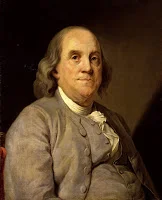
“The having made a young Girl miserable may give you frequent bitter Reflections, none of which can attend the making an old Woman happy.... [and Lastly] They are so grateful!!”
-- Benjamin Franklin in a letter toa friend in 1745
It probably is not true that older wives are by nature more grateful than, say, Melania Trump, soon to be the nation’s First Lady. But, true or not, Franklin’s whiplash wit helps one to understand why the American ambassador, who lived in France for nine years, was so joyously received in French salons.
The Republican Party in Connecticut has for a long while been the old wife whom voters do not wish to marry. Registered Democrats in the state still outnumber Republicans by a ratio of two to one, and Democrats are outnumbered by party averse Independents, who, hopping from bed to bed, apparently do not believe in political marriages. This may be changing. Republicans will be very grateful if it does.
The change, if any, will be brought about in part by the mistreatment suffered by voters at the hands of their contractual spouse, the Democratic Party. Gov. Dannel Malloy’s fling with Connecticut voters certainly changed radically after Mr. Malloy’s first honeymoon campaign was over. Economically, everyone in the state but for those receiving tax payouts is poorer following the largest and second largest tax increases in state history. But the radical changes among Connecticut’s cutting edge progressives may best be appreciated when viewing social rather than economic issues.
The operative economic principle of progressivism is that laisse faire government is inherently unjust for reasons stated by Woodrow Wilson, a president who is viewed as marking an historical line of division between progressive government and the generally accepted pre-Wilson ideal that government governs best which governs least, a sentiment credited variously to Thomas Jefferson, Tom Paine and Henry David Thoreau.
Wilson’s view on the prerogatives of the state was, well… different. Prior to the advent of the Wilson presidency, said Wilson, “the ideal of government was for every man to be left alone and not interfered with, except when he interfered with somebody else; and that the best government was the government that did as little governing as possible.” However, this arrangement, Wilson felt, leaves defenseless citizens at the mercy of predatory corporations. Limits on government should be expanded, Wilson thought, so that the “sphere of the state may reach as far as the nature and needs of man and of men reach, including intellectual and aesthetic wants of the individual, and the religious and moral nature of its citizens."
Government overreach under both outgoing President Obama and Governor Malloy is proof, if any were needed, that a government without limits that does everything will do everything poorly.
Is there any area of life into which the state may not intrude in order to redress perceived injustices? Apparently not, according to the modern progressive. Mr. Wilson, who had been a Princeton professor and the university’s president before becoming New Jersey governor and then president, had an aversion to Big Business; but the modern progressive has an aversion to anyone seeking to escape molestation by an omnipresent and omniscient state.
No red line may be drawn between a citizen and his solicitous state, which is why we are now debating whether it is proper for the state to order predatory businesses to allow men who want to be women to use women’s bathrooms. Progressives in Connecticut have protectively leapt aboard this new bandwagon, arguing that forbidding a transgender man-to-woman, or a man who fancies dressing up in women’s clothing, from bursting in upon women in public powder rooms is on a par with forbidding African Americans from being seated in public lunch counters and busses along with white folk. One can only wonder what the Rev. Martin Luther King Jr. might have made of that proposition.
Connecticut has been for the past few years a vanguard progressive state. It provides sanctuary to illegal aliens, college educations to some of its convicted criminals, and its governor has proudly marched with union strikers, some craven few would say, to garner union votes during elections. Such was the case before Governor Malloy very recently detected retrograde conservative tendencies in his approach to governance. “Who is the most conservative governor that any of you have worked with in the last whatever period of time you’ve been here?” Mr. Malloy recently asked Connecticut’s media. The media, dumbfounded, could make no answer.
Mr. Malloy’s messaging is purposely confusing. Is his government fish or fowl, progressive or conservative? It cannot be both.
Mr. Malloy is quoted most recently in Politico to this effect in defense of sanctuary cities: “I am not a shy individual; I have opinions, and as long as people ask my opinion I will lend it.” No kidding.
And he continues, “There are these states that are progressive that have benefited from that progressiveness, that are going to be examples of restraint and voices of responsibility. I would urge right-thinking individuals who’ve benefited from the advances our society has made to not be quiet. We’re going to continue to do the things we can do, and the things we can afford to do. We’re certainly not going to backtrack on refugees. We’re certainly not going to backtrack on gay, lesbian, transgender rights. We’re certainly not going to give up on making sure our citizens have healthcare."
Sure, sure. Progressivism is the opposite of a doctrine of governmental restraint, and progressives in Mr. Malloy’s administration have been boisterously progressive, in word and deed. Connecticut is suffering from progressive overreach, the corrective for which is a large dose of conservatism or, as President Calvin Coolidge might have insisted, a return to economic and social traditional and normality. That is the message that was delivered by voters during the late lamented national elections. This unsatisfied longing for normalcy very well may deliver the political heights in Connecticut to Republicans in the near future. To be sure, Donald Trump, infested with some dangerous conservative tendencies, is no “silent Cal,” but neither is Mr. Malloy.
Don Pesci is a Vernon, Conn.-based political writer.
The soul of Maine
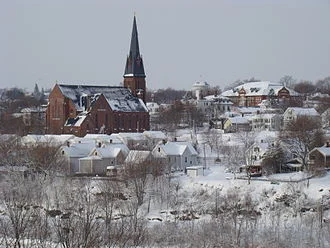
Bangor, Maine.
Maine is a joy in the summer. But the soul of Maine is more apparent in the winter.
--- Paul Theroux
Jim Hightower: Would Trump put a big tariff on his daughter's company?
Via OtherWords.org
Bring those jobs back home, Donald Trump bellowed to those greedy corporate executives who’ve shipped middle-class jobs out of country, or I’ll slap you with a big tariff when you try to sell your foreign-made products here.
Great stuff, Donnie — and to prove you mean business, I know just the CEO you should target first: Her name is Ivanka. Your daughter.
Her multimillion-dollar line of clothing and accessories, sold through major national retailers ranging from Macy’s to Amazon, is pitched to America’s working women. Yet practically all of her products are made on the cheap in low-wage factories in China, Indonesia and Vietnam — anywhere except America.
Imagine the message it would send to runaway corporations — and the integrity it would establish for Trump — if he slapped his first tariffs on Ivanka’s goods.
But neither Daddy Trump nor the daughter want to discuss the embarrassing conflict between his political bluster and her ethic of runaway capitalism. Instead, she’s tried to dodge the issue by saying it doesn’t matter, since she’ll “separate” herself from the business if she becomes a White House adviser.
Nice try, Ivanka, but the stench of hypocrisy will only grow nastier if you’re at your father’s side while he pretends to castigate other corporations that abscond from America.
The only way to salvage even an iota of moral virtue is to repatriate the manufacturing of your brand-name apparel. Bringing those middle-class jobs home to the Good Ol’ US of A would also make a powerful political statement.
Yet because money trumps both political savvy and the morality of simply doing what’s right, Ivanka says her corporate brand will stay offshore. As a spokeswoman put it: “We want to make responsible business decisions.”
Really? How does that “Make America Great Again”?
Jim Hightower is a radio commentator, writer, public speaker and editor of the newsletter, The Hightower Lowdown.

But now slush-soaked

"Windswept'' (pastel), by Ann Coleman, at Ann Coleman Gallery, Wilmington, Vt.
New England's beloved January thaw is a bit early this year.
Frank Carini: Brockton's water use threatening region's environment
By FRANK CARINI
In late October of last year, the water level of Silver Lake, in the Brockton, Mass., area, was down 72 inches, or 6 feet. Three weeks later, in mid-November, the level had dropped another 8 inches. Large portions of Massachusetts remain under drought conditions, but Alex Mansfield and Pine duBois of the Jones River Watershed Association claim the lake’s demise is a preventable manmade crisis.
They and others blame the problem on decades of overuse and misuse of local and regional waters. The city of Brockton, for instance, takes about 10 million gallons daily out of Silver Lake and pumps it 20 miles through two pipes, one of which is more than 100 years old.
The water level of 640-acre Silver Lake, which touches three Massachusetts communities, Pembroke, Kingston and Plympton, is at a 30-year low, according to Mansfield. He said this fact shouldn’t surprise anyone. In fact, both he and duBois say it’s long been known that Silver Lake can’t sustain that amount of daily withdrawal. It can’t even sustain half the current daily allotment, according to duBois.
Mansfield said the city of Brockton tracks the lake’s water level and water quality daily. ecoRI News spoke with Mansfield and duBois on the evening of Jan. 4. They said Silver Lake’s water level was down another foot and a half from mid-November.
“This issue doesn’t have anything to do with drought,” Mansfield said. “It’s about the city taking too much water. And the thing is we haven’t seen anything close to the worst of it. We’re starting 2017 at a 30-year low, and it’s so low that the lake isn’t going to rebound by April. That’s a bad starting point.”
Silver Lake, which lies within the Jones River watershed, is the 12th-largest natural lake in Massachusetts. When substantially drained, many additional feet of lakebed are exposed, and slow-moving animals, most notably freshwater mussels that clean the lake water of nutrients, can’t keep up with the receding shore and die.
Mansfield said the current crisis has killed fish, turtles and “tens of thousands” mussels. He also noted that people are riding their ATVs around the dry lakebed.
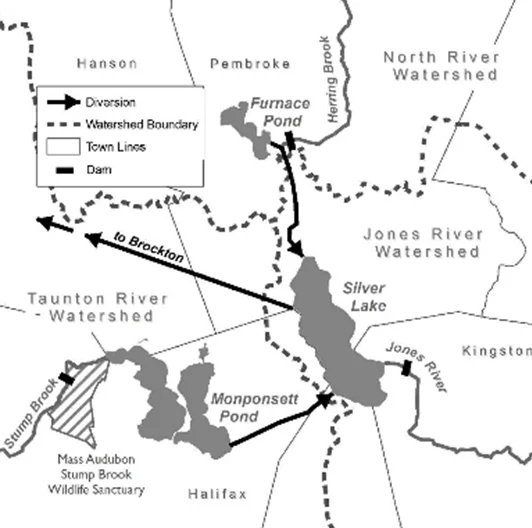
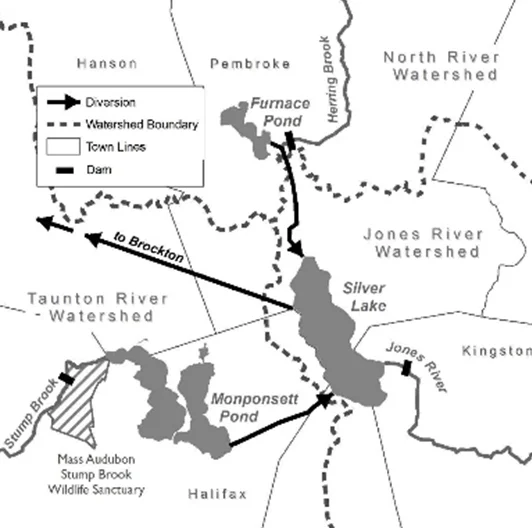
The city of Brockton gets its water from Silver Lake and several ponds in the surrounding area. (Mass Audubon)
The pumping of Silver Lake and other area waterbodies to meet Brockton’s water needs is impacting water quality and wildlife habitat from Halifax to Cape Cod, according to the Jones River Watershed Association (JRWA). Both Tubbs Meadow Brook, Silver Lake’s largest inflow, and Mirage Brook, a sub-watershed that makes up 25 percent of Silver Lake’s watershed, are stressed, according to the Kingston-based organization.
“The city of Brockton couldn’t care less,” said Mansfield, noting that the city is still negotiating a consent order with the Massachusetts Department of Environmental Protection (DEP). “They continue to say there’s no problem.”
In a Jan. 5 e-mail to ecoRI News, Larry Rowley, Brockton’s Department of Public Works commissioner, wrote that the city is “still in negotiations with DEP on this issue so no one should be discussing anything about this. When we have a final agreement we would be happy to talk to you.”
The city of Brockton began pumping water from Silver Lake in 1904. Several times during the next five decades the city was encouraged to find additional sources, or likely face water shortages. The advice was ignored.
In 1964, Brockton and the lake’s surrounding communities got a first-hand look at the predicted impact, when Silver Lake was drawn down by more than 8 feet, like it is now. The city had to stop drawing water from the lake for several months. The crisis prompted the creation of a special commission to find Brockton more water.
The commission’s report found that Silver Lake couldn’t supply more than 4.5 million gallons daily. Despite local opposition, however, the report eventually lead to an emergency legislative action that allowed Brockton to divert water from Monponsett Ponds in Halifax and Furnace Pond in Pembroke into Silver Lake, to expand the city’s water supply.
The decision to increase Brockton’s regional water withdrawals — the JRWA says 11 million gallons a day from all sources is the recommended limit — has had an adverse impact on the environment, according to Mass Audubon.
Among those impacts, according to the organization, are: lack of flow to Jones River, from Silver Lake, Stump Brook, from Monponsett Ponds, and Herring Brook, from Furnace Pond, during significant periods of the year; severe drawdown of Silver Lake for months at a time every year; habitat for fish and other aquatic life in local waterways is severely degraded, and in some cases eliminated for months at a time; and both Monponsett Ponds and Furnace Pond both have excessive-nutrient problems.
The special commission also suggested that connecting Brockton to the Metropolitan District Commission — now the Massachusetts Water Resources Authority (MWRA) — water supply would be the better solution, But it was decided that such an effort would take too long to address the existing emergency.
A decade later, in 1974, a consulting firm was hired to examine the city’s existing water supplies and needs. It determined that Brockton still didn’t have enough water to survive a drought. Nothing was done. In both 1982 and ’86, Massachusetts had to enact water-supply emergencies because Brockton had drawn Silver Lake down by as much as 20 feet.
A search began for more water. Connecting to the MWRA water supply was again recommended. The idea was again ignored. Instead, a desalination plant was built on the western banks of the Taunton River in Dighton. The facility takes water from the lower part of the Taunton River and purifies it to drinking-water standards.
Since the Aquaria Desalination Plant went on-line in 2008 it has supplied Brockton with about 3 percent of its annual water needs. Last year, the plant supplied less than 7 percent of the city’s water.
Mansfield said Brockton has never made the switch to MWRA water because of cost. “It’s more expensive than taking water out of the lake,” he said. “The desalination plant is barley used because the city doesn’t want to get locked into using it.”
The MWRA was established by an act of the Legislature in 1984 to provide wholesale water and sewer services. Today, the agency serves some 2.5 million people and more than 5,500 large industrial users in 61 cities and towns.
The 1964 Legislative act didn’t include any protections for Silver Lake, but it did include protections for Monponsett and Furnace ponds. The act set limits on when water can be diverted: no diversions in the summer when there are recreational uses; no diversions when the ponds are low; and no diversions when water quality presents a public-health risk, for example.
These important protections mean these additional water supplies aren't always available. Monponsett Ponds have been suffering from poor water quality for more than year. Excessive nutrient loading, lack of flushing and other problems have led to blooms of potentially toxic cyanobacteria. In fact, cyanobacteria cell counts have been measured in the millions per milliliter, far exceeding the public-health standards for swimming, according to the DEP.
The DEP has found that the nutrient levels of Monponsett Ponds, most notably West Monponsett Pond, are more than 300 times what they should be, which is fueling the cyanobacteria blooms.
Silver Lake also has spent time on the Massachusetts impaired waters list, for “fish, other aquatic life and wildlife,” according to DEP. The Jones River, which flows out of Silver Lake, is impaired in terms of “aesthetics, fish and wildlife, and recreational contact.” The river’s specific impairments include low dissolved oxygen and excess algae growth. DEP cites “flow alterations from water diversions” as the reason for these impairments.
“The quality of the ponds that go into Silver Lake have been degraded,” Mansfield said. “Bacteria blooms, swimming bans, no pets in the water. The entire arrangement has caused water-quality problems.”


David Warsh: Of Russian hacking and 'minimal democracy'

CHICAGO
I pored over the program of the Allied Social Science Associations, looking for a panel devoted to Russia, the topic uppermost on my mind. (I’m interested in the thinking behind the Russian intervention in the U.S. election.)
The closest I came was a session on the persistent effects of culture and institutions. It had been organized by James Robinson, director of the Pearson Institute for the Study and Resolution of Global Conflicts at the Harris School of Public Policy of the University of Chicago (not dean of the school, as asserted earlier) and author, with Daron Acemoglu, of the Massachusetts Institute of Technology, of Why Nations Fail: The Origins of Power, Prosperity, and Poverty (Crown, 2012).
That produced an especially interesting paper, A Theory of Minimal Democracy, by Francesco Trebbi, of the University of British Columbia, Chris Bidner, of Simon Fraser University, and Patrick Francois, also of UBC. Trebbi distinguished between relatively robust democracies, extending all or most of the familiar complement of rights to non-elites — to vote; to form and join associations; to be protected by the rule of law, and by a free press — and those states long known as minimalist democracies These hold regular elections, which may be hotly contested, but otherwise offer ordinary citizens relatively little else. They are widely distributed around the world but little understood: competitive autocracies, non-redistributive democractizations, captives of the resource curse.
Clearly Russia is one. The Dominican Republic, Ecuador, El Salvador, Haiti, Honduras, Nicaragua, Panama, Indonesia, Nepal, Moldova, and Mongolia are others.
A major question is how they change. Does deep culture dominate? Or might institutions — elections, for example — become self-enforcing? Questions like this one are at the heart of the contretemps with Russia: Vladimir Putin apparently believes that Hillary Clinton, as Secretary of State, sought to foment dissent in Russia in 2011, when he ran for a third term as president. Maybe she did.
A new sub-discipline of political economy, revivified by Acemoglu and Robinson, Torsten Persson and Guido Tabellini, and many others, has much to say about the issue, but has only just begun to train a new generation of area experts.
The territory of economics has exploded in the last 55 years, the American Economic Review, which once decorously appeared but five times a year, now arrives with a pound or two of new material every month. The Journal of Economic Literature, established to keep non-specialists abreast of the steadily broadening stream of publications, is approaching fifty; the Journal of Economic Perspectives, designed to communicate developments to an interested lay audience, is celebrating thirty years; four new field journals publish new work in microeconomics, macroeconomics, applied economics, and economic policy. And those are just the organs of the American Economic Association. Universities publish distinguished journals, too, as do other associations, societies, and commercial publishers.
A new entrant, The Annual Review of Economics, has begun to impinge on this established universe slightly since it first appeared, eight years ago. The first Annual Review — of Biochemistry — appeared in 1932. The enterprise proved so successful that the independent publishers who started it prepare today 41 collections of critical surveys of tightly focussed disciplines — including the Annual Review of Financial Economics and the Annual Review of Resource Economics. Established by Kenneth Arrow and Timothy Bresnahan, both of Stanford University, editing of ARE this year passed to Philippe Aghion, of the College de France, and Helene Rey, of London Business School..
By providing more and somewhat higher-level surveys of new important findings and new tools, the ARE has forced, or freed, JEL editor Steven Durlauf, of the University of Wisconsin, to cast his net more widely. The JPE, where Enrico Moretti, of the University of California at Berkeley, has replaced David Autor, of Massachusetts Institute of Technology, now seems more newsy than ever. As for the AER, I zero-in to see what’s new when the mammoth Papers and Proceedings record of the annual meeting arrives in May. Because it offers rapid publication of lightly-vetted articles deemed important, it regularly contains the first reports of inquiries that lead in due course to fault lines and fractures in received wisdom — hence to further spreading of the disciplinary tent.
The meetings themselves still fufill the basic functions. The incoming president and his program committee organize the sessions that are to be published in the Proceedings; he or she invites the Ely lecturer, too. President this year was Nobel laureate Alvin Roth, of Stanford University, an exponent of market design; he chose Esther Duflo, of MIT, who spoke about “The Economist as Plumber: Large-Scale Experiment to Inform the Details of Policy-Making.” Next year Olivier Blanchard will preside, having stepped down from eight years as chief economist of the International Monetary Fund.
A luncheon honored Nobel laureate Angus Deaton, of Princeton University. The John Bates Clark Medal was presented, to Yuliy Sannikov, of Stanford University. Four Distinguished Fellows of the Association were recognized: Richard Freeman, of Harvard University; Glenn Loury, of Brown University; Julio Rotemberg, of Harvard Business School; and Isabel Sawtell, of the Brookings Institution. The exhibit hall bustled a little less than usual, perhaps at the news that Peter Dougherty, a famous economics editor, would soon retire as director of the Princeton University Press.
Robert Shiller, of Yale University, gave the presidential lecture, “Narrative Economics.” He told the audience, “Narratives matter for human thinking, and they ought to matter for economics.” I think so too. There are too few of them. But there’s no time for narrative at the ASSA.
David Warsh, a longtime financial journalist and economic historian, is proprietor of economicprincipals.com.

An exciting tour of Trump's deep ties with Putin's mobster empire

"Avarice,'' by Jesus Solana.
For a fascinating if alarming look at Donald Trump's connections to murderous Russian dictator Vladimir Putin and the ruthless fellow kleptocrats around him, read this investigative piece in the magazine The American Interest by hitting this link. The text below is from journalist David Cay Johnson's introduction:
Throughout Donald Trump’s presidential campaign he expressed glowing admiration for Russian leader Vladimir Putin. Many of Trump’s adoring comments were utterly gratuitous. After his Electoral College victory, Trump continued praising the former head of the KGB while dismissing the findings of all 17 American national security agencies that Putin directed Russian government interference to help Trump in the 2016 American presidential election.
As veteran investigative economist and journalist Jim Henry shows below, a robust public record helps explain the fealty of Trump and his family to this murderous autocrat and the network of Russian oligarchs. Putin and his billionaire friends have plundered the wealth of their own people. They have also run numerous schemes to defraud governments and investors in the United States and Europe. From public records, using his renowned analytical skills, Henry shows what the mainstream news media in the United States have failed to report in any meaningful way: For three decades Donald Trump has profited from his connections to the Russian oligarchs, whose own fortunes depend on their continued fealty to Putin.
We don’t know the full relationship between Donald Trump, the Trump family and their enterprises with the network of world-class criminals known as the Russian oligarchs. Henry acknowledges that his article poses more questions than answers, establishes more connections than full explanations. But what Henry does show should prompt every American to rise up in defense of their country to demand a thorough, out-in-the-open congressional investigation with no holds barred. The national security of the United States of America and of peace around the world, especially in Europe, may well depend on how thoroughly we understand the rich network of relationships between the 45th President and the Russian oligarchy....

Wintry-looking scribbles

One of Sol Lewitt's "Scribble Wall Drawings''.
Eric Litke, an assistant to Mr. Lewitt in 2001-2006, will present an overview of the artist's ''wall drawing'' murals, which used a graphite-scribbling technique. Meanwhile, there's a current exhibition of Mr. Lewitt's graphite wall drawings at Barbara Krakow Gallery, Boston.
Mr. Litke's lecture will be at Concord Art, 37 Lexington Rd., Concord, Mass., on Jan. 19, starting at 6:30 p.m.
.
Endure this evil month
"January, month of empty pockets! … let us endure this evil month, anxious as a theatrical producer's forehead."
-- Colette

Snow's 'pure' beauty

"To be part of summer one must feel a part of life, but to be part of winter one must feel a part of something older than life itself....A snowscape is white of course, and of course white is the universal symbol of "purity''. But its beauty is also a matter of "pure'' form, without color and without accent. Most important of all, perhaps, it is "pure'' after a fashion peculiar to that which is not alive, since all life is "impure'' both in the sense of being mixed and in the sense of being warm in various ways, including the sexual.''
-- Joseph Wood Krutch

Tim Faulkner: Mass., R.I. seek to patch natural-gas leaks from mains and service lines

Via ecoRI.News (ecori.org)
Beneath our streets and front yards lie miles of leak-prone natural-gas pipes. Most are decades-old cast-iron and steel pipes. How much gas is escaping into the atmosphere and contributing to climate change is hard to calculate.
A 2015 Harvard University-led study estimated that nearly 3 percent of natural gas is lost as it moves through gas mains and service lines that connect to homes and businesses across southern New England. It may not sound like much, but depending on the season, the leaking gas accounts for between 60 percent and 100 percent of methane emissions in the region. Natural gas, of course, is about 90 percent methane, one of the most potent greenhouse gases.
Massachusetts and Rhode Island are looking to patch these errant emissions to meet their long-term emission-reduction goals to address climate change.
Fortunately, these old and leaking pipes are getting replaced, albeit slowly. Rhode Island is currently on pace to replace 1,237 miles of leak-prone pipes — about 39 percent of all gas pipes in the state — by 2035. Massachusetts has an estimated 20,000 gas leaks, but only those that pose an immediate health hazard are being fixed.
To speed up and expand the process, Massachusetts passed a law in 2016 to repair leaks that pose a low threat for explosion but still cause a significant environmental impact. As a result of the law, the state Department of Public Utilities (DPU) is exploring ways for utilities to quickly and affordably spot and fix the leaks, known as fugitive emissions.
As part of its efforts to curb climate emissions, the DPU released new rules in December that set emission caps for gas-distribution companies such as National Grid and Eversource Energy based on the miles of pipeline they own. The caps are expected to cut emissions by 10 percent by 2020.
Natural gas, of course, isn't a liquid but an invisible and mostly odorless gas. Leaks therefore seep undetected into the ground and percolate up into the atmosphere. In addition to causing explosions, leaky gas pipes increase ground-level ozone and reduce oxygen. They also kill vegetation, such as trees. In Massachusetts, Brookline, Hingham, Milton and Saugus have filed lawsuits against National Grid for not fixing leaky pipes that killed trees in their communities.
National Grid, the largest distributor of natural gas in the Northeast, is gradually replacing these gas lines. In 2015, they replaced 75.3 miles of gas lines in Rhode Island. In 2016, 64.6 miles were replaced. They plan to replace another 65 miles this year.
The improvements are part of a $445 million upgrade to pipes and natural-gas infrastructure in the state. Ratepayers pay those costs. Environmental advocates claim repairing leaks and replacing old pipelines reduces the need for new, interstate gas pipelines and other fossil-fuel infrastructure, such as power plants.
The Conservation Law Foundation estimates that gas customers in Massachusetts pay $38.8 million annually for gas that is lost from leaks.
“It's consumers that pay the price for a perpetually leaking gas system. The end consumer pays for all of the gas that local distribution companies purchase from producers, regardless of how much of that gas is lost to leaks (or other causes) on the way to consumers’ homes and businesses,” CLF said in a report it did on gas leaks.
Distribution pipelines are the “mains” that run under the street and can be 2 inches to 2 feet in diameter. Service pipelines are the gas pipes that connect from the main to homes and businesses. They are about 2 inches in diameter.
Transmission lines are the large pipelines that carry natural gas from the well, such as a fracking field, to a regional distribution center.
Prior to the 1950s, many of the mains and service pipes were made of cast iron. In the 1950s, the pipes switched to steel. Since the 1980s, plastic composite tubes have become the primary material for pipelines and now account for more than half of distribution and service pipes.
National Grid says that the age of a service line or a gas main doesn’t necessarily mean that it leaks. According to the company, third-party incursions caused by construction close to the lines by contractors or homeowners causes most leaks.
The new plastic pipelines are flexible and lighter than the cast-iron and steel mains, some of which date back to the late 1800s. Cast-iron and steel sections were mostly welded together. The plastic sections are fused to one another with a heat-producing device. This eliminates the joints between sections, which are the source of many leaks.
Wood pipes were first used when gas pipelines began in the mid-1800s. They were eventually abandoned for cast iron and steel. Some wood pipes remain in the ground but are unused.
The advocacy group HEET Home Energy Efficiency Team of Cambridge, Mass., says the public can help patch leaky pipes by supporting state bills and municipal endorsements of efforts to speed up repairs.
The public can also help by reporting suspected leaks to their utility. Patches of dead vegetation are a sign of leaks. A sulfur-like smell is another. A substance called mercaptan is added to natural gas, which is odorless, to give it its distinctive rotten-egg smell.
Tim Faulkner writes for ecoRI News.