
Vox clamantis in deserto
Not the Trump inaugural

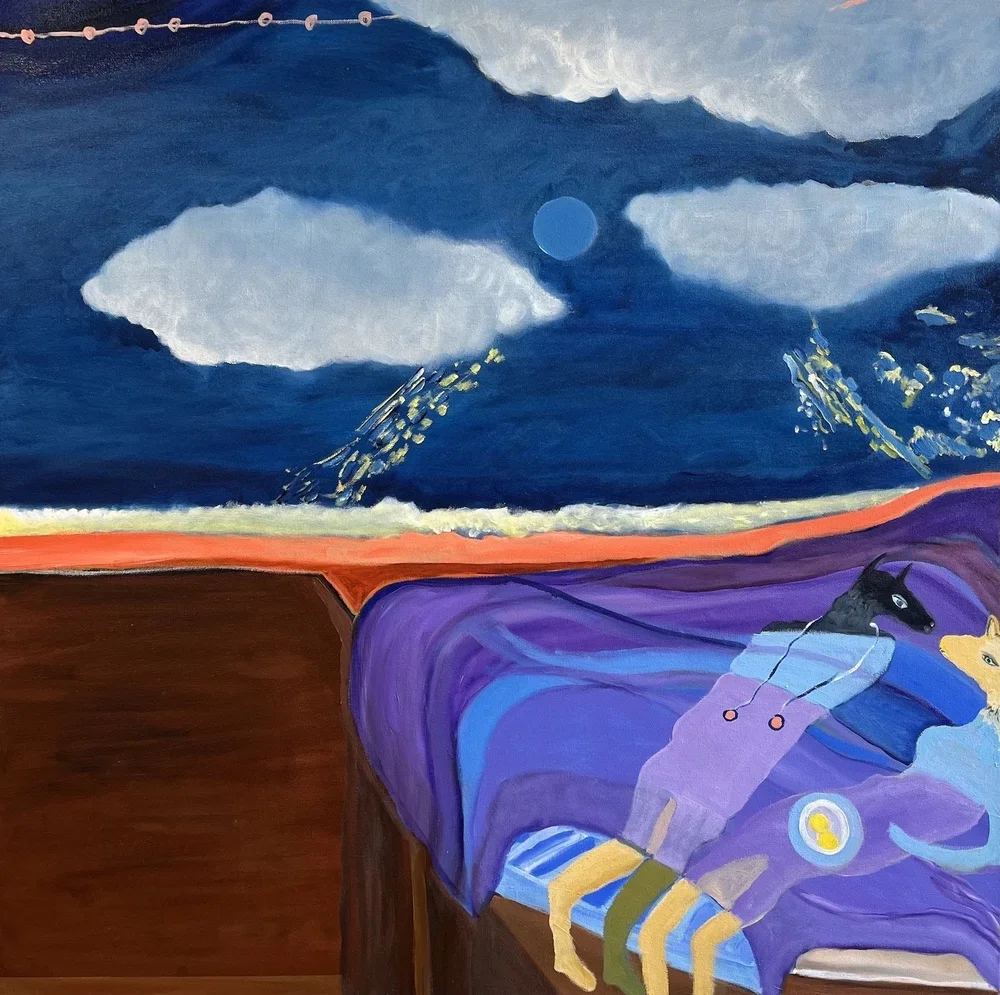
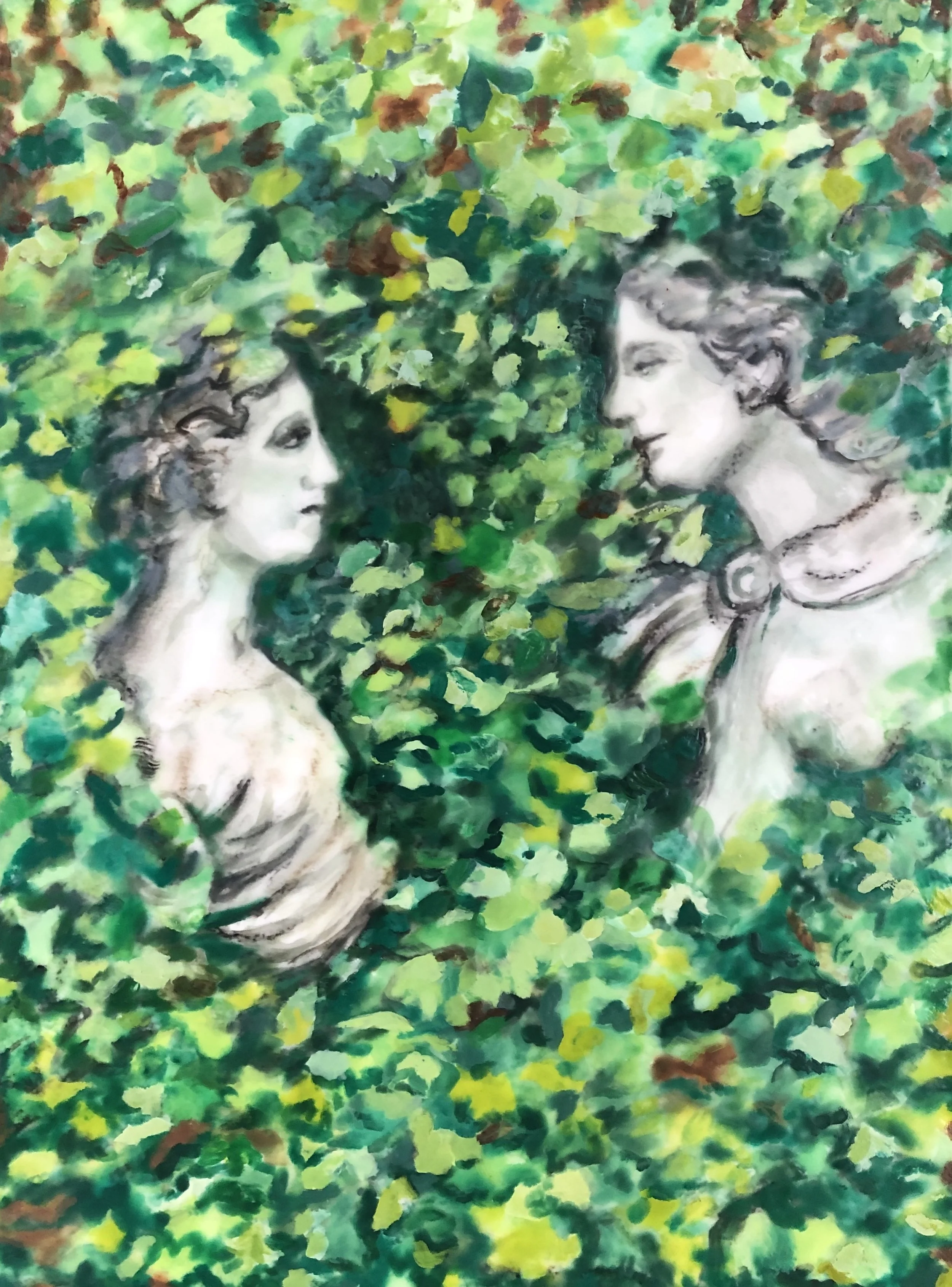
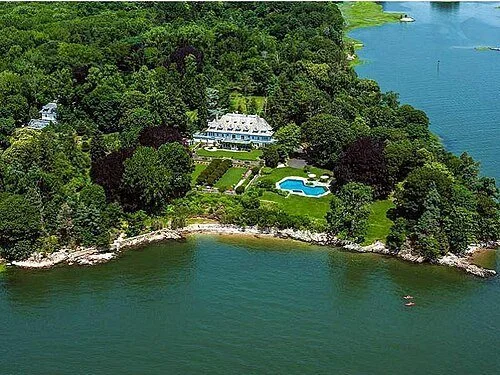
"Party Lines'' (oil on canvas), by Robert Freeman, in the show "Robert Freeman: New Works,'' at Adelson Galleries, Boston, through Dec. 18.
The gallery says he's "revisiting themes of race and culture in ... eight oil paintings of African Americans at formal social events, including two large triptychs. While his exhibition statement notes that much has changed over the past half-century — including the election of the nation’s first African American president — questions of identity and inclusion remain.” One thinks of the black upper middle class that made Oak Bluffs, on Martha's Vineyard, an early resort for African Americans.
Llewellyn King: The flood of fake news on the Web gives hate a powerful delivery system
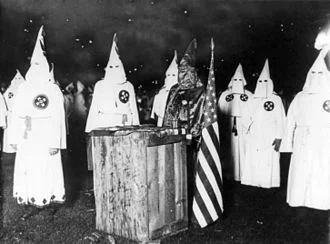
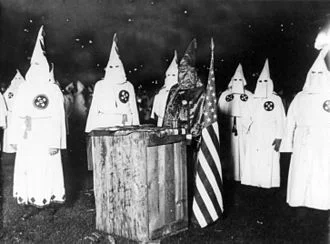
There is an ill wind blowing across America. Sometimes it is a foul gale, other times just a smelly zephyr. But it is as evil as it is nauseating, as noisome as it is cruel. It blights good fellowship, throttles reasonable discourse, and brings threatening clouds for the future.
Lies, insinuations, fabrications and distortions are not new to politics, but now they have an awesome delivery system: fake news on the World Wide Web..
Fake news likely inspired a man to storm into the public library in Barrington, R.I., on Nov. 10, and verbally attack a young patron. Wearing a Trump hat and T-shirt emblazoned with “Racist Cracker 88,” he approached her, chanting, “Obama is out! We control this place now!” The librarians called the police, and the man was escorted out.” To this buffoon, literacy was akin to elitism, liberalism and moral decay.
A fringe of the already fringy alt-right believes that the election victory of Donald Trump established a new order of self-righteous bigotry, as though decency has been repealed, kindness put on hold and common sense sent to the jailhouse.
A quiet block of small businesses on Connecticut Avenue in the Chevy Chase section of Washington, D.C. has become a focal point for the venomous malice of fake news on the Internet.
On one side of the road is a Washington institution: the book store Politics & Prose, a favorite place for authors to talk about their books on C-SPAN. Across the street are two neighborhood restaurants: a large family pizza place, Comet Ping Pong, and a small French bistro and craft shop, Terasol.
All three establishments have been the victims of fake news, which alleges that they are dealing in pedophilia, asserting that Hillary Clinton, her presidential- campaign manager, John Podesta, and former Secretary of State Madeleine Albright, who have been customers, are kidnapping children and holding them in tunnels under the pizza place.
Sabrina Ousmal, who with her husband Alan Moin, own Terasol, has also been under attack. Here, I feel a personal involvement. Ousmal worked for me for more than a decade, and she and Alan are personal friends of me and my wife, Linda Gasparello.
Alan works full-time at Terasol, while Sabrina is the assistant publisher of The Energy Daily, which I founded in 1973 and sold in 2006.
She has been besieged with hundreds of e-mails, spreading a vile story of child molestation and kidnapping and even suggesting that The Energy Daily is an alternative energy publication. Not true. It covers the electric utility industry and the government nuclear complex with dogged determination.
Politics & Prose is under attack, presumably, because the owners, Bradley Graham and Lissa Muscatine, had worked as Washington Post reporters, and Muscatine was a speechwriter for First Lady Hillary Clinton.
The police and the FBI are on the case. But this is a new perversion of truth and the perpetrators enjoy the courage that comes from anonymity: the courage of the ultimate bully.
The implications here go far beyond one block of small businesses in Washington.
The problem as I see it is that people love to hate and once that infection has taken hold, it is resistant to cure. I have seen people warming themselves at the fires of hate around the globe; in South Africa, where the Afrikaners and the English traded in hate, as did the Xhosa and the Zulu; in Zimbabwe, where the hate was stirred by its evil president, Robert Mugabe, between his Shona people and the Ndebele.
It has been stirred up, largely by a section of the press in Britain toward the continent, particularly the French. This, in the name of sovereignty, has led to the slow, almost ritual economic suicide now playing out in London.
Hate is at work daily in the Middle East, where it is the one thing people cling to: the paradoxical love of hating. Now there is a hate front here.
Llewellyn King (llewellynking1), a veteran publisher, columnist and international business consultant, is executive producer and host of White House Chronicle, on PBS, and a longtime friend of New England Diary. This first ran in Inside Sources.
Don Pesci: Of 'sanctuary cities' and the Fugitive Slave Act
Sanctuary, when practiced by governors rather than churches, is nullification, a common practice infamously deployed by the Southern states during and after the Civil War.
Henry David Thoreau, author of “Slavery in Massachusetts,’’ was what might be called a-party-of-one nullifier. Thoreau famously refused to pay a tax that might have been traced, even indirectly, to the purchase of a bullet used by slave owners to recover the “property” they had lost after the infamous Fugitive Slave Act had been passed. That law lit the bonfire of resistance among abolitionists in Massachusetts. Thoreau no doubt would have encouraged those in his audience who heard his address – for reasons unknown, seldom circulated in schools – to do the same, but the monk of Walden Pond knew the limits of audacity. Refusing to pay a tax, he went to jail himself, as ever a party of one.
The Fugitive Slave Act was for Thoreau an offense to the moral sense, and he was particularly incensed with the churchmen and journalists of his day who did not condemn a law that forced honest citizens to return self-liberated slaves to their owners. His fiery comments on the media of his day were far more severe than those of a petulant Donald Trump.
The reader is invited to speak the words aloud as they were delivered; he will then hear the notes Christian morality adds to defiance:
“Your tax is commonly one cent daily, and it costs nothing for pew hire. But how many of these preachers preach the truth? I repeat the testimony of many an intelligent foreigner, as well as my own convictions, when I say, that probably no country was ever ruled by so mean a class of tyrants as, with a few noble exceptions, are the editors of the periodical press in this country. And as they live and rule only by their servility, and appealing to the worse, and not the better, nature of man, the people who read them are in the condition of the dog that returns to his vomit.
“The Liberator and the Commonwealth were the only papers in Boston, as far as I know, which made themselves heard in condemnation of the cowardice and meanness of the authorities of that city, as exhibited in '51. The other journals, almost without exception, by their manner of referring to and speaking of the Fugitive Slave Law, and the carrying back of the slave Sims, insulted the common sense of the country, at least.”
What should we do when we meet a law so morally offensive it begs to be defied? The brief answer is -- disobey the law and go to jail.
However, once defiance of the law is taken up by governors, the moral calculus on sanctuary cities changes. One cannot listen long to Governors Mario Cuomo (of New York) and Dannel Malloy (of Connecticut) without realizing that – possibly for political reasons – they seem incapable of making work-a-day distinctions between legal and illegal immigration. Mr. Cuomo speaks as if Jean Jacques – an illegal alien sentenced to 17 years in a Connecticut prison for attempted murder -- were his grandfather, an Italian immigrant who likely was legally processed at Ellis Island in New York.
On release from prison, Mr. Jacques, a convicted criminal illegal alien, was supposed to have been deported to Haiti by The U.S. Immigration And Customs Enforcement Agency (ICE). That never happened. Released from prison, Mr. Jacques murdered Casey Chadwick in Norwich, Conn., stabbing her 17 times and disposing of her brutalized body in a closet. Mr. Jacques was an illegal alien and a criminal, and he had precisely nothing in common with Mr. Cuomo’s grandfather, a legally processed immigrant.
ICE is authorized to enforce immigration law – but not in Connecticut’s sanctuary cities, whose chief executive officers defy federal law and ICE’s Congress approved mandate. When this defiance of law is sanctioned by governors, the umbrella of sanctuary is raised over the whole state. Would Mr. Malloy, a supporter of sanctuary cities in his state, cooperate aggressively with a federal action to prosecute mayors in his state who defy federal law?
Legal immigrants are not illegal immigrants, and illegal immigrants who have additionally committed illegal acts while in the United States illegally fall into a separate category that should not be welcomed in sanctuary states like Connecticut. These distinctions should not be lost on mayors and governors who have determined – for political rather than moral reasons – to engage in precisely the kind of nullification practiced by Jim Crow Democrats in the post-Civil War South for political rather than moral reasons. There is no direct moral umbilical cord connecting ICE’s failure to deport Mr. Jacques and Mr. Cuomo’s grandfather or Mr. Malloy’s defense of governmental sanctuary for illegal-alien criminals.
Don Pesci (donpesci@att.net) is an essayist, mostly on political and cultural matters, who lives in Vernon, Conn.
Todd McLeish: Feral cats are ravaging the wildlife around us
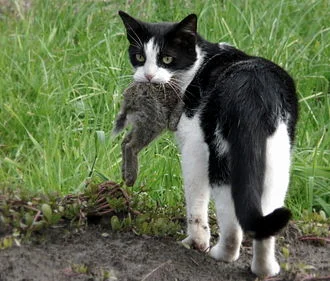
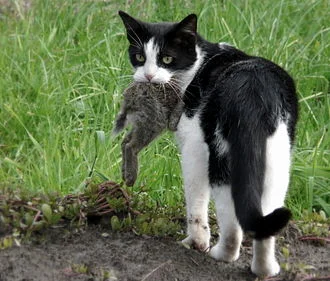
A feral cat with prey.
A new book examining the complicated issue of cats and wildlife has re-opened a difficult discussion that has long pitted animal welfare organizations against biologists, birdwatchers and the environmental community. And the position taken by authors Peter Marra and Chris Santella is doing little to make that discussion any easier.
You can tell by its title, Cat Wars: The Devastating Consequences of a Cuddly Killer, that the authors don’t pull any punches. Marra, who directs the Smithsonian Migratory Bird Center, and Santella, a journalist, argue that drastic action is necessary to curb the massacre of birds and small mammals caused by feral cats and house cats that are allowed to go outside.
After reviewing thousands of reports, pet-owner surveys, cat regurgitation studies, academic research and other data, they calculated what they say is a conservative estimate: Cats kill up to 22 billion small mammals, 4 billion birds, 822 million reptiles and 299 million amphibians in the United States annually.
“More birds and mammals die at the mouths of cats than from wind turbines, automobile strikes, pesticides and poisons, collisions with skyscrapers and windows, and other so-called direct anthropogenic causes combined,” they write.
What’s more, the authors say that feral cats are also a hazard to human health. Feral cat colonies where humans provide food to the felines attract raccoons, skunks, foxes and coyotes, easing the spread of rabies. Cats also carry a variety of diseases that can be transmitted to humans, from a bacterium that causes a life-threatening infection in cat scratches and bites to a parasite that can cause birth defects when pregnant women are exposed to cat feces.
The authors call feral cats an invasive species and say the only answer to solving the problem is what is euphemistically called “trap and remove,” which means capturing the animals and euthanizing them.
“No one likes the idea of killing cats,” they write. “But sometimes, it is necessary.”
It’s unclear how many feral cats live in little Rhode Island, but all the interested parties agree it’s too many. Estimates range as high as 250,000, though state veterinarian Scott Marshall said it’s probably closer to “tens of thousands.”
He established a Feral Cat Working Group in 2010 after receiving innumerable complaints about the animals. The group, which includes members from animal welfare groups, academia, environmental organizations and public-health agencies, hired a student from the Tufts University School of Veterinary Medicine to census known feral cat colonies in the state. She found 302 colonies, mostly in urban areas, with a total of about 4,000 cats.
It’s believed there are many more colonies than those she surveyed, plus thousands of uncounted cats that aren’t part of established colonies and an estimated 60,000 house cats whose owners let them go outside.
“Cats are a serious problem for wildlife,” Marshall said. “Their hunting instinct isn’t diminished by feeding them. A pet cat that is fed at home still brings birds and rodents home. We can’t deny that they’re having an impact on wild birds, rodents and to a lesser extent reptiles. They kill whatever they can get.”
According to Marshall, feral cats live very short lives. Their life expectancy is less than two years. Half don’t make it out of kittenhood; 75 percent don’t survive one year, and 85 percent die before their second birthday.
“People don’t realize that when animals are dying young in large numbers, they have a miserable life and a miserable death,” he said. “They’re struck by cars, exposed to parasitism, die of exposure, get ripped to shreds by predators. They don’t live good lives.”
He agrees with the authors of Cat Wars that, unfortunately, the best solution is euthanasia.
“Given the tools we have, that’s the only way to solve it,” Marshall said. “If a male contraceptive were available, that could be effective, but right now nothing else works.”
Most of the animal-welfare groups in Rhode Island disagree. Vehemently. They argue instead for a method called “trap, neuter and return,” or TNR, in which feral cats are captured at colonies, brought to clinics to be spayed or neutered, and returned to their colony. Advocates say it’s the most humane alternative to euthanizing the animals, and because the cats can no longer reproduce, the colonies will eventually disappear.
Gil Fletcher, a member of the Feral Cat Working Group who runs a cat-rescue organization called PawsWatch, acknowledges that not all of the animal-welfare groups agree with the “return” component of TNR, and because there are numerous small grassroots groups advocating for feral cats, there is considerable tension among them. But, he wrote in a recent e-mail, “it goes without saying that any form of large-scale lethal approach to reducing the free-roaming cat population (trap and euthanize, hunting, targeted poisoning, etc.) is an anathema to this group.”
Fletcher is pushing for municipal governments to adopt the TNR approach, because the feral-cat problem is one he equates with other community concerns addressed with taxpayer funds, like anti-littering campaigns and roadside beautification efforts.
While he barely mentions the impact of cats on wildlife — other than to disagree with the cat predation numbers Marra and Santella claim — he said “the cat people” and “the wildlife people,” as he calls them, all seek to remove free-roaming cats from the outdoor environment. Their “interest, motivation and their presently favored means are poles apart, but the end goal is the same,” he said. “By all logic, they should be natural allies.”
Part of the reason they aren’t, according to Marshall and the scientific community, is that there is no evidence that TNR works. In practice, feral cat colonies managed with TNR don’t get smaller and disappear. Instead, the populations remain mostly the same and the animals continue to kill wildlife. To be successful, at least 80 percent of the cats in a colony must be spayed or neutered, and the colonies must be constantly monitored as new animals arrive.
“TNR seems to be the panacea that animal-welfare groups endorse, but there’s virtually no evidence that it’s effective,” Marshall said. “Everybody wants it to be effective, but it’s very labor intensive, expensive, and ultimately it’s ineffective. Unless people can shut down new inputs into the colonies, it’s doomed to fail.”
The one thing that Marshall and Fletcher agree on is that it will be nearly impossible to address the issue of feral cats in Rhode Island without public support for whatever strategy is chosen. And they both say the public won’t support a widespread euthanasia effort.
“The science would say that cats should be removed from the environment, but emotions run very high and there is no public support for removal,” Marshall said. “I personally don’t like the idea of tolerating their existence, because in my opinion the lives and deaths they experience are far less humane than trapping and removing them.”
The authors of Cat Wars, however, are less concerned with the sad lives of feral cats and more concerned for the welfare of wildlife and the environment. They say that of all the threats to birds that are directly or indirectly caused by humans, cats are the easiest problem to fix, especially when compared to complex issues such as climate change.
“To me, this should be the low-hanging fruit,” Marra is quoted in Smithsonian Magazine. “But as it turns out, it might be easier stopping climate change than stopping cats.”
Rhode Island resident and author Todd McLeish runs a wildlife blog.
Looks like the quintessence of late November

"Morning Fog, Land's End'' (on the coast of Hingham, Mass.) by Russell duPont. Copyright Russ duPont Photographs.
I have long felt that Russell duPont is one of the greatest photographers in the history of New England -- Robert Whitcomb

James T. Brett: Holistic approach needed to address New England's growing energy crisis

At a recent energy forum hosted by The New England Council, Gordon van Welie, CEO of ISO New England — our region’s power grid operator — described New England’s electric reliability this coming winter as “precarious.”
And, van Welie warned, with more power plants closing down and the strain on available natural gas supplies for heating and electric generation unrelenting, by 2019 keeping the lights on in extreme cold weather threatens to become “unsustainable.”
The situation is all the more challenging when you consider that our region has no native sources of gas, oil, or coal, and little opportunity for adding large-scale local hydroelectric power. New England pays markedly more for energy relative to the rest of the country because we are “at the end of the pipeline” for energy supply. This affects the region’s economic competitiveness both for businesses choosing to locate or expand here and for their employees and the energy bills they pay. For many businesses, high energy costs are the number-one challenge to succeeding, growing, and adding jobs in New England.
In the coming months and years, policymakers face challenging, interrelated, and far-reaching decisions about how the region meets its future power needs and environmental policy mandates, from what energy sources, and at what cost for businesses and consumers across the region.
The New England Council recently published a report, “The New England Energy Landscape: History, Challenges, and Outlook,” that aims to offer an impartial, unbiased explanation of the fundamental issues facing policymakers in the New England energy debate.
On questions about natural gas supplies, imported hydro, renewables, nuclear power, and more, the council doesn’t take sides. But we want to stress three key points from the report to policymakers:
All these energy decisions are tightly interrelated, far more so than many may realize. Promoting more energy from one source for cost or environmental reasons will affect the economics and viability of every other kind of energy. That in turn will affect how we meet 2020 and 2050 emissions mandates — and at what cost.
Given that our six states share a single power grid, policy goals in any one New England state will undoubtedly affect its neighbors. Massachusetts’s and Rhode Island’s desire for more wind energy may require new transmission lines in Vermont and Maine; Maine’s and New Hampshire’s desire for greater gas supplies may require expanded gas pipelines in Connecticut and Massachusetts.
Rather than approaching questions about renewables, gas, nuclear or imported hydro as one-off choices that end at state borders, we encourage our region’s leaders and energy stakeholders to take a more comprehensive, holistic approach to tackling our energy challenges.
The New England Council looks forward to continuing to be an advocate for reliable, affordable, and environmentally sound energy for our region, and serving as a leader, convener, and supporter of regional discussions and negotiations — and national legislation and policies — that will bring about the best energy future possible for all New Englanders.
James T. Brett is the president and CEO of The New England Council, a nonpartisan alliance of businesses, academic and health institutions, and public and private organizations throughout New England formed to promote economic growth.
Charles Pinning: Recalling my disastrous Thanksgiving trip to lovely Little Compton

Friends (Quaker) Meeting House in Little Compton.
Speeding by the pastures and farms that lead out to Sakonnet Point and the ocean there was, for me, no prettier drive anywhere than through Little Compton, R.I.
I’d left Baltimore early in the morning in my old Jaguar sedan, which was performing admirably (knock on the walnut dash), and now under a darkening royal blue sky I no longer chewed upon the guilt of not spending Thanksgiving with my family back in Virginia, but pressed on with a mindless glee toward the expansive compound of my girlfriend’s family.
There was Bonnie, willowy in her bell bottoms and there was her scrawny sister, Suki, and her preppy brother, Rex, and their handsome mother and father
I put the special chipotle cranberry sauce I’d made before leaving Baltimore into the fridge and Bonnie and I took a walk to the beach with her sister.
Leaving the house, her brother said, “What kind of car is that anyway?
“It’s a Jaguar,” I said. “Mark Nine.” I’d bought it used for $600 when I was in high school, but there was no need to divulge that.
I’d brought a borrowed Canon camera and asked Suki to take few pictures of Bonnie and me.
“This is a pretty fancy camera,” commented Suki.
Her parents seemed to have forgotten that although I attended college at Johns Hopkins University, in Baltimore, I was not studying to be a doctor despite the international fame of Hopkins’s medical school. Rather, my interests were writing and acting. I reminded them I’d spent the summer doing summer stock just down the road at the Carriage House Theatre.
“Right-o” said Mr. Fort.
I’d met Bonnie in June at Wilbur’s General Store. She was buying chicken salad.
“Is it good?” I asked her.
“It’s the best,” she said.
Then I saw her at the beach. Heart Attack!
Bonnie went to Brown University, in Providence, and we bounced back and forth a few times after school started.
I spoke of George McGovern, whom I’d just voted for in my first eligibility, against Nixon, and how the Vietnam War had to end. “So much stupid, needless death!”
After dinner, I read a little story I’d written about meeting Bonnie at Wilbur’s then at the beach. Mrs. Fort complained about the annoying sticky door at the foot of the backstairs leading up to the bedrooms and the popping sound that it made.
First thing in the morning, I grabbed a tube of Door-Ease out of my toolbox and took care of the sticky door and its popping sound.
At lunch I passed around my cranberry sauce. Suki said, “What’s this?”
“Cranberry sauce,” I said. “It has a little kick. You’ll like it.”
The family talked about their upcoming Christmas trip to Bermuda.
I excused myself and went up the backstairs to my room to get a ceramic bulldog I wanted to give to her mother and father. The family had strong Yale ties and the university’s mascot is a bulldog. When I came back down through the door that no longer made a popping sound Mrs. Fort was talking.
“I just don’t like him, Bonnie. That car he drives is so ostentatious and—”
“Making us listen to that story,” said Suki.
“He always needs to be the center of attention,” said Rex.
“He’s arrogant,” said Mrs. Fort. “He thinks he’s smarter than everyone else. And why isn’t he having Thanksgiving with his own family? Doesn’t he have a family? Who are they, anyway?”
I waited for Bonnie to say something in my defense. Nothing came. I drew a deep breath and walked into the dining room.
“I’m going to be leaving now,” I said, and I handed the little bulldog to Mr. Fort. “This is for you. Thank you for not speaking ill of me.”
He looked down at the table, nodding his head. He died on Christmas in the next year. Mrs. Fort lived on another 30 years. Rex fatally contacted a tree skiing at Gstaad, and Suki married a wealthy Mexican avocado grower.
Bonnie….Bonnie and I still enjoy swimming in Little Compton whenever possible. It’s taken us awhile to understand each other, but we’ve persisted and have largely found it a worthy effort. Regular pilgrims we are, I suppose.
Charles Pinning is a Providence-based novelist and essayist.
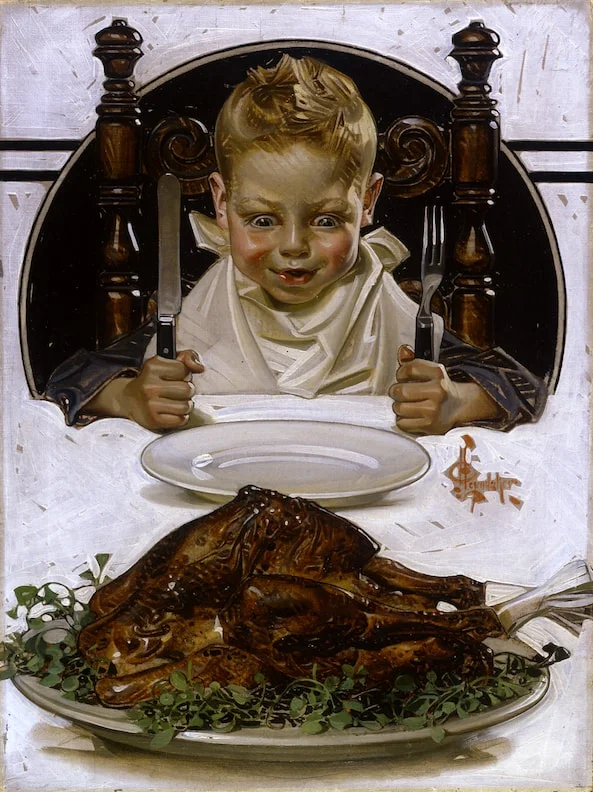
Fierce joy at the feast
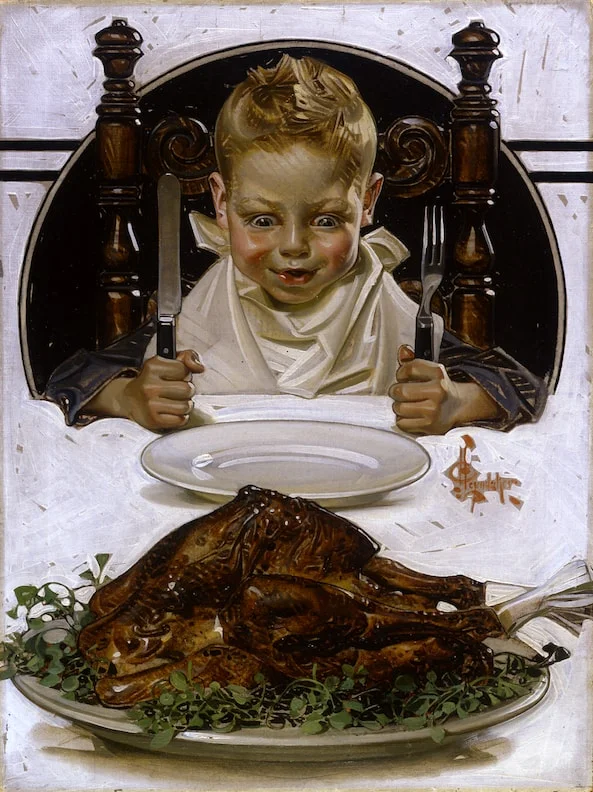
"Ready for Thanksgiving Feast'' (oil on canvas), by J.C. Leyendecker (1874–1951), at the National Museum of American Illustration, Newport, R.I. This kid's family was presumably very happy that World War I had ended on Nov. 11, 1918. But in part because of ill-considered, revenge-seeking peace treaties signed in 1919, there would be another, even worse, world war in 20 years. Perhaps the boy who was the model for the one here would fight in it. Perhaps he'd look back longingly at the family feasts of his childhood as he ate his Army K-rations.
This turkey, raised before big-time agribusiness, would never pass muster now -- too skinny, not enough steroids and antibiotics.
Image courtesy of, and copyrighted by, American Illustrators Gallery, New York, N.Y., 2016.
,
Chris Powell: Conn. governor should feel free to be hated
Much of Connecticut state government's budget problem, Gov. Dan Malloy noted last week,,
arises from the failure of previous governors and legislatures to appropriate
adequately for the state employee and teacher pension funds.
That'swhy state government and municipal governments should be prohibited from
offering defined-benefit pensions to their employees. Elected officials always
divert pension deposits to ordinary current spending so they can look like
political heroes in the present, knowing that the pension bills will come due
only when they are long out of office and enjoying their own state pensions down
South.
While Malloy is trying to improve pension funding, he has done little to restore
state government's general solvency. His two massive tax increases only fed the
government's usual pursuits. Nearly every week he triumphantly announces new
spending that would be inessential in good times and now, in bad times, is
delusional.
Last week, for example, the governor announced nearly $5 million in state grants
to 17 towns for purchase of open space, even as most of those towns are rural
and will remain mainly open space for a long time as the state's economic
decline continues.
Asked about the grants, a spokesman for the governor said the money came from a
fund dedicated to such purposes, drawn from the tax on real estate transactions.
But amid the budget shortfalls, the Malloy administration often has diverted
money from dedicated funds and has imposed "rescissions" on many appropriations.
The open space money also could be diverted to more compelling needs.
Indeed, with a shortfall of more than a billion dollars predicted for the next
state budget, the governor should declare an emergency and challenge the many
mistaken policy premises that have laid Connecticut low.
Last week the governor lamented a report that within two years "fixed costs" --
costs locked in by law or contract, mainly pension and debt payments -- will
consume more than half the state budget. Yet his administration continues to add
to the debt and has not even endorsed Republican proposals to eliminate
defined-benefit pensions for new state employees. Anyone lamenting "fixed costs"
should realize that the first step in saving Connecticut is [ITALICS] unfixing
[END ITALICS] them, since those costs were fixed not by God but by man.
But then Connecticut will not even be trying to save itself financially while it
maintains collective bargaining for government employee unions and binding
arbitration for their contracts, forfeiting democratic control over huge
government expense; while it subsidizes childbearing outside marriage instead of
defining it as catastrophically expensive child abuse; while its primary
education system operates as social promotion and its higher education system is
largely remedial; while it spends hundreds of millions every year pretending to
outlaw popular drugs, not realizing that society has only as much crime as it
legislates; and while it fails to imprison incorrigibles for life after three
felonies instead of waiting for 23.
Of course there is little political support for saving the state. Everyone on
the payroll will risk riding the ship to the bottom rather than sacrifice
anything to keep it afloat.
Last week the Connecticut Conference of Municipalities, whose acronym, CCM, is
often construed as "Caucus of Crying Mayors," objected to a new law that gently
limits the growth of municipal spending. The mayors don't want to have to
challenge their municipal employee unions; they want the state to keep
reimbursing the wage gains of municipal employees through increased financial
aid.
No, saving the state will require a political leader who is ready to be hated.
Since the polls say he already is, and since the presidential election has
foreclosed any escape for him through a federal appointment, Malloy might as
well try.
Chris Powell is managing editor of the Journal Inquirer, in Manchester,
Conn.
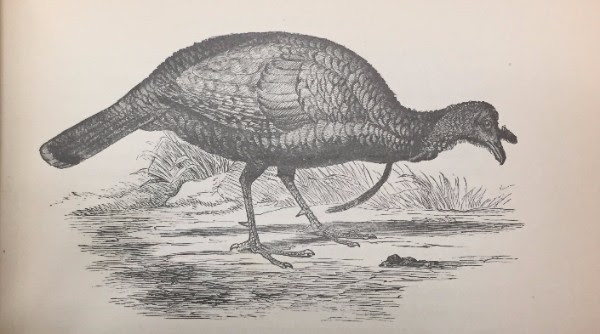
Back in force
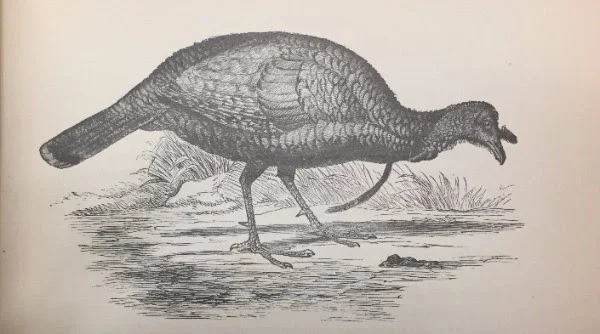
From the collection of the Providence Athenaeum: a wild turkey from A Popular Handbook of the Ornithology of the United States and Canada, by Montague Chamberlain, 1891. After many years of over-hunting, wild turkeys almost disappeared from southern New England but conservation efforts in the past few decades have brought them back big time.
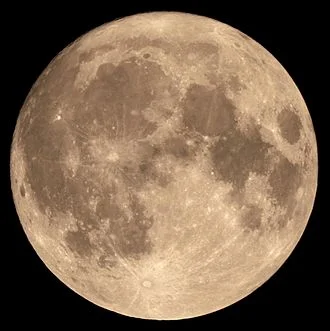
More things in heaven and earth than in all your politics*
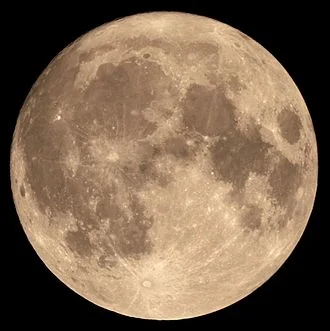
The "Super Moon'' on Nov. 14.
Adapted from Robert Whitcomb's Nov. 18 "Digital Diary'' in GoLocal 24.
Not everything in life is politics, thank God. Until the last few gray, windy and cold days, it's been golden here in southern New England, with the weather perfect for walking in burnished woods and looking across bays to the far shore. And the “Super Moon’’ was semi-spectacular early last week, reminding us of our insignificance, although that big fat satellite wasn’t quite as “super’’ as promised. At least we can still see the moon in cities, unlike many of the stars we used to see that are now obscured by manmade-light pollution.
Thereare some local signs of kindness amidst the current rancor. Consider that Massachusetts voters by a wide margin backed a state ballot question that will set new rules on the size of the cages in which farmers can raise chickens, cows and pigs.
A new law will ban selling eggs in Massachusetts from hens raised in cages too small for them to spread their wings, meat from pigs kept in tight quarters—or pigs whose mothers were similarly confined during pregnancy—and veal from calves trapped in tiny crates before being slaughtered. The new law also bars Massachusetts farmers from using these torture chambers.
This will be a tough law to oversee.
Given the interstate nature of agriculture, it’s unclear howthis will work out for Bay State farmers, who have enjoyed a renaissance in recent years because of the spreadof local farmers’ markets and the “Locavore’’ movement. I hope that the idea spreads. More and more we learn that nonhuman animals are much smarter, and more intensely feeling, than we had thought. Even birds, let alone our fellow mammals. (Pigs are especially smart.)
But if only all “animal lovers’’ showed as much empathy for, say, the Syrians, many of them children, being killed every day by Assad, Putin and ISIS.
Increasingly the big changes in American life come from the coasts and then move inland, albeit slowly. This may be another example. Within 20 years, maybe even many Trump people will turn vegetarian as the research accumulates on how much we make other animals suffer.
* After the line in Hamlet:
"There are more things in heaven and earth, Horatio, Than are dreamt of in your philosophy.''
But wash first
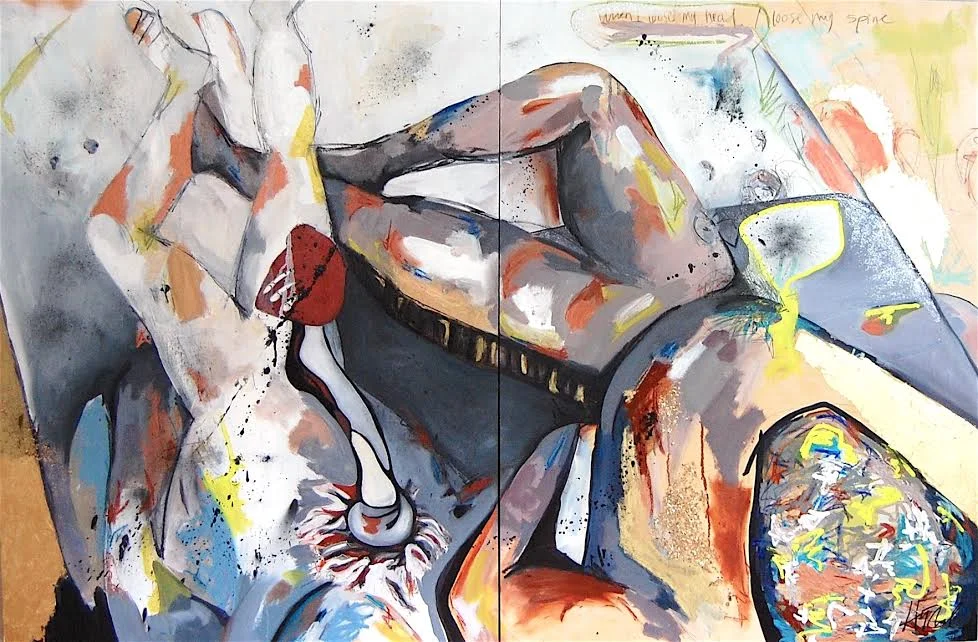
"Come and Rest Your Bones with Me'' (oil and mixed media), by Hilary Tait Norod, at Sotheby's Unlimited, Jamaica Plain (Boston), Mass.
Hilary Cosell: 'National Nervous Breakdown'***
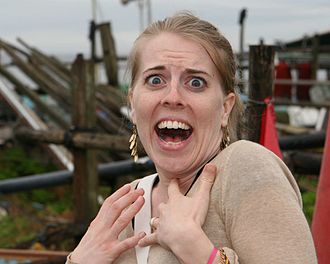
He’s a birther, bigot, bully, brat you can’t avoid to save your life.
Center of a crowd, talking hate so loud, sowing violence and such strife.
It seems to us he’s been a psychopath and predator all his years
And he never tries to stop his lies or trading on our fears.
We better stop! and look around
Here it comes, here he comes, here it comes, here he comes
Here comes our national nervous breakdown.
When he was just a child he was filthy rich
But he was never, ever brought up right.
Wouldn’t rent a place to anyone whose skin wasn’t pure white.
His businesses went bankrupt but he still made a lot of dough
Paid no taxes, stiffed his workers, assaulted women down below.
We better stop! And look around
Here it comes, here he comes, here it comes, here he comes
Here comes our national nervous breakdown.
Oh, who’s to blame, that man’s just insane.
Nothing we try don’t ever work.
It just gets worse ‘cause he’s such a jerk oh, please.
His opponent’s a crook, the election’s rigged, the media treat him mean.
He ponders nukes and Putin’s looks and endlessly vents his spleen.
He’ll build a wall, deport them all and keep all Muslims out.
He’s out of his mind, now I’m out of mine, and we’re all drowning in doubt.
America, stop! And look around.
Here it comes, here he comes, here it comes, here he comes
Here comes our national nervous breakdown.
Oh, who’s to blame? The GOP’s insane.
Got Breitbart Bannon crawling in my brain
And racist Jeff Sessions causing me such pain
We better stop! And look around.
Here it comes, here he comes, here comes our national nervous breakdown.
Here comes our Trump-fed nervous breakdown.
***(Sung to the tune of “19th Nervous Breakdown,” by Jagger-Richards)
Llewellyn King: Why I am greatly grateful to little old Rhode Island
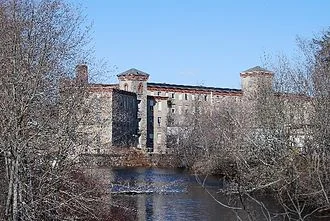
Centreville Mill, in West Warwick, R.I.
I have special reasons to be thankful this Thanksgiving. One is to be thankful to America for admitting me as an immigrant back in 1963. From what I can remember, I was welcomed as part of the then-huge British quota that applied to me, even though I was born in Southern Rhodesia (now Zimbabwe).
I am also very grateful to Rhode Island, where my wife, Linda Gasparello, and I have, by happy chance, made our home for more than four years.
People, you have a little treasure here; a bolthole for the world-weary, a welcoming and pleasant place with great restaurants, a wonderful selection of beaches, interesting countryside and the warmest people this side of I know not where -- and I have traveled to more than 100 countries and lived on three continents.
Take it from me, Rhode Island is a treasure. To me, it nestles between the arrogance of Massachusetts and the upward-tilted-nose superiority of Connecticut.
In London, they listen to how you speak: “Just listen to her speak, She's not our class, darling.” In New York, they speak about money: “I’m heavily invested in pharmaceuticals.” In Washington, they speak about power: “I’m well-connected at the White House.”
By comparison, Rhode Islanders speak about everyday things. But, oh, must you have such a bad self-image? Self-deprecation has its limits and, if I might be so bold, you have reached them. I sometimes want to take dear Little Rhody by its lapels and gently shake it, saying, “Don't you know you have it all here, give or take a larcenous politician?”
John of Gaunt described England in Shakespeare's Richard II as “this other Eden, demi-paradise.” Of course, he had not seen Rhode Island, the jewel in New England’s crown.
But Rhode Island, my adopted home, is more than being about eating and sunbathing. A special delight for us has been good, affordable theater. There is live theater everywhere, if you look. Sure you know about Trinity, the Gamm, 2nd Story and Ocean State. But did you know about the Arctic Playhouse, in West Warwick's impoverished Arctic village? Its productions are polished, and it is moving to new, swankier premises next year. Whereas the other theaters charge around $50 a ticket (which is a bargain), little Arctic only charges $10 for its own productions. That should be sent to the Guinness Book of World Records for theater ticket prices.
Newport has its place on the list of destination cities, but I would throw in Providence with its downtown masculine charm, and the best Italian food offerings in the nation. I speak as a man familiar with the likes of Little Italy in Baltimore and North Beach in San Francisco.
When I lived in London in the early 1960s, the thing that struck Americans was how polite the English were. Now London and New York are interchangeable, and Washington is well on the way to losing what is left of its manners.
I would offer up the whole state of Rhode Island for recognition as a place of lovely, cheering politeness that makes daily living a pleasure, and smooths a little grease on the rough edges of any day. People of all ages open doors, thank you profusely for even a small purchase, give way to traffic entering a highway and stop for pedestrians.
Also -- and as an old newspaperman, this is important to me -- Rhode Island has great pubs, as in public houses. A bar is where you go to drink, a pub is an extension of a living room: a place to hang out, meet friends, eat and, yes, imbibe if you wish. In Rhode Island, as in Britain, people tend to have a “local,” a regular haunt. I have two quite different locals that are quintessentially pubby: the Harris Grill, in Coventry, and the Square Peg, in Warren.
I give thanks to Rhode Island and you, the Rhode Islanders. You are a good lot.
Llewellyn King is executive editor and host of White House Chronicle, on PBS, and a veteran publisher, columnist and international business consultant. His e-mail is llewellynking1@gmail.com.

James P. Freeman: Post Trump victory, looking at ambiguities of 'the Catholic vote'
Much has been made over the failed prognostications by pundits and pollsters this past election at the presidential level. One particularly fascinating epic “miss” was predicting how the “Catholic Bloc” would vote. The results of the 2016 election reveal, if anything, how difficult it is to measure the depths of voter sentiment — especially religious fervor — in a complex, continental country of 320 million people.
On Aug. 30, a Washington Post story, “Donald Trump Has a Massive Catholic Problem,” showed that Democrat Hillary Clinton was leading among Catholic voters by a margin of 27 percentage points (61 percent to 34 percent) over Republican Trump.

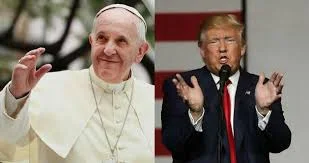
“Trump is basically adding 5 to 7 percentage points to Clinton’s overall margin,” wrote the Post. The paper cited Trump’s tussle with Pope Francis this past February over the border wall with Mexico as a possible reason (“A person who thinks only about building walls, wherever they may be, and not building bridges, is not Christian,” the pontiff said).
But two months later, in a vacillation as wide as St Peter’s Basilica, an IBD/TIPP poll had Trump ahead of Clinton among Catholics by 13 percentage points — 50 percent to 37 percent.

In his Oct. 5 letter to the Denver Catholic, The Most Rev. Samuel J. Aquila, Archbishop of Denver, raised a conundrum for Catholics: “I have voted in every presidential election since 1972 and I have never experienced an election like this year’s. So, what should Catholics do when we vote in November?”
Like many Americans (80 percent of likely voters nationwide were embarrassed by the presidential race, according to a Colby College-Boston Globe poll commissioned just prior to the election), Archbishop Aquila shared an “aversion for both candidates.” As might be expected, he believed that the faithful needed “to reflect on the platforms of both parties, with an emphasis on the human life issues.”
Purported Catholic support of Clinton and her stance on abortion (pro-choice) seemed to defy Archbishop Aquila’s call for Catholics to focus on “human life issues.” Further still, with agonizing irony, Clinton (as discovered in the WikiLeaks email hacks) appeared to be mocking Catholics during the campaign — what the Washington Times just last month called an “assault on Catholics.” Notably, Trump throughout the campaign professed his pro-life stance.
But according to The New York Times’s review of exit polling, Trump actually won the Catholic Vote by 7 percentage points (52 percent to 45 percent). This led cruxnow.com a day after the election to conclude, “rumors of the demise of religion as a voting issue have been greatly exaggerated.” But this conclusion may be overly simplistic even as Catholics represent 20 percent of the electorate.
Catholics have played a pivotal role in voting and affecting outcomes since the earliest days of the republic. In its captivating “History of the Catholic Vote,” Our Sunday Visitor traces the roots of its political leverage from Catholic Federalists in the 1700s to the John F. Kennedy’s narrow election victory over Richard Nixon in 1960 (“the time had come when ‘a man can say his beads in the White House’”) through the modern era.
Today, national media still cite the influence of the so-called “swing vote” of the Catholic Bloc” which was thought to vote as a monolithic group. However, the reality now is that, as a demographic group, it is more disparate and no longer reliably a single-issue bloc of voters. Commentator E.J. Dionne, who is Catholic, has steadfastly said: “there is no Catholic vote and it is important.” As National Catholic Reporter sees it, “they are important because they have voted for the winner of the popular vote in almost every presidential election since Roosevelt.”
Since 1960 — when Kennedy won 78 percent of the Catholic vote — Catholics have voted for the presidential winner in every election except in 1976 (Carter-Ford), 1988 (Dukakis-Bush), 2000 (Gore-Bush) and 2004 (Kerry-Bush). In 2012, Mitt Romney lost the Catholic vote by two percentage points (50 percent to 48 percent).
Nevertheless, Catholics look at the complexities of modern day politics as it interweaves the complexities of their spiritual and religious lives as factors in their voting decisions. Their voting patterns, which were once well defined and clear, are murkier, marked, at times, by confused convictions. Hence Dionne’s assertion that there is no “Catholic vote.” This helps explain why they twice did not vote for pro-life George W. Bush.
Translating “human life issues” into the simple act of casting a vote for one candidate, while adhering to Catholic doctrine, all in the name of compassion, is an enormously difficult exercise. Euthanasia, LGBT rights, and immigration along with abortion and contraceptives, are, after all, a complicated bundle of human life issues.
Archbishop Aquila also warned that “Our society suffers and has suffered for quite some time because too few people live an integrated life — one that does not divide ‘the personal’ from ‘the public.’” He must have been addressing those Catholic politicians whose private views differ from their public positions —such as Tim Kaine.
Should Clinton have won, Kaine would have become only the second Catholic to be vice president in our history (the first being Joe Biden). But Breitbart observed that Kaine’s “habit of showcasing his faith credentials is proving to be a two-edged sword, as more and more Catholics find his ambiguous relationship with Church teaching to be deeply problematic.” For Catholics, then, like many Americans, this election might have been more anti-Clinton/Kaine than pro-Trump.
James P. Freeman is a New England-based writer and a former Cape Cod Times columnist. He also works in the financial-services industry.This first ran in The New Boston Post.

The big picture

"Lisbon,'' by Gary Duehr, in the show "Inventing 3D Landscapes,'' at the Brickbottom Artists Association, Somerville, Mass., Dec. 1-Jan. 14. The group show focuses on new ways with which artists use dimensionality to explore landscapes -- whether, as the gallery notes say, "inspired by Google or ancient means of navigation.''

Philip K. Howard: Repairing Democracy in an age of distrust
Democracy can’t earn the allegiance of its citizens with centralized dictates. We need to have our say, and be free to do things in our own way. This crisis of democratic identity can’t be resolved merely with new policies at the top. Top-down government is itself the problem. Americans now have an historic opportunity to reimagine government. The key is to abandon the centralized operating philosophy which, in thousand-page rulebooks, purports to tell everybody how to do everything. Government must still protect against abuse—otherwise freedom will be destroyed by bad actors just as surely as it is by suffocating bureaucracy.
Americans now have an historic opportunity to reimagine government. The key is to abandon the centralized operating philosophy which, in thousand-page rulebooks, purports to tell everybody how to do everything. We need to re-empower human agency at all levels of society.
The Trump revolution was not a Republican revolution. It was a revolt against Washington. Voters wanted someone who would shake things up. The new President’s mandate is for change, but what kind of change? The campaign did not exactly illuminate a new vision for how to govern.
Since the election, Republican leaders have pulled off the shelf their standard agenda, including broad de-regulation. But I doubt if disaffected voters are dreaming about fixing Dodd-Frank or corporate taxes. Voters seemed to be lashing out in every direction. Many are upset at stagnant wages and a perception that jobs are disappearing.
But voters were angry at more than that. They seemed tired of being talked down to by political phonies and know-it-all bureaucrats. They were tired of political correctness and mindless bureaucracy in their schools, hospitals, and workplace. Anger comes from the gut, not the mind. No clear policy agenda emerged from the Trump campaign because the struggle was not about policy. It was about a sense of frustration, alienation, and powerlessness. There can be a kind of wisdom in crowds.
Democracy can’t earn the allegiance of its citizens with centralized dictates. We need to have our say, and be free to do things in our own way. This crisis of democratic identity can’t be resolved merely with new policies at the top. Top-down government is itself the problem. Americans now have an historic opportunity to reimagine government. The key is to abandon the centralized operating philosophy which, in thousand-page rulebooks, purports to tell everybody how to do everything. Government must still protect against abuse—otherwise freedom will be destroyed by bad actors just as surely as it is by suffocating bureaucracy.
But government can protect freedom by adopting an oversight role that guards against abuses rather than micromanaging daily choices. Communities ought to be able to run schools and provide services in their own way, within broad boundaries. Regulatory dross of all sorts—HIPAA privacy forms, and most warnings and disclaimers—should be revised or scrapped, because they insult our common sense and cumulatively interfere with our ability to focus on what’s important. There are some areas where centralized, detailed regulation is needed—say, pollution discharge limits. But in areas that hinge on human attitudes and competence—say, workplace safety or school discipline—too many rules and protocols are generally counterproductive. Far better for government to stand at a distance, making sure people don’t breach the boundaries of reasonableness.
Guarding outer boundaries is the traditional mechanism of law—acting as a kind of dike against misconduct. Law is vital to freedom because it affirmatively protects an open field of free interaction. Law sets “frontiers, not artificially drawn, within which men should be inviolable,” as Isaiah Berlin put it. Law today doesn’t protect an open field of freedom; it more often strangles daily choices with dictates that make no sense in the circumstances.
Scrapping the micro-regulation model is not a matter of degree—not merely cutting back on red tape. American government requires an historic shift of operating philosophy, one that puts humans back in the driver’s seat. Law must be the framework, but human responsibility must be the activating mechanism. The goal is to liberate people to try to do what’s right and sensible, accountable to those around them.
So far, so good. But there’s a bone here that will stick in throat of ideologues from both sides. Without a thick rulebook, the official must be free to use his or her best judgment. How else can he use common sense, when applying legal principles to the particular circumstances, to decide when conduct is unfair or unsafe? Oversight for results almost always requires human judgment. The paradox of freedom, forgotten in recent decades, is that empowering citizens requires empowering officials to fulfill their legal responsibilities.
This is not just the Hobbesian requirement of police protection. The interdependence of the modern world puts a huge burden on government oversight. People you don’t know are taking care of your loved ones in schools and nursing homes. How can you influence them if the official in charge is not empowered to act sensibly? The parents’ ideas don’t matter if the principal doesn’t have authority to act on them. The current void of human authority disempowers everyone. People don’t feel they, or anyone around them, can roll up their sleeves and fix things. The answer to every frustration is the same: “The rule made me do it.” (President Obama, explaining why the 2009 stimulus couldn’t be used to fix broken infrastructure: “There’s no such thing as shovel-ready projects.”)
The solution to powerlessness—the only solution—is to re-empower human agency at all levels of society. I’ll assert two first principles that hold the key to remaking a healthy democracy: Principle One: Human choice at implementation is required for accomplishment. Nothing good in the history of mankind was created except when a human, or group of humans, made it happen. Rules, and law in general, can prevent bad things from happening, and can establish protocols for joint action. But even those negative goals cannot be accomplished with a selfexecuting legal structure. Following rules mindlessly crowds out what Michael Polanyi called “tacit knowledge,” the vast store of instincts and know-how that resides in our subconscious.
Most people don’t know and cannot clearly articulate how they get things done. Trial and error—the opposite of compliance—is the secret sauce of progress. No endeavor can succeed, management expert Peter Drucker found, without “a principle of management that will give full scope to individual strength and responsibility.”
Principle Two: Personal ownership of choices is required for self-fulfillment. People want to make a difference. It gives us a sense of self-worth. Doing things in our own way requires freedom to adapt, adjust, and try new things. Being stymied by a rulebook, or trudging all day through compliance checklists, makes people miserable. Anomie, now hardened into anger, comes mainly from a feeling of personal unimportance. People with rote jobs have higher levels of stress and heart disease, while, paradoxically, people with more responsibility and personal risk feel less tension and are healthier.
Tocqueville here as in other areas put his finger on the misery of self-executing systems: “It is especially dangerous to enslave men in the minor details of life. For my own part, I should be inclined to think freedom less necessary in great things than in little ones” because, otherwise, “their spirit is gradually broken…” Humans need to be in charge. Only then can things get done sensibly. Only then does democratic accountability mean anything.
Today, the FAA certifies new aircraft as “airworthy” based on their expert judgment, not detailed specifications like how many rivets it has. This is not “de-regulation,” but an all too-rare liberation of American common sense inside government. When humans are allowed to take responsibility, law becomes far simpler and more effective. A few legal principles can replace a thousand rules if people are free to take responsibility for implementation. To regulate nursing homes, Australia replaced a thick rulebook with 31 results-oriented principles, such as to have a “home-like setting.” Within a short period nursing homes had improved markedly. Why? Professors John and Valerie Braithwaite found that all stakeholders—nurses, regulators, and families—now focused on making homes better instead of mindless compliance with a thousand input-oriented rules.
Letting humans focus on results would transform every area of public concern. For example, within a year we could get America rebuilding its decrepit infrastructure—just by giving an environmental official the job of deciding when there’s been sufficient environmental review. Today, multi-year environmental reviews obscure, not illuminate, vital issues, and often cause environmental harm by prolonging bottlenecks. Schools and government agencies would have a lot more zip if principals and managers could make basic personnel decisions without having to endure a years-long legal trials to prove that someone doesn’t do the job. Everybody knows who the bad teachers are; site-based oversight committees could guard against vindictive or unwise decisions. Recently Bill Bradley, Mitch Daniels, Tom Kean, and Al Simpson joined with the nonprofit Common Good, which I chair, to launch a campaign (“Who’s in Charge Around Here?”) advocating the radical simplification of government so that people can take charge again.
Human responsibility was, of course, the founding concept of our Republic: Elect and appoint people who have the job of using their best judgment for the common good. James Madison could hardly have been clearer: “It is one of the most prominent features of the Constitution, a principle that pervades the whole system, that there should be the highest possible degree of responsibility in all Executive officers thereof; anything, therefor, which tends to lessen this responsibility is contrary to its spirit and intention.”
Principles-based regulation would actually make law comprehensible to real people—a core tenet of the rule of law ignored by the mandarins in Washington. Again, Madison: “It will be of little avail to the people, that the laws are made by men of their own choice, if the laws be so voluminous that they cannot be read, or so incoherent that the cannot be understood.” Democracy will be revitalized when officials can take responsibility for results. Focusing regulation on goals will also allow people in different communities to do things in different ways. They can take ownership of their choices. As legal philosopher Jeremy Waldron has argued, a principles-based structure offers humans the dignity of being able to argue about right and wrong with a real decision-maker. People won’t feel so powerless any more.
The Wages of Distrust
Distrust is the mortar that keeps the current America governing philosophy firmly in place. Distrust of democracy went into high gear in the 1960s, when we woke up to abuses of racism, pollution, lies about Vietnam, neglect of the disabled, and more. Making law as detailed as possible was the solution chosen to balance against supposedly bad values. There would be no room for abuses of authority if official decisions were prescribed in thick rulebooks. Even some libertarians joined in. They believe in the power of human freedom, of course, but legal control of officials is how they strive to preserve freedom.
Nobel economist Friedrich Hayek, usually a font of wisdom, pronounced in early writings that “government in all its actions . . . [should be] bound by rules announced and fixed beforehand.” It is now received wisdom, among liberal professors as well as industry lobbyists, that laws and regulations should be as detailed as possible. The Volcker Rule is 950 pages of casuistry because lobbyists wrote it that way. Obsessive legal control is a formula not for better freedom, but for mutual powerlessness: The tighter the shackles on the regulator, the tighter the shackles on the regulated. If the nursing home inspector is shackled to a thousand detailed rules, so are the nurses in the nursing home —even if the rules do little or nothing for the quality of the home. Freedom turns out to be a concentric concept. If the traffic cops aren’t free to do their job, then pretty soon you’ll be stuck in gridlock. The citizen’s vote matters only when the President is free to make genuine choices.
John Locke, no fan of centralized authority, concluded that “many things…must necessarily be left to the discretion of him that has executive power in his hands.” The fear that keeps everyone quivering in the legal jungle is also based on a misconception: There’s no need to trust any particular flesh-and-blood official. What’s required is to trust the framework of our republic—to rely on human checks and balances, in which each official is surrounded by other officials who check his fidelity to legal principles.
An official or judge is not, as Justice Benjamin Cardozo put it, “a knight errant roaming at will.” Just as free citizens are not free to breach contracts or cheat others, officials are constrained by their legal mandate. As Ronald Dworkin has put it: “Discretion, like the hole in a doughnut, does not exist except as an area left open by a surrounding belt of restriction…. An official’s discretion means not that he is free to decide without recourse to standards of sense and fairness.”1 Havel viewed democratic authority as a temporary delegation that “is lost when a person betrays that responsibility.”
Our paranoia about official authority is ironic. The rule of law famously fosters trust because it gives people confidence that, say, contracts will be honored and abuse not tolerated. What we’ve forgotten is that law itself is tethered to norms of good faith and reasonableness, applied by judges and officials taking responsibility to do justice in the particular case. Hayek himself recanted his views on the “supposed greater certainty [when]…all rules of law have been laid down in written and codified form.”
Law can only support freedom when a judge or official applies it in a way most people consider reasonable. “Law floats in a sea of ethics,” as Chief Justice Earl Warren put it. Without giving it much thought, Americans generally trust the judges and others who enforce broad principles of civil and criminal law. Government, too, must be tethered to norms of reasonableness. Putting official authority into solitary confinement, hemmed in by impregnable and obsessively detailed law, was supposed to enhance our freedom.
Instead, we locked ourselves in as well. The “simultaneous recession of both freedom and authority in the modern world” is no accident, Hannah Arendt observed. Without a coherent theory of authority, we are “confronted anew…by the elementary problem of human living-together.”
Rebuilding Trust Through Responsible Choices
Here we are in 2016, with half the country in revolt, needing to find a way to live together. We shouldn’t worry too much about abandoning the de facto technocratic regulatory system as it has evolved. Our government “has outgrown the structure, the policies and the rules designed for it,” Peter Drucker observed, with the result that it is “bankrupt, morally as well as financially.” It was an heroic effort but, like central planning, it was doomed to fail because it was built on “the arrogant belief, “as Vaclav Havel put it, “that the world is merely a puzzle to be solved, … a body of information to be fed into a computer in the hope that sooner or later it will spit out a universal solution.”
America requires a new operating philosophy that embraces the unavoidable humanness of governing. Getting past the pervasive distrust is the challenge. Years of public failure and powerlessness feed the distrust. If there were any trusting souls left in America, the 2016 campaign showed that it’s “us versus them.”
The stakes are high. Trusting cultures tend to prosper, as Francis Fukuyama and others have demonstrated, because people can stride toward their goals without fear of ambush. Shared values of fair dealing and common purpose are reinforced by shared norms of reciprocity; you do your part, others will do theirs. People feel they own their own choices, and feel comfortable with trial and error. Success feeds on itself.
Distrust, by contrast, corrodes the foundations for success. Like acid, it weakens our willingness to move forward because we don’t trust other people to do their part. People become defensive, and tiptoe through the day. Transactions slow to a crawl, or don’t happen at all. In Edward Banfield’s study of a backward village in Italy, pervasive distrust removed the conditions for cooperation. Neighbors could not get together to fix roads and other common resources. The local Mayor refused outside subsidies because, he said, his constituents would assume he would pocket much of it.
For the past half century, America has looked to law not only to change values, a good thing, but also to dictate daily choices. Now Washington overflows with law, but it is also a cesspool of distrust. As in Banfield’s village, America’s leaders can’t get together to fix broken roads. People in Washington also huddle within defensive bubbles, treating outsiders as enemies. Political leaders from different parties no longer break bread, much less forge deals to move forward. The White House has walled itself off from the Executive Branch it supposedly runs.
Do Americans really differ on basic values of hard work and fair play? I don’t think so. I think government drove us apart, with the best of intentions, by clogging up society with a giant bureaucratic hairball and by removing our ability to try to work things out for ourselves. People don’t want to be trapped in red tape, and they’re obviously sick of political leaders who act like “puppets…in a giant rather inhuman theatre,” as Havel put it.
Rebuilding trust starts at the top: Leaders must make choices that are trustworthy. President Trump will not be reluctant to start making decisions. But his decisions must be viewed as fair and sensible, with due respect for differing interests. Trust is also a two-way street. If Trump empowers others to do things in their own way, they will be more likely to reciprocate. If his decisions are viewed as high-handed, however, we’ll soon fall back into the maw of too much law. This is an historic and perilous moment. Change is overdue. But it’s not the change advocated by either party. The change needed, to liberate American citizens and to fix American government, is to return to our founding philosophy: to honor humans by creating a framework that empowers them to take initiative, act on their beliefs, and make a difference.
Philip K. Howard is chair of Common Good, a nonprofit government- and legal-reform group, and author, most recently, ofThe Rule of Nobody (2014). This piece first ran in The American Interest.
In Mass., striving for 100 percent renewable energy
ecor.org
BOSTON
The nation can move quickly to generate 100 percent of its energy from renewable resources such as solar and wind, according to a panel of researchers and experts who spoke Nov. 14 at Old South Church to an audience of about 200 people.
“America needs to shift to 100 percent renewable energy to address our largest environmental challenges,” said Ben Hellerstein, state director for the Environment Massachusetts Research & Policy Center. “At a time of great uncertainty over our national climate and energy policy, it’s more important than ever before for Massachusetts to lead the way towards 100 percent renewable energy. Now is the time for bold action, not half steps.”
Experts in the fields of public health, urban sustainability, renewable-energy technology and the electric utility sector spoke at “The Road to 100 Percent: Opportunities and Challenges in the Transition to a Fully Renewable Energy Society” — a town hall event organized by the Environment Massachusetts and co-sponsored by several other environmental and health organizations.
The discussion is one of more than 50 events held across the country during the week of Nov. 14 for the “100% Committed, 100% Renewable Week of Action.” The week of action is sponsored by Environment America, the national partner of Environment Massachusetts.
“The road to 100 percent renewable is finally achievable because of a confluence of lower prices for solar and wind and increasingly greater access to all electric transportation,” said Sanjeev Mukerjee, Ph.D., professor of chemistry and chemical biology at Northeastern University and faculty director of the Northeastern University Center for Renewable Energy Technology. “Massachusetts has to make proper policy decisions which incentivize decentralized power, higher subsidies for hybrid and electric vehicles and higher spending on public transportation. In all of these, energy storage is the key. Massachusetts can set the national clean-energy agenda by providing the proper basis for success in this arena.”
Jonathan Buonocore, Ph.D., program lead for Climate, Energy and Health at Harvard’s T.H. Chan School of Public Health, said, “While we often think about averting climate change when we think about renewable energy, getting energy from fossil fuels has many other social costs. Air pollution from fossil-fueled electricity is responsible for around 21,000 deaths each year, and there are other impacts, including water pollution, land disruption, and accidents, to name a few.”
Earlier this year, Environment Massachusetts released We Have the Power, a report that reviewed seven studies from academics, government agencies and nonprofits showing that there are no insurmountable technological or economic barriers to achieving 100 percent renewable energy.
“We need to fuel the nation with renewable energy. The technology exists, and the benefits go far beyond just reducing carbon,” said Robert Dostis, vice president of Green Mountain Power. “Energy transformation is an economic driver, creating jobs and fueling a new green economy. Utilities are especially positioned to achieve an energy transformation that reduces costs and carbon while increasing reliability and resilience — a critical focus in light of a changing climate.”
Advocates argued that one of the ways Massachusetts can accelerate the transition to 100 percent renewable energy is by strengthening the Regional Greenhouse Gas Initiative, a program that limits carbon pollution from power plants in Massachusetts and eight other northeastern states, including Rhode Island. Environment Massachusetts is urging Gov. Charlie Baker to double the pace of renewable-energy progress under the regional initiative.
San Diego, Aspen, Colo., and Greensburg, Kan., are among the cities that have pledged to achieve 100 percent renewable energy. Hampshire College in Amherst will soon become the first residential college in the United States to obtain 100 percent of its electricity from on-campus solar installations.
This past summer Environment Massachusetts profiled 17 cities and towns in Massachusetts, including New Bedford and Worcester, that are leading the way toward 100 percent renewable energy.
Guano factory assembly-line worker

"Gull Perch,'' by Alecia Barry Underhill, in group show at ArtProv Gallery, Providence, Dec. 7-Jan. 20.

A November space

"Fall Trees" (pastel on paper), by Dave Kaphammer, in the show "32 Almost Miniatures,'' at Francesca Anderson Fine Art, Lexington, Mass., through Jan. 14. He works primarily in pastels to evoke impressionist details of nature to capture the beauty and personality.
“But there is always a November space after the leaves have fallen when she felt it was almost indecent to intrude on the woods…for their glory terrestrial had departed and their glory celestial of spirit and purity and whiteness had not yet come upon them.”
L.M. Montgomery, from "Anne of Windy Poplars''
Featured artist Dave Kaphammer works primarily in pastels in order to create impressionist details of nature in order to capture the beauty and personality,