Vox clamantis in deserto




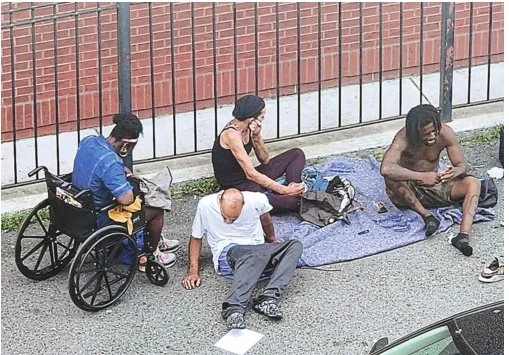
Armed and ready for the election
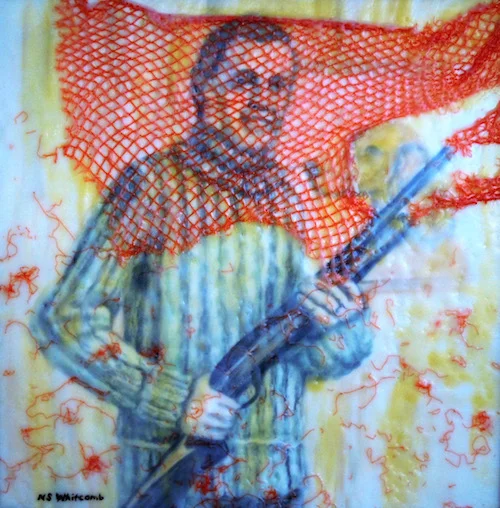
"Hunter's knitting pattern'' (encaustic), by Nancy Spears Whitcomb.
One of the few nice things in the past few weeks of this hideous presidential campaign has been that the noise about the glories of the Second Amendment (the most important amendment to many people and certainly the most fun) has been drowned out by sexual and business scandals.
Insulting visual cliches of yesteryear
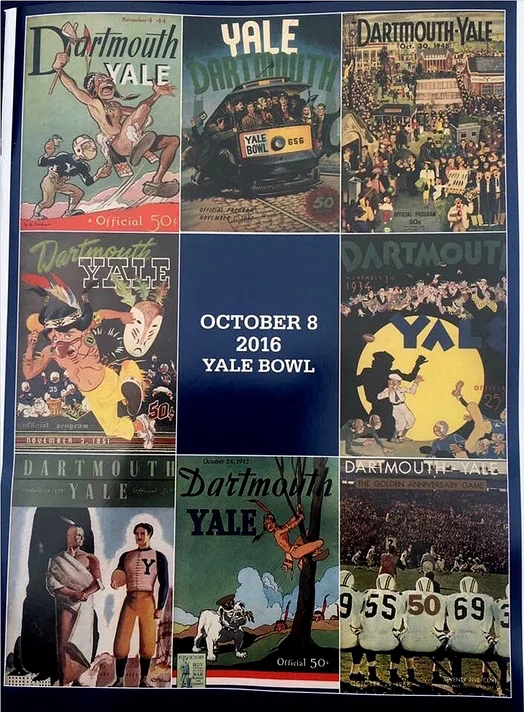
It's remarkable what sort of stuff went up only a few decades ago. The "Indian'' motif, by the way, stems from the fact that Dartmouth College goes back to a secondary school founded for Native Americans in Connecticut in the 1750s that later, in 1769, became a college in Hanover, N.H., whose first mission (quickly abandoned) was to educate Native Americans. But the college in the past few decades has sought to become a major institution for Native Americans.
Sarah Anderson: The best presidents for tax fairness
With all the debate over Donald Trump’s tax-dodging, I’ve been wondering how taxes have played into presidential politics in the past.
For some answers, I turned to Bob McIntyre, head of the nonpartisan research and advocacy group Citizens for Tax Justice. For 40 years, McIntyre has been on the frontlines of efforts to make our tax code fairer.
When asked what American president he considers the worst on tax fairness, his initial response was “Yipes, there are so many.”
After some consideration, he bestowed that honor on Ronald Reagan, whose 1981 tax act slashed taxes on the rich.
The top marginal tax rate dropped from 70 percent to 50 percent (before being cut even further to 28 percent in 1986). And, even more harmful, according to McIntyre, was the bill’s vast expansion of corporate tax loopholes.
Ironically, though, when I asked what president has done the most to advance tax fairness, Reagan’s name came up again — not as number 1, but as the runner-up.
While Reagan is a big hero of anti-tax Tea Partiers, later in his presidency, he agreed to raise taxes several times to address mounting budget deficits.
McIntyre was particularly involved in the fight over Reagan’s 1986 reform, after cranking out reports for a decade that documented rampant tax-dodging among America’s largest corporations and wealthiest individuals.
The loophole-closing 1986 reform was still not enough to solve the problem of insufficient revenue to pay for federal spending. But by creating a broader tax base, Reagan set the stage for President Bill Clinton’s increases in the tax rates on the highest earners.
The top marginal rate rose to 39.6 percent in 1993, where it stands today.
The combination of the 1986 and 1993 reforms was essential to the balanced federal budgets that occurred in the late 1990s, according to McIntyre.
But of course, then President George W. Bush blasted a cruise missile-sized hole through all that fiscal responsibility with a new round of tax cuts and a spike in war spending.
So who was the best president for the cause of tax fairness?
Again, the answer was surprising: Teddy Roosevelt, but not because he was a strong advocate of progressive taxes (which indeed he was). Instead, McIntyre says TR deserves the honor because of the unintended consequences of his pettiness.
To understand his argument requires a bit of a history refresher.
In 1912, Roosevelt, who’d held the nation’s highest office from 1901 to 1909, decided to throw his hat back in the ring because he was dissatisfied with the presidential performance of his former protégé, William Taft.
When TR failed to beat Taft for the nomination, he founded his own party — the progressive, so-called “Bull Moose” Party — and while he didn’t win the election, he succeeded in splitting up the Republican Party.
This, McIntyre points out, led to Democratic takeovers of previously Republican state legislatures, which was critical to delivering the three-quarters of states necessary to ratify the 16th Amendment.
“Without Teddy’s petulance,” McIntyre told me, “the amendment authorizing a federal income tax would almost certainly have failed to be adopted.”
So how does one stay motivated to keep fighting for fair taxation for 40 years? “Perhaps I have Sisyphus as my hero,” McIntyre said.
Trying to stop big corporations and billionaires from rigging the system does indeed seem like pushing a rock up a hill over and over. But until we elect public servants willing to stand up to these powerful forces, we have no choice but to keep pushing.
Sarah Anderson directs the Global Economy Project at the Institute for Policy Studies and is a co-editor of Inequality.org. Distributed by OtherWords.org.
Stump Trump
Election Expectation
It shouldn't be hard to defeat Donald Trump --
Where there's a real issue, he's easy to stump.
-- Felicia Nimue Ackerman

James P. Freeman: The indomitable spirit of my Cape Cod aunt
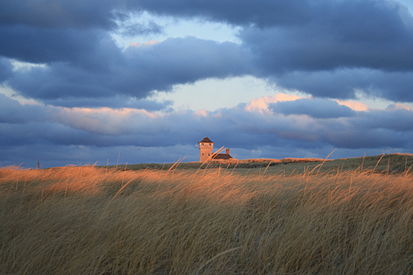
On the Cape Cod National Seashore.
My aunt, Irene Doane, lived a life that was uniquely Cape Cod -- where she lived her entire life -- but also recalled, in many ways, the broader America of the 20th Century… full of ups and downs, hopes and heartbreaks, and vast change during her nearly 90 years on the Cape.
She was born in1927, in the Roaring Twenties, which Scott Fitzgerald dubbed “The Jazz Age,’’ two years before October 1929 crash that led to the Great Depression. And like many Americans of that generation, her character was cemented by the Second World War. These events guided and informed her patriotism, independence, indomitable spirit, and, as would be evident later in life, her survival instincts. With gusto.
These traits were validated when she met my uncle, George, who himself embraced many of these values. Just as he had landed on the beaches of Normandy during D-Day, he landed in her heart. For 50 years as a married couple. It is hard to believe that he died almost 20 years ago. Yet she fought on with her own brand of style and swagger.
When I moved to New England permanently, in late 2002, I got to know her much better. When I was living in Orleans that first winter; we had dinner together nearly every two weeks. I still marvel at her love of nature (it was merely coincidence that she lived on Chick-a-dee Lane and that the state bird in Massachusetts is the Black-capped Chickadee) and her dedication to the many social organizations -- her extended family – the guilds, lodges and women’s groups, not to mention aspiring public officials.
These were the days of real, actual human interaction, before the days that my generation would think of social interaction as the digital space of Twitter and Facebook. Coffee at her home base, “The Homeport,” in Orleans, will never be the same. Sunday suppers will lose some of their charm.
I will miss her at family gatherings like Christmas and the Fourth of July, where she was always checking on the family. And the stories. The Freeman gift of gab. One in particular is priceless and was recalled by a 1955 Cape Codder column entitled “Scuttlebutt.”
“George and Irene Doane of Orleans recently turned in their Ford for a new model. Last week Irene drove the new car to the center to do her marketing. She came out of the store loaded down with the makings for a good chicken dinner. And over in the parking lot sat the old Doane car, having been purchased by someone else. Well, you guessed it! Irene marched right up to the familiar vehicle, opened the back door and deposited her groceries on the seat. Then she went back to do some more shopping. Later, half way home in the new car, she noticed that there were no groceries on the back seat. Realizing what she had done, Irene hurried back to the center. But the other car had pulled out. Needless to say, George didn’t have chicken that night.”
We do not know God’s plan but in a way, God’s plan was entirely fitting this time, in that she passed away as fall began. With the approaching explosion of colors, a reminder of one of the thousands of rich, elegant bouquets she made down the road at Thayer’s Florist Shop, her passion and vocation.
The following passage from Gladys Taber’s My Own Cape Cod, captures beautifully her fondness for nature, literature and storytelling. Even in her last days she was sharing stories.
“Summer slides so gently into autumn on Cape Cod that it is easy to believe there will be no end. Day dreams toward twilight, skies are sapphire, the tide ebbs quietly. I begin to think time itself is arrested and the green leaves will stay forever on the trees. Gardens glow with color, with the roses and with carpets of zinnias and asters….
Times have changed but the Harvest Moon of September exerts the same magic, shines so bright. The fishing boats that are at anchor in the channel nudge the piling softly, perhaps dreaming of tomorrow.”
Our tomorrows will be a little sadder now that she has departed us. But we are comforted in knowing that she will see George soon and that means there will certainly be a good story somewhere too, a story, no doubt, rich with New England humor, imagery and traditions. We can all dream about that…
James P. Freeman, a former banker, is a New England-based essayist.
Llewellyn King: Running for office: Terrible and exhilarating
So you want to run for office, shake up Washington and clean out the political stables? Then prepare to subject yourself and your family, possibly your old paramours, to the rigors of a very rough ride.
Little of what you will endure will have much, if anything, to do with your fitness to govern. Expect abuse, distortion, rejection and exhaustion.
Get ready to eat bad food, struggle to remember names, endure bores, suffer poorly prepared reporters and watch the money flow out. Steel yourself against crises you never dreamed of and betrayals you never thought possible. All this before a single vote is cast and the prize is won or lost.
If you are after national office, you will need professional campaign help. The first thing you will be asked is not what you believe, but how much money do you have?
Second question: Do you know any wealthy people who might back you or have indicated they might be prepared to contribute to your campaign? If your answers are in the affirmative, you are on the way to becoming a candidate.
After the money issue is settled, then you can get into the details: your party affiliation and your relationship, if any, with the local party apparatus.
What the professionals will not tell you is just how awful running for office can be; being lied about, being besmirched, having your private life picked over, having your spouse examined as though he or she were the candidate. Any skeletons in the closet can be expected to come out, pointing bony fingers at you. Youthful indiscretions, boisterous behavior of yore, padded resumes, driving offenses, unpaid taxes, taxes not paid for domestics and your religion, or the lack of it, are all fair game to your opponents and the media.
You privacy will be violated in ghastly creative ways, like having your garbage sifted through, your telephone hacked and, God forbid, if you have said anything impolitic or off-color on Facebook: It will be front page tomorrow.
Think hard about the times when you advocated causes, like gun control, that are now too hot to handle. Everything you ever thought aloud can turn into a smoking gun. A paper trail can be incendiary. A 30-year-old photograph of you mooning the flag may be curtains for you. Selfies have lethal possibilities.
You will think the media is out to get you; those nice people at the newspaper may seem to grow horns and those unscripted TV interviews are journeys through the mine field.
If it is any comfort, the media is not out to get you, nor is it out to help you. It is out to get a story. Bad information may be fed to the media by your opponent’s campaign or dug up by reporters themselves.
You will be in The Overton Window, also known as The Window of Discourse. It is a concept developed by Joseph Overton, the late conservative political scientist, which identified political and social issues acceptable for discussion. Thirty years ago, for example, gay marriage was not in the window. In the time of Franklin Roosevelt, Americans with disabilities were not in the window. And in the time of John Kennedy, sexual peccadilloes were not in it.
Today the window is wide open: everything allowed.
However, this presidential election, where nothing has not been mentioned, may have reduced the shock value of how lives have been led. We may be at a watershed in private-life-as-political-fodder. Donald Trump has been married three times and has had some questionable business episodes, Hillary Clinton has had her time in government cruelly dissected, and it has been suggested that she was an enabler of her husband’s infidelities.
The window is wide open now, but it may be closing because of the excesses of this election.
So why would anyone run for office? Because it is the most exciting, adrenalin-fueled time that those who are prepared to pay the price will ever have. You will be on a steed galloping across the battlefield of ideas. If you win, you can affect things. If you lose, well, you will have enjoyed an exhilaration like none other.
Go for it — and implore your spouse’s forgiveness.
Llewellyn King is executive producer and host of White House Chronicle, on PBS, and a longtime publisher, columnist and international business consultant. He is based in Rhode Island and Washington.
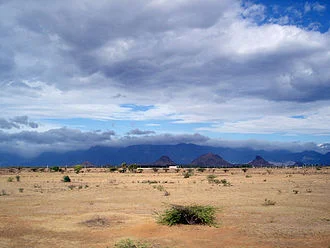
Drought continues in Mass.
From ecoRi News (ecori.org)
With large portions of Massachusetts continuing to experience rainfall amounts remaining below average for a seventh straight month, Energy and Environmental Affairs Secretary Matthew Beaton has declared a drought warning for the Connecticut River Valley, Central, Northeast and Southeast Massachusetts, unchanged for the Central, Northeast and Southeast regions, and up from a drought watch for the Connecticut River Valley in September; and a drought watch for the Cape and Islands and western Massachusetts, up from a drought advisory for western Massachusetts and unchanged for the Cape and Islands in September.
The declaration was the result of a recommendation issued from a recent meeting of the Drought Management Task Force, comprised of state, federal and local officials, and will remain in effect until water levels return to normal in the affected regions.
“Most of Massachusetts received very little precipitation during the month of September, preventing needed relief from the ongoing drought conditions currently being experienced throughout much of the state,” Beaton said. “Water reservoirs, groundwater, streamflow, and soil moisture levels continue to decline, severely impacting the commonwealth’s riverine habitats and fisheries, agricultural sector, and elevating the risk of fire. Now more important than ever, we all must administer best water conservation practices to avoid additional stress on our drinking water sources and other water dependent habitats.”
A drought warning, as outlined in the Massachusetts Drought Management Plan, indicates consecutive months of groundwater, streamflow and reservoir levels being below normal, and initiates a much more concerted set of government responses including instating water restrictions. Areas within the drought warning are currently experiencing precipitation levels below normal for six out of seven consecutive months.
The declaration of a drought watch represents extremely low groundwater and streamflow levels resulting from prolonged periods of precipitation deficit, including a lack of snowfall in the winter. This declaration warrants detailed monitoring of drought conditions, close coordination among state and federal agencies, and technical outreach and assistance for the affected municipalities.
For regions in drought warning: outdoor water use should be eliminated.
For regions in drought watch: outdoor water use should be limited to “handheld watering” with a hose or a watering can after 5 p.m. or before 9 a.m., to avoid evaporative losses; filling swimming pools, washing cars and washing buildings is prohibited.
For regions in drought advisory: outdoor watering with irrigation systems and sprinklers should be limited to no more than one day a week; outdoor water use should be limited to “handheld watering” with a hose or a watering can after 5 p.m. or before 9 a.m., to avoid evaporative losses.
“MassDEP strongly encourages suppliers to keep outdoor restrictions in place into October,” Massachusetts Department of Environmental Protection Commissioner Martin Suuberg said. “The prolonged drought created a significant water deficit that will need time and a return to normal precipitation patterns to replenish.”
Drought task force officials noted that while reservoir levels, especially smaller systems, are low for this time of year, the Massachusetts Water Resources Authority (MWRA) water supply system isn’t currently experiencing drought conditions.
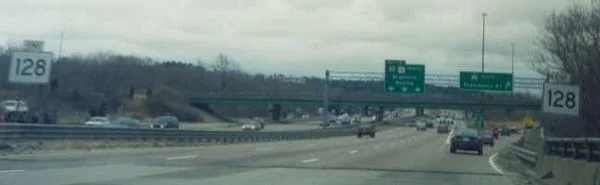
Abandon all hope ye who enter here
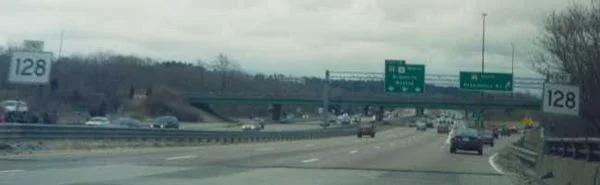
Route 128 in Canton, Mass.
Take cover! As part of a bridge project, Route 128 will be closed from the night of Nov. 4 through Nov. 6 in Needham, with trafficto be rerouted through local roads. Even though this will be on a weekend and with plenty of official warning, expect chaos! With all the whining about the MBTA, thank God that Greater Boston, unlike many U.S. metro areas, at least has a fairly dense mass-transit system to take pressure off the roads. If only it were denser.
-- Robert Whitcomb
When you spend too much time alone

"Portrait of Sydney Skukerman'' (acrylic paint on paper), by Stephen Fischer, in his show "Stephen Fischer: Recent Work -- Portraits, Illustrations, Drawings,'' at the Wedeman Gallery at Lasell College, Auburndale, Mass.
'Younger in October'

"A child looking at ruins grows younger
but cold
and wants to wake to a new name
I have been younger in October
than in all the months of spring
walnut and may leaves the color
of shoulders at the end of summer
a month that has been to the mountain
and become light there
the long grass lies pointing uphill
even in death for a reason
that none of us knows
and the wren laughs in the early shade now
come again shining glance in your good time
naked air late morning
my love is for lightness
of touch foot feather
the day is yet one more yellow leaf
and without turning I kiss the light
by an old well on the last of the month
gathering wild rose hips
in the sun."
- W. S. Merwin, "The Love of October''
Don Pesci: Courant for Clinton: Do media endorsements matter?
The media have lost their moral pull. The approval rating of the lowest bottom-feeding politician is several fathoms higher than that of “the media,” according to a September 2016 Gallup Poll (http://www.gallup.com/poll/195542/americans-trust-mass-media-sinks-new-low.aspx)
The media, even less than the current Democratic and Republican presidential nominees, simply do not give a hoot about approval polls directed at them, which are worth pausing over none-the-less.
Since 1972, Gallup has been putting the following question on a yearly basis to the great unwashed, and the graph below traces the decline in media approval from 1997 to 2015:
Any politician – perhaps with the exception of Connecticut Gov. Dannel Malloy, whose current approval rating, according to the most recent Quinnipiac June 2016 poll, is 24 percent, near bottom in the nation – might be alarmed by the negative drift in approval since 1997 from 53 to 32 percent.
Consider The Hartford Courant’s recent endorsement of Hillary Clinton. Frequent readers of Courant endorsements will understand that the paper’s rather warm embrace of Mrs. Clinton was a forgone conclusion, even in April 2015, when she first announced her bid for the presidency.
The paper’s current endorsement was, so to speak, written in the stars, and her Republican opponent simply did not figure into the paper’s endorsement calculations. Possibly if Jeb Bush had emerged from the Republican Party primary rough and tumble as the nominee of his party, The Courant might have had a pang of conscience in delivering its endorsement to the badly tarnished Mrs. Clinton. The emergence of Donald Trump as an unexpected victor in the primary made the Clinton endorsement a slam-dunk. But the warmth radiating from the paper’s endorsement is inexplicable.
The Courant easily disposes of Mr. Trump in its editorial lead: “The problem with this election isn't that Donald Trump is racist. The problem is that we are.”
To be sure, the Courant here is not using the royal “we.” It would be a viperish untruth to conclude that the paper’s editorial board is a nest of racists. No, The Courant is subtly suggesting that what Mrs. Clinton has dubbed “the deplorables,” those who have in their heart of hearts endorsed Mr. Trump, are racists. This volatile charge lies like a scorpion’s sting in the paper’s larger proposition: We are all racists now; but most especially are those racists who, for whatever reason, will vote for the racist Republican nominee for president.
Well now, Courant simpaticos doubtless will argue, Mr. Trump, who has recklessly deployed hyperbole in his campaign, certainly has it coming to him.
But really, are all Americans racists – even those who deplore Mr. Trump’s reckless hyperbole?
Apparently so; it is difficult to put any other construction on the paper’s lead : “The problem with this election isn't that Donald Trump is racist. The problem is that we are.”
The Courant has turned a phrase made popular in 1888 by British politician William Vernon Harcourt (“We are all socialists now”) andlater deployed by Nobel economist Milton Friedman against the Keynesians (“We are all Keynesians now”) in a widely misunderstood 1966 Time Magazine article. Mr. Friedman was being sardonic, he later explained: “In one sense, we are all Keynesians now; in another, nobody is any longer a Keynesian.”
But The Courant is quite serious. The paper really does believe that “in one sense” we are all racists. And if this is true, how do we extricate ourselves from the coils of the racist serpent?
Easy: We do it by resting comfortably in the propositions put forth by Mrs. Clinton -- an unrepentant Keynesian, if not a socialist like Bernie Sanders -- whom the paper has fulsomely endorsed. An assent to Mrs. Clinton’s politics, however ruinous, marks our distance from the racist serpent. The Courant in its editorial does this with moral energy and dispatch and professes some misgivings that, considering Mrs. Clinton’s opposition, matter not at all.
Read the following with a jeweler’s eye. First come the obligatory disclaimers:
“Her track record as secretary of state is mixed. The aggressive policies that tried to force regime change in troubled parts of the world have had questionable results, arguably generating a backlash that helped fan the growth of the Islamic State. Even though she was not found personally culpable, the attacks at Benghazi happened on her watch. It is debatable whether the Middle East is any safer than it was before her tenure at the State Department.
“Mrs. Clinton has other flaws. She was wrong to use a private e-mail server in her home while working at State, and she took far too long to apologize for it. The Clinton Foundation has always been seen as a way to buy her influence, no matter how many firewalls are put up. She's taken large speaking fees that could make her feel beholden. She is too close to Wall Street. She can appear arrogant and distant — traits that do not serve a national leader well.”
This is followed by a crash of cymbals endorsement:
“But even with those flaws, Hillary Clinton and Donald Trump are not even in the same ballpark. Critics though she may have, Mrs. Clinton is a smart, compassionate leader. Mr. Trump is a showman whose act is regrettably playing well on Main Street.”
The attentive reader will notice the micron-thin dusting of disapproval.
The “aggressive policies” that “tried to force regime change” in various unmentioned parts of the world arguably have had “questionable results.”
Arguable indeed! Some would argue that the “aggressive” Middle East policies of the Obama-Clinton administration were not aggressive enough. Mr. Obama’s “lead from behind” posture in foreign policy was and is, in most important respects, an abdication of political responsibility. Some Middle East nations, formerly friendly to the United States, now making cooing sounds in the direction of Russian President Vladimir Putin, have reluctantly concluded that the Obama-Clinton “strategy” in the Middle East lacked spine and intellectual rigor. The word “tried” as used in The Courant endorsement points to a massive failure. And the “results” of the Obama-Clinton Middle East strategy, or lack of it, are not at all “questionable.”
Indeed, the murderous results of Mr. Obama’s withdrawal from Iraq, largely the result of a diplomatic failure, are painfully obvious. The inevitable consequences of Mrs. Clinton's Libyan policy -- let’s come, conquer and kill Muammar Gaddafi – are evident in the smoldering ruins of the American Embassy Compound in Benghazi, Libya. It is the Obama-Clinton Middle East policy, the absence of a long-range strategy in the Middle East, that failed. The obvious results of this failure were predictable.
It is quite true that Mrs. Clinton’s “flaws” are not in the same ballpark as those of Mr. Trump – because Mrs. Clinton’s disastrous term as Secretary of State reveals real-time ruinous consequences flowing like a rush of blood from her character flaws, the most prominent of which is a disposition to bend reality to campaign rhetoric and to substitute campaign promises for a cogent and responsible Middle East foreign policy.
“It is debatable,” The Courant avers in its Clinton encomium, “whether the Middle East is any safer than it was before her tenure at the State Department.”
Debatable? No, it is not at all debatable. The Middle East is soaked in the blood of martyrs, both Christian and peaceful Islamic martyrs, slaughtered by Islamic terrorists.
Homosexuality used to be “the love that dare not speak its name.” In the modern world, the name is now shouted approvingly as a boast and a challenge. We ought to be glad of it; it was entirely unnecessary to throw Oscar Wilde on the pyre prepared for him by the Marquis of Queensbury. But among those who tolerate the failed policies of Mr. Obama and Mrs. Clinton – on pain of being called racist -- Islamic terrorism, even when it strikes its deathblows at the marrow of the core beliefs of American culture, may be the last remaining sin that dare not speak its name -- among politicians on the left. The terrorists themselves, of course, never tire of shouting their terrorism from the rooftops.
We ought to thank Mr. Trump, among others, for blowing up this dangerous pretension. Islamic terrorists and ISIS especially, much more potent now than it was when Mr. Obama dubbed the terrorist group a “JV team,” continues to destroy Christian Churches, execute both priests and so called “pagans” – death to the kafir! -- uproots the structure of the modern feminist movement, defended aggressively by Mrs. Clinton, and throws gays to their deaths from rooftops, in accordance with Sharia law. Iran adopted the extreme punishment of execution for sodomy in its 1991 Constitution: “Sodomy is a crime, for which both partners are punished. The punishment is death if the participants are adults, of sound mind and consenting; the method of execution is for the Sharia judge to decide.”
It was the Obama-Clinton administration that fashioned a nuclear deal with Iran that a) will not prevent the country from developing nuclear weapons, and b) would not have been possible had not the Obama-Clinton administration paid billions of dollars in cash to a regime that hopes to become a hegemonic power in the Middle East, so that it may destroy Israel, whose prime minister, Benjamin Netanyahu, beseeched the Obama administration not to go forward with the deal. Mr. Netanyahu also warned the Congress – Sen. Dick Blumenthal in attendance – that its implementation would be a disaster for the West.
For all his pains, Mr. Netanyahu might have been Cassandra warning the Trojans concerning Greeks hidden in a wooden horse. Iran could easily buy with the cash transported to Iran in the dead of night in a modern Trojan horse any weaponry it wishes to purchase from America’s traditional enemies, Russia and China, to wreak havoc in Israel, making full use of its proxy Hamas terrorist forces in Lebanon – poor Lebanon, a country overmastered by the friends of Iran.
A few months back, this writer took a course in fresco at St. Michael's Institute for Religious Art at Enders Island, a stone’s throw from Mystic, Conn. The teacher, a master artist in fresco and Icon writing, was Lebanese. When I said to him, “Poor Lebanon,” he said, “Yes. The Muslim terrorists in Hamas march into villages and ask you your name. If it is a Christianized name – John, Mathew, Mark – they cut your head off in the public square. It sends a message.”
Sen. Dick Blumenthal and other members of Connecticut’s U.S. congressional delegation – all Democrats who endorsed the Obama-Clinton Iran deal, which ended a successful embargo and opened Iran to the usual corporations that do not scruple to march through blood to make a profit – should have a talk with him, or any of the other Christians who have suffered a Neronian persecution at the hands of terrorist Islam. But they won’t. Every one of them knows that the number of Syrian Christians among refugees fleeing Mohammed’s sword, blessings be upon him, and admitted into the United States is only three percent or less. Perhaps the Congressmen do not want their mercies to be read by Islamic terrorists as a crusader response.
Mrs. Clinton’s most glaring flaws may be seen most clearly in the smoking ruins of the American embassy in Benghazi, the terrorist attacks in Paris, the rapes of German, Belgian and Swedish women, the terrorist attacks in the United States by radicalized Muslims, Mr. Putin’s annexation of Crimea and his ardent defense of Bashir al Assad in Syria, where once Mr. Obama drew a “red line” that quickly disappeared when Mr. Assad, every bit as ruthless as his father, used chemical weapons on his opponents. And Mrs. Clinton’s narcissistic flaws peek out at us like grinning devils from her e-mails, purloined by hackers and containing, despite Mrs. Clinton’s false denials, top-secret treasures that would not have been shared with the world had Mrs. Clinton, fully schooled in security matters when she was a U.S. Senator, not put the safety of her country in jeopardy by using a private server.
“But even with those flaws,” The Courant's endorsement of Mrs. Clinton concludes, “Hillary Clinton and Donald Trump are not even in the same ballpark. Critics though she may have, Mrs. Clinton is a smart, compassionate leader. Mr. Trump is a showman whose act is regrettably playing well on Main Street.”
Bill Buckley thought that Mr. Trump was a deeply flawed vulgarian, and a video taped 11 years ago showing a younger Trump trash talking about his sexual prowess has proven Mr. Buckley right.
But given Mrs. Clinton’s record in defense of her vulgarian husband and her foreign policy as Secretary of State, neither of which can bear close scrutiny, one may agree with the paper that both are operating in different ballparks. There are no smoking embassy ruins atop Trump Towers, and Mr. Trump, despite his deeply offensive locker-room talk, never had sex in the White House with Monica Lewinsky, who even today is recovering from Mrs. Clinton’s psychological bite marks. (A search on The Courant's site for a report on Ms. Lewinski's recent visit to Connecticut, where she held a talk on bullying, produces no coverage of the event.) In this regard, Mr. Trump is a JV player; the Clintons are Big League. And if the editorial board of The Hartford Courant had its moral Geiger counter recalibrated, it might have noted in its editorial endorsement of Mrs. Clinton the differences in their ballparks.
Don Pesci is a Vernon, Conn.-based essayist on political and other matte
Don't let them block train-line improvement
Excerpted from Digital Diary, in GoLocal24
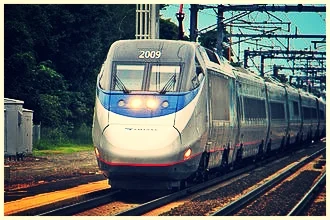
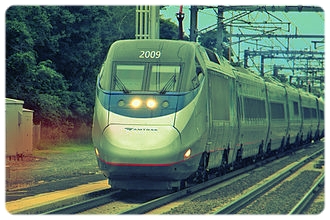
Let’s hope that the opposition of a few mostly affluent people near the Connecticut coast is not permitted to block construction of a long-needed 50-mile bypass (to reduce the number of curves and choke points) that would finally let Amtrak offer the high-speed train service common in much of the rest of the Developed World.
America’s decrepit transportation infrastructure and failure to install true high-speed rail has hurt the nation’s competitive position, kept far too many people on our crowded roads and hurt the environment (trains are much less polluting than cars and tracks take up much less space than highways).
The bypass would not only let Amtrak trains go much faster; it would allow a major improvement in commuter train service.
This improvement, of course, would be a boon for most everyone in southern New England.
-- Robert Whitcomb
The exit is more beautiful than the entry

From Mark Platais's one-man show at Francesca Anderson Fine Art, Lexington, Mass., through Oct. 29.
"October is nature's funeral month. Nature glories in death more than in life. The month of departure is more beautiful than the month of coming -- October than May. Every green thing loves to die in bright colors.''
-- Henry Ward Beecher
The TPP does NOT include China!
Excerpted from the "Digital Diary'' in the Sept. 29 GoLocalProv.
Many (most?) American politicians (including Hillary Clinton) now say that they oppose the Trans-Pacific Partnership (TPP) trade deal with Asia. They’re making a mistake.
While this is officially unstated, the deal is meant to, among other things, bolster the economies and security of some Asian nations so that they can defend themselves from an increasingly aggressive and expansionist China. Too many Americans think that the TPP includes China, which has used currencymanipulation, intellectual-property theft and other nasty strategies to hollow out parts of the U.S. economy. China is not part of the TPP
More business reporters please.
-- Robert Whitcomb
'A shadow history'

From Eileen Claveloux's series "Diasporan Portraits,'' Oct. 12-Nov. 9, at the Hampden Gallery, at the University of Massachusetts at Amherst.
In the series, each of her subjects is descended from a family with one or more ancestors among the 1.5 million who died in the Armenian Genocide under Turkish rule during World War I. "The Armenian Genocide has become a kind of shadow history, denied and mostly forgotten,'' says the gallery.
'So pleasant an effect'
"There is no season when such pleasant and sunny spots may be lighted on, and produce so pleasant an effect on the feelings, as now in October."
-- Nathaniel Hawthorne
David Warsh: Jeb Bush redux, at Harvard
When former Florida Gov. Jeb Bush announced his presidential candidacy in January 2015, I was enthusiastic, largely on foreign policy grounds. It seemed he might champion the sort of conservative internationalism that characterized his father’s one-term presidency. I didn’t pay much attention to his views of domestic policy, but Alec MaGillis’s New Yorker article about Bush’s enthusiasm for privatizing public education caught my eye. Before I had time to follow up, Donald Trump had elbowed him out the race.
Last week Bush came to Harvard to deliver its annual Godkin Lecture. That the occasion was announced just two days ahead of time came as something of a surprise. I went round to hear what the would-have-been candidate had to say.
The Godkin series is Harvard’s most most prestigious lecture in the social sciences. It was established in 1903, endowed by Andrew Carnegie, J.P. Morgan, and others, to explore the essentials of democratic government and the duties of the citizen, in memory ofEdwin Godkin, founder of The Nation magazine and for 20 years editor of The New York Post. Herbert Croly, Walter Lippmann, J. Robert Oppenheimer, C.P. Snow, Clark Kerr, Gunnar Myrdal, Paul Samuelson, George Will, Daniel Patrick Moynihan have been among the lecturers.
Bush’s presentation turned out not to be a lecture. It was billed as a “conversation,” but what the audience heard instead was an abbreviated stump speech, plus some back-and forth with Harvard Professors Paul E. Peterson and Roland Fryer.
“I was thinking about what I was going to talk about,” he said, “and I asked my mother, who is the boss of the Bush family, and she said, ‘Jeb, talk about 10 minutes, then get off and let people ask you questions.’”
He talked for 15 minutes about the desirability of a “bottom-up” society of individuals as opposed to a “top-down” society in which institutions were paramount, ending with a caIl for a “radical transformation” of public education. “A system that has 13,100 government-run, politicized, unionized monopolies as the governance model for educating millions of children of great diversity is not going to work….
“No other element of society is forcing people to go to a monopoly. We don’t have state-run grocery stores. Even the Medicaid program is basically privatized, where there are choices. . In schools, the most important thing we do, we’re stuck in this model that probably worked really well a hundred years ago….”
Perhaps Bush is planning to write a book. If so, the invitation to lecture was premature. He has promised to return to Cambridge periodically during the autumn term to work with students at the John F. Kennedy School of Government’s Program on Education Policy and Governance, led by Professor Peterson, a voucher enthusiast. Perhaps the Godkin invitation slipped between the cracks; Kennedy School Dean took over only in January.
More likely, the event was timed with a November 8 ballot initiative in mind. In Proposition 2, Massachusetts votes on whether the state should authorize more charter schools. Its backers call it an effort to support public education.
Whatever the case, Bush’s presidential candidacy is in the rear-view mirror. Future Republican leaders will come from the bottom up.
David Warsh is proprietor of economicprincipals.com and a longtime financial columnist and economic historian. He is based in the Boston area.
New England's greatest natural resource

![[#Beginning of Shooting Data Section]
Nikon D100
2004/05/08 10:48:19.9
RAW (12-bit) Lossless
Image Size: Large (3008 x 2000)
Lens: 70-300mm f/4-5.6 D
Focal Length: 270mm
Exposure Mode: Programmed Auto*
Metering Mode: Multi-Pattern
1/80 sec](https://images.squarespace-cdn.com/content/v1/561446cce4b094b629347f8d/1475629409394-EZWBRYSL6EDJN8N6FGFZ/fullsizeoutput_10d27.jpg)

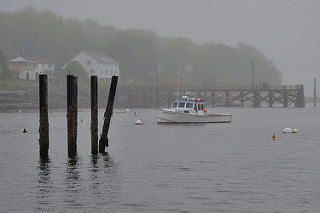

Excerpted from the Digital Diary posted Sept. 29 in GoLocal24
"I love the fall. I love it because of the smells that you speak of; and also because things are dying, things that you don't have to take care of anymore, and the grass stops growing."
-- Mark Van Doren (1894-1972), American poet and scholar
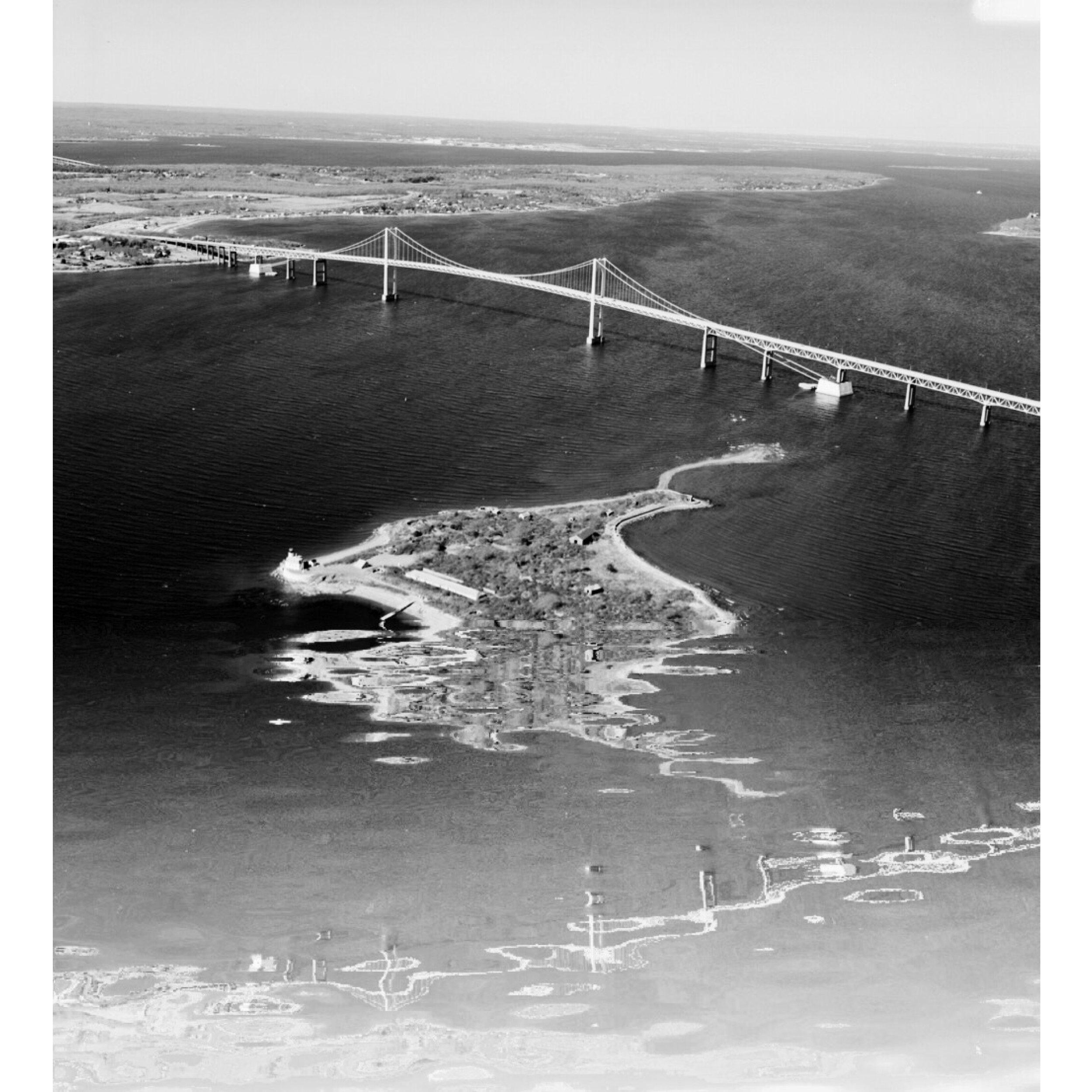
Global warming doesn’t just mean rising sea levels, which threaten the New England coast, particularly the low, flatter section of it in southeastern New England. It also means more extremes in weather, from drought to floods.
Parts of New England, especially in the south, are now starting to resemble Greater Los Angeles--- green where watered by people, brown and dusty elsewhere. Reservoirs are way down, and well water in many places is threatened.
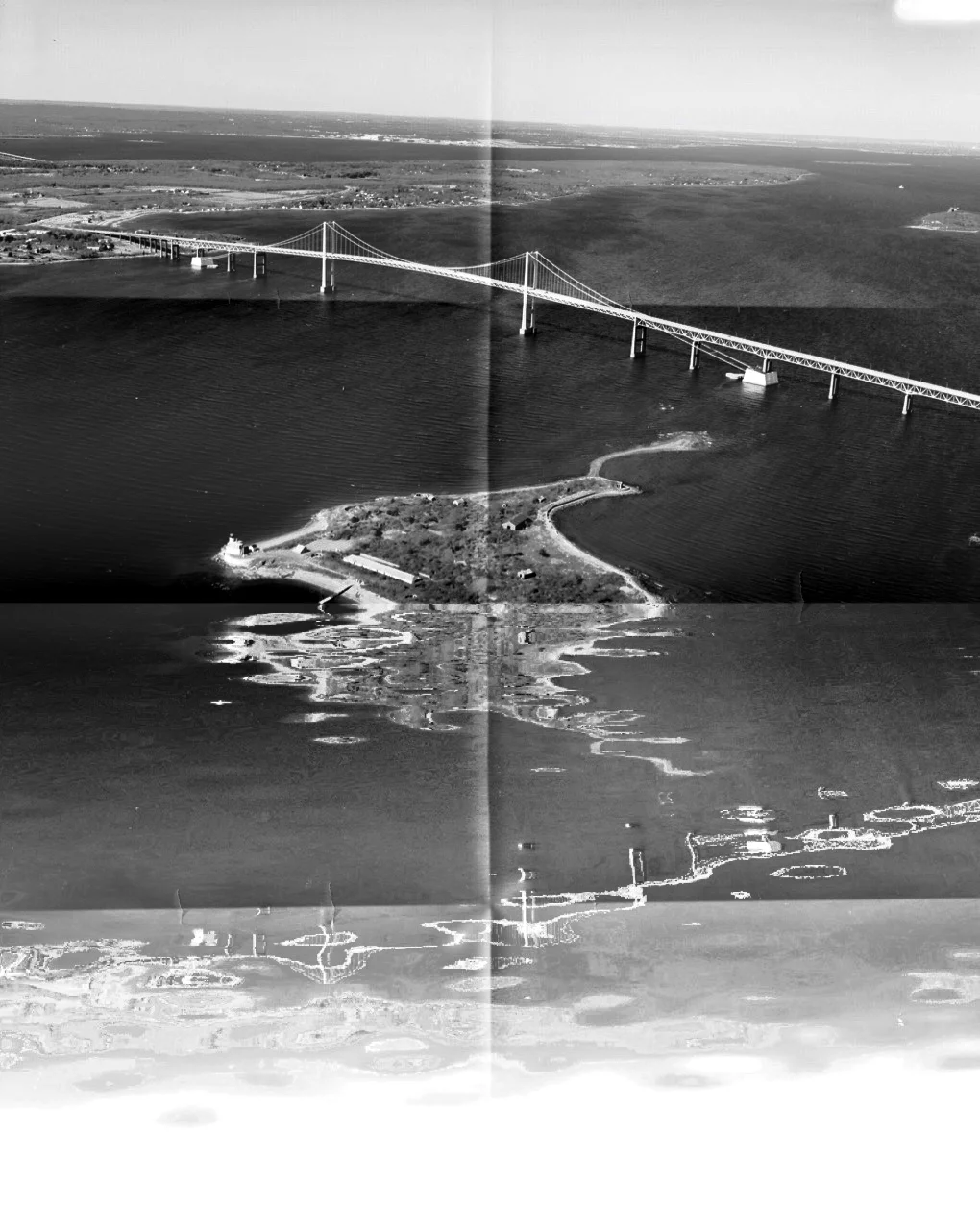
The states understandably don’t have comprehensive ways to monitor well-water supplies and the condition of aquifers, let alone know what to do whenmany wells go dry, except, of course, urge conservation.
Scientists have been predicting that weather would become more erratic with global warming, and that seems to happening. In temperate zones this probably means more droughts interspersed with stretches of very heavy rainfall.
Of course, New England has had droughts before. But they have tended not be accompanied by particularly high temperatures. (Long summer droughts in the ‘60s came along with frequent cool northwest winds.) That seems to be changing. Now we get more hot days (and remarkably warm nights – a better indication of global warming than daytime temperatures). Thus faster evaporation.
Natural-resource managers and the public need new plans to address the drought part of climate change. But at least New England will remain better watered, and have a milder climate, than most of the United States. Indeed, we may end up selling some of it to points south and west.
-- Robert Whitcomb

Power and changeability

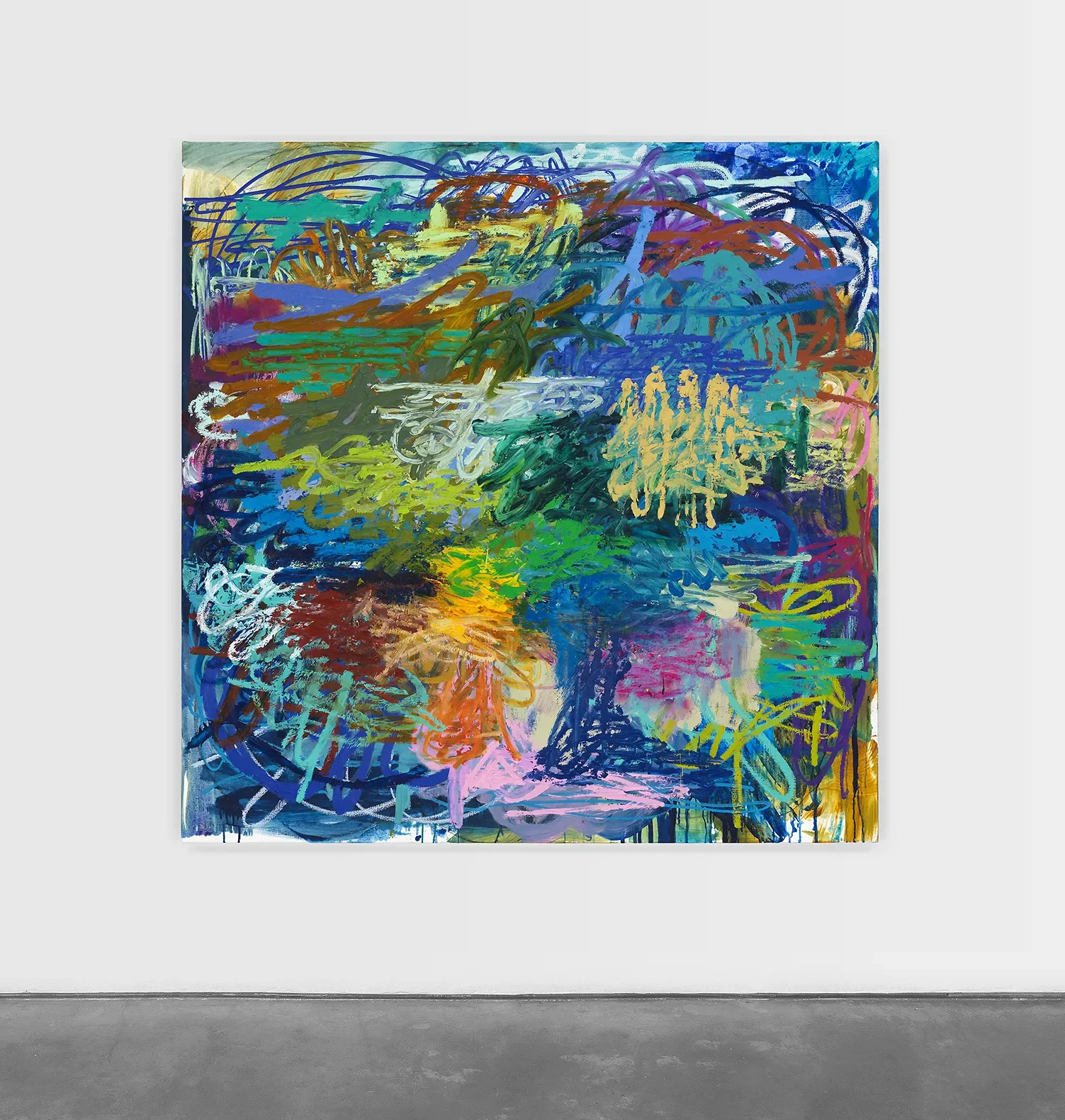
"Wow'' *acrylic on canvas), by Mira Cantor, in her show "Inundated,'' at Kingston Gallery, Boston, through Oct 30.
The gallery says Ms. Cantor's "horizon and ocean waves serve as metaphors for processing contemporary issues regarding the landscape and sociology.
The shoreline's unique combination of vulnerability, changeability, and power from the persistent movement of the waves proves a consistent source of inspiration for Cantor. ''