
Vox clamantis in deserto







William Morgan: The joy and curse of being the 'prettiest village in Maine'
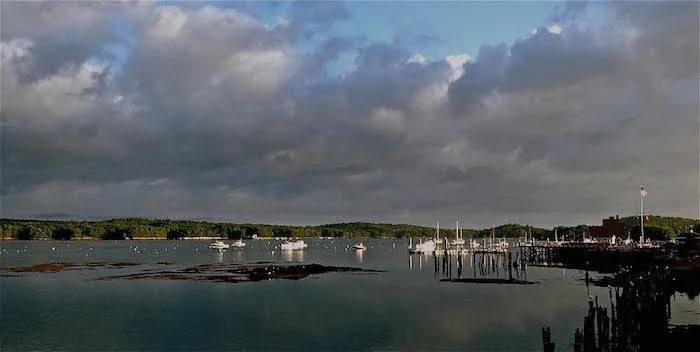
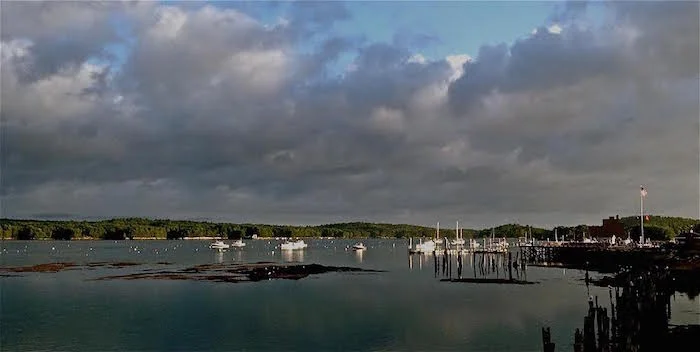
The Sheepscot River (William Morgan)
WISCASSET, Maine
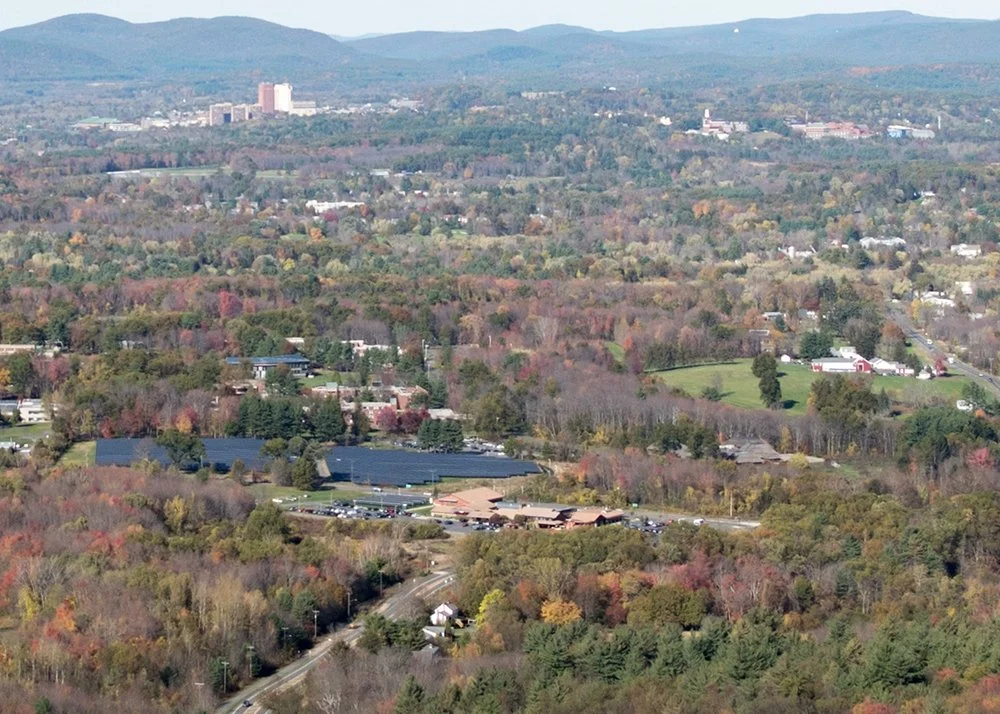
This handsome village is mostly known for Red's Eats (famous lobster rolls; see photo below) and as a traffic bottleneck. U.S. Route 1 snakes through town, down a hill, and across the Sheepscot River. Years ago, Wiscasset voted down a by-pass, figuring that it would hurt downtown business. So huge trucks grind gears going up a long hill in the town.
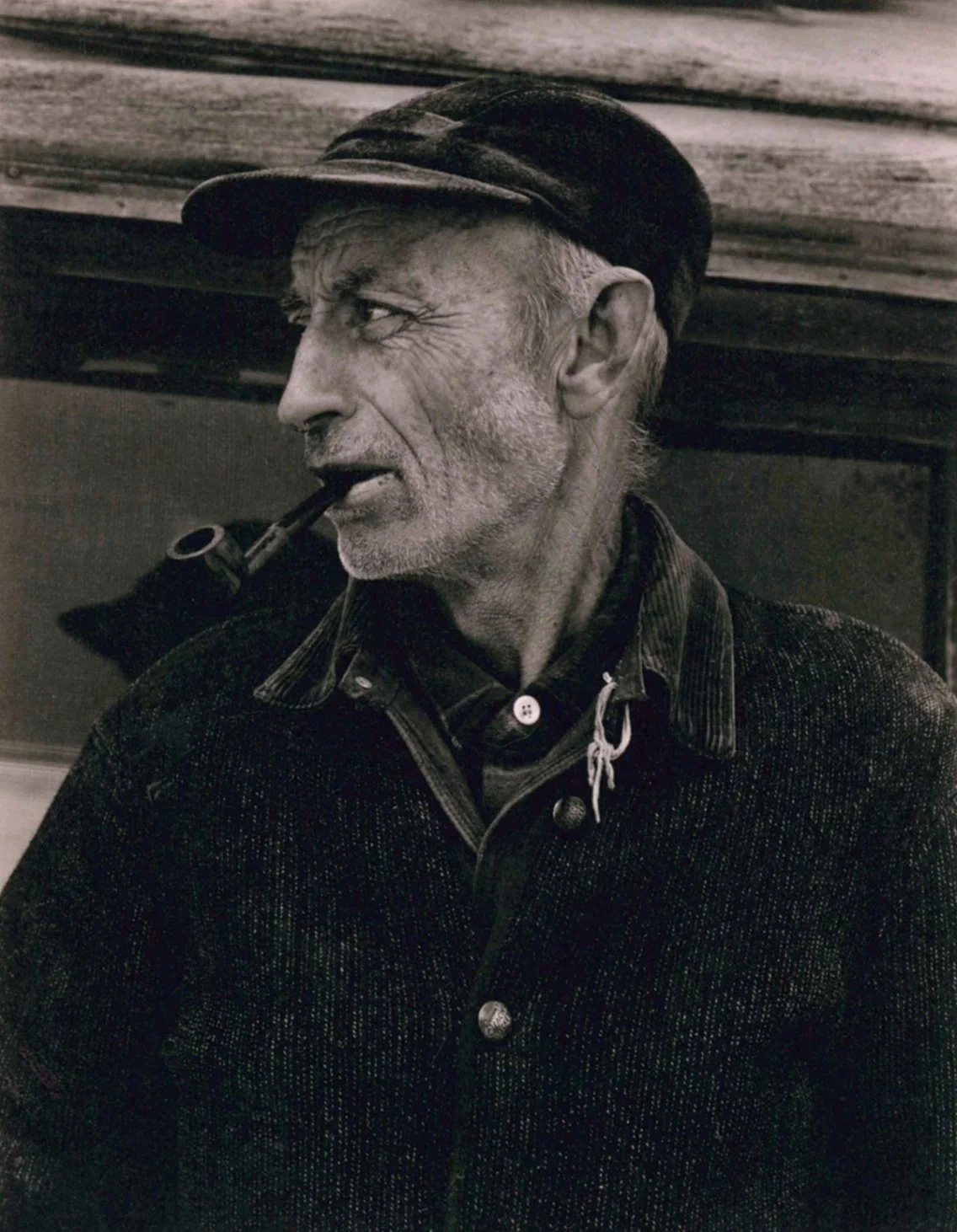
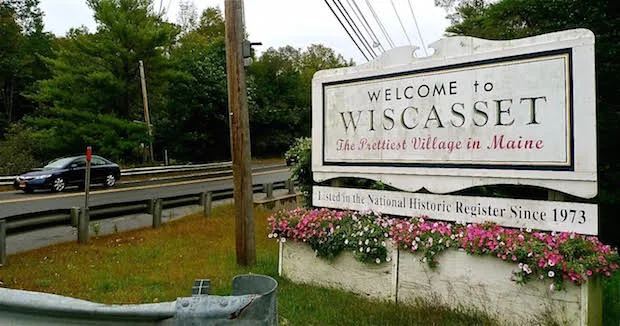
Wiscasset was cursed by having been chosen decades ago by photographer Samuel Chamberlain as the "prettiest village in Maine'' (see photo below), in a book that featured a town from each of the New England states. A constant battle to live up to that, especially as signs on the town borders serve as constant reminders. (Sort of like being voted the Most Likely to Succeed in high school. Where are you now, oh promising youth?)
That old houses that make Wiscasset so attractive (along with the beautiful natural setting) were built during her greatest age, around the turn of the 19th Century, when its ships traveled the globe. Such wealth got frozen by Thomas Jefferson's Embargo and by "Mr. (James) Madison’s War" (of 1812). Wiscasset fortunes never fully recovered.
Since the wide Sheepscot River does not freeze over, a scheme was floated in the 1920s to connect Wiscasset by rail with Montreal and transform it into that city's winter port. It came to naught.
Traffic, tourists and a flat off-season economy aside, the town is still fabulous.
William Morgan is a Providence-based architectural historian and columnist.

Red's Eats
That fatal phrase.

No surprise: A house not necessarily a home in the '50s, or now

"It Was Getting Late,'' by Leslie Graff, in her show "Housed,'' at the Conant Gallery in Lawrence Academy, Groton, Mass., through Dec. 18.
The gallery notes say she creates "complicated imagery featuring women in stereotypical gender roles and dress, from the shoulders down.''
"House has a much colder connotation than home does...'housed' creates a feeling closer to being trapped than to being comforted.''
The picture certainly evokes the '50s or perhaps '60s. Note that she's reading the long-dead McCall's magazine.
Brexit bathos, followed by mysterious Mongolia
To members and friends of the Providence Committee on Foreign Relations (thepcfr.org; pcfremail@gmail.com), which meets at the Hope Club:
Our new season will open on Wednesday, Sept. 14. Our Web site, meanwhile, will be updated with news items fairly frequently. PCFR evenings start with drinks at 6 p.m., dinner by 6:50; the talk by dessert, and the evening ends at 9, except for those who would like to repair to the Hope Club’s lovely bar.
Meanwhile, we are working on a newelectronic system to make thespeakers’ remarks clearer everywhere in the room.
Mark Blyth, our first speaker, whom some of you have heard on NPR commenting on Brexit, will speak on Wednesday, Sept. 14, on Europe after Brexit.
Mark Blyth is Eastman Professor of Political Economy andProfessor of Political Science and International and Public Affairs at Brown.
He is an internationally celebrated political economist whose research focuses upon how uncertainty and randomness affect complex systems, particularly economic systems, and why people continue to believe stupid economic ideas despite buckets of evidence to the contrary. He is the author of several books, including Great Transformations: Economic Ideas and Institutional Change in the Twentieth Century (Cambridge: Cambridge University Press 2002, Austerity: The History of a Dangerous Idea (Oxford University Press 2013, and The Future of the Euro (with Matthias Matthijs) (Oxford University Press 2015).
Coming fast after that will be:
Prof. Morris Rossabi, probably the world’s greatest expert on Central Asia and particularly Mongolia: a democracystuck between the police states of Russia and China, Sept. 21. How does this faraway country do it? He’ll be speaking to us soon after returning from Mongolia and other points in Asia.
Then:
FormerU.S. Ambassador to Slovakia Tod Sedgwick, on thetense situation in Central Europe, Oct. 5.
Meanwhile, the World Affairs Council of Rhode Island and the PCFR are preparing a forum for Oct. 20 at the Hope Club on the foreign-policy visions and challenges of the U.S. presidential candidates. Stay tuned.
Naval War College Prof. James Holmes on the geopolitics of global warming, Nov. 15.
German General Consul Ralf Horlemann on the role of Germany in an E.U. without the U.Kand with an aggressive Russia pressing in from the east, Dec. 14.
Internationalepidemiologist Rand Stoneburner, M.D., on Zika and other burgeoning threats to world health, Jan. 18.
Indian Admiral Nirmal Verma, on military and geopolitical issues in South and Southeast Asia, Feb. 15.
Dr. Stephen Coen, director of the Mystic Aquarium, on the condition of the oceans, March 8.
Brazilian political economistand commentator Evodio Kaltenecker on April 5 to talk about the crises facing that huge nation.
James E. Griffin, an expert on ocean fishing and other aspects of the global food sector, will speak to us on Wednesday, May 17.
Joining us on Wednesday, June 14, will be Laura Freid, CEO of the Silk Road Project, founded and chaired by famed cellist Yo-Yo Ma in 1998, promoting collaboration among artists and institutions and studying the ebb and flow of ideas across nations and time. The project was first inspired by the cultural traditions of the historical Silk Road.

Llewellyn King: Nix wasteful, overrated college and get yourself a craft to make a good living

If Donald Trump becomes the next president of the United States – which is looking slightly more likely – he will, so to speak, hit the wall.
Yes, he will hit his wall: the beautiful, technological marvel he plans to build along the southern border to keep out people he thinks are going to harm the United States.
Yet the first thing he might have to do is to send recruiters into Mexico and beyond to find craftsmen to build his wall.
Mexico might not pay for the Trump wall, but Mexicans most certainly will build it. The reason: there is a critical labor shortage in the United States of skilled craftsmen and women.
There are still way too many unskilled people arguing over what the minimum wage should be for selling a hamburger and far too few who can swing a hammer, use a spirit level, lay a brick, connect a sewer line or wire a building.
These people, these yeomen in 21st-Century society, are in critically short supply. Known as the “crafts,” they are the people who build our bridges, water systems, power plants, submarines and other military materiel, and restore power after a storm.
Whether you are trying to build a new suburban house, a ship or a road, you need the crafts: people who work with tools and their bodies. Their brains, too, for it is not brainless work. Do not ever think that it is. The glass sheathing on those super tall, super skinny buildings in New York would not have gotten there, or stayed there, without people with brainpower.
The crafts shortage is not hypothetical: it is affecting new home construction and big projects, like new nuclear plants in South Carolina and Georgia.
Utilities have special programs to train people to climb poles, string lines, and become first responders after severe storms. These are secure jobs with benefits and retirement packages. Nice work if you can get it, and you can get it if you get round your local utility hiring office.
The political response to the crafts shortage is predictable. There are demands for trade schools, for special courses, for subsidized apprenticeships. As usual, money will be requested. It is not a money problem. It is a human-resource allocation problem.
There is simply too much social, I repeat, social value attached to a university education -- an education that often wastes time, while the students learn what they should have learned in high school.
A degree from one of the second- and third-tier universities is increasingly of little value in getting work. How many political scientists, communications executives, and marketing gurus does society need? An arts degree qualifies its recipient in today’s market to be an Uber driver or such.
Societal pressure says if you do not have a university degree, you are inferior. Everyone without a degree butts up against the mortar-board ceiling at some time.
Yet much of what passes for education is, in fact, the ability to pass tests. Test-passers move up the system and seek other test-passers to keep the game going.
But we are happy to entrust air traffic control, policing, ship piloting, EMT response and other life-saving jobs to people with only high school educations. All those welds on ships, nuclear plants and bridges, are the work of high school graduates and dropouts.
I am happy to report that one of my wife’s nephews has told his mother, an Ivy Leaguer no less, that rather than going through the warehouse-as-education system, he is going to be a welder. I hope he works on worthwhile things, like a bridge or a submarine, not on Trump’s silly wall.
Let the Mexicans have that as their jobs program -- which we will pay for. Believe me.
Llewellyn King is executive producer and host of White House Chronicle, on PBS. His e-mail is llewellynking1@gmail.com. He is also a Rhode Island- and Washington,D.C.-based publisher, columnist and international business consultant.
The joy of public browsing
Excerpted from the Sept. 1 "Digital Diary'' column in GoLocalProv.
The City of Cambridge, Mass., may force the famous Out of Town News business from its eccentric little building in the middle of Harvard Square in order to “repurpose’’ the building as a public space. (Waiting room with news-crawl screens, public bathrooms?) This may force the business, beloved by browsers looking for publications from around the world for so many years, to close.
The structure, actually a kiosk built in 1928, was built at Zero (!) Harvard Square, as an entrance building for the Harvard Square subway station. In 1981, it was moved slightly and renovated. Out of Town News, which opened at Harvard Square in 1955, has been in the kiosk since 1984.
The business is one of the centers of New England, a lively urban space where all sorts of people congregate – not just local academics. I hope that the business stays where it is, letting many thousands of patrons and visitors a year continueto get a sense of what’s going on around the world by reading on paper, still more congenial for many people than reading on a screen. And, unlike in your home or office staring at a screen, while browsing at an old-fashioned newsstand you might actually meet someone interesting.
Robert Whitcomb is New England Diary's overseer.

Native impression

"Heart First'' (Dartmouth) (oil on mylar), in the show "In Our Own Words: Native Impression 2015-2016,'' at Cade Tompkins Projects, Providence, Sept. 10-Nov. 5.
It's a collaboration with Lucy Ganje chronicling the lives of native Americans in the Tribal Nations of North Dakota. These are works that Mr. Heyman created during an artist residency at Dartmouth College (which was created in the 1760s with the aim of educating Native American as well as "English youth.'')
After the hottest August ever

"Group at Sunset'' (giclee print), by Penelope Jencks, in her group show with Peter Watts and Selina Trieff at the Berta Walker Gallery, Wellfleet, Mass., through Sept. 19.

Don Pesci: An education flower blooms in New Haven

VERNON, Conn.
Some teachers and school administrators wait an entire lifetime to receive the kind of accolades liberally bestowed by Kaylani Rosado on the Amistad Academy, in New Haven, the mother-school of Achievement First, a network of 32 public charter schools in Connecticut, New York and Rhode Island serving students in grades K-12.
“Too many people,” Ms. Rosado writes, “lower the bar of expectations for students like me. They accept substandard work and objectionable behavior because, deep down, they don't think we can do it, or worse, they believe we aren't worthy of the effort needed to prepare us for college and life. I benefited from a higher bar of expectation from the adults my family entrusted with my education.”
From its very first year, Amistad Academy has shown its students how they might best lift themselves up by their own bootstraps, and the school was and remains the fairest pedagogical flower in Connecticut. – so much so that it has sent out roots far and wide.
We know that the unemployment rate, particularly ruinous in cities, increases in direct proportion to the level of education. A recent presentation sponsored by the Yankee Institute featuring Dacia Toll, co-CEO of Achievement First charter schools and the co-founder of Amistad Academy, vividly underscores the importance of strong schools, particularly in inner cities.
Consider: The unemployment rate among students with less than a high school education is 11 percent -- but only 2 percent among those who have acquired more than a high school degree; 100 percent of the students enrolled in an Achievement First public charter school will gain acceptance to a college or university; 97 percent will matriculate; 50 percent are projected to graduate from college. This last figure may seem slight to some, but in fact the percentage is larger than that of college graduates who had attended school at some of Connecticut's most prestigious and successful high schools.
A number of factors have contributed to the success of Achievement First schools. Most important, according to Ms. Toll, are highly energized teachers, strong success-affirming principals and superintendents invested with the authority to shape a winning staff – though Achievement First is extremely reluctant to let go of any of its teachers, much preferring remediation -- and a team of educators willing to take seriously the advice of the late 19th Century Chancellor Otto von Bismarck: “Only a fool learns from his own mistakes. The wise man learns from the mistakes of others.”
It may be a sign of the times that the near miraculous success of the Achievement First paradigm is not more widely replicated. Ms. Toll, a pedagogue on fire, devoted some of her presentation to batting away common misassumptions: No, Achievement First does not skim the crème de la crème of students from the public education system. Access to Achievement First schools is non-discriminatory and much the same as that of public schools; in fact, charter schools are public schools, with one important financing difference. In Connecticut – but significantly not in New York and Rhode Island – state financing is set about 17 percent lower than public-school financing. And that is why Achievement First will not in the future be expanding in Connecticut. This underfunding was hard-wired into the legislation that launched charter schools, and might be corrected were it not for…
But let Ms. Rosado tell the story: “I am continually astounded by the attacks on schools like Amistad and on students like me. What I find most disheartening, and frankly offensive, in all of the conversations about charter schools, and, specifically, Achievement First, is the opposition and outright dismissal of real results… Charter schools have a target on their backs because they unapologetically do what is in the best interest of children. I believe that says more about our country than it does about organizations like Achievement First. When you disrupt the status quo and produce excellence and equity in a country built on the oppression of others, powerful people who rely on the status quo become threatened. While many jump to publicly bash charters, very few make it a point to speak to those of us who have experienced them. Attending an Achievement First school was the difference between surviving and thriving for me, I will never deny that fact because it makes other people feel uncomfortable.”
In an inner-city public school system in which failure is tolerated – inadequate education in such failing schools has been accommodated for the last half century -- any success that threatens the status quo must be resisted: Your success calls attention to my failure. When the last Catholic school in Hartford closed this year, those in Hartford who might have saved such successful schools by instituting a system in which dollars that finance education follow the student breathed a huge sigh of relief. Pedagogical failure can only succeed by the elimination of one’s successful competitors – and THIS is what the under-financing of successful pedagogical enterprises such as the Achievement First network accomplishes.
That under-financing was hardwired into contractual statutes that established charter schools in Connecticut, virtually assuring financial failure, and the doom can only be undone through a change in statutory law. Unless Connecticut adopts a system of school financing in which money follows the child, the pedagogical success of Achievement First will continue to leach from Connecticut to New York and Rhode Island.
Don Pesci, of Vernon, Conn., writes columns on politics and society.
Offshore windpower: They'll come to love it
Excerpted from the Sept. 1 "Digital Diary'' column in GoLocal24.
It’s too bad that it has taken so long, but the completion of Deepwater Wind’s five-turbine wind farm off Block Island, R.I., is very good news for New England.
The facility, expected to start producing electricity inNovember, will mean that a little more of New England’s electricity will come from the region’s own sources andthat we might be able to use a little less natural gas from fracking. That process, contrary to the corporate publicity and wishful thinking, does not slow global warming because the process releases so much methane from the fracking sites. And the Block Island project will help reduce air pollution: The island’s electricity has been produced by unavoidably dirty diesel fuel.
Further, success in getting this project up will boost, by example, much bigger offshore windpower projects planned for nearby waters, most notably between the eastern tip of Long Island and Martha’s Vineyard. Eventually, this should dramatically improve the reliability of our electricity and in the long run cut its cost as windpower technology improves.
As usual with such projects in places like Block Island, Deepwater Wind had to fend off some affluent summer people who were offended that they’d have to look at wind turbines (which many folks think are beautiful) on their horizon. Most famously, a group of very few rich people in Osterville, Mass., led by Bill Koch (of the Koch Brothers) have managed to block the big Cape Wind project, which was to go up in middle of Nantucket Sound, although the project has been supported by a large majority of theMassachusetts public. Yet again, a few privileged NIMBYs have sabotaged the public interest. (I co-wrote (with Wendy Williams) a bookabout that controversy, called Cape Wind, later made into a movie called Cape Spin.)
The Obama administration and some states, including Rhode Island and Massachusetts have, to their credit, enacted laws and regulations to encourage offshore wind. This is especially attractive in the Northeast, with its reliable breezes and shallow water extending a lot further offshore than you see off the West Coast.
The Europeans have long embraced offshore windpower, for environmental reasons and to reduce reliance on fossil-fuel imports, especially from an increasingly aggressive Russia.
I predict that many current offshore-windpower foes will come to tolerate and even like the turbines’ curious beauty. And the fishermen will come to love them because fish congregate in the supports of such structures.
-- Robert Whitcomb
Crickets and crows
"September's Baccalaureate
A combination is Of Crickets -- Crows -- and Retrospects
And a dissembling Breeze
That hints without assuming --
An Innuendo sear
That makes the Heart put up its Fun
And turn Philosopher."
- Emily Dickinson, "September's baccalaureate''
James P. Freeman: State representative a brilliant warrior against the opioid crisis
Massachusetts state Rep. Randy Hunt was casually flippant — but with an intentionally serious undertone — when he imagined the day when constituents would call him complaining that they “can’t find any heroin anymore.”
Given the still-raging opioid crisis in the Commonwealth, that call will take time arriving as four people die every day of overdose here. But Hunt (R.-Sandwich), who sits on the Joint Committee on Mental Health and Substance Abuse and recognized as one of the state’s top thinkers on this crisis, is still hopeful that that day will indeed arrive.
Today, every community in Massachusetts is fighting a two-front war involving illegal street heroin (the contents of which are largely unknown to both dealer and user), and legally prescribed — and highly addictive — medications (oxycodone, hydrocodone and methadone). Both fronts of chemical cousins have collided, forming a complicated battle line which is forcing elected officials to devise new means of productive combat.
Hunt realizes that this also is a public-policy crisis, involving addiction, criminal justice, immigration, a maze of public entities not normally known for successfully collaborating and patience (see Special Commission on Substance Addiction Treatment in the Criminal Justice System). In 2014, he was instrumental in passing ASSIST Act (creating a path for formulating long-term strategies). HisWeb site is must-reading for those interested in information, not just data on the subject matter. Much of his public service is dedicated to seeking solutions to this man-made epidemic.
Sitting comfortably in his office and appropriately dressed for a typically humid August day, Hunt was stoically reflective on why he has taken such a zealous interest. He said that “the opiate epidemic was going to be one of the biggest problems we would be facing,” after reading the work done by the OxyContin and Heroin Commission, during the 2009-2010 legislative session, just before he was elected to the House of Representatives.
Shortly after joining the legislature, he determined that “very few of my colleagues had any appreciation of the scope of the problem.” Today they do. Awareness, seemingly, is no longer an issue. But action, what kind of action, and specifically, efficacious action, is another matter.
Last year, the governor — who consulted with Hunt about the crisis during the 2014 gubernatorial election — commissioned the Governor’s Opioid Working Group (GOWG). This past March, a landmark bill limiting certain prescriptions on opioids was signed into law. Progress was made for those seeking treatment for addiction, requiring weeks of treatment without pre-authorization, a recognition of the critical need for immediate assistance. Over the course of the last year, more than two-thirds of the 65 recommendations made by GOWG have been implemented. And work continues on prevention, education and early interdiction.
But the statistics are a staggering stampede of defiance.
The year Hunt was elected, in 2010, the Commonwealth reported just 526 opioid-related deaths. Last year, that figure rose to 1,531 deaths and, incredibly, 221 of the 351 towns and cities in the state reported at least one overdose death in 2015. Hunt had hoped that 2015 would have been the “high water mark” for these grim figures but already the deaths for the first half of 2016 are estimated to be higher than those for the first half of 2015. “Policy,” he reasons, “takes time to filter” through the system. And annual appropriations may be short-term fixes for a problem demanding long-term oversight. So he is looking for ways for the state to make commitments in 10-year blocs.
Hunt is as rare as a longhorn in a cranberry bog.
He hails from the dust of El-Paso, Texas, not the dunes of Cape Cod. He is an accountant by profession, not a lawyer or career politician. He is a three-term incumbent Republican in a House controlled 80 percent by Democrats, and yet he is running unopposed in this year’s general election. And his perfect voting record was interrupted this past session only because he served jury duty (having “dropped to 99.11 percent,” as only a CPA could describe it).
Best described as a low-key personality, Hunt nonetheless radiates analytics like a prairie fire, no doubt the burning residue from the exacting science of accountancy; since he applies an outcomes-based approach to solving problems, he is not interested in the vauntingly ambitious or the vaguely ambiguous. Therefore, his method at creating and shifting public policy is markedly different than those of most public officials.
He looks at the supply-demand equation of addiction, where he calls street heroin an “economic rescue,” as it sells far cheaper than pills, when addicts run out of resources and alternatives. But today’s heroin is often laced with an even more powerful additive, fentanyl (that combination was responsible for half of the deaths in 2015). Now, there are legitimate fears that heroin infused with carfentanil, known as an elephant tranquilizer (10,000 times more powerful than morphine), will soon be hitting Massachusetts streets, as it has already in other drug ravaged states.
He wonders if legalizing recreational marijuana is a “gateway behavior” rather than a “gateway drug.” And he is already preparing for the likelihood of the marijuana ballot measure passing this November. If so, does creating a state-chartered bank solve many secondary issues associated with its passage, such as accounting for these new “revenues”?
While Hunt appreciates the emotional and spiritual toll on addicts and their families, he is mindful that solutions will arrive based upon cold metrics — the process of measuring what works, identifying trends that may emerge from using the same tools that yield different results or directions. Accordingly, he is encouraged by the conclusions reached in a recent study of Falmouth High School students, the 2015 Communities That Care Youth Survey. Administered over an eight-year period, it charts a dramatic reduction in drug and alcohol use by students and suggests prevention methods are working.
This simple but powerful indicator gives Hunt hope that someday he will get that phone call about no more heroin.
James P. Freeman is a New England based political writer. This piece first ran in The New Boston Post.

Stuck in one's own head

"Untitled (Charlie Parker)'' (silver, rubies, tektite and graphite on paper), by Todd Pavlisko, in his show "Now's the Time,'' in the University Hall Gallery at the University of Massachusetts at Boston, Sept. 8-Oct. 15.
The gallery says, somewhat heavily:
"In Charlie Parker’s classic hit 'Now’s the Time,' the jazz great culls us to 'Gather around, tale to be told - Maybe it's new, maybe it's old, listen my friend….''
"Bird of a feather, Todd Pavlisko resurrects this crooning in his layered exhibition by the same title. Pavlisko’s “Now’s the Time” looks at the proclamation less as a carpe diem call to action and more as an internal examination of that endless cycle of being stuck in one’s own head—that often comfortably uncomfortable, seemingly tractionless mental hovering over one’s deep desires and obsessions. The time that is now in Pavlisko’s case is like that rinse-and-repeat 'now-time' that gets played over and over again in our heads—the record needle of our fixations continually getting waxed right back to the beginning, onto the scratchy edge of our memory’s looped replay. Pavlisko asks us to 'gather around,' not necessarily to join arms and plot our path to rattle change, but rather to step inside a chamber of passions—a cauldron of boiling preoccupations. Through these individual works, which also function collectively as a singular installation, the artist gives us a peek behind the curtain as he steps us through a visual landscape of his own character development while also asking us to find ourselves (or not) within this veritable garden of earthly delights.''
'Prepared to fade'
Departing summer hath assumed
An aspect tenderly illumed,
The gentlest look of spring;
That calls from yonder leafy shade
Unfaded, yet prepared to fade,
A timely carolling.
-- William Wordsworth, "September''
Aerial aquaculture

"Rock Harbor Gray'' (Orleans, Mass.) from ''Rock Harbor Clam Trees'' collection, by Bobby Baker. Copyright Bobby Baker Photography.

Llewellyn King: The scripted and the spontaneous

Teleprompter.
If you want to rise the heights in politics, get in front of a mirror and start reading aloud from a newspaper, a novel, anything. The proof of this lies before us in the presidential election.
Donald Trump is a natural orator. Brilliant. But when it comes to reading from a teleprompter, he is much less so. The act of reading aloud reduces him, robs him of his ebullience and his tremendous talent at playing an audience.
Hillary Clinton, with or without a teleprompter, is not a great speaker, but she reads her speeches well. Her problem may be in the content of the speeches; they seem, like so much of the Clinton campaign, to be touched by too many hands, massaged by committee.
But she has skill at the teleprompter, seldom looking at the speech in front of her, but looking up to the judiciously placed screens that carry the words that she is reading, looking as though she is saying them, not often going off script.
I believe the ability to sightread may be something we are born with. Most broadcasters have it, but not all. I marvel at the ability of my friend and colleague Tim Farley, host of The Morning Briefing, on SiriusXM Radio, to read anything faultlessly, even if he has never seen it before.
By contrast the late Tim Russert, a master questioner, often stumbled when reading. I myself am such a stumblebum that I do without a teleprompter, which has its own liabilities.
When Winston Churchill — the man who was to become the greatest orator of the 20th Century — gave his first speech in the House of Commons as a 29-year-old, he blew it. He had planned to speak extemporaneously and he froze for three minutes. From that time on, Churchill wrote out his speeches, memorized them and delivered them as though extemporaneously. During World War II, he kept his dental technician handy so that a prosthetic he wore could be adjusted to maintain that distinctive lisp.
George W. Bush was a disaster when trying to speak off the cuff, failing and falling back on platitudes and cliches, but reading effortlessly. Also his speeches were well-written and not bolted together.
I watched Bush stumble through an impromptu session outside the German Parliament, the Bundestag, in May 2002. The German chancellor, Gerhard Schroeder, showed off his ability to think on his feet. But inside, Bush carried the day by reading a good speech superbly. I was watching Secretary of State Colin Powell sitting a few feet from me, and he visibly relaxed as Bush found his stride.
Martin Luther King wrote out his great speeches and seemed to have at least half-memorized them, so that when he said, “I have a dream,” it came not from his notes but his heart.
Much as we love to hear speakers who can enthrall without notes, in high-stakes politics, delivery and content need to be written down, so that, if for no other reason, they are accurately reported in the high-speed news cycle.
Trump needs to work on his reading-aloud skills, to get comfortable with the teleprompter. If he should win, he will not, one hopes, wing it when war and peace are in the balance.
Clinton needs fewer props, like the teleprompter. She needs to peak out of the shell of committee-written jargon so the voters can get the measure of her. Press conferences would be a good start. At a press conference, we learn how fast the candidate is on his or her feet, what the blindsides are, and the candidate learns firsthand, perhaps for the first time, what people are asking.
It is a two-way affair, ideas coming and going. That is the test of the unscripted response: the American equivalent of Britain’s revered “Question Time” in the House of Commons.
You do not get that on the Sunday-morning talk shows: they lack the spontaneity of a forest of hands with many correspondents vying to ask a question. That is democracy raw.
Llewellyn King (llewellynking1@gmail.com) is executive producer and host of White House Chronicle, on PBS, and a longtime publisher, editor, columnist and international business consultant. This first ran on InsideSources. Mr. King is based in Rhode Island and Washington, D.C.
Charles Chieppo: Prisons raise wider issue of privatization
The Justice Department's recent announcement that the federal government would phase out contracts with privately operated prisons has refocused attention on the issue of privatization in the corrections realm and beyond. The bottom line is that governments at all levels would do well to avoid knee-jerk reactions and consider each privatization proposal on its own merits.
Deputy U.S. Attorney General Sally Yates wrote that private prisons, in which the federal government began housing some prisoners in 1997, aren't producing substantial savings and offer fewer rehabilitative services, such as education and job training, than Bureau of Prisons facilities provide.
Reactions were predictable. U.S. Sen. (and former Democratic presidential candidate) Bernie Sanders issued a statement asserting that "study after study has shown private prisons are not cheaper, they are not safer, and they do not provide better outcomes for either the prisoners or the state." A spokesperson for one of the companies that operates prisons countered that public-private comparisons were inappropriate because the privately operated federal facilities house a larger number of hardened criminals than their federally operated counterparts.
The reality is that most of the nation's 2.2 million prisoners serve their sentences not in the federal system but in state and local prisons and jails. And prisons operated by for-profit companies account for about 6 percent of state inmates, according to the American Civil Liberties Union.
Beyond prisons, there are a number of reasons why privatization can be an appealing option for state and local governments. The pay for success approach can shift risk away from taxpayers by conditioning a contractor's payment on the achievement of various metrics.
Privatization can be particularly effective in areas outside a public agency's primary focus. The Boston area's transit authority, for example, is the second largest land owner in Massachusetts, but it had little expertise in property management. The authority realized large revenue increases when it contracted out its real-estate management operations many years ago.
And even if privatization doesn't provide short-term savings, over time it can reduce the costs of pensions and other post-employment liabilities by reducing reliance on public employees.
But privatization is no panacea. One trap state and local governments often fall into isturning to it as a last resort to plug budget holes. Public-sector financial woes are rarely a secret, which gives any potential private partner the upper hand in negotiations. Other situations that can lead to bad outcomes for taxpayers are when governments are unclear about what they want to achieve from a privatization contract or when a contract is not carefully written to make each side's rights and responsibilities clear.
Nevertheless, privatization can be a smart option when demand for a particular service increases more quickly than an unwieldy government bureaucracy can accommodate, as was the case with the federal prison system. Prison populations spiked in the wake of enactment of mandatory minimum sentences and other "tough on crime" legislation in the 1980s, and the federal government turned to the private sector to keep up with a rapidly rising inmate population. But with an overall drop in crime and a recent move away from zero-tolerance policies, the prison population has begun to decline.
It's too soon to predict the impact that the federal government's decision will have on the much larger universe of state and local corrections facilities. But one thing is clear: Political leaders and advocates too often approach privatization proposals with their minds already made up. Taxpayers would benefit from officials who combine an open mind with a healthy dose of skepticism and who judge each potential opportunity on its own merits.
Charles Chieppo (Charlie_Chieppo@hks.harvard.edu) is a research fellow at the Ash Center, at Harvard’s Kennedy School. This first ran in governing.com.

Water wonderland

"Reflections'' (7-color silkscreen), by Alex Katz, at Heather Gaudio Fine Art, New Canaan, Conn.
FORECAST FOR BLOCK ISLAND, WHERE SOME WEDDINGS ARE SCHEDULED THI WEEKEND:
446 PM EDT THU SEP 1 2016 TONIGHT NE WINDS AROUND 5 KT...BECOMING N 10 TO 15 KT AFTER MIDNIGHT. SEAS AROUND 2 FT. A CHANCE OF SHOWERS WITH ISOLATED TSTMS THIS EVENING. FRI N WINDS 10 TO 15 KT...BECOMING NE 5 TO 10 KT IN THE AFTERNOON. SEAS AROUND 2 FT. FRI NIGHT E WINDS 5 TO 10 KT. SEAS 2 TO 3 FT. SAT E WINDS 5 TO 10 KT...INCREASING TO 10 TO 15 KT WITH GUSTS UP TO 20 KT IN THE AFTERNOON. SEAS 3 TO 4 FT. SAT NIGHT E WINDS 15 TO 20 KT...INCREASING TO 20 TO 25 KT AFTER MIDNIGHT. GUSTS UP TO 30 KT. SEAS AROUND 5 FT...BUILDING TO 8 FT AFTER MIDNIGHT. A CHANCE OF RAIN AFTER MIDNIGHT. SUN NE WINDS 25 TO 30 KT WITH GUSTS UP TO 45 KT. SEAS 12 TO 13 FT. RAIN LIKELY...MAINLY IN THE AFTERNOON. SUN NIGHT E WINDS 20 TO 25 KT WITH GUSTS UP TO 35 KT... BECOMING NE 15 TO 20 KT WITH GUSTS UP TO 25 KT AFTER MIDNIGHT. SEAS 12 TO 13 FT. RAIN LIKELY. MON NE WINDS 15 TO 20 KT WITH GUSTS UP TO 30 KT. SEAS 8 TO 9 FT. RAIN LIKELY...MAINLY IN THE MORNING. MON NIGHT TROPICAL STORM CONDITIONS POSSIBLE. A CHANCE OF RAIN.
'One season too many'
"The foliage has been losing its freshness through the month of August, and here and there a yellow leaf shows itself like the first gray hair amidst the locks of a beauty who has seen one season too many."
-- Oliver Wendell Holmes
Providence panhandling out of control
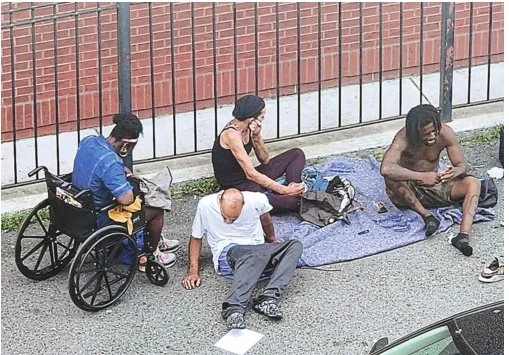
Providence officials must be willing to take on the ACLU and address the ever-more-serious panhandling and loitering problem in Providence. It seems obvious that the city’s failure to stop this epidemic is drawing in more panhandlers in what is not really a freedom-of-speech issue but a public-disorder one. These people are causing traffic problems, littering and harassing citizens just trying to go about their business. And, of course, hurting the economy. Time to enforce common-sense ordinances. Go up to the U.S. Supreme Court if necessary.
-- Robert Whitcomb
David Warsh: Duking it out about the European economic crisis
This first ran in economicprincipals.com and then on the site of the Providence Committee on Foreign Relations (thepcfr.org)
Towards the end The Euro and the Battle of Ideas (Princeton, 2016), by Markus Brunnermeier, Harold James and Jean-Pierre Landau, the authors observe that most of the debate about the economic crisis of the European Union takes place in the English-language press: the Financial Times, The Wall Street Journal, The New York Times, The Economist. This means it is filtered through a sort of condescension about Europe not really “getting it,” they say.
Moreover, they note that the debate fosters the impression that a considerable gap exists between central bankers and technocratic experts and ordinary folk caught in the machinations of the technocrats. European crises thus are increasingly depicted by populists who see themselves as defending citizens against a cosmopolitan elite.
Doubt it? The authors are too polite to say so, but a case in point is The Euro: How a Common Currency Threatens the Future of Europe (Norton, 2016), by Nobel laureate , a peripatetic Columbia University professor. According to Stiglitz, the Euro has been an abject failure. Policy-makers removed two key adjustment mechanisms from member states – interest and exchange rates – without creating various pan-European policy instruments and safety nets to replace them.
The result, he says, is disastrous, with depressions in some countries worse than the Great Depression. “Europe need not be crucified on the cross of the Euro,” writes Stiglitz. It is time to give up on a single currency, separating the Euro into Northern and Southern versions, with debts of all parties denominated in the softer and more flexible Southern Euro.
Stiglitz’s book has been reviewed in the FT, WSJ, NYT, and The Economist, generally respectfully, often critically (Roger Lowenstein gave the book a proper going-over in the Sunday Times). Meanwhile The Euro and the Battle of Ideas has appeared in none of them. Yet in all respects the latter is the better book. It is harder to read, that’s true. In their determination to expose the roots of the battle of ideas that has escalated since the Euro-crisis began – between the northern, or German economic philosophy, and a southern view, associated since the French Revolution mainly with France – the authors have produced a book that is in equal parts history lesson, international economics primer, guide to cultural differences, and political treatise. .
They have the advantage of being deeply involved. Brunnermeier, who is German, is a Princeton University professor, a cutting-edge international macroeconomist who serves on the European Systemic Risk Board. James, a British citizen, also of Princeton, is an economic historian, author of Making the European Monetary Union and Europe Reborn. Landau is a former deputy direct of the Banque de France and former executive director of both the World Bank and the International Monetary Fund. They write:
"The basic elements of the contrasting philosophies can be delineated quite simply. The northern version is about rules, rigor, and consistency, while the southern emphasis is on the need for flexibility, adaptability and innovation. It is Kant vs. Machiavelli. Economists have long been familiar with this kind of debate and they refer to it as rules versus discretion.''
If that sounds familiar, it’s because European integration is fraught with the same kinds of misunderstandings and misinterpretations as exist between men and women, according to the authors. In the last sentence of the book, they draw the obvious moral: “[W]hat we have characterized as the German view and the French view actually need each other to be sustainable.” As with men and women, in between exists lifetimes of negotiation, including some doleful possibilities. Surmounting many little crises all at once often results in closer union; too many crises all at once may mean divorce.
If Europe is high on your list of concerns, you should read this book; European leaders will. Otherwise you can go to whatever is next among your Sunday responsibilities. I have no time to do it justice here to the intricacies of its Teutonic /Mediterranean, east-of-the-Rhine/west-of-the-Rhine arguments. For me, the most intriguing idea was the brief discussion of the emergence of Spitzenkandidaten (leading candidates, in English) that Brunnermeier, James and Landau identify as a promising sign.
Popular election of European leaders appeared for the first time in 2014. Instead of waiting, as in the past, to be assigned to the task by log-rolling heads of state, pan-European candidates competed directly with one another to head the European Commission. They traveled around the EC’s twenty-eight member states, debating each other and giving interviews to local media, each in his or her own language.
Ever-better simultaneous translation is in the offing. British premier David Cameron was, not for the last time, the big loser. Here is an excellent video account of the innovation, as buoying, at least to my mind, as a quick trip to Berlin, Meanwhile, a little less hectoring from I-told-you-so American economists would be welcome.
David Warsh, a longtime economic historian and financial columnist, is proprietor of economicprincipals.com, where this first appeared.