
Vox clamantis in deserto





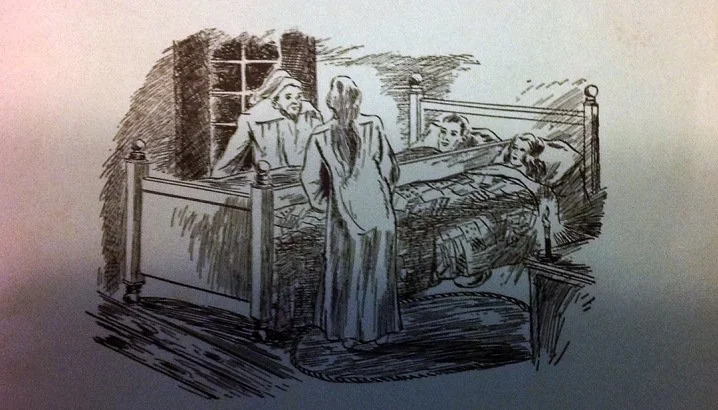
Blighted and bright college days
The dangers of afternoon naps

"Seance II,'' by HYMAN BLOOM,'' at the University of New Hampshire Museum of Art.
Survey map of surveillance
 "I See You'' (gouache/pencil marker on paper ), by BRENDA VAN DER BEEK, at Galatea Fine Art, Boston, in a Feb. 1-28 show.
A troubled beauty


Manmade beauty within natural beauty -- but not refuges from reality. That's what William Morgan has described in his new book, with gorgeous photos by Trevor Trento: "A Simpler Way of Life: Old Farmhouses of New York & New England'', published by Norfleet Press and selling for $49.59. This book itself can be a heirloom.
Mr. Morgan, a distinguished architectural historian, has written a text that does not sugarcoat the tough and uncertain lives led by many farmers, especially when most of these farmhouses were built, in inland, upland New England and New York State, in the late 18th Century and well into the 19th.
The farmers were constantly at the mercy of the weather, far-away market forces and other factors over which they had no control. The book is informed by a deep understanding of the architectural, social and economic history, and life today, of the rural part of our corner of North America.
Messrs. Morgan and Mr. Trento implicitly make the argument that the old country house can be as beautiful as any mansion, while evoking more humanity. There's a poignancy about these old houses.
But, my God, they sure can be hard to heat and maintain!
Laying a glove on Seekonk

Stick together till spring

"Both'' (oil on panel), by ELLEN GRANTER at Peter Alpers Fine Art, Andover, Mass.
Chris Powell: Get paid to hire back those you fired
By CHRIS POWELL

Maybe other big employers in Connecticut will get an idea from the state
Economic and Community Development Department's latest excursion into corporate
welfare.

Last March ClearEdge Power Corp., owner of the former United Technologies Corp.
fuel-cell factory in South Windsor, laid off more than 100 employees. But this
week state government loaned the company $1.4 million at a deeply discounted
rate, with about half the loan to be forgiven if the company adds 80 employees
over three years. Rehiring employees laid off in March will count toward the
total of new employees to be added to achieve loan forgiveness.

So in Connecticut you now can lay off your workers and then get money from state
government for hiring them back.

The economic development commissioner, Catherine Smith, explains this as a plan
to induce ClearEdge to expand in Connecticut rather than at its facilities in
Oregon and California. But the plan will work only at the expense of inviting
more big employers to blackmail state government -- not just by threatening to
move but also by laying off employees and then demanding that state government
ransom them.

While the Democratic Party still poses as the party of working people, the
“economic development” policy of Connecticut's Democratic administration takes
from the poor to give to the rich. Big employers have blackmail power; small
employers don't. So small employers and their employees pay more in state taxes
to subsidize bigger companies and their employees.

Yes, many states are subsidizing big employers this way and inducing subsidy
competitions with other states. But since subsidies to big business come at the
expense of small business, both in taxes and general competitive disadvantage,
the best economic development policy still is a tax and regulation regime that
is favorable to all businesses without regard to size.

Connecticut's unattractiveness to business and residents alike did not arise
from a lack of subsidies to particular businesses but rather from the failure of
government generally to provide value even as it has
grown and become more expensive.

That is, education policy has not been producing more or better education but
mainly has just been enriching educators. Welfare policy has not reduced poverty
and enabled and required people to start supporting themselves but rather has
worsened dependence and anti-social behavior. Connecticut's government employee
policies practically forbid ordinary public administration. And so forth.

Connecticut's big problem is that the premises of some of its major policies are
mistaken or, really, mere pretexts for parasitism.

* * *

According to a recent study by the state Office of Policy and Management, as
reported by the Waterbury Republican-American, revenue foregone by state tax
exemptions totals nearly half of state government's tax revenue -- $7 billion in
tax breaks against $15.3 billion in receipts.

While some broad exemptions may be sensible and command wide support, like the
exemption of food from the sales tax, many exemptions are obscure and the
product of special pleading or pandering, like the celebrated exemption for
clothing and footwear. Legislators propose dozens of such tax breaks every year
and some become law, like the one enacted last year to give tax credits for
restoring historic houses.

Apart from basic decency, which explains the food exemption, there may be only
one justification for tax exemptions: efficiency, as when application of a
general tax to a specific transaction will forfeit more money than it raises, by
driving business out of state. By that standard state government probably could
raise billions of dollars or finance billions in general tax reduction by
repealing many less compelling tax exemptions.

But it has been many years since Connecticut has been able to appropriate that
much political courage.


Chris Powell is managing editor of the Journal Inquirer in Manchester, Conn.
Better without the players
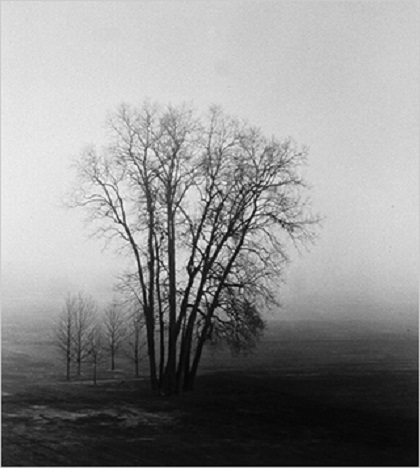
"First Tee,'' by DIANNE BUNIS, at Gallery Seven, in Maynard, Mass.
She specializes in large-format black and white photography of the New England landscape, using the Zone System.
With the decline of farming, golf courses are some of the few remaining open stretches of green (or brown) open land in much of the Northeast. That's nice, although they'd look better if they had animals grazing on them. They're wonderful to run in, in the winter.
Something to look forward to

"Redbud Tree in Bottomload,'' photo by ELIOT PORTER, at the Portland Museum of Art (but photo is copyrighted by Amon Carter Museum of American Art, Forth Worth) in the Portland Museum's show "American Vision: Photographs from the Collection of Owen and Anna Wells''.
Please comment via rwhitcomb51@gmail.com
Jan. 7, 2014
Cold morning today but far from the "polar vortex'' catastrophe that it's being made out to be by the news media because their denizens think that nothing much else is going on. Of course, lots of stuff is going on but it bores those reporters and editors who haven't yet been laid off in the ferment caused by the triumph of mostly ''free'' information on the Internet. And maybe the public doesn't care all that much either.
Most importantly, "polar vortex'' sounds like a horror-movie monster. Very sexy. More vortexes to come because global warming is screwing up the jet stream? Too early to say with scientific assurance.
It's all rather typical of January, the coldest month. But February is often the snowiest because warm wet air begins to edge north again, setting up conflict with the cold air. Great for creating Nor'easters! Arctic air and the Gulf Stream can be in explosive proximity.
As I walked the dog this morning I enjoyed the crunch of my feet on the thin layer of snow that had fallen overnight as the front swung through from Canada, bringing a snow squall or two. And the frozen trees were creaking. Too cold to be slippery! The problem in the coastal Northeast is the wind. It can make urban walking miserable. When I lived in the Upper Connecticut River Valley, the temperature could be much colder than in Boston, Providence, New York and Philadelphia but the comfort level much higher because there was much less wind and it was very, very dry. Sort of exhilarating -- bright and almost antiseptically clean.
Meanwhile, along the lines of ever-more "nurturing'' of children by parents and schools (at the ones I attended we were often called by our last names and there wasn't much open concern for our feelings), is the practice of clothing our dogs for winter walks, even outside of the Upper East Side of Manhattan. I must confess that my wife and I have adopted this habit. The dog, a rescue mutt from San Antonio (via "Alamo Rescue''), fought having a coat on at the start but has since accepted it -- especially when it's windy.
My most physically painful memories of winter are in the streets of big cities with the northwest wind squeezing between the high buildings.
When it's really, really cold, ice is so sticky that you don't even worry about driving up and down steep snow-covered hills. A few times I had to drive my drunken mother to a drying-up spa at a place called Beech Hill Farm, on top of a mountain in Dublin, N.H. -- the little town where Yankee magazine was, and is, put out and where Mark Twain spent some happy times. If it was the winter, I'd pray for very cold weather. Around freezing was the most insidious, with a thin layer of melting in the sun, then quick refreezing toward evening.
The dramatic freeze-thaw cycles in New England make skiing more, well, exciting here than on the dusty, dry "powder snow'' promoted by resorts in the Rockies. Skiing in the White and Green mountains is much more of a challenge to muscles and nerves than is skiing at, say, Taos.
Anyway, I long for late February, when sun-facing cars and rooms suddenly seem to start to warm up much faster as the sun gets stronger. Even on a very cold day last week, I found the stone on a southwest-facing wall remarkably warm. We really do need to do a lot more with passive solar heating.
'Pretty white gloves'
By PAUL STEVEN STONE
CAMBRIDGE
He sits on a folded-over cardboard box, slightly off-balance and without any visible sign of support other than the granite wall of the bank behind him and the few coins in the paper cup he shakes at each passerby.
Does he realize it is 4 degrees above zero, or minus 25 degrees if you factor in the wind that blows through the city and his bones with little concern for statistics? Does he notice the thick cumulus lifeforms that escape from his mouth in shapes that shift and evanesce like the opportunities that once populated his life?
Can he even distinguish the usual numbing effect of the cheap alcohol from the cruel and indifferent caress of this biting alien chill?
Too many questions, he would tell you, if he cared to say anything. But his tongue sits in silence behind crusted chapped lips and chattering teeth while half-shut eyes follow pedestrians fleeing from the bitter cold and his outstretched cup.
His gaze falls upon the hand holding the cup as if it were some foreign element in his personal inventory. Surprised at first to find it uncovered and exposed, especially in weather this frigid, he now recalls that someone at the shelter had stolen his gloves and left in their place the only option he still has in much abundance.
Acquiescence.
Examining the hand, and the exposed fingers encircling the Seven-Eleven coffee cup, he smiles in amused perplexity, murmuring to himself, “White gloves.”
Lifting his hand for closer inspection, he adds, “Pretty white gloves.”
An image of his daughter . . . Elissa, he thinks her name was . Yes, Elissa!, he recalls. An image of Elissa rises up in his mind, from a photograph taken when she was ten and beautifully adorned in a new Easter outfit: black shoes, frilly lavender dress and hat and, yes, pretty white gloves. The photo once sat on a table in his living room, but he couldn’t tell you what happened to it, nor to the table or the living room, for that matter. They were just gone. Swept away in the same tide that pulled out all the moorings from his life, and everything else that had been tethered to them.
The last time he’d seen Elissa she was crying, though he no longer remembers why. Must have been something he’d done or said; that much he knows.
“Pretty white gloves,” he repeats, staring at his hand.
He recalls the white gloves from his Marine dress uniform. At most he wore them five times: at his graduation from officer’s training school, at an armed services ball in Trenton, New Jersey, and for three military funerals. There was never a need for dress gloves in Vietnam. They would have never stayed white anyway; not with all the blood that stained his hands.
Out of the corner of his eye he can see a policeman walking towards him and instinctively hides his cup, some vestige of half-remembered pride causing him to avert his gaze from the man’s eyes at the same time.
“We need to get you inside, buddy,” the officer says. “You’ll die of cold, you stay out here.”
Moments later, a second police officer, this one a woman, steps up to join them.
“That’s the Major,” she tells her colleague. To the seated figure she offers a smile.
“You coming with us, Major?”
“Go away,” he answers, looking up as he leans further against the cold granite wall. “Don’t need you. Don’t need no one.”
“Can’t leave you out here,” the first officer says. “We’ve got orders to bring you and everyone else in.”
“Leave me alone!” the seated man shouts, gesturing with his hands as if he could push them both away.
“Oh shit,” the female officer says under her billowing breath. To her partner she whispers, “His hands. Look at his hands.”
Quickly recognizing the waxy whiteness for what it is, the officer shrugs, “Guess we’re a little late.”
To the man on the sidewalk, he offers, “That’s frostbite, buddy.”
“No,” the seated man protests. He holds up both hands, numb and strange as they now feel and offers a knowing smile of explanation.
Just like the Marine officer he once was, just like the sweet innocent daughter he once knew, just like the young man grown suddenly old on a frozen sidewalk, his hands are beautiful and special in a way these strangers will never understand.
“White gloves,”he insists proudly.
“Pretty white gloves.”
Paul Steven Stone is a Cambridge-based writer. His blog, from which this comes, is www.paulstonesthrow.com.
Public-sector embarrassments

From HELEN PAYNE'S show "Here I Sit, Brokenhearted" at the Bromfield Gallery, Boston.
The gallery says her show is an " installation on bathroom tiles where drawings make visceral vignettes, showing moments ranging from giving birth to getting booked. A shape-shifting protagonist emerges from the tiles. She morphs in time and race and limps along at odds with expectations but at one with viscera.''
It's "about the ill fit of the body and how our most private moments can play out in the public sphere.''
Our private moments playing out in the private sphere can be bad enough.
Baby Boomers as shut-ins; Gees' infernal groves of academe

Will America soon get more realistic about the “Silver Tsunami” of Baby Boomers heading into old age? So far, the nation’s policymakers have mostly been in denial, though it’s probably the biggest fiscal and social challenge of the next few decades in America and Western Europe.
But then, most Boomers themselves have been in deep denial. Many have not saved nearly enough money. They might have been lulled into complacency by seeing how many of their parents, beneficiaries of historical luck, have lived comfortably on old-fashioned defined-benefit pensions (and Social Security), which many of them started enjoying upon remarkably early retirements.
Some of the oldest Boomers — those born in the late 1940s — have those traditional pensions; most of the younger ones will have to settle for, at the most, 401(k)s. Meanwhile, most Boomers underestimate how much ill health will beset them as they age.
But there are even bigger problems. Consider how dispersed America (capital of anomie) has become. As always, many families with children break up as couples divorce — though more and more the couples don’t get married in the first place — and people move far away from “home” to seek jobs or better weather, or are just restless. This leads to a sharp decline (accelerated by modern birth control) in the number of large but close-knit families. At the same time, there has been a huge increase in the number of younger families where only a very harried mother, who may well never have been married, is the sole parent in place, amidst a societal emphasis on “self-actualization” above family and civic duties. All these factors mean that a lot of old people won’t have the family supports enjoyed by previous generations of old people, even as they generally live longer, albeit with chronic illnesses.
There are, of course, retirement communities, with some of the high-end ones set up like country clubs. The better ones have gradations of care, from independence, within a rather tight if safe community, organized by for-profit or nonprofit organizations, to “assisted living,” which usually involves residing in an apartment and getting help with some daily tasks, and, last, the nursing-home wing for those who have slipped into full-scale dementia or are otherwise disabled.
But plenty of people can’t afford to live in a retirement community.
More realistic and pleasant for many folks are such organizations as the Beacon Hill Village model, in Boston. In this, for hundreds of dollars a year in dues you become part of a formal network of old people (and thus indirectly the networks of their families and friends) and get such services as easy access to transportation, shopping, some health-care connections and trips to cultural events. The central idea is to let people “age in place” — to stay in their homes as long as possible.
Of course, most old people eventually get very sick and end up in the hospital and/or nursing home. But the Beacon Hill approach is attractive — if you can afford the dues.
The fact is that most oldsters will have to create their own informal networks of family and friends to help look after each other as their mobility declines. And in the end, the majority must depend on family members, if they can find them. So often, obituaries report that the recent decedent was at the time of demise in some strange place with no seeming link to his or her past. It’s very often the community where a child — more often a daughter — has been living. As Robert Frost said: “Home is the place where, when you have to go there, they have to take you in.” “They” generally means a relative, not a friend.
Until then, will you have enough loyal friends to look after you when you get really old? You’d better make sure that your pals include some folks too young to live in retirement communities.
***
Hurrah for “Higher Education: Marijuana at the Mansion,” Constance Bumgarner Gee’s well-written memoir. Most of the self-published book is about her time as the wife of the very driven, peripatetic and big-spending E. Gordon Gee, who has led the University of Colorado, West Virginia University (twice), Ohio State University (twice) and Brown University, where he had the tough luck to succeed the much-liked and world-class hugger Vartan Gregorian, who had gone on to run the Carnegie Corporation of New York.
There’s lots of, by turns, hilarious and sad personal stuff in the book — about her sometimes bizarre relationship with her immensely well-paid and workaholic husband, the silly controversy about her using marijuana to treat her Meniere’s disease, her love of her riverfront house in Westport, Mass., and her ambivalent attitude toward her native South. But best is her vivid portrayal of university boards and administrations these days.
It’s not a pretty picture. The social climbing, empire-building, brand obsession, backstabbing and money-grubbing don’t present many good civic models for today’s students. The stuff at Brown was bad; it was much worse at Vanderbilt in Mrs. Gee's story. Big universities are starting to look like New York City hedge funds whose partners are driven to build ever bigger houses to show off to each other in East Hampton.
Now to reread Mary McCarthy's novel "The Groves of Academe''.
Robert Whitcomb (rwhitcomb51@gmail.com), a former editor of The Providence Journal's editorial pages, is a Providence-based editor and writer.
An old-fashioned face
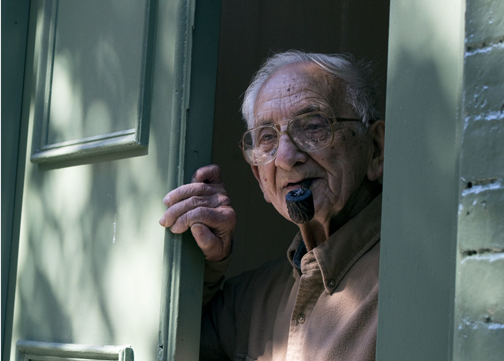 "North End Saturday" (photo), by JUDITH MONTMINY, in the "Synergies: New Gallery Artist Expo," at South Shore Art Center, Cohasset, Mass.
What a face of weathered wisdom (however misleading it might be)! Of course, he would be told not to smoke a pipe -- danger of oral cancer.
But pipe-smoking used to be considered a sign of calm, good humor and, yes, a kind of healthiness. A lot of doctors smoked pipes; it went along with their bow ties. But then, they'd do ads for cigarettes, too. Just look in a big magazine from the '40s. "Not a cough in a carload!"
Hard-wired for art

From the ''Head'' series of Mary Mead (here a woodcut intaglio monoprint), in her show at Kingston Gallery, Boston, to open Jan. 10.
Don't send out for ice

"Breaching Iceberg: Greenland, August 8'' (photo), b y CAMILLE SEAMAN, in the show "Seeing Glacial Time: Climate Change in the Arctic, '' through May 18 at the Tufts University Art Gallery, Medford, Mass.
The layered effect

"Winter Painting',' by DAVID BARNES, in his show at the Hess Gallery at Pine Manor College, Chestnut Hill, Mass., through Jan. 20.
When I was a kid, I couldn't sleep in gleeful anticipation of blizzards, which were particularly dramatic at our house on the top of a windy hill near the sea. Now I still can't sleep but the snow seems like a blanket of death.
How we ended 2013 and entered 2014
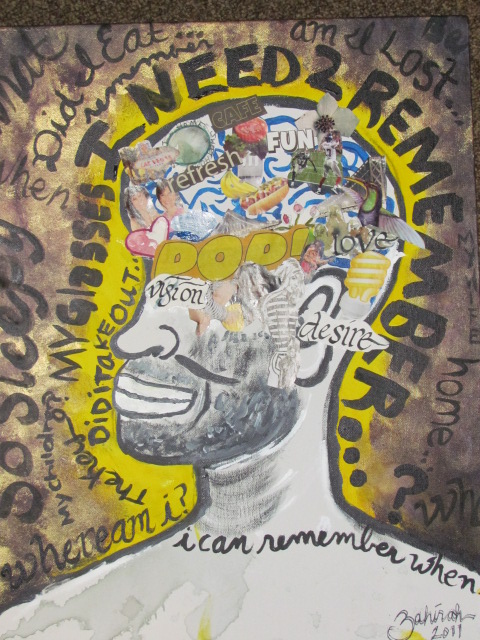
Painting by ZAHIRA TRUTH, at Roxbury Open Studios, Boston.
Blank slate, for a minute
A perfect New Year's Day morning here in southern New England -- cold, calm and head-clearing, with cirrus clouds suggesting more storms to come.
From the capital of New Year's Eve

"Saarinen Reflections, New York '' (digital c-print, 60 x 48 inches). by MICHAEL EASTMAN, at Heather Gaudio Fine Art, New Canaan, Conn.
Chris Powell: What have you got for this patient?
By CHRIS POWELL

MANCHESTER, Conn.

Hey, supporters of "Obamacare" -- the Affordable Care Act: Take a look at the case of the 10-year-old girl in Oxford, Conn., whose story was told the other day by the Waterbury Republican-American. Her small intestine has failed and she needs a transplant. She's ready for surgery at a hospital in Pittsburgh but her family's medical insurance won't cover the whole cost and the hospital won't undertake the surgery without proof of full funding.

So the girl's family and friends are holding little events in the community and soliciting neighbors as they try to raise the $65,000 needed. They're still about $35,000 short.

While it is denounced as sweeping and intrusive, "Obamacare" won't help the girl or thousands of others like her with remediable conditions whose families have been reduced to begging for their lives even as the government pours money down toilets from Afghanistan to the National Endowment for the Arts.

And hey, opponents of "Obamacare": What have you got for that girl and her family? The slogan used by opponents of "Obamacare" in Congress has been “repeal and replace,” but while they have held many votes to repeal, they have not yet offered any plan to replace.

People having to beg for their lives or those of loved ones when saving them is entirely possible -- what kind of society is this?

* * *

Recognizing the clamor about excessive sentences for nonviolent drug offenders, President Obama has commuted the sentences of eight federal prisoners who already had served at least 15 years for involvement with crack cocaine. Incredibly, six of them had been sentenced to life.

Three years ago federal law reduced crack cocaine sentences to the level of sentences for powder cocaine, but thousands of people remain in prison serving the harsher sentences even as there is no sign that the criminal-justice approach to drugs is anything but an economic stimulus program for employees of law enforcement and the illegal drug trade. The criminal-justice approach to drugs is also oppression of the poor, who disproportionately see the drug trade as economic opportunity and end up in prison for it.

At least Connecticut's Sentencing Commission is recommending reducing from 1,500 feet to 200 feet the circumference of the silly “drug-free” zones around schools. Since very few drug sales are to children, those zones don't protect kids; they only enable police to pile extra criminal charges on anyone caught doing drugs in cities.

Arguing for medicalizing the drug problem, LaResse Harvey of Hartford's Better Way Foundation told the commission that the best way to protect children from drugs is to help their parents overcome addiction. But in Connecticut most people in authority couldn't care less if half the young men of color are imprisoned over drugs as long as the other half can be hired to guard them.

* * *

South Windsor Conn.'s police department soon may lead the way toward greater accuracy and accountability in police work and criminal justice in Connecticut. Chief Matthew D. Reed says the department is studying whether to equip its officers with body cameras to record every word and movement in their work.

Like many police cruisers, the South Windsor department's are already equipped with dashboard cameras, but what they record is very limited.

Besides serving as a comprehensive record, video and audio from body cameras can protect people against police misconduct and protect officers against the false complaints commonly made against them by criminals and traffic scofflaws. If there's videotape, there will be far fewer false charges by officers and their targets alike and there will be much less time spent in court sorting out the credibility of witnesses.

Being videotaped, more people will be on their best behavior -- at least until the so-called victims' rights movement gets police videotape exempted from Connecticut's freedom-of-information law because disclosure might hurt somebody's feelings.


Chris Powell is managing editor of the Journal Inquirer in Manchester, Conn.