
Vox clamantis in deserto









Llewellyn King: The birth of a new reactor
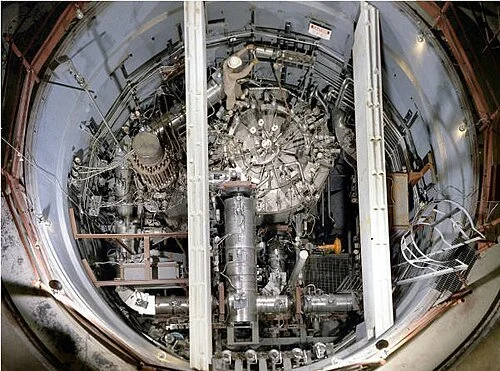
Early thorium-based (MSR) nuclear reactor at Oak Ridge National Laboratory in the 1960s.
WEST WARWICK, R.I.
If you are designing a car from scratch, there are certain essentials to begin with. You need to start with the wheels on the corners, for example.
But when it comes to building a nuclear reactor, things are different. There are hundreds and maybe thousands of ways of doing it. The constant is that you need fissionable fuel and a moderator to collect the heat and manage the neutron flux.
That embarrassment of choice — now reflected in the number of small modular reactors (SMRs) vying for market acceptance — may be why thorium reactors, which began with promise, have been left on the shelf.
The nuclear establishment, goaded by the Nuclear Navy’s Adm. Hyman Rickover, wanted light water technology. That is what the first 100-plus U.S. civilian reactors employed.
At the dawn of the civilian nuclear age, it was a straight contest between two fuels: uranium and thorium. Thorium is fertile but not fissile: It can’t start a chain reaction unless it is triggered by a small amount of the isotope uranium-235.
Once this happens, thorium becomes uranium-232 and fizzes wonderfully with a steady stream of neutrons, producing heat in the moderator, which is where the first steps in making electricity are taken.
That heat is captured to create steam that turns a turbine.
Thorium was used in part in the first power-producing, commercial nuclear reactor: the 60-megawatt Shippingport Nuclear Atomic Power plant in Beaver County, Pennsylvania. With three different fuel assemblies, it ran for 25 years, starting in 1957. It used solid fuel, which was to become the standard for civilian nuclear power.
Meanwhile, at the Oak Ridge National Laboratory, in Tennessee, under its director, physicist Alvin Weinberg, work went ahead on what would become a legendary fast-breeder thorium reactor, using a liquid fuel embedded in molten salt. It went critical in 1965 and operated for five years before it was closed by the Atomic Energy Commission (forerunner of the Department of Energy) in a political move.
A fast reactor uses extra neutrons to create new fuel and burn up radioactive waste. The process is akin to perpetual motion — but isn’t, of course.
Now a charismatic nuclear engineer, Yash Patel, founder and CEO of AMR Reactor, is planning to bring thorium back as a viable future option for space exploration, power generation and, eventually, ship propulsion.
Patel told me he has designs for a microreactor (under 20 MW) and for a SMR (250 MW). The planned reactors are molten salt-moderated, thorium-fueled fast reactors.
He believes they will not only be cheaper, but will also operate better than the SMRs now entering the market.
Patel’s plan for Austin-registered AMR Reactor is to outsource as much of the fabrication as possible.
A fast reactor is called a breeder reactor because it generates more neutrons than are needed to produce fission, and these transmute waste into additional fuel.
Patel went to school in California and while looking for a career, a break came that changed the trajectory of his life. He got an internship with NASA at the Jet Propulsion Laboratory. There he worked on Curiosity, the plutonium-fueled Mars rover. His nuclear love affair, he said was “complete and instant.”
From NASA, he went to Texas A&M and graduated in nuclear engineering. He was well along with his PhD, when a family illness caused him to abandon it.
Patel lists two great blessings in his life. “The first was that I moved to America from India. The second was attending Texas A&M. That was another wonderful break.”
After a stint in biopharma, where he prospered, Patel started designing reactors in all his waking hours along with a friend, D’mitri Scott, now the chief technology officer at AMR Reactor.
Patel said the numbers didn’t work for their plans until they switched to thorium. It was a eureka moment.
There followed a period which he likened to Bill Gates and Steve Wozniak working on the first computer operating system. The two young men were obsessed and inspired by what they believed was extraordinary. “Our girlfriends, now our wives, saw very little of us. We sometimes worked all night,” Patel said.
With thorium, they found all they were looking for: a stable source of reliable power that was safe, couldn’t melt down, and was able to handle most of the fission products.
And it was proliferation-proof because of the presence of intense gamma radiation, which made it hard to process, steal or divert. “Thorium was the winner,” he said.
A new reactor is on the way.
Llewellyn King, an international energy-sector consultant, is executive producer and host of White House Chronicle, on PBS. His email is llewellynking1@gmail.com and he’s based in Rhode Island.