Vox clamantis in deserto







Chris Powell: Teachers unions ready to take over Connecticut
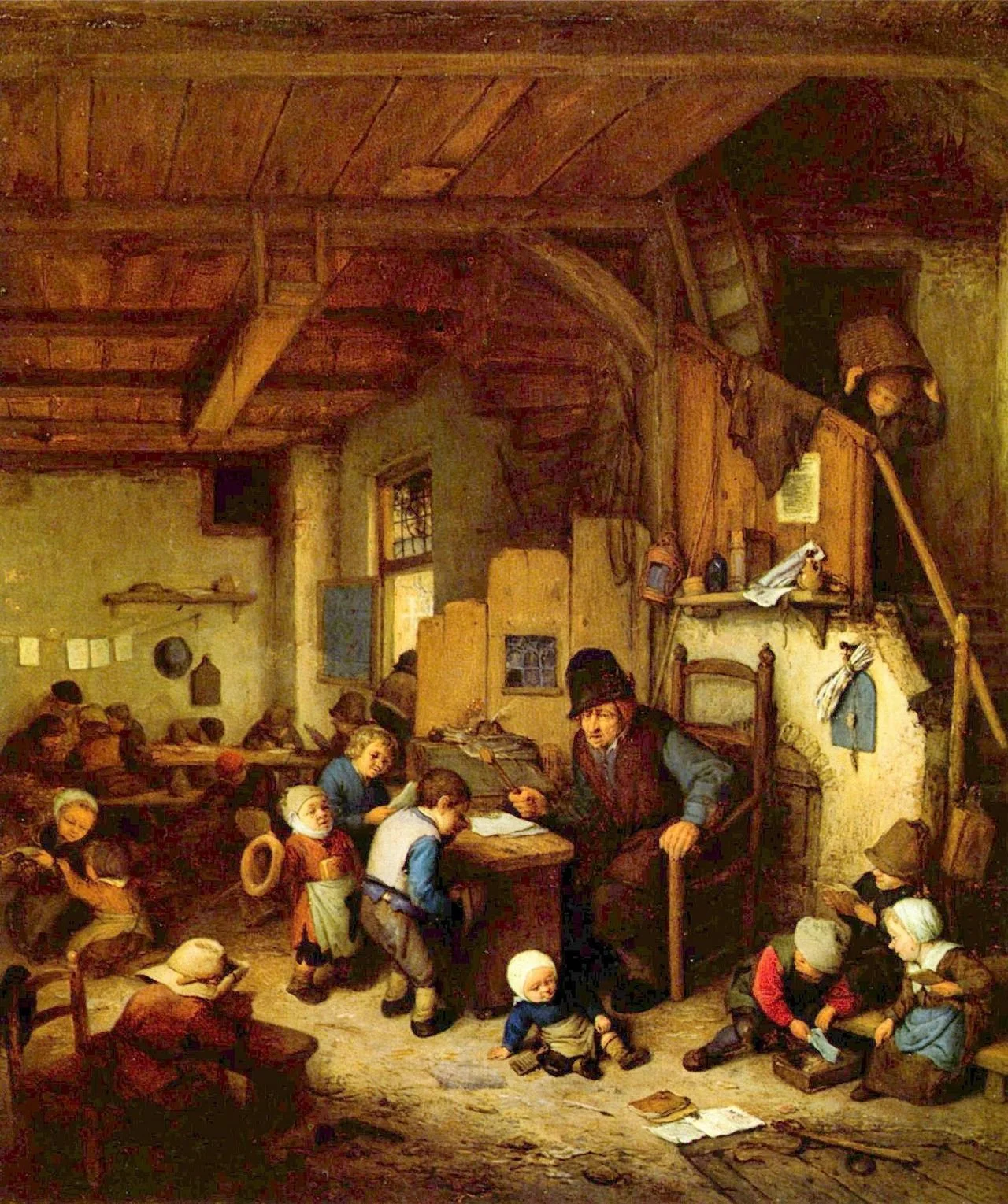
“Dutch schoolmaster and children” (1662), by Adriaen van Ostade.
MANCHESTER, Conn.
For many years Connecticut's teacher unions ran a discreet political racket. Many of their members would hold teaching jobs in towns adjacent to the towns in which they lived and then seek municipal office in their home towns, particularly office on their local board of education. They were usually elected.
This arrangement -- working in one town, getting elected in another -- would mask a potential conflict of interest, wherein, as municipal officials, these board members would decide on or even negotiate contracts with a local affiliate of the statewide union to which they also belonged via their job in a neighboring town. Were board members most loyal to the public interest or to their union interest?
Since the connection of school board members to the union whose members get most money spent by school boards was seldom reported by news organizations, the question of primary loyalty was not posed in public forums. If it had been posed, it might have elicited a claim that the public interest and the union interest were identical. That might have been an interesting discussion.
The teacher unions racket is no longer discreet. For the Yankee Institute's Meghan Portfolio reported the other day that the state's largest teacher union, the Connecticut Education Association, now celebrates the racket. The union's December newsletter proclaims that in November's municipal elections 57 CEA members won elections in more than 45 towns, with only five of the union's candidates losing.
The CEA newsletter, Portfolio writes, “makes clear this was no spontaneous wave of civic participation. Candidates were guided through a union-run pipeline, including a formal questionnaire process and participation in the National Education Association's ‘See Educators Run' program."
The union threw its resources into its members' campaigns with e-mails, text messages, flyers, telephone calls, and door-to-door canvassing. Since name recognition and personal contact are the main deciders of most municipal elections, such electioneering is usually successful, especially since news coverage of school board elections, always skimpy, has vanished.
Indeed, the CEA may already have figured out that with just a little more effort it can gain control of every school board and town council in the state before people realize what is going on, there being no one left to tell them.
Of course this is only democratic politics in the era of local journalism's demise. Even people with the worst potential conflicts of interest have the right to run for public office, and special interests with access to big money, especially money derived from government, heavily influence if not control all sorts of political nominations and elections everywhere, though this is most pronounced with teacher unions’ power in the Democratic Party. Teacher union members typically constitute 10 percent of the party's national convention delegates.
But the special-interest influence in politics and government may be worst with teacher unions, since education is the prerequisite of democracy. Destroy education and you destroy democracy, and the trends in American education are terrible. Enrollments, student proficiency, and accountability are falling even as school costs keep rising, and civic engagement is collapsing along with journalism and literacy generally.
This is the perfect environment for special-interest control of government. No wonder the CEA, special interest No. 1, is celebrating.
College-student-loan debt remains a huge problem, so people may have welcomed the announcement last week that Connecticut's Student Loan Reimbursement Program has begun accepting applications for reimbursement of college student loan payments made in 2025.
Reimbursement of up to $5,000 per year is available to Connecticut residents who earned a degree in the state and are making $125,000 a year or less.
This isn't fair. It's really a bailout for the failure of higher education, which is grossly overpriced, long having awarded degrees of little use in making a living and having stuck its victims with debt that seriously impairs their lives or that, as with Connecticut's reimbursement program, is transferred to taxpayers, many of whom did not attend college or paid their own way.
It's another part of the education racket.
Chris Powell has written about Connecticut government and politics for many years (CPowell@cox.net).
Chris Powell: Conn. devalues education while throwing more money at it
MANCHESTER, Conn.
Except to the teacher unions, Connecticut's Linda McMahon is a big relief as secretary of the U.S. Education Department, mainly because her predecessor, Connecticut's Miguel Cardona, was such a disaster.
Cardona spent most of his time pandering to the unions. In contrast, the other day McMahon celebrated National Charter Schools Week, applauding competition among schools and the reduction of union influence, which has dumbed down education while inflating its costs.
As long as the teacher unions have so much power in the Democratic Party, and are the foremost special-interest in politics in most states, as in Connecticut, there's no chance of saving public education, and alternative schools may be the only way of preserving any education at all.
Still, it would be nice if somebody tried to restore public education. For public education often used to accomplish what private education seldom could and usually didn't even try to do: integrate society comprehensively -- racially, ethnically, religiously, economically, and by all levels of student intelligence.
Of course, children would and will always be bratty, snobby, cruel, and cliquish much of the time, but even then public schools still can introduce them to different kinds of people and force them to deal with differences and thereby get a hint of the need to unify the country.
Regional “magnet’’ schools in Connecticut and elsewhere were meant to increase racial integration by putting city and suburban students together across municipal boundaries. But there aren't enough “magnet’’ schools to achieve much integration, and, as Hartford's experience has shown, the integration achieved by “magnet’’ schools has led to greater segregation of the urban underclass. For the "magnet" schools have drawn the more parented and engaged students out of neighborhood schools in the city, leaving the students in those schools even more indifferent and demoralized.
The urban underclass is the essence of the education problem. Many people naturally want to escape it and place their children in schools that aren't dragged down by their demographics. That means “magnet’’ or charter schools or, most of all, fleeing the city for the suburbs, not that all suburban schools are so much better.
The only way to recover the integrative influence of public education may be to try to improve public education everywhere at once, first by recognizing that student learning correlates far more with parenting than with school spending. Parenting has declined not just because welfare policy is so pernicious, subsidizing fatherlessness and child neglect, but also because government and schools have let parenting decline by eliminating behavioral and academic standards for both parents and students.
There are no penalties for parents who fail to see that their children get to school reliably. There are no penalties for parents who avoid contact with their children's teachers when something is wrong. There are no penalties for parents or students when students fail to learn.
Indeed, Connecticut's only comprehensive policy of public education -- social promotion -- destroys behavioral and academic standards. It proclaims to parents and students alike that there is no need to learn and that school isn't important. Thus Connecticut devalues education even while increasing its cost.
Connecticut's underclass has figured this out. The underclass knows that no student needs to earn a high school diploma, and that people who have children they are unprepared to support will be subsidized extensively by the government in a fatherless home -- subsidized enough to avoid starvation but not enough to get a proper upbringing.
But if even ignorant students must be graduated from high school, at least their dismal academic records could be printed on their diplomas so a diploma might mean something again, if only a horror story.
Making failing students repeat grades, as was done before self-esteem trumped learning, would have even more impact. Limiting students to two repeated grades before graduating them early but ignorant would have still more.
Until society forcefully demonstrates its respect for education and realizes that just throwing more money at it doesn't work, the underclass won't respect it either.
Chris Powell has written about Connecticut government and politics for many years (CPowell@cox.net).

Chris Powell: Teachers of your memories, and today’s

The Wylie School, in Voluntown, Conn. Built in 1856, this public “one-room” school house was used by the town until 1939. It is now used as a meeting space and museum by the local historical society. The building is listed on the National Register of Historic Places.
MANCHESTER, Conn.
Nearly everyone will forever remember some admired or even beloved teachers whose insights, enthusiasm and caring pointed students in the right direction. Of course, there were and are some mediocre, incompetent and even malicious teachers too, but they are easily forgotten.
So even as society becomes more fractious and angry, there is still a cult of respect around the teaching profession.
But that cult may not last much longer as teacher unions, most notoriously in big cities like New York, Chicago and Los Angeles, but also in most states, including Connecticut, obstruct normal school operations amid the virus epidemic. The unions insist on perfect protection against the virus when there is no perfect protection, though risk of transmission is far lower in school than in other places that continue to operate normally.
Of course, the damage to schoolchildren from the loss of in-person schooling has been catastrophic -- not just in education but also in their mental and physical health. Recovery will take years.
The teachers unions long have proclaimed the importance of education and the dedication of their members to students, so now maybe the country will see how empty this prattle has been. In effect, the unions now are proclaiming that education and children don't matter that much at all.
In pursuit of the greater good during the epidemic, risks are being borne by hospital and nursing-home employees, emergency personnel, postal and delivery workers and supermarket clerks and cashiers. But according to the teachers unions, their members cannot bear any risk. No -- if even one student or school employee contracts the virus, even without showing symptoms, the whole school must be closed for a week or two and everyone in it must be quarantined, though children are the least susceptible to the virus and fatalities from exposure in school are rare.
The "remote" learning offered as an alternative to regular schooling is a joke, since as many as half the students don't show up and many of those who do show up are impossibly distracted. But while education is destroyed, everyone employed in its name remains on the payroll anyway, compensated many times better than the supermarket clerks and cashiers without whom no one would be fed.
Connecticut Gov. Ned Lamont and state Education Commissioner Miguel Cardona, President Biden's nominee for U.S. education secretary, are part of this pretense. The governor and the commissioner have been hailed for favoring normal operation of schools, but most of Connecticut's schools have not been operating normally.
Though he has ruled by decree under his emergency powers since last March, the governor has failed to order schools to do anything in particular. Local school boards are free to be intimidated by the teacher unions, as they usually are intimidated along with state legislators and as the governor himself seems to be, since keeping government employee union members happy long has been the primary objective of government in Connecticut.
Some people say that teachers are not pleased with the intransigence of their unions amid the destruction of education. But if teachers are displeased with their unions and are ready to take the same risks as supermarket clerks and cashiers, they have yet to show it. Teachers union leaders may know better than anyone else what is required for election to their offices -- better even than people with happy memories of beloved teachers from many years ago. After all, back then Connecticut's public schools were public -- that is, administered by elected officials. Today, not so much, as even most school administrators are unionized in a conspiracy against the public. School management is not really management.
There’s no harm in cherishing memories of old school days. But they should not blind anyone to the huge change in public education since then, a change that invites the sort of reflection with which the journalist William L. Shirer prefaced one of his books about modern European history. Shirer quoted the great German writer, scientist and statesman Johann Wolfgang von Goethe (1749-1832):
“I have often felt a bitter sorrow at the thought of the German people, which is so estimable in the individual and so wretched in the generality.”
Chris Powell is a columnist for the Journal Inquirer, in Manchester, Conn.