
Vox clamantis in deserto








Llewellyn King: The new ‘news’ media: A pea of news in a mattress of Words

— Photo by Pmau
WEST WARWICK, R.I.
Journalism is choking on the low-hanging fruit.
Every day hundreds of newsletters and podcasts flood inboxes. These are almost entirely concerned with political goings-on in Washington.
But this isn’t to say that journalism is alive and well. In fact, this is a symptom of journalism’s straitened times.
Mostly, there is just a pea of news in a mattress of words.
The web has made the delivery of journalism cheap and easy, but it hasn’t helped with the high cost of covering the news, of sending reporters to see what is happening in the courts, the state houses, and overseas; or in science and technology, which so affect modern life.
It also hasn’t enabled news organizations to spend months on an investigation that may or may not pay off.
Instead, every minuscule development in politics is treated as a big, breaking event, and is analyzed exhaustively.
Analysis is substituting for reporting. The actual snippet of reporting is often attributed to a newspaper like The Wall Street Journal or The New York Times, or one of the news services, say, Reuters.
Analyzing nothing much doesn’t change it to something.
Much of what is rushed out as news wouldn’t get past an old-fashioned editor like Jim Michaels of Forbes, who I am told, in that magazine’s print heyday would chide reporters, saying, “You’re telling me things I already know.”
The ease of distribution and recording has also caused blogs with attendant webinars to sprout across the news ecosystem. Much of it is in the form of analysis, more and more analysis of less and less.
The big new entry in my inbox is magazines which were once monthly or weekly, but have joined the frenzy with daily newsletters. These include The Economist, The New Yorker, The Spectator, The Atlantic and even Vanity Fair.
I subscribed because they were weekly or monthly. I didn’t want a daily gusher.
There is also a plethora of digital-only publications — the best in my inbox is ProPublica, which manages original reporting.
The big ones which are, almost, substitute newspapers but are heavy on political coverage include Politico (which is broader) and Semafor. A new entry, NOTUS, is staffed by former Washington Post reporters. So far, it is heavily political.
I remember when people bought the Post for the Style section and its other goodies, not just its hometown industry of politics.
A further indication of the news drought, despite the torrents of words, is how many of the new dailies are quoting what was said on television. Time was when no print outlet would deign to do that. It was expected for television to pick up from the newspapers, not the other way round.
There was a reason behind the old pecking order: Broadcasting needs to have people say things in front of a camera or a microphone. By contrast, print’s best stories come from sources who are keen not to be identified, let alone go on television or radio.
In today’s vengeful times, unidentified sources are essential, to be used sparingly, but nonetheless essential. The reader has to depend on the high standing of the platform and the integrity of the byline to judge the truthfulness.
There is no doubt that the tumultuous politics that began when Donald Trump entered the arena have been good for cable news stations, which have morphed into political channels, shamelessly partisan. The politics have also been good for newsletters and blogs.
But will that be true after the Trump era? The strictly conservative New York Sun reports traffic to MAGA websites is down dramatically.
To escape the virtual political overload, I reach for the three heavyweights among newspapers: The Wall Street Journal, The New York Times and, though diminished, The Washington Post.
What the bulk of the press, from weeklies to big city papers to the new digital entrants, need is a sound source of income so that they have the money to do the job, to weed out local scandal, corruption and abuse, and to develop entertaining writers.
You get what you pay for and in the news business, since it lost its advertising revenue to the likes of Google, you are getting political froth: opinions about the news — most days the same opinion with shadings of difference from many publishers.
Yesterday, I counted 19 of these offerings in my inbox. I gave up on the breathlessness and read a book.
Llewellyn King is executive producer and host of White House Chronicle, on PBS, and an international energy-sector consultant. His email is llewellynking1@gmail.com , and he’s based in Rhode Island.
Llewellyn King: In the collision between billionaires and news coverage, the public loses

“Big Fish Eat Little Fish,” by Pieter Bruegel the Elder (1556)
WEST WARWICK, R.I.
Trillions, as in trillions of dollars, are being bandied about in the way millions were, then billions. But take a look at 1 trillion expressed numerically: 1,ooo,ooo,ooo,ooo. Awesome, isn’t it? Twelve zeros.
The national debt stands at $39 trillion and the interest on that will top $1 trillion this year.
Very soon the first trillionaire will thunder past the post, presumably Elon Musk.
I have nothing against Musk. And I have nothing against successful people being rewarded for their talent.
Musk has done enormous things. An immigrant from South Africa, he made his first fortune with PayPal. Since then, he has been important in solar-energy revolution, electric cars, and in leading development of a heavy-lift rocket that has made space exploration cheaper than when NASA alone was at the controls. His Boring Company still holds promise.
It is assumed, as so often, that because a person is good at one thing, that same person must be good at everything else. Whoa! Musk’s limits as a manager and a visionary were exposed when he barged about “streamlining” the government for President Trump.
It was a case of a bridge-too-far for Musk — a disaster for America that eroded privacy, critically wounded many departments and saved no money.
Whereas much of what Musk has achieved has been beneficial, his purchase of Twitter, rebranded to X, was evidence of the harm that is a part of gigantic wealth. He wanted to control not just the medium, but also the news.
Musk — although it isn’t good that he has taken steps to control the message with X — isn't the problem facing the media and the public’s right to know. When there is so much money floating around, news-media freedom is in trouble.
The immediate threat comes not from Musk, but from two other men of gargantuan wealth: Larry Ellison, co-founder of the tech firm Oracle Corp., whose personal net worth is estimated at $245 billion, and his son, David.
Together they are set to control the media to an extent not imagined and never seen. The media titans of yesteryear — Pulitzer, Hearst, Luce, Thompson, Sulzberger, Graham and Murdoch — are knee-high to the fearsome power that the Ellisons have, and which will more than double if (and it is more when than if) the merger of their Paramount Skydance Corp. with Warner Bros. Discovery is approved by regulators.
At present, the Ellisons control the CBS Television Network, CBS Sports, MTV, Nickelodeon, Comedy Central, Paramount Network, and BET. They control CBS News, and Paramount+ which has 79 million streaming subscribers.
But if the merger goes through, they will control CNN, HBO Max, and Warner Bros. Studios — a treasure trove of entertainment.
In short, they will control a huge swath of American broadcast news, information dissemination, and movie and television culture.
Their declared purpose is to incorporate more technology and more AI across their astounding current and probably future empire. That is bad for journalism and worse for movies. The invasion of the bots.
I know how media control works. I have seen it firsthand: It isn’t what is said, but what is implied or what employees feel those who own the outlet want. A casual remark can become policy; a hint of preference can become a hard rule.
If an Ellison family member were — of course, this is hypothetical — to say they hated rhubarb, you could bet the Food Network wouldn’t do a show episode on rhubarb pie making. If it were known that one of the owners of Paramount were boosters of nuclear power, movies such as The China Syndrome and Silkwood would never have been made.
In journalism, the story that isn’t covered is as important as the one that is covered. If a disease caused by a common product — asbestos is a good example — isn’t covered because the staff has heard that the media owners love that product or is invested in it, then you can bet it won’t be covered.
Consolidated corporate ownership is antithetical to free speech, creativity, and open government. No news is bad news.
News isn’t suited to the corporate world; it isn’t a fit with those whose interest is adding zeros to bottom lines. It is the pursuit by an irregular army of often eccentric individuals, who turn over stones to find out what is beneath.
Likewise, individual ownership furthers the news objective, which for me was summed up by something Dan Raviv said when he was a correspondent for CBS Radio (recently shuttered by the Ellisons), “My job is simple. I try to find out what is going on and tell people.” Write that in the corporate prospectus.
News organizations need to be owned by news people, such as Ted Turner, Bill Paley and, yes, even Rupert Murdoch.
Llewellyn King is executive producer and host of White House Chronicle, on PBS. His email is llewellynking1@gmail.com, and he’s based in Rhode Island.
Llewellyn King: Cynically denigrating the news media has become a mainstay — attacking the messenger rather than the message
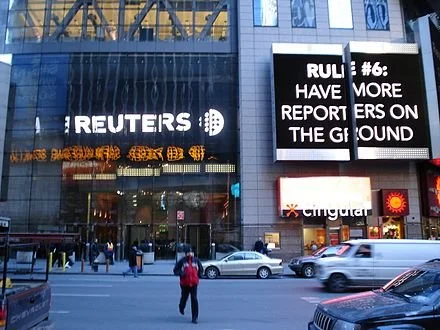
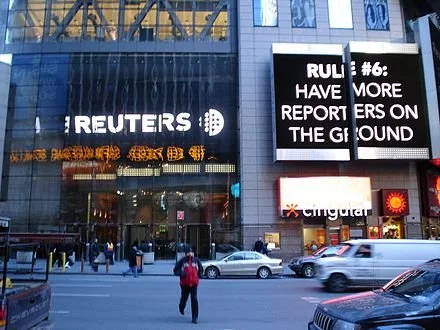
Outside the Reuters news service building in Manhattan
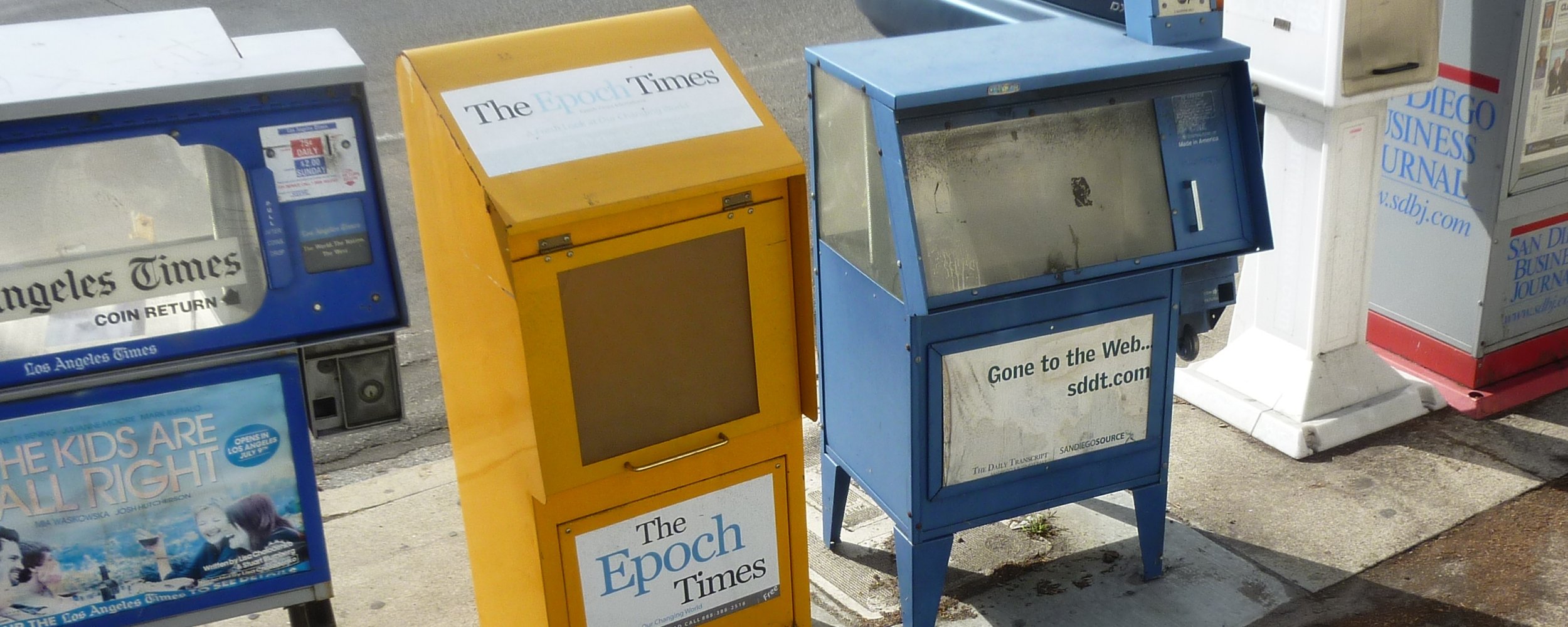
Newspapers "gone to the Web" in California
— Photo by SusanLesch
WEST WARWICK, R.I.
In the 1990s, someone wrote in The Weekly Standard — it may well have been Matt Labash — that for conservatives to triumph, all they had to do was to attack the messenger rather than the message. His advice was to go after the media, not the news.
Attacking the messenger was all well and good for the neoconservatives, but their less-thoughtful successors, MAGA supporters, are killing the messenger.
The news media— always identified as the “liberal media” (although much of the news media are right wing) — are now often seen, due to relentless denigration, as a force for evil, a malicious contestant on the other side.
No matter that there is no liberal media beyond what has been fabricated from political ectoplasm. Traditionally, most news proprietors have been conservative and many, but not most reporters, have been liberal.
It surprises people to learn that when you work in a large newsroom, you don’t know the political opinions of most of your colleagues. I have worked in many newsrooms over the decades and tended to know more about my colleagues’ love lives than their voting preferences.
This philosophy of “kill the messenger” might work briefly but down the road, the problem is no messenger, no news, no facts. The next stop is anarchy and chaos — you might say, politics circa 2024.
Add to that social media and their capacity to spread innuendo, half-truth, fabrication and common ignorance.
There is someone who writes to me almost weekly about the failures of the media — and I assume, ergo, my failure — and he won’t be mollified. To him, that irregular army of individuals who make a living reporting are members of a pernicious cult. To him, there is a shadow world of the media.
I have stopped remonstrating with him on that point. On other issues, he is lucid and has views worth knowing on such subjects as the Middle East and Ukraine.
That poses the question: How come he knows about these things? The answer, of course, is that he reads about them, saw/heard the news on television or heard it on radio.
Reporters in Gaza and Ukraine risk their lives, and sometimes lose them, to tell the world what is going on in these and other very dangerous places. No one accuses them of being left or right of center.
But send the same journalists to cover the White House, and they are assumed to be unreliable propagandists, devoid of judgment, integrity or common decency, so enslaved to liberalism that they will twist everything to suit a propaganda purpose.
That thought is on display every time Rep. Elise Stefanik (R.-N.Y.), an avid Trumper, is interviewed on TV. Stefanik attacks the interviewer and the institution. Her aim is to silence the messenger and leave the impression that she isn’t to be trifled with by the media, shades of Margaret Thatcher. But I interviewed “The Iron Lady,” and I can say she answered questions, hostile or otherwise.
Stefanik’s recent grandstanding on TV hid her flip-flop on the events on Jan. 6, 2021, and failed to tell us what she would do if she were to win the high office she clearly covets.
I have been too long in the journalist’s trade to pretend that we are all heroes, all out to get the truth. But I have observed that taken together, journalists tell the story pretty well, to the best of their own varied abilities.
We make mistakes. We live in terror of that. An individual here and there may fabricate — as Boris Johnson, a former British prime minister, did when he was a correspondent in Brussels. Some may, indeed, have political agendas; the reader or listener will soon twig that.
The political turmoil we are going through is partly the result of media denigration. People believe what they want to believe; they can seize any spurious supposition and hold it close as a revealed truth.
You can, for example, believe that ending natural-gas development in the United States will lead to carbon reduction worldwide, or you can believe that the Jan. 6, 2021 insurrection with loss of life and the trashing of the nation’s great Capitol Building was an act of free speech.
One of the more dangerous ideas dancing around is that social media and citizen journalists can replace professional journalists. No, no, a thousand times no! We need the press with the resources to hire excellent journalists to cover local and national news, and to send, or station, staff around the world.
Have you seen anyone covering the news from Ukraine or Gaza on social media? There is commentary and more commentary on social media sites, all based on the reporting of those in danger and on the spot.
This is a trade of imperfect operators, but it is an essential one. For better or for worse, we are the messengers.
Llewellyn King is executive producer and host of White House Chronicle, on PBS. His email is llewellynking1@gmail.com, and he’s based in Rhode Island and Washington, D.C.
Don Pesci: The news media have a duty to cause turbulence
The Hartford Courant, which began as a weekly called the Connecticut Courant on Oct. 29, 1764, and become a daily in 1837, is considered the oldest continuously published newspaper in America.
VERNON, Conn.
If we can but prevent the government from wasting the labours of the people, under the pretense of taking care of them, they must become happy."
-- Thomas Jefferson to political philosopher Thomas Cooper, Nov. 29, 1802.
How much time should Connecticut politicians spend consulting Twitter and other like venues?
It depends how much time they have to waste. Positive comments are self-affirming, negative comments put a dent in swelling egos. Such sites are not a reliable guide to the majority temperaments of voters.
Do Washington, D.C., political-advisory groups offer winning advice to state non-incumbent politicians?
That has not been the case in Connecticut in the recent past. We all know that the second thing that happens after a non-unionized company becomes unionized is that “going out of business sales” are posted. The second thing that happens after a non-incumbent in Connecticut ties his or her political ascent to a Washington, D.C., campaign-advisory group is that the politician loses the race. State politics really is local. And politicians easily lose themselves in the gap that forms when they adopt unthinkingly a program hatched by underwriters detached from state issues. However, the financing of state campaigns is sometimes national. So, Washington contacts may be both financially necessary and politically lethal.
Is straddling the fence on “cultural issues” in Connecticut useful or not?
It is not useful. There is a problem with the nomenclature. Any issue not strictly economic is cultural. And there are very few economic issues that have no cultural ramifications. Inflation, for instance, is both an economic and a cultural issue, because excessive spending, excessive borrowing, and the devaluation of the currency through excessive printing of money causes cultural upheaval.
Straddling the fence on any issue, cultural or economic, does not generally achieve a positive purpose, because the straddler must engage in some form of dissimulation to garner the votes of both those who support A and not-A.
Now, political compromise is not the same sort of thing as embracing ends that exclude each other. You cannot both jump into the pool and not jump into the pool. But you may fashion an arrangement between swimmers and non-swimmers that may benefit both parties — for example by regulating the time during which the pool may be used. Gun regulation and abortion regulation are instances of this kind.
How much influence have Connecticut news media had in shaping the destiny of the state?
That depends on uniformity of purpose. A state’s media should be intellectually diverse enough to accommodate rival political viewpoints and, ideally, state media that have not simply surrendered to the status quo should be contrarian. This is what William Randolph Hearst meant when he said a newspaper “should have no friends.”
Politics is too important a business to leave entirely in the hands of incumbent politicians. When a state’s media offer political views that do not differ markedly from those officiating in what we might call a nearly permanent one-party state, it is fair to say that the nature of the state is what it is because the nature of journalism is what it is.
We are living when it has become exceedingly dangerous to let the reigning power think for us. As an institution, the media, which have changed a good deal over the years, have in the past been a sector whose members have jealously guarded their indispensable mandate – to think fearlessly, to say the thing that is, without fear or favor.
That is what a free press really means. Thomas Jefferson, the archangel of First Amendment freedoms, called our attention to the importance of a free press when he said that constitutional government in a republic, once destroyed by politicians, could be recovered and restored, provided that the press remained free.
In a letter to Edward Carrington in 1787, Jefferson wrote, “Were it left to me to decide whether we should have a government without newspapers or newspapers without a government, I should not hesitate a moment to prefer the latter. But I should mean that every man should receive those papers and be capable of reading them.”
Jefferson served as president from March 4, 1801, to March 4, 1809. The Jefferson/John Adams campaign, in 1800, was especially bruising. Yet we find Jefferson writing to the Marquis de Lafayette in 1823, “The only security of all, is in a free press. The force of public opinion cannot be resisted, when permitted freely to be expressed. The agitation it produces must be submitted to. It is necessary to keep the waters pure.” The turbulence aroused by a free press, Jefferson stressed, is “as necessary in the political world as storms in the physical… a medicine necessary for the sound health of government.”
Everyday upon awakening, reporters should ask themselves, “What turbulence have I caused today? Are we still free?”