
Vox clamantis in deserto








Finally, a way to sleep through surgery!
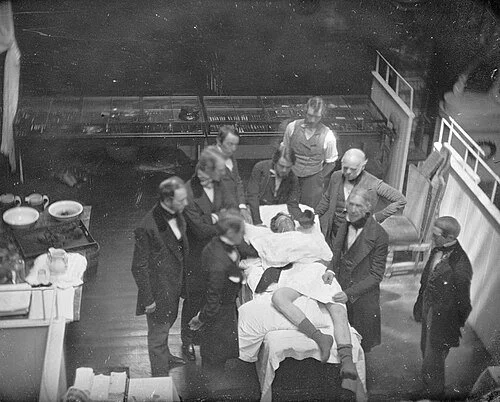
Daguerreotype by Southworth & Hawes of a historic ether operation at Massachusetts. General Hospital, in Boston, on July 3, 1847. The MGH Department of Anesthesia, Critical Care and Pain Medicine traces its roots back to the Oct. 16, 1846 public demonstration of medical ether
Boston Guardian article by Mannie Lewis (not including picture above), slightly edited.
Robert Whitcomb, New England Diary’s editor, is chairman of The Boston Guardian
A single 19th Century operation at Mass General Hospital (MGH) transformed surgery from an excruciatingly painful endeavor into a safe, routine and widespread practice.
In 1846, the fledgling hospital was home to the first publicly demonstrated use of ether, an anesthetic that finally allowed doctors to perform surgery with minimal pain. That procedure proved a turning point in the history of medicine, kicking off almost two centuries of change.
When MGH was founded more than 200 years ago, surgeries were performed without anesthesia, making them unpleasant, to say the least, for doctors and patients alike.
These procedures were so gloomy that MGH’s operating room was purportedly built on the hospital’s top floor to prevent the noise of writhing patients from disturbing other people in the hospital.
As a result, surgery was infrequent, focusing primarily on fixing obvious problems visible from the body’s surface, according to Sarah Alger, director of MGH’s Russell Museum of Medical History.
“Surgery, at the time, didn’t happen terribly often,” Alger said. “Since your patient was conscious, you couldn’t go that deeply into the body. You had to worry about blood loss and shock.”
Confronted with this problem, doctors tested a range of chemicals they thought could relieve pain. Some doctors used nitrous oxide on patients, but these attempts were derided as unsuccessful “humbugs.”
William T.G. Morton, a Boston dentist, was among the first medical professionals to try ether as an anesthetic, inspired by ether’s popularity as a recreational drug. After some successful experiments, he was invited to MGH’s operating theater, now known as the Ether Dome.
Morton arrived at MGH on Oct. 16, 1846, to assist with a routine surgery. Morton held a glass globe filled with ether up to a patient’s mouth, and the patient fell unconscious, according to notes cited by Alger. After the patient woke up, he felt so little pain that he assumed that the procedure had not started yet.
“Gentlemen, this is no humbug,” head surgeon John Collins Warren excitedly told the other doctors.
News of this painless surgery spread rapidly. A surgeon in London used ether within two months, according to Alger, and doctors around the world adopted the chemical as an essential part of surgery.
It met early resistance from religious leaders, some of whom argued that pain is important to the human experience, Alger said. Still, doctors began using ether extensively, which stimulated the discovery of other pain-relief drugs. The era of anesthesia had arrived.
Despite the fanfare, recognition and wealth that Morton accumulated, he was not even the first medical professional to use ether as an anesthetic. Shortly after the MGH procedure, a dentist in Georgia revealed that he had privately used ether on patients for several years, though he never published his findings, Alger noted.
No matter its origins, ether anesthesia transformed the medical field. Surgeons were no longer so constrained by time, allowing them to be more precise, Alger said. By the time ether fell out of favor in the 1940s, it had vastly broadened surgeons’ ability to serve their patients.
“It allowed surgeons to explore more deeply in the body than ever possible,” Alger said. “Anesthesia is really credited with allowing surgery to become the field that it is.”