
Vox clamantis in deserto


John O. Harney: Immigration and geometry intersect on the Greenway in Boston
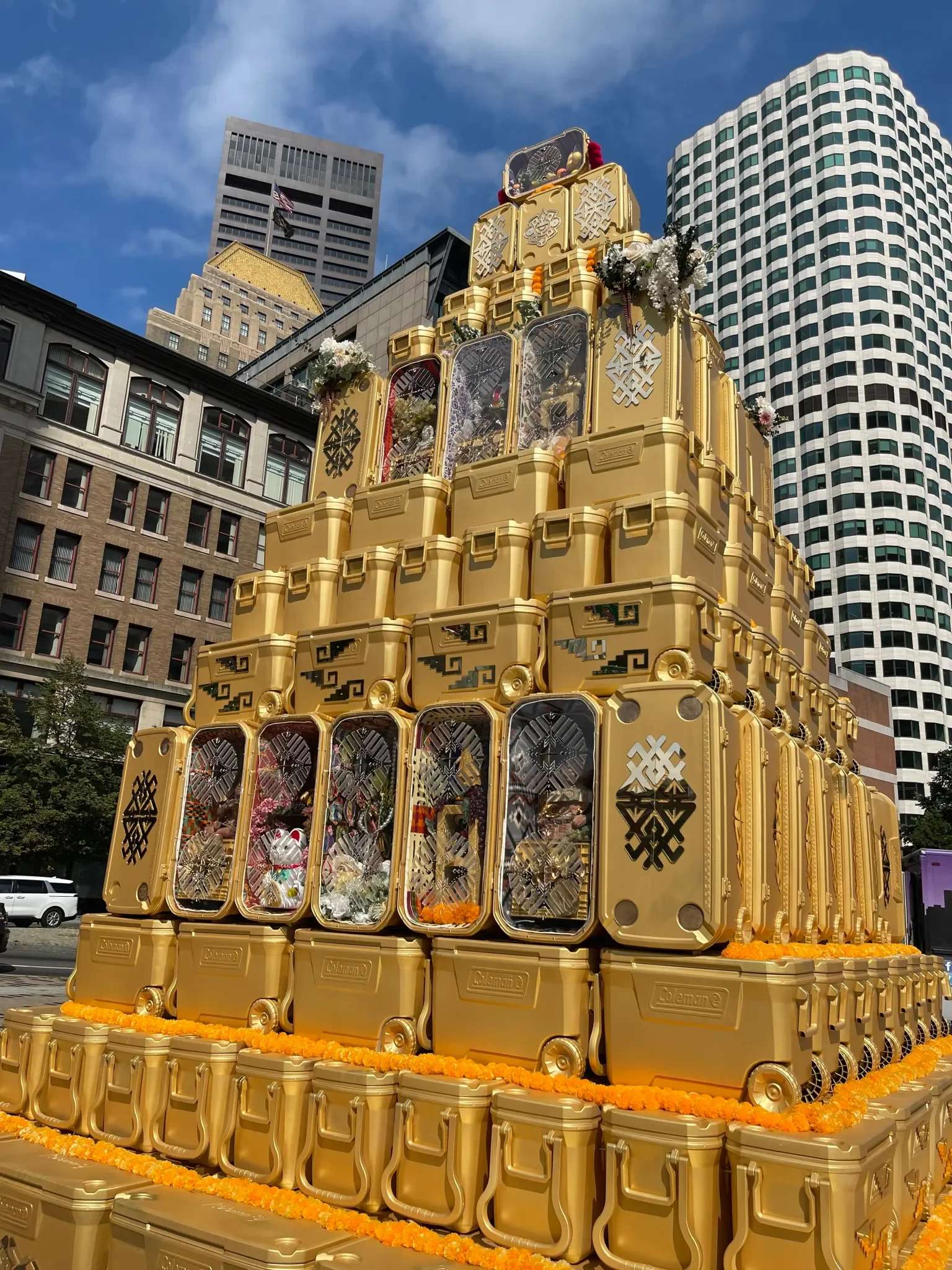
Art installation near Dewey Plaza, in downtown Boston, by Brooklyn-based artist Victor “Marka27” Quiñonez, featuring coolers spray-painted gold and images reminiscent of Mexican folk-art altars.
Early this fall, I took up an offer from the folks at the Armenian Heritage Park to present a lesson connecting immigration and geometry in the context of the Rose Kennedy Greenway, in Boston.
The lesson is part of a grant-funded curriculum developed by the Friends of the Armenian Heritage Park in collaboration with the 4th grade teachers at Boston’s Eliot K-8 Innovation School. The curriculum has been implemented in more than a dozen other public schools in Boston and beyond with funding for bus transportation from the schools to the Greenway.
The intent of the curriculum called “Geometry as Public Art: Telling A Story” is to spark awareness of geometric shapes and their expression of ideas and thoughts, and to engage students in sharing their own or their families’ immigrant experience and, in doing so, celebrate what unites and connects us.
It’s all very warm and loving despite the masked ICE agents operating a few hundred years away—and the general anxiety and avoidance of the topic a few miles beyond.
The event organizers provided a script for me to memorize. I was tempted to mention that even in my pre-retirement professional days, I always resisted speaking from a script and, in those days, urged others to resist, too. But also appreciating a crutch, I went along.
Another challenge: I hated geometry in school. Sure, I had done OK in math grade-wise and later published work in The New England Journal of Higher Education (NEJHE) on the importance of school math if only to help ensure that students pursue education beyond high school as an entry to good jobs.
But I couldn’t call it a special strength.
The twain shall meet?
I left the NEJHE editorship in early 2023 and began volunteering in phenology at the Greenway, in Boston, and in English language teaching at the Immigrant Learning Center (ILC) in Malden, Mass.
I have posted occasional reflections on the Greenway gig in my blog. I’ve posted less about the ILC experience. I’ve worried about drawing attention to the immigrant students who are made vulnerable by America’s xenophobia and advancing nationalism. Here though was a rare chance to see these two interests meet.
I have occasionally suggested that groups from the ILC tour the Greenway. Understandably, the newcomers thought that my Greenway garden work had to do with growing crops for food, not the more First-World idea of gardening for aesthetics associated with the Greenway.
Beyond the Armenian Heritage Park, the larger Greenway features notable recognition of the importance of immigration. Theoretically, other parcels along the Greenway were intended to celebrate the immigration flavors of their neighborhoods, as the Chinatown parcel does well with its bamboo planting, waterfall and recirculating stream.
Most recently, an art installation near Dewey Plaza by Brooklyn-based artist Victor “Marka27” Quiñonez, featuring coolers spray-painted gold and images reminiscent of Mexican folk art altars, paying tribute to the various groups of immigrant that have journeyed to Boston.
The Armenian geometry engagement also gave me an excuse for a mid-October visit to the Greenway for my routine bloom monitoring. It’s a time when few flowers are blooming, but there is that beauty unique to New England fall (if you’re OK with the approaching cold).
Amid the wilting astilbes, browning goldenrods and now hit-and-miss hydrangeas, a few colorful attractions remain. Among them: fall crocuses flowering pale bluish, vivid pink anemones, pink turtleheads, fluffy white snakeroot, nasturtium, isolated amaranths, resilient Russian Sage, purplish asters and red-fruiting winterberries.
The curriculum
The multidisciplinary curriculum in the Armenian Heritage Park integrates geometry, art, language and social studies while promoting cross-cultural understanding and respect.
The way it works: In Lesson One in the classroom, students discover geometric shapes, view info about the park and receive an “About My Family” questionnaire to guide a conversation with a family member or friend to learn about the first person in their family to come to the U.S.
Lesson Two (the one I was involved with) takes place at the park, where students experience firsthand how the park’s geometric features tell the story of the immigrant experience. They view an abstract sculpture, a split rhomboid dodecahedron, which is reconfigured every year to symbolize the story of the immigrant experience, “one that unites and connects us.” (The 2025 reconfiguration was scheduled for Oct. 19.)
The split rhomboid dodecahedron sits on a reflecting pool. An inscription notes: “The sculpture is dedicated to lives lost during the Armenian Genocide of 1915-1923 and all genocides that have followed.”
The water of the reflecting pool washes over the sides and re-emerges as a single jet of water at the center of the labyrinth (at least until the city turns off the water in mid-October as colder weather sets in).
The labyrinth celebrates life’s journey. The labyrinth serves as a place for meditative practice to reduce stress (though 4th-graders liberated by a field-trip day naturally relieve their stress by jumping and horsing around). There is one path leading to the center of the labyrinth and the same path leading out, symbolic of a new beginning, but clearly connected to where it began. The jet of water at its center represents rebirth.
The few calm students read the inscription on a reflecting pool on which the sculpture sits.
Ideally, the students discover the words etched around the: art, science, service, commerce in recognition of the contributions made to life and culture.
Students then write a wish on a ribbon for “The Wishing Tree.”
Back in the classroom for Lesson Three, students reflect on their visit to the park and receive the “I AM” poem template to create their poem, using an About My Family questionnaire. The poem is written in the voice of the first person in their family (sometimes the student) to come to this country. Students also create a portrait of that person or a geometric illustration.
Some messages on the Wishing Tree show hope, some signal worries. One youngster tackling his packed lunch, tells a friend, “things will be bad for four years because of Trump.” And indeed, these school kids, like so many across America, have the complexions that make them targets today.
John O. Harney: The Rose Kennedy Greenway bursts into bloom

The Rose Kennedy Greenway
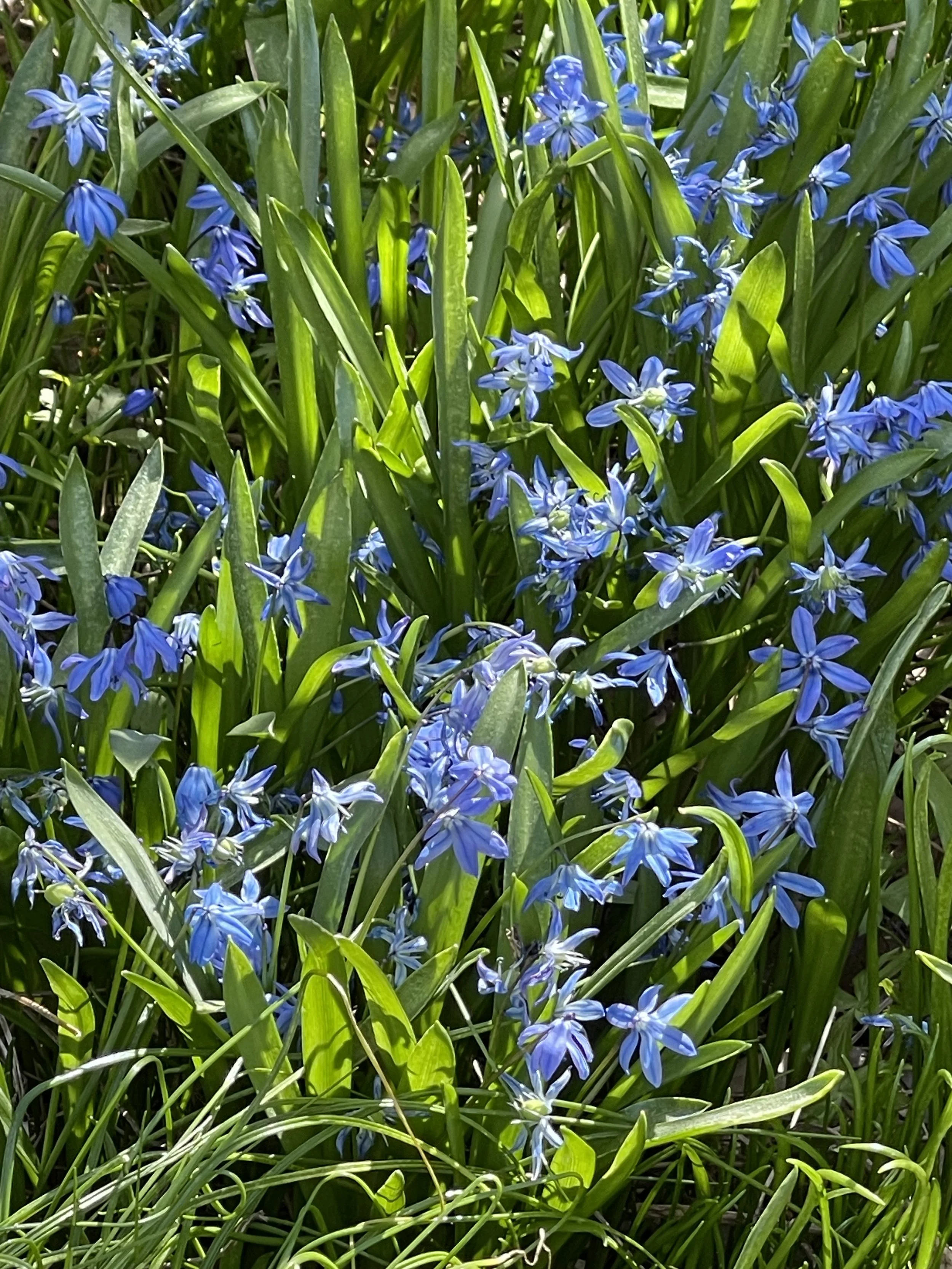
Some sights on the Greenway:
BOSTON
I began volunteering as a phenologist on the Rose Kennedy Greenway, in downtown Boston, in spring 2023 and returned a few weeks ago for the 2024 season.
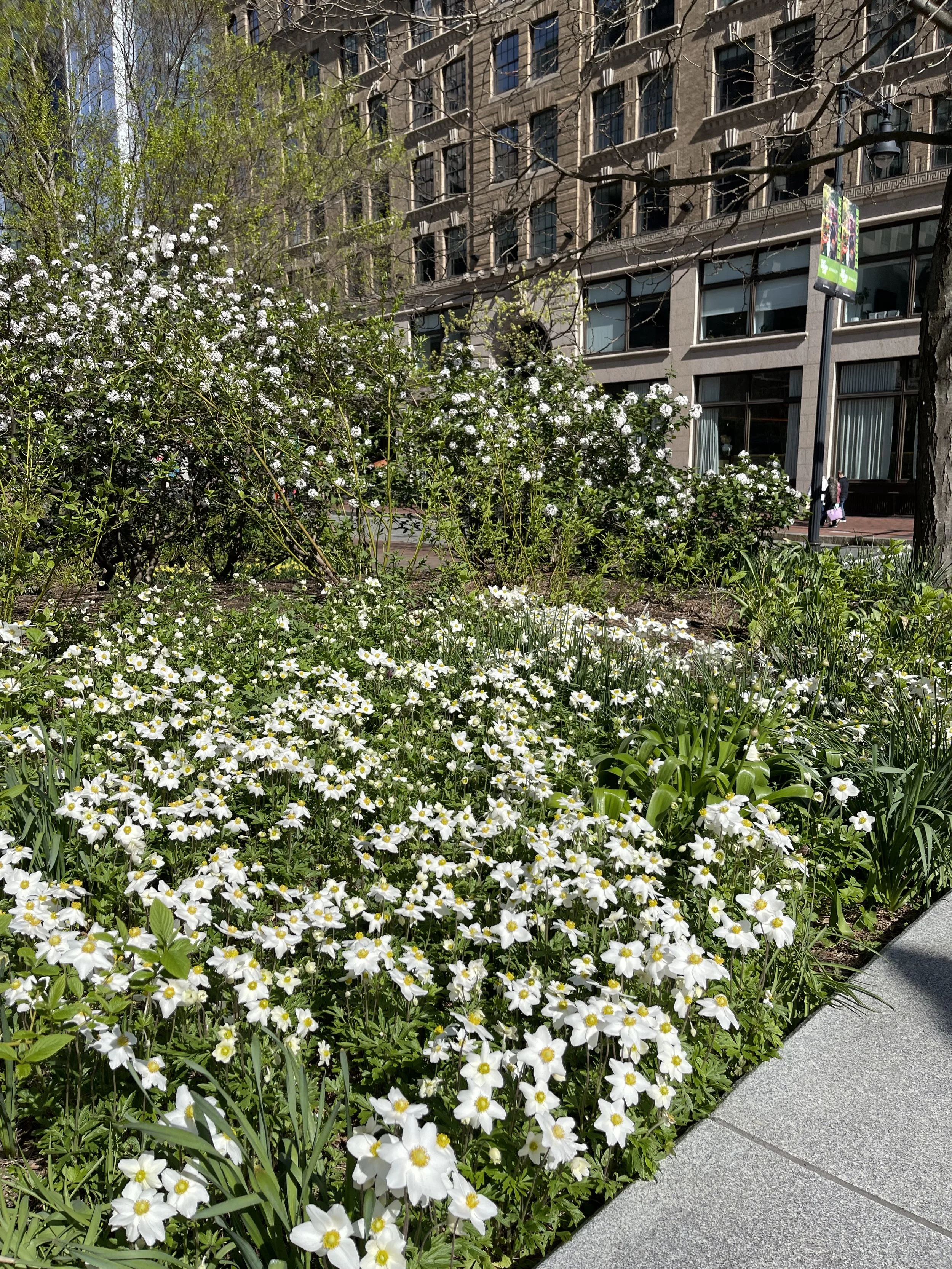
Peppermint-striped tulips were flowering along Pearl Street. Grape hyacinths create purple blankets; anemones whitish carpets. Hellebores that made an early spring show with dusty green-white and pink flowers were already fading. In one spot, it looked like a resting animal has flattened a bed of irises and allium.
Last year, all narcissuses were daffodils to my hardly trained eye. This year, I think I was seeing poeticus with white petals and yellow and reddish-outlined centers, sagitta with yellow double flowers around an orange tube and pheasants eye with its complex yellow and orange center. But I could be wrong.
Many plants were leafing but not yet flowering: irises, alliums, yellow- and red-twig dogwoods, lamb’s ear, roses, penstemon leafing purplish, dracunculus, astilbes, peonies, tickseed in a tough place along Purchase Street, nepeta, grasses near the tunnel vent still yellowish but with a few strands of green, achillea, aruncus and hosta shoots I’ve watched turn from young purplish shoots to fat green leaves reminiscent of a Rousseau painting. Few veggies or fruits visible. No sunflowers yet.
(By the way, in my old job as the executive editor of the New England Journal of Higher Education I was in charge of editorial style rules … things such as when to capitalize words, including names of plants I suppose. It always seemed too arbitrary, and, in retirement, I don’t bother.)
At the corner of Congress Street, I notices a mat of creeping blue phlox with its many light blue-purplish flowers—not, to my eye at least, the pink phlox associated with April 2024’s pink moon.
Speaking of such connections, serviceberry shrubs (also known as shadbushes) had flowered, mirroring the season when shad fish run up New England rivers and, for me, the promise of the delicious season of shad roe.
Jumping out to me on Parcel 21 was a humble dandelion. I note that, sure, it’s a pest, but it’s flowering full yellow, so it gets a 3 in the Greenway ranking system that I’ve never quite got my head around, as they say. The “best” rank among 1 to 5 is 3, not the lowest or highest, but 3 for full flower … peak.
A few other observations …
Maybe it’s the natural magnificence of the Greenway that somehow makes man-made signs catch my eye. Even the troubles of the world pierce the serenity of the park. Take the spot near the North End where a Priority Mail sticker on a park sign reads: “FROM: POWER TO THE RESISTANCE TO: GLOBALIZE THE INTIFADA’’.
Then the welcome reminder of “No mow May on the Greenway … The Greenway Conservancy is participating in Plantlife’s No Mow May initiative to support local pollinators, reduce lawn inputs, and grow healthier lawns. Certain areas of the Greenway will not be mowed in May.” A noble goal for homeowners too.
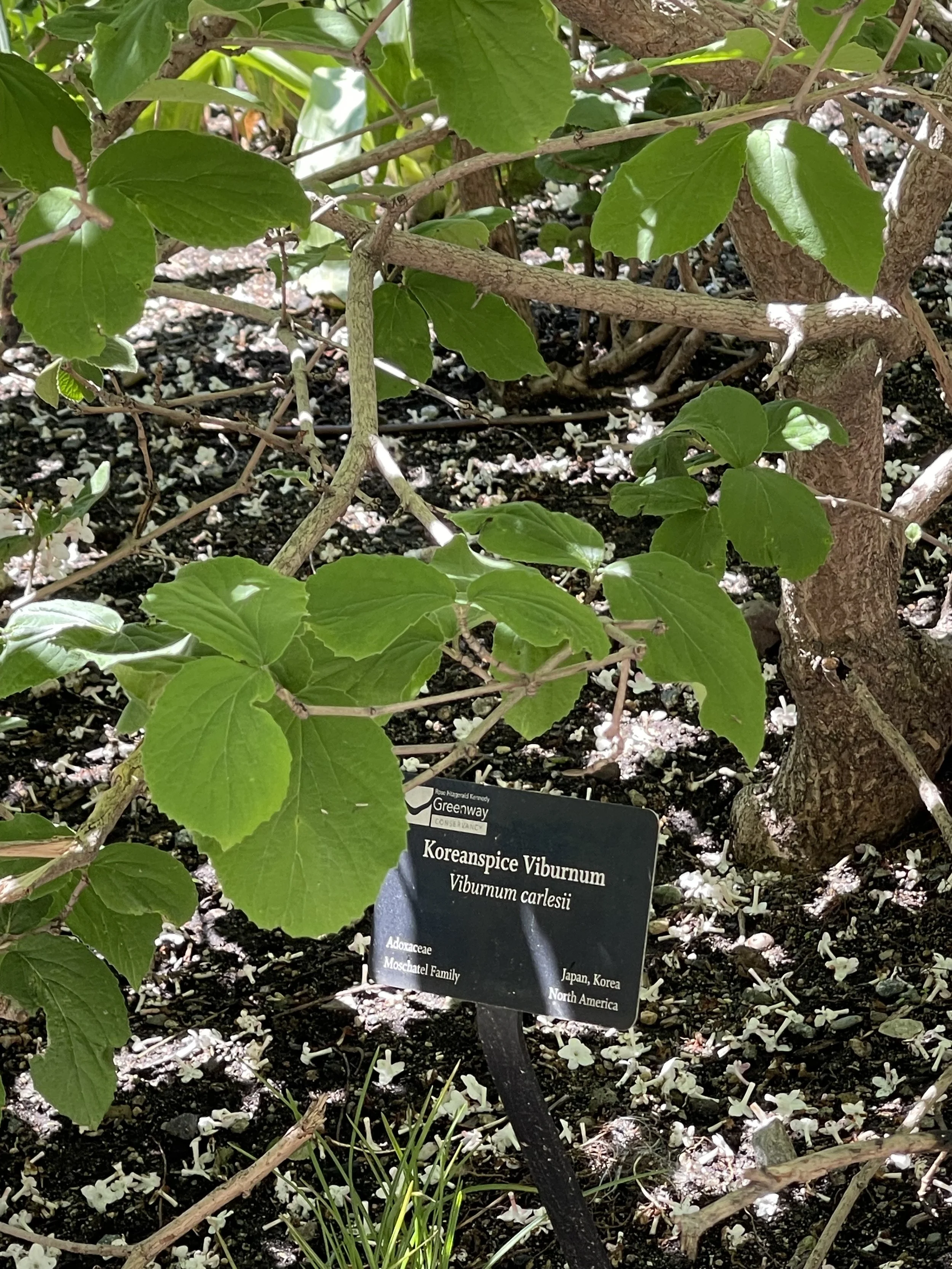
Nice to see a rare nametag on the Greenway identifying the good-looking and great-smelling Koreanspice viburnum. I had proposed such tagging last year in my piece on A Volunteer Life. Undoubtedly, others made similar suggestions. Still, I naively congratulated myself for any role in the tag, as two houseless people tried to tell me that there are apps on the market that ID plants. Immersed in my headphones, I reacted dismissively. Like a jerk, really. Quickly realizing my rudeness, I returned and apologized. These gardens are theirs more than mine.
With the helpful tips from the houseless on my mind and my interest in signs piqued, I also noticed for the first time, in Parcel 22, a green sign reading: “PARK CLOSED, 11 PM – 7 AM Trespassers will be prosecuted.”
With its tunnel vent, Parcel 22 is a big part of my Greenway life partly for its proximity to the park’s edible and pollinator gardens and Dewey Square and the Red Line plaza. The tunnel vent holds the Greenway mural. A sign reads: “What has this mural meant to you?” A mailbox is supplied for reader comments. One of the recent murals depicted a youth from the city, who critics insisted was a Middle Eastern terrorist. (Murals are dangerous business in New England. See here and here.)
And now to presumably dazzle the Greenway: colorful coneflowers, sturdy Joe Pye weeds, beebalm, furry salvia, white fringe trees, flowering black elderberries and hydangeas.
John O. Harney: My new parcels of volunteer life
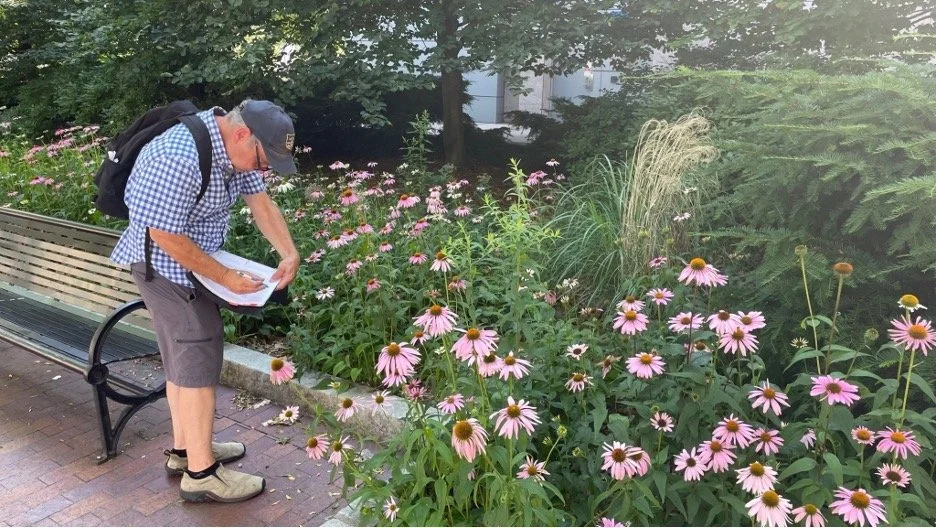
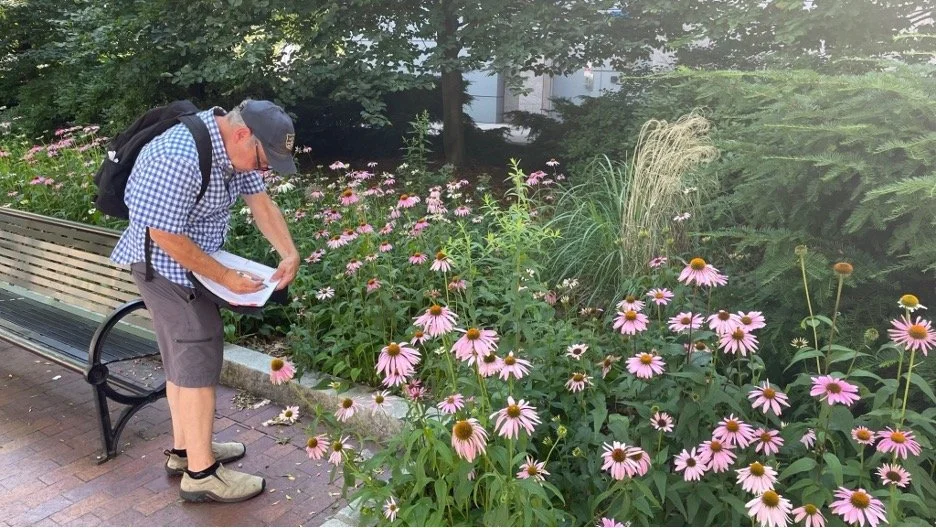
The author overseeng coneflowers at the Rose Kennedy Greenway
Inspired by the story of George Orwell caring for his roses while writing masterpiece essays, I looked forward to a retirement spent partly watching over the plants on Boston’s Rose Kennedy Greenway. Sure, I got a bit stressed over whether the fading white blooms I saw were Virginia Sweetspire Itea Virginica or Witch Alder Fothergilla. As I had earlier over whether the purple perennials were Salvia or Veronica. But for the most part, my most stressful dilemma would be choosing which dim sum joint to hit near the Greenway’s Chinatown “parcel.”
As for my own essays, never brilliant like Orwell’s, they’ve slowed to a crawl since the beginning of this year, when after 30-plus years, I left the editorship of The New England Journal of Higher Education and began volunteering in phenology at the Greenway. (Regrettably, I may have planted a kiss of death on the journal, where you’ll see few new postings since my departure.)
Fearing America’s increasing flirtations with nationalism and Us vs. Them politics, I also began volunteering in English language teaching at the Immigrant Learning Center, in Malden, Mass.
On the Greenway
Early on, a Greenway staff member gave me her cell number in case I needed help ID’ing plants or, she quipped, if I needed to report anything unusual on the Greenway, “like a body.” A staffer mentioned during an earlier volunteer pruning day, “the Greenway is enjoyed by all kinds of people so watch out for needles as you clean up around plants.”
Then Greenway retirement gig also reminded of my work days, attending economic conferences at the Federal Reserve Bank of Boston, directly across the street from Parcel 22. That Dewey Square stretch of gardens was then housing Boston’s version of the Occupy Wall Street movement. (Sometimes, feeling out of place in my ill-fitting suit, I wished that I was helping their cause rather than returning to my office.) By now, though, the whiff of rebellion had yielded to a riot of pink and white Coneflowers Echinacea and a Boxwoody imperial fragrance in the parcel near the Fed.
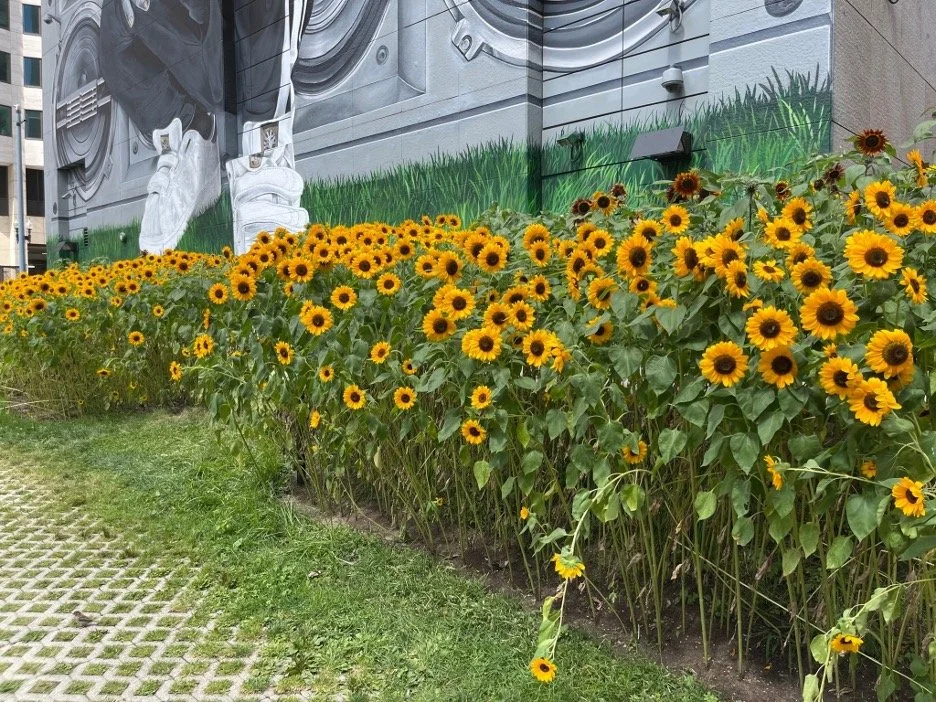
Sunflowers on the Greenway
Earlier in the summer, the Greenway folks worked with local nonprofit groups from Roxbury to plant massive stands of Sunflowers, the unofficial flower of my daughter-in-law’s war-torn Ukraine. In August, the Sunflowers bloomed gloriously around the vent and mural on Parcel 22. But more recently, it looked like some force had crashed into the middle of the main patch, pushing the Sunflower stocks outward like the Tunguska event in Siberia.
Nearby, I’m fascinated by the Pawpaw tree because of my childhood memory of a nursery rhyme that went: “Where, oh where oh where is Johnny [personalized for me], way down yonder in the Pawpaw patch.”
I’m also drawn to the paver my kids and I placed at the corner of Milk Street for my wife, saying “Joanne Harney We Love You.” I still check on the paver when I go to visit my “parcels.” And it looks sharp, as if a good angel has been coming along and buffing it. A half-joke in my house was that we could all meet there in case of disaster (though the urban location 500 feet or so from a rising sea may not be a safe haven forever).
I am also heartened by the Greenway’s small steps in food equity. In the edible garden, a sign reads:
ATTENTION GARDEN VISITORS: Please help us share the harvest!
The produce grown here is specifically cultivated and donated to our local homeless shelters.
Kindly refrain from picking the food to ensure it reaches those in need.
Your cooperation will help us make a difference in our community.
I’ve noted the ferny asparagus and carrots as well as strong corn and tomatillos. One day, a woman emerged from near a small houseless encampment and asked me if there was any mint in the garden. I said I thought there was some in Parcel 22, to which, she seemed relieved, saying that her husband, who camps out with her, eats it from time to time. A staffer suggested some of the Milkweeds in the gardens were planted secretly by visitors hoping to encourage Monarch Butterflies on the Greenway.

Ricinus
But I assume all know the stay clear of the purplish-leaved Ricinus growing in a galvanized bucket on Parcel 22 … host of the castor bean but also of famously deadly ricin.
My confines became Pearl, Congress and Purchase streets and Atlantic Avenue. The key reference points in my geographic descriptions were: the restaurant Trade, the Brazilian consulate with its national flag, the Native American Land Acknowledgment, the various Greenway maintenance sheds (and hangouts for the houseless), the Fed, the Red Line plaza, the Purchase Street tunnel (a reminder that the Greenway sits just a matter of a few feet over an interstate highway) and my favorite landmark, the Japanese Umbrella Pine in Parcel 21.
At the Immigrant Learning Center
Given America’s xenophobia, I also wanted to use my newly found time to help marginalized people in immigrant communities. I had tried to cover their predicament editorially in the journal. But retirement brought a new commitment. Reasoning that my decades of editing was something like teaching English, I applied for volunteer teaching of adults at the Immigrant Learning Center.
It has been a great pleasure to work with new immigrants from Haiti, Vietnam, China, Syria, Rwanda and elsewhere. When I helped one Syrian student read a children’s book about Winnie the Pooh, the description of the One Hundred Acre Wood reminded me of the Greenway work.
Many of the countries of origin of students at the center share a history of exploitation by the U.S., where these innocents fervently want to settle.
I have covered a few subjects probably too subtly for non-English speakers. Holidays, for example. I explained that Memorial Day was a day to remember people who had died. Sure, it was originally people who died in wars, but really anyone who’s died. Back to my old view that people who resisted the Vietnam War were as worthy of honor on Veterans Day as those who served.
Of Juneteenth, I tried to explain that while Americans say that they believe all are created equal, the concept of slavery clearly ran counter to that. And I reminded the many Haitians in the class that Haiti was among the many countries that abolished slavery before the U.S. I also mentioned to the Haitian students that I was rooting for the Haiti women’s national soccer team in the World Cup. To which, I was asked to explain the meaning of “rooting for.”
The immigrant lessons also teach much about the U.S. economy. One exercise focuses on occupations such as dishwasher, house cleaner, delivery driver and “manager.” One student noted getting a pay raise of 50 cents per hour—a modest honor. In one lesson, my lead teacher, himself a Haitian immigrant, drilled students on the difference between odd from even numbers … somewhat unimportant I thought until he noted smartly that Americans increasingly were getting shot knocking on the wrong doors.
Too much analytics
My aversion to analytics—clearly taking over the worlds of higher education and journalism that I recently fled—hobbles me even in volunteer life.
The Greenway folks prefer describing bloom progress with number rankings rather than comments. To make matters worse, the rankings are not the usual, 1 is best and 5 is worst, or vice versa. Instead, 3 is the best. It is peak flowering, then 4 is much less and 5 about done. 1 signifies just starting to bloom and 2 is progressing. Even an amateur like me can take a stab at peak flowering, but discriminating between 1 and 2 and between 4 and 5 is much tougher. And what to think of the Lamb’s Ear whose foliage graced two large banks in Parcel 21 but only shot out one flower on my watch.
The ranking snafu is familiar to anyone pestered by evaluation requests whenever you buy a product or service these days. As a former writer and editor, I’m happier with my rough notes than my arbitrary rankings.
I tell myself I may be a small part of a grand repository of plant info, or at least some effort to introduce identifying plant tags, which the Greenway lacks. Or an “interactive bloom tracker,” which sees to be always out of order when I try it. Of course, the data may be going into a black hole. But for me, the exercise is worth it.
The immigration educators understandably discourage use of synonyms, puns and anecdotes that may just confuse new English learners. All tough for a guy who considered himself “thoughtful,” but may have really been “wordy” and “unfocused.”