
Vox clamantis in deserto

Gerald FitzGerald: our ‘last, best Ride’
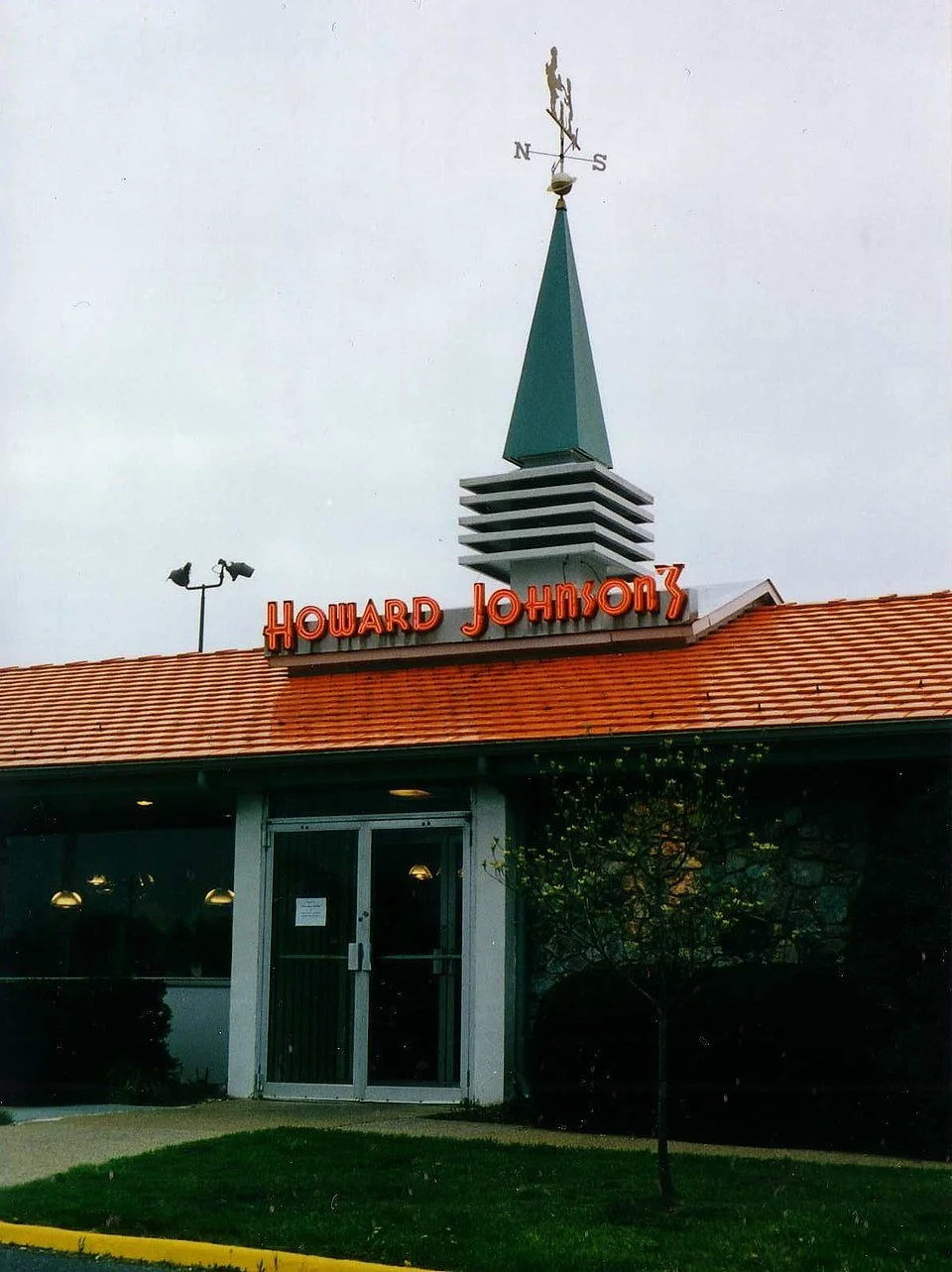
A “HoJo’s” restaurant, with its emblematic red roof and steeple.
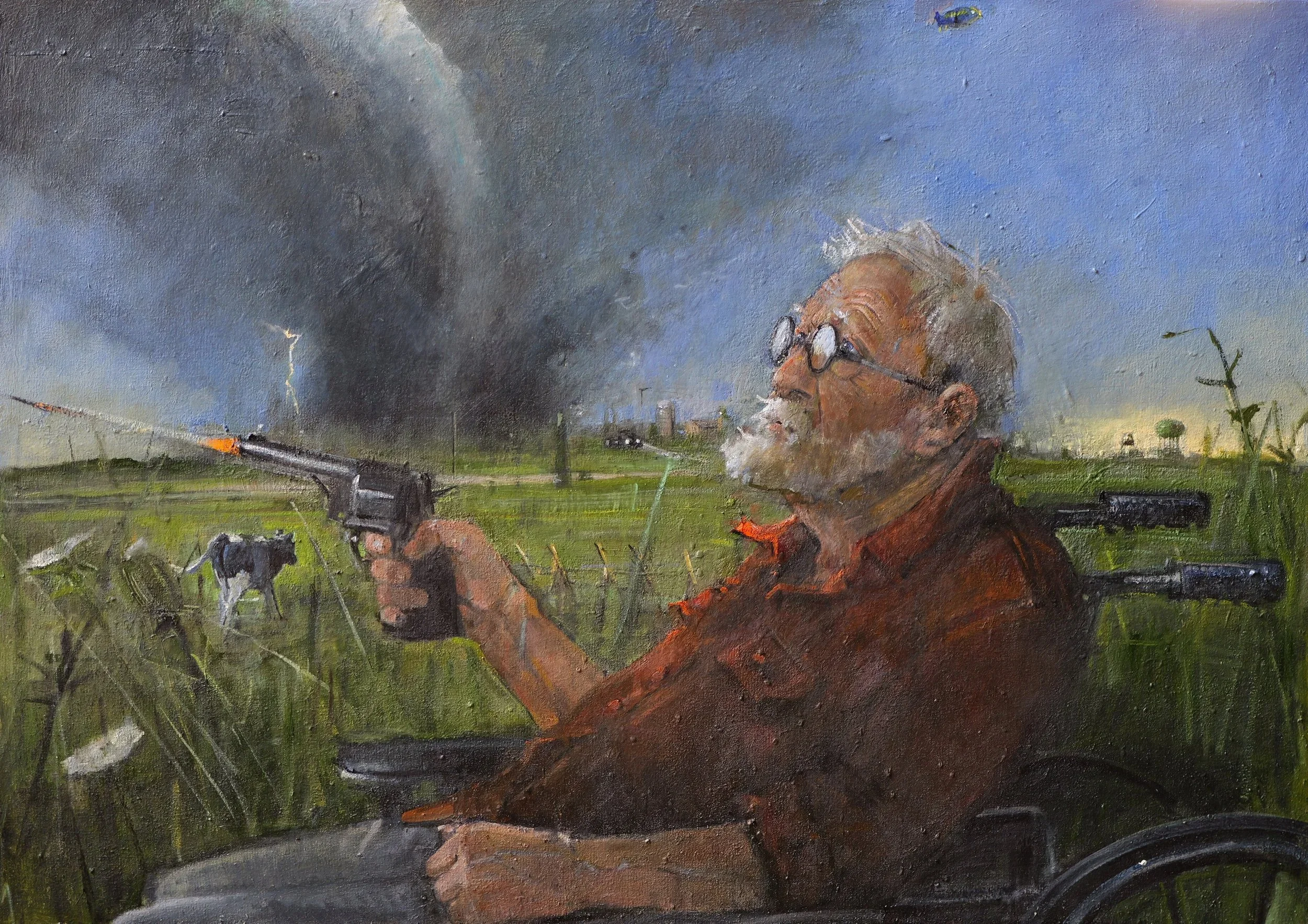
We sat on counter stools for 23 hours at a Howard Johnson’s restaurant in Pennsylvania trying to hitchhike to New York City on a turnpike shut down by a blizzard. There were four of us. It was early February, 1966, and things were not looking good.
I'm unsure why my big brother, Chip, and his girlfriend, Ellen, had thumbed out to Cleveland from New York City for a turnaround weekend to begin with, since they each had regular jobs. Paul Burke and I had just flunked out of our Ohio college, John Carroll University. Perhaps they came to empathize or, probably, to help out. Now we were broke, stranded, and had most of 500 miles left to cover.
Like Paul, I had spent my last three bucks on dinner, but it came with bottomless coffee until the waitress on our fourth shift in ripped off the sign taped to the mirror, tore it in half and dropped it into the trash. For a few hours Chip and Ellen had tried to catch shuteye lying down in a small booth. Half the battle was holding onto our individual real estate in the crowded restaurant. No vehicles had moved for many hours other than to pull into the HoJo’s lot and park in the snow.
There had been no more of those for the longest time. I remember questioning a waitress on how she and the rest of the staff managed to get to work since the thruway was closed. She told me that there were cleared local roads behind the restaurant. I started thinking how I might use that fact possibly to change our intended route home but hadn't thought long before something else changed.
Even getting up off your stool to use the bathroom required care. Someone had to watch the seat to enforce its “taken” status. Just getting up to mosey across the restaurant to look out a window at the snowbound highway might be interpreted as surrender by any of numerous standees. But I thought that I had spied some sort of vehicle barreling through the white drifts of the eastbound lanes. That required inspection.
Sure enough! A truck flashing lights and pushing a plow was braving the blizzard. Not only that, but spaced carefully behind that plow were two black, shiny sedans making beautiful headway.
They all pulled into the HoJo’s. I don't think that the plow driver ever got out of his truck but two guys in rumpled raincoats stepped from one sedan and headed toward the restaurant's vestibule. I signaled a suggestion to Paul that we cover the entrance.
Of course, you're going to hit up a potential ride on their way out, not on their way in. You don't know whether people are staying or going. These two men stalked straight past us and the food cashier on toward the back of the building. Then they did the strangest thing: They checked out the ladies room. One went inside while the other stayed out in the hall. Ditto to the gents. After that they stalked right past us without a word back out into the snow. They looked so unfriendly that we said nothing at all. Surely, they were packing. We figured them for mobsters or bodyguards or both. Nothing that helped us.
When they reached the sedans the doors of one opened simultaneously and out stepped a strikingly attractive young couple, one from each side. The raincoats positioned themselves front and back, as if surrounding the young man and woman who were clearly high-end. Dressed in casual, crisp ski wear the young man was ramrod straight and his dark-haired, similarly attired, companion looked downright elegant. We let them pass smoothly. They headed to the rest rooms.
Chip and Ellen were closer to us now. I gestured for Ellen to come stand next to Paul. Then, stepping away with Chip to make the exit less crowded, I turned to Paul and said:
“When they head out you do the talking.”
“Me? Why?” Burke replied.
“Because you were raised in Greenwich.”
I must have dropped my eyes for a bit because I didn't see anyone in the group stop at the cash register to order food or drink. Still, the mobsters and their elegant couple sailed past smiling Ellen and polite Paul, who asked if they might have a little extra room in their two cars and plow truck. The silent, raven-haired Luci Baines Johnson, youngest daughter of then-President Lyndon B. Johnson, stepped into the snowy parking lot licking an ice cream cone. The young man with her was John Patrick Nugent, whom she married later that year.
The celebrity travelers gave us nothing, of course, unless perhaps indirectly. Once they moved out it seemed like everybody started dribbling back to their vehicles. I've no idea whether the turnpike was officially opened around the time that the president's daughter and companions left or whether people just started realizing that if the celebrities could move on down the road so could regular folk.
The first free ride went to Chip and Ellen in the quickly warm cab of a big tractor-trailer. Much later Ellen told me that she had been nervous about the driver because he had a generous supply of uppers. While his passengers declined his offer, the driver regularly shoveled handsfull of pills into his mouth with, or without, coffee. Still, she calmed down after a while when she got to stretch out in the sleeper berth.
Paul and I, too, snagged a big rig about which I recall nothing at all except that it carried us into Jersey. I guess we got dropped off somewhere near Newark and were trying to get to Hoboken for the Hudson Tubes, the under-the-river subway to Manhattan. Talk about hope and trust, between us we had no money at all.
I would give a lot to have been bright enough even to ask the first name of the guy who gave us what Paul many years later described as our “last, best ride,” or even to remember the make and model of his car. He was maybe mid-30's and driving an old coupe, black or gray two-door, with a snow shovel lying across the the back seat. We each tossed a bag on top of the shovel.
The car had the kind of front seat where each side bent forward to allow passengers into the back. We joined the driver sitting three abreast up front. He told us that he had worked construction through some kind of shape-up but that “the Puerto Ricans” would work for lower wages and between that and the weather – but mostly the Puerto Ricans -- his construction hires dried up. He was pretty hot about it. The driver smoked Camel cigarettes (Paul's brand). The driver said that he was listening to the local radio that morning and learned that there was some kind of line-up in an hour or so to shovel snow for the City of Hoboken. That's where he was headed. This must've been early Monday morning, but I remember it was daylight.
Not only did that generous young man give Paul and me more smokes, when we pulled up at the Tubes station he gave us the remaining pack. Then he asked if we had the fares. It was pretty obvious that we did not. The driver dug deep and pulled from his pocket four quarters, giving each of us fifty cents to go with the cigarettes. I wanted to hug the guy.
As I recall, the Tubes cost about a quarter each, one way. Coffee and a doughnut inside the station at the window above a slice of counter cost another quarter. Fingers wrapped around cardboard cups, Paul and I were warm and happy – strangely subsumed by the comfort smokers feel who had gone a while without but whose addictive cravings are now satiated. It is a satisfaction you can actually touch, even in memory.
Chip and Ellen had offered us to stay with them on East Fourth Street in Greenwich Village while we looked for jobs. In about two months, they would marry after signing a new lease on an apartment on West 92nd Street with a cutaway kitchen overlooking what Chip called “the Grand Ballroom.” We – Paul and I and fellow flunk-out good friend Ralph Chiesi, could then take over “the 4th Street” for ourselves.
The Tubes station in Manhattan was on or near Christopher Street, in the West Village. That was nearly a straight shot walk to East Fourth through the top of Washington Square and past Gerdes Folk City. Closer to Christopher Street, Greenwich Avenue yawned like an open mouth leading up two blocks to unseen ladies who jammed against the high windows of the Women's House of Correction catcalling and jeering in the sunny warmth.
O yeah, things sure looked good again.
Gerald FitzGerald’s career has included being a newspaper editor, a writer, a prosecutor, a defense lawyer and a civic leader.He lives on the Massachusetts South Coast.
Editor’s note: The once very big and now defunct Howard Johnson’s restaurant chain was founded in 1925 in Quincy, Mass. The last “HoJo’s” closed in 2022.
James P. Freeman: Howard Johnson nationalized New England food
“There’s many a king on a gilded throne
But there’s only one king on an ice‐cream cone.
So we crown him today with friendly acclaim,
All over the country we’ll blazen his name.
With hot dogs barking in approbation,
He’s the man who believes he can feed the nation.”
n Howard Johnson’s (1940)
Like many like‐minded entrepreneurs, his dream was built on a simple idea with blazing clarity: “I figured that America really preferred good food nicely served,” and if it was made “as attractive as I knew how, easy to look at and hard to forget,” it would surely be successful, reasoned the founder of the eponymous restaurant, Howard Johnson, during The Great Depression.
Johnson, raised in Quincy, did indeed feed the nation and helped create the modern hospitality industry. But as widely reported just before Labor Day weekend, just one restaurant, in Lake George, N.Y., now bears the name “Howard Johnson’s. ‘’
With a prologue set firmly in New England, the spectacular rise and fall of this cultural icon is a quintessentially American story; it represents brilliantly the paradox of the creative destruction in democratic capitalism — in which the outdated is constantly replaced by new and better products and, ultimately, new and better processes. And with a delicious irony — being the very purveyors of disposable consumerism they helped to create — the epilogue also reflects today’s Baby Boomers’ sentimental nostalgia about a past they helped destroy, itself a gorgeous paradox of cultural progress.
But what a story it was. Much of it is recalled in his wonderfully reverential book, A History of Howard Johnson’s: How a Massachusetts Soda Fountain Became an American Icon, by Anthony Mitchell Sammarco.
It began as a store in Wollaston, Mass., in 1926. In the 1950s he pioneered efforts at freezing complete meals, which became staples in supermarkets. By 1969, at its corporate peak and prestige, a new restaurant was opening every nine days and a lodge every two weeks.
So large was this conglomerate that by 1975 the company had grown to 929 Howard Johnson’s restaurants, 32 Red Coach Grill restaurants, 63 Ground Round restaurants, and 536 motor lodges in 42 states, Puerto Rico and Canada. Successful entrepreneurs rely upon risk and luck and Johnson had a hunch. He rightly thought that Americans would be mobile with the advent of the automobile and with the creation of the Interstate Highway System (after the Great Depression and after World War II) they would be hungry too. And eventually tired.
As Sammarco notes, the “phenomenal growth” of Howard Johnson’s was “based on the application of two relatively new and untried concepts.” Johnson pioneered the retail franchise (where others bore start‐up costs) and also standardized the operations (branding, menus, décor). Howard Johnson’s restaurants and motor lodges became familiar terrain on roads from Maine to Florida and points west, such as the Pennsylvania Turnpike.
In many respects, Johnson nationalized New England. While the fried clam had been on Boston’s Parker House (hotel) menu beginning in 1865, Johnson introduced the fried clam strip (known as the “Tendersweet”) to America in 1951. Later, chef Jacques Pepin was brought in to prefect New England clam chowder. And, Sammarco writes, Johnson’s colonial‐style motor lodges “were attractive to nostalgic Americans,” and the architectural style was from a “melting pot of New England style that triggered the ‘old‐fashioned comfort’” with Americans.
But in the 1970s America experienced economic discontentment and dislocation because of its first great energy crisis and inflation. Travelers were driving less and flying more. Fast food chains such as McDonald’s and up‐scale hotels such as Marriott perfected the business model that Johnson had begun 40 years before. Many in the public came to see Howard Johnson’s as “dated” and “old‐fashioned” and its traditions uncool.
The bulk of the company was sold to a British conglomerate, Imperial Group Limited, in 1979.
Still, the story of Howard Johnson’s captures the rapid cultural changes of 20th‐Century America that continue to reverberate today. For many Boomers, their collective memory of “HoJo’s” is best remembered in faded family photographs taken over the years in the same rest stops along America’s highways and byways or Polaroids taken at the same restaurant for a sundae after a game or postcards sold in the lobbies of the same motor lodges during the ‘50s, ‘60s and ‘70s. It was a shared experience for which today’s generation can barely comprehend.
Today, for Millennials, there is no station wagon, no family road trip, no journey, no picture, no place like Howard Johnson’s; their idea of permanence and remembrance is a digital image “selfie” that disappears in 10 seconds on Snapchat.
Soon, service will mean a meal delivered by drone.
At the intersection of Routes 6A and 28 in Orleans still stands the structure that housed the first franchised Howard Johnson’s, in 1935 (about 25 miles from where the Pilgrims ate their first meal in the New World, in 1620). Since it was sold in 1979, it has changed names four times. Today it is painted in neutral browns and beiges. It looked and felt much better with the distinctive orange roof and turquoise blue shutters and 28 flavors, during an era that is by-gone, but not forgotten.
James P. Freeman, a New England essayist, is a former Cape Cod Times columnist and was formerly in the financial-services industry. This piece first ran in The New Boston Post.