
Vox clamantis in deserto









‘Don’t join the book burners’
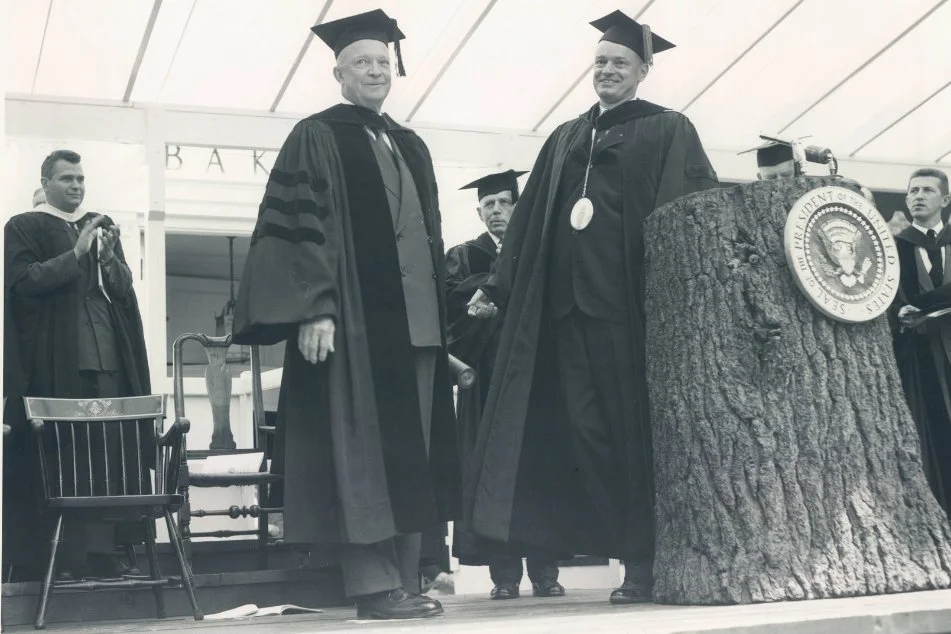
President Eisenhower and Dartmouth President John Dickey
Remarks by President Dwight D. Eisenhower on June 16, 1953, at Dartmouth College (in Hanover, N.H.) commencement, during the Red Scare led by Sen. Joseph McCarthy(R.-Wis.)
President Dickey, Secretary Pearson, members of Dartmouth's family and their friends:
(John Dickey, president of Dartmouth College, and Lester B. Pearson, secretary of state for external affairs of Canada.)
Your president possesses a brash bravery approaching foolhardiness when he gives to me this platform in front of such an audience, with no other admonition except to speak informally, and giving me no limits of any other kind.
He has forgotten, I think, that old soldiers love to reminisce, and that they are, in addition, notoriously garrulous. But I have certain limitations of my own I learned throughout these many years, and I think they will serve to keep me from offending too deeply. But even if I do offend, I beg, in advance, the pardon of those families and friends, sweethearts that are waiting to greet these new graduates with a chaste handshake of congratulations, and assure you that any overstaying of my time was unintentional and just merely a product of my past upbringing.
First, I could not pass this occasion without the traditional congratulations to this Class, the completion of 4 years of arduous work at a college of such standing as Dartmouth, and of which there is no higher.
Next, I think I may be pardoned if I congratulate you on the quality of the addresses you have heard today up to this moment. I think that your commencement address and the two valedictory addresses established a standard that could well be one to be emulated even here in the future.
Now, with your permission, I want to talk about two points-two qualities--today that are purely personal. I am not going to be an exhorter, as Secretary Pearson has said. I want to talk about these two things and merely suggest to you certain ideas concerning them.
I am going to talk about fun--joy--happiness, just fun in life. I am going to talk a little about courage.
Now, as to fun: to get myself straight at once, for fear that in my garrulous way I might stray from my point, I shall say this: unless each day can be looked back upon by an individual as one in which he has had some fun, some joy, some real satisfaction, that day is a loss. It is un-Christian and wicked, in my opinion, to allow such a thing to occur.
Now, there are many, many different things and thoughts and ideas that will contribute--any acts of your own--that will contribute to the fun you have out of life. You can go along the bank of a stream in the tropics, and there is a crocodile lying in the sun. He looks the picture of contentment. They tell me that often they live to be a great age--a hundred years or more-and still lying in the sun and that is all they do.
Now, by going to Dartmouth, by coming this far along the road, you have achieved certain standards. One of those standards is: it is no longer so easy for you to have fun, and you can't be like a crocodile and sleep away your life and be satisfied. You must do something, and normally it must involve others, something you do for them. The satisfaction--it's trite but it's true-the satisfaction of a clear conscience, no matter what happens.
You can get a lot of fun out of shooting a good game of golf. But you wouldn't have the slightest fun out of it if you knew to achieve that first 79--you broke 80 today--if you did it by teeing up in the rough or taking the slightest advantage anywhere, and no one else in the world but you knew it. That game would never be a 79 to you, and so it was not worth while because you had no fun doing it.
Whatever you do--a little help to someone along the road-something you have achieved because you worked hard for it, like your graduation diploma today, those things have become worth while, and in your own estimation will contribute to your happiness. They will measure up to your standards because your standards have become those that only you know, but they have become very high. And if you do those things, they are the kind of things that will satisfy you and make life something that is joyous, that will cause your face to spread out a little, instead of going this way [indicating a long face]. There's too much of that in the world, anyway.
You are leaders. You are bound to be leaders because you have had advantages that make you leader to someone, whether you know it or not. There will be tough problems to solve. You have heard about them. You can't solve them with long faces-they don't solve problems, not when they deal with humans. Humans have to have confidence. You have got to help give it to them.
This brings me up to my second little topic, which is courage. I forget the author, but one many years ago, you know, uttered that famous saying, "The coward dies a thousand deaths, but the brave man dies but once." In other words, you can live happily if you have courage, because you are not fearing something that you can't help.
You must have courage to look at all about you with honest eyes--above all, yourself. And we go back to our standards. Have you actually measured up? If you have, it is that courage to look at yourself and say, well, I failed miserably there, I hurt someone's feelings needlessly, I lost my temper--which you must never do except deliberately. You did not measure up to your own standards.
Now, if you have the courage to look at yourself, soon you begin to achieve a code or a pattern that is closer to your own standards. By the same token, look at all that is dear to you: your own family. Of course, your children are going to be the greatest, the most extraordinary that ever lived. But, also, look at them as they are, occasionally.
Look at your country. Here is a country of which we are proud, as you are proud of Dartmouth and all about you, and the families to which you belong. But this country is a long way from perfection--a long way. We have the disgrace of racial discrimination, or we have prejudice against people because of their religion. We have crime on the docks. We have not had the courage to uproot these things, although we know they are wrong. And we with our standards, the standards given us at places like Dartmouth, we know they are wrong.
Now, that courage is not going to be satisfied--your sense of satisfaction is not going to be satisfied, if you haven't the courage to look at these things and do your best to help correct them, because that is the contribution you shall make to this beloved country in your time. Each of us, as he passes along, should strive to add something.
It is not enough merely to say I love America, and to salute the flag and take off your hat as it goes by, and to help sing “The Star Spangled Banner’’. Wonderful! We love to do them, and our hearts swell with pride, because those who went before you worked to give to us today, standing here, this pride.
And this is a pride in an institution that we think has brought great happiness, and we know has brought great contentment and freedom of soul to many people. But it is not yet done. You must add to it.
Don't join the book burners. Don't think you are going to conceal faults by concealing evidence that they ever existed. Don't be afraid to go in your library and read every book, as long as that document does not offend our own ideas of decency. That should be the only censorship.
How will we defeat communism unless we know what it is, and what it teaches, and why does it have such an appeal for men, why are so many people swearing allegiance to it? It is almost a religion, albeit one of the nether regions.
And we have got to fight it with something better, not try to conceal the thinking of our own people. They are part of America. And even if they think ideas that are contrary to ours, their right to say them, their right to record them, and their right to have them at places where they are accessible to others is unquestioned, or it isn't America.
I fear I have already violated my promise not to stay too long and not to exhort. I could not, though, go back to that chair without saying that my sense of distinction in Dartmouth's honorary doctorate, in the overgenerous--extravagantly overgenerous remarks of your president in awarding me that doctorate, in the present of the cane from the young men of the graduating class-all of these things are very precious to me.
I have been fortunate in that my life has been spent with America's young men, probably one of the finest things that has happened to me in a very long life.
I thank you again for this.

David Warsh: Getting personal about the Israeli-Hamas warTheY

Hamas logo

The Israeli flag
SOMERVILLE, Mass.
Is it possible to criticize Israeli policy in Gaza and the West Bank without being anti-Semitic? The question seems worth asking, even if it almost certainly means being called anti-Semitic by some. Surely it is possible to deplore Hamas without being called anti-Palestinian.
I don’t know what to do with this except to be personal about it.
I grew up in a suburb of Chicago in which racism was pervasive, though mostly polite, because no people of color lived there. Unspoken replacement theology held sway – that is, the premise that Jews, followers of the Old Testament – the Hebrew Bible – eventually would be converted to the principles of the New Testament, the Christian Bible.
Folkways of the village in the Fifties exhibited some pretty strange ideas about gender, too. The use of atomic bombs and carpet bombing against civilian populations during World War II raised few objections. And as for the indigenous populations we had displaced? The hockey team was named for them.
A large part of my education since has involved escaping those prejudices, by degrees, via participation in “movements” of various sorts: college, civil rights, anti-war, pro-women, and now, opposition to Israel’s “Second War of Independence;” that is, its special military operation in Gaza.
Revolted as I was by the Hamas raid, my first reaction to the news of the massacre of some 1,200 innocents was to ask myself what Israeli Prime Minister Benjamin Netanyahu should have done? I had grown up to become a member of a Congregational church; I could use my confirmation instead of a birth certificate to obtain a passport, or so I was told. For a time, I had been a Zionist: I knew a good deal about the Holocaust; I had thrilled to the film Exodus in high school.
Netanyahu should have turned the other cheek, I thought, called out Hamas to worldwide disgust and scorn, and resigned. It took only a day to realize that recommending the Sermon on the Mount to the Israeli Defense Force was no solution. That set in motion this skein of thought.
I had never seen, until I came across the other day, , in an article in The Atlantic, President Dwight Eisenhower’s advice in a letter to one of his brothers, in 1954, in the early stages of the Cold War:
You speak of the “Judaic-Christian heritage.” I would suggest that you use a term on the order of “religious heritage” – this is for the reason that we should find some way of including the vast numbers of people who hold to the Islamic and Buddhist religions when we compare the religious world against the Communist world. I think you could still point out the debt we all owe to the ancients of Judea and Greece for the introduction of new ideas.
Advice as sage today as it was then. Even much-loathed former Commies might be included in the heritage of humanity today. I’ll leave it to historians, Biblical scholars, ethnologists, anthropologists, and sociologists to pick apart the differences. But theologian Paul Tillich’s phrase “Judaic-Christian heritage,” which offered such comfort during the years after World War II, is no longer part of my vocabulary.
Having said this much, I must come to the point. I am aghast at the Israeli government’s invasion and occupation of Gaza; appalled by its plan to occupy the territory after the slaughter stops; embarrassed by the United States’ veto of the 13-1 United Nations Security Council resolution calling for an immediate cease-fire.
I object to the congressional and donor bullying of university presidents. The American newspapers I follow seem to have been somewhat intimidated as well. (Here is a long view of the situation in The Guardian that makes sense to me.) The stain on the reputations of the leaders and policymakers involved, including those in the United States and Iran, can never be erased.
I have had this privilege of writing this column, called Economic Principals, for 40 years. I couldn’t live with myself if I didn’t say this much about current events in the Middle East. It is, however, as much as I have to say. I’m against the war in Ukraine, too, but after twenty years of following its genesis, it is a problem I know something about.
The relevance to these matters of economics should be clear, at least intuitively. I pledge to work harder to spell it out.
xxx
Swedish Television does an excellent job on its short profiles of each year’s well Nobel laureates. The link offered here last week to their visit with Harvard economist Claudia Goldin didn’t work. Here is one that does. At fourteen minutes, it is well worth watching.
David Warsh, a veteran columnist and an economic historian, is proprietor of Somerville-based economicprincipals.com, where this column originated.

Chris Powell: Military-industrial complex is fine with Conn. delegation

This building in the affluent Hartford suburb of Farmington, Conn., was United Technologies’ headquarters in 2015-2020.
— Photo by Daniel Pennfield
MANCHESTER, Conn
In his farewell address 60 years ago President Dwight D. Eisenhower warned against what he called "unwarranted influence, whether sought or unsought, by the military-industrial complex." Since he was a military hero, perhaps only Eisenhower could give such a warning during the Cold War without risking denunciation as a Communist.
But Eisenhower's warning has never been heeded, and President Biden, with his defense secretary, is essentially proclaiming the victory of the military-industrial complex. The new secretary is retired Army Gen. Lloyd Austin, who upon leaving the Army a few years ago joined the board of directors of military contractor and Waltham, Mass.-based Raytheon Technologies Corp., which recently acquired Connecticut-based United Technologies Corp. Austin will have to sell Raytheon stock he received for serving on the board. It may net him as much as $1.7 million.
Acknowledging what will be his continuing potential for conflict of interest, Austin pledges to avoid decisions involving Raytheon for a year. But this can't worry Raytheon much about its investment in the general, since the corporation plans to be doing government business a lot longer than that.
With Austin at Defense and former Federal Reserve Chair Janet Yellen becoming Treasury secretary after receiving at least $7 million in speaking fees from big banks and investment houses in the last three years, the federal government's two most lucrative agencies will have been securely captured by their primary beneficiaries.
With the exception of Sen. Richard Blumenthal, the members of Connecticut's congressional delegation -- all supposed liberals -- are fine with this exploitation. After all, the state is full of investment bankers and military contractors and what's good for them may be considered good for the state. As for the country, that's something else.
Even Blumenthal's concern about Austin probably became a mere quibble. Federal law prohibits military officers from becoming defense secretary until they have been out of uniform for seven years, so Austin needed a waiver from Congress. Such waivers have been granted twice before. Blumenthal said that to uphold the principle of civilian control of the military, he opposed another waiver. But few other members of Congress objected to it, and Blumenthal and those others still had it both ways, voting against the waiver and then voting to appoint Austin once the waiver is granted.
Besides, with the Democrats in full control of the federal government, conflicts of interest and civilian control will barely register against the party's new highest objective in Cabinet appointments -- racial, ethnic and gender diversity. Austin is Black and so meets the decisive qualification.
xxx
PAY AS YOU THROW?: The administration of Connecticut Gov. Ned Lamont seems to have determined that state government no longer can make any money by burning trash to generate electricity at the state Materials Innovation and Recycling Authority's facility in the South Meadows section of Hartford. Such generation apparently is now much more expensive than electricity generated from natural gas, and the facility's equipment already needs renovation estimated to cost more than $300 million.
So the authority plans to close the facility by July 2022, turning it into a trash-transfer depot and shipping to out-of-state dumps the trash now being burned. This is not only retrograde environmental policy; it likely will raise costs for the authority's 70 client towns. As a result the authority and the towns are discussing how to reduce their "waste streams" -- possibly by charging residents a fee for every bag of trash collected, a system called "pay as you throw."
There would be some sense to this, since it would cause people to take more responsibility for their trash, the packaging of what they buy, and recycling. But this also would increase the risk of illegal dumping, even as Connecticut's roadsides and city streets are already strewn with trash.
It might be best for state or federal sales taxes or fees to recover in advance the disposal costs of everything sure to wear out, as the state already does with beverage containers and mattresses and used to do with tires.
Government needs to teach people more about the trash issue. But all that roadside litter suggests that many people are unteachable slobs.
Chris Powell is a columnist for the Journal Inquirer, in Manchester, Conn.
Chris Powell: Eisenhower's secret campaign to defeat Joe McCarthy
Ike and McCarthy, by David A. Nichols (Simon and Schuster. $27.95. 379 pages).
With demagoguery now running rampant across America, in large part because of a president indifferent to the truth and the dignity of his office, David A. Nichols's book is a fascinating voyage to a similarly threatening time that at least had a happy ending.
Nichols, a scholar of the administration of President Dwight D. Eisenhower, aims to correct the misimpression that Ike was timid in the face of the country's second great Red Scare (the first one came right after World War I). Rather, Nichols writes, in his first two years in office Ike became devoted to breaking the scare's primary perpetrator, Wisconsin Sen. Joseph McCarthy, with a secret political campaign run from the White House by the president's aides.
The impression of Eisenhower's timidity arose in part from his steady refusal to confront McCarthy or even mention his name as the senator kept charging, usually without evidence, that the federal government was riddled with Communists who were security risks if not outright spies for the Soviet Union. Of course there were Communists and spies, but McCarthy seldom got near one of any importance. Yet Eisenhower restrained himself even when McCarthy updated his smear of the Franklin Roosevelt and Harry Truman administrations, Democratic administrations -- from "20 years of treason" to "21 years of treason" -- encompassing the first year of the Eisenhower administration, the administration of a fellow Republican.
Eisenhower, Nichols writes, loathed McCarthy from the start but didn't want to talk back to him, believing -- or maybe rationalizing -- that this would elevate the senator and give him even more attention. Eventually Eisenhower and his aides decided that the country needed to see more of McCarthy, not less, so that the senator's bullying, intemperance and distortions would become his most prominent characteristics in the public mind.
The result was the famous Army-McCarthy Hearings in 1954 before a Senate committee, largely staged by the president and his supporters, at which the central issue became not Communist infiltration at all but McCarthy aide Roy Cohn's confidential and unseemly hectoring of the Army to get favors for another McCarthy aide, G. David Schine, who had just been drafted into the Army. Cohn and Schine were suspected of having a homosexual relationship. {Roy Cohn was later a close mentor of Donald Trump.}
Here Nichols makes plain that the supposed good guys were not above McCarthyite tactics themselves. For the Army's lead lawyer, Joseph Welch, who has gone down in history for puncturing the senator with the famous rebuke at a televised hearing -- "Have you no sense of decency, Sir?" -- had just used televised innuendo to suggest Cohn's homosexuality and to exploit prejudice against homosexuals.
Further, Nichols shows, Eisenhower himself, as president, initially flirted with and patronized the fascism of anti-communist politics, at one point proposing to outlaw membership in the Communist Party. The president also dissembled and induced his associates to dissemble about the creation of the Army's report on Cohn's interventions for Schine, even getting Secretary of the Army Robert T.B. Stevens to commit perjury about it.
Journalists of the time don't come out so well either, as Nichols shows many of them sensationalizing McCarthy's reckless allegations and others, including CBS's Edward R. Murrow, colluding with the White House press office against the senator.
Eisenhower, in light of some of those who followed him, turned out to be a pretty good president, siding soon enough with free thought and speech and due process of law. But it is hard not to wonder if the president would have come around so soon if McCarthy had not targeted the Army, from which Ike had retired as the general who had led the Western armies against Hitler.
And while McCarthy quickly fell from national influence, sunk into alcoholism, and died prematurely, his censure by the Senate remains misunderstood. The two counts of the censure had nothing to do with McCarthy's abuse of supposed Communists and their sympathizers and his contempt of due process but rather his affronting the dignity of the Senate itself.
Nichols has told and extensively documented a compelling story. Anyone interested in American history and politics may have a hard time putting this book down.
Chris Powell is managing editor of the {Manchester, Conn.} Journal Inquirer and a frequent contributor to New England Diary.