
Vox clamantis in deserto





Don Morrison: We need protection from tech bros and their gigantic data centers

Cervalis' Norwalk facility, Connecticut's largest data center.

The Massachusetts Green High Performance Computing Center, in Holyoke.
So, I’m driving down the interstate and need to make a pit stop. As I approach the exit, my steering wheel freezes up. I hit the brakes, to no effect. Panic rising, I tell the car’s voice assistant to pull over. It responds in a soft and friendly tone: “I’m sorry, Don, but I’m afraid I can’t do that. It’s not part of the mission.”
That’s when I wake up. Ever since I saw an HBO rerun of Stanley Kubrick’s 1968 film 2001: A Space Odyssey, featuring a polite but frighteningly stubborn computer named HAL, I’ve been having variations of this dream. I now realize it’s not about a car. It’s about how we’re losing control of artificial intelligence, even as it reshapes our lives.
To many of us, that development might seem too distant to worry about, and maybe even something to cheer. After all, Siri, Alexa, ChatGPT, Claude, Waymo and “smart” household appliances have already made life easier in so many ways. Yet I’m not alone in worrying about AI and its potentially disastrous effects — on our jobs and, ultimately, our democracy.
In a new study by the Massachusetts Institute of Technology and Australia’s University of Queensland, 272 experts examined two dozen potential types of AI-related disaster and found that 18 of them have at least a 10 percent chance of happening in the next five years. Among those potential catastrophes: a new cyber-weapon will cause at least 1 million deaths or $100 million in losses; also, AI-generated misinformation will wreak emotional harm on multitudes or affects the outcome of an election.
AI mishaps are already with us. News reports — and a few lawsuits — indicate that prolonged interactions with chat bots may have contributed to delusions, emotional crises and in some cases, suicides. Criminals are using “deepfake” photos and even voices to facilitate identity theft and extortion. The internet is filled with AI-generated “slop,” annoying but largely harmless, though some of it is aimed at changing our political views.
The problem isn’t so much that such fantasies are convincing. It’s that every year it gets easier to manufacture more plausible ones. Eventually, the public might not know what to believe. Even President Trump now posts AI-generated images, nearly all of them obvious confections and mildly amusing — like last week’s “photo” of him showing his controversial White House ballroom project to George Washington.
Not so amusing is news that the federal government and both houses of Congress now allow the use of AI in official business, often without much supervision. Rep. Anna Paulina Luna of Florida was embarrassed last week when her staff posted a summary of a proposed defense bill amendment that retained the words “Claude responded,” a sign they had used the AI chatbot.
More troubling still was last month’s disclosure that an autonomous OpenAI agent escaped its testing environment and hacked into Hugging Face, an AI-development platform. No serious harm was done, but the fact that intrusion occurred at all — and went undetected for days — have raised fears that we might be losing control of AI and that our personal data is in danger.
So, it appears, are our communities. Artificial intelligence systems require enormous computing power, which is supplied mostly by data centers: shopping-mall-sized complexes filled with computer servers. The centers consume vast amounts of land, water (for cooling) and electricity. They strain local power grids, drive up retail electricity prices, create noise and otherwise degrade the quality of life in thousands of localities.
Though polls show that as many as 70 percent of Americans oppose them, data centers are popping up all over the place. The U.S. now has around 4,000, with at least 2,000 more planned or under construction.
Of course, data centers provide jobs and property-tax revenues for localities, just as the growth of AI generally is expected to boost U.S. economic growth. Yet the toll on American society and democracy could be high. What’s truly worrying is that the decisions about what risks can be acceptable in pursuing AI’s future are being taken by a group of people who stand to profit from its unfettered growth.
The industry is dominated by a handful of tech-firm founders, nearly all of them men, who — along with their major investors — have become multibillionaires. These and other wealthy “tech bros” have put vast sums into political action committees (PACs). Elon Musk spent $243 million to help elect Donald Trump in 2024 and plans a $100 million effort for Republicans in this year’s midterm elections. Leading the Future, a network of super-PACS, has amassed $100 million to support candidates who share the AI industry’s opposition to regulation and taxation.
A major battle is shaping up. Many Americans are worried about the growing disparity of wealth in the U.S. between AI winners and victims. Many also worry about the possibility of losing their own jobs — and not just the manufacturing and clerical positions currently affected. AI can now generate movie scenes, prepare tax returns, develop new drugs, even write news stories and opinion columns. A college degree may no longer offer the protection it once did.
Amid such anxiety, people see the enormous wealth generated by AI and think they deserve a share. A few states have responded with higher taxes on data centers. A new Virginia levy on data-center power consumption is expected to raise $600 million in the coming year. Some members of Congress want to impose stronger safety rules and more rigorous anti-trust regulation on artificial intelligence giants. Let’s hope it’s not too late.
Despite the industry’s public-relations efforts, the current wave of anxiety over the rise of the AI is unlikely to subside anytime soon, nor should it. Only if people get worried enough to take action can we wrest control of this ground-shaking technological revolution from the self-serving handful who profit from it.
As someone who must endure HAL’s occasional efforts to take control of his dreams, I’ll be pulling for the triumph of real — not artificial — sanity.
Don Morrison is a veteran editor, reporter, columnist and media executive. A part-time resident of The Berkshires, he’s a member of the editorial advisory board of The Berkshire Eagle.
Don Morrison: Learning how to father
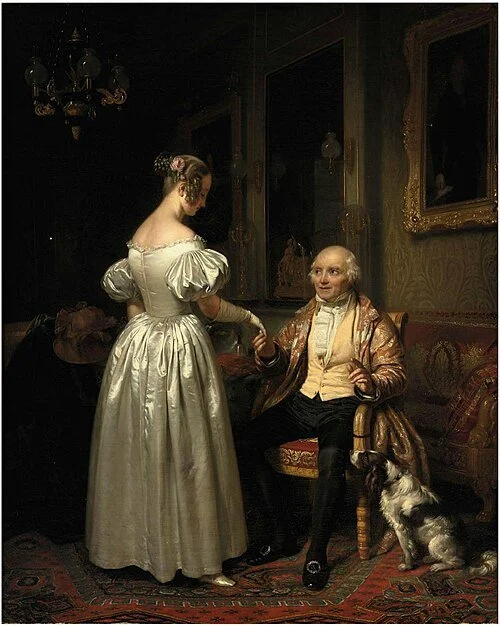
“Paternal Advice,’’ by Josephus Laurentius Dyckmans
PITTSFIELD, Mass.
Sonora Smart Dodd was 16 years old when, in 1898, her mother died in childbirth. The baby survived, and Sonora helped her beleaguered father raise the boy and his four older brothers on a farm outside Spokane, Wash.
One Sunday morning, after sitting through a church sermon praising the new Mother’s Day celebrations popping up around the country, she decided that fathers deserved equal recognition.
Sonora began lobbying local church leaders, and on June 19, 1910 — her father’s 68th birthday — Spokane marked America’s first Father’s Day. The idea caught on, and in 1972 President Richard Nixon established the third Sunday in June as a national holiday in honor of dads.
This Sunday, once again, Americans will come together to salute their family patriarch with gifts of neckties and power tools as he grills various meat products to cinders. The day also gives us an opportunity to reflect on what fatherhood has become in this age of fractured families, shifting gender roles and proliferating views of masculinity.
Everybody has a father — present, absent or long gone — so nearly all of us can claim some familiarity with the job, regardless of how it was handled. My own dad was a man of his time. To him, a father’s main role was as family breadwinner. He focused on running his retail store while our mom raised the little ones. Eventually, the business faltered, and she began working alongside him, entrusting us kids to a shifting pageant of paid help.
That wasn’t rare in our dying little town. So I almost didn’t notice when, a few decades later, mothers began joining the U.S. workforce in record numbers as their spouses took on more child-rearing and housekeeping responsibilities.
My own wife went back to work shortly after our first son was born. She found a terrific babysitter, who remained with us for years, and I got to learn a few domestic skills.
In truth, I was never good at diaper-changing, skinned-knee disinfecting, bedtime storytelling and other elements of effective parenting, but I did find such chores surprisingly satisfying. Only later did I realize why.
Neuroscientists have found that the brains of new fathers are altered by the birth of their first child. Neuronal patterns change and dormant hormones stir. Testosterone-fueled assertiveness is crowded out by oxytocin-infused feelings of tenderness and generosity. Touching or merely being near their kids brings unaccustomed pleasure. Not for nothing did God and evolution make the little nippers so adorable.
Thus, I was not surprised when the role of paterfamilias began shifting a few decades ago from my dad’s mostly hands-off approach to a deeper male involvement in the details of child-raising.
Not every father is OK with that change. Traditionalists see the blending of parental roles as troublingly “woke,” or inefficient, or bad for children. Some husbands are uncomfortable with the idea of wives working outside the home, and some moms simply aren’t interested in doing so.
That’s fine. The world of kid-raising has room for multiple approaches, and children can thrive under a variety of family arrangements — provided these offer love, safety and stability. For a father, psychologists say, being a presence in his kids’ lives is crucial, even if he and their mom eventually split.
One of the nice things about Father’s Day is that it honors all who have taken up that responsibility. The celebration doesn’t favor some theories over others, new fathers over veterans, live-in dads over separated ones. What counts is that the guy stays in the picture.
That’s why the third Sunday of June is one of my favorite holidays. It’s an equal-opportunity, non-judgmental celebration. If you’ve fathered, you qualify.
When my first son was born, I consulted books and articles about how to raise him. Yet the recommendations seemed simplistic, sometimes confusing. So I winged it, made stuff up as I went along, even borrowed some moves from my dad — like trying to make each kid feel special. I no doubt committed a few mistakes, such as assuming their world was similar to the one in which I grew up. Still, both of my sons turned out better than fine.
I recently recalled the moment when, in the maternity ward, I gazed into the eyes of my firstborn. He seemed remarkably self-asssured. I realized that much of who he would become was already present, and that my ask was less to shape him than to support him. The best I could ever do was keep him safe and make him feel valued.
That’s not such an easy task for a stressed-out dad in a high-pressure job, and my joys were tempered with doubt and anxiety. But the years flew by, and the kids have retained their self-assurance. They are now raising their own cubs.
I resist giving advice. Though staying engaged is important, fatherhood is ultimately a journey each man must navigate for himself. He may falter, but he plods on.
As Sonora Smart Dodd understood more than a century ago, being a dad is one of the most demanding, most rewarding jobs in the world. Sure was for me and, I hope, fellow dads everywhere. Happy Father’s Day to us all.
Don Morrison is a veteran international editor, writer and lecturer. He’s also co-chairman of The Berkshire Eagle editorial advisory board.
Don Morrison: My strange long-ago encounter with conspiracy theorist RFK Jr.

Robert F. Kennedy Jr. earlier this year.
Back in 1982, I got invited to a reception at Hickory Hill, the Kennedy family spread in Virginia just outside Washington, D.C. The event had something to do with the opening of the Vietnam War Memorial, and I was there as a journalist.
I was thrilled at the opportunity to meet the grande dame of the estate, Robert F. Kennedy’s indomitable widow, Ethel (clever and charming), as well as a passel of current and future public officials (many of them Kennedys).
My most vivid memory of the event is getting cornered by Robert Kennedy Jr., who was fresh out of law school and eager to save the world — in particular, through legalizing psychedelic drugs for treating mental illness, a far-fetched idea in those war-on-drugs days.
I didn’t know about his own substance abuse back then {he was a long-time heroin addict}, or else I might have suspected an underlying influence. In any case, he hinted darkly that big drug companies were undermining his crusade. The more that he talked — and, boy, did he talk — the less sense he made.
I think of that conversation whenever I read about RFK Jr.’s rocky tenure as our 26th secretary of the U.S. Department of Health and Human Services. Why Donald Trump chose a longtime crusader against vaccines and other proven tools of public health, we’ll never know — though there is a strong anti-science strain among the MAGA crowd.
Kennedy has wasted little time dismantling the nation’s public-health system. He has cut medical-research budgets, fired qualified administrators and scientists; replaced them with inexperienced amateurs and fellow anti-vaccine activists; and made it harder to get the shots that protect children from such lethal threats as measles and polio — and all of us from COVID. Why, I wonder, is he trying to kill us?
I have a theory, based largely on RFK Jr.’s history and slightly on my encounter with him: He exhibits all the symptoms of a chronic conspiracy theorist.
For decades, Kennedy has been pushing far-fetched notions about election interference, unproven links between wireless technology and cancer, as well as between childhood vaccines and autism. He has touted the alleged benefits of raw (i.e., unpasteurized and thus highly risky) milk and the COVID-fighting properties of the horse deworming drug Ivermectin. He has warned darkly about the power of big pharmaceutical firms to block low-cost cures for illness.
The best conspiracy theories contain just enough truth to be intriguing. (RFK Jr.’s suspicions about “Big Pharma” seem at least modestly plausible).
But even the worst ones are emotionally satisfying, especially to people who are insecure, hungry for meaning in a confusing world or recovering from some unexplainable trauma.
RFK Jr.’s trauma was losing his father at 14 to an assassin’s bullet, five years after losing his uncle John the same way. Even for people who merely read about such puzzling tragedies, alternative theories are compelling. Indeed, RFK Jr. subscribes to the unproven notion that two gunmen, not one, took part in his father’s killing, which would suggest a larger conspiracy.
Moreover, some people get an ego boost by thinking that they possess inside knowledge others don’t. Finding fellow believers is especially pleasing, a phenomenon that explains the popularity of online conspiracy echo-chambers.
Psychologists say that humans are hard-wired for conspiracy thinking. We’re subject to what is known as confirmation bias: overvaluing facts that confirm our prior suspicions. Then there is “intentionality bias,” believing that things happen on purpose rather than by chance; and “proportionality bias,” the notion that big events must have big causes.
Besides, conspiracy theories are often more interesting than mundane reality. They have stronger storylines, more coherent plots and compelling villains. “The moon landing was faked” makes for a better movie than “the moon landing went fine.” And if your life, like mine, happens to be on the quiet side, it’s hard to resist a good story.
Hmmm. I’m beginning to wonder whether my attempt to paint RFK Jr. as a conspiracy nutcase doesn’t itself exhibit some of the above-mentioned symptoms. Maybe I’m a closet conspiracy theorist. After all, my narrative does make for a better story than “RFK is a just a normal, boring bureaucrat.”
Interestingly, his crusade to legalize psychedelic drugs for treatment of mental illness has been bolstered lately by some positive research results. Medical experts are starting to take the idea seriously.
Indeed, what if we mainstream critics have got it all wrong? What if RFK Jr. is not just correct in his beliefs but also the mastermind of a secret Trump-backed operation to discredit the naysayers by luring us into ludicrous excesses of denial — a plot the current HHS secretary might have hatched back at Hickory Hill decades ago after a chat with some obnoxious journalist?
And what if, any day now, he and his boss in the White House pull the rug out from under us doubters with some documented, irrefutable, headline-grabbing disclosures: “Big Pharma caught suppressing cheap drugs!” “Horse dewormer really does prevent COVID!” “Raw milk cures cancer!”
This movie would no doubt end with me bound and gagged in a dank basement room at Hickory Hill. RFK Jr. approaches with a gleam in his eye and, in his hand, a large syringe full of Ivermectin. Now there’s a plot for you. Call my agent!
Don Morrison, partly based in western Massachusetts’s Berkshire Hills, is an author, editor and university lecturer. A longtime former editor at Time Magazine in New York, London and Hong Kong, he has written for such publications as The New York Times, the Financial Times, Smithsonian, Le Monde, Le Point and Caixin. He is currently a columnist and advisory board co-chair at The Berkshire Eagle, a podcast commentator for NPR’s Robin Hood Radio and Europe editor for Port Magazine.
Don Morrison: We must declare independence from this power-mad criminal

LENOX, Mass.
When in the Course of human events, it becomes necessary for one people to dissolve the political bands which have connected them with their President, a decent respect to the opinions of mankind requires that they should declare the causes which impel them to the separation.
We hold these Truths to be self-evident: that all men — and women — are created equal, that they are endowed by their Creator with certain unalienable rights, that among these are Life, Liberty and the pursuit of Happiness, That to secure these rights, Governments are instituted among Men, deriving their just powers from the consent of the governed, and that whenever any President becomes destructive of these ends, it is the right of the people peaceably to replace him.
Prudence will dictate that Presidents should not be changed for light and transient causes. But when a long train of abuses and usurpations evinces a design to reduce a free people to absolute Despotism, it is their Right, it is their Duty, to throw off such a leader.
The history of the current President is a history of repeated injuries and usurpations, all having in direct object the establishment of an absolute personal Tyranny. To prove this, let facts be submitted to a candid world:
— He has systematically attempted to undermine the prestige and credibility of the Congress, the Judiciary, the Military, the Press, the Scientific Community, the Federal Reserve and other mediating Institutions necessary for a free and democratic Society.
— He has attempted to withdraw Health Coverage from tens of millions of his fellow citizens in order to provide tax breaks for the wealthiest among them.
— He has coarsened the National Discourse and, by his own example, encouraged his supporters to engage in displays of incivility and even violence, including violent insults upon the very seat of democratic government, the Capitol. For that, and for myriad other attempts to impose his will upon a free People, he has so far escaped sanction.
— He has chosen, through words and actions, to divide the people of the Nation rather than unite them.
— He has undermined the laws for Naturalization of Foreigners and brought open warfare on Immigrants to a country that was in fact founded by Immigrants and, as a result of their patriotic service, has prospered for years as a Beacon of Freedom in the world.
— He has appointed Cabinet Ministers distinguished by their lack of qualifications and their determination to subvert the very purpose of their Agencies.
— He has accepted Emoluments from self-interested parties both foreign and domestic, and he has enriched himself and his family at the public expense, to a degree heretofore unseen in these States.
— He has offered praise and encouragement to murderous Dictators and undemocratic human rights Abusers around the world, many of whom have rewarded him for his patronage with personal gifts.
— He has turned a blind eye to the efforts by certain hostile foreign Powers to subvert our nation’s Electoral Process on his behalf, meanwhile showing contempt for traditional Allies and Alliances that have long embodied our democratic Values.
— He has disrupted our Trade with all parts of the world through the imposition of tariffs and threats thereof, thus undermining our hard-earned reputation as a beacon of Free Trade.
— He has belittled and insulted friendly nations, withdrawn from Treaties commercial, environmental and military, thereby diminishing the influence and reputation of our Nation as a reliable partner in international affairs.
— He has, in his preference for insults, unreliable behavior and a smirking contempt for integrity and consistency in his personal affairs, as well as his chaotic conduct of the affairs of state, proven lacking in dignity for the Office of the Presidency.
We, therefore, the citizens of these United States of America, appealing to the Supreme Judge of the world for the rectitude of our intentions, do solemnly publish and declare that we of right deserve leadership better than this and are determined to obtain it.
For the support of this Declaration, with a firm reliance on the protection of divine Providence, we pledge to each other our Lives, our Fortunes and our sacred Honor.
Proclaimed this day in the Spirit, and the great Tradition, of 4 July 1776.
From Don Morrison, a Berkshire Eagle columnist.

Don Morrison: As Israeli-Hamas War rages, ‘X,’ as usual, marks a spot for brazen lies; then there's Facebook ….

Don Morrison is an author, lecturer, member of The Berkshire Eagle’s Advisory Board, a commentator for NPR’s Robin Hood Radio, European editor of the British magazine Port, an ex-Time Magazine editor, and a longtime part-time resident of the Berkshires.
As war rages between Israel and Hamas, I’ve been devouring reports of the conflict from newspapers, radio and TV. Also, social media, where – according to a recent Pew Research Center survey -- nearly a third of U.S. adults now get much of their news.
But I noticed something weird. Dubious reports and images kept popping up on X, formerly known as Twitter. Some of these posts appeared to depict fighting in Gaza, complete with an Israeli helicopter being shot down.
Turns out the clips were derived from a video game and footage of old fireworks celebrations. Equally fake were alleged photos of a Hamas fighter holding a kidnapped child and of soccer star Ronaldo waving a Palestinian flag.
Those images also popped up on other sites, including Facebook, but were quickly taken down. On X, not so fast.
Much has changed since Elon Musk acquired that platform last year. Besides changing the name, he fired half the staff that polices disinformation. He also started offering Twitter’s Blue Check reliability badge to just about anybody who could pay $8 a month.
The rebranded X now gives incentive payments to users who attract large audiences, thereby increasing the volume of what sells best on social media: conflict, controversy and conspiracy. As of last week, the site started stripping the original headlines from news stories shared by users. That makes it easier to put a fake spin on real events.
Long a free-speech absolutist, Musk seems determined to make X more open to controversial views. Including his.
Shortly after taking over, he began using his personal X account (160 million followers) to criticize government COVID policies, declare war on “big media companies” and call for Ukraine to give up territory to Russia. He compared liberal Jewish investor George Soros to Magneto, Marvel’s Jewish super-villain.
That last one prompted complaints of anti-Semitism. Musk denied them, even though allowing Hamas propaganda on X does not help his case. Nor does his recent claim that the Anti-Defamation League, founded in 1913 to combat anti-Semitism, is pressuring X’s advertisers to “kill this platform.”
Which is unlikely to happen. Though X’s revenues and market value have fallen since Musk took over, its monthly active users have nearly doubled to more than 500 million. That’s a lot of influence.
In a scathing report on major social media companies last month, the European Union noted that X had the worst misinformation quotient of them all. Last week, the E.U. warned Musk that X could face penalties in Europe over its Israel-Hamas lapses.
You’ve likely never met Elon Musk, but in Walter Isaacson’s masterful new biography, Elon Musk, the South African-born billionaire comes across as a mercurial man-boy whose visionary ambitions – Reinvent the car! Colonize space! Dig tunnels under cities! – are magnets for controversy.
Isaacson’s book broke the news that Musk derailed a Ukrainian drone attack on Russian naval forces early in their conflict by declining to extend coverage of his Starlink satellite broadband network to the area of conflict.
Musk, of course, is not the only techno-overlord to cause agita. Mark Zuckerberg’s Facebook came in a close second on the E.U.’s misinformation list. Jeff Bezos’ s Amazon was accused last week of directing its Alexa cloud-based device to tell users that the 2000 U.S. presidential election was “stolen by a massive amount of election fraud.” Amazon insisted that the false statement was “quickly fixed.”
Well, not exactly. Several days later, I asked Alexa about the alleged election theft. She replied: “I’m not able to answer that question.”
The power of social-media platforms remains largely unchecked. Section 230 of the federal Communications Decency Act shields them from being sued for removing – or refusing to remove – third-party content. Congressional attempts to end that protection have met with heavy industry lobbying.
I personally experienced the majesty of the social-media industry the other day. I tried to report a blatantly bogus claim – something about Hamas being financed by the Biden Administration. I was informed that X’s permissible reasons for removing a post no longer include false or misleading information.
How can we protect ourselves from this malarky? The internet is full of tips, such as: See if the story has been picked up by reputable news sites, or whether a fact-checking outfit like Snopes or Factcheck.org has weighed in on it. If the post contains a questionable photo, run a check on Google Images or Tin Eye to find its original source.
Also, get a life. I’ve been reducing my own presence on X. That means missing some personal news from family and friends, as well as Musk’s ever-entertaining comments. But I sure do have a lot of free time now.
And, in these troubling days, there’s so much else to read. Stuff that’s actually true.