
Vox clamantis in deserto








Linda Gasparello: Now America has its very own Caligula
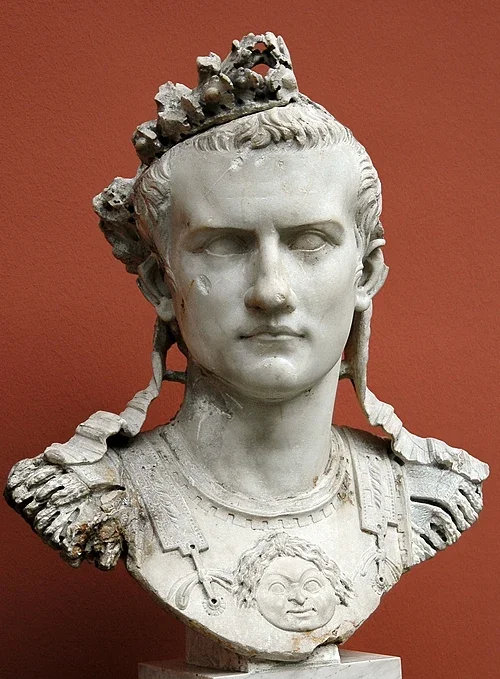
Bust of Caligula, by Ny Carlsberg Glyptotek
WEST WARWICK, R.I.
If the Roman Emperor Caligula were alive today, you can bet that he would have cheered the Ultimate Fighting Championship (UFC) fight on the South Lawn of the White House, which President Trump hosted on June 14 to mark his 80th birthday, and the nation’s 250th anniversary.
Caligula, who reigned from 37-41 A.D., hosted lavish spectacles and games for his birthday and other occasions at Roman venues. According to the Roman historian Suetonius, author of “The Twelve Caesars,” these celebrations were notorious for their extravagance and cruelty, including instances where he forced senators to run alongside his chariot for miles or ordered spectators thrown into the arena.
There are many parallels between the twisted Caesar’s reign and the Trump administrations.
For some fast fun, I asked Gemini, Google’s AI assistant, to write an account of Trump’s second administration in the style of Suetonius, whose juicy history of Julius Caesar and the first 11 emperors of the Roman Empire is one of the only sources of Caligula’s horrid reign.
Here is the slightly hallucinatory result:
The Life of Donald the Second Ancestry and Early Omens
He was born of the lineage of the Trumps, a clan enriched by the building of great monuments and towers of glass. His father, Fred, had amassed vast wealth in the provinces of New York, which the son multiplied through daring spectacles and the renaming of structures after his own image.
Before his second elevation to the principate, many omens appeared. It is said that a leaden bullet grazed his very ear during an oration in the fields of Pennsylvania, yet he arose bloody and defiant, shouting to the crowds to fight. This escape was viewed by his followers as a sign of divine favor from Mars himself.
The Second Ascent to the Throne
Having once held the supreme power and lost it to the elder statesman Joseph of Delaware, Donald did not retire to quiet contemplation. Instead, he waged a relentless four-year campaign from his seaside villa at Mar-a-Lago, which resembled an imperial court.
In the Year of the Ballot, he routed the faction of the Democrats led by the priestess Kamala, securing not only the electoral college but (narrowly) the popular vote of the entire Republic.
His return to the capital was celebrated with grand spectacles, and the Senate was quickly filled with his most loyal tribunes.
The Purge of the Bureaucrats and the New Court
Upon re-entering the White House, his first decree was the systematic dismantling of the "Deep State," which he likened to a hidden cabal of corrupt patricians.
He stripped thousands of public servants of their protections, replacing them with fiercely loyal clients.
He appointed Elon, a wealthy maker of celestial chariots, and Vivek, a young merchant, to oversee a new commission to hollow out the Treasury's waste.
He banished traditional magistrates and elevated loyal praetorians to head the legions and the courts.
Habits, Vices, and Public Spectacles
In his personal conduct, Donald retained the eccentricities of his first reign, though hardened by age and past grievances.
He eschewed standard imperial dispatches, choosing instead to govern by electronic edicts broadcast at all hours of the night to millions of citizens.
Diet: He disdained the refined banquets of the elite, preferring the charred flesh of cattle and the sparkling syrups of the West.
Amusements: He spent his days on manicured lawns, striking small white spheres with iron clubs, surrounded by courtiers seeking his favor.
Temperament: He rewarded absolute loyalty with high honors, but those who crossed him were subjected to public mockery, branded with insulting epithets, and cast out into political exile.
Foreign Tributes and Border Walls
Toward foreign nations, Donald acted with the unpredictability of a capricious deity.
He demanded heavy tribute from the allied kingdoms of Europe, threatening to withdraw the protection of the Republic's legions if they did not pay.
He placed vast tariffs upon the silks and wares of the Seres (the Chinese), initiating a fierce war of merchants.
At the southern frontier, he renewed the construction of his massive wall with frantic energy, boasting that he had successfully stemmed the migration of the barbarian tribes.
The End of the Reign
As his second term drew to its close, the Republic remained deeply fractured, split into warring factions that could no longer agree on the truth of things.
Some viewed him as a savior who restored the golden age of the Republic, while others whispered in fear of an absolute monarchy.
Having fulfilled the constitutional limit of his rule, he prepared to pass the mantle to his chosen Caesar, James David of Ohio, ensuring his shadow would loom over the state for generations to come.
Linda Gasparello is producer at White House Chronicle, on PBS, and an essayist. She’s based in Rhode Island.
Don Pesci: Those gubernatorial Caligulas

Decisive executive: A marble bust of Caligula restored to its original colors, identified from particles trapped in the marble
VERNON, Conn.
Gore Vidal – deceased, but not from Coronavirus complications – was once asked whether he thought the Kennedy brood had exercised extraordinary sway over Massachusetts. He did. And what did he think of the seemingly unending reign of “Lion of the Senate” Edward Kennedy, who had spent almost 43 years in office?
Vidal said he didn’t mind, because every state should have in it at least one Caligula.
The half-mad Roman emperor Caligula, who reigned in 37-41 A.D., considered himself a god, and the senators of Rome generally deferred, on pain of displeasure, to His Royal Deity. Caligula certainly acted like a god. The tribunes of the people deferred to his borderless power, which he wielded like a whip. They deferred, and deferred, and deferred… .Over time, their republic slipped through their fingers like water. Scholars think Caligula may have been murdered by a palace guard he had insulted.
Here in the United States, we do not dispose of our godlike saviors in a like manner. At worse, we may promote them to a judgeship, or they may be recruited after public service by deep-pocket lobbyists or legal firms, or they may remain in office until, as in Edward Kennedy’s case, they have shucked off their mortal coil and trouble us no longer
.Coronavirus has produced a slew of Vidal Caligulas, all of them governors. In emergencies, when chief executives are festooned with extraordinary powers, the legislature is expected to defer to the executive, and the judiciary remains quiescent.
This deference to an all-powerful executive department is not uncommon in war, but even in war, the legislative and judiciary departments remain active and viral concerning their oversight constitutional responsibilities.The war on Coronavirus, however, is a war like no other. Here in Connecticut, the General Assembly remains in a state of suspended animation. Every so often, an annoying constitutional Cassandra will pop up to remind us that we are a constitutional republic, but constitutional antibodies in Connecticut are lacking. Our constitutions, federal and state, are still the law of the land, and even our homegrown Caligulas are not “above the law,” because we are “a nation of laws, not of men.”
These expressions are more than antiquated apothegms; they are flags of liberty that, most recently, have been waved under President Trump’s nose. However, in our present Coronavirus circumstances, no one pays much attention to constitutional Cassandras because --- do you want to die? Really, DO YOU WANT TO DIE?Every soldier who has ever entered the service of his country in a war has asked himself the very same question. And we are in a Coronavirus War, are we not? Pray it may not last as long as “The War on Drugs.” Drug dealers won that one, and Connecticut has long since entered into the gambling racket; the marijuana racket looms in our future.
Then too, in the long run, we are all dead. Even “lions of the Senate” die. The whole point of life is to live honorably. And this rather high-falutin notion of honor means what your mama said it meant: don’t cheat; don’t lie; treat others as you expect them to treat you. Bathe every day and night in modesty, and remember – as astonishing as it may seem -- sometimes your moral enemy may be right. Put on your best manners in company. “The problem with bad manners,” William F. Buckley Jr. once said, “is that they sometimes lead to murder.” Caligula forgot that admonition.
Once Coronavirus has passed, we will be able honestly and forthrightly to examine closely the following propositions, many of which seem to be supported by what little, obscure data we now have at our disposal: that death projections have been wildly exaggerated; that reports of overwhelmed hospitals were exaggerated; that death counts were likely inflated; that the real death rate is magnitudes lower than it appears; that there have been under-serviced at-risk groups affected by Coronavirus; that it is not entirely clear how well isolation works; that ventilators in some cases could be causing deaths. These are open questions because insufficient data at our disposal at the moment does not permit a “scientific” answer to the questions that torment all of us.
At some point, a vaccine will be produced that will help to quiet our sometimes irrational fears, but vaccine production lies months ahead. The question before us now is: what is more dangerous, the wolf or the lion? New York Gov. Andrew Cuomo, and allied governors in his Northeast compact, cannot pinpoint a date to end their destructive business shutdown because of insufficient data. According to some reports, Cuomo has hired China-connected McKinsey & Company to produce “models on testing, infections and other key data points that will underpin decisions on how and when to reopen the region’s economy.”
If the economy in Connecticut collapses because Gov. Ned Lamont accedes to the demands of those in his newly formed consortium of Northeast governors that business destroying restrictions should remain in place for months until a vaccine is widely distributed, the effects of the resulting economic implosion will certainly be more severe than a waning Coronavirus infestation. After Connecticut has reached the apex of the Coronavirus bell curve, it is altogether possible that a continuation of the cure – a severe business shutdown occasioned by policies rooted in insufficient data – will be far worse than the disease it purports to cure.
Don Pesci is a Vernon-based columnist.