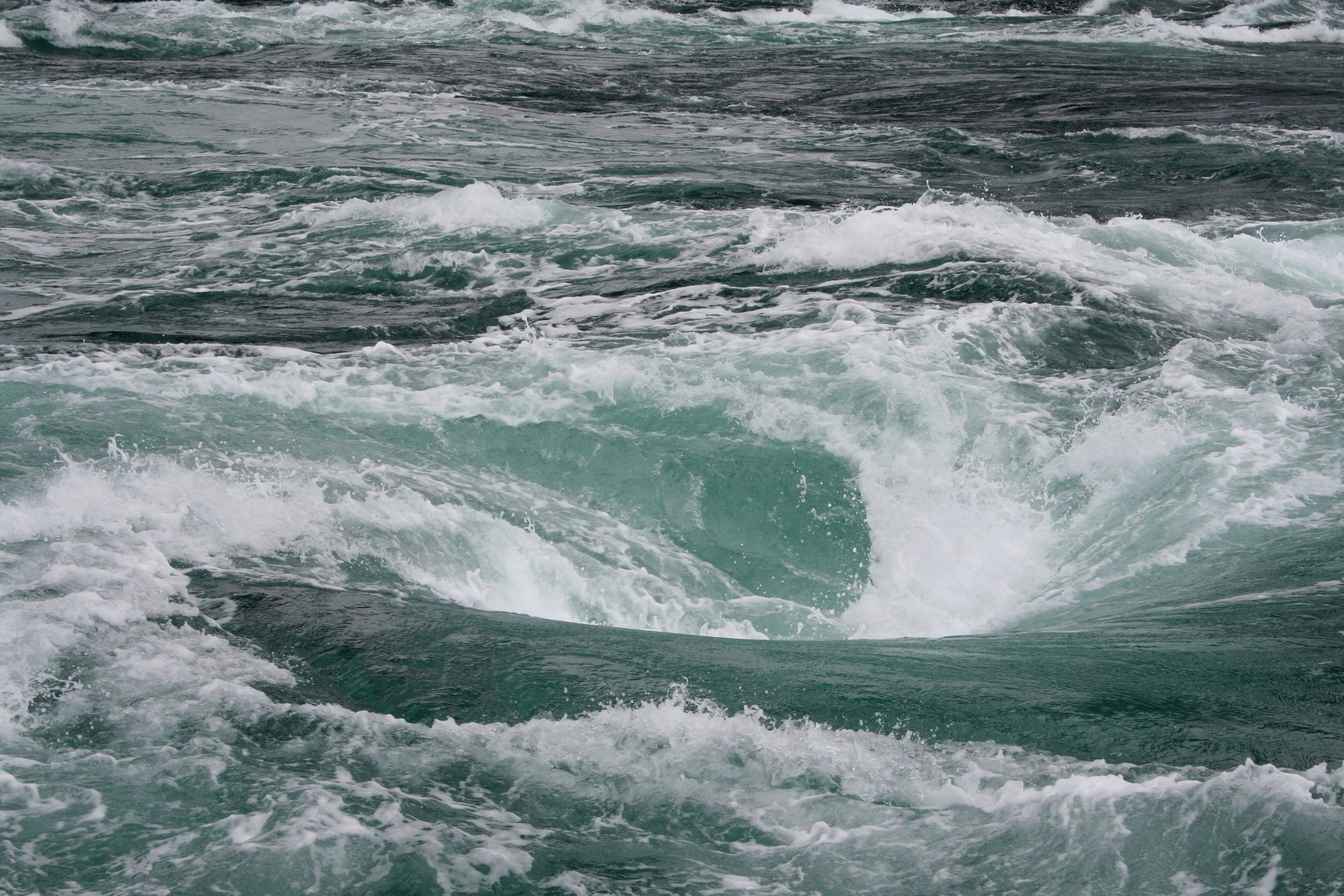
— Photo by Hellbuny.
Read this famous poem for context
Ah, the joys of living – and flying – in a country that is, quite literally, falling apart.
As nearly everybody knows by now, the nation’s air-traffic-control system suddenly went on the blink on Nov. 13. In response, the Federal Aviation Administration declared a rare nationwide “ground stop,” banning nearly all civi-aviation take-offs. Over the next three days more than 12,000 flights were cancelled and hundreds of thousands of passengers stranded.
The cause of all that chaos still remains a mystery. There was talk of sabotage, or maybe a cyber-attack by some hostile foreign power, though U.S. officials said they had no evidence of such mischief. Some folks blamed artificial intelligence, a popular villain these days. Its fingerprints have yet to be found on this incident, though in recent weeks there have been cases of AI bots acting on their own to probe private digital security systems in search of exploitable vulnerabilities.
The FAA did say that engineers at several regional traffic-control facilities had been updating their data-transmission systems, switching from 1980s copper coaxial cables to modern silica-glass optical fiber. As a result, electronic routers can now transmit so much data so fast that some copper-era routers on the receiving end were overwhelmed, possibly causing the shutdown.
President Trump blamed his predecessor, Joe Biden – who, he said, “hooked up a lot of copper into glass” in connection with that upgrade. Trump added: “If you know anything about electrical engineering, you cannot hook up copper into glass.” (Actually, you can, using a converter.) Trump also said that he was not taking “any responsibility” for the incident.
He should. As part of a decades-old modernization program, the FAA “hooked up copper to glass” throughout Trump’s first White House term and into his current one. Until now, though, technical problems have been rare.
Rather than a blame game, the recent shutdown should provoke some serious reflection. The U.S. – which carved a modern nation out of vast wilderness, built the Interstate highway system and put a man on the Moon – has been spending an ever-dwindling share of its gross domestic product on infrastructure, including the technological kind. Now infrastructure is striking back.
The day before the FAA ground stop, Microsoft announced a worldwide outage of its Outlook, Teams and Copilot services. On the following Monday, United Airlines said that a “widespread” outage of its electronic systems was delaying departures across the U.S. On the next day, the National Security Agency experienced a “temporary degradation” of its international communications. Before the week was out, J.P. Morgan Chase Bank, Microsoft and Apple announced that customers were having trouble accessing their services.
That’s just the electronic stuff. America’s more tactile accomplishments are also crumbling. Half of all U.S. bridges and school buildings are more than 50 years old. In its latest annual infrastructure Report Card, the American Society of Civil Engineers gives the country’s roads, airports, schools, electrical grids, dams and levees overall grades of D+ or lower.
That crisis has not gone completely unaddressed. President Joe Biden authorized more than $1.2 trillion to improve U.S. infrastructure. Last year, however, President Trump halted dispersal of those funds until he could root out any projects connected to climate change.
The problem with infrastructure – aside from being one of the most boring words in the English language – is that it’s usually too expensive for private entities to fund. That’s why governments ended up with the job. After all, public works benefit the public. Such projects also typically result in higher economic growth, a more productive workforce, better public health and lower rates of accidents and deaths.
Those projects can also forge a sense of community, especially in a diverse country such as the U.S. That’s why many citizens’ hearts swell with pride at the sight of a magnificent new bridge, dam or public building. (But will they like Trump’s triumphal arch?)
Big construction dreams do, of course, have downsides: noise, dust, degraded air and water, loss of open space, cost overruns and other things that abutters and taxpayers don’t like. Whatever the reasons, the U.S. has in recent years let things fall apart.
We are now paying the price. Not just our infrastructure, but the very fabric of society seems to be crumbling. A new Rasmussen survey finds that 62 percent of Americans think the country is becoming more divided politically. We also seem to be increasingly at odds with each other over cultural and moral values, social class, taxation and how to control AI.
“Things fall apart; the centre cannot hold / Mere anarchy is loosed upon the world,” as the Irish literary genius W.B. Yeats wrote in his famous 1919 poem, “The Second Coming.” It’s about the sour mood that gripped a devastated world in aftermath of World War I, but it could describe America today.
I may soon find out how accurately Yeats’s observation describes our current state. I have to fly a lot. Wish me luck.
Don Morrison is an international editor, writer and podcaster and co-chairman of the editorial advisory board of The Berkshire Eagle (based in Pittsfield, Mass.)