A Boston Guardian article by Joe Walsh and Will Nelson
(Robert Whitcomb, New England Diary’s editor, is chairman of The Boston Guardian.)
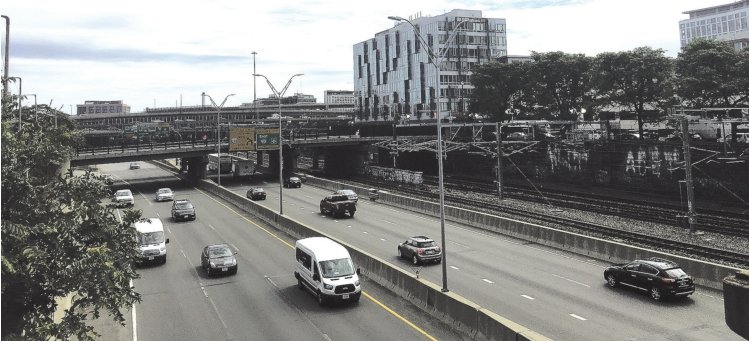
Scores of residential buildings have sprouted up steps away from Boston’s busiest highways, but the city has few regulations protecting these buildings’ tenants from dangerous car pollution.
More than a dozen new developments have been proposed near the Mass Pike and the Southeast Expressway, including thousands of residential units, millions of square feet of commercial space and two public schools, according to a Boston Guardian review.
Some of these developments could see hazardous levels of particulate pollution. Yet it is unknown how many of them designed their ventilation systems with this type of pollution in mind, and experts say the city’s rules for building near highways are lacking.
Cars and trucks on highways spew ultrafine particles less than a hundred thousandth of a meter wide. These particles can get swept into lungs and the bloodstream, leading to a host of heart and lung problems.
Ultrafine particles are most concentrated close to busy highways, leaving some development-heavy parts of Chinatown, the South End and the Fenway at risk, says Doug Brugge, a University of Connecticut public health professor who has studied air quality throughout Greater Boston.
In particular, several high-end developments like Ink Block, 112 Shawmut Avenue and the Troy occupy one of the city’s most heavily polluted areas. That corner of the South End lies next to both the Pike and the Expressway and is within range of South Station’s commuter trains.
“That whole area has very high ultrafine levels on a regular basis,” Brugge said. “I think it’s an area in which developers should be taking some very strong protective measures.”
Most developers planning projects near highways did not respond to requests for comment.
If developers choose to build right to highways, Brugge says they should adjust their designs to protect the residents and workers inside. These buildings’ ventilation systems should recirculate as much air as possible, Brugge says, and any new air should pass through tight filters.
On the public-sector side, Boston Public Schools has installed strong air filtration systems at the new Josiah Quincy Upper School building, which abuts the Mass Pike in Chinatown.
However, private developments near highways are not required to take any special protective measures.
The city’s zoning code requires developments to meet the US Green Building Council’s Leadership in Energy and Environmental Design (LEED) standard, which includes air quality rules, a Boston Planning and Development Agency spokesperson said. But according to Brugge, LEED does not take traffic pollution into account, so he does not see these rules as sufficient.
The Boston Public Health Commission, meanwhile, does not regulate developments, a spokesperson said. And the Boston Environment Department (BED) helps to review large projects and occasionally offers feedback, but it focuses on reducing car pollution rather than regulating construction.
“The major efforts that we are making are in reducing the production of particulate matter in the first place,” said BED spokesperson. “The most important thing to do is to reduce the source.”
In such other cities as Los Angeles and Somerville, zoning rules have begun to address highway pollution, forcing new developments in hazardous areas to install tighter filtration systems, Brugge notes. With stronger rules, Boston can ensure developers are proactive.