What to do with those defunct colleges’ campuses? How about schools for real ‘seniors’?
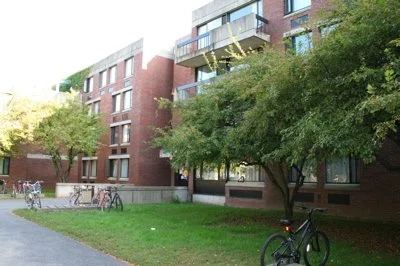
The Dakin House dorm at Hampshire College, in Amherst, Mass. Hampshire is the best known of defunct or soon-to-be-defunct small New England liberal-arts colleges. It’s closing at the end of its current semester.
Adapted from Robert Whitcomb’s “Digital Diary,’’ in GoLocal 24.com
Some small New England colleges are treasures, while some seem superfluous, and a few have been close to scams. In any case, the region’s small liberal-arts colleges have been closing at an accelerating rate in the past few years. Blame changing demographics, especially the decline in the number of college-age students; the steep price of higher education; Zoom, and the rise of artificial intelligence (whose effects already include a decline in thinking, let alone critical thinking, among students). AI, Zoom and even Google undermine -- for some people -- the perceived usefulness of being physically present on a campus. Then there are other technological “advances” with good and bad effects.
One of the most, er, exciting things about artificial intelligence is how easy it makes it for malign forces to lie, to erase the space between truth and falsehood.
Some have noted that as the Internet has been killing newspapers (which might be considered educational), it has also been killing colleges. Anyway, at least 10 New England colleges have closed (or are about to close – e.g., most famously Hampshire College) since 2020.
One way to help keep some of these smaller colleges open is for them to save them money by having multiple colleges merge some of their administrative functions and costs (such as purchasing) and to cross-market. That could include letting students cross-register and try different college campuses in different semesters, by means of a central coordinating organization, such as The New England Board of Higher Education. Appeal to students’ curiosity and adventurousness. For example, some might want to be in a city one semester and in the country another, or, more importantly, want out courses not available at their home campuses. But promote New England colleges as a general brand.
Think regionally!
Look at what the University of Vermont, while not a small liberal-arts college, is doing. To boost enrollment, starting next year UVM will be offering plus-35 percent tuition breaks to students from other New England states in 31 majors.
Other states in the region are doing similar things. Read about the New England Board of Higher Education’s Tuition Break program.
For that matter, members of such organizations as the Twelve College Consortium (linking better known and financed schools in the Northeast) have for decades pooled resources by encouraging cross-registration and promoting each others’ special strengths.
With intense competition for students from colleges and universities in the rest of the United States, some with fast-growing populations, olde New England’s colleges and universities, in the region that virtually invented American higher education, must collaborate much more.
Of course, small financially wrought colleges will continue to close, and in some places that could help address the region’s serious lack of housing affordable for low-and-middle-income people. Convert dorms and other college buildings into rental and/or owned housing. The lack of housing has increasingly hampered New England’s economy, though the region remains the nation’s richest, to no small degree because it’s the most educated and all-in-all the most honestly and competently governed, whatever the corruption that pops up in some localities.
College-campus-to-housing conversations are starting to happen around New England. Consider, for example, that a local community housing-development group is moving to buy the campus, in Craftsbury, Vt., of Sterling College, which closed this year.
Also, as I’ve written here before, another good way to address the housing shortage, and therefore high costs, is to encourage the use of prefabricated and modular construction, which is cheaper, and faster to put up, than traditional housing construction. And it can be quite attractive.
Or maybe parts of some of these closed campuses could be converted for use as public K-12 schools.
I got a suggestion from my friend Dr. Edward Iannuccilli asking if some of those closed colleges might be good venues for elderly people to take courses while staying in these “defunct’’ campuses’ dorms. While the demographic of college-age young people is shrinking, that of old people is surging!
Dr. Iannuccilli, a well known author, best known as a memoirist, as well as distinguished physician and former health-care executive, noted:
“I've attended and given several presentations, including Circle of Scholars, the Learning Connection, and Lifelong Learning.
“They are always well attended by engaged, enthusiastic senior citizens.’’
Maybe turn some of these campuses into colleges for senior citizens, where some people might even get late-in-life degrees. More productive than taking a cruise.