
Vox clamantis in deserto









But the city always rights itself

“Chrysler Dreaming,’’ by Nancy Whitcomb, from the monotype edition of New England Wax’s “Home/Away.’’
Zapping the crops

“Tower Over Farm’’ (watercolor), by William Talmadge Hall, in his “Obstruction to a Landscape” series.
‘Work as its own activism’

Work by Somali-American artist Uman, in her show “After all the things,’’ at the Aldrich Contemporary Art Museum of Art, Greenwich, Conn., Oct. 19,2025 to May 10, 2026.
She says:
“My work offers an escape. Whether it’s the night sky, the sun, or a cow in a field, I want it to feel good for the audience. And the first audience is me. I’ve always felt like if I was to make great art, it would have to come from deep within me and be very honest. My work is its own activism, just painting my life, existing, living. I don’t need to say too much.’’
Nancy Forster-Holt: Tailor small-business policies to owners’ age
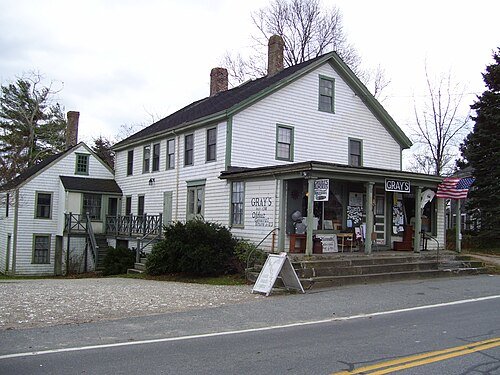
Quintessential small business: Gray’s General Store, in Adamsville, R.I., opened in 1788 and closed in 2012. It’s now a collectibles and antique store.

Can it do more for business owners as they try to move to retirement?
Except for images above, this is from The Conversation
Nancy Forster-Holt is an associate professor of innovation and entrepreneurship at the University of Rhode Island.
She does not work for, consult, own shares in or receive funding from any company or organization that would benefit from this article, and has disclosed no relevant affiliations beyond their academic appointment.
KINGSTON, R.I.
Americans love small businesses. We dedicate a week each year to applauding them, and spend Small Business Saturday shopping locally. Yet hiding in plain sight is an enormous challenge facing small business owners as they age: retiring with dignity and foresight. The current economic climate is making this even more difficult.
As a professor who studies aging and business, I’ve long viewed small business owners’ retirement challenges as a looming crisis. The issue is now front and center for millions of entrepreneurs approaching retirement. Small enterprises make up more than half of all privately held U.S. companies, and for many of their owners, the business is their retirement plan.
But while owners often hope to finance their golden years by selling their companies, only 20 percent of small businesses are ready for sale even in good times, according to the Exit Planning Institute. And right now, conditions are far from ideal. An economic stew of inflation, supply chain instability and high borrowing costs means that interest from potential buyers is cooling.
For many business owners, retirement isn’t a distant concern. In the U.S., Baby Boomers – who are currently 61 to 79 years old – own about 2.3 million businesses.
Altogether, they generate about US$5 billion in revenue and employ almost 25 million people. These entrepreneurs have spent decades building businesses that often are deeply rooted in their communities. They don’t have time to ride out economic chaos, and their optimism is at a 50-year low.
New policies, new challenges
You can’t blame them for being gloomy. Recent policy shifts have only made life harder for business owners nearing retirement. Trade instability, whipsawing tariff announcements and disrupted supply chains have eroded already thin margins. Some businesses – generally larger ones with more negotiating power – are absorbing extra costs rather than passing them on to shoppers. Others have no choice but to raise prices, to customers’ dismay. Inflation has further squeezed profits.
At the same time, with a few notable exceptions, buyers and capital have grown scarce. Acquirers and liquidity have dried up across many sectors. The secondary market – a barometer of broader investor appetite – now sees more sellers than buyers. These are textbook symptoms of a “flight to safety,” a market shift that drags out sale timelines and depresses valuations – all while Main Street business owners age out. These entrepreneurs typically have one shot at retirement – if any.
Adding to these woes, many small businesses are part of what economists call regional “clusters,” providing services to nearby universities, hospitals and local governments. When those anchor institutions face budget cuts – as is happening now – small business vendors are often the first to feel the impact.
Research shows that many aging owners actually double down in weak economic times, sinking increasing amounts of time and money in a psychological pattern known as “escalating commitment.” The result is a troubling phenomenon scholars refer to as “benign entrapment.” Aging entrepreneurs can remain attached to their businesses not because they want to, but because they see no viable exit.
This growing crisis isn’t about bad personal planning — it’s a systemic failure.
Rewriting the playbook on small- business policy
A key mistake that policymakers make is to lump all small business owners together into one group. That causes them to overlook important differences. After all, a 68-year-old carpenter trying to retire doesn’t have much in common with a 28-year-old tech founder pitching a startup. Policymakers may cheer for high-growth “unicorns,” but they often overlook the “cows and horses” that keep local economies running.
Even among older business owners, circumstances vary based on local conditions. Two retiring carpenters in different towns may face vastly different prospects based on the strength of their local economies. No business, and no business owner, exists in a vacuum.
Relatedly, when small businesses fail to transition, it can have consequences for the local economy. Without a buyer, many enterprises will simply shut down. And while closures can be long-planned and thoughtful, when a business closes suddenly, it’s not just the owner who loses. Employees are left scrambling for work. Suppliers lose contracts. Communities lose essential services.
Four ways to help aging entrepreneurs
That’s why I think policymakers should reimagine how they support small businesses, especially owners nearing the end of their careers.
First, small business policy should be tailored to age. A retirement-ready business shouldn’t be judged solely by its growth potential. Rather, policies should recognize stability and community value as markers of success. The U.S. Small Business Administration and regional agencies can provide resources specifically for retirement planning that starts early in a business’s life, to include how to increase the value of the business and a plan to attract acquirers in later stages.
Second, exit infrastructure should be built into local entrepreneurial ecosystems. Entrepreneurial ecosystems are built to support business entry – think incubators and accelerators – but not for exit. In other words, just like there are accelerators for launching businesses, there should be programs to support winding them down.
These could include confidential peer forums, retirement-readiness clinics, succession matchmaking platforms and flexible financing options for acquisition.
Third, chaos isn’t good for anybody. Fluctuations in capital gains taxes, estate tax thresholds and tariffs make planning difficult and reduce business value in the eyes of potential buyers. Stability encourages confidence on both sides of a transaction.
And finally, policymakers should include ripple-effect analysis in budget decisions. When universities, hospitals or governments cut spending, small business vendors often absorb much of the shock. Policymakers should account for these downstream impacts when shaping local and federal budgets.
If we want to truly support small businesses and their owners, it’s important to honor the lifetime arc of entrepreneurship – not just the launch and growth, but the retirement, too.
Chris Powell: Illegal-immigration backers in Conn. don’t get critical questions

MANCHESTER, Conn.
Immigration-law enforcement agents must be compelled, by congressional action or court order, to identify themselves conspicuously during arrests, to display their badges, and to make prompt public reports identifying the people they have detained, why they have been detained, and where they are being held. A free country cannot allow secret arrests. The necessity of such accountability in government goes back centuries to the Magna Carta.
Democrats in Congress should press this issue instead of simply decrying all immigration-law enforcement. Most of the country will agree, and Republicans in Congress who disagree will risk being exposed as totalitarians.
Police in Connecticut already are obliged by law to follow similar procedure, though they sometimes neglect to report arrests promptly and news organizations fail to notice.
But the greater failure of Connecticut journalism lately involves its reporting of complaints against immigration law enforcement. Reporters can't be blamed when they can't reach or get responses from immigration law enforcers, but they can be blamed when they quote officials, activists, and others in the immigration controversy without posing critical questions.
The recent arrest by immigration agents of a woman as she was driving her children to school in New Haven provoked outrage. Some of it verged on hysteria, like the statement issued by Mayor Justin Elicker.
"To arrest a mother in front of her two young children while taking them to school is simply unconscionable," the mayor said.
So what is the appropriate time to arrest and detain someone with children who is suspected of being in the country illegally? Will such a suspect necessarily cooperate in scheduling her arrest and detention, or might she flee instead? Do New Haven's own police always give notice to the targets of their arrest warrants?
Mayor Elicker wasn't asked.
He continued: "We condemn this deplorable act of family separation and call upon the Trump administration to stop its inhumane approach and cruel tactics."
But don't arrests in New Haven and elsewhere routinely separate people from their children, or are children brought to jail with their parents?
The mayor wasn't asked.
"New Haven," the mayor said, "is a welcoming city for all, and our immigrant neighbors are a part of our New Haven family."
Does New Haven really welcome legal and illegal immigrants, the well-intentioned and the ill-intentioned, and the self-supporting and the dependent alike? Does New Haven distinguish among them, or is that properly the work of immigration authorities? Or should no one do that work and should the nation's borders be opened again?
Mayor Elicker concluded: "New Haven will continue to stand up for our residents and our values, and we will continue fight back with every resource available to us against the Trump administration's reckless immigration policies."
What exactly does "every resource available" mean? Even as the mayor was so upset about that immigration arrest, New Haven's school system was facing a deficit of $16.5 million and was preparing to lay off scores of employees, and the chronic absenteeism rate of its high school students stood at 50 percent.
Since New Haven can hardly take care of itself, how can it afford to be a "sanctuary city," accepting, housing, concealing, and trying to educate unlimited numbers of illegal immigrants? And since state government covers so much of New Haven's expenses, how can Connecticut afford to let the city assume unlimited liabilities like these?
Nor were compelling questions posed the other week amid outrage in Meriden about the immigration agents’ arrest and detention of a city high school student and his father a few days before the boy's graduation.
The two were reported to have been arrested at a scheduled meeting with immigration authorities, so presumably they knew there was something wrong about their presence in the country.
Protesters in Meriden chanted that they want immigration authorities to get out of Connecticut. But wouldn't that leave the borders open again? Is that what the protesters want?
Though they were surrounded by journalists, the protesters were never asked.
Chris Powell has written about Connecticut government and politics for many year (CPowell@cox.net).
Don’t obey in silence

At an anti-Trump demonstration at Boston Common on Feb. 5, 2025
“The voice of protest, of warning, of appeal is never more needed than when the clamor of fife and drum, echoed by the press and too often by the pulpit, is bidding all men fall in and keep step and obey in silence the tyrannous word of command. Then, more than ever, it is the duty of the good citizen not to be silent.”
― Charles Eliot Norton (1827-1908), author, social critic and Harvard professor
Plenty of trouble

Untitled (ink and pencil on paper), in Layla Ali’s “Typology series,’’ in her show “Is Anything the Matter: Drawings by Layla Ali,’’ at the University Museum of Contemporary Art at the University of Massachusetts at Amherst.
The museum says that “the drawings explore Ali’s interest in the amalgam of race, power, gender, human frailty, murky politics, and other complex topics that are often treated as separate.’’
‘Finally waking up’

Work by Timothy Hunsoo Lee in his show, through June 29, at the Griffin Museum of Photography, Winchester, Mass.
— Image courtesy Timothy Hunsoo Lee and Sabrina Amrani Gallery
The Korean-American artist says:
“My practice, and the breadth of my interests, tells a fragmented story constantly reassembling itself – a story of how a boy grew into his body and into his home. A story about migrating, and the rituals and labors of that journey. A story about feeling the politicized, fetishized, and abstracted body so deeply long before learning the vocabulary to describe it. A story about dreaming and finally waking up."
Llewellyn King: Trump’s slashing of science funding is a blow against America’s future
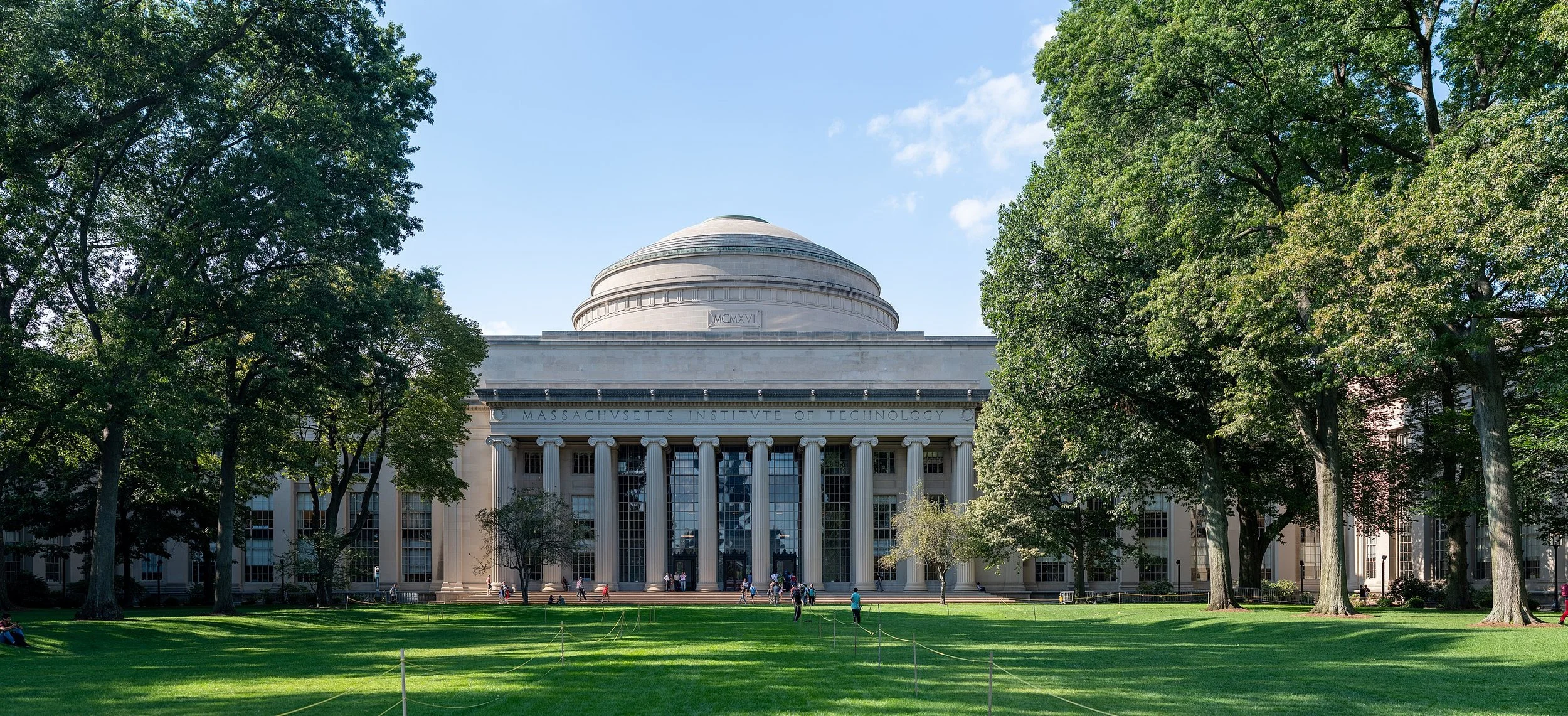
Building 10 and Great Dome overlooking Killian Court at the Massachusetts Institute of Technology, in Cambridge.
—Photo by Mys 721tx
WEST WARWICK, R.I.
When I asked John Savage, the retired co-founder of the Department of Computer Science at Brown University, what the essential ingredient in research is, he responded with one word: “Passion.”
It is passion that keeps scientists going, dead end after dead end, until there is a breakthrough.
It is passion that keeps them at the bench or staring into a microscope or redesigning an experiment with slight modifications until that “eureka moment.”
I have been writing about science for half a century. I can tell you that passion is the bridge between daunting difficulty and triumphant discovery.
Next comes money: steady, reliable funding, not start-and-stop dribbles.
It is painful to watch the defunding of the nation’s research arm by roughly a third to a half; the wanton destruction of what, since the end of World War II, has kept the United States the premier inventor-nation, the unequaled leader in discovery.
It is dangerous to believe the status quo ante will return when another administration is voted in, maybe in 2028.
You don’t pick up the pieces of projects that are, as they were, ripped from the womb and put them back together again, even if the researchers are still available — if they haven’t gone to the willing arms of research hubs overseas or other careers.
The work isn’t made whole again just because the money is back. The passion is gone.
There are crude, massive reductions in funding for research and development across the government — with the most axing in the National Institutes of Health (NIH), the National Science Foundation (NSF) and the Department of Energy (DOE). But the philistines with their metaphorical chainsaws have slashed wildly and deeply into every corner of science, every place where talented men and women probe, analyze and seek to know.
This brutal, mindless slashing isn’t just upending careers, causing projects to be abandoned in midstream, destroying the precious passion that is the driver of discovery, but it is also a blow against the future. It is a turn from light to dark.
The whiz kids of DOGE aren’t cost-cutting. They are amputating the nation’s future.
The cutting of funds to NIH — until now the world’s premier medical research center, a citadel of hope for the sick and the guarantor that the future will have less suffering than the past — may be the most egregious act of many.
It is a terrible blow to those suffering from cancer to Parkinson’s and the myriad diseases in between who hope that NIH will come up with a cure or a therapy before they die prematurely. It is a heartless betrayal.
The full horror of the dismantling of what they call the nation’s “scientific pillar” has been laid out by two of America’s most eminent scientists in an essay in the Bulletin of the Atomic Scientists.
They are John Holdren, who served as President Barack Obama’s science adviser and as director of the White House Office of Science and Technology Policy, and Neal Lane, who was President Bill Clinton’s science adviser and is a former NSF director. In their alarming and telling essay, they appeal to Congress to step in and save America’s global leadership in science.
They write, “What is happening now exceeds our worst fears. Consider, first, the National Science Foundation, one of the brightest jewels in the crown of U.S. science and the public interest. …. It's the nation's largest single funder of university basic research in fields other than medicine. Basic research, of course, is the seed corn from which future advances in applied science and technology flow.”
The NFS co-stars in the federal research ecosystem with NIH and DOE, the authors write. The NSF has funded research underpinning the internet, the Google search engine, magnetic resonance imaging, laser eye surgery, 3-D printing, CRISPR gene editing technology and much more.
The NIH is the world’s leading biomedical research facility. The writers say it spends 83 percent of its $48 billion annual budget on competitive grants, supporting over 300,000 researchers at more than 2,500 institutions in all 50 states. Another 11 percent of the agency’s budget supports the 6,000 researchers in its own laboratories.
Holdren and Lane write, “Of the energy department’s $50 billion budget in fiscal 2024, about $15 billion went to non- defense research and development.”
Some $8 billion of this went to the DOE Office of Science Research, the largest funder in basic research in the physical sciences, supporting 300 institutions around the country including the department’s own 17 laboratories.
In all of the seminal moves made by the Trump administration, what The Economist calls the president’s “War on Science” may be the most damaging.
Llewellyn King is executive producer and host of White House Chronicle, on PBS. He’s based in Rhode Island.
On X: @llewellynking2
Healthy housing?
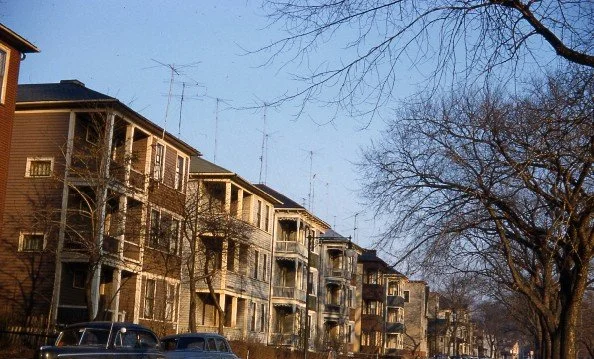
Three-decker cityscape in Worcester in the 1950’s, when Worcester was still a major manufacturing center and many industrial workers lived in three-deckers.
“People in the field of public health believed that {three-decker residential} buildings did much to account for the general good health of Worcester’s populations. Each apartment received sunshine and fresh air from all sides. People, young and old, took their daily airings on the comfortable porches, where they could enjoy some of the best views in Worcester. Each back porch held a clothes reel where the laundry could hang to dry in the beneficial sunshine….’’
From Heart of the Commonwealth, Worcester: An Illustrated History, by Margaret A. Erskine and Worcester Area Chamber of Commerce (1981)
The long view

“View from Bald Rock,” 1971, (oil on canvas), by Joseph Fiore (1925-2008), at Maine Art Gallery, Wiscasset. He and his wife lived seasonally at a farm they bought in Jefferson, Maine.
-Courtesy of Maine Farmland Trust
Climate and memory

Image from the show “Remote Sensing,’’ by Hannah Perrine Mode, through Oct. 18, at Northeastern University's Gallery 360, in Boston.
— Image courtesy Gallery 360
The gallery says the show explores geological forces, stewardship and memory-keeping. It’s the first major solo show by artist, educator and researcher Mode. The multi-disciplinary exhibition captures landscapes primarily between New England and Alaska. It asks viewers to “consider how climate systems are seen, felt and understood from a distance — offering a window into landscapes both miles away and in our backyard." For more information, visit here.
Learning from the final innings

Adapted from Robert Whitcomb’s “Digital Diary,’’ in GoLocal24.com
As we age, most of us go to more and funerals, and visit more and more house- or institution-bound friends and relatives. A few of the visited don’t remember who we are, but we go to see them anyway to celebrate who they were, and they generally like our company, whoever we are. And sometimes they’ll blurt out an alarming or amusing anecdote from the past that resolves some old mysteries. Given the age of some of these people, we’re sometimes surprised that they say how fast their lives have gone. “Eighty-two years old, and what happened?!,’’ said one old lady in New Hampshire we met.
I worry that there are so many aging people without close relatives to help look after them, including by such visits.
America still likes to think of itself as a young country, but it’s increasingly a place for the old, and not just in Washington, D.C.
Aging is so quirky. Some people start to seem out of it at age 60; others are sharp to over 100. The brain remains a mystery in so many ways.
Take a look at the New England Centenarian Study.
Will they leave as happy?

“And the Symbol of Welcome is Light (Guests Arriving at a Party)” (1920), by Norman Rockwell (advertising illustration for Edison Mazda Lamps in collection of GE Aerospace), in the show “Illustrators of Light: Rockwell, Wyeth and Parrish,’’ at the Norman Rockwell Museum, Stockbridge, Mass.
Read it on paper this summer

“La Lecture’’ (“Reading”), (oil on canvas) by Berthe Morisot (1888)
Adapted from Robert Whitcomb’s “Digital Diary,’’ in GoLocal24.com.
Summer is the prime season for reading books for pleasure. And physical books are the best way to read long works. You can better focus and reflect as you turn pages with your fingers than by looking at and clicking at backlit screens. And science suggests that you remember more of what you read in a physical book than from a screen, though the latter is fine for shorter pieces, especially if you can discipline yourself from being distracted by the colorful and sometimes blinking features that accompany many Web pages
The mild revival of small, independent bookstores in recent years shows a healthy desire to escape from digital distractions, which can be anxiety-provoking.
So happy summer reading, be it fiction (which boosts our imaginative powers and empathy) or nonfiction. Lose yourself in books, maybe while sitting under a tree.
Here’s some science promoting reading on paper. And here’s some more.
A different look at wet

“Water Goes Well with Fuji”(artist proof), (woodcut), by Iwami Reika, in the show “Trailblazers: Celebrating Contemporary Japanese Prints,’’ opening June 21, at Highfield Hall & Gardens,Falmouth, Mass.
— Courtesy of College Women’s Association of Japan
Chris Powell: Look for places with good parenting

MANCHESTER, Conn.
Anyone asked to guess the 10 best public high schools in Connecticut would probably select some of those chosen by the Internet site Niche, which connects high school graduates with colleges.
Nine of the 10 high schools chosen by Niche are in Westport, New Canaan, Darien, Greenwich, Wilton, Ridgefield, Avon, Farmington, Glastonbury and Norwalk. All but Norwalk are prosperous communities that spend a lot of money on their schools and get good results. The high school in Norwalk cited by Niche is a regional school drawing especially motivated students, many from outside the city.
According to Niche, all 10 of the best public elementary schools in the state are in three of the towns with the best high schools -- Greenwich, New Canaan and Westport -- and nine of the 10 best middle schools are in the towns with the best high schools.
Of course educators will conclude from these rankings that per-pupil spending correlates with student performance -- spending up, education up. This is self-serving and wrong.
For while not everyone in the towns with the supposedly best schools is rich, most people there are at least middle class and most children there have two parents, either living with them or otherwise involved in their lives. Their parents spend time with them. Most know their letters, numbers, and colors when they first arrive in school. They know how to behave. They have some interest in learning. Their attendance is good because their parents see to it.
Most such children are easy to teach -- not because per-pupil spending is high but because per-pupil parenting is.
Of course circumstances are much different in high schools in municipalities with terrible demographics, municipalities with high poverty and low parenting. Here many children live in fatherless homes, homes with only one wage earner and a smattering of welfare benefits, homes over which a stressed, exasperated, and sometimes addicted mother presides. These children get much less attention and many are frequently absent from school.
In New Haven, the city that is always lecturing Connecticut about how to live, high schools have a chronic absenteeism rate of 50 percent, highest in the state. Good luck to teachers and administrators trying to educate children who frequently don't show up and, when they do, often disrupt classes, get into fights, or suffer mental breakdowns, but whose general discipline or expulsion is forbidden.
That's why the Niche school rankings are so misleading.
For schools and teachers play the hands they are dealt by community demographics.
Any school dealt four aces is almost certain to win regardless of its resources and the competence of its staff. Any school dealt mostly jokers will resort to clamoring at the state Capitol for more money, as if the great increase in state financial aid to schools since the Education Enhancement Act was passed in 1986 has made any difference in education results, and as if the clamor for more money isn't just an excuse for ignoring the parenting problem, which seldom can be discussed in polite political company.
Connecticut's best schools are actually the ones that get the best results from the students who are hard to teach -- the students neglected at home -- not those who are easy to teach. Nobody seems to compile such data, perhaps because it would impugn the premise of education in Connecticut -- that only spending and teacher salaries count and educational results are irrelevant.
For many years in Connecticut the only honest justification for raising teacher salaries has been to induce teachers to stick around with the demoralized, indifferent, and misbehaving kids about whom nothing can be done until government finds the courage to restore academic and behavioral standards. These days teachers are given raises mainly to secure labor peace and union support for the Democratic Party.
It's the same with police departments. Cities, where poverty is worst, struggle to keep officers not so much because suburbs often pay better but because, like city teachers, city cops increasingly want to escape the worsening social disintegration and depravity around them.
Chris Powell has written about Connecticut government and politics for many years (CPowell@cox.net).
‘The Body Imagined’

“El guerrero (The Warrior)” (acrylic and crayon on paper), by Javier Chavira (American, born in Mexico), in the show “The Body Imagined: Figurative Art in the Bank of America Collection,’’ at the Mattatuck Museum, Waterbury, Conn., June 22-Sept. 28.
His Web site says:
“Guided by both analytical and intuitive processes, Chavira’s pluralistic practice is open to using a variety media to seamlessly integrate formal elements to create pictures and objects that exist in the space between non-objective abstraction and representation, without rigidly adhering to either. Chavira’s diverse oeuvre is a testament to this distinctive approach.’’

Waterbury was once famous for clock and watch making, as well as for brass.
Rezoning plan blindsides Downtown Boston residents
This article is slightly edited for use here.
(Disclosure: Robert Whitcomb, New England Diary’s editor, is chairman of The Boston Guardian.)
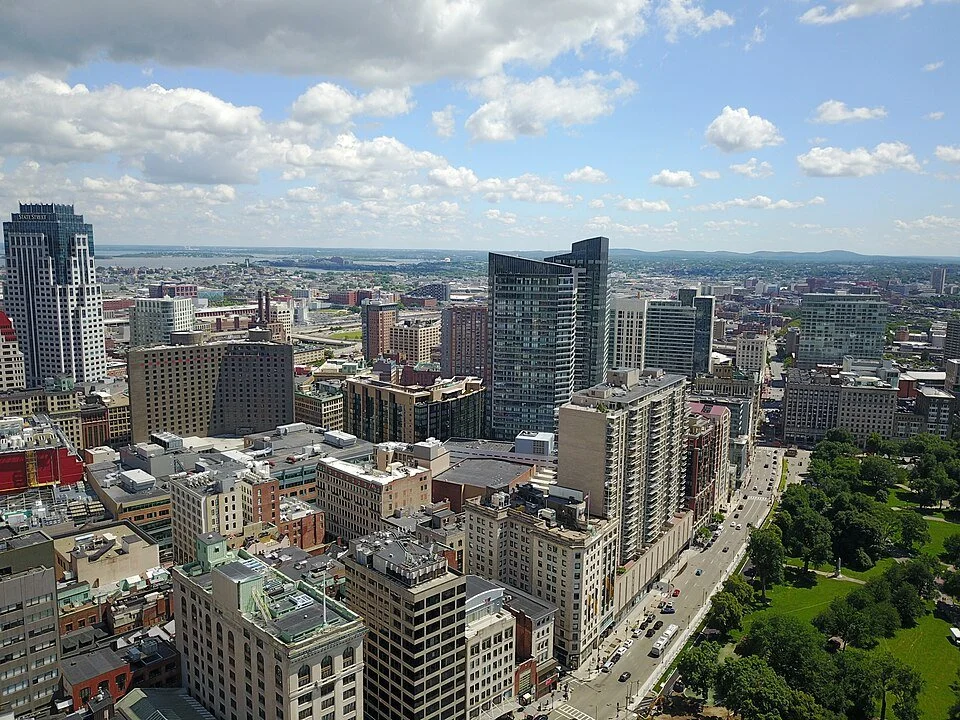
The newest Downtown Boston zoning update allows for towers of up to 700 feet, much to the surprise and disappointment of community leaders who have been involved in negotiations with the Planning Department (BPD) since February.
The zoning plan, known as PLAN: Downtown, has been an issue for months, after the city proposed a draft in January that allowed for 500-foot residential towers on Washington Street. When it received over 500 letters of opposition from residents, the city agreed to revise the plan along with a coalition of Downtown community leaders. But those stakeholders say the latest version of the draft is not what they expected or planned for.
“The mayor personally assured this coalition that the city would work collaboratively to engage in meaningful dialogue and aim to reach a compromise,” the Downtown Boston Neighborhood Association (DBNA), a major player in the coalition, said in a statement. “It has become abundantly clear that this was never the administration’s intention and that the few meetings that were held with the coalition were simply a disingenuous ‘check the box’ exercise.”
Rishi Shukla, of the DBNA, said the city had been radio silent with the coalition since mid-April after only three meetings. On May 27, Shukla had requested a call with Chief of Planning Kairos Shen to get an update. Midway through the call, Shukla said he received a text from a city contact letting him know the city planned to release its final draft two days later.
The latest draft of the plan has two districts spanning the Downtown. One, adjacent to the parks, has a maximum height of 155 feet. The other has a variable maximum height, such that it complies with whatever the smallest number is between state shadow regulations, parks shadow regulations, and the critical airspace limit of 800 feet. That means that, as buildings get farther away from the parks, they can increase in height in progressive stages, up to 700 feet.
The boundary of the districts is at Washington Street. A map of the zoning published by the city shows that the western side of the street, closer to the parks, has a height limit of 155 feet, while the eastern side can have up to 400-foot tall buildings.
The city has argued since January that its goal was to increase housing opportunities, despite resident opposition that any housing constructed in the area would not be affordable.
“This zoning update is one of several plans and initiatives underway across Boston to address our housing crisis,” Mohammed Missouri, Mayor Wu’s senior strategy advisor, wrote in an email to people who submitted comments on the original draft.
“As the most rapid-transit-accessible part of our city, Downtown is a critical location for focusing new mixed-use and residential density, where Inclusionary Zoning requirements will produce affordable housing at a scale not feasible in other parts of the city.”
But according to the DBNA, this initiative has not been accompanied with any actual planning.
“In its latest release, the city once again fails to provide any basic analysis, renderings, shadow studies, or infrastructure impacts related to the proposed zoning plans,” the DBNA wrote. “This is not thoughtful, comprehensive planning. It is a high-rise tower gamble devoid of sound analysis and valid proof of concept.”
The BPD will hold a virtual public meeting about the new plan on June 16 at 6 pm.