
Allison Stanger: Replacing our republic with ‘network state’ dictatorship
Artificial intelligence icon. Elon Musk is heavily involved in this unregulated sector, which has formidable potential for exercising power.

An example paper printable Bitcoin wallet consisting of one Bitcoin address for receiving and the corresponding private key for spending.
MIDDLEBURY, VT.\
Elon Musk’s role as the head of the Department of Government Efficiency, also known as DOGE, is on the surface a dramatic effort to overhaul the inefficiencies of federal bureaucracy. But beneath the rhetoric of cost-cutting and regulatory streamlining lies a troubling scenario.
Musk has been appointed what is called a “special government employee” in charge of the White House office formerly known as the U.S. Digital Service, which was renamed the U.S. DOGE Service on the first day of President Donald Trump’s second term. The Musk team’s purported goals are to maximize efficiency and to eliminate waste and redundancy.
That might sound like a bold move toward Silicon Valley-style innovation in governance. However, the deeper motivations driving Musk’s involvement are unlikely to be purely altruistic.
Musk has an enormous corporate empire, ambitions in artificial intelligence, desire for financial power and a long-standing disdain for government oversight. His access to sensitive government systems and ability to restructure agencies, with the opaque decision-making guiding DOGE to date, have positioned Musk to extract unprecedented financial and strategic benefits for both himself and his companies, which include the electric car company Tesla and space transport company SpaceX.
One historical parallel in particular is striking. In 1600, the British East India Company, a merchant shipping firm, began with exclusive rights to conduct trade in the Indian Ocean region before slowly acquiring quasi-governmental powers and ultimately ruling with an iron fist over British colonies in Asia, including most of what is now India. In 1677, the company gained the right to mint currency on behalf of the British crown.
As I explain in my upcoming book “Who Elected Big Tech?” the U.S. is witnessing a similar pattern of a private company taking over government operations.
Yet what took centuries in the colonial era is now unfolding at lightning speed in mere days through digital means. In the 21st century, data access and digital financial systems have replaced physical trading posts and private armies. Communications are the key to power now, rather than brute strength.
A security officer blocks U.S. Sen. Ed Markey, right, from entering the U.S. Environmental Protection Agency headquarters on Feb. 6, 2025, in an effort to meet with DOGE staff. Al Drago/Getty Images
The data pipeline
Viewing Musk’s moves as a power grab becomes clearer when examining his corporate empire. He controls multiple companies that have federal contracts and are subject to government regulations. SpaceX and Tesla, as well as tunneling firm The Boring Company, the brain science company Neuralink, and artificial intelligence firm xAI all operate in markets where government oversight can make or break fortunes.
In his new role, Musk can oversee – and potentially dismantle – the government agencies that have traditionally constrained his businesses. The National Highway Traffic Safety Administration has repeatedly investigated Tesla’s Autopilot system; the Securities and Exchange Commission has penalized Musk for market-moving tweets; environmental regulations have constrained SpaceX.
Through DOGE, all these oversight mechanisms could be weakened or eliminated under the guise of efficiency.
But the most catastrophic aspect of Musk’s leadership at DOGE is its unprecedented access to government data. DOGE employees reportedly have digital permission to see data in the U.S. government’s payment system, which includes bank account information, Social Security numbers and income tax documents. Reportedly, they have also seized the ability to alter the system’s software, data, transactions and records.
Multiple media reports indicate that Musk’s staff have already made changes to the programs that process payments for Social Security beneficiaries and government contractors to make it easier to block payments and hide records of payments blocked, made or altered.
But DOGE employees only need to be able to read the data to make copies of Americans’ most sensitive personal information.
A federal court has ordered that not to happen – at least for now. Even so, funneling the data into Grok, Musk’s xAI-created artificial intelligence system, which is already connected with the Musk-owned X, formerly known as Twitter, would create an unparalleled capability for predicting economic shifts, identifying government vulnerabilities and modeling voter behavior.
That’s an enormous and alarming amount of information and power for any one person to have.
Candidate Donald Trump speaks at a key cryptocurrency industry conference in July 2024. AP Photo/Mark Humphrey
Cryptocurrency coup?
Like Trump himself and many of his closest advisers, Musk is also deeply involved in cryptocurrency. The parallel emergence of Trump’s own cryptocurrency and DOGE’s apparent alignment with the cryptocurrency known as Dogecoin suggests more than coincidence. I believe it points to a coordinated strategy for control of America’s money and economic policy, effectively placing the United States in entirely private hands.
The genius – and danger – of this strategy lies in the fact that each step might appear justified in isolation: modernizing government systems, improving efficiency, updating payment infrastructure. But together, they create the scaffolding for transferring even more financial power to the already wealthy.
Musk’s authoritarian tendencies, evident in his forceful management of X and his assertion that it was illegal to publish the names of people who work for him, suggest how he might wield his new powers. Companies critical of Musk could face unexpected audits; regulatory agencies scrutinizing his businesses could find their budgets slashed; allies could receive privileged access to government contracts.
This isn’t speculation – it’s the logical extension of DOGE’s authority combined with Musk’s demonstrated behavior.
Critics are calling Musk’s actions at DOGE a massive corporate coup. Others are simply calling it a coup. The protest movement is gaining momentum in Washington, D.C., and around the country, but it’s unlikely that street protests alone can stop what Musk is doing.
Who can effectively investigate a group designed to dismantle oversight itself? The administration’s illegal firing of at least a dozen inspectors general before the Musk operation began suggests a deliberate strategy to eliminate government accountability. The Republican-led Congress, closely aligned with Trump, may not want to step in; but even if it did, Musk is moving far faster than Congress ever does.
Protests have arisen nationwide against Elon Musk’s actions in the federal government. Drew Angerer/AFP via Getty Images
Taken together, all of Musk’s and Trump’s moves lay the foundation for what cryptocurrency investor and entrepreneur Balaji Srinivasan calls “the network state.”
The idea is that a virtual nation may form online before establishing any physical presence. Think of the network state like a tech startup company with its own cryptocurrency – instead of declaring independence and fighting for sovereignty, it first builds community and digital systems. By the time a Musk-aligned cryptocurrency gained official status, the underlying structure and relationships would already be in place, making alternatives impractical.
Converting more of the world’s financial system into privately controlled cryptocurrencies would take power away from national governments, which must answer to their own people. Musk has already begun this effort, using his wealth and social media reach to engage in politics not only in the U.S. but also several European countries, including Germany.
A nation governed by a cryptocurrency-based system would no longer be run by the people living in its territory but by those who could could afford to buy the digital currency. In this scenario, I am concerned that Musk, or the Communist Party of China, Russian President Vladimir Putin or AI-surveillance conglomerate Palantir, could render irrelevant Congress’ power over government spending and action. And along the way, it could remove the power to hold presidents accountable from Congress, the judiciary and American citizens.
All of this obviously presents a thicket of conflict-of-interest problems that are wholly unprecedented in scope and scale.
The question facing Americans, therefore, isn’t whether government needs modernization – it’s whether they’re willing to sacrifice democracy in pursuit of Musk’s version of efficiency. When we grant tech leaders direct control over government functions, we’re not just streamlining bureaucracy – we’re fundamentally altering the relationship between private power and public governance. I believe we’re undermining American national security, as well as the power of We, the People.
The most dangerous inefficiency of all may be Americans’ delayed response to this crisis.
Allison Stanger, a political scientist and economist, is a professor at Middlebury College.
She receives funding from the Berkman Klein Center for Internet and Society at Harvard University.
Green when we need it

“Valhalla” (acrylic on canvas) by Emilie Stark-Menneg, at Moss Gallery, Portland, Maine.
— Photo courtesy of Luc Demers.
Save clams by eating Green Crabs

Green Crab
From Robert Whitcomb’s “Digital Diary,’’ in GoLocal24.com.
European Green Crabs flourish in ocean waters warmed by climate change, are voraciously eating New England clams (especially the soft-shell ones) mussels, oysters, and lobsters, and damaging eelgrass beds and marshes, undermining entire wildlife coastal ecosystems.
But, as I have written, you can help by eating the crabs, which are very tasty. The more they’re harvested, the better. They are very popular amongst gourmands in Europe, by the way.
Hit this link from a Providence-based nonprofit.
And order some Green Crab stuff at this Rhode Island outfit:
Riverside softness

“Fog Along the Concord River” (archival pigment print from scanned color negative), by Suzanne Revy, in her show “A Murmur in the Trees,’’ opening Feb. 15 at the Danforth Art Museum, Framingham, Mass.
Barbara Kates-Garnick: How states could be hurt by Trump’s offshore wind-turbine freeze

Turbine components for Revolution Wind at New London, Conn., last year.
MEDFORD, Mass.
A single wind turbine spinning off the U.S. Northeast coast today can power thousands of homes – without the pollution that comes from fossil fuel power plants. A dozen of those turbines together can produce enough electricity for an entire community.
The opportunity to tap into such a powerful source of locally produced clean energy – and the jobs and economic growth that come with it – is why states from Maine to Virginia have invested in building a U.S. offshore wind industry.
But much of that progress may now be at a standstill.
One of Donald Trump’s first acts as president in January 2025 was to order a freeze on both leasing federal areas for new offshore wind projects and issuing federal permits for projects that are in progress.
The U.S. Northeast and Northern California have the nation’s strongest offshore winds. NREL
The order and Trump’s long-held antipathy toward wind power are creating massive uncertainty for a renewable energy industry at its nascent stage of development in the U.S., and ceding leadership and offshore wind technology to Europe and China.
As a professor of energy policy and former undersecretary of energy for Massachusetts, I’ve seen the potential for offshore wind power, and what the Northeast, New York and New Jersey, as well as the U.S. wind industry, stand to lose if that growth is shut down for the next four years.
Expectations fall from 30 gigawatts by 2030
The Northeast’s coastal states are at the end of the fossil fuel energy pipeline. But they have an abundant local resource that, when built to scale, could provide significant clean energy, jobs and supply chain manufacturing. It could also help the states achieve their ambitious goals to reduce their greenhouse gas emissions and their impact on climate change.
The Biden administration set a national offshore wind goal of 30 gigawatts of capacity in 2030 and 110 gigawatts by 2050. It envisioned an industry supporting 77,000 jobs and powering 10 million homes while cutting emissions. As recently as 2021, at least 28 gigawatts of offshore wind power projects were in the development or planning pipeline.
With the Trump order, I believe the U.S. will have, optimistically, less than 5 gigawatts in operation by 2030.
That level of offshore wind is certainly not enough to create a viable manufacturing supply chain, provide lasting jobs or deliver the clean energy that the grid requires. In comparison, Europe’s offshore wind capacity in 2023 was 34 gigawatts, up from 5 gigawatts in 2012, and China’s is now at 34 gigawatts.
What the states stand to lose
Offshore wind is already a proven and operating renewable power source, not an untested technology. Denmark has been receiving power from offshore wind farms since the 1990s.
The lost opportunity to the coastal U.S. states is significant in multiple areas.
Trump’s order adds deep uncertainty in a developing market. Delays are likely to raise project costs for both future and existing projects, which face an environment of volatile interest rates and tariffs that can raise turbine component costs. It is energy consumers who ultimately pay through their utility bills when resource costs rise.
The potential losses to states can run deeper. The energy company Ørsted had estimated in early 2024 that its proposed Starboard Offshore Wind project would bring Connecticut nearly US$420 million in direct investment and spending, along with employment equivalent to 800 full-time positions and improved energy system reliability.
Massachusetts created an Offshore Wind Energy Investment Trust Fund to support redevelopment projects, including corporate tax credits up to $35 million. A company planning to build a high-voltage cable manufacturing facility there pulled out in January 2025 over the shift in support for offshore wind power. On top of that, power grid upgrades to bring offshore wind energy inland – critical to reliability for reducing greenhouse gas emissions from electricity – will be deferred.
Atlantic Coast wind-energy leases as of July 2024. Others wind energy lease areas are in the Gulf of Mexico, off the Pacific coast and off Hawaii. U.S. Bureau of Safety and Environmental Enforcement
Technology innovation in offshore wind will also likely move abroad, as Maine experienced in 2013 after the state’s Republican governor tried to void a contract with Statoil. The Norwegian company, now known as Equinor, shifted its plans for the world’s first commercial-scale floating wind farm from Maine to Scotland and Scandinavia.
Sand in the gears of a complex process
Development of energy projects, whether fossil or renewable, is extremely complex, involving multiple actors in the public and private spheres. Uncertainty anywhere along the regulatory chain raises costs.
In the U.S., jurisdiction over energy projects often involves both state and federal decision-makers that interact in a complex dance of permitting, studies, legal regulations, community engagement and finance. At each stage in this process, a critical set of decisions determines whether projects will move forward.
The federal government, through the Department of Interior’s Bureau of Offshore Energy Management, plays an initial role in identifying, auctioning and permitting the offshore wind areas located in federal waters. States then issue requests for proposals from companies wishing to sell wind power to the grid. Developers who win bureau auctions are eligible to respond. But these agreements are only the beginning. Developers need approval for site, design and construction plans, and several state and federal environmental and regulatory permits are required before the project can begin construction.
Trump targeted these critical points in the chain with his indefinite but “temporary” withdrawal of any offshore wind tracts for new leases and a review of any permits still required from federal agencies.
Jobs and opportunity delayed
A thriving offshore wind industry has the potential to bring jobs, as well as energy and economic growth. In addition to short-term construction, estimates for supply chain jobs range from 12,300 to 49,000 workers annually for subassemblies, parts and materials. The industry needs cables and steel, as well as the turbine parts and blades. It requires jobs in shipping and the movement of cargo.
To deliver offshore wind power to the onshore grid will also require grid upgrades, which in turn would improve reliability and promote the growth of other technologies, including batteries.
The U.S. has offshore wind farms operating off Virginia, Rhode Island and New York. Three more are under construction. AP Photo/Steve Helber
Taken all together, an offshore wind energy transition would build over time. Costs would come down as domestic manufacturing took hold, and clean power would grow.
While environmental goals drove initial investments in clean energy, the positive benefits of jobs, technology and infrastructure all became important drivers of offshore wind for the states. Tax incentives, including from the Inflation Reduction Act, now in doubt, have supported the initial financing for projects and helped to lower costs.
It’s a long-term investment, but once clear of the regulatory processes, with infrastructure built out and manufacturing in place, the U.S. offshore wind industry would be able to grow more price competitive over time, and states would be able to meet their long-term goals.
The Trump order creates uncertainty, delays and likely higher costs in the future.
Barbara Kates-Garnick is a professor of practice in energy policy at Tufts University, in Medford.
She receives funding as an outside director for Anbaric Transmission, which has no operating projects related to offshore wind. She has received funding for a research project through Tufts University jointly funded by the National Offshore Wind Research and Development Consortium and the Massachusetts Clean Energy Center. She serves on the board of several nonprofits that are not politically active organizations.
Over-thinking, or fallen into a coma?

“The Old Cogitator,’’ by Ed Douglas, in the group show “Color Therapy,’’ at Cove Street Arts, Portland, Maine, through March 15.

Portland seen from the west.
-Photo by Cyrios
‘Handed a white tray’

“In winter you are handed a white tray
with a few tiny rock walls, short lines drawn with a ruler,
an indent for where a cellar hole could be
a hyperlink to once go once more to the lake.’’
and told to go at it, go play.’’
— From “Deconstructing New England,’’ by Alexandria Peary. Here’s the whole poem.
JFK in 1946: We can carry our tax burdens

IRA logo
Speech in Boston by John F. Kennedy on June 14, 1946, when was running for Congress
At the outset tonight, I wish to extend my most sincere thanks to the hundreds of men and women from all walks of life who have taken an active interest in my efforts to give to the 11th Congressional District the representation in Washington which it deserves. The end of the long, hard road we have traveled together is now in sight. Let us be steadfast and untiring until our work is done.
To the thousands of voters from all parts of the district who have pledged their support of my candidacy, I say this. ..Rain or shine, we will fill the polling places and demonstrate once more that the people, and not the politicians, are the source of strength of our American democracy.
I have aspired to the office of your Congressman because I believe that my education, training, and experience in national and international affairs make me qualified to represent you. During the global war just past I tried to serve my country with all the strength and devotion to duty at my command. As your Congressmen, I shall try to serve you in the same way.
During recent broadcasts, I have made public my position on what I consider to be the vital issues of this campaign. I have endorsed the housing legislation enacted by the Congress. But Acts of Congress do not build houses. The letter, and the spirit of these laws, must be implemented by vigorous action to see that the huge productive capacity of American industry is geared to produce, without red tape and delay, modern, permanent and low cost housing for our people. Those who experienced the hardship and sacrifices of war at home and abroad are worthy of the best homes we can provide. This is vital for the normal development of family life, the keystone of our American way of life. Here in the 11th district we have skilled manpower in abundance. I intend to see that we get our fair share of the materials and equipment with which to work.
I have urged, and will support, the development of the Port of Boston so that it may return to its rightful place among the seaports of the world. Decaying docks are symptoms of disease within our economy. What is needed is dynamic leadership. I offer that dynamic leadership to you.
Hand in hand, with our seaport will go our airport as a key to our industrial future. The "Hub of the Air Universe" must be more than a slogan; it must become a reality. Our seaport and airport are the outlets through which the products of our industries reach the markets of the world. A busy, growing port means jobs for our men and women in mills, factories, and offices. A prosperous industrial economy means prosperity for our small businessmen and service establishments.
I intend to see that Massachusetts retains its place as a leading manufacturing center for our traditional products. I will join any efforts to encourage the location of new industries here. We have a backlog of skilled manpower second to none in the nation. We have the plant capacity and engineering know how. We have adequate capital. But dynamic leadership is needed to bring these elements together with new force and vitality. I offer that leadership.
I will oppose with all my strength any attempt to transfer by means of subsidy or otherwise, the industries of Massachusetts and New England to any other section of the country. I will fight to the bitter end any effort to give other sections advantages in rail and water transportation at the expense of Massachusetts and New England.
Having lived and fought with our veterans in war, I feel that I know and understand their problems in peace. The G.I. Bill of Rights has made the government a sponsor for veterans who desire additional education. But this legislation will be an empty gesture if the gates of our schools and colleges remain closed because of inadequate facilities. These men have had three, four, and five years carved out of their lives; they cannot wait any longer to make themselves ready for useful lives. Facilities are needed immediately, and in this the federal government can and should cooperate with the states. Employers must respond by expanding opportunities for on-the-job training so that those who need to develop skills in the trades will have the chance to acquire those skills.
For the veteran who requires hospitalization I have urged and will support legislation to improve and expand hospital facilities, and to obtain more doctors and nurses of finest professional caliber to staff them.
These steps will mean less time spent in waiting for admission to hospitals, and less time in actual treatment without lowering its quality in any way.
For the disabled veteran who is at a competitive disadvantage in our economy, I shall ask that the government meet its obligations in full. The processing of claims can be speeded up. The amount of compensation should be commensurate with the right of these men to live in comfort and dignity. The hospitalized and disabled veterans should be the primary concern of a grateful nation; they shall be my primary concern in Washington.
These undertakings, together with the normal operations of the Federal Government, will impose heavy tax burdens on the American people. But a prosperous America with growing production and a mounting national income can carry these burdens whether in the form of direct or hidden taxes. Unnecessary and wasteful expenditures in many departments of the government can be drastically reduced by careful scrutiny of appropriations. If waste can be cut down our national finances will be placed on a sound basis, and allow the government to carry forward its program to meet the great social needs of the nation.
With regard to our relationships with other nations, I have advocated the maintenance of a strong army and navy to insure the peace which we have won at so tragic a cost. As the most powerful nation on earth we must stand ready to assume the obligations which such a position entails. This means a willingness to cooperate with other nations and to compromise our differences; but it also means a readiness to oppose tyranny and oppression no matter under what form of government these evils choose to masquerade.
The United States is the hope of free people everywhere. Let us not offer them a leadership that is weak and indecisive, ever ready to abandon moral principles. Let us rather show them a strong and vigorous America, firm in its convictions and unyielding in its principles – an America which will lead the world to peace with justice.
My position on all of these issues has been made clear throughout this campaign, and I have restated it tonight. But programs and platforms have been offered before, only to be abandoned as political expediency should dictate. A politician's pledge is good until the polls are closed on Election Day.
The watchword of this campaign has been "The new generation offers a leader." The new generation refers not to age, but to a state of mind. It embraces all those who are ready to throw off the shackles of the old line politicians, and reaffirm their faith in American democracy. I ask for your confidence and support, so that together we may give the 11th district sound and progressive representation instead of political opportunism. With a deep sense of sincerity and humility I promise to serve, in the Congress of the United States, all the people of the district.
Source: David F. Powers Personal Papers, Box 28, "WCOP Radio Broadcast, MA, 14 June 1946." John F. Kennedy Presidential Library.
This is who I am

“Magic Hand (Blue)’’ (lithograph with nail decals), by Jha Moon, in her show “Magic Hands,’’ at the Nesto Gallery, at Milton Academy, Milton, Mass. through Feb. 21.
The gallery says:
“Jiha Moon’s gestural paintings, mixed media, ceramic sculpture and installation explore fluid identities and the global movement of people and their cultures.’’
Chris Powell: Would she run with giddy superficiality?

In downtown New Britain, Conn. The city was once an industrial dynamo.
MANCHESTER, Conn.
Outlining last week her potential candidacy for the Republican nomination for governor of Connecticut, New Britain's Republican mayor, Erin Stewart, said that while her likely Democratic opponent, Gov. Ned Lamont, is a nice guy, "he's not evoking excitement in anyone."
But hadn't Connecticut just had too much excitement from the first few days of the new administration of President Donald Trump? Who wants more?
Asked what she would do differently than Lamont, Stewart chirped, "Everything!" -- which was just evasion.
Stewart couldn't say much more for herself than that she had revived New Britain in her 11 years as mayor, as if the governor hadn't been a big help with that, and that Connecticut needs a "new generation of leadership," as if anyone cares much that she is 37 and the governor is 71.
Any Republican who can win six elections for mayor in a city as Democratic as New Britain must have at least congeniality going for her, but as Stewart introduced her potential candidacy she was giddy and superficial. Like any Republican running for governor in a state as Democratic as Connecticut, Stewart will have to give voters better reasons to replace the entrenched regime.
There are such reasons, but if, as expected, Lamont seeks a third term next year, his not being as exciting as Trump won't be one of them. Those reasons will have to involve policy and arise from insightful analysis that explodes the conventional wisdom that Connecticut is in great shape and offers compelling alternatives.
Since Connecticut's Republican Party has been reduced to a small minority in the General Assembly and lacks any statewide constitutional officers or members of Congress, maybe wishful thinking will persuade it that a bright, young personality is its best chance. After all, there is no one of much renown and ambition on the party's bench.
But whoever the Republican nominee is, giddy superficiality will wear thin fast, especially since news organizations won't give any Republican the fawning treatment they give Democrats.
SCAPEGOATING ISN'T FREE: New Haven's firing of four police officers involved in the case of an arrested man who became paralyzed during his transport to police headquarters in 2022 was politically correct. But it has started to cost the city money.
The officer who drove the van carrying the man has been reinstated by the state Board of Mediation and Arbitration, which determined that firing him was grossly excessive for his supposed offense. The officer continued to drive the van to police headquarters instead of waiting for an ambulance after the man complained he had been badly injured, his neck broken when the van stopped short to avoid a collision and he went flying off his seat. The van's passenger compartment had no seatbelts.
So the state board replaced the officer's firing with a 15-day unpaid suspension, and now he will receive a year and a half of back pay.
The state board has upheld the firing of an officer who was accused of treating the injured man callously at headquarters. The appeals of the two other fired officers continue.
It was a terrible incident and the city paid the man $45 million to settle his damage lawsuit, but the proximate cause of his injury wasn't any misconduct by officers but the city's longstanding failure to install seatbelts in prisoner vans. City government made scapegoats of the officers to satisfy public anger.
So now New Haven will pay for city government's negligence a second time.
PROFITABLE PUNISHMENT: An employee of the state Department of Mental Health and Addiction Services has been charged with creating fraudulent voter registration cards during a registration event in Torrington last September. She is accused of changing party affiliation entries on the cards from unaffiliated or Republican to Democratic.
Judging from recent state government employee disciplinary cases in the Public Defender Services Commission, the Administrative Services Department, and the Department of Energy and Environmental Protection, she could be in big trouble. That is, she may be facing a year or two of paid leave.
Chris Powell has written about Connecticut government and politics for many years (CPowell@cox.net).
Clark University is launching a climate and environment school
Edited from a New England Council report:
“Clark University, in Worcester, has announced the establishment of the School of Climate, Environment, and Society. A $10 million donation from philanthropist and former Clark trustee Vickie Riccardo and her daughters, Jocelyn and Alyssa Spencer, let the school to hire a new dean, Lou Leonard, and begin to launch its initial research programs.
“Opening in fall 2025 on its Worcester campus, the new school aims to help undergraduate and graduate students advance in such disciplines as political science, earth science and sustainable and climate-resilient development, preparing them for careers in tackling the climate crisis.
“‘If we can unleash the energy and the talent of higher education to get after these global challenges, it would probably make as big a difference as anything else that we could do, because we’ve got all this talent that’s insufficiently mobilized at a time when, literally, the world is burning, and we all need to be at the table,’ said Leonard.’’
Llewellyn King: Deconstructing Trumpian myths about the federal bureaucracy

WEST WARWICK, R.I.
The trouble with governing from myth rather than fact is that you break that which isn’t broken and end up with the very opposite of what you set out to achieve.
The personnel decisions of the Trump administration are driven by the myth — repeated throughout the campaign and earlier in conservative circles — that the bureaucracy is an extra branch of government, powerful, left-leaning and determined to impede change.
Presidents, including political opposites Jimmy Carter and Ronald Reagan, have run against Washington, and then grew the government. It is easy to say that the employees of the government are the problem; that fits with the myth.
The government workforce has no lobby, and its unions are limited in their power by law. They are subject to castigation by myth and have to take it in silence.
The myths about the bureaucracy are just that, myths. But they stifle good government. If you are told long enough that you are the problem, you might be tempted to act that out.
The government may well need trimming. It does appear to be overstaffed, but it is something that needs a scalpel, not a saw.
The Trump administration’s invitation to federal employees to accept a buyout or face uncertainty will be counterproductive.
Anyone who is familiar with the idea of reducing the workforce with buyouts knows what happens: The best and ablest leave because they can prosper elsewhere; the dross remains.
It won’t so much reduce the federal payroll by tens of thousands of workers as it will scour out its talent. Brains out, time servers in.
I am told by people in the government, work has already come to a standstill as demoralized workers debate their options. The government just got less efficient, its productivity went down.
This assault followed another de facto attack on the most productive in government: the one-size-fits-all return-to-office order. By and large, it might be better if more employees worked in their offices, but not all.
Again, there is a talent factor.
Devoted scientists and engineers — and the government employs tens of thousands of them in places like the national laboratories, NASA, NIH, USDA, NSA and throughout the civilian-military.
In the age of computers and artificial intelligence, these knowledge workers are the aristocrats. Many are more productive at home and have built their lives in recent years working there two or more days a week.
The return-to-office order is disruptive and counterproductive. The workplace has changed, and we have changed. We have technologies we didn’t have even five years ago.
The challenge has to be to find new ways of managing remote work, not banishing it.
The trouble with the administration’s return-to-office order is that one size doesn’t fit all. There are seldom simple solutions to complex problems unless a solution is embraced that is more radical than useful. You can cure tooth decay by pulling out all the teeth and fitting false ones, but that is hardly a solution.
Any officer knows that the troops he has are the troops who will save his life or otherwise. They are a general issue, but they are the fighters he or she has at their back. So, too, with the federal workforce.
A Cabinet secretary once told me during an interview that his staff was the “lame, the blind and the halt.” When I got back to the office before writing a line, his office called to implore me not to use the quote.
Criticizing staff is a poor way to get the best out of them: It is leadership in reverse.
Day in and day out, a country is run by its civil service; it is the outfit that delivers or falls down. It isn’t a deep state, a malevolent, secret organization, cherishing power, out to humiliate its political masters. It is also not a monolithic whole, organized and equipped with motives of its own.
It is a large, sometimes efficient — and often less so — organization of individuals: the silent backbone of any country.
On Twitter: @llewellynking2
Llewellyn King is executive producer and host of White House Chronicle, on PBS. He based in Rhode Island.
John Long: Trans-Atlantic travelers

Northern Lapwing
— Photo by Andreas Trepte
Just down the road from the cedar-shingled Conanicut Friends Meetinghouse (1786), at the junction of North Road and Weeden Lane, in Jamestown, R.I., and over Windmist Farm’s lichen-covered stone wall on the north side of a furrowed field, we spot an amazing visitor: a Northern Lapwing, Vanellus vanellus, in his elegant attire, including a backward-slanted wispy crest, and a cape, as if he were planning to attend an opera.
Normally Lapwings live in northern Europe, but my friend Steve spots this one near the eastern end of a Windmist’s field. Kildeer are also feeding near our visitor, who is near the middle of a tawny, furrowed field. The Newport-Pell Bridge’s towers rise in the distance. Cornell Ornithology Lab tells us that Lapwings’ feathers are iridescent in strong light, but Steve and I are too far away to glimpse those stunning details.
How does a Northern Lapwing fly thousands of miles across the Atlantic, seemingly without resting, and finally land on an island in the middle of Narragansett Bay? Did a northeast storm blow it off course?
Could Northern Lapwings hitch rides on oil and gas tankers or offshore cable-laying vessels that cross the Atlantic from northern Europe to Narragansett Bay?
My friend Capt. Howard McVay, a retired Narragansett Bay ship pilot, tells me:
“Ospreys frequently land on the up-wind side of the incoming vessel’s bridge wing in search of fish. I have seen them many times. They have landed within 15 feet of me on occasion. Once they spot their prey, they are off.’’
It’s a lovely winter afternoon, the wind has died down from the preceding day’s gale, and sky is Delft-blue without clouds. Normally we would notice the farm’s aroma—a musty scent of soil and hay--except for today’s biting cold.
Other bird watchers had parked along Weeden Lane before Steve and I arrived. They kindly allowed us to view through their scopes. A half dozen men were wearing winter coats, gloves and hats pulled down while focusing various spotting scopes mounted on tripods. One birder said that he’d driven all the way from Windsor Locks, Conn., (97 miles one way) that morning.
Are Northern Lapwings circumpolar visitors briefly resting along the way, making looping flights from such touchstones as Iceland, Greenland, Labrador and finally arriving at Jamestown? How can Northern Lapwings navigate such long distances?
Is Jamestown an ancient, perfect sojourn destination—their meetinghouse on acres of pristine pastures, maple-tree-lined stone walls, combination stone-and-weathered-shingled barns rimmed by the farm’s sloping pastures and ending in a saltwater marsh at Marsh Meadows Wildlife Preserve, which is a haven for migrating waterfowl? Hit this link.
John Long is a Warwick, R.I.-based writer.
‘Motion and stillness’

From Ira Garber’s show ‘‘Kinetic Landscapes,’’ at Panopticon Gallery, Boston, Feb. 13-April 28.
The Providence-based photographer explains:
‘‘‘Kinetic Landscapes’ is based on expanding earlier single-image panoramic photographs. In the motion images, I am mesmerized by that split second of reversing direction: when it goes right, of that second of becoming weightless. The landscape series holds similar meaning for me but with a focus on stillness. The overlapping component of these images is from modifying the camera back to allow for a continuous and overlapping image across the entire roll. There was no way to know what the assembled roll would look like until processed. It unfolds by chance, in a way similar to the chance taken by those in the photo. Motion and stillness is the way I am working, and at the same time, it is what I am looking to describe.”
New England in a previous trade war….
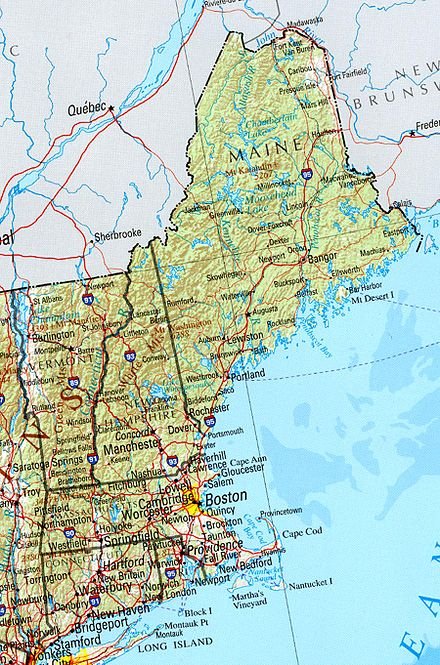
From generative AI
“The Smoot-Hawley Tariff Act of 1930 significantly harmed the New England economy by drastically reducing exports, particularly in the textile industry, as other countries retaliated with their own tariffs, leading to a decline in international trade and further exacerbating the Great Depression in the region; this resulted in job losses, factory closures, and depressed wages in key New England manufacturing sectors.
Key points about the Smoot-Hawley impact on New England:
Textile industry hit hard:
New England was a major center for textile production, and with increased tariffs on imported goods, foreign markets retaliated by reducing their purchases of New England textiles, causing significant economic hardship in the region.
Reduced export markets:
The tariff act led to a sharp decline in U.S. exports overall, as other countries imposed retaliatory tariffs, which directly affected New England businesses heavily reliant on international trade.
Job losses and factory closures:
Due to reduced demand for exported goods, many textile factories in New England were forced to scale back production or shut down, resulting in widespread job losses.
Wage depression:
With high unemployment in the region, wages for textile workers in New England also fell, further impacting the local economy.”
Character-building

Photo by Eugene Crist
“There has been more talk about the weather around here this year than common, but there has been more weather to talk about. For about a month now we have had solid cold—firm, business-like cold that stalked in and took charge of the countryside as a brisk housewife might take charge of someone else’s kitchen in an emergency. Clean, hard, purposeful cold, unyielding and unremitting. Some days have been clear and cold, others have been stormy and cold. We have had cold with snow and cold without snow, windy cold and quiet cold, rough cold and indulgent peace-loving cold. But always cold.’’
From “Cold Weather,” by E.B. White (1899-1985), of Brooklin, Maine, from his series “One Man’s Meat,’’ in Harper’s Magazine in 1944.
Support Art

From left, Élan Cadiz, “SCAFFOLD Equity of Treatment” (pen, pencil, acrylic, and flash paint on Shizen paper). Right, Rosalind Daniels, “Construction Reflected” (quilted fiber), in the show “Scaffolding, a AVA Gallery and Art Center, Lebanon,N.H., through March 1.
The gallery explains: “This unique group exhibition features a variety of artwork installed throughout all three levels of AVA’s beautiful historic textile mill building. The exhibition is themed around the term ‘scaffold’ or ‘scaffolding,’ suggesting lifting or providing support.’’
Cold clay

“Winter Landscape,” by Steve Branfman, is his show “Fifty Years Above the Wheel,’’ Feb. 16-May 4, in Duxbury, Mass. at the Art Complex Museum.
Naomi Cahn/Leah A. Plunkett: States trying to limit teens’ exposure to social media

CAMBRIDGE, Mass.
Children should be seen and not heard, or so the old saying goes. A new version of this adage is now playing out across the United States, as more states are passing laws about how children and teens should use social media.
In 2024, approximately half of all U.S. states passed at least 50 bills that make it harder for children and teens to spend time online without any supervision.
Some of the new laws in places such as Maryland, Florida, Georgia and Minnesota include provisions that require parental consent before a child or teenager under the age of 18 can use a social media app, for example. Other new laws prevent targeted marketing to teens based on the personal information they share online. Others recognize child influencers who have active social media followings as workers.
In 1998, long before the age of Instagram or TikTok, the federal government set a minimal baseline for internet safety for children under the age of 13 with the Children’s Online Privacy Protection Act. This law, known as COPPA, prevents websites from sharing children’s personal information, among other measures.
As law professors who study children’s online lives and the law, we are tracking state governments that are providing new protections to children when they use social media.
So far, almost all of these new protections are happening at the state level – it remains to be seen how the Trump administration will, if at all, weigh in on how children and teens are spending time on social media.
Almost half of teens ages 13 to 17 said in 2024 they are “almost constantly” online and virtually all of them use the internet every day.
And approximately 40% of children ages 8 to 12 use social media on a daily basis.
Research shows that adolescents who spend more than three hours a day on social media have an increased risk of anxiety and depression.
Almost half of teens have faced online bullying or harassment, with older teen girls most likely to have experienced this. Social media use has been linked to self-harm in some cases.
In 2023, 41 states and the District of Columbia sued Meta, the parent company of Facebook and Instagram, claiming that it was harming children. Although Meta tried to have the case dismissed, it is still moving forward.
States including New York and California have made a number of legal changes since 2023 that make it safer for adolescents to spend time online.
California, for example, has expanded information protection for young social media users by limiting apps from collecting kids’ and teens’ geolocation data.
Utah and Florida have raised the age for social media use. Children under the age of 14 cannot open their own social media account, and the platforms are supposed to shut down any such accounts used by children in those states.
In 2024, the Utah Legislature determined that social media was similar to regulated “products and activities” like cars and medication that create risks for minors.
Utah’s new law requires social media platforms to verify a user’s age, such as by requiring a photo ID.
A 2024 Tennessee law allows minors to open their own accounts but requires that social media companies ensure that anyone under the age of 18 has parental consent to do so.
Some states, including Texas and Florida, are trying to create a different experience for minors once they have an account on a social media platform. They are blocking apps from sending targeted advertisements to minors or, in states such as New York, curating social media feeds based on an algorithm instead of based on the minors’ own choices.
A growing number of states have also focused on creating more protections for children influencers and vloggers, who regularly post short videos and images on social media and often have other young people following their content. So far, California, Illinois and Minnesota have passed child digital entertainer laws since 2023.
All of these laws set up financial protections for child influencers. Illinois’ law requires child influencers to receive a portion of the profits they make from their content. Minnesota’s law includes privacy protections: forbidding children under the age of 14 from working as influencers and giving them the right to later delete content, even when their parents have created the post or video.
These laws face different legal challenges. For example, some private industry groups claim these laws restrict free speech or the rights of parents. The U.S. Supreme Court is now considering – for the first time since 1997 – the constitutionality of age restrictions for social media usage.
States across the political spectrum, as well as social media companies themselves, are creating more protections for kids whose online activity might suggest that federal law reform will finally happen.
Members of a dance group in Times Square on Jan. 14, 2025, record videos to be used for social media. Adam Gray/Getty Images
Federal action on social media
Congress has considered new online privacy legislation for children in the past 25 years, including banning targeted ads. But nothing has been enacted.
There is no clear indication that the Trump administration will make any substantial changes in existing law on children and internet privacy. While federal agencies, including the Federal Trade Commission, could take the lead on protecting children online, there has been little public discussion of issues involving children and media access.
Trump’s choice for surgeon general, Janette Nesheiwat, said in 2024, “Social media has had a tremendous negative impact on all aspects of society, especially our younger generations.” It’s unclear how widely this view is shared within the new administration.
On other social media issues, such as the future of TikTok, Trump’s nominees and advisers have been divided. Particularly in an administration in which “the president owns a social media company, and one of his main associates owns another,” the future scope of federal action to protect children online is uncertain. This is likely to prompt states to advance laws that create more protections for children on social media.
Even though social media platforms have national and global reach, we believe that state-by-state leadership might be the best way to make laws in which the needs and rights of children and their families are seen, heard and protected.
Naomi Cahn is a professor of law at the University of Virginia. Leah A. Plunkett is a professor of law and associate dean of learning experience at Harvard University.
William Morgan: A watercolor thank you from New England

Painting by Dorothy Worden.
Posted on Jan. 31, 2025 in New England Diary (newenglanddiary.com)
English watercolor artist Dorothy Worden does not have much of an art historical presence – an Internet search turns up only that she was born in Newcastle upon Tyne in 1868, and she likely met her husband, the painter William E. Osborn, when they were both members of the vibrant early 20th-Century art colony at St Ives, in Cornwall. This Worden watercolor turned up for sale at the Acushnet River Antiques Mall, in New Bedford, priced at $45.
Given the sparseness of details of Worden’s life, we know nothing of any trips that she might have made to the United States. This scene, nevertheless, is indubitably rural New England, a village in the Berkshires or Vermont. And the watercolor is an unusual but clearly a very heartfelt note of gratitude. “Great Blessings … I am well, Thanks to you, and hope for an exhibition this coming year.”
Who was the Dr. Constantine, the dedicatee of the pastoral picture? The tone suggests that he was more than an emergency room doctor, maybe a psychiatrist, perhaps at one of the private clinics tucked in the hills of western New England, such as the Austin Riggs Center, in Stockbridge, Mass.
Painted, one would guess, in the 1920s or ‘30s, where has this picture been for almost a century? Did the healing doctor treasure this expression of thanks? It survived somehow, and made it to the seemingly inevitable estate sale, and then to the antiques mall. And now it has been purchased (I did not buy it), maybe to be framed and revered, a mild sort of adoration for a forgotten English painter. Or not.
A chronicler of things architectural in New England, William Morgan is the author of Monadnock Summer: the Architectural Legacy of Dublin, New Hampshire, and The Cape Cod Cottage, which will be published in March. He’s also the author of Academia: Collegiate Gothic Architecture in the United States, which includes major examples of the style in New England.