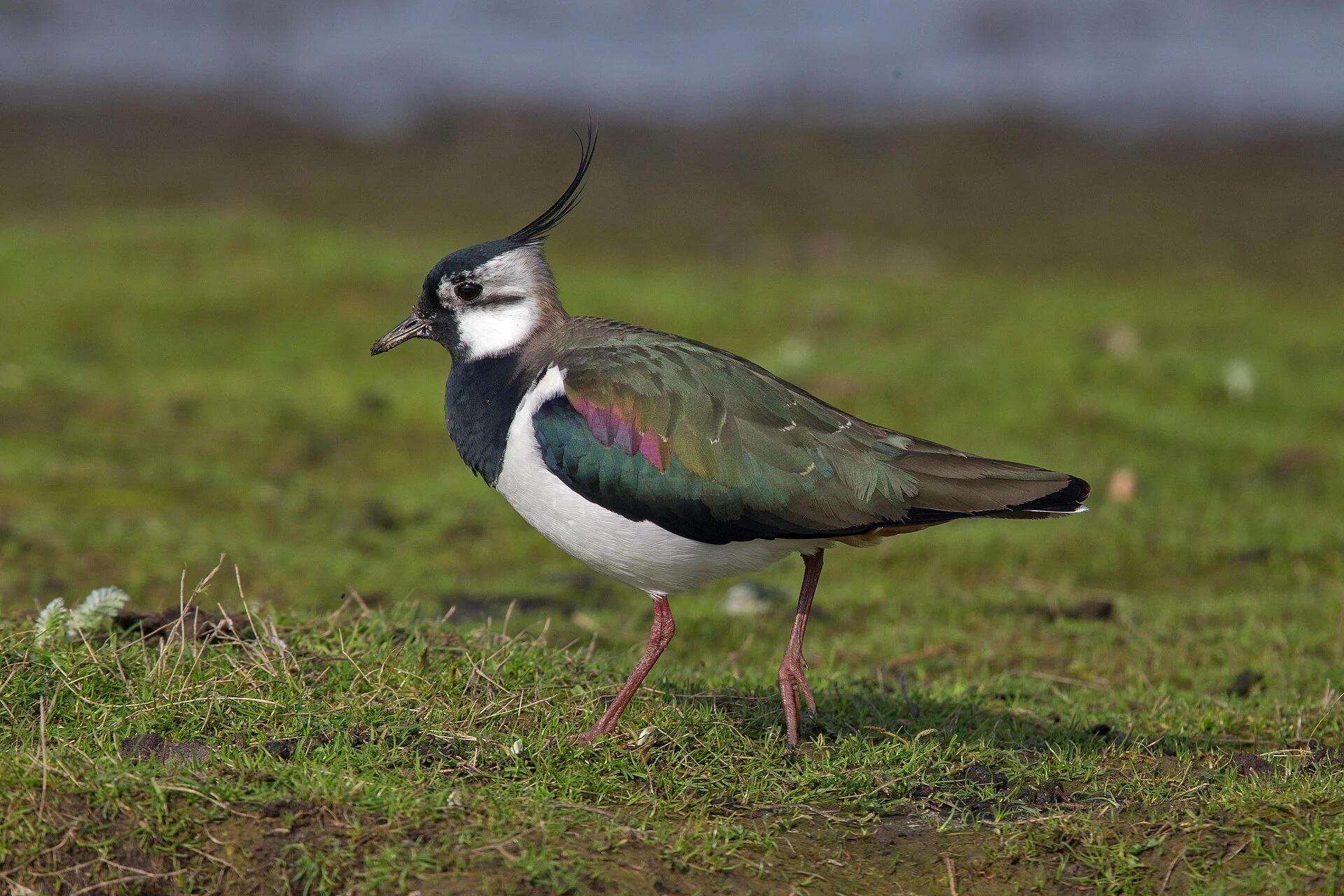
Northern Lapwing
— Photo by Andreas Trepte
Just down the road from the cedar-shingled Conanicut Friends Meetinghouse (1786), at the junction of North Road and Weeden Lane, in Jamestown, R.I., and over Windmist Farm’s lichen-covered stone wall on the north side of a furrowed field, we spot an amazing visitor: a Northern Lapwing, Vanellus vanellus, in his elegant attire, including a backward-slanted wispy crest, and a cape, as if he were planning to attend an opera.
Normally Lapwings live in northern Europe, but my friend Steve spots this one near the eastern end of a Windmist’s field. Kildeer are also feeding near our visitor, who is near the middle of a tawny, furrowed field. The Newport-Pell Bridge’s towers rise in the distance. Cornell Ornithology Lab tells us that Lapwings’ feathers are iridescent in strong light, but Steve and I are too far away to glimpse those stunning details.
How does a Northern Lapwing fly thousands of miles across the Atlantic, seemingly without resting, and finally land on an island in the middle of Narragansett Bay? Did a northeast storm blow it off course?
Could Northern Lapwings hitch rides on oil and gas tankers or offshore cable-laying vessels that cross the Atlantic from northern Europe to Narragansett Bay?
My friend Capt. Howard McVay, a retired Narragansett Bay ship pilot, tells me:
“Ospreys frequently land on the up-wind side of the incoming vessel’s bridge wing in search of fish. I have seen them many times. They have landed within 15 feet of me on occasion. Once they spot their prey, they are off.’’
It’s a lovely winter afternoon, the wind has died down from the preceding day’s gale, and sky is Delft-blue without clouds. Normally we would notice the farm’s aroma—a musty scent of soil and hay--except for today’s biting cold.
Other bird watchers had parked along Weeden Lane before Steve and I arrived. They kindly allowed us to view through their scopes. A half dozen men were wearing winter coats, gloves and hats pulled down while focusing various spotting scopes mounted on tripods. One birder said that he’d driven all the way from Windsor Locks, Conn., (97 miles one way) that morning.
Are Northern Lapwings circumpolar visitors briefly resting along the way, making looping flights from such touchstones as Iceland, Greenland, Labrador and finally arriving at Jamestown? How can Northern Lapwings navigate such long distances?
Is Jamestown an ancient, perfect sojourn destination—their meetinghouse on acres of pristine pastures, maple-tree-lined stone walls, combination stone-and-weathered-shingled barns rimmed by the farm’s sloping pastures and ending in a saltwater marsh at Marsh Meadows Wildlife Preserve, which is a haven for migrating waterfowl? Hit this link.
John Long is a Warwick, R.I.-based writer.